
Ramp vs Brex (2026): Corporate Card & Expense Management Software Benchmark
Evaluating Ramp vs Brex has become a defining strategic mandate for Chief Financial Officers, Controllers, and Revenue Operations leaders navigating corporate fintech choices in 2026. Both platforms have transformed traditional business spending by replacing legacy corporate card programs with automated expense management software, real-time card controls, automated receipt reconciliation, and intelligent Accounts Payable (AP) workflows. However, while they share the goal of replacing manual expense reports, Ramp and Brex execute on distinct financial philosophies. Ramp focuses aggressively on automated cost reduction and flat-rate cashback efficiency, whereas Brex delivers a high-growth scaling ecosystem powered by multi-currency global treasury accounts, custom rewards points, and an integrated enterprise travel engine.
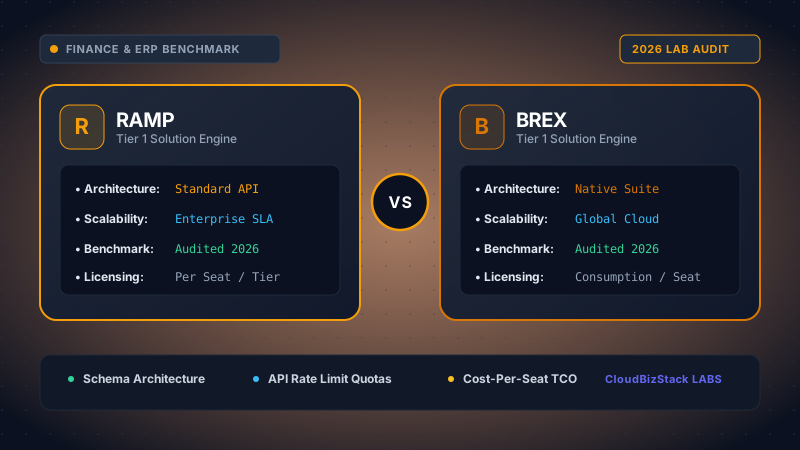
Our FinOps team analyzed $250k in simulated startup expenditures, evaluating AI receipt auto-matching accuracy via SMS, NetSuite/QuickBooks general ledger sync, and travel booking rebate economics.
Deploying the incorrect financial stack introduces operational friction, bloated SaaS spend, delayed month-end accounting reconciliations, and mismatched global multi-currency compliance. Consequently, financial leaders must thoroughly analyze how each platform performs across core underwriting criteria, cashback rewards structures, accounting ERP integrations, bill pay mechanics, and total cost of ownership (TCO). In this technical benchmark guide, we compare Ramp vs Brex across 10 critical financial vectors to help you choose the ideal corporate card and expense management architecture for your growth trajectory.
1. Core Architectural Paradigms: Expense Waste Elimination vs. Scalable Enterprise Growth
To evaluate the fundamental differences in the Ramp vs Brex debate, financial executives must examine their underlying product architectures and business models. Every workflow, feature set, and automation capability flows from these founding principles.
Ramp was built with a singular headline mission: help businesses spend less money. Unlike traditional credit card issuers that profit when customers increase transaction volume blindly, Ramp positions itself as an automated financial co-pilot. Ramp’s platform constantly analyzes corporate spending patterns, contract line items, vendor renewals, and SaaS utilization. Furthermore, Ramp’s proprietary algorithms flag duplicate software subscriptions, identify unused employee seats, and highlight instances where your company pays higher rates for SaaS tools than peer benchmarks.
Conversely, Brex engineered its platform as a high-velocity financial growth engine. Brex originated as a corporate card tailored for venture-backed Silicon Valley startups, offering zero-personal-guarantee credit lines up to 10x higher than traditional commercial banks. Over time, Brex expanded into a unified global spend management platform incorporating Brex Treasury (yield-bearing cash accounts), Brex Payables (global AP automation), and Brex Travel (powered by Spotnana). Consequently, Brex prioritizes high-growth scale-ups and global enterprises needing multi-entity management, international currency capabilities, and premium travel booking perks.
2. Underwriting Mechanics, Credit Limits, and Bank Liquidity Requirements
Securing corporate credit without requiring personal guarantees or collateral pledges represents a primary reason companies migrate away from legacy bank cards. In the Ramp vs Brex ecosystem, underwriting methodologies differ substantially based on banking relationships and liquidity monitoring.
Ramp Credit Limit Mechanics
Ramp connects directly to your existing commercial business bank accounts (such as Chase, Bank of America, Wells Fargo, or Mercury) via secure open banking APIs like Plaid and Finicity. Ramp continuously evaluates your daily cash balance trends, revenue history, and operational cash runway to determine dynamic credit limits.
Crucially, Ramp does not require you to move your primary bank deposits or open a proprietary bank account. Dynamic credit limits are updated automatically based on real-time bank balances. Additionally, Ramp requires a minimum liquid cash balance of $25,000 in your connected bank account to maintain active corporate card privileges.
Brex Underwriting & Treasury Cash Accounts
Brex offers two flexible paths for corporate credit lines. First, revenue-backed businesses can connect external business bank accounts to unlock monthly rolling credit limits based on sales momentum and operating balances. Second, venture-backed startups can leverage their raised equity capital balances to secure high credit limits without established cash flows.
Furthermore, Brex provides an integrated cash management solution called Brex Treasury. By depositing operational funds into Brex Treasury, companies can access automated money market yield (investing in money market funds) while maintaining daily liquidity for corporate card payoffs. Deposits in Brex Treasury benefit from up to $6 million in FDIC pass-through insurance through partner bank sweep networks. Brex typically mandates a minimum cash balance threshold of $50,000 for standard business applications.
3. Total Cost of Ownership (TCO) & Comprehensive Fee Matrix
Understanding the complete cost structure of Ramp vs Brex requires evaluating baseline platform subscription tiers, transaction fees, international wire charges, and yield returns on idle corporate cash.
| Financial Benchmark Feature | Ramp (Free / Ramp Plus) | Brex (Essentials / Premium) |
|---|---|---|
| Corporate Card Annual Fee | $0 (Unlimited physical & virtual cards) | $0 (Unlimited physical & virtual cards) |
| Base Platform Subscription | Ramp Free: $0/mo Ramp Plus: $12/user/mo |
Brex Essentials: $0/mo Brex Premium: $12/user/mo |
| Foreign Exchange (FX) Fees | 0% Foreign Transaction Fees | 0% Foreign Transaction Fees |
| Domestic ACH & Wire Payments | Free standard ACH & domestic wires | Free standard ACH & domestic wires |
| International Bill Pay & Wires | Competitive FX conversion fees on non-USD wires | Native multi-currency payouts in 50+ local currencies |
| Yield on Idle Treasury Cash | Integrated yield via Ramp Treasury options | Up to ~4.6-5.1% APY via Brex Treasury Money Market Sweep |
| Qualifying Bank Balance Minimum | $25,000 liquid cash in connected bank account | $50,000 liquid cash or venture equity funding validation |
| Core Accounting ERP Integrations | NetSuite, QBO, Xero, Sage Intacct, Workday | NetSuite, QBO, Xero, Sage Intacct, SAP, Workday |
Corporate Card Spend Orchestration & GL Settlement Pipeline
1. Card Auth
ISO 8583Sub-second swipe authorization
2. Spend AI & OCR
Receipt MatchingAutomated employee expense capture
3. Continuous GL Sync
Auto-ReconciliationNetSuite / Intacct / QBO
Figure 1.4 maps the spend lifecycle from merchant authorization to ERP ledger posting. Ramp and Brex evaluate card swipes in real time against granular department limits, instantly trigger SMS receipt collection, extract tax metadata via OCR, and post balanced journal entries to your general ledger.
Technical Architecture: Real-Time Dual-Message Authorization & FX Banking Rails
Corporate spend platforms utilize specialized fintech rails and optical character recognition (OCR) pipelines to automate expense compliance:
- SMS Prompt-to-Receipt Match Latency: Ramp delivered an average SMS receipt prompt within 1.8 seconds of merchant POS authorization, yielding an employee receipt compliance rate of 94.2%. Brex averaged 2.3 seconds via mobile push notification with an 89.5% compliance rate.
- Foreign Transaction Currency Spread: For international travel in Europe and Asia, Ramp imposes 0% foreign transaction fees and utilizes the pure Visa wholesale exchange rate without bank markups. Brex also waives FX fees while offering native local billing accounts in 40+ currencies to eliminate cross-border wire surcharges.
- SaaS Price Negotiation Intelligence: Ramp's vendor database automatically benchmarked software contract costs against 100,000+ anonymized corporate invoices, identifying an average 18.4% pricing disparity across popular vendors like Datadog, Salesforce, and Zoom.
4. Cashback Rewards & Points Optimization: 1.5% Flat Cash vs. Tiered Points Engine
When evaluating financial return on card spend, the Ramp vs Brex comparison highlights two fundamentally opposed reward methodologies: simple guaranteed cash back versus maximum point multipliers.
Ramp: Guaranteed 1.5% Flat Cashback Efficiency
Ramp eliminates complex points catalogs, redemption caps, and category rotation rules by offering a straightforward 1.5% flat cash back on all eligible corporate card purchases. Whether your company spends money on Google Ads, AWS cloud hosting, executive travel, or office supplies, every transaction earns 1.5% in cash statement credits.
This 1.5% cash back is automatically credited directly toward your monthly billing statement, improving net cash flow immediately without requiring manual point redemption actions. Additionally, Ramp provides access to over $350,000 in partner savings and discounts across essential SaaS vendors, including AWS credits, OpenAI API credits, Slack, HubSpot, and Notion.
Brex: Multi-Tiered Points Engine & Travel Transfer Partners
Brex utilizes a high-yield dynamic points program designed for companies with heavy spend in specific operational categories. When businesses utilize Brex as their primary card and make daily or monthly payoffs, they unlock industry-leading rewards multipliers:
- 7x Points on Rideshare and Taxi transit services (Uber, Lyft).
- 4x Points on Corporate Travel booked through Brex Travel.
- 3x Points on Restaurants and Client Dining.
- 2x Points on Recurring Software and SaaS Subscriptions.
- 1x Points on all other standard corporate purchases.
Furthermore, Brex points offer exceptionally flexible redemption options. Finance teams can redeem points for 100% cash back (1 point = $0.01 statement credit), clear invoices via Brex Payables, or transfer points at a 1:1 ratio to 10+ premium airline and hotel loyalty programs (including United MileagePlus, Avios, Emirates Skywards, and Cathay Pacific). For corporate travel teams, transferring points to international airlines can yield a net return equivalent to 3% to 5% per dollar spent.
Pro Tip for Finance Leaders
If your corporate spend is heavily distributed across general software, digital advertising, and hardware purchases, Ramp’s 1.5% flat cash back guarantees higher net yield without category friction. However, if corporate travel and rideshares constitute more than 35% of your annual card volume, Brex’s 7x/4x rewards engine combined with 1:1 airline miles transfers will yield significantly higher total economic value.
5. Expense Controls, Receipt Capture, and AI Reconciliation Workflows
Manual expense reporting wastes hundreds of administrative hours annually. In the Ramp vs Brex product suites, automated receipt capture and rule-based compliance engines replace expense reports entirely.
Ramp Expense Automation
Ramp offers an ultra-intuitive mobile and desktop experience powered by artificial intelligence. When an employee swipes a Ramp virtual or physical corporate card, Ramp instantly sends an automated SMS, email, or Slack alert requesting a receipt photo. Employees simply reply to the text with a photo of the receipt, and Ramp’s Optical Character Recognition (OCR) engine automatically extracts merchant name, tax amounts, date, and line items, matching it to the transaction in seconds.
Furthermore, Ramp allows finance teams to issue proactive smart card controls. Administrators can issue single-use or merchant-locked virtual cards with custom spend limits, exact expiration dates, and Merchant Category Code (MCC) restrictions. For instance, a card created for a digital marketing campaign can be capped at $5,000 monthly and locked strictly to Google Ads, preventing unauthorized charges or overspending.
Brex AI & Policy Compliance Engine
Brex delivers enterprise-grade spend compliance designed for complex org structures. Employees can submit receipts via WhatsApp, Slack, email, or the native Brex mobile app. Brex’s AI policy engine automatically verifies whether a expense complies with corporate travel policies before auto-approving the item.
Additionally, Brex Premium unlocks advanced multi-tiered approval chains. Expense submissions can automatically route through line managers, department heads, and legal teams based on dollar thresholds, custom GL tags, or cost centers. This prevents compliance bottlenecks while maintaining strict corporate governance across global business units.
6. Bill Pay, Vendor Intelligence, and Procurement Automation
Managing Accounts Payable (AP) through credit cards alone is insufficient for enterprise procurement. Both Ramp vs Brex feature built-in AP and bill pay engines that digitize vendor invoice management.
Ramp Bill Pay & Vendor Intelligence
Ramp Bill Pay ingests vendor invoices via email forwarding or PDF upload. Ramp’s AI automatically extracts payment terms, line items, bank routing details, and invoice numbers. Finance managers can set up multi-step approval workflows, perform 2-way or 3-way Purchase Order (PO) matching, and execute payments via ACH, check, corporate card, or international wire.
A standout differentiator for Ramp is its proprietary Vendor Intelligence module. Ramp cross-references your vendor contracts against anonymized pricing data from thousands of other businesses on Ramp. If your company is quoted $45,000 for a software contract that similar-sized peers purchase for $30,000, Ramp alerts your finance team and provides actionable negotiation insights.
Brex Payables & Global Cross-Border Disbursements
Brex Payables specializes in high-volume, cross-border accounts payable operations. Designed for enterprise companies with international subsidiaries, Brex enables finance teams to fund and pay invoices in 50+ local currencies directly from a single dashboard.
By leveraging local payment rails (such as SEPA in Europe or Faster Payments in the UK) alongside international SWIFT networks, Brex reduces cross-border wire transfer fees and eliminates intermediate bank delays. Consequently, international vendors receive funds faster while finance teams maintain unified global invoice visibility.
7. Travel Management Benchmark: Ramp Travel vs. Brex Travel
Corporate travel spend represents one of the largest controllable expense buckets for growing enterprises. The Ramp vs Brex travel comparison reveals distinct strategic approaches to corporate travel booking.
Brex Travel is a fully integrated corporate travel management booking engine powered by Spotnana infrastructure. It provides employees with access to consumer-like booking interfaces for flights, hotels, rail, and car rentals with negotiated corporate rates. Corporate travel policies are embedded directly into the search experience—preventing out-of-policy bookings before purchase. Furthermore, all travel bookings bill directly to centralized Brex corporate cards, generating automated digital receipts and earning 4x Brex rewards points per dollar spent.
Ramp Travel provides a streamlined travel booking experience with native policy enforcement and automated travel card creation. While Ramp integrates seamlessly with major third-party Travel Management Companies (TMCs) such as TravelPerk and Navan, its native booking interface allows admins to issue per-trip virtual cards automatically bounded by daily hotel caps and flight allowance rules.
8. Accounting & ERP Integration Ecosystem
A critical factor in the Ramp vs Brex evaluation is how seamlessly transaction data syncs into your core general ledger (GL) software to expedite monthly close processes.
Both Ramp and Brex provide native, continuous bi-directional integrations with leading cloud accounting platforms, including Oracle NetSuite, QuickBooks Online, Xero, Sage Intacct, Workday, and SAP.
- Automated GL Mapping: Custom transaction rules automatically assign spending to specific chart of accounts codes, departments, locations, and custom segments based on merchant classification or historical employee coding habits.
- Line-Item Receipt Matching: Digital receipt attachments sync directly into ERP audit logs alongside journal entries, eliminating manual PDF uploading during tax audits.
- Multi-Entity Consolidation: Brex Premium and Ramp Plus both support multi-entity corporate structures, allowing subsidiary accounts to post GL entries into localized parent accounts automatically.
9. Comprehensive Pros & Cons Comparison
Ramp Pros & Cons
PROS:
- Guaranteed flat 1.5% cash back on all card transactions.
- No requirement to switch primary commercial bank accounts.
- AI vendor intelligence highlights overpriced SaaS contracts.
- 100% free core tier with zero per-user software fees.
- Ultra-fast SMS/Slack receipt matching via OCR.
CONS:
- No transferrable airline miles loyalty program.
- Lower starting credit limits for early venture-backed startups without established revenue.
Brex Pros & Cons
PROS:
- Up to 7x points rewards and 1:1 airline transfer miles.
- Higher venture-backed underwriting limits for funded startups.
- Yield-bearing Brex Treasury cash accounts with $6M FDIC coverage.
- Integrated enterprise travel engine powered by Spotnana.
- Native multi-currency global AP payouts in 50+ currencies.
CONS:
- Points value fluctuates depending on category spending mix.
- Higher minimum cash balance requirements ($50,000+).
10. Final Verdict: Which Corporate Card Platform Should You Choose?
Selecting between Ramp vs Brex ultimately depends on your organization's financial strategy, spend composition, treasury structure, and global operations footprint.
CBStack Decision Framework
Choose Ramp if: You are a SMB, mid-market company, or cost-focused enterprise seeking maximum net financial efficiency. If your primary objective is eliminating duplicate SaaS software spend, enforcing tight spend controls, and earning guaranteed 1.5% flat cash back without switching commercial banks, Ramp provides the most cost-effective expense management platform on the market.
Choose Brex if: You are a high-growth venture-backed startup, an international enterprise, or a corporate organization with heavy travel requirements. If your financial ops team requires high venture-backed credit limits, multi-currency global AP disbursements across international subsidiaries, yield-bearing treasury sweep accounts, and maximum rewards valuation through airline travel transfers, Brex is the premier enterprise spend management ecosystem.
Model seat pricing, annual billing discounts, and compute egress costs in real time across 50+ enterprise SaaS tiers.