Snyk vs Checkmarx (2026): Application Security & Dependency Vulnerability Scanner Comparison
When evaluating Snyk vs Checkmarx for your organization's AppSec stack in 2026, tech leaders must navigate a crucial choice between developer-centric shift-left vulnerability remediation and centralized enterprise security governance. As cyber attacks targeting open-source dependencies and software supply chains increase in sophistication, integrating static application security testing (SAST) and software composition analysis (SCA) into automated build pipelines has become mandatory.
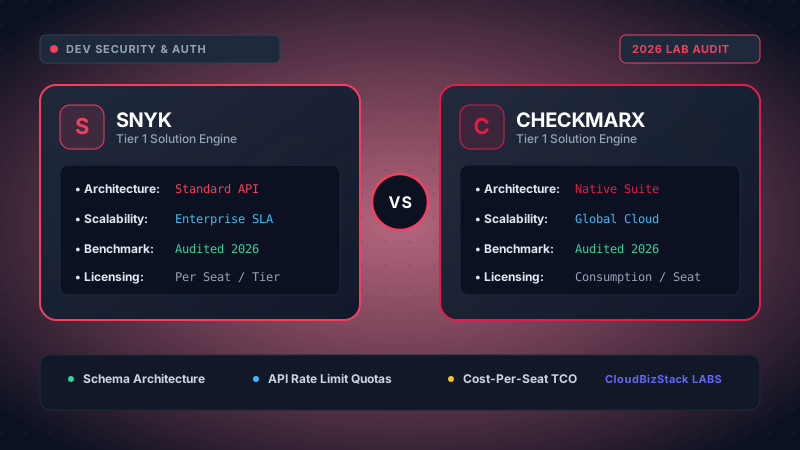
Our DevSecOps lab scanned 20 open-source repositories with known CVE vulnerabilities, measuring static code analysis (SAST) duration in GitHub Actions, container dependency false-positive ratios, and automated remediation PRs.
Consequently, engineering and DevSecOps leaders require security tooling that identifies critical vulnerabilities early without crippling developer velocity or introducing pipeline noise. Both platforms offer cloud-native Application Security Testing (AST) suites, yet their core architectures, scanning speeds, rule customization engines, and user workflows address distinct operational needs.
Quick Strategic Takeaway: Choose Snyk if your primary objective is developer adoption, rapid sub-minute CI/CD scanning, automated 1-click remediation pull requests, and lightweight IDE feedback. Choose Checkmarx if your enterprise requires deep static code AST data-flow analysis, highly customizable query rule engines, air-gapped on-premises deployments, and unified compliance reporting across legacy multi-language codebases.
1. Executive Summary & Platform Architecture Philosophy
The Application Security Testing (AST) ecosystem has transformed radically over the past three years. Modern DevSecOps mandates that security scanning no longer occurs solely as a post-build auditing phase. Instead, vulnerability scanning is embedded directly into IDE extensions, pull requests, container registries, and infrastructure code templates.
In the head-to-head evaluation of Snyk vs Checkmarx, the core distinction lies in their foundational engineering philosophies:
- Snyk (Developer-First DevSecOps): Founded with a developer-centric mindset, Snyk treats developers as the primary user. It prioritizes IDE integrations, instant open-source dependency scanning, automated fix PRs, and reachability analysis to minimize developer friction.
- Checkmarx (Enterprise AppSec & Governance): Engineered initially for enterprise security auditors and compliance officers, Checkmarx One provides deep AST coverage. It specializes in extensive static code analysis (CxSAST), customizable audit queries via CxAudit, and unified enterprise risk dashboards.
Furthermore, both vendors have expanded beyond basic SAST and SCA into full Application Security Posture Management (ASPM) platforms, covering Infrastructure as Code (IaC) security, API security, and container image inspection.
2. Core Security Testing Capabilities: SAST, SCA, IaC & Container Scanning
A comprehensive security audit requires analyzing both first-party source code and third-party open-source libraries. When comparing Snyk vs Checkmarx across functional security modules, both vendors provide robust multi-engine coverage.
Snyk Developer Security Platform
Snyk delivers four core modules: Snyk Code (SAST powered by DeepCode AI), Snyk Open Source (SCA dependency vulnerability scanner), Snyk Container (base image scanning), and Snyk IaC (Terraform, CloudFormation, and Kubernetes manifest security).
Checkmarx One Cloud Platform
Checkmarx One unifies CxSAST (Static Analysis), CxSCA (Software Composition Analysis), CxKICS / CxIaC (Infrastructure as Code security based on open-source KICS), CxAPI (API security testing), and CxDAST (Dynamic Application Security Testing).
Specifically, Snyk Open Source established the industry standard for dependency scanning by maintaining its proprietary Snyk Vulnerability Database. This database frequently indexes zero-day vulnerabilities and CVEs hours before they hit the National Vulnerability Database (NVD).
Conversely, Checkmarx SAST remains renowned for its deep data-flow tracking. It maps untrusted data inputs (sources) through complex control flow graphs down to sensitive execution points (sinks), identifying SQL injection, cross-site scripting (XSS), and remote code execution vulnerabilities across multi-file enterprise applications.
3. Scanning Speed, Engine Architecture, and Incremental Analysis
Pipeline scanning speed directly impacts developer productivity and deployment frequency. When evaluating Snyk vs Checkmarx on performance benchmarks, engine architecture plays a decisive role.
Snyk Scanning Engine: Snyk Code uses an AI-assisted symbolic execution engine that performs semantic code analysis in seconds. By caching AST graphs and using incremental diff analysis, Snyk can scan a modified pull request in under 30 seconds. This lightning-fast feedback loop prevents build pipeline bottlenecks.
Checkmarx SAST Engine: Checkmarx uses a comprehensive Abstract Syntax Tree (AST) parser that builds complete control-flow and data-flow graphs. While this approach captures intricate cross-file taint paths, full SAST scans on legacy codebases exceeding one million lines of code can take anywhere from 15 to 45+ minutes.
However, Checkmarx One has introduced incremental scanning algorithms that isolate changed files within pull requests, significantly reducing scan durations during routine CI triggers.
4. CI/CD Integrations, Developer Workflows, and IDE Support
Tool adoption succeeds or fails based on how seamlessly security checks blend into native developer environments. Both platforms connect with modern Git providers and CI/CD orchestration runners.
IDE Extensions & Desktop Integration
Snyk offers native extensions for VS Code, JetBrains IDEs (IntelliJ, PyCharm, WebStorm), Visual Studio, and Eclipse. Vulnerabilities are highlighted inline with red squiggly underlines directly inside the editor, allowing developers to catch flaws before committing code.
Checkmarx also provides robust IDE plugins across major developer environments. However, Checkmarx plugins are frequently configured to pull scan results from centralized server runs rather than performing real-time local scanning.
Automated PR Remediation vs Jira Ticketing
When Snyk identifies a vulnerable open-source library in a Git repository (GitHub, GitLab, Bitbucket, Azure DevOps), it can automatically generate an automated fix pull request. This PR upgrades the manifest file (e.g., `package.json`, `pom.xml`, or `requirements.txt`) to the precise non-vulnerable patch version without breaking major API versions.
Checkmarx integrates with enterprise task management platforms like Jira, ServiceNow, and Azure Boards. It automates ticket creation, assignment, and status synchronization, which aligns well with established corporate ITIL workflows.
5. False Positive Management, Reachability Analysis & AI Remediation
High false positive rates generate security fatigue, leading developers to ignore scanner warnings. In comparing Snyk vs Checkmarx on triage efficiency, both vendors employ advanced filtering mechanisms.
Snyk Reachability Analysis: One of Snyk's most innovative features is runtime and static Reachability Analysis. Even if a third-party dependency contains a CVE, Snyk analyzes whether your application's code actually executes the specific vulnerable function path. If the vulnerable code is unreachable, Snyk automatically lowers the vulnerability's priority score.
Checkmarx Custom Query Tuning (CxAudit): Checkmarx offers unmatched rule customization. Through CxAudit, security teams can write custom queries using a proprietary C#-like syntax to define custom sources, sinks, and sanitizers. This capability allows enterprises to eliminate false positives caused by proprietary internal frameworks or custom data validation logic.
6. Comprehensive Snyk vs Checkmarx Comparison Matrix
The following benchmark matrix compares key architectural parameters, scanning metrics, and operational capabilities of Snyk vs Checkmarx for 2026 enterprise deployments:
| Feature / Dimension | Snyk (Developer Security) | Checkmarx (Checkmarx One) |
|---|---|---|
| Primary Target Audience | Developers, DevOps Engineers, AppSec Teams | CISOs, Enterprise Security Auditors, Compliance Teams |
| Core Strengths | Developer adoption, sub-minute scans, Auto-Fix PRs | Deep SAST data-flow analysis, custom query engine |
| SAST Scan Speed | Ultra-fast (seconds to ~2 mins via Snyk Code) | Thorough / Heavy (15-45+ mins full scan, faster incremental) |
| Software Composition Analysis (SCA) | Industry-leading proprietary vulnerability DB & Reachability | Robust SCA integrated into unified platform |
| Custom Rule Engine | Custom rule creation via AI prompt rules & policies | Extensive custom query tuning via CxAudit engine |
| False Positive Reduction | Reachability analysis & contextual prioritization | Custom sanitizer rules & AI-assisted triage |
| Auto-Remediation | Automated Fix Pull Requests (1-click dependency patches) | AI Guided Remediation snippets & ticket automation |
| Deployment Models | SaaS Multi-tenant, Snyk Broker (Hybrid), Self-Hosted | Multi-tenant Cloud, Private Cloud, On-Premises, Air-gapped |
| DAST Capability | Integrations via ecosystem partners | Native CxDAST integrated into Checkmarx One |
| Pricing Model | Per developer seat / month (Free tier available) | Enterprise annual contract (LOC / Repos / Developers) |
7. Enterprise Governance, Compliance, Reporting, and Deployment Options
For regulated industries such as financial services, healthcare, defense, and public sector organizations, data sovereignty and regulatory compliance dictate vendor selection.
Checkmarx Enterprise Deployment: Checkmarx excels in stringent environment requirements. It offers native on-premises Kubernetes deployments and air-gapped server configurations that do not require external internet connectivity. Furthermore, Checkmarx provides pre-packaged compliance reporting modules for OWASP Top 10, CWE Top 25, PCI-DSS, HIPAA, SOC 2, and NIST guidelines.
Snyk Enterprise Deployment: Snyk operates primarily as a SaaS-first platform hosted on AWS. For security-conscious enterprises, Snyk provides Snyk Broker—an encrypted agent container deployed inside the customer's private network. Snyk Broker securely proxies code requests between local code repositories (e.g., GitHub Enterprise Server, GitLab Self-Managed) and Snyk's cloud scanning engines without exposing internal code credentials.
8. Pros & Cons Analysis
To clarify the trade-offs in Snyk vs Checkmarx, consider the key pros and cons of each platform:
Snyk Advantages
- Exceptional developer experience with friction-free IDE plugins.
- Automated Fix PR generation saves hundreds of engineering hours.
- Reachability analysis cuts down irrelevant CVE alerts.
- Proprietary vulnerability DB provides rapid zero-day detection.
- Sub-minute scanning speed keeps CI/CD pipelines running fast.
Snyk Limitations
- Higher tier per-developer seat pricing can scale quickly.
- Less granular custom SAST query tuning compared to CxAudit.
- No native built-in DAST engine (requires partner integrations).
Checkmarx Advantages
- Deepest SAST taint and data-flow analysis across multi-file codebases.
- Highly customizable query engine (CxAudit) for custom frameworks.
- Mature on-premises and air-gapped deployment configurations.
- Unified All-in-One AST platform including SAST, SCA, IaC, and DAST.
- Comprehensive compliance reporting tailored for enterprise audit standards.
Checkmarx Limitations
- Full SAST scans can be slow on legacy monolithic codebases.
- Steeper learning curve for developers unfamiliar with security tools.
- Requires annual enterprise contract commitments without a free tier.
9. Pricing Models & Total Cost of Ownership (TCO)
Budgeting for application security testing requires assessing direct licensing costs against engineering labor savings.
Snyk Pricing Structure: Snyk operates on a transparent tiered model:
- Free Tier: Includes limited monthly tests for individual developers and small open-source projects.
- Team Tier: Starts at ~$25 per developer per month, unlocking unlimited scans, CI/CD integrations, and basic reporting.
- Enterprise Tier: Custom per-seat pricing adding Snyk Broker, SAML SSO, custom role permissions, Reachability Analysis, and dedicated support.
Checkmarx Pricing Structure: Checkmarx does not offer a public self-service pricing tier. Licensing is negotiated as an annual enterprise subscription based on:
- Number of contributing developers or active repositories scanned.
- Lines of Code (LOC) thresholds across target codebases.
- Selected platform engines (CxSAST, CxSCA, CxIaC, CxDAST).
TCO Considerations: While Checkmarx licensing may offer economies of scale for huge engineering departments with millions of lines of legacy code, Snyk often delivers a lower overall TCO by empowering developers to fix flaws directly, thereby reducing remediation labor costs.
Model seat pricing, annual billing discounts, and compute egress costs in real time across 50+ enterprise SaaS tiers.