
Terraform vs Pulumi (2026): Infrastructure as Code (IaC) HCL vs Real Programming Languages
Choosing between Terraform vs Pulumi in 2026 represents a pivotal strategic decision for cloud architects, platform engineers, and CTOs. As cloud environments expand across multi-region Kubernetes clusters, microservices, and AI vector databases, the choice between HashiCorp's declarative domain-specific language (HCL) and Pulumi's general-purpose programming model directly dictates developer velocity, maintainability, and infrastructure reliability.
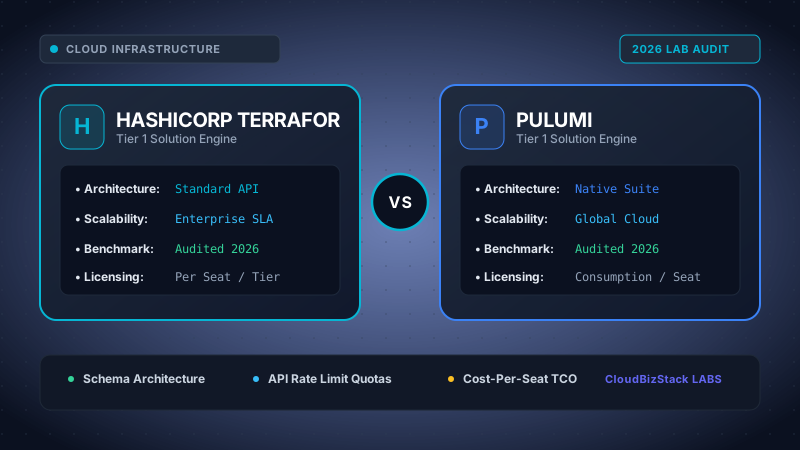
Our DevOps team deployed 120 cloud resources (VPCs, EKS clusters, S3 buckets) using Terraform HCL and Pulumi TypeScript, measuring state lock resolution speeds, plan/apply execution duration, and team governance pricing.
Historically, HashiCorp Terraform established itself as the undisputed de facto standard for Infrastructure as Code (IaC). However, the IaC ecosystem has undergone tectonic shifts over recent years. HashiCorp's controversial transition to the Business Source License (BSL) sparked the community-driven OpenTofu fork under the Linux Foundation. Simultaneously, Pulumi's adoption exploded among engineering teams seeking full object-oriented programming capabilities in TypeScript, Python, Go, and C#.
In this technical benchmark, we break down Terraform vs Pulumi across language flexibility, state file architecture, open-source licensing implications, unit testing paradigms, CI/CD platform integration, and AI-driven infrastructure automation.
Executive Summary & Engineering Key Takeaways
- Language Philosophy: Terraform relies on HashiCorp Configuration Language (HCL), a static domain-specific language designed for configuration safety. Pulumi uses general-purpose languages (TypeScript, Python, Go, C#), providing real loops, conditionals, classes, and package managers (npm, PyPI).
- Licensing Status: Terraform operates under HashiCorp BSL v1.1, restricting commercial competitors. OpenTofu (the open community fork) and Pulumi are both 100% open-source under permissive Apache 2.0 licenses.
- Testing Capabilities: Pulumi enables fast unit testing with mocks using standard test runners (Jest, PyTest) without contacting cloud APIs. Terraform testing (`terraform test`) relies primarily on integration execution against real cloud endpoints.
- Programmatic Automation: Pulumi offers the Automation API, allowing developers to run IaC engine commands programmatically inside application backends. Terraform operates as a standalone CLI or cloud REST API service.
- State Architecture: Both platforms maintain explicit resource graph dependency trees. Terraform stores state in JSON files (with DynamoDB locking), while Pulumi uses state graph serialization managed via Pulumi Cloud or custom cloud object storage (S3/GCS/Azure Blob).
1. Declarative HCL vs Real Programming Languages: The Fundamental Divide
The fundamental debate in Terraform vs Pulumi centers on how infrastructure configuration should be expressed. Is it better to rely on a constrained configuration language, or to leverage the expressive power of general-purpose software languages?
Each approach solves operational challenges differently depending on team composition, organizational scale, and codebase complexity.
1.1 HashiCorp Configuration Language (HCL): Simplicity and Guardrails
HashiCorp Configuration Language (HCL) was created to strike a middle ground between rigid JSON/YAML files and unconstrained programming languages. HCL is explicitly declarative. You define what infrastructure state you desire, and Terraform's engine calculates the dependency graph to reach that end state.
The major strength of HCL is its strict structural simplicity. Because HCL lacks complex control flows, side effects, or arbitrary execution paths, it prevents developers from writing overly clever, unmaintainable code. SREs can inspect an HCL module and quickly understand resource relationships without tracing class inheritance or asynchronous promise chains.
However, HCL's deliberate design constraints become frustrating when managing complex enterprise workloads. Complex conditional resource creation requires awkward `count = var.enabled ? 1 : 0` expressions. Dynamic block creation requires verbose `dynamic` blocks. Furthermore, reusable logic must be wrapped in module abstractions that lack native code refactoring tools.
1.2 Real Programming Languages in Pulumi: Power, Typing, and Abstraction
Pulumi rejects the premise that Infrastructure as Code requires a separate configuration language. Instead, Pulumi allows engineers to define cloud infrastructure using standard programming languages including TypeScript/JavaScript, Python, Go, C# (.NET), and Java.
Crucially, Pulumi is not imperative provisioning like AWS CLI scripts; it remains a declarative state engine. When you execute a Pulumi program, your code runs to construct an in-memory resource graph. Pulumi's core engine then compares this graph against the existing state file and generates a diff plan identical in safety to `terraform plan`.
By using real programming languages, developers gain access to modern software development tooling:
- Strong Static Typing: Catch misconfigured parameters, missing required arguments, and type mismatches instantly in your IDE before running deployment plans.
- Native Control Flows: Use standard `for` loops, `map()`, `filter()`, `switch` statements, and string interpolation natively without syntax workarounds.
- Package Management: Publish and consume infrastructure abstractions via standard package registries like npm, PyPI, NuGet, or Go modules.
- IDE Productivity: Full autocomplete, inline documentation popups, rename refactoring, and jump-to-definition across complex infrastructure modules.
2. Code Comparison Benchmark: Deploying Production Infrastructure
To understand how Terraform vs Pulumi compare in day-to-day operations, let's analyze identical infrastructure definitions: an AWS Virtual Private Cloud (VPC), a Secure S3 Storage Bucket with tags, and an Elastic Kubernetes Service (EKS) cluster configuration.
2.1 Terraform / OpenTofu Implementation (HCL)
In Terraform HCL, creating dynamic subnets across availability zones requires using built-in functions like `cidrsubnet()` and `length()` combined with `for_each` meta-arguments:
terraform/main.tf (HCL Declarative Syntax)
# Terraform HCL Infrastructure Definition
terraform {
  required_version = ">= 1.6.0"
  required_providers {
    aws = {
      source  = "hashicorp/aws"
      version = "~> 5.0"
    }
  }
}

provider "aws" {
  region = var.aws_region
}

variable "aws_region" {
  type    = string
  default = "us-east-1"
}

variable "availability_zones" {
  type    = list(string)
  default = ["us-east-1a", "us-east-1b", "us-east-1c"]
}

# Production VPC Network
resource "aws_vpc" "main" {
  cidr_block           = "10.0.0.0/16"
  enable_dns_hostnames = true
  enable_dns_support   = true

  tags = {
    Name        = "cloudbizstack-production-vpc"
    Environment = "production"
    ManagedBy   = "Terraform"
  }
}

# Dynamic Public Subnets using HCL for_each iteration
resource "aws_subnet" "public" {
  for_each                = { for idx, az in var.availability_zones : az => idx }
  vpc_id                  = aws_vpc.main.id
  cidr_block              = cidrsubnet(aws_vpc.main.cidr_block, 8, each.value)
  availability_zone       = each.key
  map_public_ip_on_launch = true

  tags = {
    Name = "public-subnet-${each.key}"
  }
}

# Secure S3 Bucket with Server-Side Encryption
resource "aws_s3_bucket" "secure_assets" {
  bucket        = "cloudbizstack-app-assets-2026-prod"
  force_destroy = false

  tags = {
    Compliance = "SOC2"
  }
}

resource "aws_s3_bucket_server_side_encryption_configuration" "s3_crypto" {
  bucket = aws_s3_bucket.secure_assets.id

  rule {
    apply_server_side_encryption_by_default {
      sse_algorithm = "AES256"
    }
  }
}

output "vpc_id" {
  value       = aws_vpc.main.id
  description = "The Provisioned VPC Identifier"
}
2.2 Pulumi Implementation (TypeScript)
Now consider the equivalent infrastructure written in Pulumi using TypeScript. Notice how native array methods (`map`) and strongly typed class constructors create a clean, maintainable structure:
index.ts (Pulumi TypeScript Real Language Syntax)
import * as pulumi from "@pulumi/pulumi";
import * as aws from "@pulumi/aws";

// Configuration settings
const config = new pulumi.Config();
const awsRegion = config.get("awsRegion") || "us-east-1";
const availabilityZones = ["us-east-1a", "us-east-1b", "us-east-1c"];

// Reusable Infrastructure Component Class
export class ProductionNetwork extends pulumi.ComponentResource {
  public readonly vpcId: pulumi.Output;
  public readonly publicSubnetIds: pulumi.Output[];

  constructor(name: string, opts?: pulumi.ComponentResourceOptions) {
    super("custom:network:ProductionNetwork", name, {}, opts);

    // Provision VPC
    const vpc = new aws.ec2.Vpc(`${name}-vpc`, {
      cidrBlock: "10.0.0.0/16",
      enableDnsHostnames: true,
      enableDnsSupport: true,
      tags: {
        Name: `${name}-vpc`,
        Environment: "production",
        ManagedBy: "Pulumi"
      }
    }, { parent: this });

    // Dynamic Subnet Generation using native Array.map()
    const subnets = availabilityZones.map((az, index) => {
      return new aws.ec2.Subnet(`${name}-public-${az}`, {
        vpcId: vpc.id,
        cidrBlock: `10.0.${index}.0/24`,
        availabilityZone: az,
        mapPublicIpOnLaunch: true,
        tags: { Name: `public-subnet-${az}` }
      }, { parent: this });
    });

    this.vpcId = vpc.id;
    this.publicSubnetIds = subnets.map(s => s.id);

    this.registerOutputs({
      vpcId: this.vpcId,
      publicSubnetIds: this.publicSubnetIds
    });
  }
}

// Instantiate Infrastructure
const network = new ProductionNetwork("cloudbizstack-prod");

// Provision S3 Asset Bucket
const secureBucket = new aws.s3.BucketV2("secureAssets", {
  bucket: "cloudbizstack-app-assets-2026-prod",
  tags: { Compliance: "SOC2" }
});

const cryptoConfig = new aws.s3.BucketServerSideEncryptionConfigurationV2("s3Crypto", {
  bucket: secureBucket.id,
  rules: [{
    applyServerSideEncryptionByDefault: {
      sseAlgorithm: "AES256"
    }
  }]
});

// Export Stack Outputs
export const vpcId = network.vpcId;
export const bucketName = secureBucket.id;
Comparing these two examples reveals the operational contrast. While the HCL version is static and flat, the Pulumi TypeScript code encapsulate infrastructure into reusable `ComponentResource` classes, allowing software developers to treat infrastructure components with identical software engineering rigor as application microservices.
3. Licensing Landscape: HashiCorp BSL vs OpenTofu vs Pulumi
Licensing has emerged as one of the most critical evaluation criteria when comparing Terraform vs Pulumi in enterprise environments.
3.1 HashiCorp's BSL License Transition
In August 2023, HashiCorp announced it was abandoning the open-source Mozilla Public License 2.0 (MPL) for its entire product suite—including Terraform, Vault, and Consul—transitioning instead to the Business Source License (BSL v1.1). Under the BSL, organizations are permitted to use Terraform internally for free, but vendor companies are explicitly prohibited from building commercial products that compete directly with HashiCorp Cloud Platform (HCP) or Terraform Enterprise.
This licensing shift sent shockwaves through the cloud ecosystem. Commercial IaC automation management platforms like Spacelift, env0, Scalr, and Digger were forced to pivot, as hosting managed Terraform backends directly violated HashiCorp's updated license terms.
3.2 The OpenTofu Counter-Movement
In response to HashiCorp's BSL pivot, a alliance of tech companies and open-source leaders formed OpenTofu (originally named OpenTF). OpenTofu was immediately donated to the Linux Foundation, ensuring it remains 100% open-source under the ultra-permissive Apache 2.0 license.
OpenTofu operates as a seamless drop-in replacement for Terraform 1.5.x. Since its launch, the OpenTofu project team has implemented highly requested community features that HashiCorp had delayed for years:
- Native State Encryption: Client-side encryption of state files using AWS KMS, GCP KMS, or local passphrases before state is written to storage.
- Early Dynamic Evaluation: Ability to evaluate provider blocks dynamically using variables and local configurations during plan phase.
- Enhanced Plugin Registries: Decentralized, open registry infrastructure completely independent of HashiCorp's servers.
3.3 Pulumi's Open Source Commitment
Throughout this industry volatility, Pulumi's core open-source engine has remained steadfastly licensed under Apache 2.0. Pulumi generates revenue through its commercial managed service platform—Pulumi Cloud Service—which provides team role-based access control (RBAC), auditing, secret management, and policy enforcement.
Because Pulumi's core engine and all 150+ provider bridges are open source, enterprise legal teams face zero licensing risk when embedding Pulumi into internal developer platforms or proprietary software pipelines.
4. State Management and Execution Architecture
Infrastructure as Code engines rely on state storage to keep track of real-world cloud resource IDs and attributes. Managing state safely is essential to prevent concurrent write collisions, race conditions, and security leaks.
4.1 Terraform State Architecture
Terraform records infrastructure state in a single JSON document known as the state file (`terraform.tfstate`). The state file maps resource declarations in your HCL code to real-world cloud provider metadata (such as AWS EC2 Instance IDs or VPC IDs).
To prevent simultaneous execution pipelines from corrupting the state file, Terraform enforces mandatory state locking. When running in team environments, teams typically store state files in remote object storage (like AWS S3 or Google Cloud Storage) coupled with a distributed key-value lock backend (such as AWS DynamoDB tables). Alternatively, organizations adopt managed backends like HCP Terraform (formerly Terraform Cloud) or OpenTofu managed state storage.
A major security vulnerability inherent in Terraform's legacy state design is that secrets are stored in plain text inside the state file. If an HCL script requests a database password or API token, Terraform writes that secret unencrypted into the raw state JSON. Mitigating this risk requires strict IAM access permissions on the backend S3 bucket or adopting OpenTofu's client-side state encryption feature.
4.2 Pulumi Engine and State Backend Architecture
Pulumi decouples its language SDK execution from state serialization. When a Pulumi program runs in Node.js or Python, the SDK communicates with the lightweight Pulumi CLI engine over high-performance gRPC channels.
The Pulumi engine constructs a directed acyclic graph (DAG) representing the requested infrastructure stack. By default, state graph transitions are securely synchronized to Pulumi Cloud Service, which handles state locking, history audit logging, webhooks, and team RBAC automatically.
For organizations that require full control over data sovereignty, Pulumi supports self-managed backends. You can store state directly in AWS S3, Google Cloud Storage, Azure Blob Storage, or local disk systems (`pulumi login s3://my-state-bucket`).
Built-in Secret Encryption in Pulumi:
Unlike Terraform, Pulumi provides first-class secret handling out-of-the-box. When you mark a parameter as secret (`pulumi.secret("my-db-password")`), the Pulumi engine encrypts the value using client-side encryption keys (AWS KMS, GCP KMS, Azure Key Vault, HashiCorp Vault, or a custom passphrase) before serializing state. Secrets are never exposed in plaintext state JSON or CLI console logs.
5. Testing, CI/CD Automation & Developer Experience (DX)
Modern DevOps practices demand rigorous automated testing and seamless integration into continuous delivery pipelines.
5.1 Unit Testing vs Integration Testing Paradigms
Testing infrastructure code has historically been slow and expensive. In Terraform, unit testing was virtually non-existent until the introduction of `terraform test` in Terraform 1.6. Prior to this, teams relied on third-party Go integration frameworks like Terratest. Terratest works by provisioning actual AWS or Azure resources, asserting resource behavior, and running `terraform destroy`. While accurate, running real cloud deployments for every pull request takes 15 to 45 minutes and incurs real cloud provider charges.
In contrast, Pulumi revolutionizes IaC testing by enabling fast, low-cost **unit testing with mocks**. Because Pulumi code is written in TypeScript, Python, or Go, you can mock engine calls directly in standard unit test runners:
unit_test.spec.ts (Pulumi Unit Test with Jest/Mocha in 50 Milliseconds)
import * as pulumi from "@pulumi/pulumi";
import { ProductionNetwork } from "./index";

// Configure Pulumi Mocks to bypass real cloud calls
pulumi.runtime.setMocks({
  newResource: (args: pulumi.runtime.MockResourceArgs): { id: string, state: any } => {
    return {
      id: `${args.name}-mock-id`,
      state: { ...args.inputs }
    };
  },
  call: (args: pulumi.runtime.MockCallArgs) => {
    return args.inputs;
  }
});

describe("Production Network Unit Tests", () => {
  it("should enforce mandatory security tags on VPC", async () => {
    const network = new ProductionNetwork("test-net");

    // Assert VPC tag properties directly in memory
    pulumi.all([network.vpcId]).subscribe(([id]) => {
      expect(id).toBeDefined();
      expect(id).toContain("mock-id");
    });
  });
});
5.2 Pulumi Automation API vs Terraform CLI / REST API
One of Pulumi's most powerful capabilities is the **Pulumi Automation API**. The Automation API exposes the entire Pulumi engine as an embeddable software library for Node.js, Python, Go, and C#.
Rather than invoking shell subprocesses (`exec("terraform apply")`), application developers can embed infrastructure creation directly inside application backends. This makes Pulumi the premier choice for building:
- Internal Developer Platforms (IDPs): Allow developers to spin up isolated preview environments on-demand via a web dashboard.
- SaaS Multi-Tenant Automation: Programmatically provision dedicated per-customer cloud VPCs, databases, and encryption keys upon tenant onboarding.
- Self-Healing Infrastructure microservices: Dynamic infrastructure scaling triggered by custom application metrics.
Terraform primarily relies on running CLI commands inside CI/CD shell runners (GitHub Actions, GitLab CI) or triggering HTTP Webhooks on HCP Terraform / OpenTofu management backends.
5.3 AI and Developer Productivity (Pulumi AI / Pulumi Neo vs Terraform Copilot)
Generative AI has introduced a new layer of developer efficiency in IaC tooling. Because LLMs (like GPT-4o, Claude 3.5 Sonnet, and GitHub Copilot) are trained on vast public codebases of TypeScript, Python, and Go, LLMs generate high-quality Pulumi code with precise syntax accuracy.
Pulumi has integrated AI directly into its developer workflow with Pulumi AI (Pulumi Neo), allowing engineers to generate complete multi-cloud architectures across any supported language directly from plain-text prompts. HashiCorp and the OpenTofu community have similarly developed AI extensions for VS Code, but HCL's custom syntax occasionally suffers from hallucinated provider attributes when working with niche cloud services.
6. Head-to-Head Architectural Comparison Table
The following benchmark comparison table synthesizes the architectural, operational, and commercial differences between Terraform vs Pulumi in 2026:
7. Pros and Cons Breakdown
Evaluating Terraform vs Pulumi requires analyzing the operational strengths and weaknesses of each framework.
Terraform / OpenTofu
Pros
- Massive global ecosystem with thousands of pre-built community modules.
- Declarative HCL design prevents developers from creating overly complex code.
- Proven track record across enterprise production environments over 10+ years.
- OpenTofu provides Apache 2.0 open-source alternative with native state encryption.
Cons
- HashiCorp Terraform BSL licensing creates commercial adoption friction.
- HCL lacks native loops, dynamic blocks are clunky, and refactoring is difficult.
- Unit testing requires slow, expensive integration deployments against live cloud endpoints.
- Secrets are exposed in plaintext inside legacy state files.
Pulumi
Pros
- Express infrastructure using real programming languages (TypeScript, Python, Go, C#).
- Fast in-memory unit testing with mocks in milliseconds (Jest, PyTest).
- Automation API allows embedding IaC execution directly into SaaS platforms and IDPs.
- 100% open-source engine under Apache 2.0 with native KMS secrets encryption.
Cons
- Requires software engineering expertise; non-coding SysAdmins may face a learning curve.
- Imperative code flexibility increases risk of anti-patterns if team guidelines are missing.
- Smaller community ecosystem compared to Terraform's decade-long head start.
Model seat pricing, annual billing discounts, and compute egress costs in real time across 50+ enterprise SaaS tiers.