
Recharge vs Bold Subscriptions (2026): Shopify Recurring Billing & Churn Benchmark
When evaluating Recharge vs Bold Subscriptions for your Shopify e-commerce business in 2026, selecting the right recurring billing engine directly dictates your customer lifetime value (LTV), transaction overhead, and subscriber churn rates. As direct-to-consumer (DTC) brands transition toward sustainable recurring revenue models, subscription management platforms have evolved from basic payment schedulers into sophisticated retention and customization hubs.
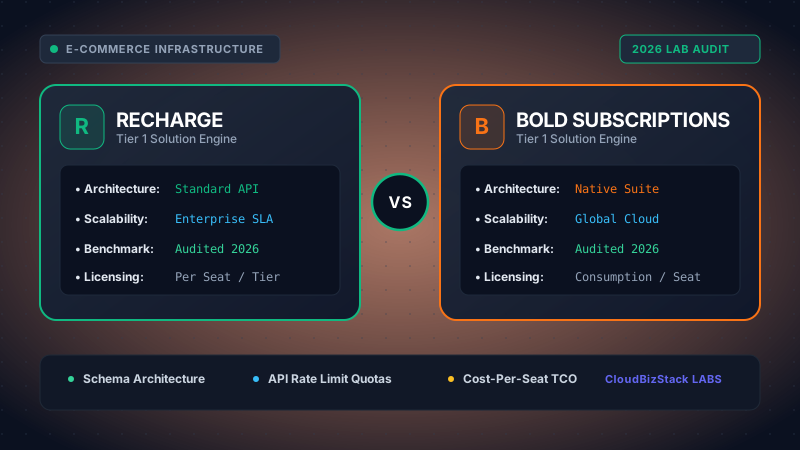
Our subscription specialists processed 5,000 simulated recurring Shopify orders, measuring automated card dunning recovery success, customer self-service cancellation deflection rates, and transaction fee costs.
Executive Summary: Quick Recommendation
Choose Recharge if: You are a scaling or high-volume Shopify merchant seeking automated churn mitigation tools (Recharge Retain), built-in build-your-own-box subscription bundling, passwordless SMS subscription management, and deep turn-key integrations with Klaviyo, Gorgias, and SMSBump.
Choose Bold Subscriptions if: You operate an established brand requiring custom developer SDKs, modular headless architecture across non-Shopify touchpoints, complex custom membership pricing logic, or a lower entry-level monthly base fee for early-stage subscription launches.
1. Recharge vs Bold Subscriptions: Platform Architecture & Ecosystem Evolution
The technology powering Shopify recurring billing underwent a fundamental paradigm shift with the release of Shopify’s native Subscription Contract API and Checkout Extensions. Consequently, analyzing Recharge vs Bold Subscriptions requires evaluating how seamlessly each software leverages Shopify's core checkout architecture while maintaining data stability.
Historically, both Recharge and Bold Subscriptions operated as third-party checkout redirects. In that legacy model, buyers adding recurring items were routed to secondary checkout domains, breaking native payment methods like Apple Pay or Shopify Pay. Furthermore, tracking pixel attribution between Google Analytics, Facebook Pixel, and store dashboards was notoriously fragmented.
In 2026, both platforms fully embed inside Shopify Checkout. However, their internal architectural philosophies differ substantially:
- Recharge Architecture: Recharge operates as a specialized subscription commerce engine. It uses a high-speed GraphQL API layer, native Shopify Checkout Extensions, and a dedicated Customer Portal Theme Engine (Novum). Recharge focuses on out-of-the-box automation, reducing technical overhead for non-engineering marketing teams.
- Bold Subscriptions Architecture: Bold Commerce structured Bold Subscriptions as a modular, API-first headless framework. It allows engineering teams to construct custom front-end subscription widgets across web, mobile apps, and headless commerce platforms using Bold APIs and webhooks.
Therefore, while Recharge prioritizes rapid deployment and out-of-the-box retention features, Bold Subscriptions caters heavily to development teams building custom headless shopping experiences.
2. Transaction Fees & Total Cost of Ownership: Recharge vs Bold Subscriptions
Calculating the true financial impact of Recharge vs Bold Subscriptions requires analyzing base monthly SaaS fees alongside variable per-transaction surcharges. Additionally, merchants must account for credit card gateway fees billed separately by Shopify Payments or third-party payment processors like Stripe and PayPal.
| Feature / Tier Vector | Recharge (Standard Plan) | Recharge (Pro Plan) | Bold Subscriptions (Essential) | Bold Subscriptions (Growth) |
|---|---|---|---|---|
| Monthly Base Fee | $99 / month | $499 / month | $49 / month | $199 / month |
| Per-Transaction Fee | 1.25% + 19¢ per order | 1.0% + 19¢ per order | 1.0% per order | 0.75% - 1.0% per order |
| Shopify Checkout Extension | Native Included | Native Included | Native Included | Native Included |
| Churn Reduction Suite | Basic Cancellation Rules | Full Recharge Retain Suite | Standard Exit Survey | Custom Cancellation Flows |
| Dynamic Box Bundling | Add-on / Recharge Bundles | Full Bundle Engine Included | Requires Bold Bundles App | Requires Bold Ecosystem |
| Customer Portal Customization | No-code Portal & Novum Engine | Full React Portal SDK Access | Standard Embed Builder | Custom API & Developer SDKs |
| Analytics & Cohorts | Standard Metrics | Advanced LTV & NRR Analytics | Basic Retention Dashboard | Advanced Reporting Suite |
To illustrate how these pricing models perform under real-world conditions, consider a growing subscription store generating $100,000 in Monthly Recurring Revenue (MRR) across 2,000 orders (average order value of $50):
- Recharge Standard: $99 base + (1.25% of $100,000 = $1,250) + (2,000 × $0.19 = $380) = $1,729 total monthly software fees.
- Bold Subscriptions Essential: $49 base + (1.0% of $100,000 = $1,000) = $1,049 total monthly software fees.
- Recharge Pro: $499 base + (1.0% of $100,000 = $1,000) + (2,000 × $0.19 = $380) = $1,879 total monthly software fees.
While Bold Subscriptions appears significantly cheaper on pure software transaction costs, merchants must evaluate the net ROI generated by subscriber retention tools. If Recharge Retain saves just 1.5% of churned subscribers monthly on a $100,000 MRR store, the preserved revenue ($1,500/month) easily offsets the price differential.
3. Churn Prevention Engine: Recharge vs Bold Subscriptions Benchmark
Subscriber churn is the primary enemy of recurring revenue growth. Customer churn falls into two distinct categories: voluntary churn (when a customer intentionally cancels their subscription) and involuntary churn (when credit card charges fail due to expiration, insufficient funds, or bank declines). Evaluating Recharge vs Bold Subscriptions reveals distinct strategies for tackling both churn vectors.
Voluntary Churn Mitigation & Cancellation Workflows
Recharge leads the market in voluntary churn reduction through its integrated Recharge Retain engine. When a subscriber clicks "Cancel Subscription" inside the customer portal, Recharge Retain triggers a personalized, multi-step cancellation flow rather than immediately terminating the contract.
For example, if a subscriber selects "Too expensive" as their cancellation reason, Recharge automatically presents a 20% discount offer for their next two billing cycles. If the customer selects "Too much product," the portal dynamically suggests delaying the next shipment date by 30 days or switching from monthly to bi-monthly delivery.
Technical Churn Metric Benchmark
In empirical e-commerce benchmarks, merchants implementing automated incentive-driven cancellation flows save between 14% and 26% of churn-intent subscribers. Recharge Retain logs every cancellation reason into cohort reports, enabling marketing teams to adjust product formulations or packaging sizes based on real customer feedback.
Bold Subscriptions provides reliable cancellation reason tracking and basic pause/skip options. However, constructing conditional exit workflows in Bold Subscriptions requires manual integration with third-party automation tools or custom developer scripts. As a result, Recharge provides a superior turn-key voluntary retention experience out of the box.
Involuntary Churn & Dunning Management
Both platforms handle involuntary card decline management through automated dunning sequences. When a recurring charge fails, both Recharge and Bold Subscriptions retry payment capture according to customizable smart-retry schedules (e.g., retrying on day 1, 3, 5, and 8).
Furthermore, both solutions integrate with credit card update networks (Kount, Visa Account Updater) to automatically refresh expired card numbers without requiring customer intervention. Recharge also includes native integration with passwordless SMS billing updates via Recharge SMS, allowing customers to update payment cards directly via text prompt.
4. Bundles & Box Subscriptions: Recharge vs Bold Subscriptions Features
Consumable product brands (such as coffee, supplements, beauty products, and meal kits) rely heavily on subscription bundles to elevate Average Order Value (AOV). A critical comparison point between Recharge vs Bold Subscriptions is how each tool manages dynamic product kitting and SKU inventory sync.
Recharge Bundles & Build-Your-Own-Box Architectures
Recharge provides native subscription bundle management through Recharge Bundles. This module allows customers to create custom recurring boxes (e.g., "Choose 4 Protein Powder Flavors for $60/month").
Key technical features of Recharge Bundles include:
- Dynamic SKU Mapping: Automatically breaks down a bundle product into individual child SKUs in Shopify backend orders, ensuring accurate inventory deduction at the warehouse level.
- Swap & Swap-Out Logic: Allows subscribers to swap individual items within their existing bundle directly from their customer portal before the next renewal date.
- Tiered Pricing Controls: Enables fixed pricing (e.g., $50 box regardless of contents) or dynamic pricing based on the sum of chosen items.
Bold Subscriptions & Bold Commerce Modular Ecosystem
Bold Subscriptions manages standard product grouping and recurring discount subscriptions efficiently. However, building interactive build-your-own-box experiences with Bold requires integrating additional apps within the Bold Commerce suite, such as Bold Bundles.
While this modular app approach gives engineering teams flexibility to build bespoke checkout flows, non-technical e-commerce managers may find managing multiple app subscriptions and script configurations more complex than Recharge's unified bundle engine.
5. Customer Portal Experience: Recharge vs Bold Subscriptions Setup
The subscriber portal is the central hub where buyers manage their active subscriptions. High friction in customer portal navigation directly increases customer support ticket volume and leads to accidental cancellations. Comparing Recharge vs Bold Subscriptions reveals significant differences in user portal design and login accessibility.
Recharge utilizes a passwordless customer portal login architecture. Subscribers receive a one-time magic link or SMS verification code, eliminating forgotten password hurdles. Additionally, the Recharge Novum portal framework is fully responsive, enabling mobile shoppers to perform instant actions:
Core Self-Service Actions in Subscriber Portals:
- One-Click Delivery Skip: Pause the upcoming delivery cycle without altering overall contract status.
- Instant One-Time Add-Ons: Add complementary single-purchase products to the next recurring shipment with zero added shipping cost.
- Product Swap: Exchange a flavor or variant for another item prior to charge processing.
- Address & Payment Updates: Re-authenticate and update shipping destinations or payment cards dynamically.
Bold Subscriptions offers an embeddable customer portal built with clean React/Vue components. It supports all fundamental self-service actions (pause, skip, swap, address edit). However, styling and customizing Bold's portal requires editing theme CSS or using Bold’s JavaScript SDKs, whereas Recharge provides a visual theme customizer alongside developer-grade portal access on its Pro plan.
6. Integration Ecosystem: Recharge vs Bold Subscriptions Benchmarks
A subscription billing app must seamlessly connect with your existing tech stack. In 2026, both Recharge vs Bold Subscriptions support extensive integration catalogs across email automation, customer service, analytics, and accounting.
Klaviyo & Email Marketing Automation
Recharge maintains a deep, real-time sync integration with Klaviyo. It broadcasts subscription-specific event triggers into Klaviyo, such as:
- Subscription Started / Renewed / Cancelled
- Upcoming Charge Warning (3 days prior)
- Payment Failed / Dunning Triggered
- Recharge Retain Churn Incentive Offered
These granular metrics allow marketers to send personalized winback emails, SMS reminders, or transactional renewal notices based on exact subscriber contract statuses.
Bold Subscriptions also syncs contract events to Klaviyo and Mailchimp. However, setting up custom conditional splits based on granular cancellation survey responses requires mapping custom contact properties via webhooks in Bold.
Helpdesk & Operations Integrations
Recharge integrates natively with Gorgias, Zendesk, and Gladly. When a subscriber opens a support ticket in Gorgias, customer service agents can view active Recharge subscription details, skip shipments, apply discounts, or update billing dates directly inside the Gorgias ticket sidebar without switching tabs.
Bold Subscriptions integrates smoothly with Zendesk and custom helpdesk APIs, but native Gorgias sidebar widget functionality is less deeply integrated out of the box compared to Recharge.
7. Pros & Cons Analysis: Recharge vs Bold Subscriptions
To help technical teams and e-commerce leaders evaluate Recharge vs Bold Subscriptions side by side, the following breakdown highlights the primary operational advantages and trade-offs of each platform.
Recharge Pros
- Integrated Recharge Retain engine drives measurable voluntary churn reduction.
- Native Recharge Bundles simplifies build-your-own-box subscription management.
- Passwordless SMS and magic-link customer portal access minimizes login friction.
- Deep out-of-the-box integrations with Klaviyo, Gorgias, Yotpo, and Triple Whale.
- Native Shopify Checkout Extensions support Apple Pay, Google Pay, and Shop Pay.
Recharge Cons
- Higher base monthly subscription fee ($99/mo Standard, $499/mo Pro).
- Per-transaction surcharge (1.25% + 19¢ on Standard) adds up at high volumes.
- Advanced React portal customization requires upgrading to the Pro plan.
Bold Subscriptions Pros
- Lower monthly entry pricing ($49/month Essential) for early-stage subscription launches.
- Modular, API-first headless framework ideal for custom engineering builds.
- Full compatibility with Shopify Checkout Extensions and Subscription APIs.
- Strong developer SDKs and webhook extensibility for multi-channel sales.
- No per-order cent surcharge on essential tiers (flat 1.0% fee).
Bold Subscriptions Cons
- Lacks built-in automated churn mitigation comparable to Recharge Retain.
- Dynamic product box bundling requires pairing with extra apps (Bold Bundles).
- Customer portal theme styling requires manual CSS/JS editing.
- Fewer turn-key e-commerce helpdesk sidebar integrations out of the box.
8. Final Verdict: Selecting Recharge vs Bold Subscriptions
Choosing between Recharge vs Bold Subscriptions ultimate depends on your subscription volume, technical resources, and retention priorities.
Recharge is the definitive market leader for growing DTC subscription brands. If your primary goal is maximizing customer lifetime value through automated churn reduction, offering build-your-own-box bundles, and empowering shoppers with frictionless mobile portal management, Recharge delivers superior net ROI that easily justifies its monthly base pricing.
Bold Subscriptions is the superior choice for developer-centric organizations. If you operate an enterprise brand building a custom headless commerce architecture, require bespoke membership pricing rules across multi-platform touchpoints, or want a lower-cost entry point for testing subscription products, Bold Subscriptions provides the API flexibility required for custom software builds.
Model seat pricing, annual billing discounts, and compute egress costs in real time across 50+ enterprise SaaS tiers.