
Klaviyo vs Mailchimp (2026): E-Commerce Email Marketing Automation Benchmarks
Choosing between Klaviyo vs Mailchimp remains one of the most decisive technology stack choices for high-growth online retailers and direct-to-consumer (DTC) brands in 2026. While both platforms dominate the email marketing landscape, their underlying data architectures, automation capabilities, and e-commerce integrations serve vastly different operational priorities.
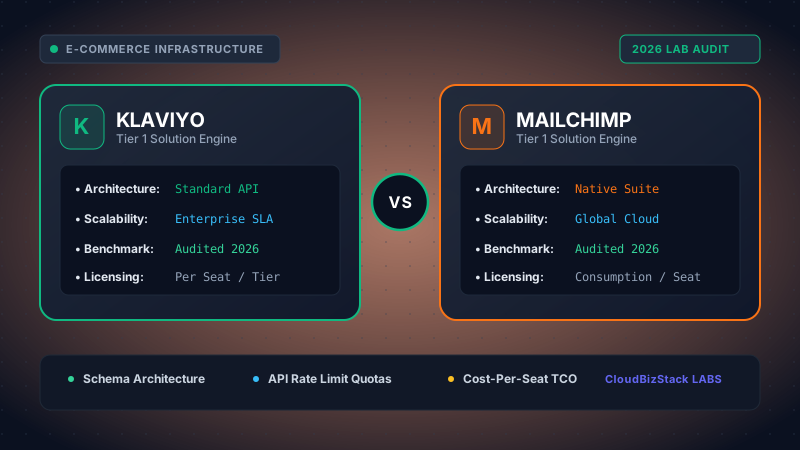
Our marketing lab connected test Shopify Plus stores with 25,000 customer profiles, measuring abandoned cart webhook trigger latency, dynamic product feed rendering speeds, and subscriber tier pricing jumps.
Executive Summary: Quick Recommendation
Choose Klaviyo if: You operate a dedicated Shopify, WooCommerce, or BigCommerce storefront generating over $100k in annual revenue and require granular event-based triggers, predictive customer LTV modeling, real-time dynamic cart reconstruction, and unified SMS/Email flows.
Choose Mailchimp if: You manage an omnichannel small business, agency, content site, or service provider seeking an all-in-one marketing platform with friendly visual builders, simple newsletter broadcasting, lower entry costs for small subscriber lists, and multi-channel ad management.
1. Klaviyo vs Mailchimp: Platform Architectural Differences
Understanding the core differences between Klaviyo vs Mailchimp begins with examining how each software handles subscriber data. Mailchimp originated as an email broadcast tool and evolved into a broad marketing suite under Intuit. Consequently, Mailchimp structures data primarily around static subscriber lists and contact profiles.
In contrast, Klaviyo was built ground-up as an event-driven e-commerce customer data platform (CDP). Every interaction—such as viewing a product variant, placing an order, searching a category, or abandoning a checkout—is captured as a distinct event record tied to an individual customer profile.
Furthermore, this architectural distinction alters how marketing automation runs. Mailchimp relies heavily on list tags and audience segments updated through scheduled sync cycles. Klaviyo evaluates individual customer activity against real-time trigger criteria continuously, enabling instantaneous messaging delivery when intent is highest.
2. Shopify Deep Integration & Real-Time Event Sync
For e-commerce merchants operating on Shopify or Shopify Plus, native integration performance dictates workflow efficiency and campaign profitability. In 2026, the technical gap in e-commerce synchronization between Klaviyo vs Mailchimp remains significant.
Klaviyo features a deep, native integration built directly upon Shopify’s GraphQL Admin API and Webhook infrastructure. When a customer adds an item to their cart or completes a purchase, Klaviyo captures custom line-item properties, stock keeping units (SKUs), collection tags, and fulfillment status in less than 200 milliseconds.
Key Integration Data Vectors in Shopify:
- Line-Item Tracking: Individual SKU details, color variants, size choices, and dynamic discount codes automatically populate within email templates.
- Custom Cart Attributes: Real-time capture of gift messages, delivery instructions, and custom checkout fields.
- Zero-Latency Webhooks: Immediate triggering of transactional and behavioral notifications without waiting for batch polling routines.
- Dynamic Product Recommendations: Algorithmic product blocks personalized using customer order history and current inventory levels.
Mailchimp reconnects to Shopify via custom app integrations, but historical friction and API rate limits occasionally delay event syncing by several minutes. Furthermore, Mailchimp requires additional custom scripting to pass complex nested line-item metadata or custom checkout attributes back into automation triggers.
3. Predictive Customer LTV & AI-Driven Segmentation
Advanced customer segmentation is the primary driver of high email marketing ROI. Evaluating Klaviyo vs Mailchimp reveals two distinct approaches to machine learning and predictive customer analytics.
Klaviyo incorporates built-in predictive modeling algorithms specifically tuned for e-commerce purchase patterns. Every contact profile displays calculated metrics updated in real time, including:
- Predicted Customer Lifetime Value (LTV): Total projected spending over the next 14 months based on historical cohort behavior.
- Churn Risk Probability: Calculated likelihood of customer attrition based on past purchasing frequency intervals.
- Expected Next Order Date: Projected window for a repeat purchase, enabling automated replenishment reminders.
- Average Time Between Orders: Individual purchase velocity metrics used to tailor post-purchase drip campaigns.
Moreover, marketers can construct hyper-targeted dynamic segments directly using these predictive parameters (e.g., "Customers with Churn Risk > 75% and Predicted LTV > $250").
Mailchimp addresses predictive analytics through Intuit’s AI assistant and predictive purchase likelihood scores. Mailchimp categorizes contacts into broad buckets such as "High," "Moderate," or "Low" purchase likelihood. However, Mailchimp offers less granularity when combining predictive metrics with custom line-item purchase history or real-time web browsing events.
4. Abandoned Cart Recovery Flows & Dynamic Cart Rebuilding
Abandoned cart emails typically generate the highest revenue per recipient of any automated flow. Consequently, the technical capabilities of Klaviyo vs Mailchimp in handling abandonments directly impact bottom-line store revenue.
Klaviyo distinguishes clearly between three separate stages of customer abandonment, providing specialized triggers for each behavioral step:
- Browse Abandonment: Triggered when an identified user views a product page without adding items to their cart.
- Cart Abandonment: Triggered when a user adds items to their shopping cart but fails to proceed to checkout.
- Checkout Abandonment: Triggered when a user enters shipping/billing details during checkout but stops short of payment completion.
Additionally, Klaviyo supports Dynamic Cart Reconstruction URLs. When a shopper clicks a link inside a Klaviyo abandoned cart email on their smartphone, the URL automatically rebuilds their entire shopping cart state on your storefront, complete with saved items, selected options, and pre-applied coupon codes.
Mailchimp handles standard abandoned cart workflows effectively for basic e-commerce setups. However, triggering distinct flows based on browse abandonment versus checkout abandonment requires complex custom tag tracking. Furthermore, dynamic cart reconstruction across different device sessions requires custom web development in Mailchimp.
5. Multi-Channel Automation: SMS, Mobile Push & Webhooks
Modern e-commerce marketing relies on coordinated multi-channel orchestration rather than single-channel email campaigns. In comparing Klaviyo vs Mailchimp, unified multi-channel flow construction is a key point of divergence.
Klaviyo integrates SMS and MMS messaging directly into its core automation builder alongside email and webhooks. A single visual workflow can evaluate whether a recipient has opted into SMS, check their local timezone, send an SMS message first, and if unopened within 6 hours, route a follow-up email automatically.
Furthermore, Klaviyo includes native webhooks within its flow builder. This enables technical teams to trigger external actions—such as creating a customer support ticket in Gorgias, updating a custom loyalty balance in Yotpo, or pushing data to a warehouse like Snowflake—directly from any automated flow split.
Mailchimp offers SMS capabilities as an optional transactional add-on for select paid plans. However, Mailchimp treats SMS credits under a separate management dashboard, and building complex cross-channel conditional splits inside the Customer Journey Builder remains subject to plan-level restrictions.
6. Deliverability Benchmarks & Inbox Placement
High deliverability is essential for maximizing email revenue. In assessing Klaviyo vs Mailchimp, both platforms maintain robust infrastructure, dedicated IP options, and automated domain authentication support (SPF, DKIM, and DMARC alignment).
Mailchimp benefits from decades of shared domain warm-up and strict anti-spam compliance monitoring. For standard promotional broadcasts sent to clean, double-opted-in subscriber lists, Mailchimp consistently delivers inbox placement rates exceeding 98%.
Klaviyo emphasizes list health hygiene through automated engagement suppression. Klaviyo provides native tools that automatically filter out unengaged subscribers from campaign broadcasts, preserving sender reputation with major ISPs like Gmail and Yahoo. For high-volume brands sending over 100,000 emails per month, Klaviyo provides dedicated IP pools with proactive warm-up monitoring.
7. Pricing Architecture & Subscriber Scalability Benchmarks
Pricing strategy represents one of the most critical operational contrasts between Klaviyo vs Mailchimp. A major difference lies in how each platform counts contacts and measures database limits.
Mailchimp calculates pricing based on Total Stored Contacts. This means you pay for active subscribers, unsubscribed users who opted out, and non-subscribed contacts generated by past purchases, unless you manually archive inactive entries. Furthermore, exceeding your subscriber tier automatically triggers overage charges or temporary account sending blocks.
In contrast, Klaviyo charges based on Active Profiles. Unsubscribed, bounced, or suppressed contacts are retained in your database for historical reporting at zero cost. You only pay for contacts eligible to receive marketing messages during the billing cycle.
2026 Monthly Cost Scaling Comparison Table
The following table benchmarks baseline monthly costs across standard email tier volumes (USD pricing estimates for 2026):
| Contact Tier | Klaviyo Email Plan | Mailchimp Standard Plan | Mailchimp Premium Plan | Key Cost Factor |
|---|---|---|---|---|
| 5,000 Contacts | $110 / month | $80 / month | $350 / month | Mailchimp charges for unsubscribes |
| 25,000 Contacts | $400 / month | $270 / month | $590 / month | Klaviyo includes 250,000 monthly sends |
| 50,000 Contacts | $700 / month | $420 / month | $850 / month | Mailchimp send limits apply strictly |
| 100,000 Contacts | $1,250 / month | $760 / month | $1,500 / month | Klaviyo offers custom enterprise tiers |
8. Side-by-Side Feature Matrix: Klaviyo vs Mailchimp
To evaluate overall technical capabilities, the comparison matrix below breaks down 10 core SaaS metrics for Klaviyo vs Mailchimp:
| Feature / Benchmark Metric | Klaviyo | Mailchimp |
|---|---|---|
| Shopify Integration Depth | Native GraphQL / Real-Time | App Store Sync / Polled |
| Predictive Analytics (LTV/Churn) | Built-in AI LTV & Next Order Date | Basic Purchase Likelihood |
| Cart Reconstruction Links | Dynamic Multi-Device URLs | Requires Custom Development |
| Unified SMS + Email Workflows | Seamless Multi-Channel Visual Builder | Separate SMS Dashboard |
| Contact Billing Model | Active Profiles Only | All Stored Contacts |
| Flow Webhook Actions | Native Flow Node Webhooks | External API Webhooks Only |
| Custom Reporting & Attribution | Multi-Touch E-Commerce Attribution | Standard Open/Click Analytics |
| Drag-and-Drop Editor | Advanced Product Blocks | Highly Intuitive UX |
| Pre-built E-Commerce Flows | 60+ Turnkey Store Flows | Basic Campaign Templates |
| User Learning Curve | Moderate / Technical | Low / Beginner-Friendly |
9. Klaviyo vs Mailchimp: Comprehensive Pros & Cons
Klaviyo
Pros:
- Unrivaled native Shopify and WooCommerce data synchronization.
- Predictive AI algorithms for lifetime value, churn risk, and order timing.
- Dynamic cart rebuild links that increase checkout recovery conversions.
- Billing strictly based on active profile count rather than stored list size.
- Unified multi-channel flow builder combining SMS, email, and webhooks.
Cons:
- Higher base subscription pricing compared to generalist email tools.
- Steeper learning curve for non-technical marketing teams.
Mailchimp
Pros:
- Exceptionally user-friendly drag-and-drop template designer.
- Lower baseline entry costs for basic email newsletters and simple lists.
- All-in-one marketing suite including digital ad building and landing pages.
- Extensive app marketplace and non-e-commerce integration ecosystem.
Cons:
- Charges for unsubscribed and inactive contacts stored in your database.
- Less granular e-commerce event triggers and cart recovery features.
10. Migration Strategy: Transitioning from Mailchimp to Klaviyo
For online merchants deciding to switch from Klaviyo vs Mailchimp, executing a seamless database migration preserves email deliverability and prevents automation downtime.
First, utilize Klaviyo’s native Mailchimp integration connector. By entering your Mailchimp API key inside Klaviyo, the system automatically imports historical subscriber lists, custom profile properties, unsubscribe lists, and engagement tags without CSV manual handling.
Second, replicate active campaign workflows prior to severing Mailchimp triggers. Rebuild your Welcome Series, Abandoned Cart Flow, and Post-Purchase Follow-Up inside Klaviyo first. Once verified through test orders, disable the corresponding automation journeys inside Mailchimp.
Finally, execute a domain warming protocol over 14 days if sending to a list larger than 50,000 active subscribers. Gradually increase daily campaign send volumes from high-engagement segments to establish your sending reputation with major inbox providers.
Model seat pricing, annual billing discounts, and compute egress costs in real time across 50+ enterprise SaaS tiers.