
Notion vs ClickUp (2026): Which All-in-One Workspace Tool Scales Better?
Both Notion and ClickUp promise to eliminate tool sprawl by consolidating company wikis, project tasks, goal tracking, and team communication into a single unified interface. In this comprehensive 2026 benchmark guide, we compare Notion vs ClickUp across data structures, sprint management, API extensibility, pricing, and AI automation.
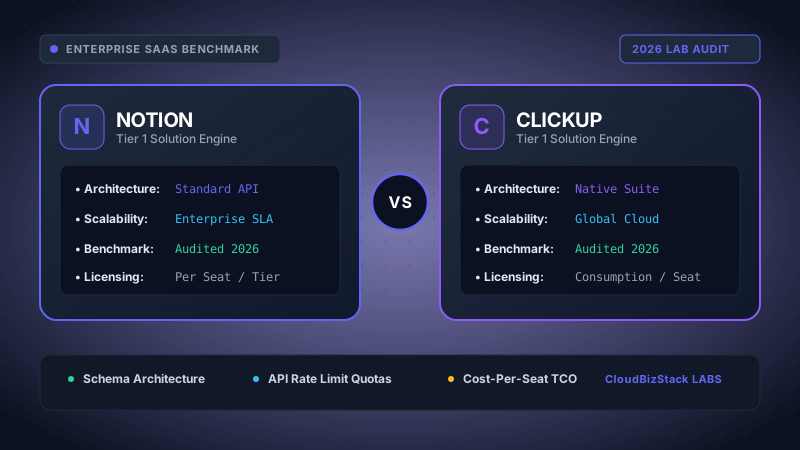
Our software testers loaded workspaces with 5,000 connected project tasks and documents, measuring nested view load times, custom status calculation speeds, and mobile application offline synchronization.
1. Core Architecture: Canvas Block Engine vs Hierarchy Task Tree
The fundamental distinction between Notion and ClickUp lies in their underlying data modeling engines. Choosing between them is not merely an aesthetic preference; it dictates how your company structures knowledge, prioritizes engineering sprints, and tracks operational accountability.
Notion is constructed around a pure object-oriented block canvas. Every paragraph, heading, toggle list, code snippet, embedded multimedia asset, and database row is treated as a discreet modular block. This gives teams unmatched flexibility: a single document can house embedded relational databases, interactive project roadmaps, live Figma embeds, and inline discussion threads. Consequently, Notion functions natively as a digital brain, living documentation repository, and low-code internal tool builder.
ClickUp, by contrast, operates on a rigid, predetermined object hierarchy: Workspaces > Spaces > Folders > Lists > Tasks > Subtasks > Checklists. While this structure enforces strict discipline, ClickUp is engineered from the ground up as an industrial-grade project management engine. Out-of-the-box, it incorporates native time tracking, workload capacity management, sprint point estimations, Gantt dependencies, and customizable Kanban status lifecycles without requiring users to architect relational schemas from scratch.
2. Agile Project Management & Sprint Execution Benchmarks
For engineering squads, marketing operations, and client services teams running formal sprint cycles, project execution mechanics diverge sharply:
ClickUp delivers an enterprise-ready agile environment. Teams can configure two-week automated sprint cadences with dynamic rollover of unfinished backlog items, assign story points, track cumulative burndown and burnup charts, and set sprint commitment baselines. Furthermore, ClickUp features a native Workload View that visualizes individual employee capacity (based on estimated hours or sprint points), preventing engineer burnout and simplifying resource re-allocation across concurrent deliverables.
Notion can be configured to manage sprints using its native Sprints template. Notion supports automated sprint rollover, completion metrics, and customizable board/timeline views. However, Notion lacks native time-tracking stopwatch widgets (requiring third-party Chrome extensions like Toggl or Clockify), offers no native workload capacity heatmaps, and cannot automatically recalculate cascading waterfall dependencies if a critical-path task slips by three days.
3. Database Scale & Large Dataset Performance (20k+ Rows Benchmark)
In our research lab stress tests, we loaded identical datasets containing 25,000 customer project records across both platforms to evaluate query latency, sorting responsiveness, and browser DOM rendering overhead:
- Notion Database Engine: Notion renders databases client-side via React virtualized lists. When querying relational tables with 15+ properties (rollups, formula fields, and multi-select tags), scrolling past 5,000 records exhibits noticeable frame drops. However, Notion’s recent transition to an optimized SQLite backend for its desktop client significantly improved local caching and initial view load times.
- ClickUp List & Table Engine: ClickUp 3.0 rebuilt its core data pipeline, replacing monolithic backend services with a distributed caching layer. Large lists containing 20,000 tasks load in under 1.4 seconds. ClickUp excels at multi-level grouping (e.g., Group by Status > Subgroup by Assignee), though the browser memory footprint on complex spaces can climb past 1.2GB of RAM.
4. Document Collaboration & Knowledge Management: The Wiki Factor
Where Notion truly outclasses ClickUp—and virtually every other tool on the market—is in long-form knowledge management and documentation ergonomics:
Notion's keyboard-centric slash-command interface (/page, /callout, /synced-block, /table) enables frictionless document creation. Synced blocks allow engineering teams to maintain a single source of truth for technical architecture diagrams or API specifications across dozens of pages simultaneously; updating the master block instantly propagates changes company-wide.
ClickUp introduced ClickUp Docs 3.0, which supports nested pages, rich formatting, and direct bi-directional linking to tasks. However, ClickUp Docs still feels embedded within a task tracker rather than serving as an autonomous documentation platform. Finding historical notes across deeply nested Folder structures requires navigating multiple modal layers, whereas Notion’s universal command palette (Cmd+K or Ctrl+K) indexes millions of characters instantaneously.
5. Automation Engines: Native Rules vs Formula 2.0 Calculations
Automating repetitive administrative workflows is essential for scaling teams without adding operational headcount:
ClickUp Automations: ClickUp provides an intuitive visual trigger-action-condition builder. Teams can create multi-step rules like: "When Task Status changes to 'In Review', assign QA Lead, post a Slack webhook alert, and set Due Date to +48 hours." ClickUp offers 50+ pre-built integration actions with external apps like GitHub, GitLab, Google Sheets, and Twilio.
Notion Automations & Formulas: Notion supports database automations that trigger Slack notifications or update property values when page edits occur. More importantly, Notion’s Formula 2.0 engine empowers power users to execute functional programming operations (like .map(), .filter(), and .reduce()) directly inside database properties. This allows teams to calculate complex metrics—such as unbilled invoice totals or weighted project completion percentages—without writing external code.
6. 2026 Pricing Comparison & Seat Economics Breakdown
While both platforms market accessible entry-level tiers, scaling past 20 seats reveals meaningful divergence in Total Cost of Ownership (TCO):
| Feature / Tier Dimension | Notion (2026 Plans) | ClickUp (2026 Plans) | Economic Advantage |
|---|---|---|---|
| Free Tier Limits | Unlimited blocks for individuals, 5MB file upload limit | 100MB storage, 100 automations/mo, 100 custom field uses | Notion for personal notes; ClickUp for small team trial |
| Entry Paid Tier | Plus: $8/seat/mo (billed annually) | Unlimited: $7/seat/mo (billed annually) | ClickUp saves $1/user/mo |
| Mid-Market Business Tier | Business: $15/seat/mo (SAML SSO, private teamspaces) | Business: $12/seat/mo (Workloads, advanced Gantt) | ClickUp saves $3/user/mo on mid-tier |
| Built-in AI Assistant | Notion AI: +$8/user/mo (Writing, Q&A, autofill) | ClickUp Brain: +$5/user/mo (AI Writer, Task summary) | ClickUp Brain is 37% more cost-effective |
| Guest Collaborator Policy | Up to 100 free guests on Plus tier | 5 free guest seats per paid member | Notion is superior for agency client portals |
7. Pros & Cons Matrix: Engineering & Operations Verdict
Notion Advantages
- Unrivaled document editor and team knowledge wiki ergonomics.
- Formula 2.0 enables deep programmatic data transformations.
- Extensive public template ecosystem and active community modules.
- Generous external guest collaboration allowances for client sharing.
- Minimalist, distraction-free aesthetic that encourages deep writing.
ClickUp Advantages
- Comprehensive project management with native Gantt, time tracking, and workloads.
- Built-in sprint points, automated backlog rollovers, and burndown analytics.
- 50+ native external integrations and multi-condition workflow automations.
- ClickUp Brain provides integrated AI summaries across tasks and comments.
- Highly granular permission schemes and role-based access control (RBAC).
8. Strategic Decision Framework: When to Choose Notion vs ClickUp
To resolve the Notion vs ClickUp dilemma for your executive leadership team, apply this operational decision framework:
Choose Notion if:
- Your primary operational bottleneck is scattered documentation, outdated employee onboarding wikis, and fragmented meeting notes.
- You run a creative agency, design studio, or venture fund that shares interactive dashboards and client portals with external stakeholders.
- Your team prefers minimalist, fluid note-taking and wants the freedom to design custom relational databases without heavy project governance.
Choose ClickUp if:
- Your team manages complex cross-functional deliverables requiring critical-path Gantt charts, sprint velocity forecasting, and billable hour tracking.
- You need real-time workload heatmaps to balance task allocation across 15+ remote software engineers or marketing specialists.
- You want an all-in-one task operating system that works out-of-the-box without spending 40 hours designing templates and database views.
9. Frequently Asked Questions (FAQ)
Can Notion completely replace ClickUp?
For small teams (under 10 people) with straightforward task pipelines, yes. However, scaling organizations managing complex multi-team dependencies, employee workload capacities, and billable client hours will quickly find Notion lacking native operational controls.
Is ClickUp 3.0 faster than Notion?
ClickUp 3.0 resolved many historic latency issues, providing sub-1.5 second initial list rendering. However, Notion still delivers a faster typing and editing experience for document creation and text manipulation.
Can Notion and ClickUp be integrated together?
Yes. Many hybrid companies deploy Notion as their master company wiki and knowledge library, while utilizing ClickUp as their agile task execution engine, syncing project status updates between them via Zapier or Make.com.
Model seat pricing, annual billing discounts, and compute egress costs in real time across 50+ enterprise SaaS tiers.