
Oyster vs Multiplier: Mid-Market Global EOR Benchmark (2026)
When venture-backed scaleups, mid-market engineering organizations, and international corporate groups expand beyond domestic labor markets, choosing an Employer of Record (EOR) transitions from an administrative convenience into an architectural, legal, and cash-flow determination. While market incumbents like Deel and Remote dominate early-stage startup consciousness, mature mid-market technology organizations with 20 to 250 international knowledge workers increasingly find their primary procurement decision centered on Oyster HR and Multiplier. This benchmark dissects both platforms across owned entity topologies, regional statutory depth in APAC versus EMEA, foreign exchange treasury spreads, immigration capabilities, and total cost of ownership (TCO) across multi-year operational horizons.
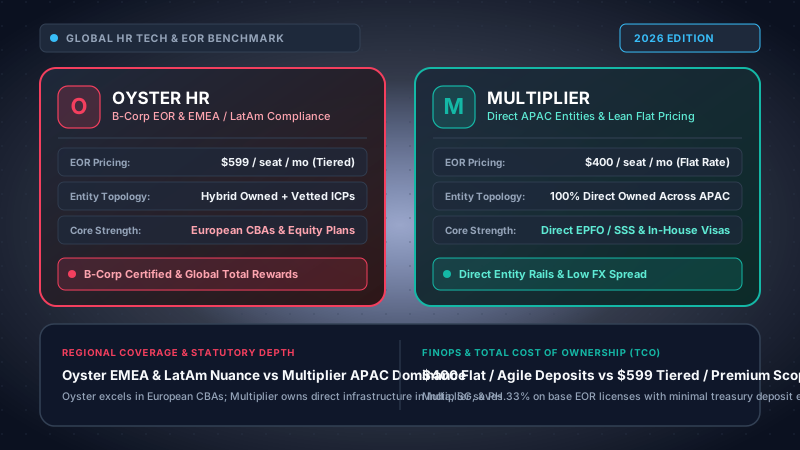
Quick Verdict: Architectural & FinOps Recommendation
Both Oyster and Multiplier represent top-tier, compliant global workforce infrastructure, but their engineering philosophies, legal entity topologies, and capital efficiency profiles diverge significantly based on geographical footprint and company scale:
Choose Oyster HR If:
- Your foreign workforce is heavily weighted toward Western and Central Europe, where complex Collective Bargaining Agreements (CBAs), statutory Works Councils, and mandatory 13th/14th month disbursements dictate legal risk.
- Your company prioritizes B-Corp certification, structured equity/stock option grant compliance (NSO/ISO tax qualification in 100+ countries), and employee-first Total Rewards programs.
- You manage a hybrid contractor-to-employee pipeline in LatAm and Europe where automated statutory classification audits and localized benefits packages matter more than raw software discounting.
Choose Multiplier If:
- Your primary technical hiring pipeline is concentrated in Asia-Pacific (India, the Philippines, Singapore, Indonesia, Vietnam), where Multiplier owns 100% direct legal entities with zero intermediary markups.
- Capital efficiency is paramount: Multiplier's flat $400/month EOR pricing saves $2,388+ per employee per year compared to Oyster's $599/mo tier, while flexible deposit terms prevent hundreds of thousands of dollars in locked treasury escrow.
- You require fast, in-house immigration desks capable of executing Singapore Employment Passes, Tech.Passes, UAE Golden Visas, or German Blue Cards without retaining third-party law firms.
1. Global Employment Topologies: B-Corp European Framework vs APAC Direct Legal Networks
The fundamental architecture of an Employer of Record (EOR) is governed by contract law, corporate tax treaties, and labor jurisdiction sovereignty. At its mechanical core, an EOR constructs a tripartite employment topology: the client enterprise maintains operational, managerial, and functional command over the worker; the knowledge worker provides specialized technical deliverables; and the EOR assumes legal status as the employer of record registered with national labor inspectorates, pension funds, and revenue services. However, the legal substrate beneath this tripartite model reveals profound architectural divergences between Oyster HR and Multiplier.
Comparative Entity Topologies & Contracting Flow
Oyster utilizes a hybrid infrastructure designed to balance geographic velocity with operational rigor. In tier-one strategic economic corridors—including the United Kingdom, Germany, France, Spain, the Netherlands, Canada, and the United States—Oyster operates wholly owned legal corporate subsidiaries (e.g., Oyster HR Germany GmbH, Oyster HR UK Ltd). In secondary, emerging, or highly bureaucratic jurisdictions across parts of Latin America, Africa, Central Asia, and Southeast Asia, Oyster partners with rigorously vetted In-Country Partners (ICPs). This enables rapid geographical coverage spanning 180+ countries while Oyster's software abstraction layer enforces uniform Service Level Agreements (SLAs), automated payroll approval gates, and compliance monitoring.
Multiplier was incorporated in Singapore with a targeted architectural mandate: eliminate third-party agency intermediaries across the Asia-Pacific (APAC) region and primary emerging tech corridors. Multiplier owns and operates 100% direct legal subsidiaries in key markets such as India, Singapore, the Philippines, Indonesia, Malaysia, Vietnam, Thailand, and Australia, while aggressively expanding direct entities across Europe and the Americas. Because Multiplier holds direct corporate registrations, local commercial bank accounts, and statutory tax identification numbers, client contracts execute directly with the entity employing the talent, eliminating multi-layered markup chains.
Tripartite Employment Contracts, Liability Segregation & IP Title
From an enterprise governance perspective, the primary structural vulnerability of international expansion is defective Intellectual Property (IP) assignment and the inadvertent creation of a Permanent Establishment (PE). If a senior staff engineer in Bangalore or Berlin commits code to a proprietary cloud infrastructure repository, the chain of title must flow unimpeded from the individual to the client enterprise without getting trapped inside foreign insolvency estates, bankruptcy proceedings, or agency liens.
Multiplier's direct entity ownership ensures a bilateral, unsevered chain of title: the employment agreement binds the engineer to Multiplier's wholly owned local subsidiary (e.g., Multiplier Technologies India Pvt Ltd), with an explicit, automatic present assignment of all moral rights, patentable inventions, trade secrets, and copyrightable software directly back to the ultimate client entity upon creation. There is no middleman ICP capable of asserting a statutory lien, local agency claim, or bankruptcy stay.
Oyster's governance framework counterbalances its hybrid partner model through specialized enterprise contract structures and its institutional status as a Certified B-Corporation. Oyster embeds institutional-grade intellectual property covenants into its Master Services Agreements (MSAs), executing mirror indemnification agreements with all third-party ICPs. Furthermore, Oyster's compliance engine enforces strict operational guardrails preventing overseas employees from executing commercial sales contracts, signing revenue-generating agreements, or binding the client corporation legally, thereby actively mitigating corporate tax permanent establishment exposure under OECD Model Tax Convention guidelines.
Permanent Establishment (PE) Risk Mitigation Under OECD Article 5
Under Article 5 of the OECD Model Tax Convention, a foreign enterprise can be deemed to have a taxable corporate presence (Permanent Establishment) through two primary mechanisms: maintaining a "fixed place of business" through which business activities are wholly or partly carried out, or engaging a "dependent agent" who habitually concludes contracts or plays the principal role leading to the conclusion of contracts in the name of the foreign enterprise.
Both Oyster and Multiplier structure their employment contracts to strictly segregate technical delivery from commercial agency. In software engineering organizations, the risk of PE is generally low unless engineering managers possess authority to sign enterprise procurement or customer sales contracts. Both platforms mandate explicit contractual language barring EOR-hired workers from representing themselves as legal officers or commercial agents of the foreign parent. Where Oyster provides an edge is its proprietary risk assessment framework, which continuously scans job descriptions, title changes, and organizational charts to alert People Ops leaders if an employee's role drifts toward commercial authority.
Furthermore, both vendors address the legal nuance of "economic employer" versus "formal employer" doctrines. In countries like the UK and Germany, tax authorities look past paper contracts to determine which commercial entity bears the financial cost and risks of the employee's labor. By maintaining arm's-length intercompany service fees and strictly managing payroll disbursements through local statutory entities, both platforms ensure that local tax inspectors assess payroll withholding taxes without asserting that the foreign parent corporation owes corporate income tax on worldwide profits.
2. Regional Coverage & Local Entity Footprint: APAC Core vs European Statutory Nuances
An EOR's software dashboard is only as resilient as its boots-on-the-ground understanding of national labor codes, statutory benefit funds, mandatory bonuses, and termination protections. When comparing Oyster and Multiplier, their regional centers of gravity become immediately apparent in execution velocity, statutory filings, and compliance accuracy.
Asia-Pacific (APAC) Deep Dive: India, the Philippines, Singapore, Indonesia & Vietnam
Asia-Pacific represents the highest-volume talent reservoir for mid-market technology organizations seeking senior full-stack developers, DevOps engineers, and cloud architects. In this region, Multiplier operates with home-field structural superiority:
- India: Indian labor compliance is notorious for state-level statutory fragmentation. Multiplier directly manages statutory deductions under the Employees' Provident Funds and Miscellaneous Provisions Act (EPFO), the Employees' State Insurance Corporation (ESIC), and varying Professional Tax brackets across Karnataka (Bangalore), Maharashtra (Pune/Mumbai), and Telangana (Hyderabad). Crucially, Multiplier establishes ring-fenced gratuity trust reserves under the Payment of Gratuity Act, 1972 (mandating 15 days of last-drawn basic salary per completed year of service after 5 continuous years), ensuring client companies never face sudden retrospective severance shock upon employee departures. Oyster handles India reliably, but routes certain sub-administrative workflows through partner channels.
- Philippines: Governed by the Department of Labor and Employment (DOLE) Department Order No. 174 (DO-174), legitimate subcontracting and EOR employment require extensive capitalization and bonded registration. Multiplier's owned Philippine entity directly processes mandatory tripartite deductions: Social Security System (SSS), Philippine Health Insurance Corporation (PhilHealth), and Home Development Mutual Fund (Pag-IBIG). Furthermore, Multiplier automates the mandatory 13th-month pay accrual (stipulated under Presidential Decree No. 851) directly into monthly treasury forecasts, preventing year-end cash crunch anomalies.
- Singapore & Indonesia: In Singapore, Multiplier automates Central Provident Fund (CPF) employer/employee contributions for Singapore Citizens and Permanent Residents, and issues automated Form IR8A filings during IRAS tax filing seasons. In Indonesia, Multiplier handles both BPJS Ketenagakerjaan (employment social security: JKK, JKM, JHT, JP) and BPJS Kesehatan (healthcare), alongside mandatory Tunjangan Hari Raya (THR) religious holiday allowances.
- Vietnam, Thailand & Malaysia: Under Vietnam's 2019 Labor Code, employers must strictly execute Social, Health, and Unemployment Insurance (SHUI) contributions, alongside standard 13th-month Tet bonuses. Multiplier's direct entity in Ho Chi Minh City executes direct filings without third-party local agency delays. In Thailand, Multiplier handles Social Security Fund (SSF) registrations and statutory severance pay scales governed by the Labor Protection Act (ranging from 30 days to 400 days of salary based on service length). In Malaysia, Multiplier operates direct integrations with the Employees Provident Fund (EPF), Social Security Organisation (SOCSO), and Employment Insurance System (EIS).
Western & Eastern Europe Deep Dive: Germany, France, the UK, the Netherlands & Poland
While Multiplier dominates Asian statutory execution, Oyster HR possesses deep, battle-tested sophistication across the complex legal labyrinth of Western and Central Europe:
- Germany: German employment law is heavily protective of workers under the Kündigungsschutzgesetz (KSchG). Dismissals after the statutory 6-month probationary period (Probezeit) require legally verified social justification (betriebsbedingte, verhaltensbedingte, or personenbedingte Kündigung). Furthermore, collective employee representation through Works Councils (Betriebsrat) imposes strict consultation protocols. Oyster's German legal entity and in-house European legal counsel provide specialized guidance on employment contracts, statutory sick pay (Entgeltfortzahlung up to 6 weeks at 100%), and tripartite social security splits (Pension, Unemployment, Health, and Nursing Care insurance, representing approximately 20-21% employer burden).
- France: French labor compliance revolves around the Code du travail and mandatory Collective Bargaining Agreements (Conventions Collectives Nationales, or CCNs, such as the SYNTEC agreement for technology and engineering personnel). Oyster excels in mapping tech workers to exact SYNTEC classifications, coefficients, and minimum wage floors, while managing the mandatory supplementary health insurance (mutuelle obligatoire) and mandatory notice periods (préavis) that catch US-centric founders off guard.
- The Netherlands & Spain: In the Netherlands, Oyster navigates the Wet werk en zekerheid (WWZ), statutory transition payments (transitievergoeding), and applications for the 30% expat tax ruling for highly skilled technical migrants. In Spain, Oyster manages the Estatuto de los Trabajadores, mandatory 14-month payment schedules (pagas extraordinarias), and statutory severance calculations (33 days of salary per year of service for unfair dismissal).
- United Kingdom & Poland: In the UK, Oyster processes Real Time Information (RTI) submissions to HM Revenue & Customs (HMRC), National Insurance Class 1 contributions, and workplace pension auto-enrolment under the Pensions Act 2008. In Poland, Oyster provides comprehensive support for standard employment contracts (Umowa o pracę) with full ZUS social security compliance, while offering compliant B2B contractor frameworks for senior software engineers operating registered sole proprietorships.
Statutory Benefits vs Private Supplemental Plans
A key distinction between European and Asian hiring lies in the interplay between public social security systems and private supplemental health insurance. In countries like the UK, Germany, and France, statutory healthcare is universal, but high-growth tech firms must provide top-up private medical insurance (PMI) to remain competitive against domestic tech giants. Oyster offers curated European group health policies through partnerships with regional carriers (such as Bupa, Allianz, and AXA).
In contrast, across India and Southeast Asia, public healthcare systems are often inadequate for knowledge workers, making corporate group medical insurance (GMI) with high sum insured limits (INR 500,000 to INR 1,000,000 in India) an absolute hiring prerequisite. Multiplier embeds corporate group medical, accidental, and term life insurance directly into its Indian and Southeast Asian entities, allowing employers to enroll workers with zero waiting periods for pre-existing diseases—a major competitive weapon in technical recruitment.
3. EOR Pricing Models, Treasury Mechanics & Hidden FX Spreads
For mid-market VP of Finance, Head of People, and Chief Financial Officers, published EOR SaaS list prices represent only the surface level of total operating expenditure. Evaluating Oyster versus Multiplier requires deconstructing base subscription fees, capital locked in security deposit escrows, and foreign exchange (FX) spread margins across multi-currency settlement rails.
Treasury Dynamics: The Hidden Cost of Escrow Deposits and FX Spreads
When hiring internationally via EOR, client companies must prepay a refundable security deposit. EORs legally require this deposit because in jurisdictions like France, Germany, and the Philippines, statutory labor law forbids withholding payroll or social security payments even if the client enterprise defaults on its invoice. The EOR bears ultimate criminal and civil liability to pay workers.
Oyster strictly enforces a security deposit policy equivalent to one to two full months of total employment cost (gross employee salary plus all statutory employer taxes, pension contributions, and mandatory insurances). For a team of 15 senior international engineers earning an average of $8,000/month plus 25% statutory burden ($10,000 total cost/mo/head), Oyster's two-month deposit locks $300,000 in non-interest-bearing escrow. In an era where corporate cash reserves yield 4.5% to 5.25% in institutional treasury bills, locking $300,000 incurs an implicit $15,000/year opportunity cost.
In contrast, Multiplier leverages its balance sheet and enterprise credit evaluation framework to offer flexible deposit terms. Well-capitalized mid-market companies or profitable scaleups can frequently negotiate a single month's deposit, or in enterprise cohorts, deposit waivers backed by corporate bank guarantees or letter of credit (LC) instruments. This directly frees working capital for engineering R&D.
Furthermore, foreign exchange conversion drag is an insidious cost center. Multiplier operates centralized treasury hubs in Singapore utilizing direct cross-border clearing networks (such as DBS and Standard Chartered Treasury APIs), achieving foreign exchange spreads between 0.5% and 0.8% over the interbank mid-market rate. Oyster routes cross-border transactions through partner banking rails, which frequently embed spreads between 1.5% and 2.0%. On an annualized foreign payroll volume of $2,000,000, a 1.0% FX differential generates $20,000 in unbudgeted annual expense.
Treasury reconciliation is another key differentiator. Multiplier provides unified multi-currency billing accounts allowing enterprises to settle in USD, EUR, GBP, SGD, or AUD into domestic accounts via ACH, SEPA, or local FAST/RTGS transfers. Oyster issues consolidated invoices primarily denominated in USD, EUR, or GBP, converting to local currencies at fixed cut-off dates each month. For finance departments managing corporate cash flow, Multiplier's real-time FX transparent locks eliminate surprises during month-end general ledger reconciliations.
4. Contractor Invoicing, Misclassification Shielding & Embedded Local Benefits
Most mid-market tech companies do not maintain a 100% EOR workforce. Instead, they operate an optimized barbell topology: core product architects and senior engineering managers are employed via full EOR contracts, while specialized contributors, QA testers, and regional SDRs operate as independent B2B contractors. Evaluating contractor operations across Oyster and Multiplier reveals stark trade-offs in software pricing, misclassification insurance, and local benefits administration.
Contractor Misclassification Shields & Legal Indemnity
Tax authorities globally—from the IRS in the United States to HMRC in the UK (under IR35 legislation) and the URSSAF in France—have aggressively tightened enforcement against bogus self-employment (falsos autónomos). If a contractor works full-time hours exclusively for your company, uses company-issued hardware, and receives fixed monthly pay without business economic risk, courts will reclassify them as an employee, demanding retroactive social security payments, unpaid holiday accruals, and statutory fines.
Oyster's Contractor Classification Engine: Oyster offers a specialized digital classification assessment questionnaire calibrated against national legal standards in 180+ countries. Furthermore, Oyster provides an optional Contractor Classification Shield. Under this program, Oyster reviews the contractor's working reality, issues a compliant bespoke local contract, and provides financial indemnification (up to $500,000 per worker) against misclassification legal judgments and statutory back-taxes. At $29/contractor/month, Oyster's base contractor seat is highly cost-effective for organizations managing 20+ contractors.
Multiplier's Embedded Healthcare & Direct Benefits: While Multiplier charges $40/contractor/month, its distinguishing technical capability is embedded local group insurance. On typical platforms, contractors receive raw wire transfers and must negotiate individual private insurance policies in local markets. Multiplier allows client companies to purchase comprehensive local health, dental, and life insurance for contractors directly within the Multiplier portal across 40+ countries. Because Multiplier holds direct master policies in countries like India, the Philippines, and Indonesia, contractors gain access to corporate-grade group rates, drastically reducing turnover among elite contract talent.
Contractor Payment Velocity & Multi-Currency Invoicing
Contractor retention often hinges on invoice settlement speed. Oyster supports automated contractor self-invoicing with settlement via SEPA Instant, US Domestic ACH, UK Faster Payments, and SWIFT wires. Multiplier adds a multi-currency digital wallet feature that allows international contractors to hold earnings in USD, EUR, or GBP, converting into their local domestic currencies on demand when market exchange rates are advantageous. This treasury flexibility is prized by technical contractors operating in emerging economies subject to high currency volatility (e.g., Argentina, Nigeria, or Turkey).
Additionally, contract generation workflows differ. Oyster provides automated milestone-based, hourly, and fixed-fee contract templates vetted by European employment counsel, featuring mandatory clauses regarding data privacy under GDPR Chapter V (cross-border data transfers). Multiplier offers pre-configured master services agreements (MSAs) with automatic intellectual property assignment covenants tailored specifically for engineering deliverables and open-source license exclusions.
5. Global Visas, Relocation & Immigration Infrastructure
In 2026, tech organizations frequently relocate senior technical leads from high-cost domestic centers or conflict zones into global tech hubs such as Singapore, Dubai, London, Berlin, or Lisbon. International work permit and visa sponsorship via an EOR is one of the most operationally demanding workflows in global HR.
Multiplier: In-House Immigration Practice
Multiplier operates an integrated in-house immigration department staffed by licensed immigration specialists and employment attorneys. Because Multiplier owns its local entities in Singapore, the UAE, Germany, and the UK, it acts as the direct sponsoring employer. Key immigration specializations include:
- Singapore Employment Pass (EP): Direct petitioning under the Ministry of Manpower (MOM) COMPASS point-scoring framework, Tech.Pass, and ONE Pass (Overseas Networks & Expertise Pass).
- UAE Golden & Green Visas: Rapid sponsorship in Dubai and Abu Dhabi for AI engineers and executive leadership without local sponsor bureaucracy.
- German EU Blue Card (Blaue Karte): Expedited fast-track processing for certified software architects and data scientists meeting statutory salary thresholds (€45,300+ in shortage occupations).
- Processing Cost: Flat, transparent legal handling fees typically 25-40% below external white-shoe corporate immigration firms.
Oyster HR: Partner-Led Global Mobility
Oyster approaches global mobility through an ecosystem integration model. Rather than employing large regional immigration desks in every country, Oyster partners with leading global relocation platforms (including Localyze and Jobbatical) and vetted local immigration counsel, orchestrating the workflow inside the Oyster dashboard.
- European Mobility Strengths: Exceptional tracking across Schengen Area work authorizations, UK Skilled Worker visas, and Spanish Digital Nomad / Tech Worker visas under the Ley de Startups.
- Unified Employee Portal: The relocated worker tracks their visa application status, upload biometrics and apostilled police clearances, and views local housing resources directly inside the Oyster mobile app.
- Processing Cost: Immigration is billed as a pass-through professional services fee plus partner markup ($2,500 to $6,000 depending on national complexity and family dependent inclusion).
Immigration Timelines, Work Authorizations & Compliance Audits
When relocating technical personnel, processing latency can make or break critical product development roadmaps. Multiplier's direct corporate presence in Singapore enables Employment Pass processing within 3 to 5 weeks, compared to 8 to 12 weeks when working through outsourced immigration intermediaries. Multiplier pre-screens candidate qualifications against the Singapore Ministry of Manpower (MOM) COMPASS scoring criteria (evaluating salary relative to sector benchmarks, degree accreditation from top-tier universities, and company diversity metrics) before submitting formal petitions, resulting in a 95%+ first-pass approval rate.
In Europe, Oyster's partnerships with Localyze provide automated tracking of consular appointments, apostille authentications, and statutory salary thresholds for the German Blue Card and French Passeport Talent. Oyster's system proactively alerts client administrators 90 days before visa expirations, preventing accidental lapses in work authorization that could expose the employer to administrative penalties and work stoppage injunctions.
6. HRIS Integrations & Enterprise Data Flow: HiBob, BambooHR, Personio, and Workday Sync
In modern mid-market engineering organizations, the EOR must never become an isolated operational silo. A disconnected EOR forces People Ops and Payroll leads to duplicate data entry across platforms, leading to mismatched employee IDs, delayed expense reimbursements, and out-of-sync paid time off (PTO) accruals. Architectural integration with existing Human Resource Information Systems (HRIS)—such as HiBob, BambooHR, Personio, and Workday—is a mandatory evaluation criterion.
Both Oyster and Multiplier provide bidirectional REST APIs and pre-built integration connectors, but their integration architectures handle payload transformations differently:
{
  "event_id": "evt_eor_sync_994821a",
  "event_type": "employee.compensation.statutory_adjusted",
  "timestamp": "2026-11-04T14:22:18.000Z",
  "data": {
    "employee_id": "emp_de_berlin_4401",
    "external_hris_id": "hibob_usr_883190",
    "legal_entity": "Oyster HR Germany GmbH",
    "jurisdiction": "DE",
    "effective_date": "2026-12-01",
    "base_currency": "EUR",
    "salary_components": {
      "annual_base_gross": 115000.00,
      "monthly_gross": 9583.33,
      "statutory_employer_contributions": {
        "pension_insurance_rv": 891.25,
        "unemployment_insurance_alv": 124.58,
        "health_insurance_kv": 699.58,
        "nursing_care_pv": 210.83,
        "statutory_accident_uv": 115.00
      },
      "works_council_cba_code": "SYNTEC_EQUIV_CLASS_3.2",
      "mandatory_13th_month_accrual": 0.00
    },
    "audit_trail": {
      "initiated_by": "api_token_bamboohr_prod",
      "authorized_officer": "jose.andrade@enterprise.io",
      "compliance_verification_status": "PASSED_AUTOMATED_CHECK"
    }
  }
}import requests
import json
import os
API_KEY = os.getenv("EOR_PLATFORM_API_KEY")
BASE_URL = "https://api.usemultiplier.com/v1"
HEADERS = {
"Authorization": f"Bearer {API_KEY}",
"Content-Type": "application/json",
"X-Client-Organization": "Enterprise-Org-918"
}
def reconcile_monthly_payroll(cycle_id: str):
response = requests.get(f"{BASE_URL}/payroll-cycles/{cycle_id}/line-items", headers=HEADERS)
response.raise_for_status()
payload = response.json()
total_statutory_tax = 0.0
total_gross = 0.0
for employee in payload.get("data", []):
emp_id = employee["employee_id"]
gross = float(employee["gross_salary"])
employer_tax = float(employee["statutory_employer_contributions"])
total_gross += gross
total_statutory_tax += employer_tax
print(f"[RECONCILE] Emp {emp_id} ({employee['country']}): Gross={gross} | Tax={employer_tax}")
print(f"Summary Cycle {cycle_id}: Gross=${total_gross:,.2f} | Employer Tax=${total_statutory_tax:,.2f}")
return {"gross": total_gross, "tax": total_statutory_tax}
if __name__ == "__main__":
reconcile_monthly_payroll("cycle_2026_11_apac_emea")HRIS Synchronization Architecture Compared
- Oyster HR: Oyster offers native, deeply polished connectors for BambooHR, HiBob, and Personio. When a candidate signs an offer letter inside your primary HRIS, Oyster automatically ingests the profile, initiates local compliance screening, and generates the localized employment contract. Time-off policies configured in BambooHR or HiBob automatically sync bidirectionally to Oyster, preventing disparate PTO records between local statutory filings and domestic dashboards. Oyster's Workday integration is tailored for upper mid-market clients, supporting SCIM user provisioning and custom payroll export mapping.
- Multiplier: Multiplier features an open REST API architecture with pre-built bi-directional connectors for BambooHR, HiBob, and Darwinbox (widely utilized across enterprise tech firms in APAC). Multiplier excels in automated localized expense synchronization: when an engineer in India or the Philippines submits an equipment or internet expense receipt, the receipt is parsed, validated against local tax rules (e.g., GST-compliant tax invoices in India), and automatically batched into the upcoming payroll cycle without manual People Ops intervention.
7. Mathematical Sizing Model: 35-Person Engineering Org TCO & Treasury Escrow Analysis
To move beyond marketing claims and evaluate true bottom-line financial impact, we construct an architectural Total Cost of Ownership (TCO) sizing model for a typical 35-person mid-market engineering organization over a 12-month operating cycle.
Engineering Cohort Baseline Specifications
- Cohort A (APAC Core - 10 Senior Engineers via EOR): 6 in India, 4 in the Philippines. Average gross salary: $65,000/year ($5,417/mo). Average statutory employer tax burden: 15% ($812/mo). Total cost per engineer: $6,229/month ($747,480/yr aggregate).
- Cohort B (EMEA Core - 5 Staff / Principal Engineers via EOR): 3 in Germany, 2 in the United Kingdom. Average gross salary: $125,000/year ($10,417/mo). Average statutory employer tax burden: 22% ($2,292/mo). Total cost per engineer: $12,709/month ($762,540/yr aggregate).
- Cohort C (Global Contractors - 20 Specialized Engineers): Distributed across Eastern Europe (Poland, Romania) and Latin America (Brazil, Colombia). Average billing: $4,500/month per contractor ($1,080,000/yr aggregate).
- Total Annual Payroll Disbursed: $747,480 + $762,540 + $1,080,000 = $2,590,020.
- Opportunity Cost of Capital: 5.0% annual yield on short-term institutional treasury funds.
Break-Even Sizing: When Does Incorporating a Direct Foreign Subsidiary Make Sense?
A recurring question for Chief Financial Officers is when to transition from an EOR to an owned local subsidiary. Incorporating a legal entity in India, for example, typically entails $25,000 to $35,000 in upfront legal, incorporation, and registration fees, followed by $18,000 to $28,000 annually in recurring corporate filings, statutory audits, transfer pricing documentation, local director fees, and corporate tax compliance.
Under Multiplier's $400/month ($4,800/yr) rate, with an annual local entity overhead of $24,000 and $6,000/yr amortized setup over 5 years ($30,000 total annual entity cost), the theoretical break-even threshold is 6.25 engineers. However, factoring in operational management friction, local director liability, and statutory audits, the real-world inflection point where incorporating an Indian subsidiary outperforms Multiplier EOR is typically 18 to 25 full-time engineers. Under Oyster's $599/month ($7,188/yr) rate, the economic inflection point occurs earlier, at approximately 12 to 15 engineers.
In high-cost European jurisdictions like Germany or the UK, local subsidiary administration is even more capital-intensive, requiring registered office addresses, statutory balance sheet audits, and works council legal representation that often exceeds €45,000 ($50,000) annually. Consequently, employing 5 to 10 staff engineers in Western Europe via Oyster HR remains structurally cheaper than maintaining a full corporate subsidiary until headcount exceeds 20 to 30 engineers in a single country.
8. Comprehensive Head-to-Head Technical Comparison Matrix (16 Dimensions)
The following architectural matrix compares Oyster HR and Multiplier across 16 critical operational, legal, FinOps, and technical evaluation criteria.
9. Granular Architectural Strengths & Platform Trade-offs
A rigorous engineering assessment requires evaluating each platform's architectural advantages against its real-world operational friction points.
Oyster HR Architectural Profile
Architectural Strengths:
- European Labor Mastery: Deepest compliance expertise in German Works Councils (Betriebsrat), French CCNs (SYNTEC), and complex EU protected termination regimes.
- Oyster Equity Infrastructure: Cross-border securities tax modeling allows US and EU tech firms to grant stock options (NSOs/ISOs) without triggering immediate foreign tax penalties.
- Contractor Shield ($500k Indemnity): Best-in-class financial backstop protecting clients against statutory labor reclassification judgments.
- Certified B-Corporation: Aligns perfectly with enterprise ESG governance mandates and mission-driven corporate boards.
- Lower Contractor SaaS Pricing: $29/contractor/month delivers substantial cost efficiency for large global freelancer networks.
Architectural Trade-offs:
- Higher Base EOR Cost ($599/mo): 33% more expensive on software subscription fees compared to Multiplier.
- Rigid Security Deposit Policy: Demands 1 to 2 months of gross salary and statutory employer taxes, locking critical corporate working capital.
- Hybrid Partner Reliance in APAC: Relies on In-Country Partners (ICPs) in certain secondary Asian corridors, creating occasional ticketing delays.
- Standard FX Spreads: 1.5% to 2.0% currency spread adds recurring friction on large multi-currency payroll disbursements.
Multiplier Architectural Profile
Architectural Strengths:
- Unbeatable EOR Economics ($400/mo): Flat pricing yields $2,388/year in direct savings per employed engineer versus Oyster.
- Direct APAC Entity Ownership: 100% owned legal infrastructure in India, Singapore, the Philippines, and Indonesia eliminates partner markups and miscommunication.
- Agile Working Capital Terms: Flexible deposit terms (often 1 month or credit-underwritten zero-deposit terms) retain hundreds of thousands in liquidity.
- In-House Immigration Law Practice: Rapid execution of Singapore EPs, UAE Golden Visas, and German Blue Cards without retaining third-party law firms.
- Embedded Contractor Insurance: Ability to purchase master corporate group health, dental, and life coverage for contractors in 40+ nations.
Architectural Trade-offs:
- Higher Contractor Seat Fee ($40/mo): $11/seat/month higher than Oyster for purely independent contractor management.
- European CBA Depth: While fully compliant across Western Europe, lacks Oyster's extensive library of niche localized European labor union playbooks.
- No B-Corp Certification: Purely commercial enterprise SaaS model without dedicated ESG institutional credentials.
- Equity Advisory Scope: Offers ESOP vesting and cap table tracking, but less hands-on cross-border tax opinion memorandum support.
10. Final Architectural Verdict & Strategic Decision Tree
Selecting between Oyster HR and Multiplier is not a matter of identifying an absolute software winner; it is an architectural decision dictated by your organization's geographic center of gravity, treasury capital priorities, and workforce equity structures.
Strategic Procurement Decision Flowchart
Profile: A 50-person SaaS scaleup hiring 15 to 30 software engineers, QA leads, and DevOps specialists in India, Singapore, and the Philippines, while preserving cash runway.
Architectural Choice: Multiplier. Direct legal entity ownership eliminates intermediary markups, the $400/mo flat EOR fee saves tens of thousands in annual OpEx, and flexible deposit structures keep hundreds of thousands of dollars on your company's balance sheet.
Profile: A venture-backed enterprise hiring senior researchers, staff architects, and regional VPs across Germany, France, the UK, and Spain, offering incentive stock option packages.
Architectural Choice: Oyster HR. Unmatched mastery of Works Councils, French SYNTEC agreements, and German termination defenses ensures bulletproof compliance. Oyster Equity provides the necessary cross-border tax opinions to prevent adverse tax events for your stock option holders.
Profile: A global fintech moving leadership talent into Singapore or Dubai, requiring expedited work passes and corporate visas without paying $5,000+ per candidate to outside immigration counsel.
Architectural Choice: Multiplier. In-house immigration legal specialists handle Singapore Employment Passes (under the COMPASS system) and UAE Golden Visas directly through Multiplier's own corporate sponsorship, slashing lead times and legal overhead.
Profile: A digital marketplace or agency managing 40 to 100+ international independent contractors across Latin America and Eastern Europe, with only 2 to 3 full-time EOR executives.
Architectural Choice: Oyster HR. At $29/contractor/month (versus Multiplier's $40), Oyster saves $13,200 annually on software seats alone, while Oyster's $500,000 Contractor Shield provides ironclad misclassification indemnity.
11. Senior Staff Systems Architect FAQ (Technical & Legal Deep Dive)
Authoritative, highly detailed technical and compliance answers addressing the most challenging operational scenarios encountered by engineering directors and corporate controllers.
How do Oyster and Multiplier differ fundamentally in their legal entity ownership model?
Multiplier operates a direct, 100% owned legal entity network across key Asia-Pacific (APAC) jurisdictions—including India, Singapore, the Philippines, Indonesia, and Australia—eliminating intermediary markups and executing payroll directly through statutory agencies. Oyster operates a hybrid model: it owns entities across Western Europe and primary global markets (UK, Germany, Spain, Canada) while partnering with heavily vetted in-country partners (ICPs) in smaller or highly regulated secondary jurisdictions. For organizations scaling primarily in Asia, Multiplier provides direct legal custody; for European-first teams, Oyster provides deep collective bargaining agreement (CBA) expertise.
The operational consequence of this architectural divergence manifests primarily in amendment velocity and edge-case resolution. In a wholly owned model like Multiplier's in India, a salary revision or stock option addendum is drafted, validated, and countersigned within hours by Multiplier's internal legal entity officers. Under an ICP model in secondary jurisdictions, contract amendments must be routed to external agency partners, requiring bilateral review cycles that can introduce 3 to 7 business days of administrative latency.
What is the true financial impact of Multiplier's $400/month pricing versus Oyster's $599/month tier?
On base software and EOR licensing alone, Multiplier saves $2,388 per employee per year compared to Oyster's annual $599/month tier ($4,800/yr vs $7,188/yr). In a distributed 15-person EOR deployment, this represents $35,820 in direct annual SaaS savings. Additionally, Multiplier offers flexible deposit terms—frequently waiving or lowering security deposits to 1 month of payroll based on credit underwriting—whereas Oyster standardizes on 1 to 2 months of gross payroll plus employer statutory taxes held in escrow, which locks significant treasury liquidity.
Beyond license fees, treasury managers must evaluate currency exchange friction. Multiplier's average FX spread of 0.65% over interbank rates versus Oyster's standard 1.75% generates an additional $11,000 in annual savings for every $1,000,000 disbursed in international payroll. When combined with the opportunity cost of escrow capital (earning 5.0% in institutional cash equivalents), Multiplier frequently yields over $50,000 to $70,000 in net annual financial efficiency for mid-market cohorts.
How do the platforms manage statutory liabilities like India's Gratuity Act and European Works Councils?
In India, Multiplier directly registers employees under its own corporate entity with the Employees' Provident Fund Organisation (EPFO) and Employees' State Insurance Corporation (ESIC), maintaining ring-fenced gratuity trust funds under the Payment of Gratuity Act 1972. In Western Europe, Oyster excels at navigating Works Councils (Betriebsrat in Germany, CSE in France) and national Collective Bargaining Agreements (CBAs such as SYNTEC in France or Metall und Elektro in Germany), ensuring strict compliance with termination notice periods, mandatory 13th-month bonuses, and protected leave entitlements.
For German terminations specifically, Oyster's specialized European legal counsel assists in drafting Mutual Termination Agreements (Aufhebungsvertrag) with structured severance settlements (Abfindung), insulating the client enterprise from unlawful dismissal lawsuits under the Kündigungsschutzgesetz. In France, Oyster guides companies through the rigorous statutory rupture conventionnelle procedure, which requires mandatory labor inspectorate (DREETS) approval and statutory minimum indemnity payments.
Can Oyster or Multiplier sponsor foreign work visas, and how do their immigration workflows compare?
Yes, but through distinctly different operational models. Multiplier maintains an in-house immigration legal practice specializing in Asia-Pacific and Middle Eastern business permits, directly petitioning for Singapore Employment Passes (under the COMPASS scoring framework), Tech.Pass, UAE Golden Visas, and German EU Blue Cards without third-party agency markups. Oyster handles global visa sponsorship via established immigration partners (such as Localyze and Jobbatical) and specialized local immigration counsel, offering structured relocation tracking inside the Oyster platform with transparent add-on legal fees.
Multiplier's in-house approach delivers faster execution in Singapore and the UAE, where corporate entity sponsorship must align precisely with local Ministry of Manpower salary criteria and quota rules. Oyster's ecosystem model provides greater flexibility across fragmented European immigration paths, such as the Spanish Ley de Startups digital nomad framework or Portuguese tech residency programs, where local relocation caseworkers assist employees with housing leases and tax identification (NIF/NIE) registration.
How do foreign exchange (FX) conversion spreads affect the total cost of ownership on both platforms?
EOR platforms bill clients in base settlement currencies (typically USD, EUR, or GBP) while disbursing payroll in local currencies (such as INR, PHP, BRL, or PLN). Multiplier routes cross-border treasury through its centralized Singapore banking hub, maintaining transparent FX markups between 0.5% and 0.8% above the mid-market interbank rate. Oyster typically charges or routes through bank partner spreads between 1.5% and 2.0%. For a mid-market engineering organization disbursing $1.8M annually in foreign payroll, a 1.2% FX spread difference accounts for over $21,600 in hidden annual leakage.
To optimize FX management, enterprises should audit their monthly EOR invoices against real-time Reuters or Bloomberg interbank rates on the exact payroll execution date. Multiplier explicitly discloses its currency conversion rate on every line item, whereas Oyster bundles currency exchange within consolidated billing statements. For organizations operating cross-border treasury accounts in Singapore or Europe, Multiplier's multi-currency settlement options allow direct funding in local currencies, eliminating double-conversion friction altogether.
José Andrade
Founder & Managing EditorSenior Staff Systems Architect and FinOps modeler directing technical research at CloudBizStack. José specializes in cross-border software procurement, international employment regulatory infrastructure, and mathematical total cost of ownership modeling for venture-backed and mid-market engineering enterprises.