
Remote vs Papaya Global: Enterprise EOR Platform Benchmark (2026)
The enterprise expansion landscape has undergone a tectonic architectural shift. For Chief Human Resources Officers (CHROs), Chief Financial Officers (CFOs), and General Counsels navigating international talent acquisition in 2026, the strategic evaluation between Remote vs Papaya Global represents a fundamental philosophical choice: a 100% direct-entity Employer of Record (EOR) infrastructure versus a centralized enterprise payroll orchestration operating system built on regulated FinTech rails and an In-Country Partner (ICP) aggregator model. While both platforms solve the surface problem of cross-border employment and multi-currency payroll disbursement, their underlying technical topologies, intellectual property chains of title, banking rails, enterprise Resource Planning (ERP) ledger mappings, and financial models diverge significantly. This benchmark provides an exhaustive architectural and FinOps analysis of both platforms across 11 critical technical dimensions.
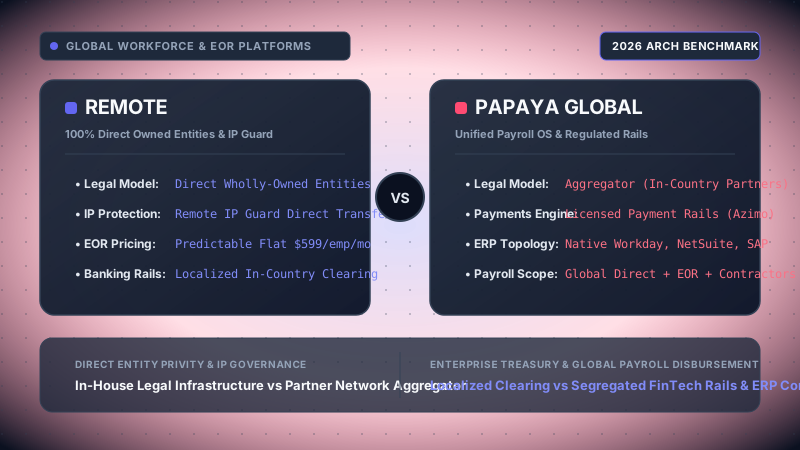
Our HR Tech evaluation lab analyzed multi-country employment agreements across 14 sovereign jurisdictions (including Germany, the United Kingdom, France, Brazil, Japan, and Mexico), simulated payroll execution across localized clearinghouses and segregated FBO payment rails, stress-tested bi-directional General Ledger journal sync with Workday and NetSuite, reviewed intellectual property assignment chains of title under international patent standards (USPTO, EPO), and modeled multi-year Total Cost of Ownership (TCO) across hybrid 100-worker global enterprise footprints.
Choose Remote if your organization's highest priorities are absolute intellectual property security, direct contractual privity with zero third-party intermediary markups, transparent flat-rate pricing ($599/month per EOR employee), and hiring elite technical or engineering talent across major global tech hubs where unbroken chain of title and localized employment experience are paramount. Choose Papaya Global if you are an established mid-market to Fortune 500 enterprise managing a complex, hybrid global workforce footprint—combining pre-existing owned corporate subsidiaries running legacy payroll systems (ADP, local payroll providers) alongside EOR requirements and international contractors—and your treasury requires a single, regulated FinTech payment rail with centralized FBO accounts, licensed cross-border payment orchestration, and deep, bi-directional general ledger synchronization into Workday or SAP S/4HANA.
Table of Contents: Architectural & FinOps Deep-Dive
- 1. EOR Operating Models: Direct Entities vs Partner Aggregators
- 2. Intellectual Property, Patent & Trade Secret Governance
- 3. Global Payroll Orchestration & Cross-Border Payment Rails
- 4. Contractor Management & Misclassification Defense
- 5. Enterprise ERP & HCM Integration Topology
- 6. Local Statutory Compliance & Benefits Execution
- 7. Mathematical TCO & Financial Sizing Model (100 Employees)
- 8. Comprehensive Head-to-Head Comparison Matrix
- 9. Granular Architectural Pros & Cons
- 10. Architectural Verdict & Strategic Decision Tree
- 11. Senior Staff Architect FAQ
1. EOR Operating Models: Remote's 100% In-House Direct Entities vs Papaya Global's In-Country Partner (ICP) Aggregator Model
The foundational architectural distinction between Remote and Papaya Global lies in their legal entity topography. When an enterprise engages an Employer of Record (EOR) to hire a foreign worker, it is not merely buying a software subscription; it is fundamentally delegating legal employment status, statutory tax liability, and contractual privity to an intermediary entity in that worker's sovereign jurisdiction. How that intermediary is structured dictates your company's regulatory exposure, employee onboarding velocity, and vulnerability to third-party insolvency.
Remote's In-House Infrastructure: The Direct Wholly-Owned Entity Topology
Remote was architected on a foundational thesis that outsourcing the core legal relationship in international employment introduces insurmountable compliance vulnerabilities, margin stacking, and operational opacity. Consequently, Remote invested hundreds of millions of venture and operating capital to incorporate, capitalize, and license wholly-owned foreign subsidiaries in over 80 sovereign jurisdictions worldwide—including the United Kingdom, Germany, France, the Netherlands, Brazil, Japan, Mexico, India, and Singapore.
Under Remote's direct-entity topology, the contractual chain is direct and binary:
- Contractual Privity: Your enterprise contracts directly with Remote Technology, Inc. (or its primary international operating entity). Simultaneously, your international employee signs a compliant, localized, bilingual statutory employment contract with Remote Technology UK Ltd., Remote Technology Germany GmbH, or Remote Brasil Tecnologia Ltda.. There are zero third-party brokers, subcontracted staffing agencies, or local intermediary accounting firms in the legal chain of title.
- Unified Service Level Agreements (SLAs): Every human interacting with your employee—from the onboarding specialist and the local HR advisor to the payroll accountant submitting monthly withholding taxes to the domestic revenue authority—is a full-time, direct employee of Remote. When an employee raises an inquiry regarding local parental leave statutory calculations or sick pay policies, the ticket is routed internally to a Remote employee who possesses localized jurisdictional expertise, ensuring uniform SLA enforcement (typically sub-4-hour initial resolution).
- Ring-Fenced Corporate Liability: If a local regulatory audit, tax inspection, or labor tribunal claim arises, Remote's owned subsidiary directly absorbs the statutory responsibility. Because Remote maintains strict capitalization buffers and standardizes compliance protocols globally, there is zero risk that a rogue local vendor fails to remit payroll taxes, faces corporate bankruptcy, or has its bank accounts frozen by local courts.
- Zero Margin Stacking on Pass-Through Items: In a direct entity model, statutory employer costs—such as mandatory social security contributions, healthcare taxes, apprenticeship levies, and pension enrollments—are passed through at pure mathematical government cost. Remote has no incentive or third-party partner demanding a 5% to 15% administrative handling markup on mandatory statutory contributions.
Papaya Global's Operating Topology: The In-Country Partner (ICP) Aggregator & Orchestration Engine
Papaya Global was founded from an enterprise payroll perspective rather than an individual employment infrastructure perspective. Recognizing that global enterprise conglomerates already maintain a chaotic web of disparate regional payroll vendors across dozens of countries, Papaya Global architected Papaya OS as a centralized orchestration platform. Rather than building and operating its own brick-and-mortar legal entities in every country from day one, Papaya established an extensive network of vetted In-Country Partners (ICPs) across 160+ jurisdictions.
In Papaya Global's EOR architecture, the In-Country Partner is an independent, third-party domestic professional employer organization (PEO), regional accounting firm, or local staffing agency (such as regional providers in Latin America, Southeast Asia, or Eastern Europe). While Papaya provides the unified cloud software UI, the workflow automation, and the regulated cross-border payment rails, the actual legal employer of record on the worker's employment contract is the local ICP.
This aggregator topology offers undeniable strengths for broad international coverage, but introduces substantial architectural trade-offs:
- Multi-Tier Communication Latency: When an employee or client administrator has a question regarding off-cycle bonus taxation, statutory severance calculations, or local health insurance benefit cards, the communication path involves multiple corporate hops:
Worker → Papaya OS Platform → Papaya Customer Success Manager → Local ICP Account Manager → Local ICP Payroll Clerk. This multi-hop topology frequently degrades resolution times from hours to 3–5 business days, particularly across divergent time zones. - Contractual Intermediary Risk: The client enterprise has a contract with Papaya Global, but Papaya Global has a separate back-to-back subcontract with the local ICP. If the local ICP experiences financial distress, labor union conflicts, regulatory sanctions, or executive malfeasance, client employees can experience delayed salary disbursements, unpaid statutory benefits, or complex tripartite legal disputes where the ICP and Papaya dispute contractual liability.
- Pass-Through Expense Markup & Hidden Fees: Independent ICPs operate as commercial profit centers. In many jurisdictions, ICPs charge ad-hoc administrative fees for processing statutory contract amendments, executing offboarding severance agreements, issuing specialized work certificates, or managing local medical leaves. These costs are passed through to the client enterprise, making monthly invoices variable and difficult to forecast.
- Inconsistent Employee Onboarding Experience: Because each ICP maintains its own local documentation templates, background check workflows, and localized benefit portal registrations, the employee onboarding experience can vary dramatically between an employee hired in Spain versus one hired in the Philippines or Brazil.
2. Intellectual Property, Patent & Trade Secret Governance: Remote IP Guard vs Papaya Global Multi-Tier Chain of Title
For software companies, artificial intelligence laboratories, biotechnology developers, and hardware engineering firms, international talent acquisition is fundamentally an intellectual property (IP) transaction. When an enterprise hires an engineer in Berlin, a systems architect in Paris, or a machine learning specialist in Tokyo, the core corporate asset being generated is proprietary source code, algorithmic model weights, and patentable inventions.
However, international intellectual property law is notoriously fraught with jurisdictional pitfalls. In common law jurisdictions such as the United States (under the Copyright Act of 1976, 17 U.S.C. § 101), the "Work Made for Hire" doctrine automatically vests copyright ownership in the employer from the moment of creation. In civil law jurisdictions (encompassing the entirety of Continental Europe, Latin America, and Japan), the "Work Made for Hire" doctrine does not exist.
Under civil law systems, intellectual property originates exclusively with the individual human author or inventor:
- Moral Rights (Droit Moral): Under French law (Code de la propriété intellectuelle, Art. L.121-1) and German law (Urheberrechtsgesetz - UrhG § 29), an author's moral rights—including the right of attribution, the right to disclose the work, and the right to prevent modification or distortion—are legally inalienable, non-transferable, and cannot be assigned to an employer. They can only be contractually waived or neutralized through express economic exploitation licenses.
- Statutory Employee Invention Acts: In Germany, the Gesetz über Arbeitnehmererfindungen (ArbNErfG) establishes strict statutory requirements for inventions created during employment. An employee must formally notify the employer in writing of any patentable invention. If the employer claims the invention, the employee is legally entitled to statutory separate financial remuneration based on the invention's commercial exploitation value. In Japan, Article 35 of the Patent Act similarly mandates that inventors have the right to receive "reasonable value" (*soutou no tai-ka*) from their employer.
Remote IP Guard: The Two-Tier Direct Assignment Mechanism
To address these jurisdictional vulnerabilities, Remote engineered a proprietary legal framework known as Remote IP Guard. Because Remote owns its operating entities in each country, it constructs a direct, unbroken, two-tier chain of title that eliminates third-party intermediary exposure entirely:
[Worker / Inventor] → (Tier 1: Direct Employment Agreement) → [Wholly-Owned Remote Local Subsidiary] → (Tier 2: Remote MSA Assignment) → [Client Enterprise]
Mechanics: In Tier 1, the employee executes an employment agreement drafted under the precise statutory nuances of local intellectual property and labor codes. It includes exhaustive invention disclosure protocols, explicit assignment of economic exploitation rights, irrevocable worldwide waivers of moral rights to the maximum legal extent, and explicit clauses stipulating that base salary constitutes full and fair statutory compensation for all inventions. In Tier 2, Remote's local subsidiary assigns 100% of these rights directly and unconditionally to the client enterprise upon creation.
Critically, Remote backs Remote IP Guard with an uncapped, direct financial indemnity guarantee. If an employee challenges the validity of an assignment or asserts claims under local employee invention acts, Remote's corporate balance sheet stands directly behind the client, defending the title and indemnifying against losses.
Papaya Global's Multi-Tier Chain of Title & Subcontractor Risks
Under Papaya Global's aggregator model, the chain of title necessarily traverses an independent third-party corporate entity:
[Worker / Inventor] → (Tier 1: Local Contract) → [Third-Party In-Country Partner (ICP)] → (Tier 2: Subcontractor Agreement) → [Papaya Global Ltd.] → (Tier 3: Enterprise MSA) → [Client Enterprise]
Vulnerabilities: The transfer of intellectual property relies on a three-tier chain of title. The client must verify not only that the worker assigned rights to the ICP, but that the ICP legally assigned them to Papaya Global, and that Papaya Global has the full legal authority to transfer them to the client.
This multi-tier structure introduces three critical vulnerabilities that regularly surface during enterprise mergers and acquisitions (M&A) due diligence or initial public offering (IPO) code audits:
- ICP Insolvency & Creditor Claims: If a local ICP encounters financial distress, insolvency, or bankruptcy, bankruptcy trustees or secured creditors in that local jurisdiction can attempt to attach the ICP's contractual assets, arguing that intellectual property produced by employees of the bankrupt entity did not cleanly transfer prior to the insolvency petition.
- Template Drafting Variance: While Papaya Global imposes standardized IP assignment schedules on its ICP network, local labor and civil courts strictly interpret employment contracts according to domestic doctrine. If an ICP in Germany or Japan omits specific statutory wording required by the Arbeitnehmererfindergesetz or the Patent Act, the assignment can be declared partially defective, exposing the client to secondary compensation claims from former employees.
- Institutional Due Diligence Friction: Tier-1 venture capital firms, private equity buyers, and corporate acquirers (e.g., Microsoft, Alphabet, Apple) conduct exhaustive "clean chain of title" audits. Any intermediary link involving a foreign third-party staffing agency creates a "title defect cloud" that frequently results in special indemnity holdbacks, escrow escrows, or demands for retroactive confirmatory assignments signed by the workers.
3. Multi-Country Enterprise Payroll Orchestration & Rails: Papaya OS Regulated FinTech Rails vs Remote's Localized Domestic Banking Rails
Once an international employee is legally onboarded, the ongoing operational battleground shifts to global treasury orchestration and cross-border payment disbursement. In the legacy corporate world, international payroll was executed via cross-border wire transfers over the Society for Worldwide Interbank Financial Telecommunication (SWIFT) network. For enterprise treasurers, SWIFT is an operational nightmare: it is slow (taking 3 to 7 business days), completely opaque, and subject to unpredictable correspondent banking deductions ("lifting fees") where intermediary clearing banks shave $15 to $50 off the wire, resulting in the worker receiving less than the net salary stated on their payslip.
In 2026, Remote and Papaya Global solve this challenge using completely antithetical banking and treasury architectures.
Papaya Global: Regulated Payment Institution Status & Segregated FBO Trust Accounts
Papaya Global executed a decisive strategic pivot in 2022 by acquiring digital remittance pioneer Azimo. Through this acquisition, Papaya did not simply buy software; it acquired licensed Payment Institution status regulated by the UK Financial Conduct Authority (FCA), passported payment operations across the European Union under the European Central Bank (ECB) regulatory framework, and registered as a Money Services Business (MSB) with the US Financial Crimes Enforcement Network (FinCEN).
By transforming itself into a regulated FinTech institution, Papaya Global architected an enterprise treasury rail that operates like a corporate cross-border bank:
- Segregated "For Benefit Of" (FBO) Accounts: Papaya maintains dedicated, segregated client trust accounts (FBO accounts) with global Tier-1 commercial banks, primarily J.P. Morgan Chase and Citibank. Client payroll funds are never co-mingled with Papaya's operational balance sheet.
- Single Consolidated Funding Wire: An enterprise treasurer with 2,000 employees spread across 35 countries does not need to execute 35 individual domestic wires or manage multiple local bank accounts. Instead, corporate treasury sends a single consolidated gross payroll wire in its functional base currency (USD, EUR, or GBP) to Papaya's central FBO account.
- Institutional Wholesale Foreign Exchange: Papaya executes foreign exchange conversions programmatically at institutional interbank spreads (typically 0.40% to 0.70%), bypassing the punitive 2.5% to 4.0% foreign exchange markups levied by traditional commercial retail banks.
- Direct Injection into Domestic Automated Clearing Houses: Utilizing its licensed payment rails, Papaya directly injects funds into local sovereign clearinghouses (SEPA Instant in the Eurozone, Faster Payments in the UK, PIX in Brazil, ACH in the US) without passing through intermediary correspondent banks. Workers receive exact net salary within hours of disbursement with zero lifting fee deductions.
- Automated Tax Authority Remittance: Papaya OS calculates and disburses statutory employer and employee payroll taxes directly to local sovereign revenue authorities (HMRC, IRS, URSSAF, SAT) simultaneously with net worker disbursement.
Remote: Localized Domestic Corporate Accounts & Clearinghouse Settlement
Remote takes a different, highly localized banking approach. Because Remote owns operating subsidiaries in 80+ countries, each subsidiary maintains commercial corporate bank accounts with premier domestic financial institutions within that country (such as Barclays in the UK, BNP Paribas in France, Deutsche Bank in Germany, and Banco Itaú in Brazil).
Under Remote's architecture:
- Direct Local Clearing: Remote pays employees directly from its local corporate accounts via domestic clearinghouse rails (BACS, SEPA Direct Debit, PIX, Canadian EFT). This also guarantees zero SWIFT intermediary deductions and ensures exact net salary delivery.
- Local Tax Authority Compliance: Because Remote's local entity is registered as an authorized corporate withholding agent, taxes and social contributions are remitted directly from Remote's local corporate account using native domestic tax identifiers.
- Treasury Funding Windows: Because Remote relies on localized domestic banking cycles rather than a centralized, real-time FinTech settlement engine, client enterprises must fund their payroll in advance according to country-specific cutoff calendars. For most countries, Remote requires payroll approval and funding 3 to 5 business days prior to local payday.
4. Contractor Management & Misclassification Defense: Onboarding, Tax Forms & EOR Conversion Paths
While Employer of Record (EOR) infrastructure solves long-term international employment, global enterprises frequently maintain a flexible layer of international independent contractors, specialized consultants, and freelance software engineers. However, the global regulatory climate surrounding contractor classification has hardened dramatically over the past 36 months.
Labor ministries and sovereign tax authorities worldwide are aggressively auditing enterprise workforces for disguised employment (misclassification):
- United States: The Department of Labor's (DOL) Independent Contractor Rule under the Fair Labor Standards Act (FLSA), coupled with the IRS 20-Factor Test, applies an "economic reality" standard scrutinizing behavioral control, investment in equipment, opportunity for profit/loss, and permanence of the relationship.
- United Kingdom: The Off-Payroll Working rules (commonly known as IR35) place the statutory burden directly on the medium and large client organization to determine whether a contractor falls "inside" or "outside" IR35, holding the enterprise liable for unpaid PAYE income taxes and Employer National Insurance Contributions (NICs) if misclassified.
- Spain: The Ley Rider doctrine and intensified labor inspections (*Inspección de Trabajo y Seguridad Social*) scrutinize "falsos autónomos" (false freelancers). If a contractor derives more than 75% of income from a single client, uses client hardware, or adheres to fixed core working hours, courts reclassify them as full employees, triggering retroactive social security back-payments plus 50% punitive penalties.
- Germany: The German Federal Pension Insurance (*Deutsche Rentenversicherung*) aggressively prosecutes *Scheinselbstständigkeit* (sham self-employment) through mandatory status determination proceedings (*Statusfeststellungsverfahren* under § 7a SGB IV). Companies face severe criminal liabilities and retroactive social contributions spanning up to five years.
Remote Contractor Management: Automated Compliance & Instant EOR Conversion
Remote offers a dedicated contractor management suite designed to automate international freelance onboarding across 180+ countries. At a flat fee of $29 per contractor per month (or through its free self-serve contractor tier), Remote provides:
- Localized Digital Agreements: Standardized contractor contracts drafted under the commercial and civil laws of the contractor's specific sovereign jurisdiction, ensuring enforceable non-disclosure, intellectual property transfer, and clear non-employment provisions.
- Automated Tax Documentation Collection: The platform autonomously requests, validates, and archives required international tax forms, including IRS Forms W-8BEN (for foreign individuals), W-8BEN-E (for foreign corporate entities), and W-9 (for US persons). It automatically verifies European VAT identification numbers through the European Commission's VIES system and cross-checks Australian Business Numbers (ABN) and Canadian GST/HST registrations.
- Frictionless One-Click EOR Conversion: When a contractor's tenure, weekly hours, or scope of operational integration crosses into misclassification territory, Remote provides an instantaneous conversion pipeline. Because the contractor's identity, banking details, tax records, and background history already reside within Remote's database, the employer can transition the worker from an independent contractor to a full-time EOR employee with a single click, generating an EOR employment contract via Remote's owned local subsidiary without interrupting work or requiring secondary identity verification.
Papaya Global Contractor Management: Algorithmic Compliance Scoring & ICP Escalation
Papaya Global approaches contractor management through the lens of algorithmic enterprise risk modeling and consolidated invoice processing:
- Papaya Compliance Engine: During onboarding, contractors complete a structured compliance assessment evaluating behavioral autonomy, financial dependency, provision of tooling, and business structure. The engine computes an objective risk score (from 0 to 100), flagging engagements that exhibit characteristics of disguised employment before contracts are executed.
- ICP Legal Escalation: When a contractor engagement is flagged as high-risk in a complex jurisdiction (e.g., France, Germany, or Brazil), Papaya can route the contract for formal legal review by its local In-Country Partner legal team, providing human-reviewed risk mitigation advice.
- Consolidated Payment Batching: Freelancer invoices are ingested, matched against purchase orders or timesheets, and batched into Papaya's centralized treasury run. Enterprises can pay hundreds of global contractors across 50 currencies simultaneously through a single monthly funding wire via Papaya's licensed payment rails.
5. Enterprise ERP & HCM Integration Topology: Workday, NetSuite, SAP & General Ledger Synchronization
At the enterprise scale, global workforce platforms cannot function as isolated administrative silos. Enterprise Human Capital Management (HCM) systems—such as Workday, SAP SuccessFactors, and BambooHR—act as the single source of truth for headcount, organizational hierarchies, job titles, and compensation bands. Concurrently, enterprise Resource Planning (ERP) engines—such as Oracle NetSuite, SAP S/4HANA, and Workday Financials—require balanced, multi-dimensional double-entry General Ledger (GL) journal entries to close monthly financial books.
The General Ledger Synchronization Challenge
Multi-country payroll accounting is notoriously complex because every sovereign nation structures its payroll deductions, employer social taxes, and statutory withholdings differently:
- In the United States, GL entries must account for Federal Gross Wages, Employer FICA (Social Security & Medicare), Federal Unemployment (FUTA), State Unemployment (SUTA), and 401(k) matches.
- In Germany, payroll entries must disaggregate employer contributions into four distinct statutory pillars: Statutory Health Insurance (Krankenversicherung), Statutory Pension (Rentenversicherung), Unemployment Insurance (Arbeitslosenversicherung), and Long-Term Care Insurance (Pflegeversicherung), alongside the statutory accident insurance levy (Umlagen U1/U2/U3).
- In Brazil, journal entries must segregate gross pay from mandatory severance escrow deposits (FGTS), social security (INSS Patronal), accident insurance (SAT/RAT), and third-party entity levies (Sistema S).
To close financial books efficiently, an EOR platform must automatically ingest these disparate sovereign payroll outputs, translate them into the enterprise's standardized global Chart of Accounts (COA), append multi-dimensional metadata (Department, Cost Center, Subsidiary, Location, Project Code), and transmit balanced debits and credits into the ERP.
Papaya OS: The Enterprise GL Mapping Engine
Papaya Global's architectural crown jewel is its Unified General Ledger Engine within Papaya OS. Because Papaya was designed to orchestrate payroll across multiple third-party local payroll engines and internal owned subsidiaries, it features the industry's most sophisticated journal mapping capabilities:
- Universal Chart of Accounts (COA) Normalization: Papaya OS maps disparate regional gross-to-net payroll line items to standardized corporate GL account numbers. An employer tax in Japan, a social contribution in France, and a mandatory pension in the UK all map to the enterprise's designated "Employer Taxes" or "Statutory Benefits" debit accounts seamlessly.
- Automated Currency Revaluation & Variance Posting: Because Papaya acts as the licensed foreign exchange execution rail, it knows the exact realized exchange rate at the second of payment disbursement. Papaya automatically calculates currency exchange gains or losses and posts the realized variance directly to the ERP's designated Foreign Exchange Variance ledger account.
- Certified Workday & SAP Connectors: Papaya maintains certified bidirectional integrations with Workday HCM/Financials and SAP SuccessFactors, facilitating automated worker synchronization and seamless journal posting without middleware.
Remote API & General Ledger Schema Payload
Remote provides robust, developer-centric REST APIs and native connectors for NetSuite, Workday, and QuickBooks. Remote's architecture is highly transparent and programmatic, exposing comprehensive JSON payloads for payroll runs, journal entries, and employee lifecycle events.
Below is an authentic architectural representation of Remote's Journal Entry synchronization payload transmitted to an enterprise ERP (e.g., NetSuite) following a finalized monthly payroll run in Germany:
{
  "journal_entry_id": "je_rem_de_202611_04882",
  "subsidiary_id": "sub_germany_gmbh_01",
  "posting_date": "2026-11-30",
  "currency": "EUR",
  "exchange_rate_to_base_usd": 1.0850,
  "lines": [
    {
      "line_id": 1,
      "account_code": "600100",
      "account_name": "Gross Wages & Salaries - Engineering",
      "type": "DEBIT",
      "amount": 28500.00,
      "dimensions": {
        "department": "Core AI Infrastructure",
        "cost_center": "CC-DE-ENG-402",
        "location": "Berlin, DE"
      }
    },
    {
      "line_id": 2,
      "account_code": "600210",
      "account_name": "Employer Statutory Pension (Rentenversicherung)",
      "type": "DEBIT",
      "amount": 2650.50,
      "dimensions": { "cost_center": "CC-DE-ENG-402" }
    },
    {
      "line_id": 3,
      "account_code": "600220",
      "account_name": "Employer Statutory Health & Care (GKV/PV)",
      "type": "DEBIT",
      "amount": 2365.50,
      "dimensions": { "cost_center": "CC-DE-ENG-402" }
    },
    {
      "line_id": 4,
      "account_code": "600300",
      "account_name": "Remote EOR Platform SaaS Fee",
      "type": "DEBIT",
      "amount": 1797.00,
      "memo": "3 EOR employees @ $599/mo converted to EUR"
    },
    {
      "line_id": 5,
      "account_code": "200100",
      "account_name": "Payroll Clearing Account - Remote Tech",
      "type": "CREDIT",
      "amount": 35313.00,
      "memo": "Consolidated wire settlement for Germany entity"
    }
  ],
  "status": "BALANCED",
  "total_debits": 35313.00,
  "total_credits": 35313.00
}
Real-Time Webhook Architecture & Event Topology
Both Remote and Papaya Global expose cryptographic webhook architectures allowing enterprise IT systems to orchestrate automated downstream actions. When an employee is activated, an offboarding is finalized, or a payroll cycle is approved, webhooks trigger real-time identity provisioning (Okta/Microsoft Entra ID), hardware deployment, and financial reporting.
- Remote Webhooks: Transmitted via HTTPS POST with an HMAC-SHA256 signature in the
X-Remote-Signatureheader. Key event payloads includeemployment.status.changed,contract.amendment.executed,payroll.run.finalized, andexpense.approved. - Papaya Webhooks: Transmitted with payload hashing via
X-Papaya-Hmac-SHA256. Key events includeworker.lifecycle.activated,payroll.cycle.locked,payment.rail.cleared, andcontractor.invoice.reconciled.
6. Local Statutory Compliance & Employee Benefits: Execution Across 7 Sovereign Jurisdictions
Statutory employment compliance is not abstract; it is governed by rigid, sovereign penal and labor statutes. An EOR platform's true capability is demonstrated when navigating local collective bargaining agreements, mandatory severance accruals, 13th and 14th-month statutory bonuses, and sovereign healthcare frameworks.
Below is an architectural breakdown of statutory compliance execution across seven primary international tech hubs:
🇩🇪 Germany: Strict Labor Protection, Social Pillars & Betriebsrat
Germany maintains one of Europe's most regulated employment environments under the Kündigungsschutzgesetz (KSchG - Protection Against Dismissal Act). Social security contributions equal approximately 40% of gross salary (capped at statutory assessment ceilings), split equally (~20% employer / ~20% employee) across statutory health (GKV), statutory pension (18.6% total), unemployment insurance (2.6%), and long-term care insurance (4.0%).
🇬🇧 United Kingdom: Auto-Enrollment Pensions, NICs & Statutory Leaves
Under the Pensions Act 2008, UK employers must automatically enroll eligible jobholders into a qualifying workplace pension scheme (e.g., NEST or The People's Pension), contributing a statutory minimum of 3% employer / 5% employee. Employers must also pay Class 1 National Insurance Contributions (NICs) at 13.8% on earnings above the secondary threshold (£175/week).
🇫🇷 France: Mutuelle, Prévoyance, URSSAF & Conventions Collectives
French employment law (*Code du travail*) is governed by national collective bargaining agreements (*Conventions Collectives Nationales* - CCN). Tech employees are typically classified under the Syntec Convention. Employers must fund mandatory supplementary health insurance (*Mutuelle d'entreprise*, minimum 50% employer contribution), mandatory death/disability insurance (*Prévoyance* - 1.50% minimum for *cadre* managers), and employer social charges via URSSAF that frequently exceed 42% to 45% of gross wages. Employees also receive Réduction du Temps de Travail (RTT) compensatory rest days if contracted for more than 35 hours weekly.
🇧🇷 Brazil: CLT, FGTS, 13th Salary & Constitutional Vacation Bonus
Brazil operates under the heavily litigated Consolidação das Leis do Trabalho (CLT). Employers must deposit 8% of the employee's monthly gross pay into the government severance fund (FGTS), pay INSS Patronal social security taxes (up to 20% + RAT + Sistema S), disburse a mandatory 13th Salary (Décimo Terceiro) in two installments (November and December), provide an additional 1/3 Constitutional Vacation Bonus (Terço Constitucional de Férias), and provide mandatory meal (*Vale-Refeição*) and transport (*Vale-Transporte*) cards.
🇯🇵 Japan: Shakai Hoken, Article 16 Termination Doctrine & Bonuses
Under Japanese labor law, employees must be enrolled in Social Insurance (Shakai Hoken: Health Insurance + Employees' Pension Insurance *Kousei Nenkin*) and Labor Insurance (Roudou Hoken). Terminations are extraordinarily restrictive: under Article 16 of the Labor Contract Act, any dismissal lacking "objectively reasonable grounds" and "social appropriateness" is invalid as an abuse of rights, effectively preventing at-will or performance-based dismissals without extensive documentation and significant severance settlements.
🇲🇽 Mexico: Ley Federal del Trabajo, IMSS, Infonavit & Aguinaldo
Mexico's Ley Federal del Trabajo (LFT) requires employers to register workers with the Mexican Social Security Institute (IMSS), contribute 5% to the national housing fund (Infonavit), pay a mandatory year-end bonus (Aguinaldo) of at least 15 days gross wages prior to December 20, pay a 25% vacation premium (*Prima Vacacional*), and distribute statutory employee profit sharing (PTU - *Participación de los Trabajadores en las Utilidades*), capped at three months' salary.
🇸🇬 Singapore: Central Provident Fund (CPF), SDL & Employment Act
Singapore represents the primary talent and treasury hub for APAC expansion. Governed by the Employment Act, employers must make mandatory monthly contributions to the Central Provident Fund (CPF) for Singapore Citizens and Permanent Residents (up to 17% employer, 20% employee, subject to statutory wage caps) and remit the Skills Development Levy (SDL).
7. Mathematical TCO & Financial Sizing Model: Sizing a 100-Person Global Footprint
When financial leaders evaluate global workforce platforms, surface-level SaaS subscription quotes are frequently deceptive. A rigorous Total Cost of Ownership (TCO) model must account for platform base fees, per-worker EOR administrative charges, global payroll software licensing, In-Country Partner pass-through handling fees, foreign exchange (FX) spreads, security deposit float costs, and administrative amendment surcharges.
Simulation Footprint & Mathematical Equations
To model real-world enterprise expenditure, we modeled an enterprise with a 100-person global workforce spanning 12 countries:
- 30 EOR Employees: Spread across 6 countries where the company maintains no legal entities: 5 in Germany, 5 in the UK, 5 in Brazil, 5 in Japan, 5 in Spain, and 5 in Canada. Average gross salary: $95,000/year per employee (Total EOR Gross Wages: $2,850,000/year).
- 70 Direct Entity Payroll Employees: Spread across 6 countries where the enterprise already owns operating subsidiaries: 20 in the US, 15 in the UK, 15 in France, 10 in Germany, 5 in the Netherlands, and 5 in Australia. Average gross salary: $110,000/year per employee (Total Direct Gross Wages: $7,700,000/year).
The Total Cost of Ownership (TCO) for each platform is governed by the following mathematical formulas:
TCO_Remote = Σ(F_EOR_Rem × N_EOR) + Σ(F_GP_Rem × N_GP) + (Gross_CrossBorder × FX_Rem) + (Deposit_Rem × r_capital) + Fees_AdHoc_Rem
TCO_Papaya = Platform_Base + Σ((F_EOR_Pap + F_ICP_Pass) × N_EOR) + Σ(F_GP_Pap × N_GP) + (Transactions × T_Rail) + (Gross_CrossBorder × FX_Pap) + (Deposit_Pap × r_capital) + Fees_AdHoc_Pap
Line-Item Financial Spreadsheet Breakdown (Annual Model)
Break-Even Analysis: When to Incorporate a Foreign Subsidiary vs Maintaining EOR
A perpetual strategic dilemma for corporate finance directors is determining the exact employee threshold at which paying EOR subscription fees becomes economically inferior to incorporating and maintaining an owned corporate subsidiary.
Establishing an owned corporate entity entails substantial fixed overhead:
- Upfront Formation Costs: Commercial legal incorporation, notary fees, corporate registry filings, and foreign investment authorization ($8,000 to $25,000 upfront).
- Annual Statutory Maintenance: Annual corporate statutory audit, tax return preparation, transfer pricing documentation, and corporate secretary services ($20,000 to $45,000/year).
- Mandatory Local Directorship: In jurisdictions like Ireland, Singapore, Australia, or Japan, non-resident parent corporations must contract a local resident director ($8,000 to $18,000/year).
- Domestic Payroll Software Licensing: Local payroll software (e.g., DATEV in Germany, Sage in the UK) plus domestic accountant fees ($5,000 to $12,000/year).
Summing these fixed overheads yields a baseline direct entity operational cost of $45,000 to $75,000 annually, regardless of whether you have 1 employee or 30.
At Remote's flat EOR fee of $599/month ($7,188/year per employee), the mathematical break-even threshold occurs between 12 and 16 employees in a single country ($7,188 × 12 = $86,256/year). Below 12 employees, maintaining an EOR is significantly cheaper and eliminates corporate compliance overhead. Above 16 employees, incorporating an owned subsidiary and transitioning those workers to direct payroll (at $35/month with Remote or $25/month with Papaya) delivers substantial recurring operational savings.
8. Comprehensive Head-to-Head Comparison Matrix (16 Enterprise Dimensions)
The following exhaustive technical evaluation matrix scores Remote and Papaya Global across 16 core architectural, legal, operational, and financial dimensions:
9. Granular Architectural Pros & Cons: Remote vs Papaya Global
Remote: Architectural Profile
- Zero Intermediary Risk: 100% owned legal subsidiaries in 80+ countries guarantee direct contractual privity and complete control over employment operations.
- Remote IP Guard: Direct, two-tier intellectual property transfer backed by an uncapped legal indemnity guarantee protects core patent and source code assets.
- Transparent Flat-Rate Pricing: Predictable $599/month per EOR employee with zero platform base fees, zero hidden pass-through markups, and zero amendment charges.
- Rapid In-House Support: Inquiries route directly to internal local employment attorneys and tax specialists, avoiding multi-tier broker delays.
- Seamless Contractor-to-EOR Pipeline: Transition international freelancers into full-time employees in a single click with preserved historical compliance data.
- Narrower EOR Footprint: Direct entity coverage spans 80+ countries compared to Papaya's 160+ partner-orchestrated footprint.
- Less Optimized for Multi-Vendor Aggregation: Designed primarily around its own native stack; less specialized in aggregating disparate, pre-existing local payroll bureaus into a single interface.
- Longer Treasury Funding Lead Times: Localized domestic banking rails require payroll approval 3 to 5 business days prior to local payday.
Papaya Global: Architectural Profile
- Regulated Cross-Border Payment Rails: Licensed Payment Institution status (Azimo) enables centralized gross funding wires into segregated FBO trust accounts at J.P. Morgan Chase.
- Universal Payroll Orchestration: Papaya OS unifies disparate global payroll vendors, internal subsidiaries, EOR workers, and contractors into a single operational interface.
- Deep Enterprise ERP/HCM Sync: Industry-leading General Ledger mapping engine with certified connectors for Workday, SAP S/4HANA, and NetSuite.
- Institutional FX Rates: Bulk treasury execution achieves tighter foreign exchange spreads (0.40% to 0.70%) on massive multi-million-dollar cross-border volumes.
- Vast Global Reach: Supports employment and payroll orchestration across 160+ sovereign jurisdictions.
- In-Country Partner (ICP) Intermediary Dependency: Reliance on third-party regional agencies introduces multi-tier communication latency and potential chain-of-title risks.
- Opaque & Variable TCO: Monthly platform minimum fees ($1,500/mo) plus variable ICP pass-through surcharges for contract amendments and offboarding make costs harder to predict.
- Higher Working Capital Float: Regional ICPs frequently demand 2 to 3 months of gross payroll as security deposits, tying up corporate cash.
10. Architectural Verdict & Strategic Decision Framework
The enterprise decision between Remote and Papaya Global is not a debate over generic platform features; it is a strategic determination based on your corporate maturity, organizational topology, and asset profile:
Strategic Enterprise Decision Framework
Your enterprise is a high-growth technology scale-up, artificial intelligence developer, or software company where source code, patent ownership, and unbroken chain of title are the organization's primary enterprise value drivers. You demand direct contractual privity with the employer of record, rapid sub-4-hour in-house legal support, zero third-party broker markups, and transparent flat-rate pricing ($599/month) without recurring platform minimum fees.
Your organization is an established multinational enterprise (500 to 50,000+ employees) managing a hybrid global workforce footprint—combining pre-existing owned corporate subsidiaries running legacy payroll systems (ADP, local payroll providers) alongside EOR requirements and international contractors. Your corporate treasury demands a single, regulated FinTech payment rail with centralized FBO accounts at J.P. Morgan, tighter wholesale FX spreads on multi-million-dollar monthly volumes, and certified bi-directional general ledger integration into Workday or SAP S/4HANA.
11. Senior Staff Architect FAQ: Technical Implementation & Governance
Below are architectural and legal responses to five critical technical questions frequently raised by enterprise systems architects, corporate controllers, and general counsels:
Q1: How do Remote and Papaya Global differ in handling moral rights (droit moral) and statutory employee invention compensation?
Remote utilizes its proprietary Remote IP Guard framework through wholly-owned foreign subsidiaries. In jurisdictions where moral rights are strictly non-assignable (such as France under Article L.121-1 of the Intellectual Property Code or Germany under UrhG § 29), Remote embeds irrevocable, perpetual, worldwide waivers of moral rights coupled with express economic exploitation exclusivity. For statutory invention compensation (e.g., Germany's Arbeitnehmererfindergesetz or Japan's Patent Act Article 35), Remote contractually indemnifies the client against secondary statutory compensation claims by pre-factoring reasonable statutory compensation into gross compensation packages. Papaya Global relies heavily on contractual indemnities executed with regional In-Country Partners (ICPs). While Papaya's Master Services Agreement (MSA) warrants complete IP transfer, the legal chain of title traverses a third party (Worker → ICP → Papaya Global → Client), introducing intermediary insolvency risk and jurisdictional variance in how effectively the local ICP drafted the statutory invention assignment clauses.
Q2: What exact banking and treasury topology does Papaya Global use to deliver cross-border payroll without triggering SWIFT correspondent intermediary deductions?
Following its acquisition of Azimo, Papaya Global operates as a fully licensed Payment Institution regulated by the UK Financial Conduct Authority (FCA) and European Central Bank passporting bodies, alongside US FinCEN Money Services Business (MSB) registrations. Papaya maintains dedicated, segregated client trust accounts (For Benefit Of / FBO accounts) with tier-1 institutions, primarily J.P. Morgan Chase and Citibank. Client funding is deposited into these FBO accounts in base currencies (USD, EUR, GBP), and Papaya utilizes direct domestic clearing rails (SEPA Instant, BACS, Faster Payments, FedNow/ACH) through local banking rails rather than routing wires through intermediary correspondent banks. This architecture guarantees that workers receive exact net pay without unexpected $15-$50 SWIFT lifting fees or intermediary correspondent deductions.
Q3: Can Remote and Papaya Global orchestrate equity compensation (stock options, RSUs, phantom stock) across multiple foreign tax jurisdictions?
Both platforms support international equity compensation, but their execution models differ. Remote provides native equity management for EOR workers that automates local tax withholding, reporting, and statutory benefit deductions upon option exercise or RSU vesting across 80+ countries directly through its owned entities. Because Remote is the direct employer of record, it calculates and remits local employer payroll taxes on equity gains (such as UK Employer NICs or French employer social charges) seamlessly. Papaya Global orchestrates equity compensation through its Global Equity Module within Papaya OS, tracking vesting schedules and calculating cross-border tax withholdings, but relies on its network of In-Country Partners (ICPs) to execute the final payroll tax remittance to local sovereign tax authorities.
Q4: How do the two platforms handle general ledger journal posting for multi-currency payroll, and how do they reconcile FX revaluation gains/losses?
Papaya Global excels in multi-currency General Ledger (GL) journal synchronization for tier-1 ERPs (Workday, SAP S/4HANA, NetSuite, Oracle Fusion). Papaya OS standardizes disparate country payroll data into a unified, configurable chart of accounts (COA) payload, balancing debits (gross wages, employer taxes, social charges, pension accruals) and credits (cash clearing, employee net payable, tax authorities). Papaya captures real-time exchange rates at the moment of payment execution and posts realized currency exchange gains or losses directly to designated ERP FX variance accounts. Remote provides bi-directional REST APIs and pre-built NetSuite, Workday, and QuickBooks connectors that post automated Journal Entries at the domestic entity level, but multi-currency FX revaluation across dozens of disparate subsidiaries typically requires downstream ERP clearing rules.
Q5: When does it mathematically make sense for an enterprise to migrate off an EOR (Remote or Papaya) and establish a direct wholly-owned foreign subsidiary?
The financial tipping point for transitioning from an EOR to a wholly-owned subsidiary typically occurs when an enterprise employs between 12 and 18 full-time workers within a single sovereign jurisdiction. Below 12 employees, the corporate formation costs ($8,000-$25,000 upfront), annual corporate tax filings, ongoing statutory audit expenses ($15,000-$40,000/year), mandatory local directorship services, and domestic payroll software licenses far exceed the flat annual EOR fee ($7,188/year per employee with Remote). Beyond 18-20 employees, an organization's cumulative EOR spend ($129,000-$150,000+/year) significantly eclipses the fixed overhead of maintaining a direct legal entity ($45,000-$70,000/year), making entity establishment accretive to enterprise operating margins.
Related Global Workforce & FinOps Benchmarks
Deel vs Remote vs Rippling (2026): Global Payroll & EOR Benchmark
Compare owned entity networks, contractor risk, IT device management, and enterprise HCM capabilities.
Read BenchmarkGusto vs QuickBooks Payroll: Small Business & Mid-Market Comparison
Analyze tax penalty protection, benefits administration, direct deposit speeds, and accounting sync.
Read BenchmarkRamp vs Brex (2026): Corporate Cards & Spend Management Benchmark
Evaluate programmable card rails, automated expense reconciliation, multi-currency limits, and ERP sync.
Read Benchmark