Deel vs Rippling: Global Payroll & Workforce OS Benchmark (2026)
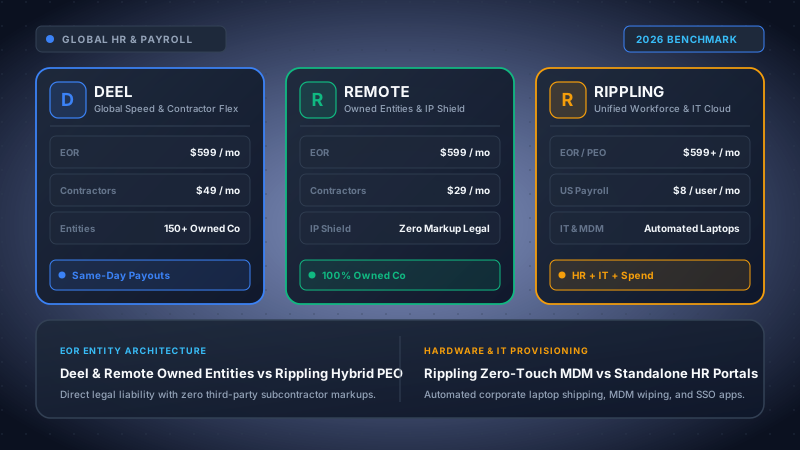
When engineering and finance executives architect a modern borderless workforce in 2026, the evaluation between Deel vs Rippling represents far more than a simple comparison between human resources portals. It is an architectural battle between two fundamentally divergent operating paradigms: Deel's global-first Employer of Record (EOR) infrastructure—anchored on 150+ owned sovereign corporate entities and specialized cross-border contractor treasury rails—versus Rippling's unified Workforce OS, which treats HR, identity management, zero-touch hardware provisioning (MDM), and enterprise spend management as a single computational graph. Navigating this technical divide requires examining statutory co-employment liability, permanent establishment risks, multi-currency clearing mechanics, and real-world multi-entity total cost of ownership (TCO).
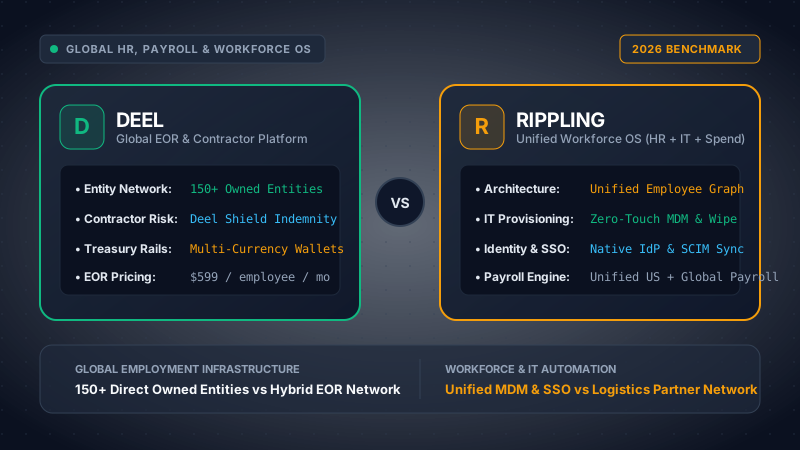
Our FinOps research lab simulated a 60-person distributed engineering organization operating across 6 foreign jurisdictions and 3 contractor regions. We evaluated API payload performance, automated SCIM provisioning latency, cross-border gross-to-net tax algorithms, local banking rails, and corporate indemnity structures across both platforms.
Choose Deel if your enterprise requires rapid international expansion without local entities, heavy contractor reliance across emerging tech hubs (LatAm, Eastern Europe, Southeast Asia), guaranteed misclassification indemnification via Deel Shield, and native worker financial tools like flexible multi-currency contractor wallets. Choose Rippling if your organization maintains a substantial US or multi-country domestic footprint and demands a single pane of glass uniting HR, domestic & global payroll, zero-touch Apple/Windows MDM hardware logistics, app access provisioning (SCIM SSO), and corporate spend management.
Architectural Table of Contents
- 1. Core Global Employment Architecture
- 2. Contractor Onboarding & Legal Indemnity
- 3. Multi-Currency Global Payroll & Treasury
- 4. Statutory Benefits & Labor Compliance
- 5. Cross-Border Equity & Stock Options
- 6. Unified Workforce OS & IT Provisioning
- 7. Mathematical 60-Person TCO Sizing Model
- 8. Head-to-Head Technical Matrix (18 Dims)
- 9. Granular Architectural Pros & Cons
- 10. Strategic Verdict & Decision Tree
- 11. Senior Staff Systems Architect FAQ
- 12. Next Steps & Related Benchmarks
1. Core Global Employment Architecture: Owned Entities vs Unified Employee Graph
The structural foundation of international employment software dictates how risk, intellectual property (IP), and statutory compliance flow between client companies and foreign workers. When evaluating Deel vs Rippling, architects must differentiate between legal entity topography and data model design.
Deel: The Sovereign Entity Infrastructure Model
Deel originated as an international hiring engine engineered to bypass the massive legal and bureaucratic friction of incorporating foreign corporate subsidiaries. To deliver this, Deel built a physical footprint of over 150+ owned legal entities worldwide. In countries like Germany (Deel Germany GmbH), the United Kingdom (Deel UK Ltd), Spain (Deel Operations Spain S.L.), Brazil, and Japan, Deel serves as the direct legal Employer of Record (EOR).
When a client company hires a worker through Deel's EOR, the legal chain of employment is direct: the worker signs a fully localized, compliant employment contract directly with Deel's local subsidiary. In turn, Deel enters into a master services agreement (MSA) with the client enterprise. This architecture provides three critical structural advantages:
- Zero Intermediary Subcontracting: Unlike legacy aggregator EORs that rely on local third-party staffing agencies, Deel controls the legal entity directly. Contract modifications, statutory wage increases, and notice periods are executed without waiting for third-party approval.
- Direct IP Assignment Custody: Intellectual property assignment clauses execute directly from the employee to Deel's subsidiary and immediately transfer upstream to the client. There are no middleman brokers in the chain of custody who could introduce intellectual property leakage or jurisdictional ambiguity.
- Standardized Labor Dispute Resolution: When an employee files an unfair dismissal claim or labor dispute in local labor courts (e.g., the Conseil de prud'hommes in France or Juzgado de lo Social in Spain), Deel's in-house legal team defends the case directly, preventing unexpected agency markups.
Rippling: The Unified Employee Graph and Hybrid EOR Model
Rippling was architected from inception not simply as an international payroll service, but as an enterprise workforce operating system built around an atomic database primitive: the Employee Graph. In Rippling's architecture, every corporate entity, permission tier, hardware asset, application seat, payroll ledger, and benefit plan points back to a single, immutable employee record.
To provide global hiring coverage across 160+ countries, Rippling deploys a hybrid EOR model. In high-density strategic markets (including Canada, the UK, Germany, France, Ireland, the Netherlands, and Australia), Rippling operates its own wholly owned legal subsidiaries. However, in smaller, long-tail jurisdictions, Rippling pairs its software with vetted local EOR partner aggregators while wrapping the entire operational experience within Rippling's native interface.
Deel Direct EOR Topology Direct Network
Primary Model: 150+ Sovereign Legal Subsidiaries.
Entity Control: In-house legal, accounting, and payroll specialists employed directly across sovereign jurisdictions.
Deployment Speed: Localized contracts generated in <15 minutes; employee onboarding completed in 24 to 72 hours.
Architectural Tradeoff: Highly optimized for international cross-border compliance, but relies on third-party integrations for advanced device management and deep domestic IT directory services.
Rippling Employee Graph Unified Graph
Primary Model: Hybrid EOR (Direct entities in core markets + aggregated partners in long-tail regions).
Entity Control: Unified software abstraction layer over multiple legal structures, combining domestic US payroll and global entities.
Deployment Speed: Rapid automated onboarding synchronized across HR, IT MDM, Google Workspace/Slack, and corporate cards.
Architectural Tradeoff: Long-tail countries may involve partner EOR response delays, but provides unmatched administrative automation for multi-system tech stacks.
From an architectural standpoint, if your organization prioritizes legal entity purity, direct IP chain of custody, and immigration sponsorship across emerging tech markets, Deel's infrastructure is superior. However, if your company prioritizes systemic automation across IT, identity, domestic payroll, and global workforce orchestration, Rippling's underlying graph architecture eliminates vast administrative silos.
2. Contractor Onboarding, Classification & Legal Indemnity Algorithms
Independent contractors represent the lifeblood of high-velocity engineering organizations. However, engaging cross-border independent contractors exposes companies to catastrophic misclassification liabilities, including retroactive social security contributions, unpaid statutory benefits, hefty tax penalties, and intellectual property invalidation.
The International Regulatory Landscape
Tax authorities and labor ministries worldwide have drastically escalated enforcement actions against "bogus self-employment" (sham contracting):
- United States: The Department of Labor (DOL) Economic Reality Test and IRS 20-Factor Analysis scrutinize behavioral control, financial control, and the relationship's permanence. If a contractor works set hours, uses company equipment, and performs core software engineering tasks, reclassification as an employee (W-2) is almost statutory.
- European Union & Spain: Spain's Estatuto de los Trabajadores (Article 1.1) and landmark labor jurisprudence (such as the precedent established by the Ley Rider) enforce strict presumptions of employment whenever dependency (dependencia) or alienation of work output (ajenidad) exists. Penalties for false autonomous workers (falsos autónomos) include up to 4 years of retroactive social security contributions plus surcharges up to 50%.
- United Kingdom: The Off-Payroll Working rules (IR35) place the burden of determining employment status directly on the medium-to-large fee-paying client. Working "inside IR35" mandates PAYE payroll tax deductions at source.
- France: The URSSAF systematically investigates service contracts where exclusivity clauses, management oversight, or subordination exist, imposing retroactive reclassification as CDI (Contrat à Durée Indéterminée).
Deel Shield: Algorithmic Classification + Full Corporate Indemnity
Deel addressed this existential threat by engineering Deel Shield. Shield is not merely an assessment questionnaire; it is a legally binding risk-shifting mechanism. Under Deel Shield:
- Deel runs a proprietary compliance assessment evaluating 15+ jurisdictional variables (exclusivity, working tools, control of schedule, integration into corporate hierarchy).
- If the role qualifies, Deel hires the contractor directly through Deel's local entity and subleases their technical services back to the client enterprise via a compliant B2B master service agreement.
- Deel assumes 100% legal and financial indemnity against misclassification claims, defending labor disputes and covering potential tax back-payments, penalties, and legal fees up to $25,000 to $100,000+ per contractor (depending on contract tier).
Rippling Contractor Management: Automation vs Self-Insured Risk
Rippling provides an exceptionally streamlined contractor onboarding workflow. When inviting international contractors, Rippling automatically collects localized tax documentation:
- Automated collection and validation of US IRS Form W-8BEN (for foreign individuals) and W-8BEN-E (for foreign entities).
- Automated VAT / VIES registration number validation for European contractors.
- Localized contractor agreements with standard IP assignment protections.
However, an essential architectural distinction exists: Rippling does not provide full-coverage misclassification indemnification comparable to Deel Shield. While Rippling offers an AI-powered worker classification screening tool to help HR teams identify high-risk profiles, the legal liability remains entirely with the client organization. If a contractor in Spain, Germany, or Brazil files for employee status, the client company must defend the claim and pay statutory fines.
Expected Annual Misclassification Cost = Σ [ P(Audit_c) × (Retroactive_Taxes_c + Penalties_c + Legal_Defense_c) ]
Where P(Audit) averages 4% to 12% in EU/LatAm tech hubs for long-tenured contractors (>12 months). Under Deel Shield, this liability is contractually transferred to Deel.
3. Multi-Currency Global Payroll & Treasury Rails: Clearing Networks & Settlement Speeds
Processing payroll for a distributed engineering team across 20+ countries exposes finance controllers to cross-border banking friction, cut-off times, intermediary SWIFT wire deductions, and unpredictable foreign exchange (FX) spreads.
The Cross-Border Payment Rail Topology: SWIFT vs Local Clearing
When funds traverse sovereign borders, payroll providers route capital through one of two primary banking architectures:
- International SWIFT Network: The traditional wire network routes payments through correspondent intermediary banks. Drawbacks include exorbitant transaction costs ($20 to $50 per wire), settlement delays of 2 to 5 business days (T+2 to T+5), and unexpected intermediary fee deductions that cause workers to receive less than their stated net paycheck.
- Local Clearing Rails: Direct integration with national automated clearinghouses:
- United States: Automated Clearing House (ACH) / FedNow / RTP.
- European Union: Single Euro Payments Area (SEPA & SEPA Instant Credit Transfer).
- United Kingdom: Faster Payments Service (FPS) / Bacs.
- Brazil: Pix (instant real-time clearing) / TED.
- Mexico: Sistema de Pagos Electrónicos Interbancarios (SPEI).
- Colombia: ACH Colombia / Transfiya.
Deel Treasury: Multi-Currency Contractor Wallets & Deel Card
Deel operates one of the most sophisticated cross-border treasury networks in B2B SaaS. Recognizing that technical contractors in high-inflation economies (e.g., Argentina, Nigeria, Turkey) need currency flexibility, Deel decoupled client invoice payments from contractor disbursement.
Clients fund contractor payroll in USD, EUR, or GBP via local ACH/SEPA or wire. Funds land instantly in the contractor's Deel Balance (Digital Wallet). The contractor can then execute granular financial choices:
- 15+ Withdrawal Methods: Direct withdrawal to local bank accounts via local clearing rails in 120+ currencies, international SWIFT, PayPal, Wise, Payoneer, Revolut, and cryptocurrency wallets (Coinbase BTC/ETH/USDC).
- Deel Advance: Contractors can request an advance on their contracted pay before client invoice approval, with zero credit checks and minimal processing fees.
- Deel Card: A physical and virtual prepaid Visa/Mastercard denominated in USD, allowing international contractors to spend their earnings directly without incurring local currency conversion taxes or domestic bank FX depreciation.
Rippling Global Payroll: Unified Gross-to-Net Engine
Rippling approaches global payroll through an engineering-centric lens: single-engine gross-to-net calculation. In legacy payroll setups, companies run US payroll on software like ADP or Gusto, while running international payroll through fragmented regional vendors. This creates massive data synchronization lags, dual journal entries, and disjointed tax reporting.
Rippling built a single proprietary calculation engine capable of running localized gross-to-net payroll across the US, UK, Canada, and global entities within a single unified cycle:
- Consolidated Single-Debit Funding: The employer's treasury account is debited once in their primary currency. Rippling automatically calculates foreign currency obligations, executes foreign exchange swaps through institutional tier-1 partner banks, and disburses payments across all jurisdictions simultaneously.
- General Ledger (GL) Precision: Rippling automatically maps multi-currency payroll runs down to department, employee, and cost center in NetSuite, QuickBooks Online, Sage Intacct, and Xero with precise currency conversion records.
- Contractor Payout Mechanics: Rippling deposits contractor payments directly into their local bank accounts using local clearing networks. While fast and transparent, Rippling does not provide a digital multi-currency wallet, virtual debit card, or cryptocurrency payout options for end contractors.
4. Statutory Benefits & International Labor Compliance
When scaling an international workforce via an Employer of Record, US-centric HR assumptions fail immediately. Foreign labor legislation is heavily protective of employees, mandating statutory benefits that cannot be waived by mutual consent.
Mandatory 13th & 14th Month Salaries
In numerous jurisdictions, total annual compensation is split across 13, 14, or even 15 monthly disbursements by law:
- Mexico: The Aguinaldo mandates at least 15 days of salary paid before December 20th. Additionally, employees receive a Prima Vacacional (25% surcharge on vacation pay) and statutory profit sharing (PTU - Participación de los Trabajadores en las Utilidades).
- Brazil: The 13º Salário (Décimo Terceiro) is paid in two statutory installments (November and December). Employers must also contribute 8% of gross salary monthly to the FGTS (severance indemnity fund).
- Colombia: The Prima de Servicios mandates one month's salary per year (paid half in June, half in December), plus Cesantías (one month's salary deposited into a severance fund) and an annual interest fee on Cesantías (12%).
- Spain & Italy: Collective bargaining agreements (Convenios Colectivos) routinely mandate 14 monthly payments (pagas extraordinarias in June and December, or Tredicesima and Quattordicesima).
Severance Accruals, Termination Protocols & Labor Courts
In the United States, "at-will employment" allows termination without cause at any time. Globally, at-will employment does not exist. Terminating an employee through an EOR in Europe or Latin America requires documented cause (objective or disciplinary) and statutory notice periods ranging from 30 days to 6 months.
In Spain, dismissing an employee without legally proven gross misconduct constitutes despido improcedente, requiring statutory severance of 33 days of salary per year worked (up to 24 months cap). In France, terminating a CDI requires a mandatory pre-dismissal interview (entretien préalable) and statutory notice indemnity.
Deel's Compliance Mechanism: Deel maintains extensive localized HR playbooks and on-the-ground labor lawyers. Deel calculates statutory termination accruals directly in monthly billing. If a termination occurs, Deel handles the settlement agreement (finiquito or mutual separation agreement - rupture conventionnelle) with localized execution.
Rippling's Compliance Engine: Rippling tracks statutory PTO accruals, mandatory holidays, and severance accrual formulas directly within the Employee Graph. When initiating an offboarding workflow, Rippling warns managers of minimum notice periods and mandatory termination payouts based on the worker's tenure and local labor agreements.
5. Equity, Stock Options & Remote Incentives: Cross-Border Tax Architecture
Attracting world-class software engineers requires offering competitive equity incentives. However, issuing equity to international remote workers is fraught with severe cross-border tax traps. Granting standard US stock options (ISOs or NSOs) to workers outside the United States without localized legal structuring can trigger catastrophic tax liabilities for both the employee and the employer.
The Cross-Border Equity Tax Trap: Grant vs Vesting vs Exercise
In the US, Incentive Stock Options (ISOs) offer favorable tax treatment: no tax is due at grant or vesting, and ordinary income tax is deferred until the underlying shares are sold (subject to Alternative Minimum Tax on exercise).
Globally, local tax authorities treat US options completely differently:
- Tax at Vesting: In several European countries, the moment stock options vest, the spread between the strike price and the Fair Market Value (FMV) is classified as taxable income, forcing engineers to pay massive cash taxes on "illiquid paper wealth."
- Tax at Exercise: In the UK (without an approved EMI scheme), Germany, and France, exercising unapproved options triggers immediate income tax and national insurance/social security contributions up to 45% to 50%.
- Securities Law Filings: Offering stock to individuals in foreign countries can violate local securities regulations unless statutory exemptions or employee share scheme filings are made with local regulators (e.g., CNMV in Spain, BaFin in Germany).
Deel Equity vs Rippling Equity Management
Both platforms have expanded into equity administration, but they address the challenge from different operational angles:
Deel Equity Global Tax Advisory
Architecture: International equity compliance and grant administration layer tailored for EOR employees and foreign contractors.
Localized Legal Structures: Generates country-specific equity grant agreements, localized sub-plans, Phantom Stock plans, and Stock Appreciation Rights (SARs) that avoid immediate tax vesting events.
Withholding Mechanics: Handles statutory employer tax withholding on equity exercises through Deel's local EOR entities.
Cap Table Integration: Syncs grant data with external cap table providers like Carta, Pulley, and AngelList.
Rippling Equity Native Cap Table
Architecture: Fully integrated native equity management system built directly into the Workforce OS and Employee Graph.
Unified Payroll Withholding: When equity vests or options are exercised, Rippling automatically triggers statutory tax withholding directly on the employee's regular payroll paycheck, eliminating manual reconciliation.
Board & 409A Automation: Automates board consent workflows, option exercise tracking, and cap table updates in real time.
Geographic Scope: Exceptionally powerful for US, UK, and Canadian teams; requires customized legal review for non-standard emerging market phantom equity plans.
6. Unified Workforce OS & IT Provisioning: Rippling's Decisive Advantage
In the evaluation of Deel vs Rippling, IT asset management and automated identity provisioning represent Rippling's most formidable competitive moat. For IT directors, security architects, and Chief Information Security Officers (CISOs), Rippling solves systemic operational headaches that Deel cannot natively address.
Rippling's Native Device Management (MDM) Architecture
Rippling built an enterprise-grade Mobile Device Management (MDM) engine natively into its platform, supporting macOS, Windows, and Linux operating systems:
- Zero-Touch Hardware Deployment: When a new engineer is hired anywhere in the world, Rippling automatically orders a pre-configured laptop (e.g., MacBook Pro M3/M4 or ThinkPad), ships it directly to the worker's home address, and enrolls it automatically in Apple Business Manager (ABM) or Windows Autopilot.
- Automated Disk Encryption & Security Profiles: Out of the box, Rippling enforces FileVault (macOS) or BitLocker (Windows) disk encryption, installs required security agents (CrowdStrike, Datadog, SentinelOne), pushes VPN certificates, and configures OS update policies without IT staff ever touching the physical machine.
- Instantaneous Remote Wipe upon Termination: When an employee offboarding is triggered in HR, Rippling's MDM can instantly lock the device, revoke all local administrator privileges, and execute a cryptographic bare-metal remote wipe over the air. Rippling then sends a prepaid return box directly to the employee's home, receives the hardware at a secure warehouse, inspects the device, wipes it, and stores it in inventory for the next hire.
Rippling App Management & Native Cloud Directory (IdP / SCIM SSO)
Rippling functions as an independent Identity Provider (IdP) capable of replacing or augmenting Okta and Microsoft Entra ID. Because Rippling links identity directly to the Employee Graph, access control is programmatic:
- Role-Based SCIM Provisioning: If an employee's department is updated from "Junior QA" to "Lead SRE," Rippling automatically provisions access to Datadog, AWS IAM Identity Center, PagerDuty, and 1Password, while deprecating legacy QA tools.
- Automated Offboarding Deprovisioning: When an offboarding is scheduled, Rippling revokes access across 500+ cloud applications in parallel via SCIM 2.0 webhooks at the exact minute of termination, eliminating orphaned enterprise accounts.
Deel IT Services: Logistics Network vs Software Control
Deel approaches IT through strategic partnerships and global hardware logistics (Deel IT). Deel allows companies to lease or purchase laptops and ship them to remote workers across 100+ countries:
- Global Courier Logistics: Deel handles customs clearance, import tariffs, and door-to-door delivery across complex jurisdictions (such as Argentina, Brazil, India, and Nigeria) where electronics imports face brutal customs delays.
- Third-Party MDM Dependency: Unlike Rippling, Deel does not own a native MDM software engine. Deel partners with hardware logistics vendors (like Hofy and GroWrk). To enforce disk encryption, remote wipe, and app deployment, clients must integrate external MDM software (e.g., Kandji, Jamf Pro, or Microsoft Intune) and external IdPs (Okta or Google Workspace).
If your company already licenses Okta for SSO and Jamf/Intune for MDM, Deel IT can serve as your physical device procurement and international shipping broker. However, if you want to eliminate the licensing costs of Okta ($6-$10/user/mo) and standalone MDM ($4-$8/device/mo) while automating device lockdown and app revocation natively through HR events, Rippling provides an unassailable architectural advantage.
7. Mathematical TCO & Financial Sizing Model: 60-Person Global Organization
To eliminate vendor marketing spin, CloudBizStack's FinOps research team constructed an exhaustive 12-month Total Cost of Ownership (TCO) simulation.
Simulation Parameters & Workforce Topography
Our model evaluates a 60-person distributed technology organization comprising:
- 20 Full-Time EOR Employees: Distributed across 6 high-volume engineering countries: 4 in the United Kingdom, 4 in Germany, 4 in Spain, 4 in Brazil, 2 in Mexico, and 2 in Colombia. Total gross annual salary pool = $1,800,000 ($90,000 average per employee).
- 40 Independent Contractors: Distributed across Eastern Europe, Latin America, and Southeast Asia. Total annual contractor invoice pool = $2,400,000 ($60,000 average per contractor).
- Hardware & IT Stack: 60 managed laptops requiring zero-touch MDM, disk encryption, remote wipe, and 15 SaaS applications requiring automated SSO/SCIM access.
Total TCO = Base_Platform_Fee + EOR_Management_Fees + Contractor_Management_Fees + IT_MDM_Tooling + Identity_SSO_Licensing + FX_Treasury_Slippage + Escrow_Capital_Cost
Where:
• EOR Fee = 20 employees × $599/mo × 12 mo = $143,760/yr.
• Contractor Fee (Standard) = 40 contractors × $49/mo × 12 mo = $23,520/yr.
• Contractor Fee (Deel Shield) = 40 × $99/mo × 12 mo = $47,520/yr.
• Rippling Core HR + Cloud Directory + MDM = 60 seats × ($8 + $5 + $8)/mo × 12 mo = $15,120/yr.
• Deel Stack External IT Tools = 60 seats × (Okta $8 + Kandji $6)/mo × 12 mo = $10,080/yr.
• FX Slippage = (EOR Net Payroll $1.2M + Contractor Payroll $2.4M) × FX_Spread_Rate (0.8% - 1.5%).
• Escrow Capital Cost = 2 Months Gross EOR Cost ($360,000) × 5.0% Cost of Capital = $18,000/yr.
12-Month Financial Sizing Model Comparison Table
| Cost Component (12-Month Horizon) | Deel Dedicated Stack | Rippling Unified OS Stack | Variance & Financial Notes |
|---|---|---|---|
| Base Software Platform Fee | $0 (Included with EOR/Contractor) | $5,760 ($8/user/mo Core HR) | Rippling charges base per-seat HR OS fee across all 60 users. |
| EOR Management Fees (20 Employees) | $143,760 ($599/emp/month) | $143,760 ($599/emp/month) | Both platforms benchmark at $599/mo for standard EOR seats. |
| Contractor Platform Fees (40 Workers) | $23,520 (Standard) / $47,520 (Shield) | $19,200 ($40/contractor/month) | Rippling provides standard contractor management; Deel Shield adds misclassification indemnity. |
| Device MDM & Hardware Management | $4,320 (External MDM: Kandji/Jamf) | $5,760 (Native Rippling MDM) | Rippling includes native inventory and remote wipe; Deel requires external software licenses. |
| Identity, SSO & SCIM Cloud Directory | $5,760 (External IdP: Okta SSO) | $3,600 (Native Rippling Cloud IdP) | Rippling replaces external Okta/Entra ID for internal SaaS provisioning. |
| Estimated FX Slippage & Banking Spread (1.0%) | $28,800 (Tiered local clearing rails) | $36,000 (Institutional bank FX spread) | Deel's localized treasury network delivers a ~0.20% tighter spread on high-volume contractor payouts. |
| Security Deposit Opportunity Cost (Cost of Capital @ 5%) | $18,000 ($360k in escrow) | $18,000 ($360k in escrow) | Both providers require 1 to 2 months gross salary + statutory taxes held in escrow. |
| Total Annual Cost of Ownership (TCO) | $224,160 (Std) / $248,160 (Shield) | $232,080 | Rippling saves ~$16,080/yr against Deel Shield, but Deel offers superior legal indemnity and contractor treasury flex. |
FinOps Takeaway: When comparing purely standard software fees without indemnity, Deel and Rippling are within 3% of each other. However, when evaluating the total organizational tech stack—incorporating third-party Okta licenses, standalone MDM tooling, and IT administrative labor hours—Rippling's consolidated platform drives substantial operational efficiency. Conversely, if your 40 contractors operate in high-scrutiny regions where a single reclassification fine can exceed $80,000, paying the premium for Deel Shield acts as an indispensable corporate insurance policy.
8. Comprehensive Head-to-Head Technical Benchmark Matrix
The following 18-dimension technical benchmark provides engineering directors, HR executives, and procurement teams with a granular architectural evaluation of Deel vs Rippling.
| Architectural Dimension | Deel | Rippling | Evaluation & Winner |
|---|---|---|---|
| 1. Core Architectural Foundation | Global EOR & Cross-Border Treasury Infrastructure | Unified Employee Graph (HR + IT + Spend + Payroll) | Rippling: Superior unified graph data model. |
| 2. Owned Sovereign Legal Entities | 150+ Direct Owned Entities Worldwide | Hybrid (Direct in core markets + Aggregators in long-tail) | Deel: Industry-leading direct entity network. |
| 3. EOR Onboarding Velocity | 24 – 72 Hours (Standard contracts in <15 min) | 48 – 96 Hours (Synchronized with IT hardware) | Deel: Faster legal execution and drafting. |
| 4. Contractor Misclassification Indemnity | Deel Shield ($25k - $100k+ legal/tax indemnity) | Self-Insured (AI screening guidance only) | Deel: Uncontested winner for risk mitigation. |
| 5. Contractor Multi-Currency Wallets | Deel Wallet (15+ withdrawal methods, Crypto, Deel Card) | Direct Bank Clearing (Local wire/ACH only) | Deel: Vastly superior liquidity for workers. |
| 6. Native Global Payroll (Owned Entities) | Available across 100+ countries with owned entities | Available across 50+ countries natively | Tie: Both deliver robust gross-to-net engines. |
| 7. US Domestic Payroll Engine | Available via Deel US (Good, but secondary focus) | Native Enterprise US Payroll (Direct Gusto/ADP rival) | Rippling: Dominant US domestic payroll engine. |
| 8. Hardware MDM & Device Provisioning | Logistics partnership (Hofy / GroWrk; no native MDM) | Native Zero-Touch MDM (macOS, Windows, Linux, Remote Wipe) | Rippling: Absolute killer differentiator. |
| 9. Identity Provider (IdP) & SCIM SSO | Integrates with external IdPs (Okta, Google, Azure) | Native Cloud Directory (Replaces or syncs with Okta) | Rippling: Full automated app provisioning. |
| 10. Corporate Cards & Spend Management | Deel Card for contractors; basic expense tracking | Rippling Spend (Corporate cards, bill pay, expense policies) | Rippling: Comprehensive enterprise spend OS. |
| 11. Equity & Stock Option Management | Deel Equity (Localized cross-border sub-plans & Phantom) | Rippling Equity (Native cap table & payroll tax withholding) | Deel for global; Rippling for US/UK domestic. |
| 12. Time, Attendance & Shift Scheduling | Basic time tracking & contractor milestone billing | Advanced time tracking, geofenced mobile clock-in, overtime rules | Rippling: Granular workforce management. |
| 13. Statutory Benefits Administration | Localized group health plans across 100+ countries | Extensive US domestic brokers + localized international plans | Deel for global coverage; Rippling for US. |
| 14. Visa & Immigration Sponsorship | Dedicated in-house immigration team across 40+ nations | Available in select core markets via partners | Deel: Much deeper global visa sponsorship. |
| 15. API Extensibility & Webhooks | Robust REST API & Webhooks for hiring & invoices | Deep REST API + Custom Workflow Automator (Rippling Unity) | Rippling: Incredible workflow builder engine. |
| 16. Enterprise Security Certifications | SOC 1 Type II, SOC 2 Type II, ISO 27001, GDPR | SOC 1 Type II, SOC 2 Type II, ISO 27001, HIPAA compliant | Tie: Both meet Fortune 500 security standards. |
| 17. Base Entry Pricing Transparency | Transparent ($599 EOR, $49 Contractor, $0 Base HR) | Quote-based modular ($8 Core HR + $5-$8 per module) | Deel: More transparent self-serve pricing. |
| 18. Customer Support & Dedicated Account Execs | 24/7 in-app chat (average response <5 min); dedicated CSM | Dedicated CSM for enterprise; tier-based ticketing | Deel: Faster frontline chat support. |
9. Granular Architectural Pros & Cons
Deel Architectural Pros
- 150+ Direct Owned Entities: Complete sovereign control eliminates middleman agency markups and ensures pristine IP chain of custody.
- Deel Shield Indemnity: Fully shifts legal and financial misclassification liability away from the client company.
- Unrivaled Contractor Treasury: 15+ withdrawal methods, instant crypto payouts, Deel Advance, and USD debit card access.
- Rapid Global Immigration: Dedicated internal legal mobility teams sponsor work visas across 40+ sovereign nations.
- Transparent Self-Serve Pricing: Zero base HR platform seat tax; clear, unbundled per-contractor and per-employee rates.
Deel Architectural Cons
- No Native Hardware MDM: Relies on logistics partners; lacks zero-touch remote wipe and kernel-level device configuration.
- No Native Cloud Identity Provider: Cannot replace Okta or Entra ID for automated SCIM 2.0 application access provisioning.
- Secondary US Domestic Payroll: Functional, but lacks the deep domestic tax and benefits nuances of specialized US platforms.
Rippling Architectural Pros
- Unified Employee Graph: Single source of truth tying HR, identity, payroll, hardware assets, and corporate expenses together.
- Native Zero-Touch MDM: Ships, configures, encrypts, and cryptographically remote-wipes Mac, Windows, and Linux hardware.
- Native Cloud Identity (IdP/SSO): Programmatically provisions and deprovisions user seats across 500+ SaaS applications via SCIM.
- Unified Domestic & Global Payroll: Single-engine gross-to-net execution eliminates data synchronization silos.
- Workflow Automator (Rippling Unity): Powerful visual no-code engine to build cross-departmental logic triggers.
Rippling Architectural Cons
- Hybrid EOR Model: Uses partner aggregators in long-tail nations, introducing potential communication and SLA lag.
- No Contractor Misclassification Indemnity: Client remains 100% self-insured against local labor court reclassifications.
- Modular Price Stacking: Base HR fee ($8/user/mo) plus add-on costs for MDM, SSO, Spend, and Payroll can escalate TCO.
- No Contractor Digital Wallet: Contractors receive standard bank deposits; no crypto or virtual multi-currency cards.
10. Final Architectural Verdict & Strategic Decision Tree
Selecting between Deel vs Rippling is not an exercise in feature tallying; it is an executive alignment between your organization's geographic distribution, risk tolerance, and IT infrastructure maturity.
Executive Strategic Decision Framework
Scenario A: Choose Deel if your operational reality matches:
- Your engineering workforce is heavily distributed across Latin America, Eastern Europe, Africa, or Asia, with >40% independent contractors.
- You demand 100% contractual insulation against bogus self-employment fines via Deel Shield.
- You do not maintain local legal entities and require the fastest possible EOR hiring speed (<48 hours) backed by direct entity ownership.
- Your company already possesses a robust IT stack (Okta + Jamf/Kandji) and merely needs international HR, payroll, and visa execution.
Scenario B: Choose Rippling if your operational reality matches:
- You have a dual domestic (US/UK) and international footprint and want a single platform running US payroll, domestic benefits, and global EOR.
- Your IT team is overwhelmed by onboarding logistics and wants to automate laptop ordering, zero-touch MDM disk encryption, remote wipe, and SCIM SaaS provisioning.
- You want to eliminate separate software licenses for Okta, Jamf, Brex/Ramp, and Gusto, consolidating them into a unified Workforce OS.
- Your international workforce consists primarily of full-time employees in core European, Canadian, or Australian markets where Rippling's native infrastructure thrives.
11. Senior Staff Systems Architect & FinOps FAQ
Calculate Your Global Workforce TCO in Real Time
Model EOR seats, contractor risk tiers, multi-currency FX spreads, and hardware provisioning costs across 50+ jurisdictions.