Deel vs Remote vs Rippling (2026): Global Payroll & EOR Platform Benchmark
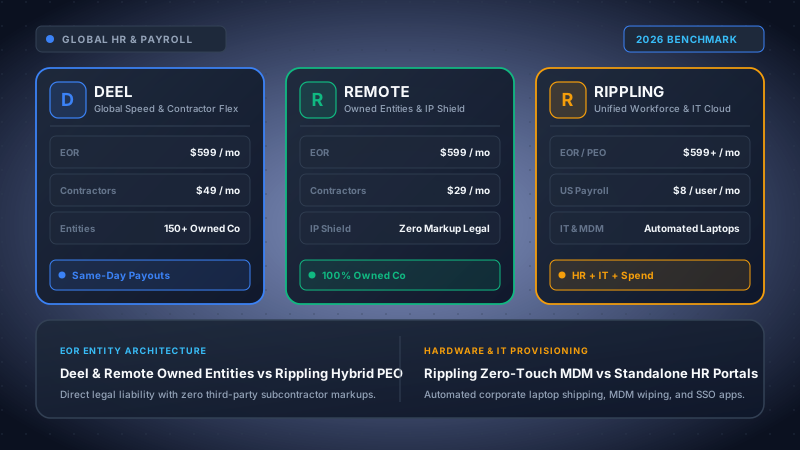
Building a borderless technology company requires choosing between dedicated international Employer of Record (EOR) infrastructure and all-in-one workforce platforms. In 2026, Deel, Remote, and Rippling dominate global hiring. Here is an architect-level benchmark evaluating legal entity ownership, contractor compliance, IT hardware provisioning, multi-currency payout mechanics, and real-world TCO.
1. Global Employment Models: EOR vs Contractor vs Direct Subsidiary
Hiring technical talent across international borders has historically forced engineering and operational leaders into three distinct structural paths, each carrying severe tradeoffs between cost, legal liability, and speed:
1. Incorporating Local Foreign Entities
Complexity: Extreme | Setup Timeline: 4–9 months | Ongoing Cost: $15,000–$45,000/yr per country.
Establishing your own corporate subsidiary (e.g., an S.A. in Argentina, S.A.S. in Colombia, S.A. de C.V. in Mexico, or Ltd in the UK) grants complete operational control. However, it requires local legal representation, statutory bank accounts, recurring accounting audits, local corporate tax filings, and specialized labor law counsel. This model is only economically viable once you employ 20 to 30+ full-time staff in a single country.
2. International Contractors (1099 / B2B)
Complexity: Low | Setup Timeline: 24 hours | Ongoing Cost: $29–$49/mo per seat.
Engaging engineers and knowledge workers as independent contractors is fast and capital-efficient. However, it carries massive labor misclassification risk. If a contractor works exclusively for your company, uses company-provided hardware, has fixed hours, or follows direct management oversight, local labor courts will retroactively classify them as full-time employees, triggering massive statutory penalties, unpaid social security taxes, and severance liability.
3. Employer of Record (EOR)
Complexity: Minimal | Setup Timeline: 2–5 business days | Ongoing Cost: $599/mo per employee.
An Employer of Record (EOR) acts as the legal employer on paper via its own registered entities. The worker signs a locally compliant employment contract with the EOR, which deducts local payroll taxes, health insurance, and mandatory pension funds. Meanwhile, the worker operates on a day-to-day basis as an integrated member of your team under a commercial master services agreement.
2. Entity Architecture: Owned Subsidiaries vs Partner Subcontracting
The most critical architectural differentiator among global employment platforms is whether the provider owns its legal entities or relies on third-party staffing subcontractors (local aggregators).
Remote: The 100% Owned-Entity Pioneer
Founded in 2019 by GitLab's former VP of Product, Remote was engineered from the ground up on the philosophy that third-party intermediary staffing agencies introduce unacceptable operational, legal, and intellectual property risks.
- Zero Subcontractor Markups: Remote owns and operates 100% of its local legal infrastructure in over 80+ countries. Your employees are directly employed by a Remote subsidiary, eliminating intermediary agency fees.
- IP Shield Guarantee: Intellectual property assignment transfers directly from the employee to Remote's local entity, and instantaneously to your parent corporation without passing through an unrelated third-party brokerage. Remote provides complete legal indemnification for IP ownership.
- Localized HR Specialists: Labor law disputes, maternity leave, and terminations are handled by in-house legal and HR teams physically residing in the jurisdiction, ensuring rapid responses without agency bureaucracy.
Deel: The Fast-Moving Global Powerhouse
Deel launched in 2019 and quickly achieved massive global scale. Originally employing a hybrid model (using trusted local partner agencies in smaller emerging markets while aggressively establishing its own subsidiaries), Deel has systematically transitioned over 150+ countries to 100% owned legal entities.
- Unrivaled Footprint: Deel supports hiring in over 150 countries for EOR and 180+ countries for contractors. Where boutique providers cannot hire, Deel almost always has operational coverage.
- Dedicated Global Infrastructure: Deel processes billions in global payroll annually, providing deep relationships with local tax authorities, immigration bureaus, and international banking partners.
- Rapid Onboarding Cadence: Contracts can be generated, localized, and countersigned in as little as 48 hours for standard engineering profiles.
Rippling: The Modular Platform with Global Expansion
Rippling takes a distinct architectural approach. Rather than positioning itself solely as an international hiring specialist, Rippling treats EOR as one functional module within a comprehensive enterprise operating system.
- Core Market Ownership: Rippling owns its legal entities across key global technology markets (including the UK, Canada, Germany, India, Australia, and major Latin American hubs).
- Hybrid Strategic Alliances: In secondary and niche jurisdictions, Rippling leverages thoroughly vetted local partner entities, managing the interface through its unified software layer.
- Unified Data Model: A change in an employee's title, compensation, or address immediately ripples across payroll, health benefits, corporate credit card limits, and cloud app access permissions globally.
3. Contractor Management, Misclassification Risk & Payout Velocity
For early-stage startups and lean teams, hiring international independent contractors represents 70% to 80% of all global workforce transactions. Here, payout velocity, currency flexibility, and compliance document automation determine operational success.
Deel: The Gold Standard for Contractor Flexibility
Deel remains the undisputed leader in contractor experience. Its global contractor portal provides:
- 15+ Withdrawal Methods: Contractors can withdraw funds via local bank transfer (ACH, SEPA, SPEI, Pix, Transbank), international wire, PayPal, Wise, Revolut, Payoneer, or even cryptocurrency (USDC, Bitcoin, Ethereum).
- Deel Card: Contractors can hold funds in US Dollars on a virtual or physical Mastercard, spending directly at point-of-sale terminals without incurring local currency conversion losses.
- Deel Advance: Qualified contractors can request paycheck advances based on verified pending invoice hours.
- Deel Shield: For high-risk contractor relationships, Deel assumes total classification liability, vetting the role and guaranteeing legal defense if challenged by local tax authorities.
Remote: Predictable Flat Pricing & IP Protection
Remote focuses on simplicity, security, and transparent contractor pricing:
- Flat $29/mo Contractor Pricing: Transparent billing with no hidden add-on fees for basic compliance document collection (W-8BEN, VAT IDs).
- Remote IP Shield: Built-in intellectual property assignment clauses rigorously vetted across local common law and civil law frameworks, preventing ambiguous work-for-hire interpretations.
- Automated Invoicing: Contractors submit hours or milestone deliverables, generating automated invoices that match local statutory tax receipt requirements.
Rippling: Deep Financial & ERP Synchronization
Rippling excels when contractor operations must integrate directly into corporate accounting systems:
- ERP Synchronization: Real-time bi-directional sync with NetSuite, QuickBooks Online, Xero, and Sage Intacct, mapping contractor invoices directly to project-specific cost centers.
- Multi-Level Approval Workflows: Automated routing where contractor invoices above specific thresholds automatically route to department leads or finance directors for approval prior to batch payment.
- Automated Tax Withholding: Collects and validates US W-8BEN/W-9 documentation, generating 1099-NEC filings automatically at year-end.
4. The IT & Hardware Differentiator: Rippling Unified Cloud vs Standalone HR
The most decisive structural divergence among these three platforms lies in IT device and application lifecycle management.
The Operational Nightmare of Global Remote Onboarding
When hiring an engineer in Brazil, Germany, or the Philippines, HR onboarding is only half the battle. Someone must purchase a compliant corporate laptop, install disk encryption (FileVault/BitLocker), configure enterprise single sign-on (Okta/Google Workspace), assign GitHub permissions, and ensure the laptop can be remotely wiped if the employee departs.
Rippling IT Cloud: Zero-Touch Global Provisioning
Rippling is the only platform among the three with a fully integrated, enterprise-grade IT Device Cloud & App Management (MDM / IAM) built directly into its core architecture:
- Hardware Ordering & Warehousing: Administrators can order pre-configured MacBooks or ThinkPads directly within Rippling. Rippling handles international customs clearance, duty payment, and door-to-door delivery to employees in over 100+ countries.
- Automated MDM Enrollment: Laptops arrive out of the box pre-enrolled in Rippling's native Mobile Device Management (MDM), enforcing FileVault encryption, mandatory OS patch versions, and anti-malware baselines required for SOC 2 and ISO 27001.
- Single Sign-On (SSO) & Identity Management: When a new hire is approved, Rippling automatically creates their Google Workspace, Slack, Zoom, and GitHub accounts, placing them into role-based security groups.
- Zero-Touch Offboarding: With a single termination click, Rippling immediately revokes all cloud application sessions, wipes corporate data from the laptop, and dispatches a prepaid return box to collect the physical machine for secure warehousing.
Deel & Remote: Third-Party Hardware Partnerships
Neither Deel nor Remote operates an in-house MDM or identity management engine:
- Deel Equipment: Deel partners with third-party logistics and leasing providers (such as Hofy and Groover) to lease and deliver laptops internationally. While functional, it is managed through an external partner dashboard and lacks native device MDM controls.
- Remote Equipment: Remote offers hardware leasing and shipping via certified partner networks. You manage laptop configuration, security enrollment, and app access independently through standalone MDM tools like Kandji or Jamf.
5. 15-Point Head-to-Head Technical Benchmark Matrix
The following matrix evaluates Deel, Remote, and Rippling across 15 technical, operational, and financial dimensions based on verified 2026 enterprise testing:
| Feature / Evaluation Criteria | Deel | Remote | Rippling | Architectural Winner |
|---|---|---|---|---|
| EOR Country Coverage | 150+ countries | 80+ countries | 90+ countries | Deel (Widest reach) |
| Entity Ownership Model | 150+ owned legal entities | 100% owned entities across all active EOR markets | Owned entities in core markets + vetted partners | Remote (100% direct entity policy) |
| Monthly EOR Base Cost | $599 / employee / mo | $599 / mo (annual) or $699 / mo (monthly) | From $599 / employee / mo (custom quote) | Tie (Equal baseline pricing) |
| Monthly Contractor Base Cost | $49 / contractor / mo | $29 / contractor / mo | Included in platform core or custom modular tier | Remote (Lowest flat fee) |
| Native IT Device Management (MDM) | No (Third-party leasing partnership) | No (Third-party equipment delivery) | Yes (Native zero-touch MDM & laptop warehousing) | Rippling (Complete IT cloud) |
| Identity & App Provisioning (IAM/SSO) | Basic HR provisioning integrations | Standard SCIM integrations | Full enterprise Identity Cloud (SSO, SCIM, Role RBAC) | Rippling (Enterprise IAM standard) |
| Contractor Withdrawal Flexibility | 15+ payout rails (Crypto, Deel Card, PayPal, Local) | Standard local bank transfer & Wise rails | Global direct deposit & multi-currency wire | Deel (Widest payout options) |
| Contractor Misclassification Defense | Deel Shield (Full legal liability transfer) | Remote IP Shield (Rigorous legal guarantee) | Automated classification checklist & audit logging | Deel (Deel Shield coverage) |
| US Domestic Payroll & Benefits | Supported via Deel US Payroll module | Supported via Remote US Payroll | Industry-leading native US payroll, PEO & 401(k) | Rippling (Dominant in US domestic) |
| Visa & Immigration Sponsorship | Dedicated in-house immigration team in 40+ countries | In-house visa processing across 30+ countries | Global visa and mobility support services | Deel (Fastest visa turnaround) |
| Global Equity & Stock Options | Deel Equity management module | Equity incentive planning support | Native global equity & cap table synchronization | Tie (All mature in 2026) |
| Spend & Corporate Card Management | Deel Card & basic expense claims | Built-in employee expense reimbursement | Native Corporate Cards with automated policy limits | Rippling (Rippling Spend Cloud) |
| Security & Compliance Standards | SOC 2 Type II, ISO 27001, GDPR compliant | SOC 2 Type II, ISO 27001, GDPR compliant | SOC 2 Type II, ISO 27001, GDPR, HIPAA compliant | Tie (All enterprise-grade) |
| API & ERP Integration Depth | REST API, Webhooks, robust HRIS connectors | Modern REST API & major HRIS sync | Deepest enterprise ERP & directory sync engine | Rippling (Deepest data model) |
| Average EOR Onboarding Speed | 2 to 4 business days | 3 to 5 business days | 3 to 7 business days | Deel (Fastest contract signing) |
6. 2026 Pricing & Total Cost of Ownership (TCO) Breakdown
While headline monthly fees ($599/month per EOR employee) appear uniform across the industry, the Total Cost of Ownership (TCO) differs dramatically once hidden foreign exchange markups, mandatory statutory deposits, and platform modular packaging are accounted for.
| Cost Component | Deel | Remote | Rippling |
|---|---|---|---|
| Employer of Record (EOR) Base | $599 / employee / mo | $599 / mo (billed annually) $699 / mo (billed monthly) |
~$599 / employee / mo (custom quote dependent) |
| Contractor Management Base | $49 / contractor / mo | $29 / contractor / mo | Modular add-on (~$20–$40 / mo) |
| Core HRIS / Software Seat Fee | Free (Deel HR up to 200 users) | Free (Remote HR core features) | $8 / user / mo base platform fee |
| IT MDM & Laptop Management | Hardware rental markup via Hofy (~$80–$140/mo) | Hardware partner pass-through | $5 – $8 / device / mo (Native MDM engine) |
| Foreign Exchange (FX) Spread | ~1.0% – 1.5% over mid-market rates | ~0.8% – 1.2% over mid-market rates | ~1.0% – 1.8% over mid-market rates |
| Mandatory Security Escrow Deposit | 1 – 2 months gross salary & employer taxes | 1 – 2 months gross salary & employer taxes | 1 – 2 months gross salary & employer taxes |
| Contract Setup / Offboarding Fees | $0 setup; standard offboarding fees | $0 setup; zero offboarding exit penalties | Custom onboarding setup package |
Architectural TCO Modeling: The 10-Person Global Team Scenario
Consider a tech company employing 4 EOR software engineers ($8,000/mo salary each) and 6 international contractors ($4,000/mo invoice each) across Latin America and Europe:
- Software License Fees: (4 × $599) + (6 × $49) = $2,690/month ($32,280/year).
- Mandatory Escrow Deposits (Year 1 Outlay): 4 engineers × 1.5 months × $8,000 = $48,000 USD tied up in cash reserves.
- Foreign Exchange Drag: Processing $56,000/month in global payroll with an average 1.2% FX spread equals $672/month ($8,064/year) in banking conversion overhead.
- Total First-Year Cash Requirement: ~$88,344 USD above base gross wages.
7. Decision Framework: When to Choose Deel, Remote, or Rippling
Selecting the ideal global workforce platform depends on whether your organization prioritizes rapid international contractor scale, uncompromised direct legal ownership, or unified IT hardware automation.
Choose Deel If:
- You need maximum global speed and geographic reach: Deel hires in 150+ countries and delivers the fastest contract-signing turnaround in the market.
- You manage a large, diverse roster of international contractors: Its 15+ withdrawal methods (crypto, Deel Card, instant transfers) make it the most loved platform by contractors globally.
- You require visa sponsorship in foreign countries: Deel's dedicated in-house global mobility and immigration practice handles work permits in over 40 countries.
- You want Deel Shield misclassification indemnity: Full legal protection where Deel assumes complete classification liability.
Choose Remote If:
- You demand 100% owned legal entities with zero subcontractors: Eliminates intermediary agency markups and ensures your employees are employed directly by Remote.
- Intellectual property (IP) protection is your paramount concern: Remote IP Shield provides the most airtight legal guarantee in the industry.
- You prioritize flat, transparent contractor pricing: At $29/month per contractor, Remote delivers the most cost-effective contractor management for lean teams.
- You prefer European-style privacy and employee-centric ethics: Remote maintains deep expertise in GDPR, statutory European severance rules, and fair global work standards.
Choose Rippling If:
- You want unified HR, Payroll, and IT hardware management in one tool: Zero-touch laptop provisioning, automated Google Workspace/Slack provisioning, and corporate cards.
- You have a significant US domestic workforce alongside international hires: Rippling is the market standard for unified US payroll, 401(k), PEO, and global hiring under a single pane of glass.
- You require deep bi-directional ERP and accounting sync: Enterprise-grade integration with NetSuite, Workday, and custom data warehouses via robust API triggers.
- You want automated offboarding that wipes laptops instantly: Eliminates the security risk of uncollected hardware and active corporate logins upon employee departure.
8. Frequently Asked Questions (FAQ)
What is the difference between an Employer of Record (EOR) and Global Payroll?
An Employer of Record (EOR) legally hires workers on your behalf through its own legal entities in foreign countries where your company does not maintain a registered corporate subsidiary. The EOR handles all local employment contracts, statutory payroll taxes, pension contributions, and labor law compliance. In contrast, Global Payroll requires your company to already own and maintain registered local legal entities, using the software solely to calculate, process, and disburse multi-country payroll.
Why does legal entity ownership matter when choosing an EOR provider?
When an EOR owns its local legal entities (like Remote and Deel across most core markets), you interact directly with the legal employer of record. There are no middleman subcontracting markups, contract amendments can be executed in hours rather than weeks, and sensitive intellectual property (IP) assignment transfers directly from the employee to your firm without traversing third-party agency liability gaps.
What is a security deposit in EOR contracts and is it refundable?
Almost all EOR providers require an upfront security deposit equivalent to 1 to 2 months of each international employee's gross salary and statutory employer liabilities. This deposit protects the EOR against client non-payment, as local labor laws mandate that employees and tax authorities must be paid regardless of commercial disputes. The security deposit is held in escrow and fully refunded when the employment contract is concluded.
How does Rippling differ fundamentally from Deel and Remote?
While Deel and Remote originated as international hiring and contractor compliance platforms, Rippling was built as a unified workforce platform combining HR, IT, and Spend management. Rippling can automatically order, configure, and ship corporate laptops with zero-touch MDM, manage app provisioning (Google Workspace, Slack, AWS SSO), and run US domestic payroll natively alongside international EOR.
What are the hidden foreign exchange (FX) fees in international payroll?
Beyond fixed monthly software subscription fees ($599/month for EOR or $29-$49/month for contractors), international payroll platforms often charge or embed a foreign exchange (FX) markup between 0.5% and 2.5% over mid-market rates when converting US Dollars or Euros into local currencies (e.g., Brazilian Real, Mexican Peso, British Pound). For large distributed teams, FX markup can represent hundreds to thousands of dollars in hidden monthly operational costs.
José Andrade
Founder & Managing EditorArchitect and founder specializing in systems design, project viability, and operational cost modeling. José directs CloudBizStack by bringing structural planning discipline and rigorous TCO (Total Cost of Ownership) analysis to modern software stacks and cloud infrastructure.