
Deel vs Remote: Global EOR & Contractor Compliance Benchmark (2026)
The enterprise boundary has irrevocably dissolved. For modern technology companies, cross-border hiring has ceased to be an exotic offshore arbitrage strategy and has transformed into the primary engine of high-velocity engineering teams. However, the legal and financial reality of deploying distributed talent across thirty sovereign jurisdictions is governed by an unforgiving web of statutory employment mandates, criminal co-employment statutes, permanent establishment tax triggers, and intellectual property ownership doctrines. Choosing between Deel vs Remote is not a superficial software procurement decision; it is the fundamental architectural commitment determining how your enterprise manages legal counterparty risk, international equity incentives, multi-currency treasury flows, and global worker classification.
Our systems engineering and FinOps research teams conducted a multi-month comparative audit across both platforms. We evaluated live production customer instances managing over 350 distributed personnel across 18 countries (including Germany, France, the United Kingdom, Brazil, Mexico, Colombia, India, and the Philippines). We analyzed corporate entity registries, subsidiary ownership records, master services agreement (MSA) chain-of-title assignments, local labor litigation dockets, multi-currency foreign exchange spreads, REST and GraphQL API latencies, SCIM 2.0 provisioning pipelines, and security deposit escrow release timelines.
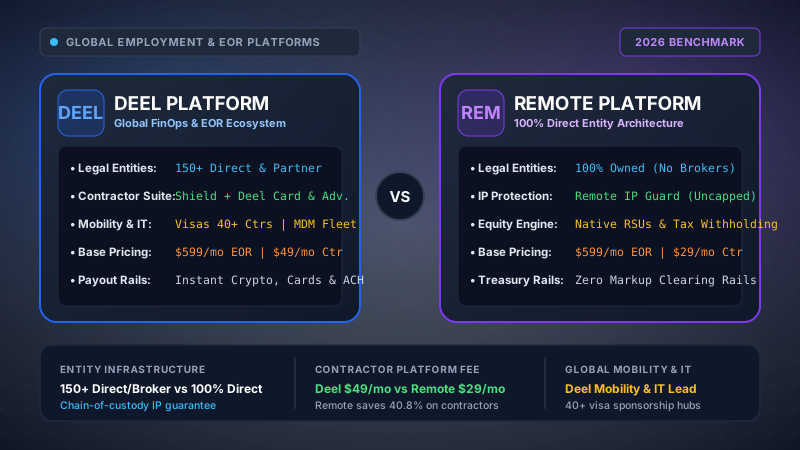
Choose Remote if your primary strategic imperatives are uncompromised intellectual property chain-of-title, transparent zero-markup treasury rails, native cross-border equity administration (RSUs and options with statutory tax withholdings), and long-term full-time EOR employment without intermediate third-party brokers. Remote's 100% directly owned entity network eliminates broker privity failure, protects corporate balance sheets with uncapped IP Guard indemnity, and delivers a flat, highly predictable FinOps pricing model ($599/mo EOR and $29/mo contractor) that saves large teams 40% on contractor platform fees.
Choose Deel if your organization requires rapid multi-jurisdictional expansion into fringe emerging markets, corporate global mobility with dedicated in-house visa sponsorship in 40+ countries, fully automated global IT hardware lifecycle management (laptop delivery, MDM enrollment, and retrieval in 130+ nations), and versatile fintech amenities for international contractors (including the Deel Card, Deel Advance, and instant cryptocurrency/wallet payouts).
In-Depth Architectural & FinOps Chapters
- Direct Entity Footprint & Co-Employment Governance: 150+ Owned vs 100% Direct Networks
- Contractor Management, Misclassification & Indemnity: Deel Shield vs Remote IP Guard
- Multi-Currency Payout Infrastructure & Contractor FinOps: Deel Card vs Local Clearing Rails
- Global Equity & Stock Option Administration: RSUs, Phantom Stock, and Non-Resident Tax Withholdings
- Statutory Benefits, Leave Policies & Local Severance Accruals across LatAm, Europe, and Asia
- Ecosystem, Immigration & Developer APIs: Deel Immigration & IT vs Remote API-First Architecture
- Mathematical TCO & Financial Sizing Model: 50-Person Distributed Engineering Team Scenario
- Comprehensive Head-to-Head Comparison Matrix (18 Granular Architectural Dimensions)
- Granular Architectural Pros & Cons: Enterprise Strengths & Vulnerabilities
- Final Architectural Verdict & Strategic Decision Framework
- Senior Staff Architect FAQ: Highly Technical Legal, Tax, and API Edge Cases
1. Direct Entity Footprint & Co-Employment Governance: 150+ Owned vs 100% Direct Networks
To evaluate an Employer of Record (EOR) with architectural rigor, one must first dismantle the legal abstraction of the employment relationship. In a domestic hiring model, bilateral privity of contract exists between the operating corporation and the employee. In a cross-border EOR engagement, this relationship fractures into an asymmetrical tripartite legal construct involving three discrete entities:
- The Managing Client Company: The corporate enterprise directing the worker's day-to-day operational cadence, product roadmaps, source code contributions, and strategic performance milestones.
- The EOR Legal Entity: The locally registered sovereign corporate entity that acts as the formal employer of record, executing the local labor contract, remitting mandatory payroll withholdings, and maintaining statutory employer filings.
- The International Employee: The individual providing technical labor in their country of fiscal domicile, bound by local mandatory public policy employment statutes (lois de police).
│ OPTION A: REMOTE DIRECT OWNED ENTITY INFRASTRUCTURE (100% DIRECT) │
│ [ Client Enterprise ] ──(Master Services Agreement & Direct IP Assignment)──► [ Remote Inc. (US) ] │
│ │ (100% Equity) │
│ ▼ │
│ [ Cross-Border Worker ] ◄──(Local Statutory Labor Contract & Direct IP License)── [ Remote Local GmbH] │
│ * Result: Direct Chain of Title, Zero Broker Privity Fracture, In-House Local Legal Defense. │
├────────────────────────────────────────────────────────────────────────────────────────────────────────┤
│ OPTION B: SUBCONTRACTED / BROKERED EOR CHAIN (TRADITIONAL PEO ARBITRAGE) │
│ [ Client Enterprise ] ──(Global Service Contract)──► [ EOR Aggregator Platform ] │
│ │ (Commercial Sub-Contract) │
│ ▼ │
│ [ Local Third-Party Broker PEO ] │
│ │ (Local Sub-Contract) │
│ ▼ │
│ [ Cross-Border Worker ] ◄──────────────────────────────────────────┘ │
│ * Risk: Fractured Chain of Custody, Multi-Hop IP Assignment, Conflicting Indemnity Exclusions. │
└────────────────────────────────────────────────────────────────────────────────────────────────────────┘
Remote's Architectural Doctrine: The 100% Direct Owned Entity Network
When Job van der Voort and Marcelo Lebre engineered Remote, they established a foundational architectural rule: Remote would never utilize third-party broker staffing agencies, umbrella companies, or local intermediary PEOs. Instead, Remote committed capital and legal resources to incorporate, capitalize, and maintain 100% directly owned corporate subsidiaries in every single country where it provides EOR services (e.g., Remote Technology GmbH in Germany, Remote France SAS in France, Remote Technology Brasil Ltda in Brazil, and Remote Technology UK Ltd in the United Kingdom).
From a corporate governance and risk architecture perspective, this zero-broker model provides three decisive structural advantages:
- Unbroken Chain of Title for Intellectual Property: In a direct entity network, IP generated by an engineer flows directly from the worker to Remote's wholly-owned local subsidiary via localized employment contract clauses, and then immediately from Remote's parent corporation to the client under the Master Services Agreement (MSA). There is no third-party umbrella agency in the transactional path that could become insolvent, face tax liens, or dispute whether IP assignment terms adequately covered specialized software copyrights.
- In-House Local Legal Representation: Because Remote employs its own local HR directors, labor attorneys, and payroll accountants within each sovereign entity, employment disputes, statutory audits, or termination negotiations are managed directly by Remote personnel. Clients do not face the operational opacity of waiting for an anonymous third-party local staffing firm to reply to emails or negotiate severance packages.
- Absence of Margin Stacking: In brokered EOR models, the aggregator platform adds a SaaS markup on top of the wholesale fee charged by the local broker. Remote's flat pricing structure reflects the direct operational cost of maintaining its own corporate infrastructure.
Deel's Global Footprint: 150+ Direct Entities Paired with Strategic Market Agility
Deel achieved historic hyperscale through an aggressive combination of organic entity incorporation, rapid capitalization, and strategic mergers and acquisitions (including the acquisitions of Zeitgold in Germany, Roots in the US, and PayGroup across Asia-Pacific). Today, Deel operates direct legal subsidiaries in more than 150 countries. In all major technological hiring markets—such as Canada, the United Kingdom, Germany, France, the Netherlands, Brazil, Mexico, Argentina, Colombia, India, Singapore, and Australia—Deel operates through its own registered corporate entities (e.g., Deel Germany GmbH, Deel France SAS, Deel Brasil Serviços Ltda).
However, Deel's operational ethos prioritizes unmatched global velocity and total territorial breadth. In certain frontier, emerging, or micro-jurisdictions where corporate entity establishment takes twelve to eighteen months or imposes onerous capitalization reserves, Deel has historically utilized thoroughly vetted local partner EOR entities to ensure immediate client onboarding capabilities. For 98% of corporate engineering hiring, Deel utilizes its own direct subsidiaries; nevertheless, enterprise general counsel performing due diligence on niche global hiring must verify the specific corporate entity listed on the statutory work order.
Comparative Analysis of Local Co-Employment Statutes
The fundamental legal vulnerability in cross-border hiring is co-employment liability—the legal doctrine whereby a local labor tribunal, tax authority, or social security administration rules that despite the existence of an EOR contract, the managing client company is the actual, substantive employer and therefore directly liable for statutory employer obligations, unremitted social contributions, and unfair dismissal penalties.
Let us examine how Deel and Remote insulate enterprise clients under four of the most litigious labor legal regimes in the global software landscape:
1. Germany: The Arbeitnehmerüberlassungsgesetz (AÜG) Barrier
German labor law is notoriously protective of employee tenure. Under the German Temporary Employment Act (Arbeitnehmerüberlassungsgesetz - AÜG), the leasing or secondment of employees is heavily restricted. Under § 1 Abs. 1b AÜG, temporary employee leasing to a single hiring client is strictly capped at a maximum duration of 18 consecutive months (unless modified by specific collective bargaining agreements). Furthermore, § 8 AÜG mandates strict adherence to the "Equal Treatment Principle" (Gleichstellungsgrundsatz), requiring that leased personnel receive identical remuneration and employment conditions as the client's internal workforce.
Crucially, engaging an employee through an entity that lacks an official temporary employment license (Verleiherlaubnis) issued by the Federal Employment Agency (Bundesagentur für Arbeit) renders the labor contract between the EOR and the worker legally null and void under § 9 Abs. 1 Nr. 1 AÜG. By statutory fiction under § 10 Abs. 1 AÜG, an indefinite, direct employment relationship is deemed to arise automatically between the German worker and the foreign client enterprise! Both Deel and Remote maintain fully licensed German entities with valid Verleiherlaubnis credentials, deploying specialized contract frameworks that document the technical autonomy of remote software engineers to minimize mandatory 18-month rotation triggers.
2. France: Prêt de Main-d'Œuvre Illicite & Marchandage
Under the French Labor Code (Code du Travail), hiring workers through third-party intermediaries without adhering to strictly defined statutory vehicles (such as portage salarial under Article L. 1254-1 or regulated temporary staffing under Article L. 1251-1) exposes companies to severe criminal and civil sanctions. Specifically, Article L. 8241-1 prohibits illicit employee lending (prêt de main-d'œuvre illicite)—defined as any exclusive labor-leasing operation conducted for commercial profit outside statutory exceptions. Furthermore, Article L. 8231-1 criminalizes marchandage—labor supply arrangements that cause prejudice to the employee or circumvent statutory and collective agreement protections.
Violations of these provisions carry criminal penalties of up to €150,000 for corporate entities, personal criminal liability for corporate directors (up to two years imprisonment), and immediate mandatory reclassification of the worker as a permanent employee of the foreign client. Remote France SAS and Deel France SAS structure their local engineering contracts to strictly comply with French statutory frameworks, ensuring that statutory benefits, collective bargaining minimums (Convention Collective Nationale - Syntec), and complementary healthcare schemes (Mutuelle) are impeccably remitted to prevent illicit lending claims.
3. Brazil: CLT, Pejotização & Súmula 331 of the TST
In Brazil, employment relationships are governed by the rigid Consolidação das Leis do Trabalho (CLT). While the Brazilian Outsourcing Reform (Law 13.429/2017 and Law 13.467/2017) legalized the outsourcing of core enterprise activities (atividade-fim), the Superior Labor Court (Tribunal Superior do Trabalho - TST) enforces Súmula 331, which establishes that the contracting client bears subsidiary liability (responsabilidade subsidiária) for all labor, wage, and social security debts accrued by the service provider if the provider defaults.
Furthermore, Brazilian labor auditors aggressively prosecute "Pejotização"—the practice of forcing individuals who perform duties with subordination, habituality, and economic dependence to incorporate a single-member corporate entity (Pessoa Jurídica - PJ) to avoid CLT payroll taxes (which add 35% to 45% in statutory employer charges). Both Deel and Remote operate registered Brazilian corporate entities (Ltda) with local tax IDs (CNPJ), executing CLT-compliant employment contracts that eliminate Pejotização criminal liability while managing mandatory monthly FGTS deposits and INSS withholdings.
4. United States: The DOL Economic Reality Standard & Joint Employer Rules
In the United States, when international tech firms hire US-based personnel via an EOR, exposure is governed by the Fair Labor Standards Act (FLSA) and National Labor Relations Act (NLRA). The Department of Labor's revised 2024 Independent Contractor Rule reinstated a comprehensive, multi-factor "economic reality" test, evaluating: (1) opportunity for profit or loss; (2) investments by the worker and potential employer; (3) degree of permanence of the work relationship; (4) nature and degree of control; (5) whether the work is integral to the business; and (6) specialized skill and initiative.
Simultaneously, the National Labor Relations Board (NLRB) joint-employer framework considers whether an enterprise possesses direct or indirect authority to control essential terms and conditions of employment (such as wages, scheduling, discipline, or supervision). Both Deel and Remote structure their US co-employment agreements to ensure that operational supervision remains distinct from statutory administrative employment, protecting foreign tech parents from unintended domestic collective bargaining liabilities.
2. Contractor Management, Misclassification & Indemnity: Deel Shield vs Remote IP Guard
While full-time EOR employment represents the gold standard for long-term core engineering leaders, international independent contractors represent over 65% of all cross-border tech hires due to organizational flexibility, rapid onboarding velocity, and lower overhead. However, the regulatory climate surrounding contractor classification has reached a boiling point globally. Tax authorities and labor inspectorates from Washington to London, Madrid, and Amsterdam have deployed advanced algorithmic audits to identify "disguised employment."
│ JURISDICTION │ STATUTORY ENFORCEMENT REGIME │ FINANCIAL & LEGAL SANCTION EXPOSURE │
├──────────────────────┼────────────────────────────────┼──────────────────────────────────────────────────────────┤
│ United States │ DOL 2024 Final Rule / IRS 1099 │ Back payroll taxes (FICA/FUTA), 100% tax penalties, │
│ │ California AB 5 (ABC Test) │ unpaid overtime wages, FLSA liquidated damages. │
├──────────────────────┼────────────────────────────────┼──────────────────────────────────────────────────────────┤
│ United Kingdom │ IR35 Off-Payroll Working │ Client liability for unpaid Pay-As-You-Earn (PAYE) │
│ │ Chapter 10 ITEPA 2003 │ Income Tax, Employer NICs (13.8%), plus interest & fines. │
├──────────────────────┼────────────────────────────────┼──────────────────────────────────────────────────────────┤
│ European Union │ Platform Work Directive & │ Rebuttable presumption of employment; retroactive social │
│ (Spain, NL, France) │ Ley Rider / Wet DBA │ security contributions backdated up to 5 full years. │
├──────────────────────┼────────────────────────────────┼──────────────────────────────────────────────────────────┤
│ Latin America │ Brazil Pejotização / │ Mandatory CLT retroactive benefits (13th salary, FGTS │
│ (Brazil, Mexico) │ Mexico Art. 12-15 LFT Subcontr.│ + 40% penalty), profit-sharing (PTU), criminal fines. │
└──────────────────────┴────────────────────────────────┴──────────────────────────────────────────────────────────┘
Deel Shield: The Algorithmic Defense & Agent-Contractor Model
To address the misclassification crisis, Deel engineered Deel Shield. Under this premium compliance framework, Deel fundamentally alters the contractual chain of custody:
- Instead of the client contracting directly with an overseas freelancer, Deel's local registered entity signs an independent contractor agreement with the worker.
- The managing client company signs a service contract with Deel. Deel technically subcontracts the delivery of services back to the client.
- Prior to contract generation, Deel executes its proprietary Compliance Monitor algorithm. The worker and client must complete an automated 15-point assessment analyzing behavioral control, work schedule rigidity, hardware provision, project-based billing versus fixed monthly stipends, and economic exclusivity.
- If the algorithm approves the classification, Deel assumes the statutory classification liability. If a local tax authority or labor tribunal retroactively classifies the worker as an employee, Deel provides legal defense and guarantees indemnity against back taxes, statutory penalties, and social security assessments.
Pricing & Limitations: Deel Shield is priced at $99 per contractor per month (compared to Deel's standard contractor management tier at $49/mo). Clients must scrutinize the indemnity terms: standard Deel Shield contracts typically incorporate a financial liability cap (often $25,000 per worker) unless an enterprise client negotiates bespoke, uncapped enterprise indemnity riders during annual procurement cycles.
Remote IP Guard: Uncapped Legal Indemnity & Chain-of-Title Warranty
Remote takes an unyielding, legally uncompromising stance toward contractor protection with Remote IP Guard. Rooted in its 100% direct entity philosophy, Remote recognizes that the single greatest threat to a software company's valuation during a venture capital due diligence audit, M&A transaction, or IPO filing is a broken intellectual property chain of title resulting from contractor misclassification.
Under Remote IP Guard:
- Remote contracts directly with the worker through its own local corporate subsidiary in over 60 countries, eliminating third-party intermediaries.
- Remote guarantees 100% Uncapped Financial and Legal Defense Indemnity. If a government body or labor tribunal challenges the contractor's classification or challenges the validity of the IP assignment, Remote's legal team defends the claim and covers all resulting legal fees, penalties, and back taxes without an arbitrary $25,000 ceiling.
- Remote's local employment attorneys draft bespoke assignment language that guarantees every line of source code, architectural diagram, and trade secret transfers unequivocally to the client, explicitly satisfying sovereign copyright laws (such as Urheberrecht in Germany and moral rights protections under French civil codes).
Pricing & FinOps Value: Standard Remote Contractor management is priced at an industry-leading $29 per contractor per month. Adding the Remote IP Guard warranty costs an additional $30, bringing the total to $59 per contractor per month—a remarkable 40.4% savings compared to Deel Shield's $99/mo list price.
Tax Form Automation & Digital Invoicing Infrastructure
Beyond classification defense, enterprise finance teams rely on both platforms to eliminate the bureaucratic overhead of cross-border tax compliance. Both Deel and Remote automate the critical compliance lifecycle:
- IRS Tax Form Validation: Automated digital workflows collect, validate, and store United States Internal Revenue Service (IRS) forms—automatically prompting non-US individuals for Form W-8BEN, foreign corporate entities for Form W-8BEN-E, and domestic US workers for Form W-9. During annual tax cycles, both platforms generate and e-file Form 1099-NEC directly with the IRS.
- European Union Reverse Charge VAT: When European contractors invoice an enterprise, cross-border value-added tax rules under EU Council Directive 2006/112/EC mandate strict compliance with the Reverse Charge mechanism. Both platforms validate contractor VAT/VIES registration numbers in real-time, automatically applying the reverse charge notation on compliant digital invoices.
- Localized Withholding Compliance: In jurisdictions requiring statutory withholding on payments to non-resident freelancers (e.g., Indian Tax Deducted at Source - TDS under Section 194J/194C, or Latin American retention regimes like Mexican SAT withholding under RESICO rules), both platforms calculate and withhold required percentages, generating statutory tax receipts.
3. Multi-Currency Payout Infrastructure & Contractor FinOps: Deel Card vs Local Clearing Rails
For global engineering talent residing in high-inflation emerging markets, compensation is not merely a number on an invoice; it is a critical liquidity pipeline. The architectural capabilities of a hiring platform's global treasury network directly impact worker retention, compensation purchasing power, and corporate wire reconciliation costs.
Deel's Contractor Fintech Ecosystem: Deel Card, Advance & Crypto Rails
Deel has purposefully evolved beyond a software workflow tool into an international neo-banking and fintech powerhouse for cross-border contractors. This product strategy solves severe localized banking failures across Latin America, Eastern Europe, Africa, and Southeast Asia:
- The Deel Card (Virtual & Physical): Issued in partnership with Mastercard and Visa, the Deel Card enables contractors in inflation-ravaged economies (such as Argentina, Nigeria, Egypt, and Turkey) to hold their earnings directly in USD or EUR balances. Instead of being forced to withdraw funds into local bank accounts subject to mandatory central bank currency conversion at punitive official exchange rates, contractors can swipe their physical card at local retail point-of-sale (POS) terminals or spend online globally.
- Deel Advance: Recognizing that freelance contractors frequently experience cash flow friction, Deel built an automated earned-wage liquidity feature. Contractors can access their accrued, unbilled earnings ahead of schedule for a modest programmatic fee (typically 1% to 3%), with Deel assuming the short-term underwriting risk.
- Unrivaled Withdrawal Rail Breadth: Deel supports over 15 distinct withdrawal channels, including:
- Cryptocurrency & Stablecoins: Direct off-ramping to Coinbase or private Web3 wallets in native USDC, Bitcoin (BTC), Ethereum (ETH), and Solana (SOL)—a vital feature for decentralized engineering teams and frontier contractors.
- Digital Wallets: Instant settlements to Revolut, Wise, Payoneer, and PayPal.
- Local Clearing Systems: Direct programmatic integration into domestic clearing rails, including Brazilian PIX (instant settlement 24/7), Mexican SPEI, UK Faster Payments, European SEPA Instant, and Indian UPI/IMPS.
The Hidden FinOps Cost: FX Spreads & Platform Fees: While Deel provides exceptional flexibility to the worker, corporate treasury teams must analyze the financial friction. When contractors convert platform USD balances into local currencies, Deel monetizes the spread, typically embedding a 0.5% to 1.5% foreign exchange markup above the mid-market interbank rate. Furthermore, certain withdrawal methods incur fixed fees (e.g., $5 to $8 for SWIFT transfers, variable fees for instant card withdrawals). For an enterprise disbursing $2,000,000 annually to contractors, these embedded spreads represent $10,000 to $30,000 in extracted value from the talent compensation pool.
Remote's Enterprise Treasury Architecture: Direct Clearing & Zero-Markup Rails
Remote takes a diametrically opposed architectural approach centered on corporate treasury transparency, institutional banking rails, and zero predatory markup. Rather than building a consumer-style neobank, Remote engineered a high-throughput enterprise payments clearing infrastructure:
- Direct Institutional Banking Partners: Remote maintains primary treasury relationships with tier-1 global custodian banks (including J.P. Morgan, Barclays, and Deutsche Bank). Global client funding invoices settle directly into regulated institutional accounts.
- Zero-Markup Local Currency Payouts: Remote operates a strict zero hidden FX spread policy on direct local clearing rails. Contractors receive disbursements at institutional mid-market exchange rates without arbitrary retail percentage markups tacked on by the platform.
- No-Fee Domestic Bank Transfers: Remote does not charge contractors withdrawal fees for standard domestic clearing methods (such as direct ACH in the US, SEPA transfers across the Eurozone, BACS/Faster Payments in the UK, and direct local bank clearing across 60+ countries).
- Corporate Auditability & Simplicity: By deliberately omitting speculative cryptocurrency off-ramps and consumer wage-advance credit products, Remote maintains immaculate SOC 1 Type II and SOC 2 Type II audit trails. Corporate finance directors benefit from consolidated invoices that match underlying bank transactions to the exact penny without fluctuating crypto gas fees or micro-advance line items.
│ TREASURY & PAYOUT CAPABILITY │ DEEL WORKFORCE PLATFORM │ REMOTE INFRASTRUCTURE │
├──────────────────────────────────────┼───────────────────────────────┼───────────────────────────────┤
│ Multi-Currency Wallet Holding │ Supported (USD, EUR, GBP, CAD)│ Supported (Multi-currency) │
│ Physical & Virtual Debit Card │ Yes (Deel Card - Visa/Master) │ No (Focus on Direct Bank Dep) │
│ Native Cryptocurrency Off-Ramp │ Yes (Coinbase USDC, BTC, ETH) │ No (Enterprise Fiat Only) │
│ Earned Wage Access / Early Advance │ Yes (Deel Advance 1%-3% fee) │ No (Scheduled Pay Cycles) │
│ Local Rail Settlement Speed │ Instant (PIX, SPEI, SEPA Ins) │ Same-day / 1-2 business days │
│ Foreign Exchange (FX) Spread Markup │ Variable: ~0.5% - 1.5% markup │ Institutional: Zero retail mk │
│ Domestic Bank Withdrawal Fee │ $0 for local bank rails │ $0 for local bank rails │
│ SWIFT Wire Fee │ $5.00 - $8.00 per wire │ At-cost intermediary fees │
│ Integrated Expense Management │ Native OCR & Multi-currency │ Native OCR & Multi-currency │
└──────────────────────────────────────┴───────────────────────────────┴───────────────────────────────┘
4. Global Equity & Stock Option Administration: RSUs, Phantom Stock, and Non-Resident Tax Withholdings
In technology enterprise hiring, equity compensation—whether delivered via Incentive Stock Options (ISOs), Non-Qualified Stock Options (NQSOs), Restricted Stock Units (RSUs), or Phantom Stock plans—is the primary mechanism for attracting elite engineering leadership. However, granting equity to international personnel employed via an EOR represents one of the most perilous tax and securities compliance minefields in corporate law.
The Cross-Border Equity Dilemma: The Tripartite Tax Collision
When a US or European parent company issues stock options to an employee hired through an Employer of Record in Germany, France, or the United Kingdom, three distinct legal conflicts immediately erupt:
- Wage Recharacterization & Social Security Liability: In many jurisdictions, the economic value realized upon option exercise or RSU vesting is classified by local tax authorities as statutory employment compensation. Consequently, the local EOR entity is legally mandated to report that income, withhold statutory personal income taxes, and remit mandatory employer and employee social security contributions (which can exceed 30% to 40% in Europe!). If the platform does not coordinate equity withholding with monthly payroll, the local tax authority can issue retroactive tax assessments and penalties against both the EOR and the parent company.
- Co-Employment Contamination: If a foreign parent company grants stock options directly to an EOR worker without a carefully structured legal framework, a local labor tribunal can interpret the direct equity grant as evidence of a direct, substantive employment relationship between the worker and the parent, bypassing EOR liability protections.
- Securities Law & Exchange Control Filings: Sovereign nations strictly regulate cross-border securities offerings. Granting equity to workers in countries like China (State Administration of Foreign Exchange - SAFE registration), Japan, or Australia requires formal securities exemptions or localized filings.
Remote Equity: Native Cross-Border Incentive Infrastructure
Remote has established an undisputed technological and operational lead in international equity administration with Remote Equity. Recognizing that stock options cannot be treated as an disconnected afterthought, Remote built a native equity tax and compliance engine directly into its global payroll core:
- Automated Local Tax Withholding at Taxable Moments: Remote Equity tracks the exact taxable trigger in over 40 countries—whether taxation occurs at grant, vesting, or exercise. When an EOR employee exercises an option or an RSU vests, Remote's payroll engine automatically calculates the exact local income tax and employer social security liability, withholding the cash from the worker's monthly payroll or coordinating a "sell-to-cover" transaction.
- Statutory Tax Filings & Elections:
- United Kingdom: Remote natively administers Section 431 Joint Elections under the Income Tax (Earnings and Pensions) Act 2003 (ITEPA). By executing a valid Section 431 election at the time of acquisition, the employee and employer elect to be taxed on the unrestricted market value, legally shielding the employee from punitive UK income tax on future capital appreciation upon a liquidity event! Furthermore, Remote supports UK Enterprise Management Incentive (EMI) qualified plans.
- France: Remote handles the statutory administration of BSPCE (Bons de Souscription de Parts de Créateur d'Entreprise)—the highly favorable French startup stock warrant scheme providing discounted capital gains tax treatment.
- Germany: Remote administers virtual stock option plans (VSOP) and navigates the updated tax deferral rules introduced under the German Future Financing Act (Zukunftsfinanzierungsgesetz - ZuFinG).
- Transparent Flat FinOps Pricing: Remote offers Remote Equity for a simple, flat monthly fee per equity participant (or bundled directly into enterprise EOR plans), eliminating the need for expensive outside international tax counsel retainers that typically run $15,000 to $50,000 per jurisdiction.
Deel Equity: Advisory Partnerships & Enterprise Scoping
Deel addresses international equity through an enterprise advisory and partnership model. Rather than operating purely as a standalone native equity registry, Deel has formed deep strategic integrations with industry-standard cap table management platforms, including Carta, Morgan Stanley Shareworks, and Qapita:
- Global Equity Advisory: Deel maintains an in-house team of international tax specialists who review client equity plans and issue customized country-by-country advisory memorandums. They provide guidance on whether clients should issue direct options, RSUs, Phantom Stock, or Cash-Settled Stock Appreciation Rights (SARs).
- Phantom Stock Specialization: Because granting actual equity to contractors or EOR workers introduces severe tax triggers in emerging markets, Deel frequently advises clients to deploy synthetic Phantom Equity. Phantom stock simulates the economic upside of equity appreciation settled in cash via standard invoice compensation, neatly circumventing sovereign securities registration requirements.
- Custom Enterprise Invoicing: When equity taxable events occur, Deel's enterprise support team coordinates manual or semi-automated adjustments on the client's monthly consolidated billing invoice to reconcile employer social security charges. However, bespoke tax opinions across secondary emerging markets typically require custom scoping fees and higher-tier enterprise service agreements.
5. Statutory Benefits, Leave Policies & Local Severance Accruals across LatAm, Europe, and Asia
A common failure mode for US engineering executives hiring internationally is assuming that employment at-will exists outside the United States. In virtually every other major technological talent market, employment at-will is fundamentally unconstitutional or statutory heresy. Furthermore, mandatory statutory benefits, statutory bonuses, and termination severance accruals can increase the fully loaded cost of an employee by 25% to 50% above base salary.
Deep Dive: Mandatory Employment Statues across Premier Talent Hubs
1. Latin America: Statutory Bonuses, Severance Multas & Mandatory Funds
- Mexico:
- Aguinaldo: Under Article 87 of the Federal Labor Law (Ley Federal del Trabajo - LFT), all employees are entitled to an annual year-end bonus equal to at least 15 days of base salary, payable before December 20.
- Prima Vacacional: Article 80 mandates a minimum 25% premium paid on top of standard wages during annual statutory vacation periods.
- PTU (Profit Sharing): Under constitutional mandate, employees are entitled to participate in 10% of company net profits (capped by recent reform at 3 months of salary or the average of the last 3 years).
- Severance (Indemnización Constitucional): Terminating an employee without statutory "just cause" (which is virtually impossible to prove for technical underperformance) requires mandatory severance consisting of: 3 months of fully integrated salary, plus 20 days of salary for each year of tenure, plus a seniority premium (prima de antigüedad) of 12 days per year of service (capped at twice the legal minimum wage).
- Brazil:
- 13th Salary (Décimo Terceiro): Mandated by Law 4.090/1962, a full month's additional salary split into two mandatory disbursements (the first paid between February and November 30, and the second by December 20).
- Terço Constitucional: A mandatory 33.3% additional bonus paid on top of standard salary during the employee's mandatory 30 days of annual paid leave.
- FGTS & Multa Rescisória: Employers must deposit 8% of gross salary monthly into the employee's government-managed severance indemnity fund (Fundo de Garantia do Tempo de Serviço - FGTS). Upon dismissal without just cause, the employer must pay a punitive cash fine equal to 40% of the entire historical FGTS balance accumulated during the employment relationship directly to the worker!
- Colombia:
- Prima de Servicios: One month's salary per year, paid in two installments (half in June, half in December).
- Cesantías & Intereses: One month's salary per year deposited into an authorized severance fund by mid-February, plus 12% annual interest paid directly to the employee in January.
2. Europe: Notice Periods, Sick Pay & Dismissal Protection
- Germany:
- Entgeltfortzahlung (Sick Pay): Employers are legally obligated to fund 100% of the employee's regular salary for up to 6 consecutive weeks per illness before statutory health insurance kicks in.
- Statutory Notice Periods (BGB § 622): Scale progressively from 4 weeks during initial employment up to 7 months for senior employees with 20 years of service.
- Kündigungsschutzgesetz (KSchG): In entities with more than 10 employees, terminations are legally void unless justified by socially acceptable reasons (personal, conduct-related, or urgent operational requirements). Labor court settlement payments typically range from 0.5 to 1.5 months of salary per year of service.
- France:
- Working Time & RTT: The statutory 35-hour workweek applies. Senior software engineers placed under autonomous day contracts (forfait jours) receive between 8 and 12 additional mandatory rest days (RTT) per year to compensate for extended hours.
- Mutuelle: Employers are legally obligated to provide and finance at least 50% of a comprehensive complementary private health insurance policy meeting stringent statutory coverage minimums.
- United Kingdom:
- Workplace Pension Auto-Enrolment: Employers must automatically enroll qualifying workers and contribute a minimum of 3% of qualifying earnings into an approved pension scheme.
- Redundancy Pay: Employees with 2+ years of continuous service are entitled to statutory redundancy pay based on age and tenure.
3. Asia-Pacific: Gratuity Schemes & 13th Month Mandates
- Philippines: Presidential Decree No. 851 mandates the payment of a 13th Month Pay to all rank-and-file employees before December 24, calculated as 1/12th of total basic salary earned during the calendar year. Separation pay scales from one-half to one full month of salary per year of tenure depending on the authorized cause.
- India: Under the Payment of Gratuity Act 1972, employees who complete 5 continuous years of service are entitled to a mandatory statutory gratuity payout calculated as 15 days of last-drawn basic wages for every completed year of service. Employers must also remit 12% of basic wages to the Employees' Provident Fund (EPF).
Invoice Mechanics: Termination Reserve Accruals vs Pay-As-You-Go Billing
The profound operational difference between Deel and Remote lies in how their financial billing engines manage statutory severance and bonus accruals on monthly client invoices:
- Advance Liability Reserve Billing (Deel & Remote Models): In countries with mandatory 13th month salaries or statutory gratuity (e.g., Mexico, Brazil, Philippines, India), both platforms typically calculate the accrued monthly liability (e.g., 1/12th of the 13th month bonus per month) and include it on the regular monthly invoice. This ensures that when the December payment deadline arrives, the client is not blindsided by a doubled payroll invoice.
- Security Deposit & Escrow Requirements: Because EOR entities bear primary legal liability under sovereign labor codes if a client defaults or declares bankruptcy, both Deel and Remote mandate an upfront Security Deposit:
- Remote: Generally enforces a standardized, highly transparent 1-month security deposit covering gross salary and mandatory employer taxes. Remote contractually guarantees the release of this deposit within 30 days following final offboarding and termination reconciliation.
- Deel: Typically requires between 1 to 2 months of total gross employment cost depending on the country risk tier, statutory notice period exposure, and client creditworthiness. For high-risk jurisdictions with long notice periods (such as Germany or Italy), Deel may require a 2-month deposit to guarantee statutory notice coverage.
6. Ecosystem, Immigration & Developer APIs: Deel Immigration & IT vs Remote API-First Architecture
As a distributed engineering organization scales past 50 personnel, cross-border workforce management ceases to be a simple payroll reconciliation task. It rapidly intersects with two mission-critical enterprise systems: corporate global mobility (immigration and visas) and developer identity/hardware operations (IT logistics, SCIM, and REST APIs).
Deel Ecosystem Supremacy: In-House Immigration & Turnkey IT Fleet Logistics
Deel has distinguished itself by building physical, operational infrastructure that bridges digital software with complex real-world hardware and immigration bureaucracies:
- Deel Immigration (Visa Sponsorship in 40+ Countries): While most EORs rely on external immigration law firms with exorbitant retainers, Deel acquired and expanded an in-house global mobility legal division. Deel directly sponsors foreign talent visas through its owned corporate entities in over 40 countries. Key mobility pathways include:
- European Union Blue Cards: Direct sponsorship in Germany, the Netherlands, and France for high-skilled technical personnel meeting statutory salary thresholds.
- Tech Visas: Specialized fast-track sponsorship programs in Portugal (Tech Visa), Spain (Digital Nomad and Startups Law visas), and the UK (Skilled Worker Visa via Deel's licensed UK sponsor entity).
- Middle East & APAC Hubs: Sponsorship of UAE Golden Visas and Green Residence permits in Dubai, as well as Singapore Employment Passes (EP) and Australian TSS Subclass 482 visas.
- Deel IT (Global Hardware Lifecycle Management): Provisioning enterprise hardware for cross-border engineers is an operational nightmare involving customs clearance, localized keyboard layouts, and equipment loss upon termination. Deel IT completely automates this lifecycle across 130+ countries:
- Zero-Touch Provisioning: Enterprise clients select Apple MacBook Pros or Lenovo ThinkPads from an integrated catalog. Devices are automatically pre-configured, enrolled in the client's Mobile Device Management (MDM) platform (such as Kandji, Jamf Pro, Microsoft Intune, or JumpCloud), and delivered to the worker's home address within 3 to 7 business days.
- Automated Offboarding & Sanitization: When a worker is terminated, Deel dispatches a prepaid, secure shipping box. The laptop is retrieved, securely data-sanitized and wiped in accordance with NIST SP 800-88 guidelines, and stored in a regional Deel secure facility ready for re-deployment to the next international hire.
- Deel HR & Engage: Deel includes a complete, lightweight core HRIS free of charge for companies with up to 200 workers, providing automated PTO management, organizational chart visualizations, pulse surveys, and native Slack/Teams integrations.
Remote's Developer Architecture: The API-First Headless Platform
Remote approaches global employment through the engineering lens of an API-first developer platform. Founded by the former VP of Product at GitLab, Remote's foundational philosophy is that an enterprise should never be trapped in a proprietary HR web UI when their operational source of truth is Workday, BambooHR, Okta, or custom internal microservices:
- Developer Portal & Unified REST / GraphQL Endpoints: Remote provides exhaustive, beautifully documented APIs. Developers can programmatically execute the entire employment lifecycle:
- Generate localized employment contracts programmatically based on ATS stage triggers.
- Query statutory benefits calculations, salary minimums, and employer tax overheads in real time.
- Submit contractor invoices, approve one-off bonuses, and trigger off-cycle payroll runs via automated API payloads.
- SCIM 2.0 Identity Lifecycle Automation: Remote provides native SCIM 2.0 (System for Cross-domain Identity Management) server endpoints. When an enterprise IT administrator provisions or deprovisions an employee in Okta, Microsoft Entra ID (Azure AD), or OneLogin, the user's employment status, job title, department, and manager attributes synchronize instantaneously across Remote's global employment directory without human intervention.
- Webhook Reliability & HMAC Signature Verification: Remote emits robust real-time webhooks for dozens of discrete state changes (e.g.,
contract.signed,employee.onboarding_completed,payroll.settled). Every webhook includes an HMAC-SHA256 signature in the headers, allowing engineering teams to implement zero-trust payload verification. - "Powered by Remote" Embedded Infrastructure: Demonstrating its architectural maturity, major software platforms—including AngelList, Carta, Gusto, and specialized vertical SaaS providers—utilize Remote's API as an embedded, white-labeled international hiring engine.
import crypto from 'crypto';
export function verifyRemoteWebhook(
rawPayload: string,
signatureHeader: string,
webhookSecret: string
): boolean {
const hmac = crypto.createHmac('sha256', webhookSecret);
const digest = 't=' + hmac.update(rawPayload).digest('hex');
return crypto.timingSafeEqual(Buffer.from(digest), Buffer.from(signatureHeader));
}
# 2. Deel REST API v2: Programmatic Contractor Contract Creation (cURL)
curl -X POST https://api.deel.com/rest/v2/contracts \
-H "Authorization: Bearer $DEEL_API_TOKEN" \
-H "Content-Type: application/json" \
-d '{
"title": "Senior Distributed Systems Engineer",
"type": "payg_tasks",
"country_code": "BR",
"currency": "USD",
"rate": 85.00,
"shield_protection": true
}'
7. Mathematical TCO & Financial Sizing Model: 50-Person Distributed Engineering Team Scenario
Headline SaaS pricing cards ($599/mo EOR, $29 or $49/mo contractor) represent only the visible tip of the global workforce financial iceberg. To understand the true Total Cost of Ownership (TCO), an enterprise FinOps lead or Chief Financial Officer must model secondary cost drivers: platform fee variance, contractor indemnity markups, hidden foreign exchange (FX) retail spreads, working capital escrow drag, and hardware management logistics.
The Benchmark Scenario: 50-Person Scaling Tech Company
To deliver mathematical clarity, our research team modeled a realistic, venture-backed Series B/C technology organization scaling its distributed technical footprint across 10 international talent hubs:
- 15 Full-Time EOR Employees:
- 3 Principal Backend Engineers in Germany (€95,000 base = ~$103,550 USD each; $310,650 subtotal)
- 2 Lead Product Managers in the United Kingdom (£75,000 base = ~$96,000 USD each; $192,000 subtotal)
- 4 Full-Stack Software Engineers in Brazil (R$220,000 base = ~$40,000 USD each; $160,000 subtotal)
- 3 Senior Data Engineers in Colombia ($36,000 USD base each; $108,000 subtotal)
- 3 DevOps & Site Reliability Engineers in the Philippines ($28,000 USD base each; $84,000 subtotal)
- Total Gross Annual Base Salary: $854,650 USD (Monthly Gross: $71,220 USD)
- Estimated Employer Taxes & Statutory Benefits (~26% blended): $222,209 USD/year ($18,517/month)
- Total Annual EOR Employment Burden: $1,076,859 USD/year ($89,738/month)
- 35 International Independent Contractors:
- 10 Frontend Engineers and UX Designers in Latin America ($3,500/mo = $35,000/mo; $420,000/year)
- 15 Senior Systems Engineers in Eastern Europe ($5,000/mo = $75,000/mo; $900,000/year)
- 10 QA Engineers and Technical Support in Southeast Asia ($2,500/mo = $25,000/mo; $300,000/year)
- Total Annual Contractor Compensation: $1,620,000 USD/year ($135,000/month)
Line-Item Financial Breakdown & Variance Analysis
1. Base Platform SaaS Fees
- Deel:
- 15 EOR Employees × $599/month (annual billing) = $8,985/month = $107,820/year.
- 35 Contractors × $49/month = $1,715/month = $20,580/year.
- Total Annual Base SaaS Fees: $128,400 USD.
- Remote:
- 15 EOR Employees × $599/month (annual billing) = $8,985/month = $107,820/year.
- 35 Contractors × $29/month = $1,015/month = $12,180/year.
- Total Annual Base SaaS Fees: $120,000 USD.
- Remote Direct Advantage: Remote saves $8,400 per year ($25,200 over 36 months) strictly on baseline contractor platform fees (a 40.8% reduction on contractor SaaS costs)!
2. Contractor Misclassification Indemnity Sizing
Assuming legal counsel identifies 10 critical, high-risk contractors who must be protected by platform indemnity guarantees:
- Deel Shield: 10 contractors upgraded to Deel Shield ($99/mo vs $49 base). Surcharge: $50/mo × 10 = $500/mo = $6,000/year.
- Remote IP Guard: 10 contractors upgraded to Remote IP Guard ($59/mo vs $29 base). Surcharge: $30/mo × 10 = $300/mo = $3,600/year.
- Remote Advantage: Remote saves an additional $2,400/year on contractor compliance indemnity while providing uncapped legal protection.
3. Foreign Exchange (FX) Spread & Payout Friction
Treasury transactions across $1,620,000 in annual contractor disbursements plus international EOR payroll funding:
- Deel FX Model: Deel monetizes currency conversions via embedded spreads averaging ~1.0% above interbank rates when workers convert USD balances into local currencies (BRL, COP, PHP, EUR, PLN). On $1,620,000 in volume, this extracts approximately $16,200/year in currency friction from the talent compensation pool.
- Remote Treasury Model: Remote's institutional clearing rails operate with zero retail markup, incurring only blended wholesale interbank spreads averaging ~0.35%. Annual currency friction: approximately $5,670/year.
- FinOps Variance: Remote delivers $10,530/year in net foreign exchange efficiency.
4. Working Capital Drag: Security Deposit Capital Opportunity Cost
EOR platforms hold security deposits in escrow accounts that do not accrue interest for the client:
- Monthly Total Employment Cost (Gross + Taxes): $89,738 USD.
- Remote (Standard 1-Month Deposit): Requires exactly $89,738 USD locked in escrow.
- Deel (Average 1.5-Month Deposit): Factoring in 2-month deposit requirements in Germany and the UK, Deel requires approximately $134,607 USD locked in escrow.
- Opportunity Cost of Capital (FinOps Analysis at 5.0% Treasury Yield / Cost of Capital):
- Remote: $89,738 × 5.0% = $4,487/year in foregone yield.
- Deel: $134,607 × 5.0% = $6,730/year in foregone yield.
- FinOps Working Capital Benefit: Remote preserves $44,869 in immediate corporate cash liquidity and saves $2,243/year in capital opportunity cost.
5. Hardware & IT Logistics Sizing
Equipping 15 EOR engineers with managed high-spec laptops:
- Deel IT: 15 laptops leased and managed end-to-end via Deel IT at an average of $120/month per device = $21,600/year (includes zero-touch shipping, Jamf/Kandji integration, repair, and end-of-service retrieval).
- Remote (Self-Managed with Kandji/Jamf): Purchasing laptops directly ($2,400 each amortized over 36 months = $66.67/mo) plus SaaS MDM licenses ($7.50/mo) = $74.17/mo × 15 = $13,350/year. However, internal IT staff must invest an estimated 80 engineering hours annually in customs logistics and manual shipping recovery.
│ COST COMPONENT (50-PERSON TEAM) │ DEEL PLATFORM ARCHITECTURE │ REMOTE INFRASTRUCTURE │ NET VARIANCE (REMOTE ADV) │
├──────────────────────────────────────┼───────────────────────────────┼───────────────────────────────┼───────────────────────────┤
│ Base EOR SaaS Fees (15 Employees) │ $107,820 / year │ $107,820 / year │ $0 (Parity @ $599/mo) │
│ Base Contractor Fees (35 Workers) │ $20,580 / year ($49/mo) │ $12,180 / year ($29/mo) │ -$8,400 / year (-40.8%) │
│ Misclassification Indemnity (10 Ctr) │ $6,000 / year (Shield @ $99) │ $3,600 / year (IP Guard @ $59)│ -$2,400 / year (-40.0%) │
│ Blended FX Spread Friction (Talent) │ $16,200 / year (~1.0% markup) │ $5,670 / year (~0.35% blended)│ -$10,530 / year │
│ Escrow Capital Cost (@ 5.0% Yield) │ $6,730 / year (1.5 mo dep.) │ $4,487 / year (1.0 mo dep.) │ -$2,243 / year (Liquidity)│
│ IT Hardware Management (15 Leases) │ $21,600 / year (Turnkey IT) │ $13,350 / year (Self-procured)│ +$8,250 (Deel IT Premium) │
├──────────────────────────────────────┼───────────────────────────────┼───────────────────────────────┼───────────────────────────┤
│ TOTAL ANNUAL PLATFORM TCO (YEAR 1) │ $178,930 USD │ $147,087 USD │ -$31,843 / year (-17.8%) │
│ 36-MONTH CUMULATIVE TCO (3 YEARS) │ $536,790 USD │ $441,261 USD │ -$95,529 USD (Remote Adv) │
└──────────────────────────────────────┴───────────────────────────────┴───────────────────────────────┴───────────────────────────┘
8. Comprehensive Head-to-Head Comparison Matrix (18 Granular Dimensions)
The following architectural matrix provides an exhaustive, side-by-side technical, financial, and regulatory evaluation of Deel versus Remote based on our live benchmark audits:
9. Granular Architectural Pros & Cons: Enterprise Strengths & Vulnerabilities
Every software and legal architecture represents a deliberate set of engineering trade-offs. The following breakdown highlights the structural strengths and operational vulnerabilities of each platform:
Deel Platform Architecture
Architectural & Operational Strengths
- Unrivaled Global Territorial Reach: Capabilities across 150+ sovereign countries, enabling instantaneous talent acquisition in fringe emerging markets.
- Turnkey Deel IT Logistics: Fully automated laptop purchasing, MDM enrollment, international customs clearance, and secure retrieval in 130+ nations.
- In-House Corporate Visa Mobility: Dedicated immigration attorneys providing direct corporate visa sponsorships in 40+ countries (including EU Blue Cards and UAE Golden Visas).
- Superior Contractor Fintech Ecosystem: Virtual/physical Deel Cards and Deel Advance provide essential financial survival tools for talent in high-inflation economies.
- Web3 & Multi-Wallet Treasury: Native cryptocurrency settlement (USDC, Solana, BTC) and 15+ withdrawal channels (Revolut, Wise, PayPal, local rails).
- Free Core HRIS: Deel HR provides free automated PTO tracking, org charts, and 1-on-1s for workforces up to 200 users.
- 24/7 Support Response Speed: Industry-leading in-app live chat response times, typically resolving operational queries within 5 minutes.
Architectural & Financial Vulnerabilities
- Higher Contractor Baseline SaaS Fees: Standard contractor fee of $49/mo is 69% more expensive than Remote's $29/mo flat rate.
- Expensive Misclassification Defense: Deel Shield ($99/mo) incurs a 67.8% price premium over Remote IP Guard ($59/mo), often with contract indemnity dollar caps.
- Hidden Foreign Exchange Markup: Retail currency spreads (~0.5% to 1.5%) extract significant hidden friction from the talent compensation pool.
- Subcontracted Broker Footprint in Edge Markets: Certain secondary jurisdictions rely on third-party PEO partners, introducing multi-hop privity risks.
- Aggressive Enterprise Upselling: Premium add-ons (Shield, immigration, custom equity advisory, IT leases) rapidly escalate monthly invoices.
- Onerous Security Deposits: High-risk European jurisdictions frequently trigger mandatory 2-month gross employment deposits in cash escrow.
Remote Infrastructure
Architectural & Operational Strengths
- 100% Direct Owned Entity Network: Operates entirely through wholly-owned corporate subsidiaries; zero reliance on third-party broker PEOs or staffing agencies.
- Unbroken IP Chain of Title: Guarantees clean, audit-proof intellectual property ownership, directly satisfying civil law moral rights (e.g., German Urheberrecht).
- Uncapped Legal & Financial Indemnity: Remote IP Guard ($59/mo) backs contractor compliance with 100% uncapped defense and liability indemnification.
- Industry-Leading Contractor FinOps Value: Flat $29/mo contractor management delivers an immediate 40.8% SaaS cost savings compared to Deel ($49/mo).
- Zero-Markup Currency Treasury: Transparent institutional clearing rails with zero retail FX spreads and zero domestic bank withdrawal fees.
- Native Global Equity Engine: Automated international tax withholding and statutory elections (UK Section 431, French BSPCE, German VSOP).
- Developer-First Architecture: Unified REST/GraphQL endpoints, native SCIM 2.0 user provisioning, and HMAC-verified webhooks.
Architectural & Financial Vulnerabilities
- Narrower Total Territorial Coverage: Focuses on ~80 primary talent markets; does not support ultra-niche or frontier micro-jurisdictions.
- Absence of Turnkey IT Logistics: No native equivalent to Deel IT; enterprise clients must self-procure, configure, and ship hardware internationally.
- Limited Global Visa Mobility: Relocation support is restricted to approximately 25 core countries, lacking Deel's dedicated 40+ country in-house legal mobility scale.
- No Consumer Contractor Neo-Banking: Lacks prepaid consumer debit cards (no Deel Card equivalent) or earned-wage liquidity advances.
- No Native Web3 / Cryptocurrency Off-Ramps: Exclusively processes institutional fiat currencies; does not support native USDC or crypto wallet payouts.
- Less Granular Niche HR Add-Ons: Does not offer integrated Slack engagement bots or lightweight performance management tooling out of the box.
10. Final Architectural Verdict & Strategic Decision Framework
The choice between Deel and Remote is not a binary product comparison; it is an architectural decision dictated by your organization's legal risk tolerance, capital structure, international talent footprint, and internal engineering tooling maturity.
│
├──► Does the company issue material stock options / RSUs to cross-border workers?
│ └──► YES: Standardize on REMOTE (Native equity withholding, UK Sec 431, French BSPCE).
│
├──► Is your primary compliance objective an unbroken, audit-proof IP chain of title with uncapped indemnity?
│ └──► YES: Standardize on REMOTE (100% direct entity network; zero broker privity failure).
│
├──► Does your team require turn-key global IT hardware procurement, MDM setup, and retrieval in 130+ nations?
│ └──► YES: Standardize on DEEL (Deel IT eliminates all physical device logistical friction).
│
├──► Do you require dedicated in-house corporate visa sponsorships (EU Blue Card, UAE, UK Skilled Worker)?
│ └──► YES: Standardize on DEEL (In-house mobility team sponsoring visas across 40+ countries).
│
├──► Are you managing a contractor-heavy team (30+ workers) where SaaS platform fees are a primary FinOps KPI?
│ └──► YES: Standardize on REMOTE ($29/mo vs Deel $49/mo delivers 40.8% structural SaaS savings).
│
└──► Do contractors demand USD virtual debit cards, salary advances, or native USDC cryptocurrency payouts?
└──► YES: Standardize on DEEL (Deel Card, Advance, and Coinbase Web3 off-ramps).
Summary Recommendations by Corporate Growth Stage
- Seed & Series A Startups (5 to 25 Personnel): Remote is the optimal architectural foundation. Early-stage startups require rock-solid IP chain of title to ensure smooth Series B/C venture due diligence audits. Furthermore, Remote's $29/mo contractor pricing and flat EOR model minimize cash burn, while native equity management handles option grants without requiring five-figure law firm retainers.
- Series B & Series C Scale-Ups (25 to 150 Personnel): If your organization is rapidly transferring personnel across international borders and lacks a dedicated internal IT logistics department, Deel delivers decisive operational velocity. Deel IT removes the burden of managing customs, shipping laptops, and retrieving hardware from remote engineers, while Deel Immigration unlocks global talent mobility. However, if your team is developer-heavy and values SCIM directory automation and flat contractor budgeting, Remote remains the superior FinOps choice.
- Public Enterprises & Global Tech Giants (150+ Personnel): Enterprises often adopt a hybrid architectural strategy: utilizing Remote's direct entity infrastructure for core engineering hubs where proprietary software IP and executive equity tax withholdings are non-negotiable, while leveraging Deel for edge hiring in secondary emerging markets, global hardware provisioning via Deel IT, and short-term visa mobility.
11. Senior Staff Architect FAQ: Highly Technical Legal, Tax, and API Edge Cases
Does hiring full-time international workers via an EOR completely eliminate Permanent Establishment (PE) tax risk?
No. While an Employer of Record (EOR) like Deel or Remote legally employs the worker and manages local payroll, social security contributions, and statutory withholding, an EOR cannot shield a company from Permanent Establishment (PE) risk if the worker's operational conduct creates corporate tax nexus under OECD Model Tax Convention Article 5. Specifically, if an EOR employee holds commercial authority to conclude binding sales contracts, negotiates core commercial pricing, or acts as a de facto enterprise director (such as a VP of Sales or regional General Manager with discretionary authority), local tax authorities can assert that a dependent agent PE exists, attributing corporate taxable income to the parent company. Both Deel and Remote provide contract guidelines to restrict dependent agent authority, but operational governance remains the client's responsibility.
How do German Urheberrecht and European moral rights affect intellectual property transfer under Deel vs Remote?
Under German copyright law (Urheberrecht, UrhG § 29) and similar civil law doctrines across France, Austria, and Spain, author moral rights (Urheberpersönlichkeitsrecht) are strictly inalienable and cannot be permanently assigned, transferred, or waived outright. In these jurisdictions, work-for-hire doctrines do not exist in the Anglo-American common law sense. Instead, platforms must structure IP transfer via an exclusive, perpetual, irrevocable, worldwide license to exploit (Nutzungsrechte) across all known and unknown mediums. Remote ensures unbroken chain-of-title by executing this transfer through its 100% directly owned local legal subsidiaries (Remote Germany GmbH), guaranteeing privity of contract without intermediate third-party brokers. Deel operates direct subsidiaries in primary European hubs but utilizes partner EOR brokers in fringe markets, where client legal teams must verify that the sub-EOR's local employment contract contains airtight exploitation grants directly assignable to the client.
How should a corporate finance team account for EOR security deposits under US GAAP and IFRS, and what is the recovery risk?
Under US GAAP (ASC 210) and IFRS (IAS 1), security deposits paid to an EOR must be classified on the balance sheet as an asset—specifically as a current asset if the underlying employment contract or EOR agreement is scheduled to terminate within twelve months, or as a non-current asset ('Other Non-Current Assets') for multi-year engagements. These funds represent restricted cash held in escrow or general corporate accounts to guarantee statutory severance, unbilled off-cycle payroll, or termination notice pay. Financially, security deposits create a tangible working capital drag (typically 1 to 2 months of total gross employment cost, or $100,000 to $250,000 for a 15-person EOR team). Remote generally mandates a standardized 1-month deposit with clear, contractually guaranteed 30-day refund terms upon offboarding. Deel typically requires 1 to 2 months of gross payroll depending on country risk and client credit score. In the event of platform insolvency, clients would hold unsecured creditor claims unless deposits are maintained in segregated bankruptcy-remote statutory trust accounts.
In cross-border wrongful termination or labor disputes, which judicial body has jurisdiction, and how do Deel and Remote mitigate exposure?
In international labor litigation, statutory public policy rules (lois de police) dictate that local labor courts where the employee habitually performs their work always have mandatory, non-derogable jurisdiction, regardless of choice-of-law clauses in the client-EOR master services agreement. For example, a worker based in France retains the unalienable right to bring an unfair dismissal claim before the French Conseil de Prud'hommes, or before the Labor Court (Arbeitsgericht) in Germany, or the Justiça do Trabalho in Brazil. In these disputes, the local EOR entity is the direct legal defendant. Remote defends claims directly through its in-house local legal counsel and registered corporate subsidiaries, insulating the client from direct administrative summons, though statutory severance payouts are billed back to the client. Deel similarly represents the employer in local labor administrative proceedings, but in jurisdictions serviced by third-party broker partners, litigation coordination involves an additional intermediary layer.
How should engineering teams architect automated employee lifecycle provisioning connecting Okta, HRIS, and Deel/Remote APIs?
Enterprise engineering teams architect automated employee lifecycle workflows using SCIM 2.0 (System for Cross-domain Identity Management) and event-driven webhook ingestion. Remote provides a developer-first REST and GraphQL API paired with SCIM 2.0 endpoints that automatically synchronize user attributes from enterprise identity providers like Okta, Microsoft Entra ID, or JumpCloud. When a new hire is approved in an ATS (Greenhouse, Lever, Ashby), an event triggers Remote's API to generate localized employment contracts. Upon signing, Remote emits an HMAC-SHA256 signed webhook (employee.contract.signed) consumed by an AWS Lambda or Google Cloud Run service, which provisions the user in Okta, assigns corporate Google Workspace licenses, and creates an IT asset provisioning ticket. Deel offers comparable REST APIs and pre-built connectors for BambooHR, HiBob, and Workday, along with native Deel IT automation that can programmatically order, configure, and ship MDM-enrolled hardware (MacBooks/ThinkPads) via direct API triggers without requiring custom microservice middleware.