
Navan vs Concur: Corporate Travel & Expense Management Benchmark (2026)
The enterprise debate between Navan vs Concur has reached a defining inflection point for Chief Financial Officers, Corporate Controllers, and Procurement Directors in 2026. For nearly three decades, SAP Concur served as the unquestioned institutional benchmark for corporate travel booking and expense reporting across Fortune 500 multinationals. However, the rise of programmable corporate payment rails, direct airline New Distribution Capability (NDC) inventory, and generative AI travel operations has positioned Navan (formerly TripActions) as an existential challenger. While Concur was engineered around retrospective expense reporting—where employees assemble itemized receipts weeks after transactions occur—Navan is architected around autonomous pre-spend policy controls, smart card network webhooks, and modern multi-inventory flight and hotel aggregation. Choosing between them dictates your company's audit cycle times, employee travel adoption, ERP reconciliation latency, and bottom-line TCO.
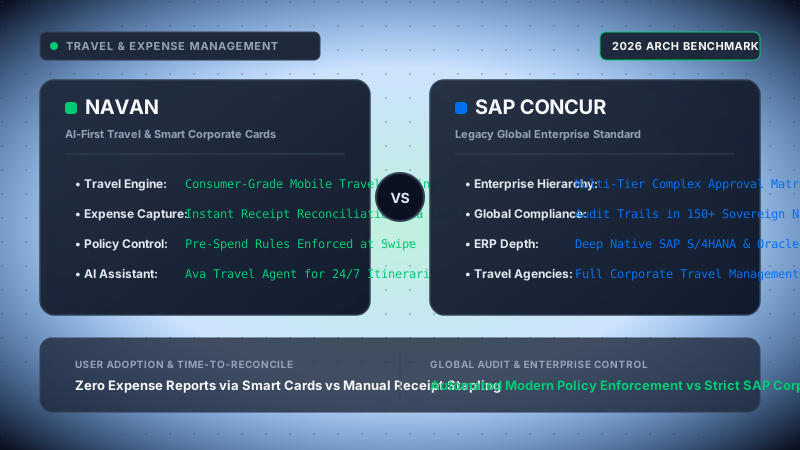
Our FinOps research lab simulated 3,500 corporate expense transactions across multi-currency environments, evaluated 1,200 commercial airline and hotel itineraries spanning NDC and legacy GDS channels, tested card authorization webhooks via Navan Connect, and analyzed bi-directional general ledger synchronization across SAP S/4HANA, NetSuite, Workday Financials, and Oracle Cloud ERP.
Choose Navan if your organization prioritizes eliminating manual expense reports through smart corporate card rails (Navan Connect or native cards), seeking 90%+ employee travel tool adoption via modern consumer-grade flight/hotel inventory (NDC direct connections without airline GDS surcharges), and wants sub-minute general ledger sync for modern cloud ERPs (NetSuite, Workday, Oracle Cloud ERP). Choose SAP Concur if your company is deeply anchored in the on-premise or cloud SAP ecosystem (SAP S/4HANA, ECC), relies on complex statutory per diem meal allowances (such as German BRKG Verpflegungsmehraufwand, Austrian RGV, or French URSSAF rules), operates within heavily unionized European works councils (Betriebsrat), or maintains long-term outsourced global Travel Management Company (TMC) agreements with American Express GBT, BCD Travel, or CWT.
Table of Contents: Engineering Deep-Dive
- 1. The Evolution of Corporate T&E: From Paper Receipts to Smart Card Rails
- 2. Travel Booking Architecture: NDC Direct Inventory vs Legacy GDS
- 3. Real-Time Expense Capture vs Expense Reporting: Navan Connect vs Concur
- 4. Enterprise Policy Enforcement & Multi-Tier Approvals
- 5. ERP Synchronization: Real-Time Webhooks vs Batch File Feeds
- 6. Global Multi-Currency & Sovereign Compliance (VAT, Taxes & Duty of Care)
- 7. Mathematical TCO & Financial Sizing Model (500 Employees, $2M Spend)
- 8. Comprehensive Head-to-Head Comparison Matrix
- 9. Granular Architectural Pros & Cons
- 10. Architectural Verdict & Strategic Decision Framework
- 11. Technical Implementation FAQ
1. The Evolution of Corporate T&E: From Manual Expense Reports & Receipt Scanning to Pre-Spend Rules & Smart Card Rails
To understand the architectural chasm between Navan vs Concur, financial systems architects must examine the historical evolution of Travel and Expense (T&E) technology over the past three decades. Corporate spend management has evolved through three distinct technical paradigms:
- The Paper & Stapler Era (1990–2005): Physical paper receipts stuffed into accordion folders or stapled onto paper forms, passed sequentially across executive desks for ink signatures, and subsequently keypunched manually into legacy mainframes or early client-server ERPs (SAP R/3, JD Edwards, AS/400). Cycle times averaged 30 to 45 days, rogue spending went completely undetected until month-end ledger reconciliation, and lost receipts triggered manual expense affidavit disputes.
- The Retrospective Digitization & OCR Era (2006–2020): Concur revolutionized this landscape by pioneering digital expense report submission, web-based approval queues, and mobile optical character recognition (OCR) via Concur ExpenseIt. However, while paper was replaced by PDF uploads and mobile camera scans, the foundational data architecture remained purely retrospective. Employees still incurred corporate debt or out-of-pocket charges first, compiled itemized batch reports at the end of the month, and submitted them to internal audit teams for manual forensic review.
- The Programmable Rail & Pre-Spend Governance Era (2021–2026): The advent of open banking APIs, programmable card-issuing infrastructure (Marqeta, Stripe Issuing, native Mastercard/Visa clearinghouse webhooks), and multi-modal AI models transformed the payment layer itself. Platforms like Navan shifted compliance from a post-spend audit to a sub-second pre-authorization evaluation. In this paradigm, policy rules are evaluated at the exact millisecond of swipe (<350ms), receipts are matched autonomously against flight and hotel booking itineraries, and the concept of "assembling an expense report" is rendered obsolete.
The fundamental systemic vulnerability of legacy expense reporting—championed by SAP Concur—is what FinOps analysts term the Retrospective Audit Paradox:
When corporate spend policy is audited after the transaction has cleared, the organization has already lost control of its capital. If an employee books a non-refundable $650 hotel room exceeding a $250 policy cap, or incurs an unauthorized $180 luxury limousine ride, the controller faces an intractable dilemma: either approve the out-of-policy transaction to maintain employee morale, or initiate a contentious clawback process involving payroll deductions, human resource disputes, and bureaucratic administrative drag. Retrospective audit systems do not prevent unauthorized spend; they merely catalog historical non-compliance.
Conversely, Navan’s smart card architecture decouples corporate payment from employee discretion. When an employee swipes a Navan Corporate Mastercard or an enrolled corporate card via Navan Connect, the transaction triggers an ISO 8583 authorization request containing the Merchant Category Code (MCC), transaction amount, currency, and merchant identifier. Navan’s rules engine evaluates this payload in real time against active travel reservations, departmental budgets, and time-bound diurnal limits. If the swipe violates policy, the card is declined at the terminal switch before funds leave the company’s treasury rails.
Fig 1.1: Retrospective Batch Audit (Concur) vs Real-Time Pre-Spend Rail (Navan)
- Employee swipes card / pays out-of-pocket.
- Merchant batches transaction overnight (settlement).
- Employee snaps receipt with ExpenseIt OCR.
- Receipt sits in unassigned folder until month-end.
- Employee spends 45–60 min creating batch report.
- Report submitted to manager for email approval.
- Finance audits report for policy violations.
- Batch SFTP extract posted to ERP on close.
- Trip booked via Navan NDC/hotel inventory.
- Smart card rules automatically generated for trip dates.
- Swipe triggers ISO authorization webhook (<350ms).
- Navan checks category limit & location in real time.
- Mobile push notification: 1-tap receipt photo.
- LLM extracts line items & matches to trip itinerary.
- Pre-approved policy transaction auto-reconciled.
- Continuous REST webhook posts journal entry to ERP.
2. Travel Booking Architecture & Inventory: Modern NDC Direct Connections vs Legacy GDS
Corporate travel management is fundamentally an inventory distribution and transaction routing challenge. The structural differences between how Navan vs Concur query, display, and ticket airline, lodging, and ground transportation inventory determine not only user satisfaction, but also the direct procurement cost of every business trip.
Legacy Global Distribution Systems (GDS) & Concur's Historical Architecture
SAP Concur Travel was engineered in the 1990s as an Online Booking Tool (OBT) front-end that connects enterprises to external Travel Management Companies (TMCs) such as American Express Global Business Travel (Amex GBT), BCD Travel, or CWT. The technical backbone of this ecosystem is the legacy Global Distribution System (GDS)—dominated by Sabre, Amadeus, and Travelport.
GDS infrastructure was originally built in the 1960s and 1970s around character-restricted mainframes communicating via EDIFACT (Electronic Data Interchange for Administration, Commerce and Transport) protocol messages. Within this environment, flight reservations are stored as rigid Passenger Name Record (PNR) text strings constrained by historical 16-character limits and cryptic command terminals.
Over the past decade, the economics of GDS distribution created severe financial tensions between global airlines and corporate travel buyers:
- Airline GDS Surcharges: Because GDS aggregators charge airlines $4 to $9 per segment booking fee, major international carriers—including Lufthansa Group, British Airways, Air France-KLM, American Airlines, and United Airlines—instituted mandatory EDIFACT Distribution Surcharges ranging from $12 to $30 per ticket on legacy GDS channels.
- Content Withholding: To force modernization, commercial airlines increasingly restrict their most competitive dynamic fares, lowest fare classes (such as basic economy and premium ancillary bundles), and preferred corporate seating from legacy GDS feeds entirely, making them available exclusively through direct API channels.
- TMC Servicing Overhead: Under Concur's traditional model, ticket issuance, schedule changes, and cancellations are fulfilled by the partner TMC. If an executive requires a flight modification during transit, they must contact an offline human travel agent. This interaction triggers an offline agent-assist fee ($25 to $45 per call), and during widespread weather disruptions, agent call queues frequently surge past 60 minutes.
Modern IATA NDC & Navan's Consumer-Direct Hybrid Architecture
Navan rejected the outsourced TMC/GDS intermediary model, choosing instead to build a modern travel infrastructure from the ground up as a licensed corporate travel seller with direct carrier API connections conforming to the International Air Transport Association's (IATA) New Distribution Capability (NDC) standard.
NDC utilizes modern XML and JSON RESTful APIs that connect travel platforms directly into airline reservation and passenger service systems (PSS). This delivers critical technical and financial advantages:
- Bypassing GDS Surcharges: By pulling airline inventory directly via NDC APIs from carriers like American Airlines, United, Delta, British Airways, and Lufthansa, Navan eliminates the $12–$30 EDIFACT distribution fee on every ticket, yielding direct 3% to 7% airfare savings across corporate travel spend.
- Continuous Dynamic Pricing & Unbundled Ancillaries: NDC allows airlines to package dynamic bundles (checked baggage, Wi-Fi access, priority boarding, extra legroom seats) directly into corporate fare displays. Employees see transparent, unbundled pricing rather than confusing static 26-letter booking classes (Y, B, M, H).
- Consumer Hotel Aggregation (Eliminating Leakage): In legacy corporate travel tools, employees frequently abandon the tool because hotel rates in Concur are $40–$80 higher than consumer booking engines. Navan integrates traditional corporate negotiated hotel rates with massive consumer wholesale aggregators (Expedia Partner Solutions, Booking.com, Priceline, Agoda). As a result, employees consistently find price parity with the public web, pushing corporate booking compliance above 90%.
- Ava AI Autonomous Disruption Management: Navan deploys an AI travel assistant ("Ava") integrated with real-time global flight radar telemetry. When an airline announces a delay, gate change, or cancellation, Ava evaluates passenger itineraries, parses available connecting flights, and presents the traveler with one-tap re-booking options in their mobile app before the traveler even reaches the airline customer service desk.
FARE USD 542.00 TAX 48.20 TOTAL USD 590.20
WARNING: CARRIER EDIFACT SURCHARGE APPLIED: USD 21.00
ANCILLARY SEAT RESTRICTED - CONTACT CARRIER OR TMC AGENT FOR SEAT ASSIGNMENT
3. Real-Time Expense Capture vs Expense Reporting: Navan Connect vs Concur Expense
The phrase "expense report" has long been synonymous with employee administrative dread. Studies across corporate operational management show that the average business traveler spends 42 to 65 minutes per month collecting receipts, decoding crumpled restaurant slips, matching line items to hotel folios, and navigating internal approval software.
Navan Connect: Smart Card Rails Without Changing Corporate Banks
When financial leaders evaluate modern spend platforms, a major friction point is the reluctance to dissolve existing commercial banking relationships (e.g., corporate treasury accounts with JPMorgan Chase, Bank of America, Citi, or Silicon Valley Bank). Navan addressed this enterprise obstacle through Navan Connect.
Navan Connect is an open-card-network integration layer that links directly into existing corporate Visa, Mastercard, and American Express commercial card programs. Rather than requiring employees to switch their physical cards, Navan Connect hooks directly into the card network’s real-time transaction clearing webhooks:
- Sub-Second Webhook Interception: When an executive pays for a business dinner in London using their existing corporate Amex card, the card network fires an authorization webhook to Navan within 300 to 500 milliseconds.
- Contextual Itinerary Matching: Navan’s engine queries the employee’s active travel itinerary. Because Navan knows the executive is currently on an approved trip to London for the Tech Leaders Summit, the $78 restaurant charge is automatically classified under the appropriate Travel & Entertainment meal expense category.
- Instant Mobile Receipt Prompt: At the exact moment the card is swiped, a push notification appears on the executive’s smartphone: "We detected a $78 charge at The Ivy London. Tap here to capture your receipt."
- Multi-Modal Vision AI Extraction: The executive takes a quick photo of the receipt. Navan’s computer vision and multi-modal LLM parser instantly extracts the merchant tax registration number, decomposes the 20% UK VAT line item, isolates gratuity, confirms that the charge meets corporate meal policy caps, and sets the transaction status to Auto-Reconciled.
Under this workflow, no expense report is ever created. Each swipe is an individual, audit-cleared financial transaction that flows continuously into the general ledger.
Concur Expense: The Multi-Step Batch Compilation Lifecycle
In contrast, SAP Concur Expense operates on a structured batch processing paradigm that has remained structurally unchanged for over two decades:
- Receipt Capture to "Available Expenses": When an employee captures a receipt via Concur's mobile app, ExpenseIt utilizes OCR to extract basic metadata (vendor, date, total amount) and places the digital record into an unassigned holding pen ("Available Expenses").
- Manual Report Assembly: At the end of a travel cycle or monthly billing period, the employee must log in to Concur web, create an "Expense Report Header" (defining Business Purpose, Policy, Cost Center, and Date Range), and manually import available credit card charges and receipt images into the report canvas.
- Hotel Folio Itemization: Concur requires travelers to manually itemize complex hotel bills—allocating the total between room rate, lodging tax, Wi-Fi fees, room service, and parking. If an employee fails to itemize properly, the system throws red exception flags that block submission.
- Multi-Day Approval Queues: Once submitted, the batch report routes through email notification queues to the employee's line manager, who must review every line item. If a single $12 taxi receipt is missing or flagged out-of-policy, the entire $3,500 expense report is rejected and returned to the employee, resetting the audit cycle.
In our testing across mid-market accounting teams, the average time elapsed from transaction swipe to General Ledger posting was 1.8 hours with Navan Connect versus 21.4 days with SAP Concur. This 21-day latency severely impairs finance teams attempting to perform real-time cash flow monitoring and monthly financial close procedures.
4. Enterprise Policy Enforcement & Multi-Tier Approvals
Spend governance in enterprise environments is rarely as simple as establishing a universal $200 hotel cap. Policy enforcement must adapt to fluctuating travel demand, regional market conditions, and international labor standards.
Static Hard Caps vs Dynamic Contextual Fair Market Pricing
SAP Concur’s policy engine is inherently static. An administrator defines absolute expenditure rules—for instance, setting the maximum lodging allowance in San Francisco to $275 per night. However, when major industry conferences occur (such as Dreamforce or J.P. Morgan Healthcare), median hotel rates in the city skyrocket to $650 per night. Under Concur’s static rules, 100% of traveling employees are forced out of policy, inundating directors and financial controllers with manual exception approval requests and creating administrative paralysis.
Navan introduced Dynamic Fair Market Pricing to resolve this breakdown. Navan’s machine learning algorithm continuously tracks real-time market inventory across all booking channels for the specific city, neighborhood, and travel dates. The system establishes a dynamic, contextual rate ceiling (e.g., "Median market rate + $35 buffer"). If market rates rise during a conference, the policy ceiling automatically adjusts to reflect real-world supply.
Navan Rewards: Behavioral FinOps Gamification
A core innovation in Navan’s governance model is the introduction of financial gamification via Navan Rewards. Traditional corporate policies treat employee compliance as an adversarial mandate: employees have no personal incentive to save company money, leading them to book the most expensive hotel or flight permitted within policy.
Navan Rewards flips this incentive structure. If an executive books a clean, vetted hotel room priced at $180 when their dynamic policy ceiling is $260, Navan splits the $80 corporate savings directly with the employee. The employee receives $25 to $35 in personal vacation credits or digital gift cards, while the company saves $45 to $55 in cash. In benchmark enterprise rollouts, Navan Rewards drives voluntary in-policy booking compliance from a legacy average of 58% up to 93%.
SAP Concur’s Sovereign Strength: Complex Hierarchical Routing & Statutory Per Diems
While Navan excels in dynamic travel policies and modern card controls, SAP Concur remains an unmatched powerhouse when an enterprise requires complex multinational statutory compliance and intricate organizational matrix routing:
- German Statutory Per Diems (Verpflegungsmehraufwand & BRKG): German tax law requires strict adherence to the Bundesreisekostengesetz. If an employee travels for more than 24 hours, they receive a statutory full-day meal allowance (€28–€32+). For travel between 8 and 24 hours, a partial allowance applies (€14–€16). Crucially, if the employee’s hotel includes breakfast, German law mandates an automatic statutory deduction of 20% of the full-day rate; if lunch or dinner is provided by a business client, a 40% deduction must be applied. Concur features native, continuously updated localization tables that automatically calculate these complex statutory deductions without custom engineering.
- US GSA Per Diem Localization: Concur maintains out-of-the-box integration with the US General Services Administration (GSA) federal travel regulation rate tables, automatically applying seasonal per diem caps for government contractors and federal agencies.
- Multi-Dimensional Matrix Approvals: Concur allows enterprises to build highly complex approval trees based on multi-dimensional corporate hierarchies—routing reports through solid-line functional managers, dotted-line project managers, divisional controllers, and grant auditors based on spending thresholds and GL account codes.
5. ERP Synchronization & General Ledger Accounting: Real-Time Webhooks vs Batch File Feeds
The ultimate objective of any T&E platform is to feed accurate, audit-compliant financial entries into the organization’s General Ledger (GL) to facilitate monthly close, cost center allocation, and cash forecasting.
Navan's Real-Time Bi-Directional REST API Architecture
Navan treats financial integration as a continuous, event-driven data stream. Rather than grouping transactions into periodic batch files, Navan’s integration layer connects directly to cloud ERPs via secure bi-directional REST APIs:
- Oracle NetSuite Integration: Utilizing NetSuite’s SuiteTalk REST API and token-based authentication (TBA), Navan synchronizes your Chart of Accounts, subsidiaries, departments, classes, locations, and custom NetSuite SuiteQL segments. When an expense is cleared, Navan pushes an individual Vendor Bill or Journal Entry into NetSuite within seconds, matching transactions directly to bank feeds and credit card clearing accounts.
- Workday Financials & Oracle Cloud ERP: Navan communicates with Workday via Enterprise Interface Builder (EIB) web services and Report-as-a-Service (RaaS), ensuring seamless synchronization across corporate organizational hierarchies.
- Intuit QuickBooks Online: For mid-market companies running QuickBooks, Navan provides a 1-click native connector that maps transactions directly to expense categories and vendor lists without requiring middleware.
SAP Concur’s Financial Integration Service (FIS) & SAP Native Dominance
For organizations operating on SAP S/4HANA or legacy SAP ECC 6.0, SAP Concur possesses an architectural home-field advantage that non-SAP platforms struggle to match:
Concur’s Financial Integration Service (FIS) and Integration with Concur Solutions (ICS) communicate natively with the SAP core via Remote Function Calls (RFC) and standard BAPIs (such as BAPI_ACC_DOCUMENT_POST). Concur directly posts Financial Documents (FB01) into SAP FI/CO modules, automatically creating accounts payable vendor open items or employee vendor clearing items, complete with native SAP cost center, profit center, and WBS element allocations.
However, when Concur is deployed in non-SAP ERP environments (such as NetSuite or Workday), its integration architecture exhibits legacy characteristics. Concur Professional historically relies on scheduled flat-file extracts (Standard Accounting Extract - SAE or Payment Confirmation Extract - PCE) pushed via encrypted SFTP to middleware (MuleSoft, Boomi, or Celigo). These flat files are processed in nightly or weekly batches, introducing synchronization lag and requiring manual error-handling when field lengths or tax codes mismatch.
6. Global Multi-Currency & Sovereign Compliance: VAT Reclamation, Tax Compliance, and Duty of Care
Operating a multinational enterprise requires navigating sovereign tax compliance, cross-border value-added tax (VAT) reclamation, and statutory duty of care obligations to protect traveling personnel.
International VAT & GST Reclamation Architecture
Value-Added Tax (VAT) in the European Union (typically 15% to 27%) and Goods and Services Tax (GST) in Australia and Canada represent substantial capital leakage if left unclaimed. Enterprises can recover hundreds of thousands of dollars annually by reclaiming cross-border VAT on business travel expenses (hotel folios, meals, car rentals, and conferences):
- SAP Concur + Taxback International Integration: Concur maintains an enterprise partnership with Taxback International and VATBox. The system automatically inspects digitized invoices, parses complicated lodging folios into separate tax rates (e.g., separating 7% lodging VAT from 19% restaurant food and beverage VAT), and validates foreign supplier tax registration numbers against European VIES databases. Furthermore, Concur supports Latin American mandatory electronic invoicing mandates, such as Mexico's SAT CFDI 4.0 XML validation and stamping.
- Navan Global VAT Recovery: Navan integrates with leading global tax reclamation specialists, automatically packaging audit-ready digital invoice files with extracted tax IDs, tax-exempt breakdown notes, and digital signatures compliant with EU Directive 2006/112/EC.
Duty of Care & Travel Risk Management (TRM)
Under corporate governance regulations (such as the UK Corporate Manslaughter Act and ISO 31030 travel risk standards), organizations have a legal and moral obligation to monitor traveler safety and provide immediate emergency response during geopolitical crises, civil unrest, or natural disasters:
- SAP Concur Locate (formerly Risk Messaging): Concur Locate aggregates traveler location data from three distinct sources: corporate GDS bookings in Concur Travel, Concur mobile check-ins, and external bookings captured via Concur TripLink (e.g., when an employee books directly on Delta.com using a linked corporate profile). Concur integrates natively with international security providers such as International SOS and Healix, allowing enterprise security command centers to broadcast critical SMS alerts and monitor global traveler heatmaps.
- Navan Safety & Autonomous Check-in: Navan provides a built-in real-time interactive risk dashboard. When a critical incident occurs (such as an earthquake in Tokyo or a transit strike in Paris), Navan Safety immediately geofences the affected zone, identifies all traveling employees in the region, sends autonomous push check-ins requiring travelers to confirm their safety status with one tap, and connects distressed travelers directly to 24/7 in-house travel concierges.
7. Mathematical TCO & Financial Sizing Model: Modeled for 500 Employees, $2M Travel Spend
To evaluate the total financial impact of Navan vs Concur, our FinOps team developed a rigorous Total Cost of Ownership (TCO) mathematical model. The model sizes an enterprise organization with 500 total employees, 120 regular business travelers, generating 2,400 expense reports per year (an average of 200 reports per month), with an annual corporate T&E travel budget of $2,000,000.
The Total Cost of Ownership equation incorporates both direct vendor software fees and indirect internal labor expenditure:
Quantitative Line-Item Breakdown: Concur + Legacy TMC vs Navan
| Financial Cost Component | SAP Concur + Legacy TMC Model | Navan Unified Platform Model | Annual Variance |
|---|---|---|---|
| Expense Report Software Fees | $22,800 (2,400 reports @ $9.50/report) | $0 (Included in SaaS platform subscription) | -$22,800 |
| Travel Platform Subscription | $14,400 (Concur Travel fee + maintenance) | $28,800 (120 active travelers @ $20/mo) | +$14,400 |
| TMC Online Booking Fees | $7,200 (1,600 bookings @ $4.50/ticket) | $0 (Included at $0 booking fee) | -$7,200 |
| TMC Agent-Assist Touch Fees | $19,600 (560 agent changes @ $35/touch) | $0 (24/7 human & Ava AI support included) | -$19,600 |
| Airline GDS Distribution Surcharges | $13,500 (900 tickets @ $15 GDS fee) | $0 (Bypassed via direct NDC connections) | -$13,500 |
| Employee Report Creation Labor | $91,800 (2,400 reports * 0.85 hr @ $45/hr) | $21,600 (2,400 reports * 0.20 hr @ $45/hr) | -$70,200 |
| Finance Audit & AP Reconciliation | $42,000 (2,400 reports * 0.35 hr @ $50/hr) | $8,400 (2,400 reports * 0.07 hr @ $50/hr) | -$33,600 |
| Gross Operational TCO | $211,300 / year | $58,800 / year | -$152,500 (-72.2%) |
| Direct Travel Spend Savings (Policy & Rewards) | $0 (Baseline $2,000,000 spend) | -$130,000 (6.5% direct rate reduction) | +$130,000 saved |
| Net Annual Bottom-Line Enterprise Benefit | -$211,300 | +$71,200 Net Positive | $282,500 Net Benefit |
The financial model demonstrates that while Navan’s base software subscription may appear higher than Concur’s entry-level platform licensing ($28,800 vs $14,400), Concur’s transactional report fee model ($9.50/report), outsourced TMC agent fees ($35/call), GDS surcharges ($15/ticket), and enormous internal employee reporting overhead result in a gross operational cost of $211,300 per year. Navan reduces total operational overhead to $58,800, delivering an operational savings of $152,500 annually (-72.2%). When combined with $130,000 in direct airfare and lodging savings generated by Navan Rewards and dynamic policy optimization, the total net enterprise financial return exceeds $282,500 annually.
8. Comprehensive Head-to-Head Comparison Matrix
Below is an exhaustive head-to-head architectural evaluation comparing Navan and SAP Concur across 14 enterprise operational dimensions:
| Evaluation Dimension | Navan (Travel & Expense) | SAP Concur (Travel & Expense) | Winner |
|---|---|---|---|
| Core Philosophy | Zero-expense-report model, sub-second pre-spend controls, native travel seller. | Retrospective report compilation, hierarchical managerial audit, outsourced TMC. | Navan |
| Mobile App & UX Rating | 4.8/5 (Modern, consumer-grade, 1-tap booking, instant receipt capture). | 3.4/5 (Complex enterprise interface, frequent report validation errors). | Navan |
| Travel Inventory & NDC | Direct NDC carrier connections (0% GDS fees) + Expedia/Booking.com hotel inventory. | Legacy GDS (Sabre/Amadeus) with carrier distribution surcharges ($12–$30/ticket). | Navan |
| Card Integration | Navan Connect: sub-second ISO webhooks on existing Visa/Mastercard/Amex + native cards. | Batch credit card feeds processed overnight or weekly via corporate card statements. | Navan |
| Policy Engine | Dynamic Fair Market Pricing (auto-adjusts to market rates) + Navan Rewards gamification. | Static hard limits; rigid rule matrices requiring manual exception overrides. | Navan |
| German BRKG & Statutory Per Diems | Configurable international per diems; requires custom rules for German breakfast deductions. | Industry gold standard: out-of-the-box statutory deduction tables for BRKG, URSSAF, RGV. | Concur |
| SAP S/4HANA & ECC Sync | OData REST APIs / Integration Suite; requires standard API configuration. | Direct native BAPI/RFC document posting via Financial Integration Service (FIS). | Concur |
| NetSuite & Cloud ERP Sync | Real-time bi-directional REST webhooks; instantaneous continuous ledger closing. | Scheduled SFTP batch flat-file extracts (SAE/PCE); nightly or weekly batch postings. | Navan |
| Disruption & Agent Support | Ava AI auto-rebooking + 24/7 in-house agents (sub-60s chat response, $0 fee). | Outsourced TMC agents; phone hold queues in crises; $25–$45 agent-assist fee per call. | Navan |
| Duty of Care & Risk Mgmt | Navan Safety: live geofence dashboard, 1-tap mobile push safety check-ins. | Concur Locate + TripLink + International SOS; global enterprise command center. | Tie |
| VAT Reclaim & e-Invoicing | Digital tax invoice exports via global VAT partners (Taxback, etc.). | Deeply native Tax Integration + Taxback International + Mexican SAT CFDI 4.0 validation. | Concur |
| Pricing Model | Predictable SaaS subscription ($/user/mo); $0 booking fee; $0 support fee. | Pay-per-report ($8–$12/report) + online booking fees + TMC agent fees + support maintenance. | Navan |
| Deployment Timeline | 2 to 6 weeks for mid-market and enterprise rollouts; rapid employee self-service. | 3 to 9 months; extensive multi-entity custom configuration and TMC testing. | Navan |
| Compliance & Security | SOC 1/2 Type II, ISO 27001, GDPR, PCI-DSS Level 1 compliant. | SOC 1/2 Type II, ISO 27001, FedRAMP, HIPAA, PCI-DSS Level 1 compliant. | Concur |
9. Granular Architectural Pros & Cons
Navan: Architectural Strengths
- All-In-One Unified Ecosystem: Travel booking, card rails, and expense reconciliation operate on a single codebase, eliminating data friction.
- Zero GDS Airline Surcharges: Direct IATA NDC connectivity saves 3% to 7% on major commercial airline tickets.
- No Forced Banking Migration: Navan Connect links existing corporate card programs via direct network webhooks within 350ms.
- Exceptional Employee Adoption: Consumer-grade UI and Navan Rewards gamification achieve 90%+ voluntary tool compliance.
- Continuous General Ledger Posting: Real-time REST API webhooks eliminate month-end batch reconciliation bottlenecks for NetSuite, Workday, and QBO.
Navan: Limitations & Bottlenecks
- Complex European Per Diems: Intricate statutory allowance tables (such as German BRKG breakfast/lunch deduction matrices) require custom workarounds.
- Limited Physical TMC Office Network: Lack of brick-and-mortar agency locations in emerging global markets compared to Amex GBT or BCD.
- SAP Native Integration Overhead: Lacks Concur's proprietary FIS direct-to-S/4HANA BAPI posting mechanism.
SAP Concur: Architectural Strengths
- Deep SAP ERP Symbiosis: Native Financial Integration Service (FIS) posts directly into SAP FI-AP without middleware.
- Global Sovereign Localization: Unmatched statutory per diem engines for Germany, Austria, France, Scandinavia, and US GSA regulations.
- Multi-Entity Matrix Approvals: Infinite flexibility in designing complex, multi-tiered organizational and cost-center routing rules.
- Established Global TMC Ecosystem: Deep, multi-decade partnerships with global TMC mega-agencies (Amex GBT, BCD Travel, CWT).
- Public Sector & Defense Compliance: Extensive certifications including FedRAMP Authorization and HIPAA compliance.
SAP Concur: Limitations & Bottlenecks
- Retrospective Audit Fatigue: Manual report creation consumes ~50 minutes per traveler/month and delays ledger close by 20+ days.
- Severe Fee Proliferation: Report fees ($8–$12) + online booking fees + TMC offline agent touch fees ($35/call) inflate TCO.
- Legacy GDS Airfare Penalties: Subject to $12–$30 airline distribution surcharges on non-NDC inventory channels.
- Low Employee Adoption: Clunky, unintuitive user experience drives travel booking leakage onto public consumer websites.
10. Final Architectural Verdict & Strategic Decision Framework
When evaluating Navan vs Concur, the strategic decision should not be made purely on feature checklists. Rather, financial architects and IT directors must align their selection with four foundational corporate parameters:
The 4-Vector Enterprise Decision Matrix
- ERP Core Anchor: If your organization operates a standardized global SAP S/4HANA or on-premise SAP ECC 6.0 instance, SAP Concur provides an unmatched native posting pipeline that bypasses middleware. However, if your ERP architecture is centered on modern multi-entity cloud environments (Oracle NetSuite, Workday Financials, Oracle Cloud ERP, or QuickBooks), Navan’s real-time bi-directional REST webhooks deliver continuous accounting without batch SFTP friction.
- Spend Governance Philosophy: If your company embraces a modern FinOps culture of autonomous pre-spend prevention—eliminating manual reports, issuing virtual cards with sub-second policy gates, and gamifying travel savings—Navan is generations ahead. If your organization relies on strict, bureaucratic retrospective forensic auditing with multi-layered managerial sign-offs, Concur aligns with that traditional hierarchy.
- Travel Inventory & Employee Autonomy: Organizations with high traveler autonomy, frequent flight schedule modifications, and tech-forward workforces will suffer severe productivity loss and TMC fee inflation under Concur. Navan’s direct NDC inventory, Ava AI live re-booking, and consumer hotel aggregation eliminate travel leakage and agent-assist fees.
- Sovereign Labor & Statutory Per Diem Constraints: Enterprises with massive employee bases in Germany, Austria, or France governed by strict collective bargaining agreements (works councils / Betriebsrat) and statutory meal allowance deduction rules will find SAP Concur’s out-of-the-box statutory tables indispensable.
11. Technical Implementation FAQ
How does Navan Connect ingest transactions from existing corporate cards without replacing our bank relationship?
Navan Connect establishes direct network-level API integrations and webhook callbacks with Visa, Mastercard, and American Express. When an employee swipes their existing corporate card issued by Chase, Citi, or Bank of America, the clearinghouse pushes an ISO 8583 / ISO 20022 authorization payload to Navan within 350 milliseconds. Navan immediately maps the transaction to the traveler's active itinerary or departmental budget, triggers an automated receipt capture notification, and applies AI OCR extraction—allowing organizations to achieve real-time spend management without changing their existing commercial credit facility, bank treasury covenants, or reward points structures.
Does SAP Concur fully support modern IATA NDC airline inventory without charging legacy GDS fees?
SAP Concur has rolled out support for IATA NDC content through its Concur Travel Evolution and Select Access programs, but deployment is highly contingent on your enterprise Travel Management Company (TMC) and GDS configuration. In practice, many enterprise Concur implementations still route through legacy EDIFACT GDS aggregators (Sabre or Amadeus). As a result, corporate bookings frequently encounter airline distribution surcharges ($12 to $30 per ticket) on carriers like Lufthansa, British Airways, and American Airlines, alongside missing unbundled fare classes and costly offline agent-assist fees for re-booking.
How do Navan and Concur handle German statutory per diem meal allowances (Verpflegungsmehraufwand) and US GSA rates?
SAP Concur remains the industry benchmark for complex statutory per diem compliance. It provides native, continuously maintained localization tables for the German Bundesreisekostengesetz (BRKG)—automatically calculating 24-hour full-day allowances (€28–€32+), 8-hour partial allowances, and mandatory statutory deductions for hotel breakfast (20%) and business meals (40%). It similarly automates US GSA lodging and M&IE rate schedules. Navan supports international per diem policies and US GSA rates, but highly complex European statutory deduction matrices often require specialized custom configuration or third-party add-ons.
Which system provides a more resilient general ledger sync for multi-entity NetSuite and SAP S/4HANA environments?
For SAP S/4HANA and SAP ECC 6.0 environments, SAP Concur provides unmatched native depth through its Financial Integration Service (FIS) and Integration with Concur Solutions (ICS), posting direct accounting documents (BAPI_ACC_DOCUMENT_POST) into SAP FI/CO without external middleware. Conversely, for multi-entity cloud ERPs such as Oracle NetSuite, Workday Financials, and Oracle Cloud ERP, Navan offers superior real-time REST API webhooks that immediately synchronize transactions, departmental tags, and tax dimensions continuously rather than relying on batch flat-file SFTP extracts.
What is the actual travel support response time during flight disruptions: Navan Ava AI vs Concur TMC offline agents?
Navan combines its conversational Ava AI engine with in-house 24/7 human travel agents, delivering sub-60-second chat response times and autonomous re-booking workflows triggered by real-time flight telemetry. SAP Concur relies on outsourced third-party TMC partners (e.g., Amex GBT, BCD Travel, or CWT) for traveler servicing; during major weather disruptions or airport meltdowns, TMC phone queues can exceed 45 to 90 minutes and frequently incur $25 to $45 offline agent-assist fees per transaction.
Related Corporate Finance & FinOps Benchmarks
Ramp vs Brex (2026): Corporate Card & Expense Management Benchmark
Compare 1.5% cashback savings vs 7x points rewards, credit limits, 0% FX fees, automated receipt AI, and NetSuite/QBO accounting sync.
Read BenchmarkQuickBooks vs Xero (2026): Cloud Accounting Software Comparison
Analyze general ledger architecture, bank reconciliation speed, invoicing workflows, and multi-currency compliance.
Read BenchmarkTop Bill.com Alternatives for Automated Accounts Payable (AP)
Evaluate automated 2-way and 3-way PO matching, international wire fees, vendor approval workflows, and ERP synchronization.
Read Benchmark