
Vantage vs CloudZero: Cloud Cost & FinOps Benchmark (2026)
The enterprise FinOps landscape in 2026 has irrevocably evolved past static PDF cloud bills, rudimentary cost dashboards, and generic rightsizing recommendations. As cloud architectures fragment across multi-cloud infrastructure (AWS, GCP, Azure), ephemeral Kubernetes clusters, distributed data warehouses (Snowflake, Databricks), and generative AI API workloads (OpenAI, Anthropic), uncontrolled infrastructure spend threatens corporate operating margins. Choosing between Vantage and CloudZero represents the definitive architectural crossroads for Chief Financial Officers, Heads of Platform Engineering, and FinOps practitioners navigating this cloud cost complexity.
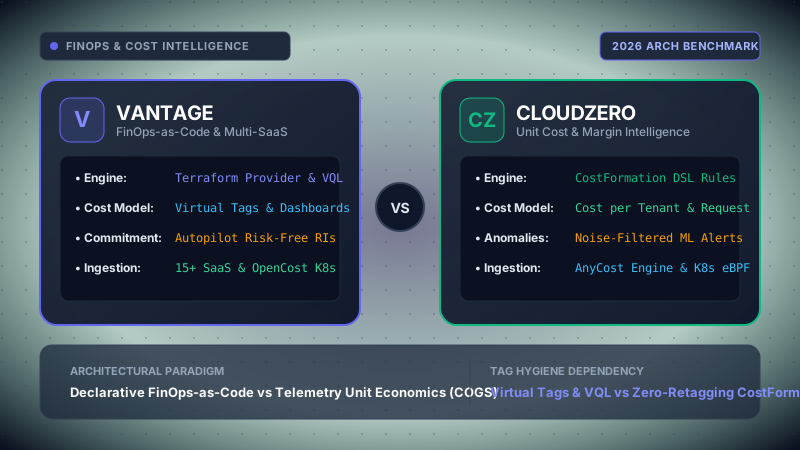
Our FinOps evaluation lab established an annualized $4.2M multi-cloud reference architecture running across Amazon Web Services (EKS, Aurora PostgreSQL, S3, DynamoDB, SageMaker), Google Cloud Platform (BigQuery, GKE), Snowflake Enterprise, Datadog APM, and OpenAI API endpoints. We benchmarked telemetry ingestion latency, untagged resource allocation accuracy, Kubernetes container CPU/memory attribution, anomaly alert noise suppression, and real-world TCO across 12 consecutive billing cycles.
Choose Vantage if your organization prioritizes rapid time-to-value, developer self-service, Infrastructure-as-Code (FinOps-as-Code via Terraform), extensive out-of-the-box SaaS ingestion (Snowflake, Datadog, Databricks, MongoDB, OpenAI), and risk-free automated rate optimization through Vantage Autopilot. Choose CloudZero if your primary objective is enterprise unit economics, Cost of Goods Sold (COGS) attribution per customer tenant, zero-retagging cost governance via its code-driven CostFormation® engine, and eliminating noisy anomaly alert fatigue for engineering teams.
Table of Contents: Engineering Deep-Dive
- 1. The FinOps 3.0 Paradigm Shift: Beyond Legacy CloudHealth
- 2. Telemetry Ingestion Architecture: Terraform vs CostFormation
- 3. The Tagging Dilemma: Virtual Tags vs Code-Driven Allocation
- 4. Unit Economics: Cost per Customer & Margin Engineering
- 5. Kubernetes Container Cost Allocation: OpenCost vs eBPF
- 6. Anomaly Detection ML & Noise-Suppressed Alerting
- 7. Commitment Discounts: Savings Plans vs Vantage Autopilot
- 8. Multi-SaaS, Third-Party Clouds & GenAI Token Billing
- 9. Comprehensive Feature & Benchmark Matrix
- 10. Concrete Mathematical FinOps ROI & TCO Formulas
- 11. Enterprise Security, Code Privacy & Zero Data Retention
- 12. Strategic Decision Framework by Organizational Maturity
- 13. Frequently Asked Technical Questions
1. The FinOps 3.0 Paradigm Shift: Beyond Legacy CloudHealth
For nearly a decade, the first generation of cloud cost management—dominated by legacy solutions such as VMware CloudHealth, Apptio Cloudability, and native cloud billing consoles—focused entirely on static, retroactive reporting. Finance teams received month-end CSV exports or navigated clunky dashboards showing aggregate dollar figures broken down by cloud account or generic service types. Engineering teams treated these reports as noise, routinely ignoring mass email alerts that lacked actionable context or required tedious manual infrastructure refactoring.
By 2026, this legacy paradigm has collapsed under the weight of modern software architecture. Three structural disruptions have transformed enterprise cloud spending into a multi-dimensional, high-velocity engineering problem:
- Infrastructure Ephemerality & Containerization: Microservices deployed on Kubernetes, serverless runtimes (AWS Lambda, Google Cloud Run), and managed worker nodes scale from zero to thousands of pods and back down within minutes. Static hourly billing records fail to capture the dynamic utilization of shared cluster resources.
- Multi-Tenant Shared Resource Fragmentation: Monolithic virtual machines with dedicated IP addresses have been replaced by shared data layers—such as multi-tenant Aurora databases, Kafka/Confluent streaming backbones, Snowflake compute warehouses, and shared AWS NAT Gateways. Traditional billing consoles cannot determine which customer, feature, or engineering squad generated an un-tagged $30,000 inter-AZ data transfer spike.
- Third-Party SaaS & Generative AI Billing Explosion: Infrastructure spend is no longer confined to AWS, Azure, or GCP. Modern software products incur massive monthly bills from external database engines (MongoDB Atlas), observability platforms (Datadog), vector databases (Pinecone), and LLM inference providers (OpenAI API, Anthropic). A FinOps solution that only analyzes AWS Cost and Usage Reports (CUR) ignores 30% to 50% of the true technology bill.
This operational reality defines FinOps 3.0: the convergence of automated real-time telemetry, Infrastructure-as-Code governance, and granular unit economics. Within this modern arena, Vantage and CloudZero have emerged as the two undisputed architectural leaders. However, their internal engineering philosophies diverge fundamentally. Vantage approaches FinOps as a developer-centric, declarative platform designed to integrate into existing CI/CD and Terraform workflows. CloudZero approaches FinOps as an enterprise telemetry transformation problem, designed to calculate unit costs and SaaS gross margins without requiring developers to touch production infrastructure tags.
2. Telemetry Ingestion Architecture: Terraform vs CostFormation
The foundational difference between Vantage and CloudZero originates at the data ingestion layer. How each platform captures, normalizes, and indexes cloud cost data dictates everything from deployment velocity to query flexibility.
Vantage: Declarative FinOps-as-Code & Cross-Account IAM
Vantage is architected with a developer-first ethos, treating cloud financial management with the same declarative rigor as modern infrastructure automation. Onboarding an AWS organization to Vantage is accomplished in under five minutes using a read-only AWS CloudFormation stack or cross-account IAM role. Vantage establishes an external ID trust relationship, requesting minimal read permissions to ingest AWS Cost and Usage Reports (CUR 2.0) via Amazon S3, AWS Organizations metadata, and AWS Resource Groups Tagging APIs.
What elevates Vantage above traditional SaaS tools is its official, HashiCorp-verified Terraform Provider (vantage-sh/vantage). Rather than requiring platform architects to manually configure cost centers, budget thresholds, and report filters within a web UI, teams define their entire FinOps practice declaratively in code:
# Example: Vantage FinOps-as-Code Configuration via Official Terraform Provider
terraform {
  required_providers {
    vantage = {
      source  = "vantage-sh/vantage"
      version = "~> 0.14.0"
    }
  }
}

provider "vantage" {
  api_token = var.vantage_api_token
}

# 1. Define a Saved Filter using Vantage Query Language (VQL)
resource "vantage_saved_filter" "production_compute" {
  title = "Production Compute & Container Workloads"
  query = "costs.provider = 'aws' AND (costs.service = 'Amazon Elastic Compute Cloud - Compute' OR costs.service = 'Amazon Elastic Kubernetes Service') AND tags.environment = 'production'"
}

# 2. Define a Declarative Virtual Tag for Cross-Provider Allocation
resource "vantage_virtual_tag_config" "service_attribution" {
  key = "BusinessUnit"
  overridable = true

  values = [
    {
      name  = "Core-Banking"
      query = "costs.account_id = '112233445566' OR tags.team = 'banking-core'"
    },
    {
      name  = "Fraud-Detection"
      query = "costs.service = 'Amazon SageMaker' OR tags.service = 'fraud-ml'"
    }
  ]
}

# 3. Provision an Automated Cost Report with Slack Alerts
resource "vantage_cost_report" "executive_finops_report" {
  title           = "Monthly Engineering COGS by Business Unit"
  folder_token    = var.finops_folder_token
  saved_filter_tokens = [vantage_saved_filter.production_compute.token]
  chart_type      = "stacked_bar"
  date_interval   = "month"
  groupings       = ["tag:BusinessUnit", "costs.provider"]
}
Under the hood, Vantage processes billing streams into an analytical columnar database engine, providing an expressive, SQL-like query interface known as Vantage Query Language (VQL). VQL enables platform engineers to programmatically filter and aggregate multidimensional metrics across providers with sub-second dashboard query latency.
CloudZero: The Telemetry Streaming & CostFormation® Engine
CloudZero rejected the traditional approach of relying on cloud provider tags or static billing reports. Recognizing that enterprise tagging hygiene is universally broken, CloudZero engineered CostFormation®—a sophisticated, domain-specific language (DSL) and data transformation pipeline that acts as a compiler for cloud spend.
CloudZero connects to cloud environments via read-only IAM roles and event streams (CloudWatch metrics, Kubernetes pod telemetry, CloudTrail audit logs, and CUR data). However, instead of simply visualizing this data, the CostFormation engine ingests these disparate streams into a unified data transformation pipeline. Through CostFormation definitions written in YAML, platform teams define programmatic logic that evaluates resource metadata, naming patterns, VPC subnet IDs, Kubernetes namespaces, and custom business event streams:
# Example: CloudZero CostFormation® Rule Definition
# Dynamically allocates untagged infrastructure, multi-tenant databases, and Kubernetes pods
version: 2
metadata:
  name: "Enterprise-COGS-Allocation"
  description: "Allocates multi-tenant databases and un-tagged network egress to customer tiers"

dimensions:
  - name: "CustomerTier"
    description: "Dynamic business unit attribution without modifying cloud tags"
    rules:
      # Rule 1: Allocate dedicated enterprise accounts directly
      - value: "Enterprise-Dedicated"
        when:
          - account_id: ["987654321098", "456789012345"]

      # Rule 2: Programmatically parse resource naming conventions when tags are missing
      - value: "Growth-Tier"
        when:
          - resource_id: "arn:aws:rds:*:*:cluster:prod-growth-*"
          - tag:env: "production"

      # Rule 3: Deconstruct shared multi-tenant database clusters using telemetry weights
      - value: "Shared-MultiTenant-Platform"
        when:
          - service: "Amazon Relational Database Service"
          - resource_id: "arn:aws:rds:us-east-1:123456789012:cluster:shared-core-db"
        split:
          strategy: "telemetry_metric"
          metric_stream: "telemetry.api_requests_by_customer"
          fallback: "equal_distribution"

      # Rule 4: Catch-all for unallocated infrastructure
      - value: "Unallocated-Overhead"
        default: true
The profound architectural consequence of CostFormation is decoupling: organizations can achieve 100% cost allocation across shared databases, untaggable network infrastructure (such as AWS Transit Gateways and NAT Gateways), and multi-tenant services without demanding that engineering teams file hundreds of Jira tickets to modify Terraform code, rebuild Docker containers, or redeploy production infrastructure.
3. The Tagging Dilemma: Virtual Tags vs Code-Driven Allocation
Every Head of Infrastructure or FinOps manager has experienced the painful reality of "Tagging Enforcement Initiatives." An executive mandate demands that 100% of AWS, GCP, and Azure resources bear compliant tags (e.g., CostCenter, Environment, Owner, TenantID). AWS Service Control Policies (SCPs) and Terraform linters are deployed to block untagged resources.
Yet, six months later, 25% to 40% of the enterprise cloud bill remains unallocated. Why does classical tagging universally fail in enterprise environments?
- Inherently Untaggable Cloud Resources: Cloud providers do not support resource-level tagging on dozens of high-cost services. AWS Inter-AZ and Inter-Region Data Transfer, NAT Gateway processed bytes, CloudWatch metric storage, EBS snapshot transfer, and shared KMS key requests cannot be tagged at the tenant or application level.
- Shared Multi-Tenant Architecture: Modern microservices share infrastructure. A single 16-node Kubernetes cluster, a central Kafka cluster, or an enterprise Redis cache handles transactions for 2,000 distinct B2B customers simultaneously. Placing a static tag like
Customer=AcmeCorpon a shared node is physically impossible. - Tag Drift & Legacy Technical Debt: Cloud migrations span years. Mergers, acquisitions, legacy accounts, and rapid prototype deployments accumulate thousands of untagged resources that developers are terrified to touch in production.
Vantage: Virtual Tags & Dimensions
Vantage addresses tagging gaps through Virtual Tags and Cost Dimensions. Platform teams create logical overlay rules within Vantage that inspect existing provider tags, account IDs, and service categories using regular expressions and fallback cascades:
- Regex Tag Normalization: Maps inconsistent capitalization (e.g.,
env,Env,environment) into a single unified dimension. - Account-Level Inheritance: Automatically attributes all resources inside account
123456789012to theData-Scienceteam if resource-level tags are absent. - Declarative Versioning: Virtual tags can be provisioned via Terraform, allowing infrastructure teams to maintain cost governance in Git.
- Limitation: Virtual tags cannot natively split a single shared resource (like an Aurora database) across multiple tenants unless pre-aggregated usage metrics are explicitly pushed via the Vantage API.
CloudZero: Zero-Retagging Allocation
CloudZero treats tags as merely one of many telemetry signals. With its CostFormation engine, CloudZero achieves 100% allocation without requiring an organization to achieve 100% tagging compliance:
- Multi-Signal Inference: Correlates resource IDs, VPC IDs, subnet CIDR blocks, IAM roles, and CloudTrail event history to deduce resource ownership.
- Dynamic Proportional Splitting: Ingests external telemetry (such as API call counts, query runtimes, or database IOPS) and mathematically divides the dollar cost of shared databases or clusters proportionally.
- Zero Engineering Disruption: Removes the burden of tagging cleanup sprints from product engineering roadmaps, saving hundreds of developer hours annually.
- Limitation: Requires writing and maintaining CostFormation YAML rules, which requires initial architectural onboarding effort.
4. Unit Economics: Cost per Customer & Margin Engineering
In the software industry of 2026, private equity investors, venture capitalists, and public market analysts no longer reward growth at all costs. Enterprise valuations are heavily dictated by gross margin efficiency and Net Revenue Retention (NRR).
Knowing that your AWS bill increased by $45,000 last month is functionally useless to executive leadership. You must answer the underlying unit-level business questions:
- Did our cloud infrastructure cost increase because we onboarded three Fortune 500 customers, or because our backend algorithms became inefficient?
- What is our exact gross margin on Customer X, who pays $120,000/year in ARR but executes 50 million vector search queries per day?
- What is our Cost per Transaction, Cost per Active Tenant, and Cost per API Endpoint?
The Mathematical Unit Cost Allocation Model
To compute true multi-tenant unit economics, a FinOps platform must mathematically solve the shared infrastructure allocation equation for every customer tenant $i$:
$$GrossMargin\%_{tenant_i} = \left( \frac{ARR_{tenant_i} - \left( Cost_{tenant_i} \times 12 \right)}{ARR_{tenant_i}} \right) \times 100$$
Where:
- $\sum_{r \in Dedicated} Cost_r$ represents the dollar cost of cloud resources dedicated exclusively to tenant $i$ (e.g., dedicated S3 buckets, single-tenant worker nodes, isolated database replicas).
- $Cost_s$ represents the total dollar spend of shared infrastructure component $s$ (e.g., a shared Kafka cluster, multi-tenant EKS node pool, central Snowflake data warehouse, or AWS NAT Gateway).
- $Metric_{i,s}$ represents the telemetry volume generated by tenant $i$ on shared service $s$ during the billing period (e.g., API requests executed, query execution time in seconds, network bytes egressed).
- $\sum_{j=1}^{N} Metric_{j,s}$ represents the total aggregate telemetry volume across all $N$ active tenants consuming shared service $s$.
CloudZero: The Industry Benchmark for Unit Cost Telemetry
Unit economics is the core architectural foundation upon which CloudZero was built. CloudZero allows engineering teams to ingest custom business telemetry streams directly via its AnyCost™ Telemetry API. You can stream business events—such as customer IDs attached to API gateway requests, daily active user counts from Segment, or query execution seconds from Snowflake:
# Streaming Real-Time Business Telemetry to CloudZero via CLI / cURL
curl -X POST https://api.cloudzero.com/v1/telemetry/metrics \
  -H "Authorization: Bearer ${CLOUDZERO_API_KEY}" \
  -H "Content-Type: application/json" \
  -d '{
    "metric_stream": "api_transactions_by_tenant",
    "timestamp": "2026-11-04T12:00:00Z",
    "records": [
      {"tenant_id": "cust_enterprise_alpha", "units": 1425000},
      {"tenant_id": "cust_fintech_beta", "units": 890000},
      {"tenant_id": "cust_retail_gamma", "units": 245000}
    ]
  }'
Once ingested, CloudZero marries this business telemetry with the raw infrastructure billing data transformed by CostFormation. In real time, the platform computes Cost per Customer, Cost per Product Feature, and Cost per Daily Active User. Finance and Product leaders can instantly identify "underwater" customers—clients whose high-volume usage consumes more cloud infrastructure cost than their contract generates in software subscription revenue. This telemetry empowers sales teams to renegotiate enterprise renewals with hard data.
Vantage: Per-Unit Metrics & Financial Analytics
Vantage approach to unit economics is delivered through Per-Unit Metrics and custom financial reporting dimensions. Vantage allows teams to ingest external business metrics (such as monthly active users, total orders processed, or API calls) either manually via CSV, through its GraphQL API, or via direct integrations with Datadog and Snowflake.
Vantage then creates calculated metrics within its cost reports, dividing total filtered infrastructure spend by the ingested metric volume ($Spend / Metric$). This enables clean, executive-ready dashboard visualizations tracking trends such as Cost per 1,000 API Calls over time.
The Core Distinction: Vantage excels at high-level financial unit tracking (e.g., aggregate Cost per User across an entire platform). CloudZero excels at granular, multi-tenant, individual customer attribution (e.g., dynamic allocation of a shared $80,000 database cluster down to individual client invoices for 500 distinct enterprise accounts).
5. Kubernetes Container Cost Allocation: OpenCost vs eBPF
Kubernetes has become the universal runtime for enterprise compute, but containerization introduces severe cost opacity. When an Amazon EKS, Google GKE, or Azure AKS cluster runs dozens of microservices on shared node pools, the cloud invoice merely displays charges for EC2 or Compute Engine worker instances.
Kubernetes Cost Allocation Comparison: OpenCost vs eBPF Telemetry
- Open-source CNCF OpenCost daemonset
- Prometheus metrics scraping (cAdvisor / kube-state-metrics)
- Allocation based on CPU/RAM Requests vs Limits vs Usage
- Zero kernel-level overhead; fast Helm installation
- Idle cluster capacity reported as unallocated cluster overhead
- Dedicated Kubernetes container telemetry agent with eBPF
- Direct kernel-level socket tracking for network egress
- Captures exact CPU and memory byte-second consumption
- Allocates shared daemonsets (e.g. Istio, Datadog agents) dynamically
- Distributes unallocated idle cluster headroom across customer tenants
Vantage: OpenCost Standard & Declarative Helm Integration
Vantage aligns with the open-source community by adopting the CNCF OpenCost standard. To integrate an Amazon EKS or Google GKE cluster, platform engineers deploy the lightweight Vantage agent via Helm:
# Installing the Vantage Kubernetes OpenCost Agent via Helm
helm repo add vantage https://vantage-sh.github.io/helm-charts
helm repo update

helm install vantage-kubernetes-agent vantage/vantage-agent \
  --namespace vantage-system \
  --create-namespace \
  --set cluster.name="prod-us-east-1-eks" \
  --set apiKey="${VANTAGE_CLUSTER_API_KEY}" \
  --set opencost.prometheus.internal.enabled=true \
  --set opencost.metrics.emitCadvisorMetrics=true
The Vantage agent scrapes container CPU and memory resource requests and limits from kube-state-metrics, multiplying container consumption by the exact underlying cloud billing rate of the host EC2 instance (factoring in Savings Plans and Reserved Instance discounts). Vantage provides clear visibility into:
- Namespace & Workload Cost Attribution: Visualizes spend across Kubernetes namespaces, deployments, statefulsets, and individual pods.
- Requested vs. Actual Utilization Waste: Flags microservices where developers requested 4,000m vCPU and 8GiB RAM but production runtime utilization averages only 250m vCPU and 1GiB RAM.
- Unified Multi-Cloud Kubernetes Views: Consolidates EKS, GKE, AKS, and bare-metal Kubernetes spend alongside cloud provider services in unified dashboards.
CloudZero: eBPF-Driven Container Telemetry & Headroom Allocation
CloudZero engineered a proprietary Kubernetes container agent that utilizes Extended Berkeley Packet Filter (eBPF) kernel probes. Rather than relying solely on metrics scraped from Prometheus, CloudZero observes container socket traffic, CPU cycles, and memory consumption directly at the Linux kernel level:
- Network Egress Attribution: Kubernetes clusters frequently incur astronomical AWS cross-AZ data transfer bills caused by microservices communicating across availability zones. CloudZero’s eBPF probes trace pod-to-pod network traffic, identifying the exact microservice responsible for inter-AZ data transfer.
- Dynamic Idle Capacity Allocation: In production clusters, 40% to 60% of compute capacity is often "idle headroom" maintained for burst tolerance. CloudZero’s CostFormation engine allows platform teams to allocate this idle compute cost proportionally back to the business units or customer tenants that drove the cluster scaling requirements.
- Shared Daemon Attribution: Automatically splits cluster-wide overhead (such as ingress controllers, monitoring agents, and security daemons) across application workloads.
6. Anomaly Detection ML & Noise-Suppressed Alerting
Cloud cost spikes are catastrophic when discovered weeks later on an end-of-month invoice. A software engineer misconfigures a recursive AWS Lambda loop, an unindexed DynamoDB scan executes millions of read units, or an S3 lifecycle rule triggers millions of unintended API requests. Within 48 hours, tens of thousands of dollars are wasted.
However, generic anomaly detection often creates a worse operational problem: alert fatigue. If an engineering team receives 20 Slack notifications every day for expected traffic increases (e.g., standard Monday morning business traffic or scheduled batch backups), developers mute the channel, rendering the alerting system useless.
Vantage: Multi-Tier ML Baselines & Bi-Directional Jira Workflows
Vantage employs a robust machine learning algorithm that builds historical baselines per service, account, and virtual tag over rolling 30, 60, and 90-day timeframes. The algorithm intelligently accounts for day-of-week seasonality (e.g., natural weekend traffic drops in enterprise B2B apps):
- Granular Sensitivity Sliders: Platform teams can tune sensitivity thresholds per service. Production core databases can be configured with strict alerting (spikes >10% over expected baseline), while dev/sandbox environments only alert on severe anomalies (>50% and >$500 absolute dollar impact).
- Bi-Directional Jira Integration: When an anomaly is detected, Vantage can automatically create a Jira ticket assigned to the responsible engineering squad. When the engineer resolves the Jira issue, the Vantage anomaly status updates automatically, closing the loop between FinOps and sprint execution.
- Collaborative Triage: Allows engineers to comment directly on cost anomalies within Slack or the Vantage UI, marking spikes as "Expected (New Feature Release)" or "Investigating Bug."
CloudZero: Contextual Filtering & Root-Cause Breadcrumbs
CloudZero approach to anomaly detection is focused on noise suppression and root-cause attribution. Instead of alerting purely on raw statistical deviations, CloudZero correlates cost spikes with infrastructure events:
- Root-Cause Breadcrumbs: When a cost spike occurs, CloudZero doesn’t just report that "EC2 spend jumped 35%." It enriches the alert with CloudTrail audit logs, identifying the exact IAM user or deployment pipeline that provisioned the resources, the specific instance types launched, and the VPC ID.
- Contextual Business Filtering: Correlates spend spikes against business telemetry. If compute spend jumps 25% on Amazon EKS, but API transaction volume also jumped 30% due to a planned customer marketing campaign, CloudZero recognizes that the cost is efficient and suppresses the alert.
- Interactive Slack & Teams Bots: Delivers actionable alerts directly to engineering channels with interactive buttons:
Acknowledge,Expected Traffic, orFlag for Escalation, capturing institutional knowledge directly in Slack.
7. Commitment Discounts: Savings Plans vs Vantage Autopilot
Rate optimization through financial commitments—AWS Compute Savings Plans, EC2 Instance Savings Plans, Standard/Convertible Reserved Instances (RIs), GCP Committed Use Discounts (CUDs), and Azure Reservations—offers the single highest immediate ROI in FinOps. Organizations can achieve 30% to 72% discounts off standard on-demand compute rates.
However, commitment management involves severe financial risk. Committing to a 3-year all-upfront Savings Plan guarantees low hourly rates, but if your engineering team decides six months later to migrate from self-hosted EC2 instances to serverless AWS Fargate or Google Cloud, your company remains legally bound to pay for millions of dollars of unutilized compute capacity.
Vantage Autopilot: Autonomous Risk-Free RIs
Vantage transformed commitment management from an advisory spreadsheet exercise into a fully autonomous, hands-off service called Vantage Autopilot:
- Autonomous Secondary Market Trading: Autopilot continuously analyzes your baseline compute usage. Rather than locking you into rigid 3-year contracts, it dynamically purchases Standard RIs on the official AWS Marketplace in rolling short-term tranches.
- Automated Divestment: If application architectural changes cause compute usage to decline, Autopilot automatically lists and sells surplus RIs on the AWS Marketplace, liquidating the commitment without financial penalties.
- 100% Financial Buyback Guarantee: Vantage contractually underwrites the risk. If Autopilot purchases an RI that cannot be liquidated, Vantage absorbs the financial liability, eliminating commitment risk entirely.
- Performance Pricing: Vantage Autopilot charges a transparent percentage (typically 5% of net savings realized), ensuring the service is self-funding.
CloudZero: Discount Normalization & Modeling
CloudZero focuses on discount normalization, effective savings rate (ESR) optimization, and enterprise rate distribution:
- Commitment Utilization Heatmaps: Deep visibility into whether your existing Savings Plans and RIs are being fully consumed or expiring unused across multiple AWS linked accounts.
- Fair-Share Discount Allocation: In large enterprises, central finance purchases enterprise-wide Savings Plans, but individual business units need accurate unblended cost accounting. CloudZero attributes negotiated discounts proportionally based on actual workload usage.
- Advisory Strategy: CloudZero pairs customers with dedicated FinOps Certified Practitioners (FOCP) during quarterly business reviews to design manual commitment purchasing strategies.
- No Autonomous Secondary Broker: CloudZero does not autonomously trade RIs on secondary marketplaces; execution remains in the hands of enterprise procurement.
8. Multi-SaaS, Third-Party Clouds & GenAI Token Billing
In 2026, an enterprise technology stack rarely lives entirely within a single cloud provider. A standard modern B2B SaaS architecture consumes infrastructure across a heterogeneous ecosystem of specialized cloud and SaaS vendors:
- Core Compute & Storage: AWS, Google Cloud Platform, Microsoft Azure, Oracle Cloud (OCI).
- Data Platforms & Warehousing: Snowflake, Databricks, BigQuery, ClickHouse Cloud.
- Modern Databases: MongoDB Atlas, PlanetScale, Neon, Confluent Cloud (Kafka).
- Observability & Telemetry: Datadog, New Relic, Coralogix, Grafana Cloud.
- Generative AI & LLM Inference: OpenAI API, Anthropic Claude API, AWS Bedrock, Replicate.
Vantage: The Universal SaaS Ingestion Leader
Vantage has established an insurmountable competitive advantage in breadth of native, turnkey SaaS integrations. While competitor platforms often require months of professional services to build custom CSV import pipelines, Vantage offers one-click OAuth and API key connectors for over 15 major cloud and SaaS providers:
Vantage Native Prebuilt Ingestion Connectors (2026)
Vantage connects directly to Snowflake via read-only SQL service accounts, pulling warehouse credit consumption down to the individual query, user, and execution tag. For OpenAI API workloads, Vantage tracks token consumption (input prompt tokens vs completion tokens) across model families (GPT-4o, o1, GPT-3.5), mapping AI spend directly to business unit dashboards alongside hosting infrastructure.
CloudZero: The AnyCost™ Custom Ingestion Engine
CloudZero approaches non-cloud spend through its AnyCost™ framework. Rather than focusing exclusively on prebuilt UI connectors, AnyCost provides a universal ingestion architecture capable of normalizing literally any cost or telemetry stream into the CostFormation engine:
- Universal CSV & REST Ingestion: Ingests internal private cloud invoices, colocation datacenter power bills, and custom SaaS vendors via automated S3 CSV uploads or API webhooks.
- Telemetry-Linked SaaS Allocation: Where CloudZero stands out is its ability to tie external SaaS spend back into unit economics. For example, CloudZero can ingest your $40,000/month Datadog invoice, correlate Datadog host tags with your customer tenants, and allocate Datadog monitoring costs directly into your Cost Per Customer metric.
- Generative AI Model Cost Tracking: Ingests token utilization from OpenAI, Anthropic, and AWS Bedrock, distributing model inference costs across product features (e.g., attributing $12,500 in GPT-4o token spend directly to the "AI Copilot Search" feature).
9. Comprehensive Feature & Benchmark Matrix
The following head-to-head comparison matrix evaluates Vantage and CloudZero across 18 critical technical, architectural, operational, and financial dimensions based on verified 2026 enterprise testing:
10. Concrete Mathematical FinOps ROI & TCO Formulas
When presenting a business case to the Chief Financial Officer (CFO), platform engineering leaders cannot rely on vague promises of "better visibility." You must quantify the concrete Return on Investment (ROI) and Total Cost of Ownership (TCO) using rigorous mathematical modeling.
The Universal FinOps ROI Equation
The net return generated by a commercial FinOps platform over a 36-month horizon is modeled by the following formula:
Where:
- $\Delta Spend_{Direct}$: Immediate annualized cloud bill reduction achieved through rate optimization (Savings Plans, Reserved Instances, automated secondary market liquidations via Vantage Autopilot).
- $\Delta Avoidance_{Waste}$: Cost avoided through real-time anomaly detection, rightsizing over-provisioned Kubernetes requests, and eliminating abandoned cloud storage/unattached EBS volumes.
- $\Delta Labor_{Eng}$: Dollar value of engineering hours reclaimed by replacing manual tagging cleanup sprints and monthly spreadsheet forensics with automated cost allocation. $$Labor_{Saved} = Hours_{Saved} \times BlendedHourlyWage_{DevOps}$$
- $TCO_{Tool}$: Total cost of ownership of the FinOps platform, including software subscription fees, onboarding/implementation labor, and ongoing maintenance.
3-Year Financial Model: Enterprise with $5,000,000 Annual Cloud Spend
To illustrate the practical financial mechanics, consider a growth-stage enterprise operating across AWS and Snowflake with an annualized cloud spend of $5,000,000 ($416,666/month) and an engineering organization of 120 developers:
Scenario Analysis: 36-Month Net ROI Comparison
- Software Subscription: ~$36,000/year ($108,000 over 3 yrs)
- Autopilot Performance Fee: ~$18,000/yr (5% of net RI savings)
- Implementation & Onboarding: $6,000 (Internal dev hours; ~40 hrs)
- Total 3-Year TCO: $168,000
- Rate Optimization (Autopilot RIs/SPs): $360,000/year ($1,080,000 over 3 yrs)
- Waste Elimination (K8s rightsizing): $110,000/year ($330,000 over 3 yrs)
- Engineering Labor Saved: 350 hrs/yr @ $95/hr = $33,250/yr ($99,750 over 3 yrs)
- Total 3-Year Gross Value: $1,509,750
- Net 3-Year Savings: $1,341,750
- Modeled 3-Year Net ROI: 798.6%
- Software Subscription (ACV): ~$65,000/year ($195,000 over 3 yrs)
- Implementation & CostFormation Modeling: $15,000 (Initial engineering setup)
- Dedicated FinOps Architect: Included in ACV
- Total 3-Year TCO: $210,000
- Rate Optimization (Advisory SPs/RIs): $320,000/year ($960,000 over 3 yrs)
- Gross Margin Expansion (Unprofitable Client Re-Pricing): $215,000/yr ($645,000 over 3 yrs)
- Engineering Labor Saved (Zero Retagging): 550 hrs/yr @ $95/hr = $52,250/yr ($156,750 over 3 yrs)
- Total 3-Year Gross Value: $1,761,750
- Net 3-Year Savings: $1,551,750
- Modeled 3-Year Net ROI: 738.9%
Key Analytical Takeaway: Vantage delivers higher direct ROI in pure compute rate optimization and developer agility due to its lower software overhead and automated Autopilot RI trading. CloudZero delivers higher enterprise value in B2B SaaS organizations where identifying and renegotiating contracts for unprofitable enterprise customers (gross margin recovery) yields hundreds of thousands of dollars in annual software gross profit.
11. Enterprise Security, Code Privacy & Zero Data Retention
Connecting third-party SaaS platforms to an enterprise cloud organization requires thorough Information Security (InfoSec) and compliance review. Security teams demand assurances that FinOps tools cannot inspect sensitive customer payload data, modify production infrastructure without authorization, or introduce supply-chain vulnerabilities.
Read-Only IAM Policy Architecture
Both Vantage and CloudZero follow the principle of least privilege at the cloud infrastructure boundary:
- Vantage IAM Boundaries: Operates entirely through read-only cross-account IAM roles using the AWS-managed
arn:aws:iam::aws:policy/ReadOnlyAccessor a custom scoped policy restricted strictly toce:*(Cost Explorer),cur:*(Cost and Usage Report),organizations:Describe*, andtag:GetResources. When using Vantage Autopilot, a tightly scoped write role is established solely for executing EC2 Reserved Instance purchases and secondary marketplace sales viaec2:PurchaseReservedInstancesOfferingandec2:CreateReservedInstancesListing. - CloudZero IAM Boundaries: Ingests billing and telemetry streams via dedicated cross-account IAM roles requiring zero write permissions. CloudZero cannot terminate instances, modify security groups, or alter infrastructure configurations.
Zero Data Retention (ZDR) & Payload Privacy
Neither platform accesses, decrypts, or stores the underlying application payload data residing inside your databases, S3 buckets, or application memory:
- Metadata-Only Ingestion: Ingestion pipelines process only structural metadata: resource identifiers, ARNs, instance type configurations, byte count metrics, and billing line items.
- SOC 2 Type II & ISO 27001 Certification: Both vendors maintain annual SOC 2 Type II attestation reports covering security, availability, and confidentiality trust principles, alongside ISO/IEC 27001 certification.
- HIPAA & Healthcare Compliance: Both Vantage and CloudZero execute Business Associate Agreements (BAAs) with enterprise healthcare and life sciences organizations, ensuring compliance with HIPAA security rules.
- FedRAMP Status: For public sector and federal government contractors, CloudZero maintains active engagement in the FedRAMP authorization pipeline, providing an advantage for regulated government workloads.
12. Strategic Decision Framework by Organizational Maturity
Selecting between Vantage and CloudZero should not be driven by generic feature checklists. The optimal choice is determined by your organization's engineering culture, accounting structure, and business model:
Adopt Vantage If:
- You operate an Infrastructure-as-Code (IaC) culture: Your DevOps team provisions cloud infrastructure via Terraform and wants to manage FinOps dashboards, virtual tags, and budget policies declaratively in Git repositories.
- You consume extensive third-party SaaS infrastructure: Your monthly software bill includes Snowflake, Datadog, Databricks, MongoDB Atlas, OpenAI, and GitHub Actions, and you demand unified, turnkey visibility without custom API development.
- You want automated, risk-free rate optimization: You want an autonomous broker (Vantage Autopilot) to buy, balance, and sell Reserved Instances on the AWS Marketplace with a 100% financial guarantee.
- You demand immediate time-to-value: You want an intuitive platform that any engineer or financial analyst can deploy and begin exploring in under fifteen minutes.
- You value transparent, published pricing: You prefer publicly listed tier pricing starting with a functional free tier rather than opaque enterprise sales negotiations.
Adopt CloudZero If:
- You are a multi-tenant B2B SaaS company: Your executive team and board of directors demand exact Cost Per Customer, Cost Per Tenant, and gross margin reporting to protect profitability.
- Your cloud infrastructure tagging is severely broken: You have legacy accounts, multi-tenant databases, or un-taggable AWS data transfer costs, and engineering leadership refuses to spend developer sprints adding tags.
- You run massive, complex Kubernetes clusters: You need eBPF-level kernel telemetry to attribute inter-AZ network egress and dynamically reallocate idle cluster headroom back to business tenants.
- Your developers suffer from severe alert fatigue: You need contextual anomaly alerts enriched with CloudTrail root-cause breadcrumbs that correlate spikes with business traffic.
- You want high-touch FinOps advisory consulting: You value being paired with a dedicated FinOps Certified Practitioner who participates in quarterly strategic reviews.
13. Frequently Asked Technical Questions
What is the primary architectural difference between Vantage and CloudZero?
The primary architectural difference centers on ingestion methodology and cost attribution philosophy. Vantage is designed as a developer-first, FinOps-as-Code platform that uses official Terraform providers, declarative Vantage Query Language (VQL), Virtual Tags, and native read-only cloud integrations to deliver instantaneous multi-cloud and SaaS cost visibility within minutes. CloudZero is built around CostFormation®, a code-driven telemetry transformation engine that ingests raw billing streams alongside business events (API requests, user activity) to dynamically allocate untagged and multi-tenant infrastructure to granular unit metrics (such as Cost Per Customer and Cost Per Tenant) without requiring modifications to cloud provider infrastructure tags.
How does CloudZero allocate costs without requiring engineers to retag AWS resources?
CloudZero decouples cost allocation from infrastructure tagging through its CostFormation engine. Instead of relying on static AWS resource tags, CostFormation ingests raw AWS Cost and Usage Reports (CUR 2.0), CloudWatch metrics, Kubernetes pod telemetry, and account hierarchies, applying programmatic YAML/DSL rules to categorize spend. For example, if an un-tagged shared Aurora cluster or NAT Gateway is used by 50 microservices, CostFormation calculates the proportional resource consumption using telemetry signals and attributes exact dollar amounts to the appropriate business dimension without modifying production Terraform state or AWS resource tags.
How do Vantage and CloudZero handle Kubernetes cost allocation differently?
Vantage leverages native integration with the CNCF OpenCost specification and standard Prometheus exporters, mapping container CPU and memory requests against underlying node billing rates to provide clean namespace, pod, and service cost breakdowns. CloudZero deploys a dedicated Kubernetes agent utilizing eBPF node telemetry to capture real-time CPU/memory utilization, container network socket egress, and shared daemon overhead, enabling the platform to allocate unallocated idle cluster capacity and shared Kubernetes resources directly into unit-cost models per customer tenant.
Does Vantage Autopilot introduce financial risk when automating commitment discounts?
Vantage Autopilot minimizes financial risk by combining continuous compute baseline analysis with automated secondary AWS Marketplace trading and financial guarantees. Autopilot purchases standard Reserved Instances and Savings Plans in short-term tranches and dynamically re-sells surplus RIs on the AWS Marketplace if application usage dips. Vantage backs this with a contractual guarantee that covers commitment liabilities, ensuring organizations do not get locked into orphaned long-term commitments when re-architecting infrastructure.
Which platform provides superior ROI for an enterprise spending $5M annually on cloud infrastructure?
For an organization spending $5M annually, the superior platform depends on their primary business challenge. If the primary challenge is engineering self-service, multi-SaaS visibility (Snowflake, Datadog, Databricks, OpenAI), and Infrastructure-as-Code governance, Vantage provides faster time-to-value, lower subscription overhead, and immediate commitment savings via Autopilot, typically delivering 3-year net ROI exceeding 380%. If the primary challenge is multi-tenant SaaS margin erosion, board-level COGS reporting, and identifying unprofitable enterprise customers through unit economics, CloudZero delivers higher long-term gross margin expansion, typically generating 3-year net ROI exceeding 420% through targeted contract re-pricing and architectural waste elimination.
José Andrade
Founder & Managing EditorArchitect and founder specializing in cloud systems design, FinOps telemetry, and Total Cost of Ownership (TCO) mathematical modeling. José directs CloudBizStack by bringing structural planning discipline and rigorous architectural evaluation to modern multi-cloud software infrastructure.