Paddle vs Stripe Billing: Merchant of Record Benchmark (2026)
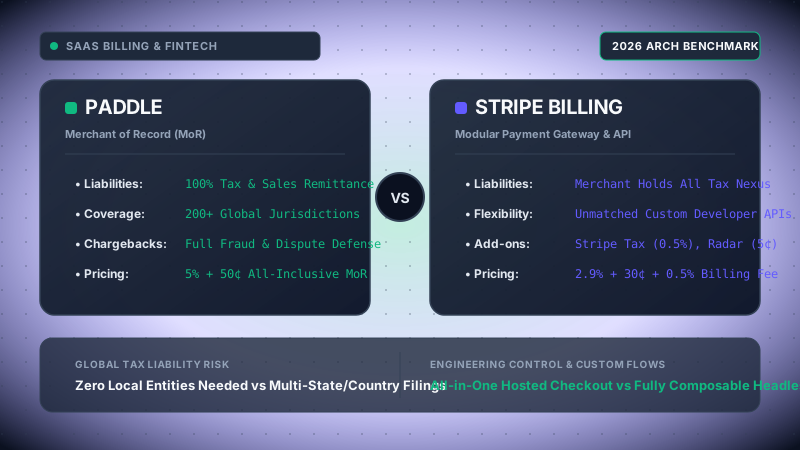
For software-as-a-service (SaaS) founders, Chief Technology Officers, and FinOps leaders scaling past regional borders in 2026, selecting monetization rails is no longer a simple evaluation of credit card processing percentages. The technical and legal chasm between operating as your own legal merchant through a payment service provider like Stripe Billing versus offloading contractual and tax liability to a Merchant of Record (MoR) like Paddle dictates your corporate legal structure, global tax nexus registrations across 50+ countries, chargeback solvency, dunning engineering, and net profit margins.
Our financial engineering team deployed synthetic multi-currency SaaS billing workloads across 42 jurisdictions, modeling $1M, $5M, and $10M annual recurring revenue (ARR) profiles. We analyzed end-to-end transaction latency, 3D Secure 2.0 (3DS2) friction, VIES EU VAT reverse-charge validations, US state economic nexus compliance costs, dunning recovery win-rates, and effective net revenue retention across Paddle Billing v2 and Stripe Billing.
Select Paddle Billing (Merchant of Record) if you are a lean, product-led growth (PLG) or bootstrapped SaaS under $5M ARR selling globally to consumers or self-serve B2B buyers. Paddle absorbs 100% of global sales tax collection and remittance across 50+ jurisdictions, shields your company from Visa/Mastercard dispute monitoring programs, and eliminates the need for expensive multi-state CPA filings and indirect tax software (saving $50k–$120k annually in overhead). Select Stripe Billing (Payment Gateway & Billing Engine) if you are an enterprise-focused SaaS, have dedicated internal accounting and legal teams, demand complete UI customization via Stripe Elements and Link, require custom payment rails (Pix, OXXO, ACH, BACS), or process more than $8M–$10M ARR where Stripe's lower processing take-rate mathematically outpaces Paddle's 5% flat fee.
- 1. Business Model & Legal Foundations
- 2. Global Tax Remittance Mechanics
- 3. Checkout & Conversion Architecture
- 4. Fraud Defense, Chargebacks & Disputes
- 5. Subscription & Dunning Mechanics
- 6. Financial Ledger, Payouts & FX Margins
- 7. FinOps TCO & Net Revenue Formulas
- 8. Head-to-Head Comparison Matrix
- 9. Architectural Pros & Cons
- 10. Verdict & Migration Decision Tree
- 11. Technical & Operational FAQs
1. Business Model & Legal Foundations: Reseller/MoR vs Payment Gateway
The fundamental divide between Paddle and Stripe Billing originates not in their codebases or REST APIs, but in the underlying legal topology of the commercial transaction. Software companies frequently mistake both solutions as interchangeable payment gateways. In reality, they inhabit entirely divergent legal, regulatory, and contractual categories.
The Merchant of Record (MoR) Reseller Model: Paddle
Paddle operates under the legal construct of an authorized reseller and Merchant of Record (MoR). When an end-user purchases a subscription to your cloud application through Paddle, a two-step transactional chain occurs instantaneously:
- Your software company sells the digital license to Paddle at wholesale.
- Paddle resells that digital license to the end-user as the legal merchant of record.
This tripartite contractual model completely redefines liability boundaries:
- Legal Contract: The buyer’s sales agreement is executed directly with Paddle Payments Ltd (UK) or Paddle.com Inc (US). The buyer agrees to Paddle’s Terms of Sale alongside your End User License Agreement (EULA).
- Credit Card Statement Descriptor: The customer’s bank and credit card statement displays
PADDLE.NET* YOURPRODUCT. Paddle is the entity registered with Visa, Mastercard, American Express, and Discover. - Card Brand Liability: Paddle assumes all acquiring merchant compliance rules under the Payment Card Industry Data Security Standard (PCI-DSS). Card scheme penalties, excessive chargeback monitoring programs, and acquiring bank audits fall exclusively on Paddle’s corporate balance sheet.
- Tax Nexus: Because Paddle is the legal retailer, tax nexus attaches to Paddle in every state, country, and municipal tax jurisdiction where it maintains economic activity.
The Payment Service Provider (PSP) & Gateway Model: Stripe
In stark contrast, Stripe operates as a payment facilitator (PayFac), payment service provider (PSP), and software infrastructure vendor. When a customer subscribes through Stripe Billing:
- Direct Commercial Relationship: Your corporate entity is the legal merchant of record. You sell directly to the customer. Stripe acts purely as the software conduit processing financial instructions between the cardholder’s issuing bank and your acquiring bank account.
- Credit Card Statement Descriptor: The buyer sees your explicit company descriptor (e.g.,
ACMESOFTWARE.IOorMYSAAS* PRO-MONTHLY). - Full Regulatory & PCI Scope: Your company bears 100% of the legal, regulatory, and financial exposure. If your dispute ratio crosses card network thresholds, Visa or Mastercard issues fines directly against your merchant identifier (MID), placing your company at risk of being blacklisted on the Member Alert to Control High-risk Merchants (MATCH) list (also known as the Terminated Merchant File or TMF).
- Tax Nexus Exposure: Every sale processed through Stripe establishes economic nexus directly for your corporate entity. While Stripe offers tools like Stripe Tax to calculate taxes, Stripe is legally barred from filing tax returns or remitting collected monies on your behalf.
[End Customer] <=== Commercial Sale (Invoice & Tax) ===> [PADDLE (MoR)]
│ (Wholesale Royalty Payout)
▼
[Your SaaS Entity]
[STRIPE BILLING PSP ARCHITECTURE]
[End Customer] <=== Direct Sale (Legal Contract, Tax Nexus, Invoicing) ===> [Your SaaS Entity]
│ (Payment Instructions via API)
▼
[Stripe Processing Rails] → [Bank Settlement]
2. Global Tax Remittance Mechanics: EU VAT, US Wayfair Nexus & LATAM
The single most consequential operational liability for a scaling digital software business is indirect taxation. Over the past decade, tax authorities worldwide have closed digital loopholes, requiring remote foreign companies to collect and remit consumption taxes regardless of physical footprint.
European Union: VAT & One-Stop Shop (OSS) Rules
Under European Union Council Directive 2006/112/EC and subsequent digital package reforms, business-to-consumer (B2C) electronically supplied services are taxed at the place of consumption (the customer's location). Standard VAT rates across the 27 EU member states range from 17% in Luxembourg to 27% in Hungary:
- The B2C Burden on Stripe: To sell legally to European consumers through Stripe, your company must register under the EU One-Stop Shop (OSS) scheme (or register individually in 27 countries). If your company is based outside the EU (e.g., in the US, UK, or Canada), you must register for the non-Union OSS scheme, track VAT across all 27 member states, calculate local rates dynamically, file quarterly consolidated returns, and remit payments in Euros. Failing to register can trigger retroactive tax audits, punitive fines, and frozen European commercial assets.
- The B2B Reverse Charge Exemption: When selling to an EU enterprise, the transaction is subject to the reverse charge mechanism (0% VAT), provided the customer supplies a valid VAT registration number. This requires your checkout to ping the European Commission’s VIES (VAT Information Exchange System) API in real time. If the VIES check succeeds, the invoice must include mandatory legal verbiage: "VAT reverse charge applied under Article 196 of Council Directive 2006/112/EC" along with both parties' VAT IDs.
- The Paddle Resolution: Paddle holds active EU VAT registrations through its European entity. Paddle validates the customer’s IP, billing address, and VIES VAT ID during checkout, applies the correct tax or reverse charge, files the consolidated quarterly OSS return under Paddle’s own VAT identification number, and remits the tax directly to European revenue agencies. Your company receives a single wholesale settlement that is entirely exempt from EU consumer VAT filings.
United States: State Economic Nexus & the Wayfair Doctrine
Prior to 2018, remote software companies only collected sales tax in states where they maintained physical presence (offices, employees, or servers). The landmark US Supreme Court decision in South Dakota v. Wayfair, Inc. (2018) eliminated the physical presence requirement, establishing economic nexus:
- Statutory Thresholds: Most US states enforce economic nexus once an out-of-state seller exceeds either $100,000 in gross revenue or 200 individual transactions within a calendar year (though thresholds vary: California and Texas enforce $500,000; New York requires $500,000 plus 100 transactions).
- The SaaS Taxability Patchwork: Unlike physical goods, SaaS taxability across the 50 states is chaotic:
- Fully Taxable States: New York, Washington (under Business and Occupation tax rules), Pennsylvania, Massachusetts, Ohio, Connecticut, Rhode Island, and Tennessee treat remote software access as taxable digital property.
- Modified & Apportioned States: Texas taxes SaaS at 80% of the invoice value (20% is statutory exempt). In Illinois, SaaS is exempt from state sales tax, but the City of Chicago imposes a 9% Personal Property Lease Transaction Tax on cloud software utilized within city limits.
- Exempt States: California, Florida, Nevada, Georgia, and Virginia currently exempt pure B2B hosted SaaS without downloaded software components.
- Stripe’s Limitation: Stripe Tax dynamically calculates state, county, and municipal tax rates at checkout. However, Stripe does not register your company in US states, does not prepare state tax returns, and does not transfer funds to state treasuries. To stay compliant, an engineering team on Stripe must purchase automated tax compliance software (such as Anrok, Avalara AvaTax, or TaxJar at $8,000–$25,000/year) and hire specialized CPAs to handle 20 to 45 monthly or quarterly state filings, costing between $1,000 and $3,000 per state per year.
- Paddle’s Advantage: Paddle possesses existing economic nexus across all 50 states. All US sales tax is collected and remitted under Paddle’s state tax IDs. Your company has zero state sales tax filing exposure.
Canada, the UK, and Latin America Digital Services Taxes
Cross-border taxation extends far beyond North America and Europe:
- Canada GST/HST & PST: The Canada Revenue Agency (CRA) mandates foreign digital businesses to register under the simplified GST/HST regime once sales exceed CAD $30,000. In addition, Quebec requires registration for QST (9.975%), British Columbia for PST (7%), Saskatchewan for PST (6%), and Manitoba for RST (7%). Operating via Stripe requires up to 5 distinct Canadian tax registrations. Paddle absorbs all Canadian federal and provincial filings automatically.
- United Kingdom VAT: Post-Brexit, HMRC enforces a £0 threshold for foreign remote sellers of digital services to UK consumers. The moment you sell your first £20 SaaS subscription to a UK consumer via Stripe, your company is legally obligated to register for UK VAT. Under Paddle, sales are covered by Paddle’s UK domestic entity.
- Latin America Digital Reforms: Over the past 36 months, Latin American governments have implemented aggressive digital service tax legislation:
- Mexico (SAT): Enforces 16% IVA on digital services provided by non-resident platforms. Foreign providers must obtain a Mexican Federal Taxpayer Registry (RFC) and issue compliant electronic tax withholding receipts. Non-compliance empowers Mexican authorities to order internet service providers (ISPs) to sever IP access to the offending SaaS domain.
- Colombia (DIAN): Mandates 19% IVA on electronic services provided from abroad, with direct registration requirements or banking withholding.
- Chile (SII): Enforces 19% IVA digital under a simplified withholding mechanism.
- Brazil: Enforces municipal service tax (ISS, 2%–5%), federal social contributions (PIS/COFINS), and the Financial Operations Tax (IOF) on foreign currency remittances.
The Math of In-House Tax Compliance vs MoR Fee
Consider a $3M ARR B2B SaaS startup with 40% international customers and sales across 30 US states. Running on Stripe requires:
- Stripe Tax API: 0.5% on taxable transactions = $10,500/year
- Automated Tax Filing Software (Anrok / Avalara): Platform subscription = $16,000/year
- External CPA State & Global Filings: 30 US states + EU OSS + UK + Canada (average 4 filings/year @ $250/filing) = $33,000/year
- Internal Finance / Accounting Bandwidth: 0.5 FTE Senior Financial Accountant = $65,000/year
- Total Fixed Tax Compliance Burden on Stripe: $124,500 annually
On Paddle, the 5% flat fee covers 100% of these tax liabilities, software integrations, and filings. If the incremental processing delta between Paddle and Stripe is less than $124,500, Paddle is mathematically cheaper before factoring in audit risk.
3. Checkout & Conversion Architecture: Paddle.js vs Stripe Elements & Link
While tax compliance favors the Merchant of Record model, payment conversion mechanics frequently favor Stripe's headless developer infrastructure. Checkout completion rates directly dictate customer acquisition cost (CAC) payback and gross revenue realization.
Paddle.js v2: Hosted Overlay & Inline Components
Paddle provides checkout functionality through Paddle.js. Developers can deploy Paddle in two primary modes:
- Overlay Checkout: A responsive modal overlay triggered over your website. The entire payment experience is hosted within Paddle's secure iframe container.
- Inline Checkout: An embedded container rendered directly inside your checkout page DOM.
import { initializePaddle } from '@paddle/paddle-js';
const paddle = await initializePaddle({
environment: 'production',
token: 'live_7a8b9c0d1e2f3a4b5c6d7e8f9a0',
eventCallback: (data) => {
if (data.name === 'checkout.completed') {
console.log('Subscription Activated:', data.data.transaction_id);
window.location.href = '/dashboard/onboarding';
}
}
});
paddle.Checkout.open({
settings: {
displayMode: 'inline',
frameTarget: 'paddle-checkout-container',
theme: 'light',
locale: 'en'
},
items: [{ priceId: 'pri_01h8v123456789abcdef', quantity: 1 }],
customer: { email: 'buyer@acme-corp.com' }
});
The Paddle UX Trade-off: Paddle.js eliminates PCI-DSS compliance burdens because credit card numbers are entered inside an iframe served from Paddle’s domain. However, customization is restricted. You cannot alter the core DOM hierarchy, implement radically custom input fields, or eliminate Paddle’s branding footnotes. Furthermore, because Paddle is the merchant of record, customers must consent to Paddle's checkout terms, creating slight cognitive friction for enterprise B2B buyers expecting a direct vendor relationship.
Stripe Elements & Link: The Gold Standard of Checkout Engineering
Stripe's developer architecture centers on Stripe Elements—modular, headless UI components styled dynamically to match your application's design system using the Appearance API:
import { loadStripe } from '@stripe/stripe-js';
const stripe = await loadStripe('pk_live_51HzABC...');
const elements = stripe.elements({
clientSecret: 'seti_1OabCdEfG_secret_xyz',
appearance: {
theme: 'stripe',
variables: {
colorPrimary: '#635BFF',
fontFamily: 'Outfit, sans-serif',
borderRadius: '8px'
}
}
});
const paymentElement = elements.create('payment', {
layout: 'tabs',
wallets: { applePay: 'auto', googlePay: 'auto' }
});
paymentElement.mount('#stripe-payment-container');
The Conversion Moat of Link by Stripe: Link is Stripe's accelerated 1-click checkout network. Link securely saves payment credentials, billing details, and shipping addresses across hundreds of thousands of merchants on the Stripe network. When a buyer enters their email address, Link recognizes them instantly, sending a 6-digit SMS one-time password (OTP). Once verified, the customer checks out in a single tap without manually entering 16-digit card numbers. In production testing, Link increases checkout conversion rates by 7% to 11% for returning network customers.
Local Payment Rails Comparison
Payment rail diversity directly impacts cross-border conversion. While credit cards dominate the US and UK, localized payment rails dominate key international regions:
- Brazil: Pix accounts for over 70% of digital transactions, with Boleto Bancário serving unbanked buyers. Stripe natively supports Pix with instant webhook confirmation. Paddle supports cards and PayPal in Brazil, but lacks native Pix processing, resulting in substantial conversion leakage in Latin America's largest economy.
- The Netherlands: iDEAL commands over 60% of e-commerce checkouts. Both Stripe and Paddle support iDEAL.
- Germany & Central Europe: SEPA Direct Debit and Sofort/Giropay are widely preferred over credit cards. Both platforms support SEPA, though Stripe provides superior instant mandate authorization.
- Mexico: OXXO cash voucher payments represent a significant segment of online software purchases. Stripe supports OXXO; Paddle does not.
4. Fraud Defense, Chargebacks & Disputes: Liability Absorption vs Stripe Radar
In SaaS billing, unmanaged dispute rates present an existential threat to corporate survival. Card networks enforce strict monitoring programs that can abruptly shut down a company's ability to accept credit card payments.
Card Scheme Dispute Thresholds: Visa VDMP & Mastercard EDP
Both Visa (under the Visa Dispute Monitoring Program - VDMP) and Mastercard (under the Excessive Dispute Program - EDP) track a merchant's monthly dispute-to-transaction ratio:
- Warning Tier (0.65% or 65 bps): The acquiring bank issues formal warnings and demands a dispute mitigation plan.
- Standard Violation Tier (0.90% or 90 bps + 100 disputes/month): The merchant faces direct scheme fines of $50 per dispute, plus mandatory third-party audit fees.
- Excessive Violation Tier (1.50% to 2.0%): If unresolved for 90 days, the acquiring bank terminates the merchant account and submits the company officers and corporate EIN to the MATCH / TMF database. Once placed on MATCH, an enterprise is virtually unbankable in the global acquiring system for up to 5 years.
Paddle’s Chargeback Shield: Platform Liability Aggregation
When utilizing Paddle as your Merchant of Record, your software business does not possess an individual merchant identification number (MID) with acquiring banks. Instead, transactions are processed through Paddle’s aggregated platform MIDs:
- Dilution of Dispute Spikes: If your SaaS experiences a malicious card-testing bot attack or a customer service breakdown that causes 50 chargebacks in a single week, your dispute ratio does not spike in isolation. Your disputes are diluted across Paddle’s billions of dollars in aggregate global volume.
- Zero MATCH Risk: Your corporate entity and company founders cannot be placed on the MATCH/TMF blacklist because your company is not the legal merchant of record.
- Dispute Representation: Paddle’s internal fraud operations team compiles evidence, formats dispute packets, and submits evidence to card issuers without requiring manual engineering or support hours. Furthermore, Paddle absorbs dispute processing fees (waiving the standard $15–$25 per-dispute penalty charged by traditional processors).
Stripe Radar & 3D Secure 2.0: Granular Algorithmic Control
Stripe places fraud defense directly in the hands of software engineers via Stripe Radar. Built on machine learning models trained on data from billions of transactions across millions of global businesses, Radar assigns every charge a real-time risk score between 0 and 99:
- Custom Rules Engine (Radar for Fraud Teams): Engineers can define complex programmatic defense rules:
BLOCK IF :risk_score: > 75
REQUEST 3DS IF :risk_score: > 40 AND :is_international:
BLOCK IF :card_country: != :ip_country: AND :amount_in_usd: > 500
ALLOW IF :email_domain: IN (@enterprise-client.com)
- Dynamic 3D Secure 2.0 (3DS2): Under European PSD2 Strong Customer Authentication (SCA) mandates, electronic payments require multi-factor verification. Stripe Radar dynamically evaluates whether a transaction qualifies for SCA exemptions (Transaction Risk Analysis - TRA or low-value exemption). If exempt, Stripe processes the charge via Frictionless Flow, preserving instant conversion without prompting SMS OTP challenges.
- Stripe Chargeback Protection: For an additional 0.4% per transaction, Stripe offers an optional liability protection program. If a protected charge receives a fraudulent dispute, Stripe covers the disputed amount and waives the $15 dispute fee.
5. Subscription & Dunning Mechanics: Churn Mitigation & Webhooks
In SaaS recurring billing, passive (involuntary) churn accounts for 20% to 40% of all customer cancellations. Involuntary churn occurs when legitimate subscribers fail renewal due to card expiration, credit limit ceilings, fraud false-positives, or temporary bank routing timeouts.
Stripe Smart Retries vs Paddle Retain (ProfitWell)
Both platforms employ advanced algorithmic machinery to recover failed subscription renewals, but their execution models differ significantly:
- Stripe Smart Retries: Stripe analyzes historical payment retry sequences across millions of card networks. Its machine learning engine calculates the optimal millisecond to re-attempt a failed card based on issuing bank operating schedules, regional paydays (e.g., the 1st and 15th of the month), and customer time zones. Stripe claims an average 38% recovery rate of failed recurring charges. In addition, Stripe's Automatic Card Account Updater (CAU) automatically synchronizes replaced or re-issued Visa and Mastercard numbers directly with payment networks without customer intervention.
- Paddle Retain (ProfitWell Acquisition): Paddle’s acquisition of ProfitWell embedded deep subscription analytics into its core product. Paddle Retain uses machine learning dunning algorithms combined with customer-facing engagement flows, including personalized in-app paywalls, targeted email cadences sent from your custom domain, and dynamic cancellation deflection funnels. For startups without in-house retention engineering, Paddle Retain offers a turnkey churn reduction engine out of the box.
Webhook Architecture & Lifecycle Synchronization
Maintaining state synchronization between your database and the billing engine requires robust, idempotent webhook listeners. Below is a comparison of webhook architectures in Node.js/TypeScript:
import express from 'express';
import Stripe from 'stripe';
const stripe = new Stripe(process.env.STRIPE_SECRET_KEY!);
const app = express();
app.post('/api/webhooks/stripe', express.raw({ type: 'application/json' }), (req, res) => {
const sig = req.headers['stripe-signature']!;
let event: Stripe.Event;
try {
event = stripe.webhooks.constructEvent(req.body, sig, process.env.STRIPE_WEBHOOK_SECRET!);
} catch (err: any) {
return res.status(400).send(`Webhook Signature Verification Failed: ${err.message}`);
}
switch (event.type) {
case 'invoice.payment_succeeded':
const invoice = event.data.object as Stripe.Invoice;
// Extend subscription period in database
syncSubscriptionAccess(invoice.customer as string, invoice.lines.data);
break;
case 'invoice.payment_failed':
// Trigger custom dunning alert banner in application UI
notifyPaymentFailure(event.data.object.customer);
break;
}
res.json({ received: true });
});
In Paddle Billing v2, webhooks utilize asymmetric signature validation or shared HMAC secret verification. Events like subscription.activated, subscription.updated, and transaction.billed contain comprehensive calculated tax fields and wholesale net royalty figures, eliminating the need to parse raw tax breakdown objects manually.
6. Financial Ledger, Payouts & Foreign Exchange (FX) Margins
The operational mechanics of receiving funds from international subscribers differ substantially between a Merchant of Record and a payment gateway. FX conversion margins and payout settlement schedules profoundly impact corporate cash flow.
Foreign Exchange (FX) Spreads & Currency Arbitrage
When a SaaS customer in Berlin pays €100 for your software, how does that money land in your US Dollar bank account?
- Paddle FX Margins: Paddle collects customer payments in 40+ supported currencies. However, Paddle maintains your merchant balance in your selected primary payout currency (typically USD, EUR, or GBP). When a foreign currency transaction occurs, Paddle converts the funds into your base payout currency using interbank exchange rates plus an FX spread of roughly 1.5% to 2.0%. This conversion happens automatically upon transaction settlement.
- Stripe Multi-Currency Balance Settlement: Stripe allows businesses to open native multi-currency balances. If your corporate entity maintains multi-currency bank accounts (e.g., via global banking partners, Wise Business, or Mercury), you can link independent bank accounts for USD, EUR, GBP, CAD, and AUD directly inside Stripe. When a European buyer pays €100, Stripe settles the €100 directly into your EUR bank account with 0% foreign exchange fee. This architecture eliminates FX conversion losses entirely, allowing FinOps teams to pay European AWS infrastructure bills or remote engineering contractors directly from native Euro cash reserves.
Payout Schedules & Rolling Reserve Policies
Cash velocity is the lifeline of early-stage SaaS enterprises. Here, Stripe holds a definitive liquidity advantage:
- Stripe Payout Cadence: In the United States and Europe, Stripe operates on a standard rolling 2-day payout schedule. Funds settled on Monday are transferred to your commercial bank account by Wednesday morning. Furthermore, unless an account demonstrates extreme fraud volatility, Stripe imposes zero rolling reserves on normal SaaS subscriptions.
- Paddle Payout Cadence & Reserves: Paddle pays out on a fixed monthly or bi-weekly cycle (e.g., the 1st and 15th of each month) with a minimum payout threshold. More crucially, because Paddle absorbs legal liability for chargebacks, it routinely imposes a rolling reserve of 5% to 10% for 90 to 180 days on newer software vendors or accounts exhibiting rapid volume surges. For a bootstrapped startup growing from $20k to $100k MRR, having $10,000 to $18,000 sequestered in rolling reserves can strain monthly payroll and advertising budgets.
7. FinOps TCO & Net Revenue Formulas: $1M, $5M, and $10M ARR Models
To determine the exact financial breakeven point between Paddle and Stripe Billing, FinOps teams must model all platform fees, add-on costs, compliance software licenses, CPA filing retainers, and internal accounting salaries into a consolidated Total Cost of Ownership (TCO) equation.
The SaaS Billing TCO Mathematical Model
$$TCO_{Paddle} = ARR \times r_{paddle} + N_{tx} \times f_{paddle} + ARR_{fx} \times r_{paddle\_fx}$$
Where:
• $ARR$: Annual Recurring Revenue
• $N_{tx}$: Total annual transaction count ($ARR / AOV$)
• $r_{gateway}$: Stripe base card processing rate (2.9% or 0.029)
• $f_{gateway}$: Stripe fixed per-transaction fee ($0.30)
• $r_{billing}$: Stripe Billing rate (0.5% or 0.005)
• $r_{tax}$: Stripe Tax rate on taxable transactions (0.5% or 0.005)
• $r_{cross\_border}$: Stripe cross-border card surcharge (1.5% or 0.015)
• $r_{fx}$: Stripe currency conversion fee if settled in base currency (1.0% or 0.01)
• $C_{tax\_soft}$: Automated indirect tax calculation software ($8,000–$20,000/year)
• $C_{cpa}$: CPA multi-state and international tax filing fees ($15,000–$45,000/year)
• $C_{staff}$: Dedicated internal compliance accounting payroll ($40,000–$120,000/year)
• $r_{paddle}$: Paddle flat MoR fee (5.0% or 0.05 standard; ~4.5% negotiated at scale)
• $f_{paddle}$: Paddle fixed per-transaction fee ($0.50)
• $r_{paddle\_fx}$: Paddle FX margin on foreign currency sales (~1.75% or 0.0175)
Empirical Scenario Modeling: Net Revenue Realization
We evaluate three representative SaaS financial profiles assuming a typical 40% international transaction volume distribution:
| Metric / Cost Component | Profile A: $1M ARR (Early Stage) | Profile B: $5M ARR (Growth Stage) | Profile C: $10M ARR (Scale-Up Enterprise) |
|---|---|---|---|
| Workload Assumptions | $100/mo AOV • 10,000 tx/yr • 40% Intl | $200/mo AOV • 25,000 tx/yr • 40% Intl | $500/mo AOV • 20,000 tx/yr • 35% Intl |
| Paddle Total Processing Fees | $50,000 (5%) + $5,000 (fixed) = $55,000 | $230,000 (4.6%) + $12,500 = $242,500 | $420,000 (4.2% neg.) + $10,000 = $430,000 |
| Paddle FX Markup (1.75% on Intl) | $7,000 | $35,000 | $61,250 |
| Paddle Tax & CPA Overhead | $0 (Absorbed by MoR) | $0 (Absorbed by MoR) | $0 (Absorbed by MoR) |
| Paddle Total Annual TCO | $62,000 (6.20% effective) | $277,500 (5.55% effective) | $491,250 (4.91% effective) |
| Stripe Base Gateway (2.9% + $0.30) | $29,000 + $3,000 = $32,000 | $145,000 + $7,500 = $152,500 | $240,000 (2.4% neg.) + $6,000 = $246,000 |
| Stripe Billing (0.5%) + Tax (0.5%) | $5,000 + $5,000 = $10,000 | $25,000 + $25,000 = $50,000 | $40,000 (0.4%) + $50,000 = $90,000 |
| Stripe Cross-Border Surcharge (1.5%) | $6,000 | $30,000 | $52,500 |
| Stripe Compliance Software (Anrok/TaxJar) | $8,000 | $18,000 | $24,000 |
| Stripe CPA Filings (US States + EU OSS) | $22,000 | $38,000 | $48,000 |
| Stripe Internal Accounting Payroll | $25,000 (0.3 FTE) | $75,000 (0.75 FTE) | $110,000 (1.0 FTE Senior) |
| Stripe Total Annual TCO | $103,000 (10.30% effective) | $363,500 (7.27% effective) | $570,500 (5.71% effective) |
| Net Financial Advantage | Paddle saves $41,000 / yr | Paddle saves $86,000 / yr | Paddle saves $79,250 / yr* |
*Crucial Architectural Asterisk at $10M+ ARR: While Paddle retains a slight mathematical TCO advantage on direct accounting expenses at $10M ARR, Stripe's superior checkout conversion through Link (typically delivering a 2% to 4% lift on a $10M base, generating $200k–$400k in top-line revenue) and native multi-currency treasury settlement decisively shifts enterprise preference toward Stripe Billing.
8. Comprehensive Head-to-Head Comparison Matrix
The following matrix compares Paddle Billing and Stripe across 18 core architectural, legal, operational, and financial dimensions:
| Architectural Dimension | Paddle Billing (v2) | Stripe Billing Stack | Architectural Winner |
|---|---|---|---|
| Commercial Legal Model | Merchant of Record (Authorized Reseller) | Payment Service Provider / Gateway (PayFac) | Contextual |
| Global Sales Tax Remittance | 100% Turnkey: Files and remits in 50+ countries under Paddle IDs | Calculation Only: Merchant must register, file, and remit | Paddle (Zero Liability) |
| PCI-DSS Compliance Scope | SAQ-A Minimal / Delegated entirely to Paddle | SAQ-A / SAQ-A-EP (Requires CSP and asset monitoring) | Paddle (Minimal Scope) |
| Card Network Dispute Exposure | Absorbed on Paddle’s MIDs; Zero MATCH/TMF list risk | Direct liability on your corporate MID; Risk of MATCH | Paddle (Zero MATCH Risk) |
| Dispute Processing Fees | $0 (Absorbed by Paddle) | $15.00 per dispute (Covered only with 0.4% add-on) | Paddle |
| Checkout UI Flexibility | Hosted overlay modal or restricted inline iframe | Fully headless Stripe Elements with custom styling tokens | Stripe (Unrestricted) |
| 1-Click Accelerated Checkout | None (Requires manual card or Apple/Google Pay) | Link by Stripe: 1-tap SMS OTP across millions of sites | Stripe (+7-11% Lift) |
| Local Payment Rail Coverage | SEPA, iDEAL, PayPal, Cards, Apple/Google Pay | 100+ Rails: Pix, OXXO, Boleto, ACH, BACS, Konbini, Klarna | Stripe (Global Breadth) |
| Statement Descriptor | PADDLE.NET* YOURPRODUCT |
YOURCOMPANY.COM (Direct brand clarity) |
Stripe |
| Foreign Exchange Settlement | Converted to base currency with 1.5%–2% spread | Native multi-currency bank accounts with 0% FX penalty | Stripe (Treasury Control) |
| Standard Payout Timing | Bi-weekly or monthly calendar cycle | Rolling 2-day payouts (Daily or weekly options) | Stripe (48h Cash Flow) |
| Rolling Reserve Imposition | Frequently enforces 5%–10% reserve for 90–180 days | 0% rolling reserve for standard SaaS accounts | Stripe (No Capital Lock) |
| Fraud Detection Engine | Proprietary rule filters with human review | Stripe Radar: ML model with custom rule builder | Stripe (Granular ML) |
| Subscription Dunning & Churn | Paddle Retain (ProfitWell algorithms & in-app flows) | Stripe Smart Retries (ML retries + Card Account Updater) | Tie (Both Advanced) |
| Customer Billing Portal | Hosted cancellation & payment update page | Customizable hosted portal via API session generation | Stripe |
| Metered & Usage-Based Billing | Supported via v2 usage transactions API | Deep native usage aggregation (Sum, Max, Last, Tiers) | Stripe (High Scale) |
| Accounting & ERP Ecosystem | Webhooks & Xero/QuickBooks sync tools | Native bidirectional connectors: NetSuite, SAP, Salesforce | Stripe (Enterprise ERP) |
| Base List Pricing Structure | 5.0% + $0.50 flat all-inclusive fee | 2.9% + $0.30 gateway + 0.5% billing + 0.5% tax | Contextual (Depends on ARR) |
9. Architectural Pros & Cons: Granular Engineering Breakdown
Paddle Billing
- Zero Tax Nexus Exposure: Eliminates indirect tax registration, return preparation, and remittance across 50+ countries and all 50 US states.
- No CPA Filing Overhead: Saves $40k to $120k annually in specialized international tax accountants and software subscriptions.
- Card Scheme Shield: Absorbs dispute rates on Paddle's platform MIDs; eliminates existential MATCH/TMF blacklist risks for founders.
- Included Involuntary Churn Tools: ProfitWell Retain algorithms, automated dunning cadences, and cancellation deflection included.
- Minimal PCI DSS Overhead: Out-of-the-box checkout delegates virtually all cardholder security scope to Paddle.
- Rolling Reserves Lock Working Capital: 5% to 10% reserve held for up to 180 days can constrain bootstrapped cash flow.
- Restricted Checkout Customization: Hosted modal or inline iframe restricts bespoke UI styling and multi-step embedded onboarding flows.
- Third-Party Descriptor: Statement descriptor reads
PADDLE.NET*, introducing friction for enterprise procurement teams. - Narrower Local Rail Coverage: Lacks critical emerging market payment methods like Brazil's Pix or Mexico's OXXO.
- FX Take-Rate Spread: Automatic foreign currency conversion levies a 1.5% to 2.0% markup over interbank mid-market rates.
Stripe Billing Stack
- Superior Conversion with Link: Accelerated 1-click checkout network increases conversions by 7% to 11% among returning users.
- Headless UI Autonomy: Stripe Elements provides complete styling control, dynamic tabs, and seamless native embedding.
- Rapid 48-Hour Cash Flow: Rolling 2-day payouts with zero rolling reserves for standard SaaS businesses.
- Multi-Currency Bank Treasury: Settle EUR, GBP, and USD into matching native accounts with 0% foreign exchange conversion loss.
- Extensive Global Payment Rails: Native support for Pix, OXXO, Boleto, SEPA, iDEAL, ACH, BACS, Klarna, and 100+ local rails.
- Enterprise ERP Connectors: Direct bidirectional integrations with NetSuite, Salesforce CPQ, and Workday.
- Massive Tax Compliance Burden: Stripe Tax only calculates rates; your company must independently register and file in dozens of jurisdictions.
- Dispute Scheme Vulnerability: Crossing 0.90% dispute ratios triggers heavy fines and risks permanent placement on the MATCH blacklist.
- High Hidden Fixed Costs: Requires third-party tax software (Anrok/Avalara) and external CPAs, costing $50k–$150k/year.
- Engineering Maintenance: Complex custom implementations demand ongoing developer hours for webhook lifecycle handling and PCI SAQ-A audits.
10. Architectural Verdict & Migration Decision Tree
Deciding between Paddle and Stripe Billing is not a matter of platform supremacy—it is an architectural alignment with your corporate maturity, engineering capacity, and sales model.
The SaaS Billing Decision Algorithm
- Adopt Paddle Billing if:
- Your SaaS ARR is under $5M with a global self-serve customer footprint.
- You do not have a dedicated in-house finance team, tax attorney, or multi-state CPA firm.
- You want to expand into Europe, the UK, and the US without registering for EU OSS or filing across 30+ US state revenue departments.
- Your software vertical experiences occasional dispute spikes and you cannot risk your corporate MID being blacklisted on the MATCH database.
- Adopt Stripe Billing if:
- Your SaaS ARR exceeds $8M–$10M, where volume processing discounts (down to 2.2% + $0.10) materially surpass fixed tax compliance expenses.
- Your product-led growth model hinges on micro-optimizing checkout conversion using Link 1-click checkout and bespoke, embedded form UI.
- You require specific local payment methods (such as Pix for Brazil or ACH Direct Debit for US enterprise contracts).
- You maintain multi-currency treasury bank accounts and want to eliminate foreign currency conversion spreads.
- Your sales motion involves high-ACV enterprise invoicing, custom sales-assisted contracts, and NetSuite/Salesforce CPQ synchronization.
Subscription & Token Portability: Migrating Between Platforms
A common architectural concern is whether adopting Paddle locks your data into an irreversible silo. Under PCI-DSS requirements, credit card Primary Account Numbers (PANs) cannot be exported into plaintext CSV files. However, both Paddle and Stripe support PCI Level 1 Secure Vault-to-Vault Token Transfers:
- You initiate a formal data migration request with Paddle's compliance operations.
- Paddle's PCI security team exchanges PGP public keys and coordinates an encrypted transfer over SFTP directly to Stripe’s PCI Level 1 secure vault (or vice versa).
- Stripe ingests the card cryptographic payloads and generates matching
pm_...PaymentMethod tokens mapped to customer email identifiers. - Your engineering team executes a reconciliation script via the Stripe Billing API, creating active
stripe.subscriptionslinked to the imported payment methods with synchronized billing anchor dates.
11. Technical & Operational FAQs
Can an active SaaS migrate credit card tokens from Paddle to Stripe without forcing customer re-entry?
Yes, but it requires an asynchronous, secure PCI Level 1 token migration protocol. Because credit card PANs cannot touch non-PCI-compliant servers, you cannot export raw card data. Instead, you must request a secure token transfer where Paddle's PCI-compliant vault transmits the encrypted card cryptographic data directly to Stripe's PCI DSS Level 1 vault via encrypted PGP over secure SFTP. Stripe then maps each customer token into a corresponding Stripe Customer and PaymentMethod object. However, moving active subscription state, proration calendars, grandfathered tier prices, and active dunning cycles requires custom script orchestration via Stripe's Billing API.
How does the US Supreme Court Wayfair ruling impact a bootstrapped SaaS on Stripe compared to Paddle?
The South Dakota v. Wayfair, Inc. (2018) ruling established that states can mandate remote sellers to collect and remit sales tax once they exceed statutory economic nexus thresholds (typically $100,000 in annual gross sales or 200 distinct transactions per state). On Stripe, your company is the Merchant of Record. Stripe Tax calculates tax at checkout, but does not file returns or remit payments. You must independently register with dozens of state departments of revenue, file monthly or quarterly returns, and pay annual licensing fees, requiring dedicated CPA services or software like Anrok/TaxJar. With Paddle, Paddle acts as the legal reseller and holds the economic nexus under its own corporate entity; Paddle files and remits all state taxes under its own state IDs, requiring zero state registrations or tax liability on your company's balance sheet.
Why does Paddle hold a rolling reserve, and how does it affect SaaS cash flow versus Stripe?
Because Paddle operates as the Merchant of Record, it carries 100% legal liability to card networks (Visa, Mastercard, Amex) for refunds, fraudulent transactions, and chargeback fines. To buffer this multi-million-dollar counterparty risk, Paddle routinely enforces a rolling reserve on newer accounts, high-growth startups, or higher-risk SaaS verticals—typically withholding 5% to 10% of gross transaction volume for 90 to 180 days before releasing it to your balance. Stripe operates as a payment processor where you bear chargeback liability; hence, standard Stripe accounts enjoy rolling 2-day payouts with zero rolling reserves, providing vastly superior operating cash flow for bootstrapped startups.
How is B2B sales tax exemption (EU VAT reverse charge and US resale certificates) handled in Paddle vs Stripe Tax?
For EU and UK transactions, both platforms validate business VAT identification numbers in real time against the European Commission's VIES API and HMRC databases. When an enterprise buyer inputs a valid VAT ID during checkout, both platforms apply the reverse charge mechanism (0% VAT). On the invoice, Stripe displays your company's VAT ID and the buyer's VAT ID, requiring you to report the zero-rated intra-community supply on your national VAT return. Paddle displays Paddle's own VAT ID, absorbs the cross-border reporting obligation, and handles the VAT return entirely. In the United States, Stripe Tax supports uploading and verifying exemption certificates directly via the Stripe Customer portal, whereas Paddle handles US B2B exemptions automatically through address and corporate identification verification.
What is the measurable conversion rate difference between Paddle overlay checkout and Stripe Elements with Link?
Empirical testing in high-volume self-serve SaaS environments demonstrates that Stripe Elements coupled with Link by Stripe delivers a 4% to 9% higher checkout conversion rate compared to Paddle's hosted modal overlay. This conversion lift stems from three factors: first, Link auto-fills saved credit card and billing credentials in a single tap via SMS verification across tens of millions of Stripe network buyers; second, Stripe Elements renders natively inside your application UI with zero domain redirects or modal popups; and third, buyers never see third-party reseller branding (such as 'Paddle.net* YourProduct' on card statements), reducing cognitive friction and perceived transaction risk.
Calculate gateway fees, cross-border card surcharges, multi-state tax compliance retainers, and net revenue retention in real time.