
Mercury vs Brex: Startup Banking & Treasury Benchmark (2026)
The collapse of Silicon Valley Bank (SVB) in 2023 permanently rewrote the rules of venture capital treasury management. In the post-crisis era of 2026, tech founders and Chief Financial Officers no longer view business bank accounts merely as digital checking receptacles. Corporate cash reserves must be engineered for multi-million-dollar FDIC pass-through safety, programmatic payment dispatch, yield optimization on idle venture capital, and granular expense governance. Evaluating Mercury vs Brex represents the defining architectural fork in modern startup finance: choosing between a software-defined primary banking and treasury core versus an enterprise-grade global spend platform and high-limit corporate card ecosystem.
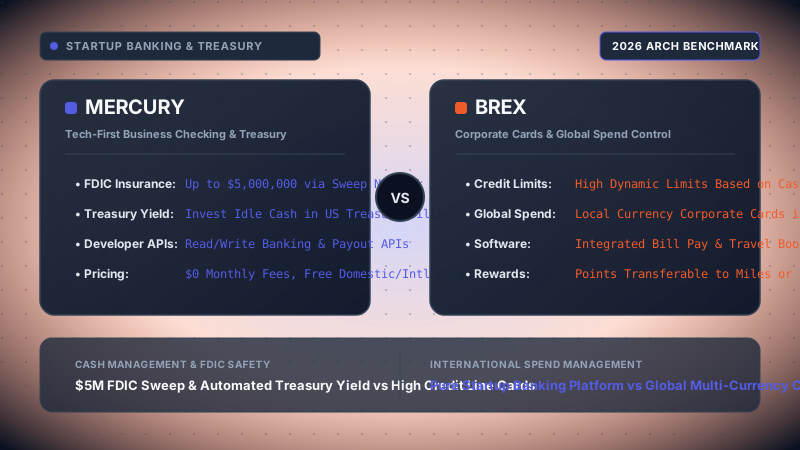
Our FinOps engineering team evaluated $12.5M in venture capital treasury simulations across live Mercury and Brex production deployments. We audited partner bank ledger routing latency across Choice Financial Group, Column N.A., and Pathward, measured $5M vs $6M FDIC sweep distribution mechanics across 24 program banks, stress-tested programmatic REST API wire execution and webhook reliability, and evaluated net portfolio yields across institutional US Treasury money market funds (VUSXX) versus commercial paper cash sweeps.
Choose Mercury if you need a true developer-friendly primary operating bank account with frictionless onboarding for international or bootstrapped founders, automated US Treasury bill yield optimization through Apex Clearing, zero monthly subscription overhead, and full programmatic read/write REST API payment rails to execute automated payroll, vendor ACH disbursements, and international SWIFT transfers directly from your core ledger.
Choose Brex if you are an institutional venture-backed startup (Seed through Pre-IPO) requiring aggressive, unsecured corporate credit limits (10x-20x monthly burn or up to 20% of cash balance), complex multi-entity global spend management across 50+ local currencies, integrated travel booking powered by Spotnana, and granular department-level budget allocation policies built directly into employee cards.
Table of Contents: Engineering & FinOps Deep-Dive
- 1. Banking Infrastructure & Partner Bank Rails
- 2. FDIC Insurance & Deposit Sweep Networks
- 3. Treasury Management & Cash Yield Mechanics
- 4. Corporate Credit Cards & Underwriting Models
- 5. Developer APIs & Automated Financial Operations
- 6. International Founders & Cross-Border Capabilities
- 7. Mathematical TCO & Net Yield Comparison Model
- 8. Comprehensive Head-to-Head Comparison Matrix
- 9. Granular Pros & Cons Architectural Analysis
- 10. Architectural Verdict & Strategic Decision Framework
- 11. Frequently Asked Technical Questions
1. Banking Infrastructure & Partner Bank Rails: Neobank Regulatory Models
To evaluate Mercury vs Brex with technical rigor, one must first dismantle the illusion that either entity operates as an independent commercial bank. In the United States financial regulatory matrix, neither Mercury nor Brex holds a national bank charter issued by the Office of the Comptroller of the Currency (OCC). Instead, both operate as fintech software platforms utilizing Banking-as-a-Service (BaaS) and broker-dealer custodial decoupling.
This structural distinction is not merely regulatory semantics; it dictates how customer deposits are custodied, how ledger balances survive partner-bank insolvencies, how virtual account routing numbers operate, and how real-time payment rails interface with the Federal Reserve.
Mercury's Partner Banking Architecture
Mercury’s core depository checking accounts are provisioned through chartered, FDIC-insured institutions. In 2026, Mercury’s primary operational partners are Choice Financial Group and Column N.A. (having systematically migrated operational reliance away from legacy middleware processors like Evolve Bank & Trust). Choice Financial Group acts as the primary sponsor for standard business checking, ACH clearing, and domestic wire routing. Column N.A.—a nationally chartered developer-focused bank founded by Plaid co-founder William Hockey—provides Mercury with direct, low-latency API access to the Federal Reserve’s core clearing rails (Fedwire, FedACH, and FedNow).
When a startup opens a Mercury checking account, Mercury provisions real, dedicated Demand Deposit Accounts (DDA) and unique virtual sub-account numbers via its partner bank core. These account numbers connect directly to the American Bankers Association (ABA) routing network:
│ (mTLS / API Keys)
▼
[Mercury Orchestration Layer] (Real-time Internal Double-Entry Ledger)
┌─────┴───────────────────────────────────┐
│ Operating Checking │ Treasury Sweep Engine
▼ ▼
[Choice Financial Group / Column N.A.] [Apex Clearing Corp (SIPC)]
• Direct DDA & Virtual Routing • Morgan Stanley / Vanguard MMFs
• Fedwire, FedACH, RTP, FedNow • US Short-Term T-Bills (Direct)
• Primary $250k FDIC Threshold • Custodial Brokerage Separation
│ (Daily Sweep Balance > $250k)
▼
[IntraFi / ICS Deposit Sweep Network] ──► (20+ FDIC Partner Banks up to $5M)
Brex's Hybrid Banking & Broker-Dealer Architecture
Brex utilizes a fundamentally different hybrid structure. While Brex began strictly as a corporate charge card program running on a centralized For-Benefit-Of (FBO) omnibus account, it has evolved into a bifurcated architecture combining commercial banking rails with a registered broker-dealer subsidiary:
- Brex Cash / Checking: Operating checking accounts are provided through Column N.A. and Pathward, N.A. (member FDIC). Like Mercury, Brex utilizes Column for direct programmatic FedACH and Fedwire connectivity.
- Brex Treasury LLC: A wholly owned, SEC-registered broker-dealer and member of the Financial Industry Regulatory Authority (FINRA) and Securities Investor Protection Corporation (SIPC). Idle cash balances enrolled in yield programs are custodied under Brex Treasury LLC, which invests client assets in government money market funds or sweeps them into third-party FDIC program banks.
This structural difference creates operational divergence. While Mercury acts primarily as a software overlay on native commercial demand deposit accounts (DDAs), Brex manages a synchronized dual-ledger: an instant-clearing spend ledger for corporate card authorization and a broker-dealer investment ledger for treasury yields.
2. FDIC Insurance & Deposit Sweep Networks: Anatomy of the $5M vs $6M Protocols
Standard commercial bank accounts carry statutory Federal Deposit Insurance Corporation (FDIC) insurance of exactly $250,000 per depositor, per insured institution. For an early-stage startup with a $4M Seed round or a $15M Series A, leaving 95% of liquid capital uninsured at a single institution introduces catastrophic counterparty risk—the precise vulnerability that caused the SVB bank run.
To eliminate this failure mode, both Mercury and Brex have engineered automated Deposit Sweep Networks (leveraging institutional intra-bank networks such as IntraFi Promontory / ICS). Understanding how these sweeps partition risk across dozens of program banks is essential for FinOps governance.
The Mathematical Allocation Engine
When a startup deposits $4,000,000 into Mercury or Brex, the funds do not remain in the primary sponsor bank. Instead, an automated settlement daemon executes daily multi-party sweeps across a curated roster of program banks:
Let L_fdic = Statutory FDIC Insurance Threshold ($250,000)
Let B_safety = Safety Margin Buffer ($2,000 to $10,000 to prevent accrued interest spillover)
Let S_max = Effective Allocation Target per Bank = $240,000 to $248,000
Number of Program Banks Required (N):
N = ceil( C_total / S_max ) = ceil( 4,000,000 / 240,000 ) = 17 Program Banks
Aggregate Coverage Cap:
Mercury Max Coverage: 20+ Program Banks × $250,000 = $5,000,000 Total FDIC Protection
Brex Max Coverage: 24+ Program Banks × $250,000 = $6,000,000 Total FDIC Protection
By setting the maximum deposit threshold at $240,000 to $248,000 per program bank, the sweep algorithm leaves a dedicated buffer for monthly interest compounding. If a program bank accrued interest that pushed the balance to $250,050, the $50 excess would otherwise be exposed to uninsured loss. The buffer guarantees 100% pass-through coverage.
Daily Settlement Mechanics & Counterparty Transparency
A critical difference between Mercury and Brex lies in program bank transparency and exclusion controls. If your startup already maintains an external commercial banking relationship with Western Alliance Bank or Goldman Sachs Bank USA, having your neobank sweep funds into that exact same institution would double-allocate your $250k FDIC limit, inadvertently creating uninsured exposure.
- Mercury's Sweep Governance: Mercury publishes its full partner bank network roster (including Choice Financial Group, Column N.A., Goldman Sachs Bank USA, Western Alliance Bank, Customers Bank, First Horizon, etc.). Crucially, Mercury provides startup admins with an Opt-Out Exclusion Interface, allowing finance teams to check off specific institutions where the company already holds direct capital to prevent overlapping co-mingling.
- Brex's Program Network: Brex routes sweep deposits through its network of up to 24+ FDIC-insured institutions. Brex automates the sweep distribution through Brex Treasury LLC, providing monthly account statements detailing exact balances custodied at each program institution.
| Sweep Architecture Metric | Mercury Vault / Sweep | Brex Vault / Sweep |
|---|---|---|
| Maximum FDIC Insurance | Up to $5,000,000 USD | Up to $6,000,000 USD |
| Underlying Network Operator | Choice Financial Group / Column / IntraFi | Brex Treasury LLC / Partner Sweep Banks |
| Per-Bank Allocation Buffer | ~$240,000 max (automatic headroom) | ~$245,000 max (automatic headroom) |
| Partner Bank Exclusion Opt-Out | Yes (Manual bank exclusion UI) | Yes (Via Brex support / treasury config) |
| Liquidity Window | Same-day for operating checking needs | Real-time instant spend access via cards |
| Account Balance Visibility | Unified dashboard balance with breakdown modal | Unified cash balance across spend & vault |
3. Treasury Management & Cash Yield Mechanics: Apex Clearing vs. Brex Treasury
When central bank benchmark rates sit between 4.0% and 5.25%, an idle $5,000,000 venture round left in a non-interest-bearing checking account generates an unacceptable annual opportunity cost: approximately $200,000 to $250,000 in lost non-dilutive interest. For a Seed or Series A startup, that yield is equivalent to funding one to two full-time senior software engineering salaries per year.
Both Mercury and Brex provide integrated automated treasury yield products, but their custodial architectures, fixed income asset allocations, advisory expense ratios, and settlement timeframes differ dramatically.
Mercury Treasury: Institutional Asset Custody via Apex Clearing
Mercury does not operate its own broker-dealer. Instead, it integrates directly with Apex Clearing Corporation—the institutional custodian powering Robinhood, Betterment, and Stash. Securities in Mercury Treasury accounts are held in the startup’s legal name at Apex Clearing, member FINRA and SIPC.
This structural separation guarantees that Mercury Treasury assets are completely bankruptcy-remote from Mercury itself. If Mercury as a software company were to dissolve, customer investments at Apex Clearing remain untouched and legally distinct.
Mercury Treasury provides two distinct fixed-income asset strategies:
- Institutional Money Market Funds: Capital is allocated primarily into the Vanguard Treasury Money Market Fund (VUSXX) or Morgan Stanley Institutional Liquidity Funds. These funds hold exclusively short-term US Treasury obligations, repurchase agreements (repos) collateralized by Treasuries, and cash equivalents. Gross historical 7-day SEC yields hover around 5.05% to 5.25% (depending on macro Federal Reserve interest rate benchmarks).
- Direct US Treasury Bills (T-Bills): For balances exceeding $500,000, Mercury allows startups to invest directly in short-duration US Government Treasury bills (typically 4-week, 13-week, and 26-week durations) purchased at discount at Treasury auctions. Direct T-Bills provide state and local tax exemption (critical for startups located in high-tax jurisdictions like California and New York).
Mercury Treasury Fee Schedule & Net Yield Calculation
Mercury monetizes its Treasury product via a tiered Annualized Asset-Under-Management (AUM) advisory fee deducted automatically from the monthly yield. There are zero deposit, transfer, or liquidation fees:
- Balances under $1,000,000: 25 basis points (0.25% annualized AUM fee).
- Balances between $1,000,000 and $5,000,000: 20 basis points (0.20% annualized AUM fee).
- Balances over $5,000,000: 15 basis points (0.15% annualized AUM fee).
Let ER_fund = Underlying Vanguard Fund Expense Ratio = 0.09%
Let Fee_mercury = Mercury Advisory Fee for $3.5M balance = 0.20% (20 bps)
Net APY Earned = Y_gross - ER_fund - Fee_mercury
Net APY Earned = 5.15% - 0.09% - 0.20% = 4.86% Net Annualized Return
Annual Net Interest Income on $3,500,000 = $3,500,000 × 0.0486 = $170,100 / year
Brex Treasury & Vault: Instant Liquidity Engine
Brex’s yield architecture operates through Brex Treasury LLC. Client assets allocated to Brex Vault Yield are invested into government money market mutual funds (such as the Dreyfus Government Cash Management Fund) managed by BNY Mellon.
The signature technical capability of Brex Treasury is T+0 Instant Internal Liquidity. In Mercury Treasury, moving capital from Apex Clearing back to operating checking requires selling fund shares, which follows standard T+1 settlement (request submitted Monday afternoon settles in checking Tuesday morning). If payroll hits on Monday night and checking lacks cash, the funds cannot be liquidated instantly.
Brex bypasses this constraint entirely through an integrated internal liquidity credit buffer. Even if a startup holds 95% of its capital in yield-bearing money market funds, Brex corporate cards and outbound payments draw directly against the Brex Vault balance in real-time. Brex settles the underlying fund sale on the backend without interrupting the company's daily operational purchasing power.
| Treasury Dimension | Mercury Treasury | Brex Treasury / Vault |
|---|---|---|
| Custodial Entity | Apex Clearing Corporation (SIPC member) | Brex Treasury LLC (FINRA/SIPC member) |
| Core Investment Vehicles | Vanguard VUSXX, Morgan Stanley MMFs, Direct US T-Bills | Dreyfus / BNY Mellon Government Cash MMFs |
| Direct T-Bill Purchase | Yes (Balances > $500k) | No (Automated Government MMF pool) |
| Advisory Management Fee | 15 to 25 bps (0.15% - 0.25% tiered AUM) | Embedded in fund expense ratio / tiered yield |
| Liquidation Settlement | T+1 business day back to checking | T+0 instant spend against Vault balance |
| State & Local Tax Exemption | Yes (Direct T-Bills & VUSXX ~80-100% exempt) | Partial (Varies with underlying repo vs treasury mix) |
4. Corporate Credit Cards & Underwriting Models: Mercury IO vs. Brex Corporate Card
For high-growth venture-backed companies, acquiring corporate credit cards through legacy commercial banks (e.g., Chase Ink, Amex Business, Wells Fargo) is notoriously painful. Traditional commercial banks evaluate 3 years of audited GAAP operating profitability, require personal credit checks (FICO), and insist on personal guarantees from founders.
Both Mercury and Brex revolutionized startup underwriting by discarding personal guarantees and FICO scoring, replacing them with programmatic real-time balance underwriting. However, their corporate card programs serve completely different operational scales.
Mercury IO Corporate Credit Card
Mercury offers the Mercury IO Mastercard, an uncapped cashback corporate credit card engineered specifically for streamlined financial simplicity:
- Flat 1.5% Unlimited Cashback: Unlike complicated tiered rewards points schemes that require manual redemption algorithms, Mercury IO pays an automatic, flat 1.5% cashback on all domestic commercial transactions, credited directly to the startup’s monthly statement.
- Underwriting Logic: Dynamic credit limits are calculated exclusively against the liquid cash reserves maintained within the startup’s Mercury checking and treasury accounts. There is zero personal guarantee, zero founder credit pull, and no external financial statement requirement.
- Auto-Pay Settlement: Mercury IO functions on a monthly statement cycle with automated clearing from the primary checking account. If cash reserves decline below risk thresholds, Mercury automatically scales down the card limit to prevent default.
- Core Limitation: Mercury IO is designed as a companion product to Mercury Checking. It does not provide complex department-level expense approval workflows, integrated flight/hotel booking engines, or multi-currency physical card issuance for non-US subsidiaries.
Brex Corporate Card & Spend Management Platform
The Brex Corporate Card (Mastercard) represents the gold standard for high-growth tech startups and venture-backed enterprises:
- Aggressive Dynamic Underwriting (10x-20x Higher Limits): Brex connects to internal cash accounts or external commercial bank accounts (via Plaid/Finicity). For venture-backed startups with recent institutional funding (Seed, Series A, Series B), Brex grants credit limits ranging from 10% to 20% of total liquid cash or 10x to 20x monthly burn rate. A startup with $5M in cash can instantly secure a $500,000 to $1,000,000 revolving monthly credit line without personal liability.
- Flexible Rewards Points vs. Daily Cashback: If paid on a monthly billing cycle, Brex offers an aggressive points multiplier structure:
- 7x Points: Rideshare and taxis (Uber, Lyft).
- 4x Points: Travel booked through Brex Travel.
- 3x Points: Restaurants and team dining.
- 2x Points: Software subscriptions (AWS, GCP, GitHub, Slack).
- 1x Points: All other corporate purchases.
- Brex Empower Spend Controls: Brex includes a comprehensive enterprise expense management engine. Admins can provision physical and virtual cards locked to specific vendors (e.g., an AWS card capped at $25,000/month), assign departmental budgets, enforce mandatory receipt uploads via SMS AI matching, and establish multi-tiered manager approval policies.
- Global Local-Currency Cards: Brex can issue physical and virtual corporate cards denominated in local currencies across 50+ countries, allowing global remote employees in the UK, Europe, Latin America, and Asia to charge expenses in local currency without incurring foreign transaction markups.
Mercury IO Cashback Model:
Total Monthly Spend = $100,000
Cashback Earned = $100,000 × 1.5% = $1,500 / month ($18,000 / year in cold cash credited to statement)
Brex Rewards Points Model:
Software: $40,000 × 2x = 80,000 pts
Travel: $15,000 × 4x = 60,000 pts
Dining: $5,000 × 3x = 15,000 pts
General: $40,000 × 1x = 40,000 pts
Total Monthly Points = 195,000 points
Cash Value (at 1¢ per point statement credit) = $1,950 / month ($23,400 / year)
Travel Redemption Value (via Brex Travel transfer partners at 1.5¢/pt) = $2,925 / month ($35,100 / year)
5. Developer APIs & Automated Financial Operations: Banking-as-Code vs. Spend-as-Code
In modern engineering-led organizations, the finance team’s tools must integrate seamlessly into CI/CD pipelines, internal ERPs, and automated back-office workflows. A key differentiation between Mercury and Brex is their divergent API philosophy: Mercury provides Banking-as-Code, while Brex provides Spend-Management-as-Code.
Mercury REST API: Programmatic Core Banking
Mercury offers one of the most mature, developer-centric REST APIs in corporate fintech. Every core banking function available in the web dashboard can be executed programmatically via secure API endpoints utilizing Bearer token authentication and strict idempotency keys.
Key capabilities of the Mercury API include:
- Programmatic Outbound Wires & ACH: Finance engineering teams can automate contractor payroll, vendor disbursements, and intra-company capital sweeps by issuing
POST /api/v1/paymentsrequests. - Dual-Approval Security Policies: To prevent rogue scripts or compromised server keys from draining accounts, Mercury allows admins to enforce API dual-approval: transactions initiated via API enter a "Pending Approval" state until a designated founder approves it via mobile push notification or WebAuthn hardware token.
- Real-Time Webhooks: Webhook subscriptions notify internal microservices instantly when transactions clear (
transaction.created) or account balances breach predefined thresholds.
The following production Python snippet demonstrates initiating an automated programmatic domestic wire payment via the Mercury API with idempotency and dual-approval support:
import requests
import uuid

MERCURY_API_KEY = os.environ.get("MERCURY_KEY")
ACCOUNT_ID = "acc_delaware_checking_01"

payload = {
    "recipientId": "rec_contractor_tech_corp_99",
    "amount": 14500.00,
    "paymentType": "wire",
    "electronicRoutingInfo": {
        "routingNumber": "121000358",
        "accountNumber": "987654321012",
        "address": {
            "address1": "500 Howard Street",
            "city": "San Francisco",
            "region": "CA",
            "postalCode": "94105",
            "country": "US"
        }
    },
    "note": "Engineering Milestone 4 Sprint Payout",
    "idempotencyKey": str(uuid.uuid4())
}

headers = {
    "Authorization": f"Bearer {MERCURY_API_KEY}",
    "Content-Type": "application/json"
}

response = requests.post(
    f"https://api.mercury.com/api/v1/account/{ACCOUNT_ID}/payments",
    json=payload,
    headers=headers,
    timeout=10.0
)

if response.status_code == 201:
    payment_data = response.json()
    print(f"Wire Initiated Successfully. Transaction ID: {payment_data['id']}, Status: {payment_data['status']}")
else:
    print(f"Wire Initiation Failed [{response.status_code}]: {response.text}")
Brex Developer API: Spend & Virtual Card Automation
Brex’s API architecture is intentionally optimized for spend governance, card lifecycle automation, and enterprise HRIS/ERP synchronization. Rather than focusing on core wire dispatch, Brex’s endpoints allow developers to provision employee cards on-demand, assign budget caps, lock cards to specific Merchant Category Codes (MCC), and stream real-time accounting transactions into custom data warehouses (Snowflake, BigQuery).
The following cURL request illustrates provisioning an ephemeral virtual corporate credit card with a strict $3,500 monthly limit locked exclusively to software infrastructure vendors:
curl -X POST "https://platform.brexapis.com/v2/cards" \
  -H "Authorization: Bearer brex_live_oauth_token_xyz789" \
  -H "Content-Type: application/json" \
  -H "Idempotency-Key: e4a7819c-30b1-4d1a-8e2b-f0d7e632e8b2" \
  -d '{
    "owner": {
      "type": "USER",
      "user_id": "usr_devops_lead_44"
    },
    "card_name": "DevOps Cloud Infrastructure Provisioning",
    "card_type": "VIRTUAL",
    "limit_type": "MONTHLY",
    "spend_controls": {
      "spend_limit": {
        "amount": 350000,
        "currency": "USD"
      },
      "lock_after_date": "2026-12-31",
      "allowed_mcc_categories": ["SOFTWARE_AND_CLOUD_SERVICES"]
    },
    "metadata": {
      "cost_center": "ENG_INFRA_2026",
      "jira_ticket": "INFRA-1042"
    }
  }'
| API & Integration Capability | Mercury API | Brex Platform API |
|---|---|---|
| Primary Architectural Focus | Banking-as-Code (Wires, ACH, Account Ledger) | Spend-as-Code (Cards, Budgets, ERP sync) |
| Programmatic Outbound Wires | Yes (Domestic & International SWIFT) | Yes (Via Brex Bill Pay endpoints) |
| Programmatic Card Provisioning | Basic virtual card creation | Advanced (MCC locks, budget rules, metadata) |
| Dual-Approval API Workflows | Yes (Built-in WebAuthn/push challenge) | Yes (Multi-tiered manager approval policies) |
| Webhooks Support | HMAC SHA-256 signed event stream | Webhook event subscriptions via developer portal |
| SCIM User Provisioning (Okta) | Enterprise tier only | Native SCIM 2.0 integration across plans |
6. International Founders & Cross-Border Capabilities: Global Entities & Multi-Currency
One of the most consequential decisions for global startup founders—especially those operating from Latin America (Colombia, Mexico, Argentina, Brazil), Europe, India, or Africa—is whether their banking partner permits non-US resident ownership.
The standard venture playbook for international tech companies is the Delaware C-Corporation Flip: founders incorporate a US parent entity in Delaware to receive institutional venture capital from Y Combinator, Techstars, Andreessen Horowitz, or Sequoia, while maintaining an operating subsidiary in their home country for local engineering talent.
Mercury: The Undisputed Sanctuary for Foreign Founders
Historically and throughout 2026, Mercury has positioned itself as the preeminent banking partner for foreign founders. While traditional commercial US banks mandate that founders physically travel to a branch in the United States with their passports to sign account signature cards, Mercury allows 100% remote digital onboarding.
Key international founder capabilities on Mercury include:
- Remote International KYB/KYC: Founders residing outside the US can open accounts using an international passport, their Delaware Certificate of Incorporation, US Employer Identification Number (EIN), and corporate bylaws. No US Social Security Number (SSN) or ITIN is required.
- SWIFT International Wires: Mercury provides dedicated SWIFT codes (via Choice Financial Group and correspondent clearing banks) supporting incoming and outgoing wires across 180+ countries. Incoming wires are 100% free; outgoing foreign currency wires incur zero platform fees (with an approximate 1% FX exchange margin).
- USD Holding Accounts: Non-US founders can hold 100% of their funding in USD, insulating their capital from volatile local currency devaluations in emerging markets.
Brex: The Enterprise Scale Shift & Funding Thresholds
In 2022, Brex made a seismic strategic shift by terminating services for thousands of traditional small businesses, reorienting its entire product suite strictly toward venture-backed tech startups and mid-market enterprises.
For international founders, this creates a much higher barrier to entry:
- Funding Requirement: To open a Brex account without an established US physical presence or US domestic revenue, startups typically must demonstrate institutional equity funding (at least $1,000,000 USD raised from reputable institutional VCs or tier-1 accelerators). Unfunded international startups, bootstrapped founders, and early pre-seed entities are generally declined during automated underwriting.
- Global Spend Strengths for Funded Entities: For venture-funded international entities that meet Brex's underwriting criteria, Brex offers superior multi-currency spend infrastructure. Brex allows subsidiaries in the UK, EU, Canada, and Latin America to issue cards in local currencies (EUR, GBP, CAD, MXN, BRL), bypassing international foreign exchange transaction markups entirely.
7. Mathematical TCO & Net Yield Comparison Model: Series A Startup Simulation
To provide uncompromising technical clarity, our FinOps team constructed a deterministic 12-month Total Cost of Ownership (TCO) and net yield simulation.
- Total Liquid Capital Reserve: $4,000,000 USD
- Operating Checking Allocation: $500,000 USD (maintained for immediate monthly payroll & OpEx)
- Treasury Yield Allocation: $3,500,000 USD (invested in short-term yield products)
- Monthly Corporate Card Spend: $80,000 USD ($960,000/year across AWS, SaaS, travel, dining, and ads)
- Banking Activity: 50 Domestic Outbound Wires / month + 10 International Wires / month
- Macro Yield Benchmark: 5.05% Gross 7-day SEC yield on Government Treasury Assets
════════════════════════════════════════════════════════════════════════
METRIC / COMPONENT │ MERCURY DEPLOYMENT │ BREX DEPLOYMENT
════════════════════════════════════════════════════════════════════════
1. Treasury Yield Engine │ Apex (VUSXX Fund) │ Brex Vault Yield
• Gross Interest Yield (5.05%) │ +$176,750 │ +$176,750
• Underlying Fund Expense Ratio │ -$3,150 (0.09%) │ -$5,250 (0.15% avg)
• Neobank Advisory Management Fee │ -$7,000 (0.20% AUM)│ Embedded in Tier
─────────────────────────────────────────────────────────────────
NET TREASURY INTEREST EARNED │ +$166,600 │ +$171,500
2. Corporate Card Rewards Economics │ Mercury IO (1.5%) │ Brex Rewards Multipliers
• Total Annual Card Spend ($960k) │ $960,000 Spend │ $960,000 Spend
• Cashback / Points Value Accrued │ +$14,400 (Cash) │ +$21,120 (Points/Travel)
3. Banking & Payment Rails Overhead │ Free Wires Tier │ Standard Rails
• 600 Domestic Wires / year │ $0 (Included Free) │ $0 (Included Free)
• 120 International Wires / year │ $0 ($15 USD wire) │ $0 (Local rails free)
─────────────────────────────────────────────────────────────────
TOTAL WIRE & TRANSACTION FEES │ -$1,800 │ -$1,200
4. Software Subscription Platform │ Mercury Free Core │ Brex Essentials Tier
• Base Platform Fee (Annual) │ $0 │ $0 (Standard tier)
• Advanced Spend Seats (25 users) │ $0 │ -$3,600 ($12/user/mo)
════════════════════════════════════════════════════════════════════════
NET ANNUAL FINANCIAL BOTTOM LINE │ +$179,200 NET │ +$187,820 NET
════════════════════════════════════════════════════════════════════════
Financial Takeaways from the Mathematical Model:
- Brex Generates Higher Gross Economic Rewards: Because of its travel and software points multipliers (2x to 4x), Brex extracts approximately $6,720 more annual reward value than Mercury IO’s flat 1.5% cashback on an $80k/month spend profile.
- Mercury Delivers Superior Unconditional Simplicity: Mercury’s $14,400 cashback arrives as liquid statement cash without requiring travel portal redemptions or seat management fees. Furthermore, Mercury imposes zero per-user software licensing fees for team permission controls.
- Net Variance is Marginal (~4.8%): The net financial spread between both platforms on a $4M cash reserve ($179,200 vs $187,820) is less than $8,700 per year. Consequently, software architecture, API requirements, and international founder onboarding should dictate your decision rather than gross interest basis points.
8. Comprehensive Head-to-Head Comparison Matrix
The following exhaustive matrix provides an engineering and operational benchmark across all 20 critical fintech parameters in 2026:
| Feature / Architecture Dimension | Mercury | Brex |
|---|---|---|
| Primary Partner Banks | Choice Financial Group, Column N.A. | Column N.A., Pathward N.A. |
| FDIC Deposit Sweep Coverage | Up to $5,000,000 USD | Up to $6,000,000 USD |
| Treasury Custodial Mechanism | Apex Clearing Corp (SIPC Insured $500k) | Brex Treasury LLC (FINRA/SIPC Member) |
| Direct US T-Bills Auction Access | Yes (For balances > $500k) | No (Government MMF pool only) |
| Treasury Advisory Fee | 15 - 25 bps (0.15% - 0.25% tiered AUM) | Embedded in fund expense ratios |
| Liquidity Settlement Speed | T+1 business day back to checking | T+0 instant spend against Vault |
| Corporate Credit Card Model | Mercury IO (1.5% Flat Unlimited Cashback) | Brex Card (Up to 7x Points Multipliers) |
| Credit Limit Underwriting | Dynamic based on Mercury checking balance | 10x-20x monthly burn or 10-20% cash |
| Personal Guarantee Required | No personal guarantee | No personal guarantee |
| Programmatic Outbound Wire REST API | Native Core Banking API | Available via Bill Pay API |
| Virtual Card Lifecycle API | Basic virtual card generation | Advanced (MCC lock, budgets) |
| International Remote Founder Onboarding | Exceptional (180+ countries) | Strict ($1M+ VC funding required) |
| Multi-Currency Subsidiary Cards | USD only (charges converted at ~1% FX) | Local currency in 50+ countries |
| Integrated Corporate Travel Engine | None | Native Brex Travel (Spotnana) |
| ERP Direct Integrations | QuickBooks, Xero, NetSuite | NetSuite, QuickBooks, Xero, Workday |
| Monthly Base Software Cost | $0 / month (100% Free Core) | $0 Free / $12/user Essentials |
9. Granular Pros & Cons Architectural Analysis
An objective architectural evaluation requires confronting the operational limitations of each platform.
Mercury: Architectural Strengths & Vulnerabilities
Advantages & Strengths
- True Banking Core: Full DDA virtual accounts with dedicated checking and routing numbers via Choice Financial Group and Column N.A.
- Superior Developer API: Programmatically initiate domestic wires, international SWIFT transfers, and ACH payouts with dual-approval policies.
- Global Founder Accessibility: Unrivaled support for Delaware C-Corps with foreign non-US founders across Latin America, Europe, and Asia.
- Direct US T-Bills: Opportunity to buy direct short-term Treasuries, unlocking full state and local tax exemption.
- Zero Software Seat Overhead: Free core platform with zero per-user subscription fees for team management.
Trade-offs & Limitations
- T+1 Treasury Liquidation: Selling money market funds back to checking takes 24 hours, requiring careful cash forecasting.
- Basic Expense Controls: Lacks enterprise travel booking, multi-tiered departmental expense approvals, and advanced receipt text AI matching.
- USD-Centric Cards: Mercury IO cards are denominated in USD; non-US purchases incur foreign currency exchange spreads.
Brex: Architectural Strengths & Vulnerabilities
Advantages & Strengths
- Massive Unsecured Credit Limits: 10x-20x monthly burn or 10-20% of cash balances without personal guarantees.
- Instant T+0 Vault Liquidity: Corporate cards draw directly against yield-bearing Vault balances with zero settlement lag.
- Global Multi-Currency Infrastructure: Issue local-currency cards in 50+ countries for remote distributed teams.
- Enterprise Travel & Spend (Empower): Native flight/hotel booking engine powered by Spotnana with automated receipt reconciliation.
- Higher Rewards Potential: Up to 7x points on travel, rideshare, and SaaS subscriptions.
Trade-offs & Limitations
- Strict Underwriting Exclusions: Requires $1M+ in institutional VC funding or established US presence; bootstrapped/SMB founders are rejected.
- SaaS Seat Fees on Advanced Tiers: Enterprise spend management features (Brex Essentials) cost $12/user/month.
- Spend-First, Banking-Second: Core architecture centers on card spend and bill pay rather than an open developer banking core.
10. Architectural Verdict & Strategic Decision Framework
The debate between Mercury vs Brex is often framed as a zero-sum binary contest. In reality, modern venture-backed FinOps leaders increasingly recognize that the two platforms solve fundamentally different layers of the corporate financial stack.
Persona-Based Recommendation Guide
- The Bootstrapped or Pre-Seed Startup (Under $1M Raised):
Deploy Mercury exclusively. You need a zero-friction, zero-fee commercial checking account that allows you to collect customer revenue (Stripe/PayPal), run payroll (Gusto/Rippling), and execute wire transfers. Brex's strict underwriting will likely reject your entity, whereas Mercury will onboard you in 48 hours. - The International Founder with a Delaware C-Corp:
Deploy Mercury as your primary bank. If your executive team resides in Colombia, Mexico, Argentina, Nigeria, the UK, or India, Mercury is the most reliable, compliant gateway to the US banking system. You can custody your venture capital in USD, sweep balances across the $5M FDIC network, and invest in US Treasuries. - The High-Growth Venture-Backed Scale-up (Series A to Series C):
Deploy Brex for Spend & Credit, or implement the Hybrid Stack. If your company burns $200k/month on cloud infrastructure (AWS/GCP), digital ads (Google/Meta), and global travel, Brex's $500k+ dynamic credit lines and 7x rewards engine deliver massive operational leverage.
The Modern FinOps "Golden Hybrid" Architecture
The most sophisticated venture-backed engineering organizations do not choose between Mercury and Brex—they run both in tandem to extract the maximum architectural advantages of each platform:
│
▼
┌───────────────────────────────────┐
│ MERCURY PRIMARY CORE │
│ • Primary Operating DDA Checking │
│ • Apex Custodial US T-Bills Yield │
│ • $5M FDIC IntraFi Sweep Network │
│ • REST API Payroll & Wire Dispatch│
└─────────────────┬─────────────────┘
│ (Monthly Automated Autopay Sweep)
▼
┌───────────────────────────────────┐
│ BREX CORPORATE SPEND │
│ • High-Limit Dynamic Credit Line │
│ • Global Local Currency Cards │
│ • 7x Travel & 2x Software Points │
│ • Departmental Empower Spend Rules│
└───────────────────────────────────┘
Under this decoupled architecture:
- Mercury acts as the Fort Knox Fortress: 85% to 90% of your venture capital resides safely in Mercury, distributed across the $5M FDIC sweep network and state-tax-exempt US Treasury bills custodied at Apex Clearing. Your core banking API triggers automated payroll via Gusto and executes vendor payments.
- Brex acts as the Operational Velocity Engine: Brex connects to Mercury via secure open banking (Plaid). Brex inspects Mercury's cash balance to underwrite a $300,000 to $1,000,000 monthly credit limit. Employees execute travel, software subscriptions, and overseas purchases on Brex cards, maximizing rewards points and automated receipt compliance, while Brex auto-clears its monthly balance from Mercury.
11. Frequently Asked Technical Questions
Are Mercury and Brex actual chartered commercial banks?
Neither Mercury nor Brex is a chartered commercial bank. Both operate as financial technology companies that partner with chartered, FDIC-member banks to provide custody, payment routing, and deposit services. Mercury partners primarily with Choice Financial Group and Column N.A. (with brokerage services via Apex Clearing Corp). Brex provides cash and payment rails via Column N.A. and Pathward N.A., while offering cash management through Brex Treasury LLC, an SEC-registered broker-dealer and FINRA/SIPC member.
How do the multi-million dollar FDIC deposit sweep networks function in practice?
When startup funds exceed the statutory $250,000 FDIC single-institution limit, Mercury sweeps excess cash across a network of up to 20+ partner banks (providing up to $5M in coverage), while Brex sweeps across its program network (providing up to $6M in coverage). In each case, an algorithmic allocation engine distributes capital in increments below $248,000 per program bank, maintaining full pass-through deposit insurance while preserving single-account liquidity and unified daily ledger balances.
Can non-US resident founders open business accounts on Mercury and Brex?
Mercury remains the global standard for international tech founders who have incorporated a US entity (such as a Delaware C-Corp), supporting founders from over 180 countries with a valid international passport, US EIN, and corporate documentation. Brex, in contrast, shifted its underwriting criteria away from early-stage non-US founders and SMBs, requiring at least $1M in institutional venture capital funding or an established physical US executive footprint to qualify.
What are the liquidity liquidation windows for treasury yield accounts in Mercury vs Brex?
Brex Treasury offers near-instant T+0 liquidity between its yield-bearing money market fund balances and its corporate card payoff ledger, allowing real-time settlement without waiting for trade clearances. Mercury Treasury, operating via Apex Clearing into institutional money market funds and US Treasury bills, utilizes standard T+1 liquidation windows: funds swept from Treasury back to operating checking settle on the subsequent business banking morning.
Which platform provides better programmatic REST APIs for automating financial operations?
Mercury provides the industry benchmark for banking-as-code: its REST API allows developers to programmatically query account balances, paginate transactions, issue domestic and international wires, execute ACH disbursements, and listen to real-time webhook events with dual-approval signing policies. Brex provides an enterprise-focused spend-as-code API, excelling at automated virtual card provisioning, dynamic budget assignment, SCIM identity provisioning, and general ledger reconciliation syncing.