Kubecost vs CAST AI (2026): Kubernetes Cost Optimization Benchmark
Kubernetes has revolutionized container orchestration, but it has created an operational nightmare for finance and platform teams: runaway cloud compute bills with zero container-level visibility. In 2026, the Cloud FinOps battle pits two conflicting engineering philosophies against each other: passive cost attribution via OpenCost (Kubecost) versus autonomous real-time cluster rightsizing (CAST AI). Here is an architect-level benchmark comparing evidence accuracy, spot automation, cluster stability, and real-world TCO.
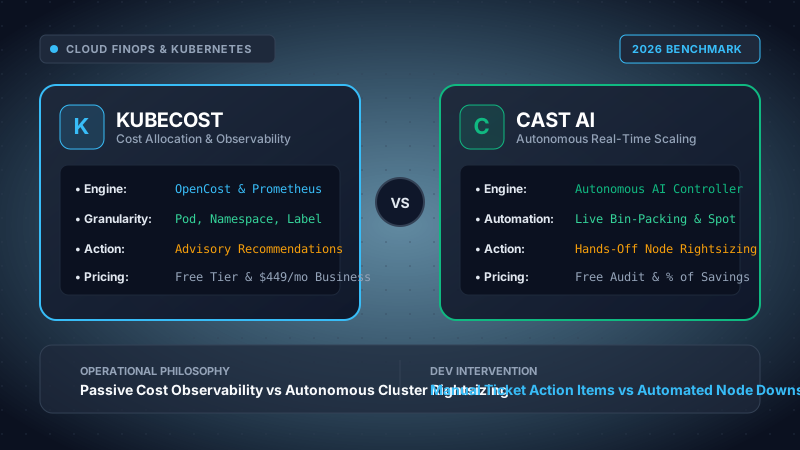
1. The Kubernetes FinOps Crisis: The Cost Blindness of Modern Compute
When an organization migrates from traditional virtual machines to managed Kubernetes clusters (such as Amazon EKS, Google GKE, or Azure AKS), their monthly cloud invoice fundamentally changes. Instead of receiving clean line items for individual web servers or database nodes, the CFO receives a single, monolithic charge for hundreds of EC2 or Compute Engine instances labeled simply: Kubernetes Node Pool Compute.
Inside that cluster, dozens of engineering squads deploy microservices across shared hardware. Due to fear of out-of-memory (OOM) kills and CPU throttling, developers routinely set excessive container resource requests:
# The Typical Over-Provisioned Kubernetes Deployment
resources:
  requests:
    cpu: "2000m"      # Developer requests 2 vCPUs
    memory: "4Gi"     # Developer requests 4GB RAM
  limits:
    cpu: "4000m"
    memory: "8Gi"
# Real runtime utilization in production: 120m CPU (6%) and 650Mi RAM (16%)
Because Kubernetes schedules pods based on requests rather than actual usage, the cluster autoscaler is forced to provision massive, expensive node fleets. Industry benchmarks indicate that the average production Kubernetes cluster operates at merely 15% to 25% CPU utilization, wasting 65% to 80% of an enterprise's compute budget on idle silicon.
2. Architectural Divergence: Passive Allocation vs Autonomous Execution
The fundamental distinction between Kubecost and CAST AI lies in their operating model: Observability & Reporting versus Autonomous Intervention.
Kubecost: The OpenCost Standard for Observability
Kubecost, founded in 2019, is built upon the open-source OpenCost specification (a Cloud Native Computing Foundation sandbox project). It operates as a non-intrusive daemonset within your cluster, scraping real-time telemetry from Prometheus and marrying it with cloud provider billing APIs.
- Granular Cost Mapping: Kubecost accurately allocates spend across namespaces, pods, deployments, services, and custom organizational labels (e.g.,
team=checkout,env=production). - Cloud Billing Reconciliation: It ingests AWS Cost and Usage Reports (CUR), GCP Cloud Billing, and Azure Cost Management, reflecting your negotiated Enterprise Discount Programs (EDP), Savings Plans, and Reserved Instances down to the individual container level.
- Advisory Recommendations: Kubecost flags idle resources, abandoned persistent volumes, and over-provisioned pods, generating recommendations. However, it does not touch your cluster. Implementing savings requires human engineers to file Jira tickets, modify Helm charts, and push code through production CI/CD pipelines.
CAST AI: The Autonomous Rightsizing Controller
CAST AI was engineered on a radically different premise: human platform engineers do not have the time to constantly tune pod YAML definitions. Therefore, cost optimization must be fully autonomous.
- Active Cluster Controller: CAST AI installs a lightweight, read-write agent into your cluster that connects to an external AI optimization engine.
- Live Real-Time Bin-Packing: The controller continuously inspects cluster load. If three worker nodes are each running at 25% capacity, CAST AI automatically creates a single, properly sized replacement instance, schedules the workloads onto it, and drains and terminates the three underutilized nodes in minutes.
- Just-in-Time Instance Selection: While AWS offers over 600 EC2 instance families, human engineers typically default to generic types (e.g.,
m5.xlarge). CAST AI's algorithms evaluate the exact compute, memory, network, and storage IO requirements of your pods, selecting the mathematical cheapest instance type available in that availability zone. - Zero-Touch Operations: The platform modifies the underlying infrastructure in real time without requiring developers to change a single line of application code.
3. Spot Instance Management & Real-Time Live Bin-Packing
Spot instances (excess cloud compute sold at up to 70% to 90% discounts) represent the holy grail of cloud cost savings. However, cloud providers reserve the right to reclaim spot instances with merely a two-minute termination notice.
Kubecost: Spot Visibility & Advisory
Approach: Informs you where spot instances could be safely used.
- Spot Opportunity Flagging: Kubecost highlights stateless workloads that are candidates for spot pricing based on historical restart resilience.
- External Tool Dependency: To actually run spot instances, you must configure, maintain, and tune external node provisioners like Karpenter or Kubernetes Cluster Autoscaler.
- Interruption Risk: If a spot node is terminated abruptly by AWS, handling pod eviction and rescheduling relies entirely on your internal engineering configurations.
CAST AI: Autonomous Spot Fallback & Prediction
Approach: Fully autonomous spot lifecycle management with zero downtime.
- Predictive Interruption Modeling: CAST AI constantly analyzes spot interruption rates across all availability zones, preemptively draining nodes before AWS issues a termination warning.
- Automated Spot-to-On-Demand Fallback: If spot capacity becomes unavailable during a market surge, CAST AI automatically provisions on-demand compute to maintain service SLAs. The moment spot inventory reappears, it migrates pods back to spot compute.
- Guaranteed PDB Compliance: Respects PodDisruptionBudgets, ensuring multi-replica deployments never violate availability constraints during rebalancing.
4. Enterprise Chargeback, Showback & OpenCost Governance
While CAST AI wins hands-down on autonomous cost reduction, enterprise engineering organizations with complex multi-departmental accounting structures require rigorous financial governance.
In large enterprise environments (50+ engineering teams sharing multi-tenant clusters), the primary challenge is often not infrastructure rightsizing, but financial accountability:
- Chargeback (Internal Invoicing): Finance needs to deduct actual AWS/GCP infrastructure costs from specific department budgets (e.g., billing $42,000 directly to the Fraud Detection product unit).
- Showback (Cost Awareness): Platform teams need to display real-time dashboard metrics to developers showing the dollar impact of their deployments.
This is where Kubecost dominates. Its integration with Grafana, Datadog, and enterprise ERPs allows financial controllers to build customized cost allocation models factoring in shared overhead (such as monitoring daemons, ingress controllers, and cross-AZ network traffic) proportionally across teams.
5. Head-to-Head Technical Benchmark Matrix
The following benchmark evaluates Kubecost and CAST AI across 14 technical and operational dimensions based on verified 2026 enterprise testing:
| Feature / Evaluation Criteria | Kubecost | CAST AI | Architectural Winner |
|---|---|---|---|
| Core Operating Philosophy | Cost allocation, visibility, and advisory governance | Autonomous real-time rightsizing and cost execution | Tie (Visibility vs Execution) |
| Automation Level (Hands-Off) | Advisory reports (Manual engineer intervention required) | 100% Autonomous (Auto-provisions & downsizes nodes) | CAST AI (Zero engineer effort) |
| Average Cloud Bill Reduction % | 15% – 30% (dependent on engineer follow-through) | 50% – 70% (immediate, continuous reduction) | CAST AI (Significantly higher ROI) |
| Open-Source Foundation | Built on CNCF OpenCost spec & Prometheus | Proprietary optimization engine & controller | Kubecost (Open-source standard) |
| Spot Instance Automation | Highlights spot opportunities (requires Karpenter/CAS) | Automated spot bidding, predictive drain, and fallback | CAST AI (Bulletproof spot management) |
| Live Pod Bin-Packing | Calculates theoretical packing efficiency | Dynamically consolidates pods onto fewer, cheaper nodes | CAST AI (Real-time live execution) |
| Enterprise Chargeback & Showback | Industry benchmark; deep namespace/label cost modeling | Basic cost allocation and reporting features | Kubecost (Superior financial tool) |
| Cluster Permissions Required | Read-only daemonset (zero operational risk) | Read-write cluster permissions (infrastructure mutations) | Kubecost (Simpler security approval) |
| Multi-Cloud & Kubernetes Engines | EKS, GKE, AKS, OpenShift, Rancher, Bare-Metal | EKS, GKE, AKS, OpenShift, k3s | Tie (Full modern K8s support) |
| Prometheus & Grafana Native Sync | Native metrics exporter and pre-built Grafana boards | Proprietary cloud console with Prometheus exporter | Kubecost (Seamless Prometheus fit) |
| Time to Financial Value | Weeks to months (depends on sprint backlog priority) | 15 to 30 minutes (savings trigger immediately) | CAST AI (Instant savings impact) |
| Custom Cloud Billing Discounts (EDP/CUD) | Deep integration with AWS CUR, GCP Billing, and Azure | Ingests cloud billing data for accurate net ROI | Kubecost (Deepest billing ingestion) |
| Cluster Security & Compliance | SOC 2 Type II, ISO 27001 | SOC 2 Type II, ISO 27001 | Tie (Both enterprise-hardened) |
| Pricing Model Alignment | Predictable flat node tiers ($449/mo Business) | Value-based (% of verified savings generated) | CAST AI (Pay only on actual savings) |
6. 2026 Pricing & Total Cost of Ownership (TCO) Breakdown
When modeling the Total Cost of Ownership for Kubernetes FinOps, calculating software subscription costs alone is deeply misleading. You must account for engineering labor. A tool that costs $400/month but requires 20 hours of senior DevOps labor per week to implement recommendations is drastically more expensive than an autonomous tool that charges a percentage of verified savings.
| Tier / Component | Kubecost | CAST AI |
|---|---|---|
| Free Community Tier | Free: 1 cluster, unlimited nodes (15-day metrics retention, open-source OpenCost) |
Free: Instant read-only cost audit (Identifies exact cluster waste in 10 minutes) |
| Mid-Market / Business Tier | Business: $449 / mo (Up to 100 nodes, 30-day retention, multi-cluster) |
Growth: % of verified savings or ~$0.015 / CPU core / hour base fee |
| Enterprise Tier | Enterprise: Custom quote (Unlimited retention, custom CUR billing, SSO) |
Enterprise: Value-shared pricing (Typically 20% – 25% of verified net savings) |
Architectural TCO Modeling: The 250-Node / $50,000/mo Cluster Scenario
Consider a tech company running a 250-node Amazon EKS cluster spending $50,000/month on AWS compute:
- Kubecost Financial Model:
Software fee: ~$1,100/month.
DevOps Labor: 1 senior platform engineer dedicating 25% of their time to review reports, tune resource requests, and safely test node sizing (~$3,500/mo labor overhead).
Total Cost: ~$4,600/month.
Achieved Savings: ~20% of cloud bill ($10,000/mo).
Net Monthly ROI: +$5,400 / month. - CAST AI Financial Model:
Software fee (based on 20% share of verified savings): ~$5,500/month.
DevOps Labor: Zero hours (fully autonomous controller).
Total Cost: ~$5,500/month.
Achieved Savings: ~55% of cloud bill ($27,500/mo via live bin-packing and automated spot failover).
Net Monthly ROI: +$22,000 / month ($264,000 USD/year net savings).
7. Decision Framework: When to Choose Kubecost vs CAST AI
Both platforms represent engineering excellence. Your choice should be governed by whether your team needs financial chargeback governance or autonomous cloud bill reduction.
Choose Kubecost If:
- You need financial chargeback and showback for finance: Your primary operational requirement is breaking down cloud costs across departments, product features, and client accounts.
- Strict security policies prohibit third-party write controllers: Your enterprise security team will not approve an external agent with cluster modification permissions.
- You have an established platform engineering team: You already run Karpenter or custom autoscalers and only require accurate cost attribution metrics to guide your strategy.
- You demand an open-source, vendor-neutral standard: You want to build your FinOps practice on CNCF OpenCost and Prometheus without proprietary lock-in.
Choose CAST AI If:
- Your #1 priority is slashing your AWS/GCP/Azure bill immediately: You want a verified 50%+ reduction in compute costs within days of installation.
- Your engineering team lacks time to tune YAML manifests manually: You want an autonomous AI controller to handle live bin-packing and node rightsizing without developer tickets.
- You want bulletproof spot instance automation: You want to run production workloads on spot instances with predictive interruption draining and automated on-demand failover.
- You prefer value-based pricing: You only want to pay software fees that are directly funded by verified cloud compute savings.
8. Frequently Asked Questions (FAQ)
What is the core architectural difference between Kubecost and CAST AI?
Kubecost is an observability and cost allocation platform built on the open-source OpenCost specification that breaks down Kubernetes spend by namespace, pod, and service, providing advisory recommendations for engineers to implement manually. CAST AI is an autonomous execution platform that connects to your cluster with read-write permissions, actively rightsizing nodes, packing pods in real time, and swapping expensive on-demand compute for spot instances with zero human intervention.
Does CAST AI risk crashing production workloads when swapping or draining nodes?
CAST AI respects native Kubernetes disruption budgets (PodDisruptionBudgets / PDBs) and graceful termination periods. Before decommissioning an underutilized node or handling a spot instance interruption notice, CAST AI spins up the replacement compute capacity first, safely drains the existing pods, and only terminates the node once all replacement pods are verified healthy and passing readiness probes.
Can Kubecost automatically rightsize Kubernetes clusters?
Kubecost primarily provides recommendations rather than autonomous execution. While it offers plugins and integrations with open-source tools like Cluster Autoscaler or Karpenter, applying Kubecost's rightsizing recommendations traditionally requires platform engineers to manually review the suggestions, update Helm values or Terraform manifests, and push code through CI/CD pipelines.
Which platform is better for enterprise financial chargeback and showback?
Kubecost is significantly superior for enterprise chargeback and showback. It incorporates cloud billing APIs directly (AWS Cost and Usage Reports, GCP Cloud Billing, Azure Cost Management), factoring in custom enterprise discounts, Savings Plans, and Reserved Instances to accurately assign dollar-for-dollar costs to specific engineering departments, business units, and customer tenants.
How does CAST AI's pricing model work compared to Kubecost?
Kubecost charges a predictable monthly subscription fee based on cluster and node count (e.g., $449/month for up to 100 nodes in its Business tier). CAST AI offers a free read-only cost audit tier, while its commercial tier typically charges a performance-based percentage of verified cloud savings (often 20% to 25% of savings generated) or a fixed compute-hour fee, ensuring you only pay if your AWS/GCP/Azure bill is actively reduced.
José Andrade
Founder & Managing EditorArchitect and founder specializing in systems design, project viability, and operational cost modeling. José directs CloudBizStack by bringing structural planning discipline and rigorous TCO (Total Cost of Ownership) analysis to modern software stacks and cloud infrastructure.