
Snyk vs Prisma Cloud (2026): Code-to-Cloud Security & SAST/SCA Benchmark
When evaluating Snyk vs Prisma Cloud in 2026, engineering organizations and Chief Information Security Officers (CISOs) confront the defining architectural dilemma of modern cloud security: bottom-up developer enablement versus top-down enterprise cloud governance. While Snyk built its reputation shifting application security left into the developer's IDE and pull request, Palo Alto Networks built Prisma Cloud into an expansive Cloud-Native Application Protection Platform (CNAPP) governing cloud posture, Kubernetes runtime defense, and infrastructure identity from the production perimeter inward.
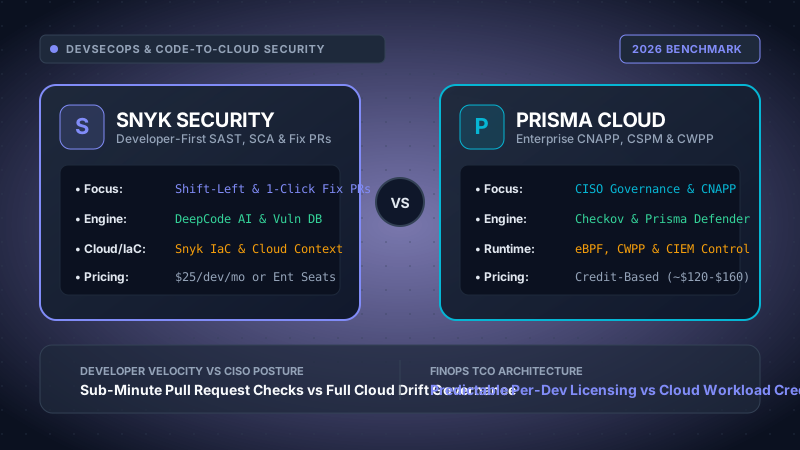
Our DevSecOps team evaluated Snyk Enterprise (Snyk Code, Open Source, Container, IaC, AppRisk) and Palo Alto Networks Prisma Cloud (Darwin release with Code Security, CSPM, CWPP Defender agents, and CIEM) across 45 microservices in Go, Node.js, and Java running on AWS EKS and GCP GKE, auditing 180 pull requests and measuring true-positive rates, pipeline friction, runtime CPU overhead, and FinOps credit burn.
Choose Snyk if your primary objective is developer adoption, rapid sub-minute CI/CD gate checks, automated 1-click remediation pull requests, and proprietary open-source dependency (SCA) intelligence. Choose Prisma Cloud if your organization demands a comprehensive CISO-governed CNAPP platform unifying multi-cloud CSPM compliance, eBPF Kubernetes runtime blocking (CWPP), identity entitlement risk (CIEM), and code-to-cloud traceability across massive enterprise footprints.
The Modern Reality: In 2026, the boundaries between Application Security Testing (AST) and Cloud-Native Application Protection Platforms (CNAPP) have blurred. Snyk has expanded upward into cloud context with Snyk AppRisk, while Prisma Cloud expanded downward into developer Git repositories through its Bridgecrew and Cider Security acquisitions. The operational question is no longer just "what gets scanned," but "who owns the fix and how much does it cost in FinOps friction?"
- 1. Developer-First vs Top-Down Enterprise Governance
- 2. SCA & SAST Engines: DeepCode AI vs Checkov & Code Security
- 3. Container & Artifact Security: Shift-Left Images vs DaemonSet Defenders
- 4. IaC, CSPM & CIEM: Snyk IaC vs Prisma Cloud Darwin Architecture
- 5. Runtime Context, Prioritization & Reachability Analysis
- 6. Head-to-Head Comparison Matrix (Scores & Specs)
- 7. Licensing Models, FinOps TCO & Mathematical Modeling
- 8. Enterprise Security, Code Privacy, Data Retention & Compliance
- 9. Pros & Cons: Real-World Engineering Trade-Offs
- 10. Final Decision Matrix & Hybrid Architecture Patterns
- 11. Frequently Asked Technical Questions (FAQs)
1. Developer-First vs Top-Down Enterprise Governance
Understanding the core operational divide between Snyk and Prisma Cloud requires looking at their architectural genealogy. Security tooling that engineers refuse to adopt becomes shelfware, while tooling that developers love but security teams cannot govern fails enterprise audits.
Snyk's Architectural Philosophy (Bottom-Up Shift-Left): Founded by Guy Podjarny in 2015, Snyk was designed under the premise that security issues are fundamentally software bugs that should be discovered and resolved inside existing developer workflows. Snyk integrates directly into VS Code, IntelliJ IDEA, PyCharm, and command-line interfaces (CLI). When a developer writes code or adds a dependency, Snyk provides near real-time feedback. Crucially, Snyk does not merely flag errors; its core value proposition is generating automated, non-breaking remediation pull requests. By embedding deeply into GitHub, GitLab, and Bitbucket webhooks, Snyk acts as an automated member of the development team.
Prisma Cloud's Architectural Philosophy (Top-Down Enterprise CNAPP): Palo Alto Networks assembled Prisma Cloud through aggressive, targeted acquisitions of market-leading category creators: Evident.io and RedLock (CSPM), PureSec (serverless security), Twistlock (container workload protection / CWPP), Bridgecrew (Infrastructure-as-Code / Checkov), and Cider Security (AppSec and software supply chain). Unifying these disparate technologies culminated in the Prisma Cloud Darwin release, which establishes a unified Code-to-Cloud intelligence graph. Prisma Cloud views security through the eyes of the enterprise CISO, SecOps teams, and cloud compliance auditors. It models runtime cloud infrastructure, Kubernetes clusters, identity entitlements (CIEM), and network perimeters, tracing runtime vulnerabilities backward to the specific line of code or engineer who introduced it.
[Snyk Workstream]
Developer IDE → Snyk CLI / Git Push → Snyk Code (DeepCode AI) + Snyk Open Source → 1-Click Auto-Fix PR → Merged to Main.
[Prisma Cloud Workstream]
Git PR Checkov Linter → CI/CD Pipeline Gate → Container Registry → K8s Admission Controller → Prisma Cloud Defender DaemonSet (eBPF Runtime) → CSPM / CIEM Drift Correlation → SecOps Incident / Code-to-Cloud Ticket.
Consequently, Snyk prioritizes time-to-remediate (MTTR) by empowering individual developers, whereas Prisma Cloud prioritizes blast-radius visibility, runtime posture enforcement, and regulatory compliance across complex multi-cloud topologies.
2. SCA & SAST Engines: DeepCode AI vs Checkov & Code Security
Both platforms provide Static Application Security Testing (SAST) and Software Composition Analysis (SCA), yet their underlying scanning engines, vulnerability databases, and PR automation mechanics operate on vastly different principles.
Snyk Open Source & Snyk Code (DeepCode AI)
Snyk’s software composition analysis relies on the proprietary Snyk Vulnerability Database. Unlike scanners that strictly mirror the National Vulnerability Database (NVD) and CVE feeds, Snyk employs a dedicated security research team that enriches entries with exploit maturity tags, vulnerable function call paths, and verified patch versions. Snyk frequently indexes high-severity zero-day open-source vulnerabilities 12 to 72 hours before they are assigned a formal NVD score.
For SAST, Snyk uses Snyk Code, which evolved from its acquisition of DeepCode. DeepCode utilizes a hybrid symbolic AI and machine-learning engine. Rather than relying solely on traditional compilation-heavy abstract syntax tree (AST) traversal that can delay CI/CD pipelines by 20 to 45 minutes, Snyk Code scans raw source code incrementally in seconds. It identifies OWASP Top 10 vulnerabilities (such as SQLi, XSS, SSRF, and command injection) while maintaining an impressively low false-positive rate.
Prisma Cloud Code Security (Bridgecrew & Checkov)
Palo Alto Networks entered the shift-left code security domain by acquiring Bridgecrew and commercializing the widely adopted open-source Checkov policy-as-code engine. Prisma Cloud Code Security performs SCA and SAST within Git pull requests and CI/CD pipelines, analyzing application code alongside Infrastructure as Code.
Prisma Cloud’s SAST engine provides policy-driven security checks across major languages (Python, Java, Go, JavaScript, C#). However, while Snyk Code is optimized for lightning-fast developer feedback with interactive IDE squiggles, Prisma Cloud Code Security focuses heavily on policy enforcement and governance. It allows security teams to write custom policies in Python or YAML, validating code against internal corporate security baselines.
The Verdict on SAST/SCA: For developer convenience, scan speed, and automated fix pull requests that developers can merge without hesitation, Snyk remains the industry benchmark. Prisma Cloud Code Security is robust and continues to advance rapidly, but its primary strength lies in policy-as-code consistency rather than developer delight.
3. Container & Artifact Security: Shift-Left Images vs DaemonSet Defenders
Container security represents one of the sharpest points of divergence between Snyk and Prisma Cloud. The distinction centers on whether container protection should be handled entirely during image creation or enforced actively inside the running Linux kernel.
Snyk Container: Base Image Upgrades & Dockerfile Linting
Snyk Container is engineered to eliminate vulnerabilities before a container image is ever pushed to an artifact registry. When Snyk analyzes a Dockerfile and its built container image, it does not merely output an overwhelming list of 500 operating system CVEs. Instead, Snyk analyzes the base image layer hierarchy and computes optimal parent image upgrade paths.
For example, if an engineer builds on an outdated node:18-buster image carrying 380 CVEs (including 15 critical glibc vulnerabilities), Snyk Container will recommend switching to node:18-alpine or a curated Distroless image, demonstrating how a single-line Dockerfile edit reduces the CVE footprint by 95%.
Prisma Cloud Compute (Twistlock Heritage & Defenders)
While Prisma Cloud also scans container images in registries (AWS ECR, Google Artifact Registry, Azure ACR, Docker Hub, Harbor), its true architectural powerhouse is Prisma Cloud Compute (formerly Twistlock).
Prisma Cloud deploys active software agents called Prisma Cloud Defenders across your infrastructure. In Kubernetes environments, Defenders run as a DaemonSet on every worker node, injecting into container runtimes via eBPF and kernel hooks. This architecture enables enterprise capabilities that pre-build scanners cannot match:
- Runtime Admission Control: Prisma Cloud acts as a Kubernetes Validating Webhook. If an image has not passed vulnerability thresholds or contains a known active exploit, the cluster API rejects the pod deployment before it can schedule.
- Automated Behavioral Profiling: The Defender monitors running containers for 24 hours, automatically learning valid process trees, active socket connections, and file system mutations. Any deviation (such as a web server executing
/bin/bashor downloading a cryptominer) is instantly killed in real time. - Container Network Segmentation & WAAS: Inline Web Application and API Security (WAAS) inspecting HTTP/gRPC traffic targeting container endpoints, blocking SQL injection and L7 attacks without requiring separate perimeter WAF appliances.
Critical Architectural Insight: Snyk Container excels at keeping messy, bloated base images out of your build pipeline. However, if an unknown zero-day vulnerability (such as Log4Shell or XZ Utils backdoor) is exploited in production, Snyk cannot terminate the malicious process. Prisma Cloud's runtime Defender actively isolates the compromised container node.
4. IaC, CSPM & CIEM: Snyk IaC vs Prisma Cloud Darwin Architecture
Modern infrastructure is codified through Terraform, OpenTofu, Pulumi, AWS CloudFormation, and Kubernetes manifests. When security issues arise, is it better to scan the static template or monitor the running cloud infrastructure?
Snyk Infrastructure as Code (IaC)
Snyk IaC analyzes infrastructure configuration templates within source control and CI/CD pipelines. It flags insecure configurations—such as open S3 buckets, unencrypted EBS volumes, or overly permissive security groups (e.g., 0.0.0.0/0 on port 22)—before terraform apply runs.
Furthermore, Snyk offers cloud drift analysis, helping teams compare their codified Terraform state files against actual deployed cloud resources. However, Snyk IaC is primarily a configuration linter and drift auditor; it does not function as a comprehensive multi-cloud CSPM governance engine.
Prisma Cloud Darwin: Full-Stack CSPM, CIEM & Code-to-Cloud Remediation
Prisma Cloud’s cloud posture architecture operates at an entirely different tier of enterprise scale. In the Prisma Cloud Darwin platform, the system ingests millions of cloud API events per second across Amazon Web Services, Microsoft Azure, Google Cloud Platform, and Oracle Cloud:
- Enterprise CSPM (Cloud Security Posture Management): Prisma Cloud maintains over 2,000 out-of-the-box compliance checks mapped directly to NIST 800-53, CIS Benchmarks, ISO/IEC 27001, SOC 2 Type II, FedRAMP High, PCI-DSS v4.0, and HIPAA. It detects live cloud drift instantly when an administrator manually modifies a security group via the AWS Console.
- CIEM (Cloud Infrastructure Entitlement Management): IAM misconfigurations are the primary attack vector in modern cloud breaches. Prisma Cloud CIEM calculates the true net-effective permissions of users, IAM roles, service accounts, and cross-account trusts. It highlights overprivileged identities that possess
sts:AssumeRoleor wildcard permissions ("*") but have not exercised them in the last 90 days. - Code-to-Cloud Traceability: When Prisma Cloud detects an exposed database or misconfigured S3 bucket in production AWS, its graph engine traces the resource back through the cloud provider metadata to the exact Terraform module, repository, and pull request in GitHub that generated it. Prisma Cloud can automatically propose a pull request fixing the Terraform code, preventing regression drift on the next deployment.
5. Runtime Context, Prioritization & Reachability Analysis
The single greatest failure of first-generation vulnerability scanners is alert fatigue. An enterprise scanning 500 microservices will frequently be presented with 15,000 to 40,000 open CVEs. Engineering teams cannot remediate 40,000 CVEs without grinding feature development to a complete halt.
To solve this, both Snyk and Prisma Cloud incorporate advanced context engines to determine which CVEs actually present exploitable risk.
Snyk Reachability & AppRisk
Snyk tackles CVE noise through Reachability Analysis. Using abstract syntax tree (AST) call-graph tracing, Snyk inspects your first-party application code to determine whether the specific vulnerable function inside a third-party library is ever invoked. If commons-text.jar has a critical RCE vulnerability but your application only imports an unimpacted utility class, Snyk automatically downranks the CVE severity. Combined with Snyk AppRisk, Snyk correlates repository business criticality, public asset exposure, and open PR velocity to prioritize the top 2% of actionable vulnerabilities.
Prisma Cloud Runtime Radar
Prisma Cloud achieves prioritization by marrying static data with live production runtime telemetry. Through its Prisma Cloud Radar and eBPF sensors, the platform observes which container binaries, shared libraries (.so/.dll), and network sockets are actively loaded into host memory. If an image contains an unpatched OpenSSL vulnerability but the binary is never executed or exposed to an ingress route, Prisma Cloud marks the finding as non-exploitable at runtime. Security teams can instantly filter by: "CVEs with active internet ingress + running binary + writable filesystem."
6. Head-to-Head Comparison Matrix (Scores & Specs)
The following comprehensive comparison matrix evaluates Snyk Enterprise against Palo Alto Networks Prisma Cloud (Darwin) across all critical enterprise architecture, testing, runtime, and operational parameters.
| Architecture Dimension | Snyk Enterprise | Palo Alto Networks Prisma Cloud |
|---|---|---|
| Primary Architectural Focus | Developer-first shift-left security (IDE, CLI, Git, ASPM). | Enterprise full-stack CNAPP (CSPM, CWPP, CIEM, Code Security). |
| SAST Engine & Speed | DeepCode AI: Near-instant semantic & ML scanning (< 60s per PR). | Code Security: Fast rule-based checking, policy-as-code focus. |
| SCA Intelligence & Vuln DB | Exceptional: Proprietary Snyk Intel DB, rapid 0-day indexing. | Strong: Comprehensive NVD, OS feeds, and commercial feeds. |
| 1-Click Remediation PRs | Native: Automated SemVer-aware fix PRs in GitHub/GitLab. | Partial: Code-to-Cloud PR proposals for IaC; manual for deep code. |
| Container Security | Dockerfile linting, base image optimization, registry scans. | Full CWPP Defender: DaemonSets, registry scans, runtime admission. |
| Runtime Defense (CWPP / eBPF) | Contextual monitoring via AppRisk; no inline blocking agent. | Industry Leader: eBPF process blocking, file integrity, network segmentation. |
| Cloud Posture & Drift (CSPM) | Snyk IaC drift analysis (lightweight template-to-cloud mapping). | Full Enterprise CSPM: 2,000+ checks across AWS, Azure, GCP, OCI. |
| Identity & Entitlements (CIEM) | Limited / non-native. | Deep CIEM: IAM graph, net-effective permissions, inactive keys. |
| Compliance Auditing | OWASP Top 10, CWE, SANS Top 25, SLSA supply chain. | FedRAMP High, PCI-DSS v4.0, HIPAA, SOC 2, ISO 27001, CIS, GDPR. |
| Deployment Topologies | Multi-tenant SaaS, Snyk Broker (hybrid proxy), Single-Tenant SaaS. | SaaS, Self-Hosted Compute Console, Air-Gapped / GovCloud. |
| FinOps Pricing Metric | Per Contributing Developer Seat ($25/mo or Enterprise annual). | Credit Consumption Model (~$120–$160/credit/year per workload/dev). |
| CBStack Technical Score | 9.2 / 10 | 9.4 / 10 |
7. Licensing Models, FinOps TCO & Mathematical Modeling
When financial architects and FinOps practitioners analyze Snyk vs Prisma Cloud, they encounter two completely divergent unit economics structures. Selecting the wrong model can lead to explosive cost overages or massive budget waste.
Snyk Pricing Structure (Per-Contributing-Developer)
Snyk operates primarily on a developer headcount model. A "contributing developer" is defined as any unique author who has committed code to a monitored repository in the preceding 90 days:
- Free Tier: Limited to 30 to 100 scans per month across individual repos. Suitable for small open-source maintainers.
- Team Tier: $25 per contributing developer per month ($300/dev/year), billed self-service. Includes Snyk Open Source, Code, Container, and IaC.
- Enterprise Tier: Custom annual negotiated contracts, typically ranging from $650 to $1,050 per contributing developer per year. Enterprise unlocks Snyk Broker (internal network integration), Snyk AppRisk ASPM, custom governance policies, SSO/SAML, and dedicated customer success management.
The FinOps Advantage of Snyk: Total annual software cost is predictable. Whether your 100 developers deploy 50 microservices or 5,000 microservices across 50,000 auto-scaled Kubernetes pods, Snyk’s core bill does not inflate based on cloud compute volume.
Prisma Cloud Pricing Structure (Credit Consumption Model)
Palo Alto Networks licenses Prisma Cloud through an annual Credit Consumption Model. Organizations purchase an annual tranche of pooled credits (retailing between $120 and $160 per credit, scaling down to ~$95-$110 per credit for multi-million-dollar multi-year commitments). Different modules consume credits at variable draw-down rates:
- 1 Standalone Host / VM (CWPP Defender): Consumes ~1.0 credit per year (~$140/host/yr).
- 1 Kubernetes Worker Node (Container Host up to 30 pods): Consumes ~1.0 to 1.5 credits per year (~$140–$210/node/yr).
- Serverless Compute (AWS Lambda / Google Cloud Functions): Consumes ~0.05 to 0.1 credit per 100 functions or invocation blocks.
- Code Security (Per Contributing Developer): Consumes ~0.25 to 0.5 credit per developer per year (~$35–$70/dev/yr).
- Cloud Security Posture (CSPM Ingestion): Consumes credits per cloud resource or monitored cloud account tier.
- Web App & API Security (WAAS): Consumes credits based on active protected endpoints and monthly web traffic volume.
Mathematical TCO Modeling Across 3 Enterprise Scenarios
To illustrate the real-world financial divergence, we model three distinct organizational profiles over a 12-month period.
Scenario A: Mid-Market Growth SaaS
Parameters: 50 Contributing Developers | 120 Cloud VMs/Hosts | 8 Kubernetes Clusters (60 total worker nodes) | 250 Repositories.
- Snyk TCO: 50 devs × $800/dev/year (Enterprise bundle) = $40,000/year. (Note: Lacks host-level runtime CWPP; organization may need standalone runtime defense).
- Prisma Cloud TCO:
• Code Security: 50 devs × 0.4 credits = 20 credits.
• Host CWPP: 120 VMs × 1.0 credit = 120 credits.
• Container CWPP: 60 K8s nodes × 1.5 credits = 90 credits.
• Total: 230 credits × $140/credit = $32,200/year.
Caveat: Prisma Cloud enterprise enterprise contracts typically mandate a minimum annual commit spend of $45,000 to $60,000.
Scenario B: Tech Scale-Up (Heavy Microservices & Multi-Cloud)
Parameters: 200 Contributing Developers | 500 Cloud VMs | 20 K8s Clusters (200 worker nodes) | 1,500 Serverless Functions | Multi-Cloud AWS + GCP.
- Snyk TCO: 200 devs × $750/dev/year = $150,000/year. Clean and predictable; zero compute overage risk.
- Prisma Cloud TCO:
• Code Security: 200 devs × 0.35 credits = 70 credits.
• Host CWPP: 500 VMs × 1.0 credit = 500 credits.
• Container CWPP: 200 nodes × 1.5 credits = 300 credits.
• Serverless & CSPM ingestion = ~25 credits.
• Total: 895 credits × $130/credit = $116,350/year.
FinOps Risk: If holiday traffic autoscaling bursts node count to 400 nodes for 3 months, unexpected credit burn will force an unbudgeted contract true-up.
Scenario C: Large Enterprise (Banking / Regulated Fintech)
Parameters: 1,000 Contributing Developers | 2,500 Cloud Hosts | 80 K8s Clusters (1,000 nodes) | Strict FedRAMP & PCI-DSS v4.0 Audits.
- Snyk TCO: 1,000 devs × $600/dev/year (Volume enterprise discount) = $600,000/year. (Must still maintain a separate CSPM/CWPP contract to pass runtime host compliance).
- Prisma Cloud TCO:
• Code Security: 1,000 devs × 0.3 credits = 300 credits.
• Host CWPP: 2,500 VMs × 1.0 credit = 2,500 credits.
• Container CWPP: 1,000 nodes × 1.5 credits = 1,500 credits.
• WAAS & CIEM modules = 300 credits.
• Total: 4,600 credits × $110/credit (Deep volume tier) = $506,000/year.
Enterprise Value: Replaces 4 distinct point solutions (SCA scanner, IaC linter, CSPM tool, and Host EDR/CWPP agent) under a single consolidated Palo Alto Networks agreement.
8. Enterprise Security, Code Privacy, Data Retention & Compliance
For chief information security officers, data privacy and software supply chain protection are critical governance criteria.
Code Privacy & AI Training Safeguards: A recurring concern with AI-assisted code scanners is whether proprietary intellectual property is leaked into LLM training corpuses. Snyk’s DeepCode AI operates under strict contractual zero-retention policies: customer source code is transmitted over TLS 1.3 to isolated volatile scanning containers, parsed into an abstract semantic representation, and flushed immediately from memory upon scan completion. Snyk explicitly guarantees that customer source code is never used to train global AI models. Similarly, Prisma Cloud processes Code Security artifacts within isolated customer cloud tenants, enforcing cryptographic separation between data plane telemetry and the administrative control plane.
Air-Gapped & High-Security Environments: For banking networks, intelligence agencies, and defense contractors operating in air-gapped or Sovereign Cloud enclaves:
- Snyk Broker: Snyk operates primarily as a SaaS platform. To connect to private GitHub Enterprise or GitLab instances sitting behind enterprise corporate firewalls, Snyk deploys Snyk Broker—an open-source containerized reverse proxy that inspects every API call, ensuring that credentials and source code never leave approved private boundaries unencrypted.
- Prisma Cloud Compute (Self-Hosted): Prisma Cloud maintains a native, fully self-hosted Compute Console edition. Enterprises can deploy Prisma Cloud completely disconnected from the public internet in air-gapped data centers, downloading offline vulnerability signature bundles to satisfy high-security compliance regimes. Furthermore, Prisma Cloud holds formal FedRAMP High Authorization on AWS GovCloud.
9. Pros & Cons: Real-World Engineering Trade-Offs
Snyk Strengths
- Best-in-class developer adoption with seamless IDE extensions and CLI integration.
- Lightning-fast SAST and SCA scanning (< 60s per PR) powered by DeepCode AI.
- Automated, non-breaking 1-click remediation pull requests that engineers actively merge.
- Proprietary Snyk Vulnerability Database frequently indexes CVEs ahead of the NVD.
- Container base image upgrade recommendations drastically reduce OS noise.
- Predictable per-contributing-developer pricing unaffected by cloud autoscaling bursts.
Snyk Limitations
- No active inline runtime container/host blocking agent (CWPP) to terminate live attacks.
- Lacks comprehensive multi-cloud CSPM governance and regulatory compliance automation.
- No native Cloud Infrastructure Entitlement Management (CIEM) IAM graph engine.
- Can become expensive for organizations with large developer counts but small cloud footprints.
Prisma Cloud Strengths
- True end-to-end CNAPP consolidating Code Security, CSPM, CWPP, and CIEM into one suite.
- Industry-leading Kubernetes runtime protection via eBPF Defenders and admission control.
- Over 2,000 automated compliance checks covering FedRAMP High, PCI-DSS v4.0, and HIPAA.
- Deep CIEM calculates true net-effective IAM permissions and detects privilege escalation.
- Automated Code-to-Cloud traceability maps runtime cloud drift directly back to Git repos.
- Fully self-hosted, air-gapped on-premise compute console for defense and sovereign clouds.
Prisma Cloud Limitations
- Steeper learning curve and higher administrative overhead for engineering teams.
- Developer pull request feedback can feel noisy and policy-heavy compared to Snyk.
- Complex credit-based consumption model requires continuous FinOps monitoring to avoid overages.
- High minimum annual enterprise commitment thresholds ($45k–$60k+ entry barrier).
10. Final Decision Matrix & Hybrid Architecture Patterns
When making the strategic choice between Snyk vs Prisma Cloud in 2026, technology leaders should map their decision against organizational ownership, cloud maturity, and architectural priorities:
Choose Snyk If:
- Your engineering organization prioritizes developer velocity, developer autonomy, and low pipeline friction.
- Your primary pain point is open-source dependency vulnerabilities (SCA) and developers ignoring static analysis alerts.
- You need automated 1-click pull requests that developers can review and merge in seconds.
- Your infrastructure team already uses native cloud tooling (AWS Security Hub, Google Cloud SCC) or lightweight posture scanners, making an expensive, heavy enterprise CNAPP platform redundant.
- Your FinOps team requires an uncompromisingly predictable, seat-based SaaS expense.
Choose Prisma Cloud If:
- Your executive mandate is driven by the CISO, SecOps, and corporate risk/compliance officers requiring strict multi-cloud governance.
- You run large-scale production Kubernetes clusters (EKS, GKE, OpenShift) that demand active eBPF runtime process monitoring, container admission controllers, and network micro-segmentation.
- You must comply with strict federal, healthcare, or financial regulations (FedRAMP High, PCI-DSS v4.0, HIPAA, SOC 2).
- You suffer from IAM privilege creep and desperately need CIEM to identify unused wildcard permissions and overprivileged service accounts.
- You want to eliminate tool sprawl by consolidating disparate SCA, IaC, CSPM, and CWPP vendors into a single Palo Alto Networks agreement.
The Enterprise Hybrid Standard: In progressive tech enterprises with 500+ engineers, we increasingly observe a dual-vendor hybrid architecture. Developers deploy Snyk in their local IDEs, CLI, and Git PR workflows for fast, friction-free SAST, SCA, and base image patching. Simultaneously, Central Cloud Security deploys Prisma Cloud across cloud infrastructure accounts to enforce CSPM posture, monitor IAM identities with CIEM, and protect production Kubernetes nodes with Prisma Cloud Defenders. Snyk remediates vulnerabilities in the code; Prisma Cloud protects the business in the cloud.