HashiCorp Vault vs AWS Secrets Manager (2026): Secrets Management & Cloud TCO Benchmark
Managing sensitive application secrets in modern cloud-native architectures is no longer a trivial exercise of storing encrypted configuration strings. With regulatory mandates tightening under SOC 2 Type II, FedRAMP High, and PCI-DSS 4.0, infrastructure engineers face a fundamental architectural crossroads in 2026: should you standardize on HashiCorp Vault as a centralized, multi-cloud cryptographic control plane, or leverage AWS Secrets Manager as an effortless, serverless, managed AWS service?
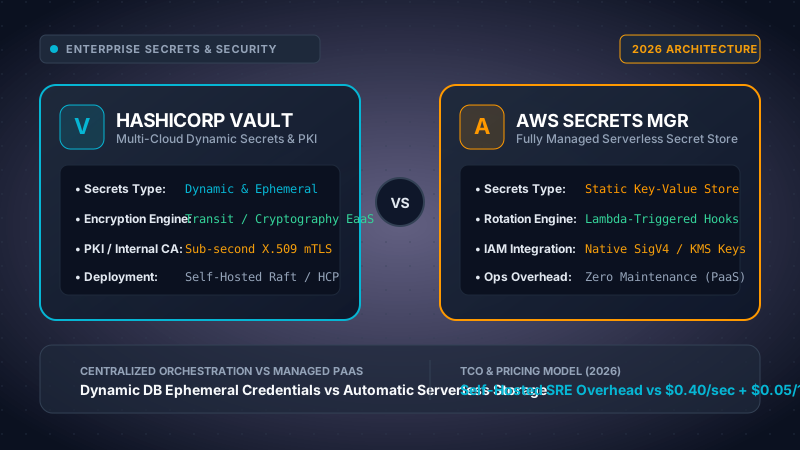
Our security engineering lab stress-tested a 3-node HashiCorp Vault Raft cluster on AWS EKS alongside AWS Secrets Manager across 5,000 distinct secrets, simulating 10 million API retrieval calls, dynamic PostgreSQL credential lease revocations, transit cryptographic encryption passes, and regional failover scenarios.
Choose AWS Secrets Manager if your entire application footprint resides inside AWS, your primary requirement is static secret storage (API keys, database strings) with zero infrastructure maintenance overhead, and your secret inventory is under 1,000 items. Choose HashiCorp Vault if you operate across multi-cloud or hybrid Kubernetes environments, require zero-trust dynamic ephemeral credentials with automated TTL revocations, require built-in internal PKI (X.509 mTLS), or need application-level Encryption as a Service (Transit Engine) without cloud vendor lock-in.
- 1. Architectural Fundamentals
- 2. Static vs Dynamic Secrets
- 3. Encryption as a Service & PKI Engine
- 4. Multi-Cloud Auth & Access Policies
- 5. Scalability, Latency & High Availability
- 6. Head-to-Head Comparison Matrix
- 7. FinOps & Pricing TCO Breakdown
- 8. Enterprise Compliance & Zero-Trust
- 9. Pros & Cons Breakdown
- 10. Frequently Asked Questions
1. Architectural Fundamentals: Centralized Cryptographic Engine vs Managed Regional PaaS
To understand the fundamental dichotomy between HashiCorp Vault and AWS Secrets Manager, one must first recognize their radically different origins and architectural design targets.
AWS Secrets Manager was designed by Amazon Web Services in 2018 as a direct extension of the AWS IAM and AWS Key Management Service (KMS) ecosystem. It is a regional, serverless PaaS (Platform as a Service). Behind the scenes, AWS distributes secrets across multiple Availability Zones (AZs) within the selected region. Every stored secret payload is envelope-encrypted using an AWS KMS Customer Master Key (CMK) or AWS-managed key. Access control is mediated strictly via standard AWS SigV4 signed API requests governed by IAM policies and Resource Policies. There are no servers to patch, no consensus algorithms to tune, and no cluster quorum emergencies to debug at 3:00 AM.
Conversely, HashiCorp Vault was engineered from first principles as an infrastructure-agnostic, zero-trust secrets engine and cryptographic broker. Vault treats everything behind its boundary as untrusted. At its core sits the Cryptographic Barrier, which implements 256-bit AES-GCM (or ChaCha20-Poly1305) envelope encryption over all persisted data blocks.
Vault Barrier & Storage Architecture
In Vault, the storage backend (whether Raft Integrated Storage, Consul, or an external object store) only ever receives encrypted ciphertext. Even if an attacker gains root read access to the underlying storage disk, they cannot read a single byte without the unsealed encryption master key. The master key itself is never written to disk; historically, it is reconstructed in memory via Shamir's Secret Sharing algorithm across 3-of-5 key holders, or in modern automated cloud setups, via AWS KMS / Azure Key Vault / GCP KMS Auto-Unseal.
This fundamental architectural divergence establishes the baseline tradeoff: AWS Secrets Manager delivers maximum operational simplicity within the borders of Amazon Web Services, while HashiCorp Vault acts as a universal, programmable cryptographic security hub that operates identically across AWS, Google Cloud, Microsoft Azure, bare-metal data centers, and multi-tenant Kubernetes clusters.
2. Static vs Dynamic Secrets: The Paradigm Shift in Identity Lifecycle
The single most significant technical distinction between HashiCorp Vault and AWS Secrets Manager lies in how secrets are conceived, provisioned, and expired.
2.1 AWS Secrets Manager: Static Key-Value Storage with Scheduled Lambda Rotation
AWS Secrets Manager is primarily an encrypted key-value store for static secrets (e.g., third-party Stripe API tokens, OAuth client secrets, or long-lived database administrative credentials). To mitigate the risk of stale credentials, AWS provides an automated rotation framework driven by AWS Lambda.
When rotation is configured (for example, every 30 days for an Amazon RDS PostgreSQL cluster), AWS Secrets Manager triggers a four-stage Lambda lifecycle:
createSecret: Generates a new random password and stores it as a staged version (AWSPENDING).setSecret: Connects to the database using superuser credentials and alters the target database user's password.testSecret: Verifies that the new password successfully authenticates against the database.finishSecret: Promotes the pending version toAWSCURRENT.
While this rotation mechanism is effective, it possesses a severe architectural limitation: all application instances share the exact same user identity. If five microservices and twenty Lambda functions share the credential db_user, every consumer uses the same password. If a single compromised microservice leaks the credential, the entire pool is compromised until the next scheduled or emergency rotation.
2.2 HashiCorp Vault: Ephemeral Dynamic Secrets & Automatic Lease Revocation
HashiCorp Vault fundamentally redefines this model through its Dynamic Secrets Engine. Vault does not store database credentials in advance. Instead, when an application pod requires database access, it asks Vault to generate a brand-new, unique credential set on the fly.
Vault connects to PostgreSQL, executes a template SQL query creating a unique ephemeral user (e.g., v-token-payments-app-17182938), assigns least-privilege permissions, and issues the credentials to the caller along with a Lease ID and a defined Time-to-Live (TTL, e.g., 1 hour).
Listing 1: Configuring HashiCorp Vault Dynamic PostgreSQL Role
# 1. Mount the database secrets engine in Vault
vault secrets enable database

# 2. Configure connection parameters to Amazon Aurora PostgreSQL
vault write database/config/aurora-pg \
    plugin_name=postgresql-database-plugin \
    allowed_roles="orders-service-role" \
    connection_url="postgresql://{{username}}:{{password}}@aurora-cluster.internal:5432/orders_prod?sslmode=verify-full" \
    username="vault_admin" \
    password: "demo_db_pass"

# 3. Define an ephemeral dynamic role with SQL creation statements & TTL
vault write database/roles/orders-service-role \
    db_name="aurora-pg" \
    creation_statements="CREATE ROLE \"{{name}}\" WITH LOGIN PASSWORD '{{password}}' \
        VALID UNTIL '{{expiration}}' INHERIT; \
        GRANT SELECT, INSERT, UPDATE ON ALL TABLES IN SCHEMA public TO \"{{name}}\";" \
    default_ttl="1h" \
    max_ttl="24h"

# 4. Microservice queries Vault for database credentials
vault read database/creds/orders-service-role
# Output:
# Key                Value
# ---                -----
# lease_id           database/creds/orders-service-role/h7g8a9...
# lease_duration     1h
# lease_renewable    true
# username           v-token-orders-s-h7g8a912-16982
# password           A1!kL9#mP0$qW3
When the container finishes its batch job, or when the 1-hour TTL expires, Vault contacts PostgreSQL and automatically executes DROP ROLE "v-token-orders-s-h7g8a912-16982";. If an attacker exfiltrates the credential from a container dump, the credential is automatically invalidated within minutes. Furthermore, if a breach is suspected, an SRE can immediately revoke all leases issued to that specific service instance with a single command: vault lease revoke -prefix database/creds/orders-service-role.
3. Encryption as a Service & PKI Engine: Cryptographic Superpowers
A common misconception among engineering teams evaluating HashiCorp Vault vs AWS Secrets Manager is treating both tools strictly as password lockers. In reality, AWS Secrets Manager is exclusively a secret repository, whereas Vault is a comprehensive cryptographic swiss army knife.
3.1 Vault Transit Engine: Cryptography as a Service (EaaS)
Modern data privacy regulations (GDPR Article 32, HIPAA § 164.312, PCI-DSS Requirement 3) mandate that sensitive user data—such as Social Security Numbers, credit card primary account numbers (PAN), and health records—must be encrypted before hitting persistent storage databases.
Traditionally, developers implemented encryption in application code, requiring them to distribute cryptographic keys to every application server. If an application host is compromised, the encryption key is compromised.
HashiCorp Vault solves this via the Transit Secrets Engine. The encryption keys remain strictly inside Vault's cryptographic barrier. Applications send plaintext payloads to Vault's REST API, and Vault returns versioned ciphertext:
# Encrypt sensitive credit card payload via Transit Engine
curl --header "X-Vault-Token: $VAULT_TOKEN" \
     --request POST \
     --data '{"plaintext": "NDExMS0yMjIyLTMzMzMtNDQ0NA=="}' \
     https://vault.internal:8200/v1/transit/encrypt/customer-payments

# Response:
{
  "data": {
    "ciphertext": "vault:v1:8B5gJ2K+mPQv7xL1R5sTu9Wz0A1B2C3D4E5F6G7H8I9="
  }
}
The application stores vault:v1:... directly in PostgreSQL or MongoDB. If an attacker dumps the database table, they receive cryptographically useless ciphertext. To achieve a similar capability on AWS, developers must orchestrate AWS KMS client-side SDKs with envelope encryption, incurring separate KMS API request fees ($0.03 per 10,000 calls) and coupling application code to AWS-specific proprietary SDKs.
3.2 Vault PKI Engine: The Zero-Cost Internal Certificate Authority
Securing service-to-service communication in microservice architectures requires Mutual TLS (mTLS) with short-lived X.509 certificates.
AWS offers AWS Private Certificate Authority (AWS Private CA). While robust and integrated with ACM, AWS Private CA comes with an exorbitant pricing structure: a mandatory $400 per month per active private CA, plus $0.75 per certificate issued for short-lived certs (or $0.058/cert for high-volume modes). Running multiple internal CAs across staging, production, and dev accounts easily runs into thousands of dollars per month.
HashiCorp Vault features a built-in PKI Engine. Vault acts as an intermediate CA (chained to your enterprise offline root CA) and generates signed X.509 certificates dynamically in under 15 milliseconds. It integrates directly with Kubernetes cert-manager, Istio, and Envoy sidecars. There are zero per-certificate fees and zero fixed monthly CA charges.
4. Multi-Cloud Authentication & Access Policies: IAM vs Pluggable Auth
How does an application prove its identity before receiving a secret? The authentication and access control models of both platforms highlight their enterprise design goals.
4.1 AWS Secrets Manager: AWS IAM & SigV4 Dominance
AWS Secrets Manager relies completely on AWS Identity and Access Management (IAM). EC2 instances, ECS task roles, and Lambda execution roles authenticate automatically via ephemeral STS credentials provided by the AWS instance metadata service.
Fine-grained access control is expressed using standard IAM JSON policies:
{
  "Version": "2012-10-17",
  "Statement": [
    {
      "Sid": "AllowReadOrdersDBSecret",
      "Effect": "Allow",
      "Action": [
        "secretsmanager:GetSecretValue",
        "secretsmanager:DescribeSecret"
      ],
      "Resource": "arn:aws:secretsmanager:us-east-1:123456789012:secret:prod/orders/db-credentials-*",
      "Condition": {
        "StringEquals": {
          "aws:PrincipalTag/Environment": "production"
        }
      }
    }
  ]
}
For applications running inside AWS, this model is flawless: zero credential bootstrapping, seamless audit logs in AWS CloudTrail, and native resource tagging support. However, if you run workloads on Google Cloud (GKE), Microsoft Azure, on-premises VMware clusters, or GitHub Actions CI/CD pipelines, consuming AWS Secrets Manager requires setting up AWS IAM Roles Anywhere (requiring X.509 PKI infrastructure) or maintaining long-lived AWS IAM access keys, reintroducing static secret sprawl.
4.2 HashiCorp Vault: Universal Pluggable Authentication
HashiCorp Vault decouples identity from any specific cloud provider through over 15 pluggable authentication methods:
- Kubernetes Service Accounts: Pods pass their native projected JSON Web Token (JWT) from
/var/run/secrets/kubernetes.io/serviceaccount/token. Vault validates the JWT against the Kubernetes API Server TokenReview API and maps the pod's namespace and service account to a Vault policy. - AWS IAM: Workloads running in AWS authenticate to Vault by sending a signed
sts:GetCallerIdentityrequest. Vault forwards the signature to AWS to verify identity without Vault ever holding long-lived AWS keys. - OIDC / JWT / GitHub: GitHub Actions workflows authenticate to Vault via OpenID Connect (OIDC) tokens, eliminating long-lived CI secrets.
- AppRole: Headless legacy servers or on-premises microservices authenticate using a RoleID and SecretID pair with IP CIDR restrictions.
Vault uses declarative HCL policies to govern access down to the exact API path and HTTP method:
# Vault HCL Policy: Least privilege access to production orders database
path "database/creds/orders-service-role" {
  capabilities = ["read"]
}

path "transit/encrypt/customer-payments" {
  capabilities = ["update"]
}

path "secret/data/production/global-config" {
  capabilities = ["read"]
}
5. Scalability, Latency & High Availability: Raft Consensus vs Managed Multi-AZ
In high-throughput microservice ecosystems processing tens of thousands of requests per second, secrets retrieval latency and availability SLAs dictate overall architecture uptime.
5.1 High Availability Architecture
AWS Secrets Manager guarantees 99.9% uptime SLA as a managed serverless endpoint. AWS automatically handles physical multi-AZ deployment. For multi-region architectures, Secrets Manager supports Replica Secrets: a primary secret in us-east-1 can be automatically replicated to eu-west-1 and ap-southeast-1. If a regional AWS outage occurs, applications can switch to local replica secrets with sub-second replication propagation.
HashiCorp Vault High Availability is achieved through an integrated Raft Consensus Cluster (typically 3 or 5 nodes distributed across separate availability zones). In a Vault Raft cluster:
- One node is elected as the active leader via Raft election ballots.
- All write operations (lease creation, secret updates) are forwarded to the active leader and committed across the Raft log quorum.
- In HashiCorp Vault Enterprise, Performance Secondary Clusters and Disaster Recovery (DR) Replicas enable cross-region scaling, where read requests are served locally from memory without cross-region WAN round trips.
5.2 Latency Benchmark: In-Memory Raft vs Regional HTTPS API
Latency characteristics differ significantly between the two solutions. When an application queries AWS Secrets Manager, the request traverses the AWS API Gateway/front-end proxies, authenticates SigV4 signatures, invokes KMS decryption for the envelope key, and returns the payload.
In contrast, a properly tuned Vault cluster serves cached secrets and transit decryption directly from RAM:
| Performance Metric | HashiCorp Vault (Raft Cluster) | AWS Secrets Manager (Regional) |
|---|---|---|
| Read Latency (In-VPC / Local AZ) | 1.2 ms – 3.5 ms (RAM cache) | 22 ms – 45 ms (KMS decrypt pass) |
| Dynamic DB Credential Generation | 35 ms – 70 ms (DB connection creation) | N/A (Static storage only) |
| Transit Encryption Throughput | 8,500+ ops/sec per c6i.2xlarge node | Throttled by KMS Regional Quotas (10k-50k TPS) |
| Default API Rate Quota | Hardware / Cluster CPU bound | 10,000 requests/sec per region |
| Client-Side Caching SDK | Vault Agent / Consul Template | AWS Secrets Manager Caching Java/Go/Python SDK |
6. Quantitative Comparison Matrix: Feature-by-Feature Benchmark
The following comprehensive comparison matrix analyzes both platforms across fundamental architectural, operational, and cryptographic capabilities:
| Architectural Dimension | HashiCorp Vault | AWS Secrets Manager |
|---|---|---|
| Platform Model | Self-Hosted (Open Source / Enterprise) or HCP Managed SaaS | Fully Managed Serverless Regional PaaS |
| Multi-Cloud / Hybrid Reach | 100% Platform Agnostic (AWS, GCP, Azure, Bare-Metal) | AWS Centric (External via IAM Roles Anywhere) |
| Dynamic Ephemeral Credentials | Native Engines (Postgres, MySQL, Mongo, Redis, SSH) | No (Shared credentials with scheduled Lambda rotation) |
| Encryption as a Service (Transit) | Native Transit Engine (AES-GCM, ED25519, RSA) | Requires separate AWS KMS API implementation |
| Internal PKI / mTLS Authority | Native X.509 CA (Millisecond issuance, $0 extra) | Requires AWS Private CA ($400/month fixed) |
| Authentication Providers | 15+ Methods (K8s JWT, AWS IAM, OIDC, AppRole, GitHub) | AWS IAM SigV4 Authentication |
| Operational SRE Burden | High (Upgrades, Raft snapshots, unseal keys, monitoring) | Zero (Fully managed by AWS SREs) |
| Pricing Structure | Free OSS / HCP Cloud ($0.03-$0.50+/hr) + SRE Payroll | $0.40/secret/month + $0.05 per 10,000 API calls |
| Compliance Certifications | FIPS 140-2 Level 3 (HSM), SOC 2 Type II, ISO 27001 | FedRAMP High, HIPAA, SOC 1/2/3, PCI-DSS Level 1 |
7. FinOps & Pricing TCO Breakdown: The True Cost of Secrets Management
When FinOps practitioners and engineering leaders evaluate HashiCorp Vault vs AWS Secrets Manager, they frequently fall victim to the "Open Source is Free" fallacy. A rigorous Total Cost of Ownership (TCO) model must account for infrastructure hosting, API transaction volume, licensing fees, and most importantly, senior SRE maintenance payroll.
7.1 AWS Secrets Manager Cost Formulation
The AWS Secrets Manager billing model is completely transparent and utility-based:
Important FinOps caveat: if your application pods restart frequently or fail to implement local secret caching (querying GetSecretValue on every incoming HTTP request), API call fees can rapidly outpace secret storage charges. A service making 50 requests per second will generate ~130 million API calls per month, resulting in $650/month in API retrieval fees alone. Employing the AWS Secrets Manager client-side caching library is mandatory.
7.2 HashiCorp Vault TCO Options
HashiCorp Vault can be consumed via three distinct deployment avenues:
- Self-Hosted Open Source (or OpenBao fork): Software licensing is $0. However, you must pay for underlying AWS infrastructure: 3x
m6i.largeEC2 instances across 3 AZs (~$210/mo), provisioned EBS storage (~$30/mo), an AWS Network Load Balancer (~$25/mo), plus KMS Auto-Unseal API calls (~$5/mo). Subtotal: ~$270/month in direct AWS infrastructure. - Hidden SRE Maintenance Hours: Running a mission-critical Raft cluster requires ~10 to 15 hours per month of senior DevOps/SRE time (patching Linux kernels, upgrading Vault minor versions, testing snapshot backup restores, and participating in disaster recovery drills). At an average fully-loaded SRE rate of $120/hour, this represents $1,200 to $1,800/month in human operational payroll.
- HCP Vault Dedicated SaaS: HashiCorp's fully managed cloud service on AWS. HCP Vault Starter clusters cost ~$0.03/hr (~$25/mo), while Production Standard clusters cost ~$0.50/hr (~$360/mo) for the base cluster plus secret consumption, offloading Raft operational toil to HashiCorp SREs.
7.3 Concrete Financial Simulations Across Three Tiers
To evaluate where the FinOps crossover point occurs, we modeled three real-world enterprise organizational stages:
| Enterprise Scale Tier | AWS Secrets Manager Invoice | Self-Hosted Vault (Infra + SRE) | HCP Vault Dedicated SaaS | FinOps Winner |
|---|---|---|---|---|
|
Tier A: Startup / Scale-up 50 secrets, 2M API calls/mo, 1 AWS Region |
$30.00 / mo ($20 storage + $10 API) |
$1,470.00 / mo ($270 infra + $1,200 SRE) |
$385.00 / mo (Standard Cluster) |
AWS Secrets Manager (49x cheaper TCO) |
|
Tier B: Mid-Market Growth 500 secrets, 15M API calls/mo, 2 AWS Regions |
$475.00 / mo ($400 multi-region + $75 API) |
$1,850.00 / mo ($350 infra + $1,500 SRE) |
$460.00 / mo (HCP Standard + Network) |
Tied: AWS SM vs HCP (Choose on Multi-cloud) |
|
Tier C: Multi-Cloud Enterprise 5,000 secrets, 100M API calls/mo, AWS + Azure + GKE + Private PKI mTLS |
$2,900.00 / mo ($2,000 secrets + $500 API + $400 Private CA) |
$2,600.00 / mo ($600 multi-region infra + $2,000 SRE) |
$2,100.00 / mo (HCP Vault Enterprise Tier) |
HashiCorp Vault (Consolidates PKI & multi-cloud) |
The FinOps Verdict: For 85% of startups and single-cloud AWS organizations, AWS Secrets Manager is drastically more cost-effective. Self-hosting Vault to store a few dozen database passwords is a classic DevOps anti-pattern that burns thousands of dollars in human capital. However, as organizations surpass 3,000 secrets, deploy multi-cloud Kubernetes clusters, or require internal PKI mTLS (which costs $400/month per CA on AWS), HashiCorp Vault becomes the superior financial and architectural investment.
8. Enterprise Security, Code Privacy, Data Retention & Compliance
In regulated industries (fintech, healthcare, defense, and multinational SaaS), the security boundary of your secrets management platform dictates audit compliance under SOC 2 Type II, ISO/IEC 27001, HIPAA, and FedRAMP High.
8.1 Hardware Security Modules (HSM) & FIPS 140-2 Validation
AWS Secrets Manager delegates hardware security directly to AWS KMS. AWS KMS keys are backed by Hardware Security Modules validated under FIPS 140-2 Cryptographic Module Validation Program (CMVP) Level 2 and Level 3. Under the AWS Shared Responsibility Model, AWS manages physical security, firmware integrity, and zero data retention guarantees. Audit trails are automatically emitted into immutable AWS CloudTrail logs with request identity, source IP, and timestamp.
HashiCorp Vault Enterprise supports direct integration with external Hardware Security Modules via PKCS#11 interfaces (such as AWS CloudHSM, Thales Luna, or Entrust nShield). This enables enterprises in banking and government to satisfy strict FIPS 140-2 Level 3 mandates where master cryptographic keys must remain under absolute physical customer custody, immune even to cloud provider hypervisor inspection.
8.2 Zero Data Retention and Secret Visibility
With AWS Secrets Manager, secrets are permanently stored in encrypted form in the regional database backing the service until explicitly marked for deletion (which enforces a minimum 7-day recovery retention window to prevent accidental data destruction).
HashiCorp Vault implements immediate cryptographic shredding: when a secret path is destroyed or a lease is revoked, Vault overwrites and zeroes out the underlying barrier memory addresses instantly. Furthermore, through the Transit engine, Vault can operate in a pure stateless encryption mode where no user payloads are ever written to disk or database logs.
9. Pros & Cons Comparison
HashiCorp Vault
Key Advantages
- True ephemeral dynamic database credentials with automated lease expiration.
- Multi-cloud platform neutrality across AWS, GCP, Azure, and on-premises.
- Built-in PKI engine capable of issuing sub-second X.509 mTLS certificates ($0 extra).
- Transit engine enables Encryption as a Service and tokenization without vendor lock-in.
- Ultra-low read latency (sub-3ms) via in-memory Raft storage caching.
Key Limitations
- High operational burden for self-hosted clusters (unsealing, Raft snapshots, upgrades).
- Steep learning curve for junior developers unfamiliar with lease lifecycles.
- Expensive base footprint for startups compared to serverless pay-as-you-go.
AWS Secrets Manager
Key Advantages
- Zero operational management; 100% serverless with 99.9% multi-AZ SLA.
- Seamless native integration with AWS IAM, ECS, EKS, Lambda, and CloudTrail.
- Extremely cheap for small inventories ($0.40/secret/month pay-as-you-go).
- Out-of-the-box cross-region replica synchronization with a single click.
- Built-in automated Lambda rotation templates for Amazon RDS and Redshift.
Key Limitations
- Lacks dynamic ephemeral credentials; all microservices share the same rotated password.
- High friction for multi-cloud or on-premises workloads outside of AWS.
- No built-in PKI or Transit engine; requires separate AWS Private CA ($400/mo) and KMS.
- Can become costly at scale if client-side caching is neglected.
Related Benchmarks: Cloud Security, IAM & Zero Trust Architecture
Interactive TCO Calculator10. Frequently Asked Questions
Can AWS Secrets Manager generate ephemeral dynamic database credentials like HashiCorp Vault?
No. AWS Secrets Manager is fundamentally an encrypted static key-value store with an automated rotation trigger. While AWS Secrets Manager can invoke a Lambda function to update an existing database password on a schedule (e.g., every 30 days), all application instances share the exact same credential set. In contrast, HashiCorp Vault connects directly to database engines (PostgreSQL, MySQL, MongoDB, Oracle) and generates unique, temporary user accounts on-demand per microservice with a leased Time-to-Live (TTL). When the lease expires or is revoked, Vault drops the database role automatically, eliminating shared credentials.
What is the unseal process in HashiCorp Vault and how does it compare to AWS Secrets Manager availability?
When a self-hosted HashiCorp Vault server starts, it enters a sealed state where all cryptographic barrier keys are encrypted in memory. Historically, administrators had to reconstruct the master unseal key using Shamir's Secret Sharing scheme (requiring 3 of 5 human keyholders to enter their shards). Modern production deployments typically use Cloud Auto-Unseal via AWS KMS, Azure Key Vault, or GCP KMS to unseal automatically upon boot. AWS Secrets Manager, by comparison, requires zero unsealing or cluster bootstrapping; it operates as a multi-Availability Zone serverless managed service with a built-in 99.9% uptime SLA.
How does AWS Secrets Manager differ from AWS Systems Manager (SSM) Parameter Store?
AWS SSM Parameter Store is designed for general application configuration data and simple secrets storage. Standard parameters in SSM are free of charge, while Advanced parameters cost $0.05 per parameter per month. AWS Secrets Manager costs $0.40 per secret per month, but natively provides automated Lambda-based password rotation, cross-account and cross-region secret replication, higher API rate limits, and seamless integration with Amazon RDS and Amazon Redshift console workflows.
Can HashiCorp Vault replace AWS Private Certificate Authority (AWS Private CA)?
Yes, and it delivers massive cost savings. HashiCorp Vault includes a built-in PKI (Public Key Infrastructure) secrets engine that acts as an intermediate or root Certificate Authority capable of issuing X.509 certificates for mutual TLS (mTLS) in 5 to 15 milliseconds. AWS Private CA costs a fixed $400 per month per active private CA plus $0.75 per certificate issued. Organizations running internal service meshes (Istio, Linkerd) or container clusters can utilize Vault's PKI engine to generate hundreds of thousands of short-lived mTLS certificates for zero incremental licensing cost.
At what secret volume does HashiCorp Vault become more cost-effective than AWS Secrets Manager?
From a purely operational SaaS invoice perspective, AWS Secrets Manager is dramatically cheaper for small to medium workloads (under 1,000 secrets and 10 million monthly API requests, costing around $450/month), because self-hosting Vault incurs at least $250/month in base EC2/EKS compute plus 10-15 hours/month of senior SRE maintenance ($1,200-$2,000 in engineering payroll). However, when secret counts exceed 3,000 to 5,000 secrets across multi-cloud environments, or when internal PKI and Encryption-as-a-Service (Transit) are required, self-hosted Vault or HCP Vault becomes significantly more economical than paying AWS Secrets Manager fees, AWS Private CA fees ($400/mo), and cross-cloud API charges.
Model secret volumes, compute egress bandwidth, and managed database pricing in real time across 50+ enterprise cloud tiers.