Wiz vs Orca Security (2026): Agentless CNAPP & Cloud Security Benchmark
Cloud-Native Application Protection Platforms (CNAPP) have fundamentally disrupted legacy host-agent architectures. In 2026, Wiz and Orca Security dominate the agentless cloud security category. Here is an exhaustive, architect-level benchmark examining snapshot scanning mechanics, SideScanning™ block analytics, Security Graph toxic risk fidelity, eBPF runtime extensions, DSPM, and FinOps TCO models.
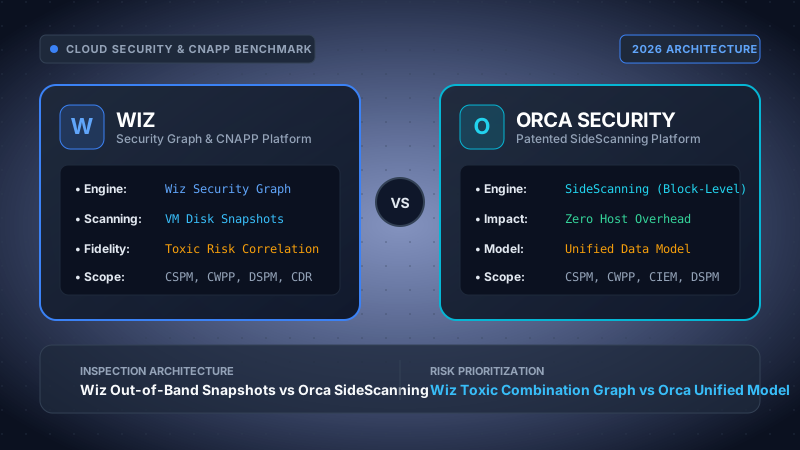
Choose Wiz if you operate a complex, multi-cloud enterprise (AWS, Azure, GCP, OCI) with intricate IAM permission chains, massive Kubernetes clusters, and require the industry-leading Security Graph to isolate the <2% of vulnerabilities that represent realistic attack paths (“toxic combinations”). Wiz provides the deepest visual query interface, superior DSPM capabilities, and best-in-class developer shift-left tooling, albeit at a premium price point (typically $35k–$75k+ minimum ACV).
Choose Orca Security if you want true zero-impact cloud visibility via patented SideScanning™ (reading raw block storage directly without spinning up heavy analysis runners), rapid time-to-value, and an all-in-one unified data model at a more flexible commercial entry point ($15k–$35k ACV). Orca excels for engineering organizations and mid-market to large enterprises seeking full-stack CNAPP (CSPM, CWPP, CIEM, DSPM) without the operational baggage and prohibitive minimum spend thresholds of Wiz.
Table of Contents
- 1. CNAPP Architectural Paradigms: The Death of Host Agents
- 2. SideScanning™ Mechanics vs Ephemeral Snapshot Mounting
- 3. Wiz Security Graph vs Orca Unified Data Model
- 4. Kubernetes, Image Registries & Admission Controllers
- 5. Runtime Threat Detection: eBPF Sensors & Cloud Detection (CDR)
- 6. DSPM, Sensitive Data Discovery & Compliance Audits
- 7. Quantitative Head-to-Head Benchmark Matrix
- 8. FinOps, Licensing Models & Real-World TCO Formulas
- 9. Final Decision Framework: When to Choose Wiz vs Orca
- 10. Frequently Asked Questions (FAQ)
1. CNAPP Architectural Paradigms: The Death of Host Agents
For over a decade, enterprise workload protection relied on traditional endpoint detection and response (EDR) or cloud workload protection (CWPP) agents. Tools like Qualys, Rapid7, and early Trend Micro required daemons installed on every Linux virtual machine, EC2 instance, and container host. In modern elastic cloud environments, this legacy paradigm fractured under four structural failure modes:
- Deployment Friction & Coverage Gaps: Ephemeral autoscaling groups, spot instances, and developer sandboxes routinely bypassed agent deployment pipelines, leaving 20% to 45% of enterprise cloud assets invisible to security teams.
- Workload Resource Contention: Host agents consume between 2% and 8% of vCPU and 200MB to 800MB of RAM. In high-density container environments, memory-hungry agents directly increase cloud compute bills and risk triggering kernel panics.
- Zero Coverage for Serverless & Managed PaaS: Agents cannot be installed on AWS Fargate, AWS Lambda, Azure App Services, Google Cloud Run, or managed database services (RDS, Cloud SQL, DynamoDB).
- Maintenance & Upgrade Overhead: Managing agent version compatibility across Ubuntu, Amazon Linux, RHEL, Debian, Windows Server, and varied kernel versions creates continuous DevOps friction.
The emergence of Cloud-Native Application Protection Platforms (CNAPP) unified Cloud Security Posture Management (CSPM), Cloud Workload Protection (CWPP), Cloud Infrastructure Entitlement Management (CIEM), Data Security Posture Management (DSPM), and Container Security into a cohesive framework. Wiz and Orca Security pioneered this transformation by leveraging cloud provider hypervisor APIs to inspect workloads out-of-band.
Wiz Paradigm The Security Graph Engine
Wiz connects to cloud accounts via cross-account IAM roles, reads cloud control planes, and performs snapshot-based workload inspection. All discovered metadata—network reachability, OS vulnerabilities, secret keys, IAM role delegations, and data classifications—is ingested into a graph database to surface attack paths.
Orca Paradigm The SideScanning™ Fabric
Orca connects via cloud provider APIs and performs out-of-band reading of block-level storage volumes (SideScanning™). By parsing virtual disk block tables directly without executing the workload operating system, Orca extracts system state, vulnerabilities, and misconfigurations with 0% runtime overhead.
Both platforms can be onboarded into an enterprise AWS, Azure, GCP, or OCI environment in under 15 minutes without installing software or restarting production instances. The onboarding workflow uses Infrastructure-as-Code (Terraform, AWS CloudFormation, or Azure ARM templates) to establish an isolated cross-account trust relationship.
{
"Version": "2012-10-17",
"Statement": [
{
"Sid": "SecurityAuditMetadataRead",
"Effect": "Allow",
"Action": [
"ec2:Describe*", "iam:Get*", "iam:List*",
"s3:GetBucketAcl", "s3:GetBucketPolicy", "s3:GetBucketPublicAccessBlock",
"rds:Describe*", "eks:DescribeCluster", "eks:ListClusters"
],
"Resource": "*"
},
{
"Sid": "OutOfBandSnapshotLifecycle",
"Effect": "Allow",
"Action": [
"ec2:CreateSnapshot", "ec2:DeleteSnapshot", "ec2:ModifySnapshotAttribute",
"kms:CreateGrant", "kms:DescribeKey"
],
"Resource": "*",
"Condition": { "StringEquals": { "aws:RequestTag/ManagedBy": "CNAPP-Scanner" } }
}
]
}
2. SideScanning™ Mechanics vs Ephemeral Snapshot Mounting
While industry marketing often lumps both Wiz and Orca into the “agentless snapshot” bucket, their underlying deep-level mechanics differ significantly. Understanding these mechanics is essential for cloud infrastructure architects evaluating I/O limits, snapshot API throttling, and tenant security boundaries.
Orca Security: Patented SideScanning™ (Block-Level Inspection)
Orca Security was awarded US Patent #10,958,667 for its SideScanning™ technology. Rather than booting a guest operating system to run scanners, Orca operates at the hypervisor storage fabric layer:
- Storage Snapshot Creation: Orca issues cloud provider API calls (e.g.
ec2:CreateSnapshotin AWS orMicrosoft.Compute/snapshotsin Azure) to take a point-in-time snapshot of the target virtual machine’s block storage volume. - Direct Block-Level Streaming: In cloud environments supporting EBS Direct APIs (such as AWS
ebs:ListSnapshotBlocksandebs:GetSnapshotBlock), Orca can read changed blocks directly over optimized HTTPS endpoints without creating intermediate virtual disks. - Out-of-Band File System Reconstruction: Orca’s scanning engine parses partition tables (MBR, GPT), file system structures (ext4, XFS, NTFS), operating system packages (dpkg, rpm, pacman), and runtime libraries in memory.
- Malware & Secret Analysis Without Code Execution: Because the scanned operating system kernel is never booted and binaries are never executed, zero-day malware residing on the scanned disk cannot break containment or execute anti-forensic code.
- Immediate Snapshot Destruction: Once block analysis finishes, the snapshot is promptly deleted, minimizing cloud storage retention fees.
Wiz: Ephemeral Snapshot Mounting & Dynamic Worker Nodes
Wiz approaches out-of-band inspection by pairing native cloud snapshotting with high-speed ephemeral scanner runners:
- Point-in-Time Snapshot: Wiz invokes storage snapshot APIs across target workloads across AWS, Azure, GCP, and OCI.
- Volume Creation & Secondary Attachment: Wiz creates an ephemeral volume from the snapshot and attaches it as a non-boot secondary data disk to a dedicated, hardened Wiz analysis runner instance.
- Read-Only OS & Container Inspection: The runner mounts the disk read-only. Wiz containerized inspection modules traverse the filesystem, extract Software Bill of Materials (SBOM), hash application dependencies, scan for embedded credentials (API tokens, private SSH keys, certs), and identify configuration drift.
- Deployment Flexibility (SaaS vs Outpost): For strict data sovereignty requirements (e.g., defense, banking, healthcare), Wiz offers Wiz Outpost / Private Scanner, allowing analysis runners to remain entirely within the customer’s own VPC/VNet, ensuring that customer disk snapshots never transit outside their corporate cloud perimeter.
- Volume Detachment & Teardown: The ephemeral volume is unmounted, detached, and deleted along with the originating snapshot within minutes.
Architectural Takeaway on I/O & Host Performance
Neither Wiz nor Orca causes any CPU or RAM degradation on production workloads. However, when taking an initial snapshot of a heavily loaded disk volume on AWS EBS, cloud providers redirect modified blocks to copy-on-write allocations. While this I/O degradation is negligible (<0.5% latency impact) for typical web apps, database workloads exceeding 25,000 IOPS should schedule daily scans during off-peak windows.
3. Wiz Security Graph vs Orca Unified Data Model
The most critical differentiator between modern CNAPPs and legacy vulnerability scanners is contextual risk prioritization. A legacy vulnerability scanner might flag 10,000 High/Critical CVEs across a 500-node cloud environment, causing immediate alert fatigue for security operations center (SOC) teams. In reality, over 98% of those vulnerabilities cannot be exploited because the affected instances have no inbound network path, no internet-facing IP, no elevated IAM credentials, and contain non-critical workloads.
Wiz: The Wiz Security Graph & “Toxic Combinations”
Wiz pioneered the concept of the Security Graph. Wiz ingests millions of data points from cloud APIs, network routing tables, firewalls, operating system packages, secrets scanners, and IAM policies into a hyper-scalable graph database.
In the Wiz graph, an alert is only escalated to Critical priority if a Toxic Combination is verified across multiple orthogonal attack vectors:
- Vector 1 (Network Exposure): The instance is directly or indirectly exposed to the public internet through an Application Load Balancer, Ingress Controller, or permissive Security Group (e.g.
0.0.0.0/0on open ports). - Vector 2 (Exploitable Vulnerability): The workload runs a software package with a weaponized, remotely exploitable CVE (e.g. Log4Shell, Spring4Shell, OpenSSH regreSSHion) listed in CISA KEV (Known Exploited Vulnerabilities).
- Vector 3 (High Privilege IAM Identity): The instance is bound to an IAM instance profile or service account with excessive cloud privileges (e.g.
AdministratorAccess,iam:PassRole, or cross-account trust). - Vector 4 (Lateral Movement / Data Access): The disk contains plaintext database connection strings, unencrypted SSH keys, or access to sensitive data buckets (S3/Blob).
By correlating these four vectors, Wiz reduces an initial avalanche of 15,000 raw vulnerabilities down to 8 actionable toxic combinations, allowing security teams to remediate the critical attack path in minutes.
↓ (Port 443 / Ingress Controller)
[AWS EC2 Instance: prod-payments-worker]
• Vulnerability: CVE-2024-6387 (regreSSHion) Remote Code Execution
• Disk Secret Found: ~/.aws/credentials (AWS Root Access Key)
• Attached IAM Role: arn:aws:iam::123456789:role/AdminExecutionRole
↓ (Allows Lateral Movement to)
[S3 Bucket: prod-customer-financial-records-pii] (DSPM Flag: 2.4M Social Security Numbers)
→ WIZ GRAPH ALERT: CRITICAL TOXIC COMBINATION DETECTED (Immediate Action Required)
Orca Security: The Unified Data Model & Orca Score
Orca addresses risk prioritization through its Unified Data Model. Rather than running separate databases for CSPM, CWPP, and CIEM, Orca correlates all telemetry into a single contextual schema:
- Orca Score: Orca calculates a dynamic risk score from 1 to 100 for every asset, categorizing alerts into four operational buckets: Compromised, Imminent Compromise, Hazardous, and Suspicious.
- Attack Path Mapping: Similar to Wiz, Orca traces lateral movement pathways, illustrating how an adversary could pivot from an unpatched bastion host to an internal database.
- Natural Language & Intuitive Search: Orca features an intuitive query interface allowing analysts to construct queries such as:
Find all VMs exposed to the internet with unpatched CVSS > 9.0 vulnerabilities that can assume an administrative IAM role.
Architectural Assessment: While both platforms successfully eradicate 95%+ of alert noise, Wiz’s Security Graph remains the gold standard in visual representation, custom graph query flexibility, and enterprise blast radius modeling. Orca’s Unified Data Model is faster to comprehend for mid-level analysts who prefer direct dashboard views over graph query syntax.
4. Kubernetes, Image Registries & Admission Controllers
Modern cloud architectures rely heavily on managed Kubernetes services—Amazon EKS, Azure AKS, Google GKE, and Red Hat OpenShift. Securing Kubernetes requires visibility across multiple abstraction layers: the underlying cloud control plane, Kubernetes API master nodes, worker node host OS, container images in registries, and running pods.
Agentless Kubernetes Security Posture Management (KSPM)
Both Wiz and Orca provide comprehensive agentless KSPM. By connecting directly to the Kubernetes API server via a lightweight read-only cluster service account, both platforms audit:
- RBAC Misconfigurations: Overly broad cluster roles, default service accounts with cluster-admin privileges, and unauthenticated API endpoints.
- Pod Security Standards (PSS): Containers running with
privileged: true, root user IDs, host network sharing (hostNetwork: true), or mounted host root filesystems (/var/run/docker.sock). - Node Host Scanning: Worker node AMI/OS image vulnerabilities inspected via hypervisor snapshots without agent overhead.
CI/CD Registry Scanning & Admission Controllers
Preventing vulnerable container images from entering production requires shifting security checks into the continuous integration (CI) pipeline and implementing Kubernetes Admission Controllers:
Wiz Container Protection Stack
• Wiz CLI (wiz-cli): Integrates directly into GitHub Actions, GitLab CI, and Jenkins to scan container images, Terraform manifests, and Helm charts.
• Registry Scanning: Continuous, out-of-band inventory and vulnerability scanning across AWS ECR, Azure ACR, Google Artifact Registry, and Harbor.
• Wiz Kubernetes Admission Controller: Webhook based on OPA (Open Policy Agent) that intercepts kubectl apply and rejects deployment of images failing security policies or containing critical CVEs.
Orca Container Protection Stack
• Orca CLI (orca-cli): Shift-left vulnerability, secret, and IaC scanner supporting Docker, Podman, and container build steps.
• Dynamic Registry Discovery: Automatically catalogs all container registries across connected cloud accounts and scans images out-of-band.
• Orca Admission Controller: Kubernetes mutating/validating webhook enforcing CIS Kubernetes Benchmarks and blocking pods with unvetted base images.
apiVersion: admissionregistration.k8s.io/v1
kind: ValidatingWebhookConfiguration
metadata:
name: cnapp-vulnerability-enforcement-webhook
webhooks:
- name: policy.cnapp.internal
rules:
- apiGroups: [""]
apiVersions: ["v1"]
operations: ["CREATE", "UPDATE"]
resources: ["pods", "deployments", "statefulsets"]
failurePolicy: Fail
sideEffects: None
admissionReviewVersions: ["v1"]
5. Runtime Threat Detection: eBPF Sensors & Cloud Detection (CDR)
While out-of-band snapshot scanning is ideal for posture management, vulnerability discovery, and secrets auditing, it has an inherent limitation: it cannot detect active, live in-memory attacks in real time. If an attacker exploits an unpatched web application via zero-day remote code execution, executes a reverse shell in memory, and downloads cryptomining malware, an out-of-band scan that runs once every 12 to 24 hours cannot stop the exfiltration.
Recognizing this operational requirement, both Wiz and Orca introduced optional lightweight runtime sensors based on eBPF (extended Berkeley Packet Filter).
The Role of eBPF in Modern CNAPP
eBPF allows sandboxed programs to execute safely within the Linux kernel without modifying kernel source code or loading unstable third-party kernel modules. This provides deep, low-overhead observability:
- Syscall Interception: Monitors critical system calls (
execve,fork,connect,accept,openat,ptrace) to detect malicious process execution, privilege escalation, and suspicious outbound socket connections. - Forensic Memory Telemetry: Detects fileless attacks, memory injection, process masquerading, and unauthorized changes to kernel data structures.
- Container-Aware Process Mapping: Maps every syscall back to its specific Kubernetes Pod, namespace, container ID, and cloud IAM principal.
- Minimal Footprint: Unlike legacy monolithic EDR agents, modern eBPF sensors typically consume <1% CPU and less than 80MB of memory per node.
Cloud Detection and Response (CDR) Capabilities
Wiz Runtime Sensor & CDR
Wiz Runtime Sensor integrates with the Wiz Security Graph. When a live attack is detected (e.g. reverse shell spawned inside an Nginx container), Wiz instantly correlates the runtime telemetry with the graph’s cloud context: identifying which IAM role the container can access, whether the cluster is connected to production databases, and automatically triggering automated containment workflows (e.g., isolating the host via security group updates or killing the container).
Orca Runtime Sensor & CDR
Orca’s CDR architecture blends cloud trail telemetry (AWS CloudTrail, Azure Activity Logs, GCP Audit Logs) with its eBPF sensor. Orca correlates suspicious control-plane actions (e.g. anomalous IAM role creation from an unvetted IP) with live host telemetry, surfacing MITRE ATT&CK tactics across the cloud lifecycle with direct SIEM/SOAR streaming.
6. DSPM, Sensitive Data Discovery & Compliance Audits
Data Security Posture Management (DSPM) has transitioned from a specialized standalone category into an essential pillar of CNAPP. Organizations migrating to AWS S3, Azure Blob Storage, Google Cloud Storage, Snowflake, and managed databases face acute data leakage risks: unencrypted buckets, exposed credentials, and accidentally uploaded customer PII or financial records.
Automated Sensitive Data Discovery & Classification
Both Wiz and Orca scan object storage and database assets to identify, classify, and map sensitive data:
- Pre-built Classifiers: Out-of-the-box pattern recognition for Social Security Numbers (SSN), Credit Card Numbers (PCI-DSS), National Identification IDs, Passports, IBANs, and Electronic Protected Health Information (ePHI / HIPAA).
- Secret & Credential Scanning: Identifies exposed
.envfiles, private SSH keys (id_rsa), cloud access keys, database passwords, and JWT tokens left in public S3 buckets or unencrypted snapshot volumes. - Shadow Data Discovery: Flags unmanaged database snapshots, orphaned EBS volumes containing legacy backups, and unmonitored test buckets created by engineering teams.
- Access Governance & Exposure Analysis: Evaluates whether sensitive data stores are accessible by third-party vendor roles, public IAM policies, or unauthenticated HTTP endpoints.
Enterprise Compliance Frameworks
Both platforms provide continuous, automated mapping against global regulatory standards:
- SOC 2 Type II: Continuous evidence mapping for CC6/CC7 trust criteria.
- ISO/IEC 27001:2022: Controls covering cloud services, data masking, and threats.
- PCI-DSS v4.0.1: Cardholder data environment (CDE) segmentation and monitoring.
- HIPAA Security Rule: Protection and audit trails for electronic health data.
- NIST CSF & SP 800-53: Federal security baseline for government workloads.
- CIS Benchmarks: Hardening profiles for AWS, Azure, GCP, and Kubernetes.
7. Quantitative Head-to-Head Benchmark Matrix
The following evaluation matrix synthesizes architectural benchmarks, deployment mechanics, operational overhead, and security fidelity observed across enterprise production environments in 2026.
| Benchmark Dimension | Wiz (2026 Release) | Orca Security (2026 Release) | Architectural Advantage |
|---|---|---|---|
| Core Inspection Engine | Out-of-band disk snapshot mounting on ephemeral runner VMs | Patented SideScanning™ raw block storage reading | Orca (Cleaner zero-execution block isolation) |
| Risk Prioritization Fidelity | Wiz Security Graph (Multi-layered toxic combination analysis) | Unified Data Model (Orca Risk Score: 1–100 & Attack Paths) | Wiz (Superior graph query traversal & visualization) |
| Production Host Overhead | 0% CPU, 0% RAM on standard agentless scan; <1% with eBPF | 0% CPU, 0% RAM on standard agentless scan; <1% with eBPF | Tie (Both zero host impact out-of-band) |
| Onboarding Speed | 12–18 minutes via AWS CloudFormation / Terraform | 10–15 minutes via CloudFormation / Terraform | Tie (Both purely API role-based) |
| Runtime CDR Capabilities | Wiz Runtime Sensor (eBPF) + Automated Graph Containment | Orca Runtime Sensor (eBPF) + CloudTrail/Activity Log correlation | Wiz (Deeper context linking runtime events to blast radius) |
| Kubernetes & Registry Coverage | KSPM, ECR/GCR/ACR registry scanning, Admission Controller | KSPM, multi-cloud registry scanning, OPA Admission Webhook | Tie (Both fully shift-left and admission ready) |
| DSPM & Data Classification | Deep S3/Blob/Snowflake discovery, toxic data path graphing | Automated PII/PCI classification, shadow storage discovery | Wiz (Tighter graph integration with IAM permissions) |
| Multi-Cloud Breadth | AWS, Azure, GCP, OCI, Alibaba Cloud, VMware vSphere | AWS, Azure, GCP, OCI, Alibaba Cloud | Wiz (Broader hybrid VMware & enterprise support) |
| Commercial Entry Point | High minimum commitment ($25k–$60k+ starting ACV) | Flexible mid-market tiers ($15k–$35k starting ACV) | Orca (Significantly better mid-market accessibility) |
| Alert Noise Reduction | Reduces raw CVE volume by ~96–98% via toxic combinations | Reduces raw CVE volume by ~92–96% via Orca Score | Wiz (Highest signal-to-noise ratio in high-volume SOCs) |
8. FinOps, Licensing Models & Real-World TCO Formulas
Selecting a CNAPP vendor is as much a financial optimization challenge as an architectural one. Both Wiz and Orca utilize modern consumption-based or workload-based licensing models, moving away from legacy per-IP or per-server pricing. However, their contract structures, minimum commitment floors, and hidden cloud provider snapshot costs vary markedly.
Licensing Units & Minimum Spend Commitments
- Wiz Workload Units: Wiz licenses based on Workload Units. A standard virtual machine (EC2 instance, Azure VM, GCE instance) consumes 1 unit. Container worker nodes consume units based on vCPU capacity or node count. Serverless functions (AWS Lambda) and managed databases are measured using fractional ratios (e.g. 10 Lambda functions = 1 unit). Wiz enforces strict annual contract minimums, with entry-level quotes rarely dropping below $25,000 to $35,000/year, and standard enterprise deployments commonly negotiated between $75,000 and $250,000+/year.
- Orca Security Asset Licensing: Orca prices based on monitored assets (VMs, container nodes, serverless assets, and databases). Orca is recognized for significantly greater commercial agility, offering entry-level tiers starting around $15,000 to $25,000/year for mid-market footprints, while scaling predictably for enterprise workloads.
Hidden Cloud Provider Infrastructure Overhead
A frequent oversight in CNAPP FinOps modeling is failing to account for the cloud provider infrastructure fees incurred when taking snapshots and reading block storage. Because both platforms trigger cloud provider native APIs, these charges appear directly on your AWS, Azure, or GCP bill:
Monthly Snapshot Cost = Σ [ N × Savg × CGB/mo × (Tscan / 720) ] + [ N × Rdirect × CAPI ]
Where:
• N = Number of active VM disk volumes scanned daily
• Savg = Average disk size in GB (e.g., 100 GB)
• CGB/mo = Cloud snapshot storage rate ($0.05/GB-month on AWS EBS)
• Tscan = Snapshot retention duration before deletion (e.g., 0.25 hours = 15 minutes)
• Rdirect = Number of EBS Direct API block read requests per volume
• CAPI = API call cost ($0.006 per 1,000 block read requests)
For a typical enterprise infrastructure running 1,500 EC2 instances scanned once every 24 hours, cloud provider snapshot storage and API call fees average between $220 and $480 per month ($2,640 to $5,760 per year). When negotiating annual budgets, ensure this operational line item is incorporated alongside the software subscription.
Return on Investment (ROI): Engineering Hours Saved
The financial justification for adopting Wiz or Orca hinges on alert triage reduction. In legacy environments, SecOps analysts spend hundreds of hours manually verifying whether a reported OpenSSL or Log4j vulnerability is exposed to the internet.
Annual Savings = (Araw × Rfilter × Ttriage × Ratehr) − (CostCNAPP + CostSnapshots)
Example Enterprise Calculation (1,000 Workloads):
• Araw = 12,000 raw vulnerability alerts generated per year by legacy tools
• Rfilter = 96% of alerts safely eliminated from manual triage by Graph/Context
• Ttriage = 0.45 hours (27 minutes) average time saved per investigated false positive
• Ratehr = $95/hour blended SecOps engineer labor rate
• Total Labor Hours Saved: 12,000 × 0.96 × 0.45 = 5,184 hours/year
• Gross Productivity Value: 5,184 hrs × $95/hr = $492,480 / year
• Net ROI: $492,480 − ($75,000 subscription + $3,500 AWS snapshot charges) = +$413,980 Net Annual Benefit
9. Final Decision Framework: When to Choose Wiz vs Orca
Both Wiz and Orca Security represent the state of the art in modern cloud security. Both eliminate the operational nightmare of host agents, provide rapid 15-minute onboarding, and deliver comprehensive multi-cloud visibility. However, their optimal fit depends on your organization’s scale, complexity, and budget:
Choose Wiz If:
- You manage complex, heterogeneous multi-cloud environments (AWS, Azure, GCP, OCI) with intricate IAM role delegation chains.
- Your SOC is overwhelmed by alert fatigue and requires the highest-fidelity Security Graph to isolate the <2% of true toxic attack paths.
- You require advanced DSPM capabilities that correlate sensitive data locations with public attack surfaces and cloud permissions.
- You have substantial enterprise security budgets ($40k–$150k+) and can absorb premium contract minimums.
- You demand deep integration into developer CI/CD workflows with custom graph query policies and automated ticket routing.
Choose Orca Security If:
- You prioritize true zero-execution block-level scanning via patented SideScanning™ without running heavy ephemeral analysis runners.
- You represent a fast-moving tech startup, scaleup, or mid-market enterprise seeking enterprise-grade CNAPP at an accessible price ($15k–$35k ACV).
- You want an all-in-one unified data model that is intuitive for generalist DevOps and cloud engineering teams to navigate.
- You value rapid, frictionless procurement with flexible contract terms and commercial agility.
- You need comprehensive CSPM, CWPP, CIEM, and container security without the complex overhead of building custom graph queries.
10. Frequently Asked Questions (FAQ)
Orca's patented SideScanning technology (US Patent #10,958,667) reads the virtual disk's raw block-level storage out-of-band via cloud provider storage APIs (such as AWS EBS Direct APIs or temporary volume snapshots) and analyzes the file systems, operating system registries, application binaries, and configuration files without executing code or booting an OS. Wiz uses cloud provider snapshot APIs to create an out-of-band disk snapshot, mounts that snapshot as a read-only secondary block device onto an ephemeral analysis runner (either hosted in Wiz's cloud or in the customer's own cloud perimeter via Wiz Outpost), and parses the filesystem using containerized inspection engines.
Neither Wiz nor Orca requires traditional host agents for 100% core CNAPP visibility, vulnerability assessment, secret detection, CSPM, or CIEM. Both connect in under 15 minutes via read-only cloud provider API roles (AWS IAM, Azure App Registrations, GCP Service Accounts). However, both platforms now offer optional lightweight eBPF-based runtime sensors (the Wiz Runtime Sensor and Orca Sensor) for enterprises requiring sub-second Cloud Detection and Response (CDR), active exploit blocking, reverse shell termination, and real-time network flow telemetry.
A toxic combination is the simultaneous presence of multiple risk vectors that create an exploitable attack path—such as an internet-exposed workload, containing a critical unpatched remote code execution (RCE) vulnerability, running with an overly permissive IAM instance profile, and containing cleartext administrative database credentials on disk. Wiz correlates these disparate signals into a unified graph database (the Wiz Security Graph) to highlight only the 1-2% of vulnerabilities that pose immediate risk. Orca solves this using its Unified Data Model and Orca Score, which correlates OS vulnerabilities, lateral movement pathways, internet exposure, and privilege levels to prioritize imminent risks over isolated static CVEs.
Both platforms utilize workload-based or asset-based licensing (counting virtual machines, container nodes, serverless functions, and managed database instances). Wiz operates primarily in the upper mid-market and enterprise tiers, with starting annual contract values (ACV) typically between $25,000 and $60,000, scaling to $150,000 to $1,000,000+ for large multi-cloud footprints. Orca Security provides more flexible packaging with entry points commonly starting around $15,000 to $35,000 ACV, making it commercially accessible to fast-growing startups and mid-market engineering teams while scaling to enterprise scale.
Both platforms trigger cloud provider infrastructure charges when capturing disk snapshots and reading storage blocks. In AWS, snapshot costs are billed under EBS snapshot storage (prorated at roughly $0.05 per GB-month for the minutes the snapshot exists before deletion) and EBS Direct API calls ($0.006 per 1,000 GetSnapshotBlock requests). For a production footprint of 1,000 virtual machines scanned daily, cloud provider snapshot storage and API overhead typically totals between $150 and $450 per month, which must be budgeted alongside software licensing fees.
José Andrade
Founder & Managing EditorArchitect and founder specializing in systems design, cloud security frameworks, and operational cost modeling. José directs CloudBizStack by bringing structural planning discipline and rigorous TCO (Total Cost of Ownership) analysis to modern cloud infrastructure, cybersecurity suites, and enterprise SaaS stacks.