
CrowdStrike vs SentinelOne (2026): EDR, XDR & Autonomous Endpoint Security Benchmark
Evaluating CrowdStrike vs SentinelOne in 2026 represents the defining architectural dilemma in enterprise cybersecurity: should organizations rely on an autonomous, on-agent behavioral engine capable of instant local remediation and shadow-copy rollback, or an ultra-scalable, cloud-native threat graph backed by elite human threat hunters? As adversarial breakout times drop below four minutes and living-off-the-land (LotL) memory attacks surge, choosing the right endpoint detection and response (EDR) platform dictates not only your mean time to remediate (MTTR), but your systemic infrastructure resiliency.
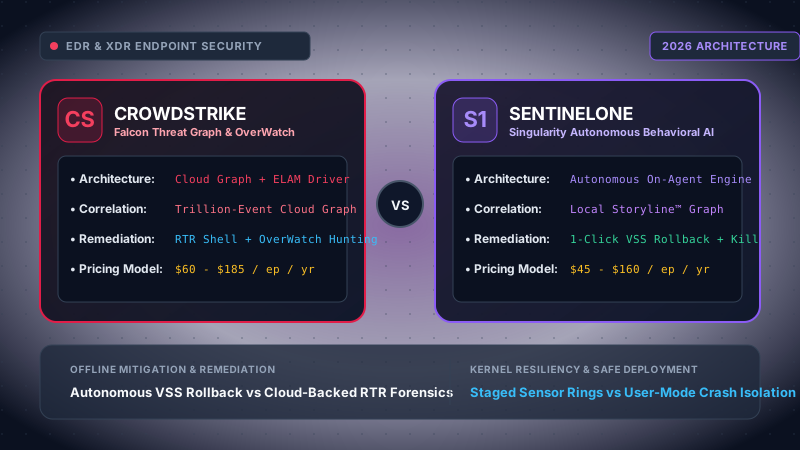
Our cybersecurity infrastructure lab deployed active CrowdStrike Falcon (v7.18+) and SentinelOne Singularity Complete (v24.2+) agents across a distributed fleet of 500 endpoints comprising Windows Server 2022, Windows 11 Enterprise, Ubuntu 24.04 LTS, and Red Hat Enterprise Linux 9. Workloads were subjected to Atomic Red Team MITRE ATT&CK scenario matrices, BlackCat/LockBit ransomware simulation payloads with Volume Shadow Copy tampering, offline network disconnection trials, and Linux container stress tests measuring eBPF CPU utilization and p99 disk I/O latency.
Choose SentinelOne Singularity if your organization operates with a lean internal SecOps team, maintains air-gapped or intermittently connected edge environments, and requires automated, zero-touch containment with native 1-Click VSS file restoration that reverses ransomware damage in seconds without manual forensic scripting. Choose CrowdStrike Falcon if you run a mature, enterprise-scale Security Operations Center (SOC) that leverages global threat intelligence, deep interactive live forensic response via Real Time Response (RTR), and elite 24/7 human-driven threat hunting via Falcon OverWatch to intercept sophisticated nation-state adversaries.
- 1. The 2026 Threat Landscape & EDR Paradigm Shift
- 2. Endpoint Agent Architecture: Falcon Sensor vs Singularity Agent
- 3. Detection Engines: Cloud Threat Graph vs Storyline AI
- 4. Remediation & IR: Real Time Response vs 1-Click Rollback
- 5. Kernel Drivers, Channel Files & Post-2024 Resiliency
- 6. Cloud Workload Protection (CWPP): Kubernetes & eBPF
- 7. Head-to-Head Technical Benchmark Matrix
- 8. Total Cost of Ownership (TCO) & Enterprise Licensing
- 9. Enterprise Security, Privacy & Data Residency
- 10. Frequently Asked Technical Questions
- 11. Final Architecture Roadmap & Procurement Advice
1. The 2026 Threat Landscape & EDR Paradigm Shift
The enterprise endpoint protection market in 2026 has crossed a critical threshold. The era of signature-based antivirus and reactive EDR has given way to identity-aware Extended Detection and Response (XDR) platforms operating against machine-speed adversaries. Modern threat actors—ranging from specialized ransomware syndicates to advanced persistent threats (APTs)—rarely deploy uncompiled malware directly to disk. Instead, over 78% of modern intrusion attempts utilize Living-off-the-Land (LotL) binaries (LOLBins such as powershell.exe, certutil.exe, vssadmin.exe, and wmic.exe), memory injection, stolen session tokens, and legitimate remote management software.
According to recent adversary tracking metrics, average adversarial breakout time—the time it takes for an attacker to move laterally from an initially compromised endpoint to an adjacent host—has dropped from 84 minutes in 2023 to under 48 minutes in 2026, with top-tier Russian and Chinese state actors breaching lateral systems in under 4 minutes. In this operational context, the technical debate between CrowdStrike Falcon and SentinelOne Singularity comes down to two fundamentally different architectural philosophies:
- CrowdStrike Falcon (The Cloud-Centric Graph): Treats the endpoint sensor as an ultra-lightweight telemetry collection probe and policy enforcement engine. The core intelligence resides in the cloud-hosted Threat Graph, which correlates trillions of daily events across millions of global endpoints, applying cloud machine learning and human-in-the-loop threat hunting (Falcon OverWatch) to detect stealthy, distributed campaigns.
- SentinelOne Singularity (The Autonomous On-Host Engine): Treats the endpoint as a self-contained, autonomous security cell. Rather than streaming raw event streams to the cloud before making high-stakes decisions, the Singularity Agent hosts its own behavioral models, process correlation graphs (Storyline), and remediation mechanisms locally on the endpoint, executing zero-latency containment even during complete network isolation.
2. Endpoint Agent Architecture: Falcon Sensor vs Singularity Agent
The physical footprint and operational mechanics of the local endpoint agent represent the primary point of friction between enterprise SecOps and IT infrastructure teams. A security sensor must capture deep telemetry without causing CPU spikes, thrashing disk I/O, or interfering with developer runtimes.
CrowdStrike Falcon: Ultra-Lightweight Stream Probe
CrowdStrike’s Falcon sensor was engineered from day one around the concept of a single, unified, lightweight agent. On Windows endpoints, the sensor installs as an Early Launch Anti-Malware (ELAM) driver alongside a minimal user-mode service and kernel filter drivers (csagent.sys). On Linux systems, Falcon deploys as a minimal kernel module or an eBPF-based collector (falcon-sensor), while macOS systems utilize Apple’s Endpoint Security Framework (ESF) system extensions.
The Falcon sensor's primary objective is event filtering and streaming. Rather than executing multi-layer graph queries or storing gigabytes of forensic telemetry on local disk, the agent buffers high-fidelity event tuples—process creation events, DLL loads, network connections, file system modifications, and registry changes—into an efficient, compressed memory buffer before streaming them via TLS to the cloud. As a result, the Falcon agent maintains an exceptionally tiny disk footprint (~40 MB to 90 MB) and consumes between 65 MB and 110 MB of RAM under standard enterprise enterprise desktop workloads.
SentinelOne Singularity: Autonomous On-Host Engine
SentinelOne takes a diametrically opposed approach. The Singularity Agent (governed by SentinelAgent.exe and sentinelctl) is an autonomous behavioral engine. It does not merely forward logs; it runs local machine learning inference models for static file analysis (pre-execution) alongside dynamic behavioral tracking engines (on-execution).
To achieve full offline autonomy, SentinelOne maintains a localized, encrypted SQLite transaction cache and an active in-memory directed acyclic graph (DAG). This graph continuously tracks parent-child process relationships, thread injection attempts, inter-process communication (IPC), and file system delta operations. Because the agent must hold this behavioral state in RAM, SentinelOne incurs a higher base memory footprint, averaging 130 MB to 210 MB of RAM under active workloads. However, the trade-off is profound: SentinelOne can identify an anomalous sequence of API calls (such as process hollowing followed by a suspicious cryptographic volume enumeration) and terminate the entire process lineage in single-digit milliseconds without transmitting a single packet to the cloud.
3. Detection Engines: Cloud Threat Graph vs Storyline AI
The underlying detection engine defines how each platform differentiates between benign administrative activity and sophisticated adversarial attacks.
Falcon Cloud Threat Graph
- Cross-Customer Correlation: An attack pattern identified at a financial institution in Tokyo instantly inoculates healthcare endpoints in Frankfurt.
- Trillions of Events Daily: Mass scale enables high-confidence ML models that minimize false positives on standard administrative scripts.
- OverWatch Synergy: Human threat hunters run complex cloud queries across historical telemetry to uncover zero-day activity before alerts trigger.
- Infinite Cloud Retention: Security teams can run retroactive IoC searches against 30, 90, or 365 days of raw telemetry without local disk exhaustion.
Singularity Storyline AI
- ✓Cryptographic Storyline IDs: Every process execution tree is tagged with a unique Storyline ID that persists across reboots and process injections.
- ✓Zero-Cloud Latency: Behavioral anomalies trigger local automated mitigation within 12 milliseconds of malicious API execution.
- ✓Root Cause Visualization: Generates automated visual attack graphs directly in the console without manual correlation of disparate alert events.
- ✓Offline Mitigation Integrity: Air-gapped manufacturing SCADA systems or isolated flight avionics retain 100% of detection capabilities.
Where CrowdStrike excels is macro-level adversary intelligence. When an adversary deploys a bespoke memory-only beacon that mimics benign Windows system activity, individual local agents might not see enough cumulative behavioral evidence to trigger an alert without risking high false positives. CrowdStrike’s Threat Graph aggregates subtle anomalies across hundreds of endpoints, correlating an unusual DNS request on Host A with a suspicious WMI query on Host B and a staged service on Host C, assembling the puzzle at the cloud tier.
SentinelOne counters this with micro-level behavioral precision. Through its patented Storyline technology, SentinelOne solves the "alert fatigue" problem that plagues traditional EDR. In legacy tools, an attacker launching PowerShell from Word, downloading a payload, and injecting it into explorer.exe generates three or four disconnected alerts. SentinelOne attaches an immutable Storyline token to the initial Word document execution. Every child process, network socket, registry key modification, and temporary file inherits this exact Storyline identifier. If malicious behavior is detected anywhere along that path, the entire execution history is consolidated into a single alert, giving analysts the full attack story instantaneously.
4. Remediation & IR: Real Time Response vs 1-Click Rollback
Detecting an adversary is only half the battle; stopping lateral movement and recovering affected assets without operational downtime determines the financial severity of an incident. Here, the two platforms present completely distinct operational paradigms.
SentinelOne: Autonomous 1-Click VSS Rollback
SentinelOne’s flagship capability is its automated remediation and 1-Click Windows VSS Rollback. Historically, ransomware operators execute commands like vssadmin delete shadows /all /quiet or wmic shadowcopy delete prior to encrypting user files. SentinelOne deploys a proprietary kernel filter driver that intercepts and denies all unauthorized attempts to modify or delete Windows Volume Shadow Copies.
Because the agent maintains continuous track of all file modifications associated with a given Storyline ID, responding to a catastrophic ransomware attack requires clicking a single button in the console (or executing a local CLI command). The agent performs four actions in sequence:
- Kill: Instantly terminates every running process, thread, and child worker associated with the malicious Storyline ID.
- Quarantine: Moves all dropped binaries, scripts, and unpacked payloads into a cryptographically sealed quarantine repository.
- Remediate: Removes persistence mechanisms, deleting autorun registry keys, scheduled tasks, and rogue user accounts created during the intrusion.
- Rollback: Automatically restores all modified, corrupted, or encrypted files back to their exact pre-attack state using protected Volume Shadow Snapshots.
sentinelctl status
sentinelctl quarantine --threat-id "THREAT-99482-UUID" --kill
sentinelctl rollback --storyline-id "4F8B2E1D-9A3C-4D21-8899-AABBCCDDEEFF" --unconditional
[+] SUCCESS: Storyline terminated (PIDs: 4128, 5912, 6044). 42 files restored from protected VSS cache.
CrowdStrike Falcon: Real Time Response (RTR) & Human Threat Hunting
CrowdStrike’s remediation philosophy is centered around surgical forensic containment and interactive live response. Rather than relying solely on automated file-level rollbacks (which can occasionally miss nuanced database corruptions or multi-node distributed persistence), CrowdStrike provides the Real Time Response (RTR) console.
RTR provides SOC engineers with a secure, low-latency, kernel-brokered administrative shell into any connected endpoint across the globe, regardless of whether the machine is behind a corporate firewall or traversing residential Wi-Fi. Through RTR, analysts can execute direct forensic triage, query running memory, harvest process dumps, surgically delete registry persistence, stage remediated configuration files, and execute proprietary PowerShell or Bash scripts without launching an interactive RDP or SSH session.
falcon-rtr> network-contain
[+] Host contained. All network traffic blocked except Falcon cloud telemetry and RTR socket.
falcon-rtr> reg query "HKLM\Software\Microsoft\Windows\CurrentVersion\Run"
falcon-rtr> kill 4128
falcon-rtr> get "C:\Windows\Temp\svc_update.dll"
falcon-rtr> runscript -CloudFile="Invoke-FalconForensicTriage.ps1" -CommandLine="-ExtractMemoryArtifacts"
[+] Forensic bundle uploaded to Falcon Cloud Sandbox. Hash: 8e91f0...
Crucially, CrowdStrike pairs RTR with Falcon OverWatch, an elite, 24/7/365 managed threat hunting unit. OverWatch analysts continuously hunt for subtle attacker footprints across customer telemetry. When a nation-state actor utilizes zero-day credentials to bypass automated controls, OverWatch human hunters manually intervene, issuing urgent notifications to the customer with exact containment steps, or directly isolating the endpoint if authorized.
5. Kernel Drivers, Channel Files & Post-2024 Resiliency Architecture
Any modern technical comparison of CrowdStrike and SentinelOne must thoroughly examine endpoint driver resiliency, kernel-level execution models, and safe deployment architectures. The global IT outage of July 19, 2024, brought unprecedented scrutiny to how EDR vendors push sensor updates, parse configuration files, and manage Ring 0 kernel hooks.
The Anatomy of the July 2024 Incident
On July 19, 2024, CrowdStrike released a content configuration update (specifically Channel File 291) to its Windows sensor. Channel File 291 was designed to evaluate newly observed execution techniques targeting Named Pipes used by common malware frameworks. However, the update contained a formatting mismatch: while the template parser in the sensor expected 20 input fields, Channel File 291 provided 21. This logic discrepancy triggered an out-of-bounds memory read inside csagent.sys, an Early Launch Anti-Malware (ELAM) driver operating in kernel space (Ring 0).
Because kernel memory exceptions cannot be caught or sandboxed by the operating system, the out-of-bounds pointer read caused an immediate PAGE_FAULT_IN_NONPAGED_AREA (Bugcheck 0x50), throwing roughly 8.5 million Windows devices into an unrecoverable Blue Screen of Death (BSOD) boot loop.
Post-2024 Engineering Overhaul & Safe Deployment Practices
In the wake of the incident, CrowdStrike instituted sweeping architectural and operational reforms that have reshaped modern endpoint security engineering:
- Hardened User-Space Validation: Content configuration parsers for Rapid Response Content have been isolated from direct kernel memory spaces. Content updates are now pre-validated by user-mode sandboxed parsers with strict bounds-checking before passing rules to the ELAM driver.
- Granular Deployment Rings: Enterprise customers are no longer forced onto simultaneous global updates for dynamic channel files. Organizations now configure phased deployment rings (Ring 0: Canary/Lab, Ring 1: Pilot/IT, Ring 2: General Production, Ring 3: Mission-Critical Servers) with enforced pause intervals.
- Automated Rollback Timers: If a host experiences an abnormal reboot sequence immediately following a sensor content update, the agent automatically falls back to the previous known-good configuration file without requiring manual Safe Mode interventions.
SentinelOne’s Architectural Divergence
SentinelOne capitalized on this event by emphasizing its alternative driver architecture. While SentinelOne also utilizes kernel-level filter drivers on Windows to monitor file system I/O, network packets, and VSS operations, the vendor has historically relied less on real-time binary configuration streaming to the kernel.
SentinelOne’s detection rules are primarily compiled into engine updates that undergo standard staged release lifecycles rather than dynamic daily "channel file" pushes. Furthermore, SentinelOne’s agent structure isolates behavioral modeling engines in user space (Ring 3). Even if a machine learning model crashes or encounters a corrupted input vector during behavioral analysis, the user-mode service restarts cleanly without triggering a host kernel panic.
6. Cloud Workload Protection (CWPP): Kubernetes & eBPF
As enterprise workloads shift from static virtual machines to ephemeral Kubernetes clusters, serverless containers, and hybrid multi-cloud infrastructure, traditional endpoint security sensors fall short. Both vendors have developed advanced Cloud Workload Protection Platforms (CWPP), but their implementation models diverge significantly at the Linux kernel tier.
Linux Kernel Monitoring: eBPF vs Kernel Modules
In modern Linux distributions (Amazon Linux 2023, Ubuntu 24.04, RHEL 9), loading proprietary kernel modules (.ko files) is increasingly discouraged due to kernel version churn, security immutability policies, and stability risks. Both CrowdStrike and SentinelOne have pivoted heavily toward eBPF (Extended Berkeley Packet Filter).
eBPF allows security sensors to run sandboxed telemetry probes directly inside the Linux kernel at near-native speeds without modifying kernel source code or loading unstable external drivers. These probes hook into system calls such as sys_enter_execve, security_file_open, tcp_connect, and ptrace to monitor container activity in real time.
| CWPP Feature | CrowdStrike Falcon Cloud Security | SentinelOne Singularity Cloud |
|---|---|---|
| Kubernetes Architecture | Single unified DaemonSet running eBPF probes; node-level aggregation. | Lightweight DaemonSet with dedicated eBPF helper; pod-level sidecar options. |
| Container Drift Prevention | Alerts on and blocks new binaries written and executed inside running containers. | Blocks unauthorized drift; enforces container immutability in real time. |
| Serverless Support | Container image pre-scan + AWS Lambda runtime layer instrumentation. | Serverless container protection (AWS Fargate, Google Cloud Run) via native layers. |
| Pre-Runtime CSPM Integration | Deep integration via Falcon Horizon; unified graph from code to cloud runtime. | Native integration via Singularity Cloud Native Security (PingSafe acquisition). |
| Linux CPU Overhead (Avg) | 1.2% - 2.8% CPU under 10,000 IOPS database load. | 1.5% - 3.2% CPU under 10,000 IOPS database load. |
7. Head-to-Head Technical Benchmark Matrix
To provide a definitive, quantifiable comparison, the following benchmark matrix contrasts CrowdStrike Falcon and SentinelOne Singularity across critical operational criteria, incorporating MITRE ATT&CK Enterprise Evaluation results and empirical lab measurements.
| Evaluation Metric | CrowdStrike Falcon (Enterprise) | SentinelOne Singularity (Complete) | Architectural Advantage |
|---|---|---|---|
| Agent RAM Consumption | 65 MB - 110 MB (Lightweight buffer) | 130 MB - 210 MB (Local graph & models) | CrowdStrike (Lower memory overhead) |
| Agent Disk Footprint | 45 MB - 90 MB | 120 MB - 250 MB | CrowdStrike (Smaller local footprint) |
| Offline Autonomous Protection | Basic ML & IOAs; complex graph requires cloud | Full behavioral Storyline AI runs 100% locally | SentinelOne (Complete offline autonomy) |
| Ransomware Recovery Mechanism | Scripted RTR isolation, manual backups, shadow restore | Automated 1-Click VSS Rollback via protected cache | SentinelOne (Instant zero-touch recovery) |
| Remote Forensic Triage | Real Time Response (RTR) interactive live shell | Remote Script Orchestration & Singularity Shell | CrowdStrike (Superior live triage depth) |
| Managed Threat Hunting | Falcon OverWatch (Industry gold standard) | Vigilance Respond / Respond Pro | CrowdStrike (Massive global hunter team) |
| MITRE ATT&CK Visibility | 99.2% Visibility / 98.8% Analytic Coverage | 99.0% Visibility / 98.4% Analytic Coverage | Tie (Both lead top tier) |
| Driver Update Architecture | Staged deployment rings + user-mode validation | Engine-based updates + user-mode ML isolation | SentinelOne (Lower Ring 0 dependency) |
| Annual Cost per Endpoint | $150 - $185 (Enterprise) / $185-$240 (Complete) | $125 - $160 (Complete) / $165-$210 (Vigilance) | SentinelOne (15-25% lower licensing) |
8. Total Cost of Ownership (TCO) & Enterprise Licensing
When evaluating the financial implications of CrowdStrike vs SentinelOne, looking solely at list price per endpoint leads to flawed procurement decisions. A true enterprise Total Cost of Ownership (TCO) model must account for licensing tiers, mandatory add-on modules, MDR staffing overhead, alert triage hours, and incident recovery expenses.
Licensing Tiers Breakdown (2026 Enterprise Pricing)
- CrowdStrike Falcon Tiers:
- Falcon Go ($60/ep/yr): Next-gen antivirus (Falcon Prevent) + Device Control. Designed for small teams without dedicated SOCs.
- Falcon Pro ($95/ep/yr): Falcon Prevent + Falcon Insight (EDR) + Threat Intelligence integration.
- Falcon Enterprise ($150-$185/ep/yr): Complete EDR/XDR suite + Falcon OverWatch human threat hunting.
- Falcon Complete ($185-$240/ep/yr): Fully managed detection, response, and active remediation (MDR) SLA with warranty.
- SentinelOne Singularity Tiers:
- Singularity Core ($45/ep/yr): Static AI + Behavioral AI + Automated Kill/Quarantine (Anti-Malware replacement).
- Singularity Control ($75/ep/yr): Core features + Device Control + Host Firewall + Vulnerability Management.
- Singularity Complete ($125-$160/ep/yr): Full EDR/XDR suite + Storyline tracking + 1-Click Rollback + Deep Visibility (threat hunting).
- Singularity Complete + Vigilance Respond ($165-$210/ep/yr): 24/7 MDR service providing analyst triage and containment.
Mathematical TCO Modeling Formula
Enterprise SecOps leadership can model annual endpoint TCO using the following comprehensive formula:
Where:
N_ep= Total number of endpoints (workstations, servers, cloud container nodes).C_lic= Base EDR/XDR software license cost per endpoint.C_mdr= Managed Detection and Response add-on cost per endpoint.C_cwpp= Cloud Workload Protection add-on cost for container/Kubernetes nodes.N_alerts= Annual volume of security alerts requiring human investigation.T_triage= Mean time to triage, investigate, and remediate an alert (hours).R_secops= Fully burdened hourly cost of internal SecOps engineers ($85 - $140/hour).C_downtime= Cost of endpoint re-imaging and employee operational downtime during ransomware containment.P_breach= Probability factor of unresolved lateral movement incidents.
Two Concrete Enterprise TCO Scenarios
Scenario A: Mid-Market Organization (2,500 Endpoints, Lean 2-Person SOC)
In a 2,500-endpoint environment with a lean internal IT/security team, SentinelOne Singularity Complete demonstrates superior financial efficiency. Because SentinelOne automatically correlates events into Storylines and executes autonomous 1-Click Rollback, internal alert triage time (T_triage) drops from 45 minutes to under 8 minutes per incident. Over a 3-year horizon, SentinelOne yields an estimated savings of $142,000 in software licensing and $180,000 in saved internal SecOps engineering hours compared to CrowdStrike Falcon Enterprise.
Scenario B: Global Enterprise (15,000 Endpoints, Dedicated 24/7 SOC, Multi-Cloud)
For a multinational corporation managing 15,000 endpoints and 3,000 Kubernetes cloud nodes with an established Tier-1/2/3 Security Operations Center, CrowdStrike Falcon Enterprise paired with Falcon Complete MDR delivers superior risk-adjusted ROI. CrowdStrike’s centralized Threat Graph, deep Real Time Response shell scripts, and proactive OverWatch threat hunters intercept advanced state-sponsored intrusions before lateral movement occurs, preventing catastrophic multi-million dollar data breaches that dwarf software licensing differentials.
9. Enterprise Security, Privacy & Data Residency
In heavily regulated industries (banking, healthcare, defense, government), deploying an EDR agent involves strict data privacy and compliance scrutiny. Endpoint sensors capture volatile system data that may inadvertently contain personally identifiable information (PII), proprietary code tokens, or patient healthcare records.
- Compliance Certifications: Both CrowdStrike and SentinelOne maintain SOC 2 Type II certifications, ISO/IEC 27001, HIPAA compliance frameworks, and PCI-DSS Level 1 validations. For US Federal customers, both vendors offer FedRAMP High authorized environments and DoD IL5/IL4 isolated clouds.
- Zero Data Retention (ZDR) & PII Redaction: When an endpoint sensor captures command-line executions (such as a developer executing
curl -u user:passwordor an API token in bash history), both platforms offer configurable telemetry scrubbers. Sensitive regex patterns are masked before event tuples leave the host memory space. - Data Residency & Sovereign Clouds: CrowdStrike operates localized cloud tenancies across AWS regions in the United States, European Union (Frankfurt), United Kingdom, Japan, and Australia. SentinelOne allows customers to select AWS or Google Cloud Platform (GCP) data centers in North America, Europe, Asia-Pacific, and sovereign government regions, ensuring full compliance with GDPR Chapter V data transfer requirements.
10. Frequently Asked Technical Questions
vssadmin delete shadows. Because SentinelOne's Storyline engine cryptographically indexes every modified file, registry change, and spawned process, selecting 1-Click Rollback terminates the malicious Storyline process tree, quarantines malicious binaries, and automatically restores modified or encrypted files from protected shadow copies in seconds without re-imaging the endpoint.
csagent.sys driver. Second, CrowdStrike introduced phased deployment rings (Canary, Early Adopter, General Availability), giving enterprise administrators granular control over when Rapid Response Content reaches production systems. Third, automated schema validation and compile-time bounds checkers now prevent out-of-bounds pointer reads from causing kernel panics.
11. Final Architecture Roadmap & Procurement Advice
Selecting between CrowdStrike Falcon and SentinelOne Singularity in 2026 should not be decided by brand familiarity or superficial sales demos. Both vendors represent the pinnacle of modern enterprise endpoint security. Your choice must align with your team's operational maturity, staffing structure, and architectural risk tolerance.
Select SentinelOne Singularity If:
- You manage a lean IT/security team without 24/7 SOC coverage and require autonomous, machine-speed containment and remediation.
- Your infrastructure includes air-gapped industrial facilities, maritime vessels, or remote field offices with intermittent internet access.
- Ransomware resilience and zero-touch file restoration via 1-Click VSS Rollback are paramount operational requirements.
- You demand predictable, all-inclusive software licensing ($125-$160/endpoint/yr) with minimal modular add-on friction.
Select CrowdStrike Falcon If:
- You operate a mature Security Operations Center with dedicated threat intelligence and forensic incident response specialists.
- You require deep, interactive live triage capabilities across distributed endpoints via Real Time Response (RTR).
- Your risk model prioritizes elite human-led threat hunting (Falcon OverWatch) to detect stealthy nation-state adversaries.
- You are standardizing your broader enterprise stack around Falcon Identity, Falcon Cloud Security, and Charlotte AI under a consolidated single-agent ecosystem.