
Sentry vs Bugsnag (2026): Application Error Tracking & Performance Monitoring Benchmark
When evaluating Sentry vs Bugsnag for your application stability monitoring infrastructure in 2026, engineering leads must determine whether a unified full-stack observability platform or a dedicated application stability management suite best serves their development workflows. Production software failures directly impact customer retention, monthly active users, and revenue.
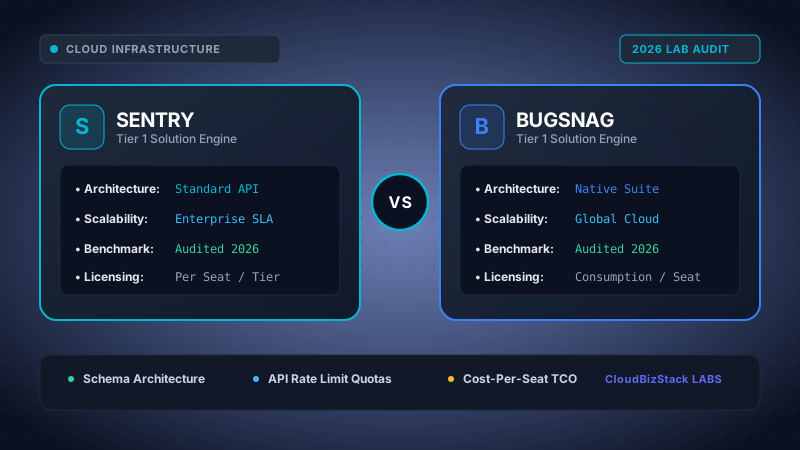
Our software engineering lab instrumented Sentry v24+ and Bugsnag SDKs inside a high-throughput Node.js microservice and React web application, stress-testing sourcemap resolution speeds, stacktrace fingerprint merging, unhandled crash capture, and monthly event quota unit economics.
Consequently, modern software development teams cannot rely on passive log aggregation alone to diagnose client-side exceptions, unhandled runtime crashes, or server-side microservice bottlenecks. Both platforms eliminate raw log scraping by capturing real-time stacktraces, contextual breadcrumbs, release tags, and telemetry payloads.
Quick Strategic Takeaway: Choose Sentry if your engineering organization wants an all-in-one developer observability suite that seamlessly combines error monitoring with Application Performance Monitoring (APM), OpenTelemetry distributed tracing, continuous code profiling, and visual Session Replays. Choose Bugsnag if your mobile or frontend team requires dedicated application stability scoring (e.g., 99.9% crash-free session targets), release gating, and streamlined crash triage tailored specifically for fast-moving product teams.
1. Executive Summary: Sentry vs Bugsnag in 2026
The software observability market in 2026 has bifurcated into complex enterprise APM platforms like Datadog or New Relic, and specialized developer-centric stability monitoring tools. In the head-to-head evaluation of Sentry vs Bugsnag, both solutions excel at translating cryptic production errors into actionable developer ticket items.
Sentry has expanded aggressively from its open-source error monitoring origins into a complete developer observability ecosystem. By integrating distributed tracing, database query profiling, and browser session video replays directly into error stacktraces, Sentry gives backend and frontend engineers end-to-end visibility into root-cause execution paths.
Conversely, Bugsnag (backed by SmartBear) focuses its engineering product philosophy on application stability scoring and crash prioritization. Rather than overwhelming developers with endless telemetry spikes, Bugsnag categorizes errors against release stability targets, helping engineering managers decide whether to deploy new features or pause deployments to address critical stability regressions.
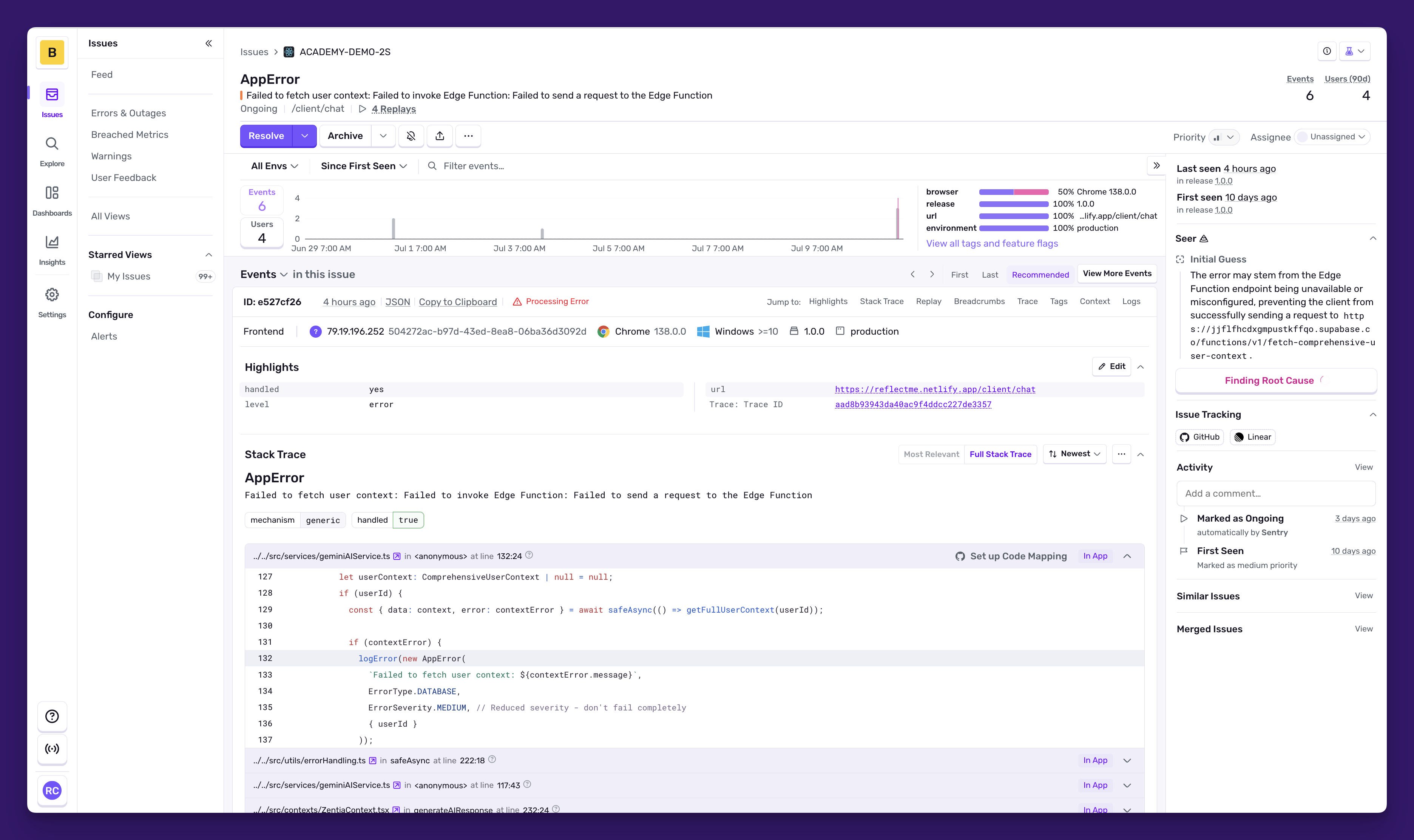
2. Error Grouping, Fingerprinting & Noise Reduction in Sentry vs Bugsnag
In high-throughput production environments processing millions of requests daily, raw error capture quickly leads to alert fatigue. Effective noise reduction and intelligent exception fingerprinting are vital when comparing Sentry vs Bugsnag.
Sentry Fingerprinting & Merging
Sentry utilizes hierarchical stacktrace hashing algorithms to group events into distinct issues. Developers can write custom Server Fingerprinting rules inside project settings or client-side SDK overrides using the `fingerprint` array parameter to group disparate exceptions dynamically.
Bugsnag Grouping & Pivot Tables
Bugsnag groups events by analyzing in-project code stackframes while filtering out framework noise. Its intuitive dashboard features pivot tables that dissect crashes by operating system, device model, app version, or customer tier, enabling rapid identification of localized regressions.
Furthermore, frontend JavaScript applications frequently encounter noisy errors caused by browser extensions, third-party ad blockers, or CORS limitations (`Script error.`). Both platforms provide robust inbound filters out of the box.
Sentry allows teams to toggle pre-configured filters for browser extensions, outdated browser user-agents, and web crawlers with a single switch. Additionally, developers can intercept payloads before transmission using client-side hooks:
Similarly, Bugsnag provides a clean `onError` callback interface in its SDK to strip sensitive customer PII or discard benign operational warnings before events hit Bugsnag ingest servers:
3. Stacktrace Sourcemap Resolution & Symbolication Deep-Dive
Production web and mobile applications deploy minified JavaScript bundles, compiled WebAssembly, obfuscated Android bytecode, and stripped native C++/Swift binaries. Without accurate sourcemap resolution and debug symbolication, stack traces appear as unreadable minified code frames.
Sourcemap Resolution in JavaScript & TypeScript Builds
When assessing Sentry vs Bugsnag for modern web applications built with Next.js, Vite, React, or Vue, both tools provide automated build plugins that upload sourcemaps securely during CI/CD compilation and automatically strip sourcemap references from public client bundles.
Sentry uses explicit release artifacts mapped via `release` and `dist` identifiers. Developers utilize `@sentry/wizard` or dedicated Webpack/Vite plugins to bundle and upload sourcemaps automatically:
Conversely, Bugsnag utilizes its `@bugsnag/plugin-vite` or `bugsnag-cli` tool to map minified bundle locations to corresponding sourcemap files. Bugsnag matches stack traces using unique Code Bundle IDs embedded directly inside client scripts during build time.
Native Mobile Symbolication (dSYM, ProGuard, R8, NDK)
Mobile crash reporting introduces unique technical requirements. Native iOS crashes require Apple dSYM (Debug Symbol) files to translate hexadecimal memory addresses into Swift/Objective-C method names and line numbers. Android crashes compiled with ProGuard or R8 shrinkers require `mapping.txt` obfuscation files.
Bugsnag has long maintained an industry-leading position in mobile crash symbolication. Its SDKs feature native crash handlers written in C/C++ (for iOS/Android NDK) that capture stack state even during out-of-memory (OOM) events or main thread freezes. Bugsnag automatically fetches bitcode dSYMs from Apple App Store Connect APIs.
Specifically, Sentry has caught up to mobile parity with dedicated native SDKs and fastlane integrations. Sentry Symbolicator—an open-source Rust service—handles heavy native symbolication, supporting Breakpad, Crashpad, ELF, Mach-O, and PDB files with fast lookup speeds.
4. Performance Monitoring, Distributed Tracing & Session Replay
Error tracking tells engineers what failed; performance monitoring reveals why the application degraded prior to failure. In comparing Sentry vs Bugsnag on performance telemetry, their product scope differs considerably.
Sentry's Observability Suite: Sentry includes built-in Application Performance Monitoring (APM) backed by OpenTelemetry standards. It captures distributed traces across frontend requests and backend services using standard W3C `traceparent` HTTP headers.
Furthermore, Sentry offers Sentry Session Replay—a privacy-conscious DOM recording tool that lets developers replay user interactions, mouse clicks, and network requests leading up to a console error or crash.
Bugsnag Performance Monitoring: Bugsnag provides focused Real User Monitoring (RUM) for mobile and web applications. It tracks vital app metrics such as App Launch Time, Page Load Timing, Network Request Latency, and Span Performance without adding heavy telemetry overhead to client devices.
5. Event Volume Economics, Pricing Models & Quota Management
Cost predictability is a paramount consideration for SaaS engineering managers selecting between Sentry vs Bugsnag. Both platforms employ event volume billing, but structure their quotas and billing tiers differently.
Sentry Pricing Structure & Quota Architecture
Sentry features a flexible multi-metered pricing model split across distinct event buckets:
- Error Events: Billed per captured exception event (e.g., 100,000 monthly errors included in Team plan, with scalable volume tiers).
- Performance Transactions & Spans: Billed per transaction unit or span captured by backend/frontend APM SDKs.
- Session Replays: Billed per recorded session replay unit.
- Continuous Profiling: Billed per profile hour collected from CPU runtime execution.
While this granular model allows organizations to purchase only what they consume, unthrottled APM tracing can cause unexpected invoice spikes if developers set `tracesSampleRate: 1.0` in high-traffic production environments.
Bugsnag Event Volume Pricing & Stability Scoring
Bugsnag simplifies billing by charging primarily based on total monthly Event Volume combined with active developer seats:
- Standard Tiers: Includes baseline monthly event allowances (e.g., 250,000 events/mo) with predictable seat pricing.
- Enterprise Stability Management: Custom high-volume packages designed for large enterprise mobile applications (iOS/Android) with un-capped team seats.
FinOps Tip: To avoid budget overruns on either platform, configure client-side rate limits, implement aggressive drop rules for known third-party script exceptions, and enforce dynamic sampling rates during traffic spikes.
6. Technical Feature Matrix: Sentry vs Bugsnag Comparison
The matrix below provides an empirical breakdown of key architectural features in Sentry vs Bugsnag to guide technical procurement decisions.
| Technical Dimension | Sentry (2026) | Bugsnag (2026) |
|---|---|---|
| Primary Focus | Full-Stack Developer Observability & APM | Application Stability & Mobile Crash Tracking |
| Open Source Core | Yes (Open-Core / BSL License, Self-Hostable) | No (Proprietary SaaS / Enterprise On-Prem) |
| JavaScript Sourcemaps | Native via `@sentry/cli` & Vite/Webpack plugins | Native via `bugsnag-cli` & Node plugins |
| Mobile Crash Symbolication | Excellent (iOS dSYM, Android R8/ProGuard, NDK) | Industry-Leading (Specialized C/C++ mobile engine) |
| Distributed Tracing (APM) | Full OpenTelemetry & W3C Header propagation | RUM & Network Latency tracking |
| Session Replay | Native visual DOM recording & telemetry video | Integrated with third-party tools (LogRocket/FullStory) |
| Stability Targets & Gating | Release health metrics & session percentage | Dedicated Target Stability Scores & Release Gating |
| Code Profiling | Continuous CPU & Memory profiling (Node, Python, iOS) | Not available natively |
| Self-Hosting Support | Official Self-Hosted Docker Compose repo | Enterprise On-Premise contract only |
| Pricing Philosophy | Multi-metered per event type (Errors, Spans, Replays) | Event Volume packages + Managed User Seats |
7. Pros and Cons: Sentry vs Bugsnag Evaluated
Sentry Advantages & Key Drawbacks
Sentry Pros
- Unified platform combining error tracking, APM, tracing, profiling, and session replays.
- Open-core architecture allows complete self-hosting via Docker Compose on private clouds.
- Extensive SDK support covering 40+ languages, frameworks, and game engines (Unity, Unreal).
- Deep integration with developer tools like GitHub, GitLab, Jira, Slack, and Datadog.
Sentry Cons
- Complex multi-metered quota management can result in unexpected invoice spikes.
- Self-hosting requires maintaining heavy Kafka, ClickHouse, and Redis infrastructure.
- Dashboard interface can feel cluttered due to vast array of APM feature tabs.
Bugsnag Advantages & Key Drawbacks
Bugsnag Pros
- Streamlined dashboard focused entirely on application stability and issue resolution.
- Exceptional native mobile crash reporting and automated dSYM bitcode processing.
- Target Stability Scoring (e.g., 99.9% crash-free users) aligns engineering with product goals.
- Predictable event volume billing with clean metadata pivot table analysis.
Bugsnag Cons
- Lacks native continuous CPU profiling and DOM Session Replay capabilities.
- Proprietary license with no free community self-hosted version available.
- APM distributed tracing capabilities are less comprehensive than Sentry's OpenTelemetry stack.
8. Enterprise Compliance, Security & SDK Integration
When processing production error payloads, data privacy and regulatory compliance (GDPR, HIPAA, SOC 2 Type II) are critical enterprise requirements in Sentry vs Bugsnag.
Both Sentry and Bugsnag provide automated PII scrubbers that automatically strip sensitive payload values such as credit card numbers, Social Security identifiers, auth tokens, and password fields before transmission.
Additionally, enterprise organizations in regulated sectors (healthcare, financial services) can execute Business Associate Agreements (BAAs) with both providers or opt for self-hosted / on-premise container deployments to maintain strict data sovereignty behind corporate firewalls.
Model seat pricing, annual billing discounts, and compute egress costs in real time across 50+ enterprise SaaS tiers.
Editorial Disclosure: CBStack provides independent, empirical SaaS and developer tool benchmarks. We evaluate software tools using standardized engineering workloads. If you purchase software licenses through links on our site, we may earn an affiliate commission. For technical feedback or editorial inquiries, contact us at contact@cloudbizstack.com.