
dbt vs Dagster (2026): SQL Transformation vs Asset-Based Orchestration
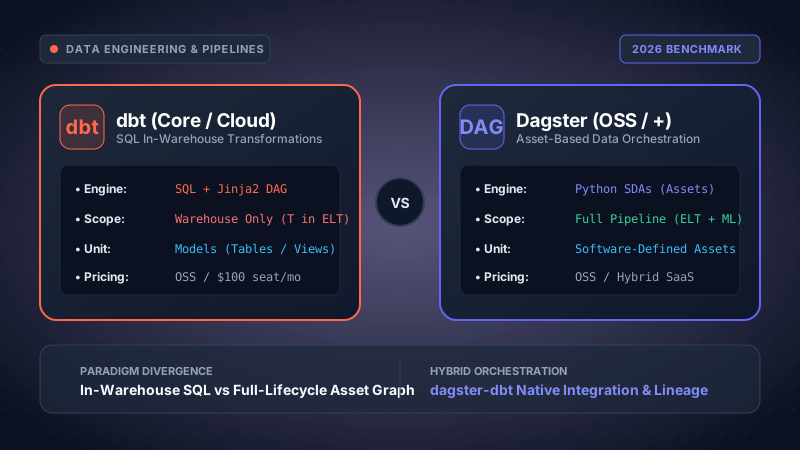
Quick Verdict: The False Dichotomy & Definitive 2026 Architectural Choice
Comparing dbt and Dagster as mutually exclusive competitors is one of the most persistent misconceptions in contemporary data engineering. dbt is a transformation engine specialized strictly in compiling modular SQL and executing in-warehouse data models via Jinja templating. Dagster is a next-generation data orchestrator built on the paradigm of Software-Defined Assets (SDAs), designed to orchestrate the entire end-to-end data lifecycle across heterogeneous compute engines.
Choose dbt Alone (Core or Cloud, $100/seat/mo) if your platform's operational boundary is 100% contained within a modern cloud data warehouse (Snowflake, BigQuery, or Databricks), where ingestion is completely outsourced to managed connectors (Fivetran or Airbyte Cloud) and you require no complex Python tasks, machine learning feature stores, cross-system sensor triggers, or sub-hourly micro-batch orchestration.
Choose Dagster (OSS or Dagster+) if your data platform encompasses multi-system pipelines—spanning API extraction, file landing in AWS S3 or Google Cloud Storage, Apache Spark or Ray compute, vector database indexing, scikit-learn/PyTorch inference, and reverse ETL—requiring declarative lineage, asset freshness policies, and automated partition-aware backfills.
dagster-dbt. This unifies dbt's model-level tests, documentation, and warehouse pushdown execution with Dagster's global asset lineage, cross-system observability, and declarative scheduling.
Table of Contents
- 1. Architectural Foundations: In-Warehouse SQL vs Asset-Based Orchestration
- 2. Paradigm Deep-Dive: dbt Models vs Dagster Software-Defined Assets (SDAs)
- 3. Concrete Implementation: dbt Model vs Dagster Asset Code Walkthrough
- 4. The Symbiotic Modern Data Stack: Integrating dbt into Dagster via dagster-dbt
- 5. Observability, Lineage & Failure Isolation: dbt Cloud Explorer vs Dagster UI
- 6. Developer Ergonomics, Local Testing & CI/CD: Slim CI vs Branch Deployments
- 7. Head-to-Head Technical Benchmark Matrix
- 8. Mathematical FinOps & TCO Breakdown: dbt Cloud vs Dagster+ vs OSS Self-Hosting
- 9. Enterprise Security, Governance, Data Retention & Hybrid Control Planes
- 10. Strategic Decision Framework: Quadrant Analysis & Organizational Fit
- 11. Frequently Asked Questions (FAQ)
1. Architectural Foundations: In-Warehouse SQL vs Asset-Based Orchestration
The rapid evolution of the Modern Data Stack (MDS) between 2020 and 2026 transformed analytical engineering from brittle procedural scripts into disciplined, software-engineering-grade workflows. Central to this transformation are two dominant technologies: dbt (maintained by dbt Labs) and Dagster (maintained by Elementl). Yet, architectural debates frequently pit them against one another as if they occupied the identical abstraction layer.
To evaluate them rigorously, one must dissect their core architectural premises:
dbt (data build tool) was deliberately constructed to solve a bounded, high-value problem: the "T" in ELT (Extract, Load, Transform). Before dbt, analytical transformations consisted of sprawling, untested stored procedures scheduled arbitrarily via cron or database-native triggers. dbt introduced standard software engineering practices to SQL: version control, modularization via Jinja templating, automatic directed acyclic graph (DAG) compilation via {{ ref(...) }} macros, environment segregation, and integrated schema testing. However, dbt possesses an explicit compute boundary: it does not execute data processing itself. It acts as an orchestration compiler that translates Jinja-SQL into target-native dialect strings (e.g., Snowflake SQL, Google BigQuery standard SQL, Databricks Spark SQL, AWS Redshift SQL, DuckDB) and dispatches those strings over JDBC/ODBC connections for remote execution within the warehouse.
Dagster, conversely, was designed from first principles by Nick Schrock (co-creator of GraphQL) to solve the fundamental flaws of legacy workflow engines such as Apache Airflow, Luigi, and Prefect 1.0. Legacy orchestrators model pipelines as directed graphs of imperative tasks—opaque execution steps (e.g., BashOperator, PythonOperator) that execute arbitrary commands without formal awareness of what data artifacts are consumed or produced. When a task succeeds, the orchestrator has no intrinsic knowledge of whether the resulting table contains fresh rows, corrupted partitions, or zero records.
Dagster replaces the task-centric mental model with Software-Defined Assets (SDAs). In Dagster, an asset is a declarative Python declaration of a persistent piece of data (a relational table, an object-store Parquet directory, a trained scikit-learn model, or a feature vector) coupled directly to the Python function that computes it. By making the data asset rather than the computational task the first-class citizen of orchestration, Dagster bridges the chasm between raw data extraction, warehouse transformations, distributed computing, and machine learning inference.
2. Paradigm Deep-Dive: dbt Models vs Dagster Software-Defined Assets (SDAs)
To understand how these systems differ in day-to-day data engineering operations, we must contrast their conceptual primitives across five structural dimensions:
| Architectural Primitive | dbt (Core / Cloud) | Dagster (OSS / Dagster+) |
|---|---|---|
| Core Abstraction | Model: A .sql file containing a single SELECT statement wrapped with Jinja macros. |
Software-Defined Asset (SDA): A Python function decorated with @asset defining an upstream/downstream contract. |
| Compute Location | In-Warehouse Only: Snowflake, BigQuery, Databricks, Redshift, DuckDB, Postgres. | Polyglot / Universal: Warehouse SQL, local Python, remote Kubernetes pods, Apache Spark, Ray, AWS Lambda, Databricks Jobs. |
| Dependency Resolution | Syntactic parsing of {{ ref('upstream_model') }} and {{ source('source_name', 'table_name') }} strings. |
Declarative type hints, function parameter names matching upstream asset keys, or explicit deps=[AssetKey(...)]. |
| Data Contracts & Quality | Post-execution generic tests (not_null, unique) or warehouse-enforced DDL data contracts (since dbt v1.5). |
Integrated @asset_check decorators, type validation via Pydantic/Pandera, and dynamic metadata logging per materialization. |
| Partitioning & Backfills | Manual Jinja logic via is_incremental() macros and warehouse clustering/partitioning keys. |
Native first-class partitioning (DailyPartitionsDefinition, MultiPartitionsDefinition) with automated multi-partition backfills. |
The decisive takeaway is scope: dbt does not know what happened to your data before it landed in your raw warehouse schema, nor does it know what happens after a model materializes into a production reporting mart. If a third-party ingestion webhook delays data loading by two hours, dbt will blindly execute its transformation models on stale inputs unless governed by an external orchestrator. Dagster, by contrast, perceives the complete lineage: it observes the API ingestion sensor, executes the landing job, triggers the dbt transformation model, validates the table freshness policy, and invokes downstream machine learning retraining in PyTorch.
3. Concrete Implementation: dbt Model vs Dagster Asset Code Walkthrough
To illustrate how engineering ergonomics differ, let us examine how both tools solve a real-world analytical problem: processing customer transaction logs, aggregating lifetime value (LTV), enforcing data contracts, and computing partitioned aggregations.
3.1 Production dbt Transformation Implementation
In dbt, business logic is expressed in declarative SQL files supported by YAML schema definitions. Below is an incremental transformation model aggregating customer metrics:
{{ config(
    materialized = 'incremental',
    unique_key = 'customer_id',
    incremental_strategy = 'merge',
    on_schema_change = 'fail',
    cluster_by = ['customer_id', 'last_order_timestamp']
) }}

WITH stg_orders AS (
    SELECT
        order_id,
        customer_id,
        order_amount_usd,
        status,
        order_timestamp
    FROM {{ ref('stg_ecommerce__orders') }}
    {% if is_incremental() %}
        -- Only process events from the last 3 days to handle late-arriving records
        WHERE order_timestamp >= DATEADD('day', -3, (SELECT MAX(last_order_timestamp) FROM {{ this }}))
    {% endif %}
),

customer_aggregations AS (
    SELECT
        customer_id,
        COUNT(order_id) AS total_orders,
        SUM(CASE WHEN status = 'completed' THEN order_amount_usd ELSE 0 END) AS total_lifetime_revenue_usd,
        MAX(order_timestamp) AS last_order_timestamp,
        CURRENT_TIMESTAMP() AS dbt_updated_at
    FROM stg_orders
    GROUP BY customer_id
)

SELECT
    customer_id,
    total_orders,
    ROUND(total_lifetime_revenue_usd, 2) AS total_lifetime_revenue_usd,
    last_order_timestamp,
    dbt_updated_at
FROM customer_aggregations
The corresponding contract and test definitions are isolated in a paired YAML file:
version: 2

models:
  - name: fct_customer_orders
    description: "Aggregated customer financial metrics and lifetime value."
    config:
      contract:
        enforced: true
    columns:
      - name: customer_id
        data_type: varchar
        description: "Primary key hashed customer identifier."
        tests:
          - unique
          - not_null
      - name: total_orders
        data_type: integer
        tests:
          - not_null
      - name: total_lifetime_revenue_usd
        data_type: numeric(18, 2)
        tests:
          - not_null
      - name: last_order_timestamp
        data_type: timestamp_ntz
      - name: dbt_updated_at
        data_type: timestamp_tz
dbt Architectural Strengths: Notice how clean, readable, and accessible this is for analytics engineers. Anyone proficient in SQL can construct complex relational models, manage incremental merge strategies, enforce strict column data types via contracts, and validate primary key uniqueness without writing a single line of Python or configuring cluster compute.
3.2 Production Dagster Software-Defined Asset Implementation
In Dagster, data engineering logic is authored in native Python. This empowers engineers to extract data from external APIs, compute transformations via Polars or Pandas, persist to object stores or relational warehouses, log detailed asset metadata, and declare freshness constraints within a unified programmatic syntax:
from datetime import datetime
import pandas as pd
from dagster import (
    asset,
    asset_check,
    AssetCheckResult,
    AssetExecutionContext,
    DailyPartitionsDefinition,
    FreshnessPolicy,
    MaterializeResult,
    MetadataValue
)
from orchestration.resources.snowflake_io import SnowflakeResource

daily_partitions = DailyPartitionsDefinition(start_date="2025-01-01")

@asset(
    partitions_def=daily_partitions,
    freshness_policy=FreshnessPolicy(maximum_lag_minutes=180),
    group_name="finance_marts",
    compute_kind="snowflake_sql"
)
def partitioned_customer_orders(
    context: AssetExecutionContext,
    snowflake: SnowflakeResource
) -> MaterializeResult:
    """
    Materializes daily customer transaction aggregates into Snowflake
    with dynamic metadata logging.
    """
    partition_date = context.partition_key
    context.log.info(f"Materializing customer orders partition for date: {partition_date}")

    query = f"""
        CREATE OR REPLACE TABLE analytics.marts.customer_orders_{partition_date.replace('-', '_')} AS
        SELECT
            customer_id,
            COUNT(order_id) AS total_orders,
            SUM(order_amount_usd) AS daily_revenue_usd,
            '{partition_date}' AS partition_date
        FROM analytics.staging.stg_orders
        WHERE DATE(order_timestamp) = '{partition_date}'
        GROUP BY customer_id;
    """
    # Execute query via managed resource
    execution_stats = snowflake.execute_query(query)

    return MaterializeResult(
        metadata={
            "partition_key": partition_date,
            "rows_inserted": MetadataValue.int(execution_stats["row_count"]),
            "query_id": MetadataValue.text(execution_stats["query_id"]),
            "warehouse_credits": MetadataValue.float(execution_stats["credits_used"]),
            "preview": MetadataValue.md(execution_stats["preview_table_markdown"])
        }
    )

@asset_check(asset=partitioned_customer_orders)
def verify_no_negative_revenue(snowflake: SnowflakeResource) -> AssetCheckResult:
    """Validates that no customer has anomalous negative aggregate daily revenue."""
    anomalies = snowflake.query_scalar("""
        SELECT COUNT(*) FROM analytics.marts.customer_orders
        WHERE daily_revenue_usd < 0
    """)
    passed = (anomalies == 0)
    return AssetCheckResult(
        passed=passed,
        metadata={"negative_revenue_records": MetadataValue.int(anomalies)}
    )
Dagster Architectural Strengths: Notice how metadata (execution duration, query ID, Snowflake credits consumed, markdown data previews) is logged directly to the central catalog upon completion. If an anomaly occurs, the @asset_check isolates the exact partition failure, records it in the asset health dashboard, and alerts downstream consumers through Slack or PagerDuty without failing entire upstream ingestion tasks.
4. The Symbiotic Modern Data Stack: Integrating dbt into Dagster via dagster-dbt
In legacy architectures, engineers attempted to connect dbt to orchestrators like Airflow by invoking dbt as a single monolithic bash task: dbt run && dbt test. This approach is an architectural anti-pattern. If a single model fails out of 800 models in a monorepo, the entire orchestrator task registers as failed. The orchestrator has zero visibility into which intermediate tables succeeded, where downstream models broke, or which lineage paths can safely proceed.
The official integration library, dagster-dbt, fundamentally redefines this relationship. Instead of executing dbt as a black-box binary, Dagster inspects the dbt project during compile time by reading the generated manifest.json.
from pathlib import Path
from dagster import AssetExecutionContext
from dagster_dbt import (
    DbtCliResource,
    dbt_assets,
    DagsterDbtTranslator,
    DagsterDbtTranslatorSettings
)

DBT_PROJECT_DIR = Path(__file__).joinpath("..", "..", "..", "dbt_warehouse").resolve()

dbt_resource = DbtCliResource(project_dir=DBT_PROJECT_DIR)
# Parse manifest at application startup
dbt_manifest_path = (
    DBT_PROJECT_DIR.joinpath("target", "manifest.json")
    if DBT_PROJECT_DIR.joinpath("target", "manifest.json").exists()
    else dbt_resource.cli(["compile"]).wait().target_path.joinpath("manifest.json")
)

# Custom translator to customize asset group names and descriptions in Dagster UI
class CustomDagsterDbtTranslator(DagsterDbtTranslator):
    def get_group_name(self, dbt_resource_props):
        return dbt_resource_props.get("fqn", ["dbt"])[1]

@dbt_assets(
    manifest=dbt_manifest_path,
    dagster_dbt_translator=CustomDagsterDbtTranslator(
        settings=DagsterDbtTranslatorSettings(enable_asset_checks=True)
    )
)
def dbt_warehouse_assets(context: AssetExecutionContext, dbt: DbtCliResource):
    """
    Translates every individual dbt model, snapshot, and test inside
    the dbt project into a first-class Dagster Software-Defined Asset.
    """
    yield from dbt.cli(["build"], context=context).stream()
When executed, dagster-dbt unpacks the dbt DAG directly into Dagster's global asset graph. Every individual SQL model appears as an independent node in the Dagster UI:
- Fine-Grained Failure Isolation: If
fct_customer_ordersfails due to a unique key test violation, only downstream reporting marts are blocked. All independent staging and dimensional models continue materializing without interruption. - Cross-Stack Lineage: An upstream Python extraction asset (e.g., pulling raw event logs from Mixpanel API) connects directly to the dbt staging model node. A downstream scikit-learn churn prediction model connects to the dbt mart node. Lineage flows uninterrupted across languages and infrastructure layers.
- Test Conversion to Asset Checks: dbt tests (such as
unique,not_null, and singular SQL assertions) are automatically translated into native DagsterAssetCheckentities, providing continuous health scores across the company data catalog.
5. Observability, Lineage & Failure Isolation: dbt Cloud Explorer vs Dagster UI
Observability in data pipelines is the difference between diagnosing an incident in 4 minutes versus spending 3 hours combing through truncated console outputs.
5.1 dbt Cloud Explorer & Run History
Within the dbt ecosystem, observability is delivered through dbt Cloud Explorer (available on Team and Enterprise tiers). Explorer renders an interactive visual graph of the warehouse schema based on the latest project manifest:
- Model Metadata: Displays model definitions, column lineages, SQL compilation histories, and historical build runtimes across environments.
- dbt Semantic Layer Metrics: Visualizes metric dependencies defined in MetricFlow, showing how business metrics (e.g., Monthly Recurring Revenue) trace back through underlying mart models.
- Failure Diagnostics: When a run fails, dbt Cloud highlights the failed model node and displays the warehouse error message (e.g.,
SQL compilation error: column 'user_uuid' does not exist).
The Limitation: dbt Explorer is strictly static with respect to warehouse boundaries. It cannot display the health or lag of the ingestion systems feeding the warehouse, nor can it monitor the latency of downstream API microservices consuming data from the analytical marts.
5.2 Dagster UI (Dagit) & Global Asset Catalog
Dagster UI is widely recognized by data infrastructure engineers as the most sophisticated operational interface in the data landscape. Because Dagster centers on persistent assets rather than ephemeral job runs:
- Global Asset Catalog: Every asset has a permanent homepage documenting its upstream dependencies, downstream consumers, compute history, historical row-count charts, column schemas, and execution durations.
- Declarative Freshness Policies & Lag Tracking: Engineers can attach a
FreshnessPolicy(maximum_lag_minutes=60)to an asset. If new rows have not arrived within 60 minutes, the asset card turns amber in the global dashboard, alerting on-call engineers before downstream executive dashboards fail. - Partition-Aware Backfill Matrix: Dagster renders a 2D matrix displaying every single date partition across months of data. Engineers can click individual failed date partitions (e.g., March 14, 2026) and trigger a targeted backfill for that single partition across 40 downstream assets with zero redundant compute.
- Timeline View & Concurrency Limiting: Dagster displays a real-time Gantt chart illustrating thread-level concurrency, worker pod CPU utilization, and queue contention across Kubernetes nodes.
6. Developer Ergonomics, Local Testing & CI/CD: Slim CI vs Branch Deployments
Developer velocity depends on how fast an analytical engineer can write code, run localized tests, and deploy changes through automated CI/CD validation pipelines.
6.1 dbt Developer Ergonomics: The CLI & Slim CI
dbt revolutionized analytical engineering ergonomics through the dbt CLI and Slim CI:
- Local Iteration: Running
dbt compileinstantly renders raw Jinja templates into valid warehouse SQL in thetarget/compiled/directory, allowing engineers to inspect the exact query dispatched to Snowflake. - Target Environments: The
~/.dbt/profiles.ymlconfiguration isolates development targets (e.g.,dbt_jandrade_dev) from production, preventing accidental overwrites of live analytical tables. - Slim CI (State Comparison): In large enterprise monorepos containing 2,000+ models, building the entire project on every GitHub pull request is financially prohibitive. dbt Slim CI downloads the production
manifest.jsonartifact from the latest successful job and runs state comparison:dbt build --select state:modified+ --defer --state path/to/prod/artifactsThis command executes only the modified models and their immediate downstream dependencies, substituting production tables (--defer) for un-modified upstream models. This slashes CI runtimes from 45 minutes to under 3 minutes.
6.2 Dagster Developer Ergonomics: Local Engine & Branch Deployments
Dagster brings full software engineering rigor to data orchestration:
- Zero-Cloud Local Development: Running
dagster devlaunches the complete Dagster web UI, GraphQL daemon, and mock scheduler onlocalhost:3000in under 3 seconds. Engineers can test pipeline logic without network connections or cloud compute. - Pure Python Unit Testing: Because Dagster assets are standard Python functions, they can be unit-tested via
pytestwithout connecting to Snowflake or BigQuery. By passing mock resources (e.g., dummy Pandas DataFrames or in-memory DuckDB connections), analytical logic is validated in sub-second test suites:pytest tests/test_customer_assets.py -k test_no_negative_revenue - Dagster+ Branch Deployments: Every time an engineer opens a pull request on GitHub or GitLab, Dagster+ automatically spins up an ephemeral, isolated clone of the entire orchestration environment. The branch deployment syncs code changes, creates isolated staging schemas, and enables stakeholders to inspect asset graphs and execute test runs in preview environments before merging to
main.
7. Head-to-Head Technical Benchmark Matrix
The following architectural benchmark compares dbt and Dagster across critical enterprise engineering criteria. Scores are graded on a 1.0–10.0 scale based on 2026 data engineering benchmarks:
| Evaluation Dimension | dbt (Core / Cloud) | Dagster (OSS / +) | Architectural Analysis & Trade-off |
|---|---|---|---|
| Core Specialization | 9.8 / 10 | 9.4 / 10 | dbt is the gold standard for SQL in-warehouse transformations; Dagster is the premier asset orchestrator for heterogeneous data pipelines. |
| Ecosystem & SQL Usability | 9.9 / 10 | 7.8 / 10 | dbt has the largest community, thousands of reusable open-source packages (dbt-utils, fivetran-models), and lower barrier to entry for pure SQL analysts. |
| End-to-End Orchestration | 4.2 / 10 | 9.8 / 10 | dbt cannot orchestrate outside warehouse boundaries (cannot trigger Airbyte syncs, Spark batch, or ML jobs). Dagster orchestrates across all compute layers natively. |
| Declarative Asset Lineage | 7.5 / 10 | 9.9 / 10 | dbt models lineage only within compiled SQL models. Dagster's Software-Defined Assets track lineage from raw API extraction through ML inference. |
| Partitioning & Backfilling | 5.5 / 10 | 9.7 / 10 | dbt relies on manual incremental Jinja configurations. Dagster features native declarative time/static partitions with visual 2D matrix backfilling. |
| Testing & Data Quality | 8.8 / 10 | 9.5 / 10 | dbt tests validate tables after execution. Dagster asset checks support pre-execution validation, non-blocking quality assertions, and automated alerting. |
| CI/CD & Testing Ergonomics | 8.5 / 10 | 9.6 / 10 | dbt Slim CI is fast and cost-effective. Dagster Branch Deployments provide complete ephemeral preview environments with mock resource unit testing. |
| Self-Hosting Viability (OSS) | 9.2 / 10 | 8.4 / 10 | dbt Core is a lightweight Python package easily run in Docker or GitHub Actions. Dagster OSS requires PostgreSQL, a web service, daemon, and Kubernetes agent. |
| Enterprise Hybrid Security | 8.2 / 10 | 9.8 / 10 | dbt Cloud provides VPC peering on Enterprise. Dagster+ Hybrid architecture ensures source code and customer data never leave private customer VPCs. |
8. Mathematical FinOps & TCO Breakdown: dbt Cloud vs Dagster+ vs OSS Self-Hosting
Data platform architects and FinOps analysts must calculate total cost of ownership (TCO) beyond simple vendor sticker prices. A thorough TCO calculation models SaaS subscription fees, underlying warehouse query credits, orchestrator compute, and dedicated platform engineering maintenance hours.
8.1 Mathematical TCO Modeling Formulations
The three governing cost equations can be expressed rigorously:
Formula 1: dbt Cloud Annual Total Cost of Ownership
Where N_dev is developer seats ($100/mo on Team), C_overage represents job run model tier charges on high-frequency schedules, Q_dbt is Snowflake/BigQuery warehouse credits consumed by dbt compilation and execution queries, and H_maint represents internal engineering support hours.
Formula 2: Dagster+ Hybrid Annual Total Cost of Ownership
Where Dagster+ uses consumption credits for control plane orchestration, C_k8s_agent is the minor compute overhead of running the lightweight user code deployment agent inside the customer's private EKS/GKE cluster (~$85/month), and data queries Q_queries push down to the data warehouse.
Formula 3: Open-Source Self-Hosted Platform (dbt Core + Airflow / Dagster OSS)
Where infrastructure costs include 3x EC2 worker nodes (e.g., c5.xlarge = ~$3,600/yr), managed Amazon RDS PostgreSQL (~$1,800/yr), AWS Application Load Balancers, and critically, FTE_allocation (0.25 to 0.50 of a Senior Platform Engineer's salary dedicated to upgrades, Helm chart patches, credential rotation, and on-call alerting = $45,000 to $90,000/yr).
8.2 Concrete Financial Scenarios: Mid-Market vs Enterprise
Let us model two realistic operational scales to evaluate real-world cash outflows:
| Cost Component | Scenario A: Mid-Market (8 Eng, 400 Models) dbt Cloud Team vs Dagster+ Hybrid |
Scenario B: Enterprise (35 Eng, 2,500 Models) dbt Cloud Enterprise vs Dagster+ Hybrid |
|---|---|---|
| SaaS Subscription Base |
dbt Cloud: $9,600/yr (8 seats @ $100/mo) Dagster+: $6,000/yr (Base credit tier) |
dbt Cloud Ent: $54,000/yr (Negotiated seat pool) Dagster+ Ent: $36,000/yr (Enterprise tier) |
| Compute Overages & Runners |
dbt Cloud: $1,800/yr (Standard job runs) Dagster+: $1,200/yr (Lightweight K8s agent compute) |
dbt Cloud: $12,000/yr (Compute seat overages) Dagster+: $4,800/yr (Customer EKS agent pods) |
| Warehouse Compute (Snowflake/BigQuery) | Identical: ~$36,000/yr (Both push SQL to warehouse) | Identical: ~$220,000/yr (Optimized incremental merge) |
| Internal Maintenance Overhead (FTE) |
dbt Cloud: ~$7,200/yr (40 hrs @ $180/hr) Dagster+: ~$9,000/yr (50 hrs agent oversight) |
dbt Cloud: ~$21,600/yr (120 hrs governance) Dagster+: ~$27,000/yr (150 hrs K8s/RBAC sync) |
| Total Non-Warehouse Platform Cost |
dbt Cloud: $18,600/yr Dagster+: $16,200/yr |
dbt Cloud: $87,600/yr Dagster+: $67,800/yr (22.6% Savings) |
FinOps Architectural Takeaway: For pure SQL modeling teams with fewer than 8 engineers, dbt Cloud's $100/seat model offers frictionless procurement and zero infrastructure overhead. However, as teams scale past 25 engineers and integrate non-SQL jobs, Dagster+ Hybrid architecture yields significant cost advantages because licensing is uncoupled from read-only analyst seat inflation and control plane execution is decoupled from customer data processing.
9. Enterprise Security, Governance, Data Retention & Hybrid Control Planes
In highly regulated industries (healthcare, fintech, defense), the fundamental architectural question is: Where does the execution agent run, and does proprietary customer data ever transit vendor servers?
9.1 Dagster+ Hybrid Architecture: Zero Data Ingress by Design
Dagster+ champions a modern Hybrid Deployment Architecture:
- Control Plane (Hosted by Dagster SaaS): Hosts the web UI, metadata database, run queue coordinator, and alert dispatchers. The control plane never connects to your databases and never reads raw records.
- Data Plane (Runs in Customer VPC / EKS): A lightweight Dagster Agent runs inside your private Amazon EKS, Google GKE, or Azure AKS cluster. The agent initiates outbound polling connections to the SaaS control plane via secure WebSockets.
- Zero Data Retention (ZDR): Customer data, warehouse credentials, database connection strings, and proprietary business code remain 100% inside the customer's private cloud perimeter. Dagster+ SaaS servers only receive execution heartbeats, status logs, and asset metadata summaries (e.g., row count: 450,210).
- Compliance Certifications: SOC 2 Type II certified, HIPAA compliant with signed Business Associate Agreements (BAAs), and GDPR compliant.
9.2 dbt Cloud Security & Isolation Architecture
dbt Cloud employs a secure managed execution architecture:
- Credential Storage: Warehouse credentials (Snowflake key pairs, BigQuery service accounts) are encrypted at rest using envelope encryption (AWS KMS) within dbt Cloud's managed database.
- Query Execution Flow: dbt Cloud workers issue SQL queries directly across the public internet or private networking to your warehouse. The data warehouse processes the transformations internally; query result sets (raw tables) do not transit through dbt Cloud, but compilation logs and query error snippets are stored on dbt Cloud infrastructure.
- Single-Tenant & VPC Peering: On dbt Cloud Enterprise plans, customers can provision isolated single-tenant environments with AWS PrivateLink or Google Cloud VPC Peering, ensuring traffic bypasses public internet routes.
- Compliance Certifications: SOC 2 Type II certified, ISO 27001 compliant, HIPAA support available under custom enterprise agreements.
10. Strategic Decision Framework: Quadrant Analysis & Organizational Fit
To determine whether to deploy dbt alone, Dagster alone, or their combined stack, evaluate your organization against the following four architectural archetypes:
Archetype 1: Warehouse-Only Analytics
Architecture: Fivetran / Airbyte → Snowflake / BigQuery → dbt Cloud → Tableau / Metabase.
Recommendation: Deploy dbt Alone. If 100% of your data processing happens in SQL within your warehouse and your ingest connectors run on automated schedules, introducing a full orchestrator like Dagster adds operational overhead without commensurate architectural value.
Archetype 2: Enterprise Hybrid Modern Data Stack
Architecture: Multi-source API Ingestion → dbt In-Warehouse Marts → Spark / ML Inference → Reverse ETL.
Recommendation: Deploy Dagster + dbt via dagster-dbt. This is the premier modern enterprise architecture. Analytics engineers write pure modular SQL in dbt, while data platform engineers use Dagster to orchestrate upstream ingestion, enforce end-to-end lineage, and trigger downstream ML pipelines.
Archetype 3: Python-First ML & Lakehouse Engineering
Architecture: AWS S3 / Delta Lake → PySpark / Polars / Ray → Feature Store → Vector DB / LLM Embeddings.
Recommendation: Deploy Dagster Alone. When data pipelines are authored primarily in Python, distributed compute frameworks (Spark/Ray), and vector indexing pipelines, dbt's SQL-centric in-warehouse paradigm is a mismatch. Dagster natively models Python dataframes and machine learning assets.
Archetype 4: Budget-Constrained Open-Source Self-Hosting
Architecture: Zero-SaaS-fee requirement, internal Kubernetes cluster, open-source stack.
Recommendation: Deploy dbt Core orchestrated by Dagster OSS on Kubernetes. Dagster OSS Helm charts are modern, container-native, and significantly easier to deploy and maintain than legacy Apache Airflow CeleryExecutor clusters.
11. Frequently Asked Questions (FAQ)
Is Dagster a direct competitor or replacement for dbt?
Dagster is not a pure dbt replacement; it is an asset-oriented data orchestrator that operates at a higher structural layer than dbt. While dbt specializes strictly in compiling and executing SQL models inside cloud data warehouses (Snowflake, BigQuery, Databricks), Dagster orchestrates the entire data lifecycle—from API ingestion and Spark clusters to dbt SQL models, ML training pipelines, and reverse ETL. In production, leading data engineering teams use both together: Dagster orchestrates the end-to-end pipeline, while dbt is embedded natively using dagster-dbt, which decomposes dbt models into individual Dagster Software-Defined Assets.
What is the primary difference between task-based orchestration and Software-Defined Assets?
Traditional orchestrators like Apache Airflow model pipelines as directed acyclic graphs of arbitrary tasks (e.g., Run Script A, then Run Query B). In contrast, Dagster models pipelines as Software-Defined Assets (SDAs)—declarative Python definitions where the central entity is the persistent data asset itself (a table, parquet file, or trained ML model) along with the code required to materialize it. This declarative paradigm enables native data freshness policies, automated lineage tracking, partition-aware incremental backfills, and asset-level health checks that are impossible in blind task execution graphs.
How does dagster-dbt integrate dbt models into Dagster's asset graph?
The dagster-dbt library reads dbt's manifest.json artifact at compile time and dynamically converts every dbt model, seed, and snapshot into a native Dagster Software-Defined Asset. Each model inherits its upstream dependencies and downstream consumers automatically. In the Dagster UI, developers can observe model execution in real time, view column schemas, run dbt tests as native asset checks, inspect execution runtimes, and trigger selective re-materializations directly without dropping into the dbt CLI.
How do pricing models compare between dbt Cloud and Dagster+ in 2026?
dbt Cloud charges on a seat-plus-consumption model: Developer seats cost $100/seat/month on the Team plan, while Enterprise agreements require annual contracts with custom seat pricing and charges for compute run minutes. Dagster+ (formerly Dagster Cloud) uses a credit-based consumption model tied to compute execution time and orchestrator resources, starting around $10 per credit bundle or hybrid compute allocations. In hybrid deployment, Dagster+ only bills for control plane orchestration while customer queries execute within customer-owned EKS/GKE clusters, frequently resulting in 35% to 50% lower total SaaS fees for mid-sized teams.
Can dbt Core replace an orchestrator for simple ELT pipelines?
Only if your entire data architecture exists exclusively inside the data warehouse and your data ingestion is handled by an external managed tool like Fivetran with scheduled syncs. However, dbt Core lacks a persistent scheduler, native event-driven sensors, cross-system dependency triggers, and the ability to execute code outside the warehouse (such as calling a Python API, transforming unstructured files in S3, or triggering a scikit-learn training job). Relying solely on dbt Core scheduled via cron creates blind gaps across ingestion and consumption layers.