Apache Iceberg vs Delta Lake: Open Table Formats Benchmark (2026)
The lakehouse architecture war of 2026 has decisively shifted from proprietary cloud storage formats to open table specifications. Modern enterprise data platforms can no longer tolerate the compute lock-in, data replication penalties, and multi-million-dollar migration costs associated with vendor-walled storage. Choosing between Apache Iceberg vs Delta Lake represents the single most consequential infrastructure decision for Chief Data Officers, Principal Data Architects, and FinOps leaders building petabyte-scale analytics engines.
Our engineering team deployed a 25TB synthetic TPC-DS benchmark dataset across Amazon S3 (us-east-1) and Google Cloud Storage. We measured query planning latency, commit throughput under high write contention, S3 API request counts, and merge-on-read scan overhead across Apache Spark 3.5, Trino 442, DuckDB 1.1, Snowflake Iceberg External Tables, and Databricks Runtime 14.3 LTS.
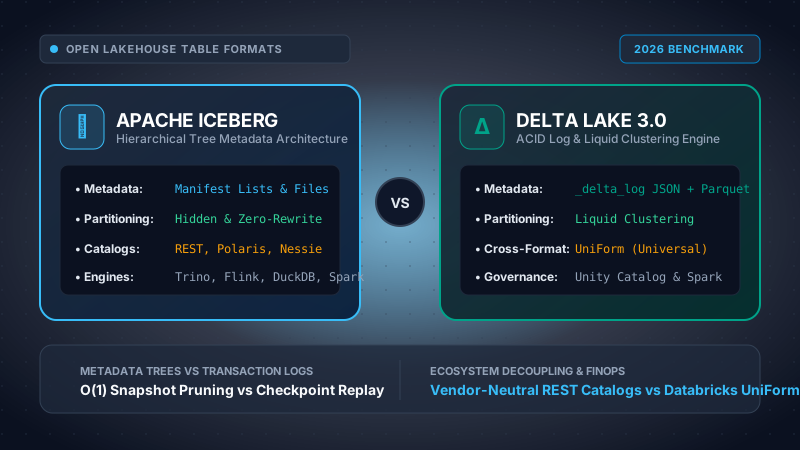
Select Apache Iceberg if your analytical strategy demands complete vendor neutrality, heterogeneous multi-engine query federation (Trino, Flink, DuckDB, Snowflake, Athena), open REST catalog ecosystems (Apache Polaris, Snowflake Open Catalog, Project Nessie), and true zero-rewrite partition evolution. Select Delta Lake 3.0 if your core data processing stack is centered on Apache Spark or Databricks, where Liquid Clustering, Unity Catalog governance, native Deletion Vectors, and UniForm automatic metadata generation yield superior operational simplicity and out-of-the-box write performance.
Table of Contents: Engineering Deep-Dive
- 1. The Death of Hive Tables & Rise of ACID Lakehouses
- 2. Metadata Architecture: Hierarchical Trees vs Transaction Logs
- 3. Partition Handling: Hidden Evolution vs Liquid Clustering
- 4. Catalog Ecosystem: REST Catalogs vs Unity Catalog
- 5. Multi-Engine Interoperability & Delta UniForm
- 6. ACID Protocols, Concurrency & Row-Level Deletes
- 7. FinOps & TCO Modeling: S3 API Costs & Compaction
- 8. Comprehensive Feature & Performance Matrix
- 9. Enterprise Security, Governance & Compliance
- 10. Architectural Verdict & Migration Playbook
- 11. Frequently Asked Technical Questions
1. The Death of Hive Tables & Rise of ACID Lakehouses
For more than a decade, the Apache Hive Metastore (HMS) served as the de facto standard for structuring big data on distributed storage systems. In the traditional Hive paradigm, a table was defined simply as a directory path on HDFS or cloud object storage (such as Amazon S3 or Google Cloud Storage), with subdirectories representing partition keys (e.g., s3://lakehouse/events/year=2026/month=03/day=20/).
While this directory-mapping design functioned adequately on POSIX-compliant file systems, it broke down catastrophically when applied to cloud object stores at modern enterprise scale:
- O(N) S3 LIST Latency: To plan a simple query, an analytics engine had to recursively list every single object under every partition folder. When tables scaled to millions of objects, directory listing alone consumed tens of minutes before a single byte of columnar Parquet data could be read.
- Lack of Atomic Transactions: Writing data required writing files into a directory. If a Spark job failed mid-write, partial corrupted data remained visible to downstream consumers. Concurrent writes resulted in race conditions, phantom reads, and data silent overwrites.
- Eventual Consistency Hazards: S3 originally lacked strong read-after-write consistency, leading to missed files or 404 errors during query execution.
- Coupled Physical Partitioning: End-user queries had to explicitly specify physical partition predicates (e.g.,
WHERE year = 2026 AND month = 3). If an analyst queried by a raw timestamp field, the engine initiated a disastrous full table scan.
To address these fatal architectural flaws, Apache Iceberg (conceived at Netflix and subsequently donated to the Apache Software Foundation) and Delta Lake (engineered by the original creators of Apache Spark at Databricks) decoupled table identity from physical directory layouts. Instead of tracking directories, both formats track exact collections of immutable data files through explicit transactional metadata. This shift unlocked true ACID transactions, serializable isolation, instantaneous query planning, time travel, and concurrent schema evolution on commodity cloud storage.
2. Metadata Architecture: Hierarchical Trees vs Transaction Logs
The most profound technical divergence between Apache Iceberg and Delta Lake lies in their underlying metadata structures. How a table represents its state determines query planning speed, driver memory utilization, write concurrency limits, and long-term storage amplification.
Apache Iceberg: The Hierarchical Metadata Tree
Apache Iceberg models table state as an immutable tree of metadata files, organized into distinct architectural layers:
│
├── Snapshot 1001 (Schema, Partition Spec, Snapshot Log)
│ └── Manifest List: snap-1001-1-uuid.avro
│ ├── Manifest Entry 1: manifest-a.avro (Partition Bounds: date [2026-03-01 to 2026-03-15])
│ │ ├── data-file-1.parquet (Min: 10, Max: 500, Nulls: 0)
│ │ └── data-file-2.parquet (Min: 501, Max: 999, Nulls: 2)
│ └── Manifest Entry 2: manifest-b.avro (Partition Bounds: date [2026-03-16 to 2026-03-31])
│ └── data-file-3.parquet (Min: 1000, Max: 1450, Nulls: 0)
└── Snapshot 1002 (Next Commit...)
In this architecture:
- Catalog Pointer: The catalog (e.g., Apache Polaris, Project Nessie, or AWS Glue) stores a single reference pointing to the current
metadata.jsonfile. Updating this pointer constitutes the atomic commit. - Table Metadata JSON (
v<N>.metadata.json): Encapsulates table schemas, partition specifications, current snapshot ID, snapshot history, and sort orders. - Manifest List (
.avro): Represents a specific table snapshot. Crucially, each entry in the manifest list contains summary metrics about an individual manifest file, including partition field ranges, file counts, and row counts. - Manifest File (
.avro): Tracks individual data files (and delete files), recording precise object paths, partition tuples, column-level lower/upper bounds, null counts, and NaN counts.
The Architectural Advantage: Because manifest lists contain partition bounds, an analytics query engine can eliminate entire manifest files during query planning without even opening them. Query planning scales in $O(1)$ or sub-linear time relative to total table size, enabling Iceberg to manage billions of files without exhausting query coordinator memory.
Delta Lake: The ACID Transaction Log (DeltaLog)
Delta Lake models table state as an ordered sequence of atomic commit files stored in a dedicated _delta_log/ directory:
├── 00000000000000000000.json (Commit 0: protocol, metaData, add files)
├── 00000000000000000001.json (Commit 1: add files, remove files)
├── ...
├── 00000000000000000010.json (Commit 10)
├── 00000000000000000010.checkpoint.parquet (State snapshot at Commit 10)
├── 00000000000000000011.json (Commit 11)
└── _last_checkpoint (JSON pointer: {"version": 10, "size": 1})
In Delta Lake's design:
- JSON Commit Logs (
0000000000000000000X.json): Every transactional operation writes an atomic JSON file recording granular action objects:commitInfo,protocol,metaData,add(new Parquet files with statistics), andremove(tombstoned Parquet files). - Checkpoints (
.checkpoint.parquet): Every 10 commits (by default), the system compacts the entire cumulative table state into a compressed Parquet checkpoint file. This collapses all previousaddandremoveactions into a finalized active file catalog. - State Reconstruction: To determine the current state of a table, an engine reads
_last_checkpoint, loads the checkpoint Parquet file into memory, and then replays all subsequent JSON commit logs forward.
The Architectural Trade-Off: Delta Lake’s sequential log architecture is brilliantly straightforward and maps directly to traditional relational database write-ahead logging (WAL). For streaming ingestion and rapid micro-batch commits, appending a JSON file is exceptionally fast. However, if checkpoint compaction is delayed or neglected, query engines must scan and parse hundreds of JSON files to reconstruct the active file set, creating latency spikes and driver memory pressure during scan planning.
3. Partition Handling: Hidden Evolution vs Liquid Clustering
Data layouts govern query skipping efficiency. The way a table formats partitions directly dictates how much irrelevant data can be pruned by query engines. In 2026, the two platforms take radically different approaches to data clustering.
Apache Iceberg: Hidden Partitioning & True Partition Evolution
In legacy data systems, partitioning required creating separate columns (e.g., extracting order_date from an event_timestamp column). This introduced user error: queries filtering on event_timestamp failed to prune partitions unless the query author remembered to filter on order_date as well.
Iceberg introduced Hidden Partitioning, where partition transforms are defined directly in table metadata:
years(ts),months(ts),days(ts),hours(ts): Temporal granularities.bucket(N, col): Deterministic Murmur3 hashing into $N$ buckets for join co-locality.truncate(W, col): String prefix truncation for high-cardinality keys.identity(col): Traditional exact-value partitioning.
CREATE TABLE iceberg_prod.telemetry.device_readings (
device_id STRING,
reading_timestamp TIMESTAMP,
sensor_type STRING,
metric_value DOUBLE
)
USING iceberg
PARTITIONED BY (
days(reading_timestamp),
bucket(16, device_id)
);
-- The query prunes automatically without referencing hidden partition fields
SELECT AVG(metric_value)
FROM iceberg_prod.telemetry.device_readings
WHERE reading_timestamp >= TIMESTAMP '2026-03-01 00:00:00'
AND reading_timestamp < TIMESTAMP '2026-03-02 00:00:00'
AND device_id = 'DEV-94812';
Partition Evolution without Data Rewrite: As ingestion volume grows, an enterprise may realize that daily partitioning causes excessive small files, or conversely, that monthly partitioning creates 50GB unprunable files. With Apache Iceberg, you can alter the partition specification in a single metadata transaction:
ALTER TABLE iceberg_prod.telemetry.device_readings
SET PARTITION SPEC (
hours(reading_timestamp),
bucket(32, device_id)
);
Crucially, zero historical data is rewritten. Historical files remain indexed under spec-id: 0, while newly written files are indexed under spec-id: 1. When a query spans historical and new data, Iceberg dynamically applies the appropriate pruning logic across both active partition specifications in a single unified execution plan.
Delta Lake 3.0: Liquid Clustering
Delta Lake traditionally utilized standard Hive directory partitioning combined with multi-dimensional Z-Order clustering (via OPTIMIZE table ZORDER BY (col1, col2)). However, Z-Ordering suffered from significant operational friction: it was computationally expensive, required rewriting complete partitions, and broke down when data skewed across directory keys.
Introduced in Delta Lake 3.0, Liquid Clustering replaces both Hive directory partitioning and static Z-Ordering with dynamic Hilbert curve space-filling algorithms:
CREATE TABLE delta_prod.telemetry.device_readings (
device_id STRING,
reading_timestamp TIMESTAMP,
sensor_type STRING,
metric_value DOUBLE
)
USING delta
CLUSTER BY (device_id, reading_timestamp);
-- Triggering Incremental Liquid Clustering Optimization
OPTIMIZE delta_prod.telemetry.device_readings;
How Liquid Clustering Works:
- Data files are stored in a flat directory structure without nested partition subfolders.
- Delta Lake computes space-filling Hilbert curve values across the designated clustering columns, interleaving multi-dimensional coordinates into a single 1D sorting line.
- Writes occur quickly without upfront re-indexing; subsequent
OPTIMIZEjobs incrementally compact and cluster unorganized data blocks without needing to re-cluster the entire table. - Clustering keys can be evolved via
ALTER TABLE ... CLUSTER BY ...without invalidating existing data layout.
Clustering Comparison Verdict: Delta Lake’s Liquid Clustering provides superior out-of-the-box performance for ad-hoc multi-column analytical filters (e.g., filtering on customer ID, region, and product category simultaneously) and completely eliminates the small-file disaster of over-partitioning. However, Iceberg’s Hidden Partition Evolution remains mathematically cleaner for strict time-series data lakes where deterministic time pruning avoids background compaction compute entirely.
4. Catalog Ecosystem: REST Catalogs vs Unity Catalog
An open table format is practically useless without a central source of truth that tracks active table references and arbitrates ACID concurrent transactions. In modern enterprise deployments, the choice of catalog architecture dictates cross-engine portability and security governance.
Catalog Integration Architectures
OpenAPI-defined HTTP contract. A single REST Catalog (e.g., Apache Polaris, Project Nessie, Snowflake Open Catalog) serves Trino, DuckDB, Flink, and Spark identically with token-vended S3 credentials and centralized RBAC.
Open-sourced multi-format governance engine. Provides unified access control, column masking, and automated lineage. Natively governs Delta Lake, while extending support to Iceberg via UniForm compatibility bridges.
The Apache Iceberg REST Catalog Specification
Iceberg pioneered the REST Catalog Specification, an open HTTP/JSON API standard that abstracts catalog storage completely. Rather than coupling engines to JDBC drivers or Hive Metastore Thrift endpoints, any analytics engine can interact with any Iceberg catalog via standard REST calls:
GET /v1/namespaces/{ns}/tables/{table}: Fetches table metadata pointer.POST /v1/namespaces/{ns}/tables/{table}: Executes an atomic compare-and-swap commit.- Credential Vending: The REST catalog validates user identity (via OAuth2 or OIDC) and dispenses short-lived, scoped AWS IAM / GCP STS credentials directly to the client engine, restricting access strictly to the exact table S3 prefix.
Prominent production REST catalogs include:
- Apache Polaris (incubating): Open-sourced by Snowflake, providing cross-engine multi-cloud table security without proprietary lock-in.
- Project Nessie: Provides Git-like data versioning, enabling branching (
CREATE BRANCH feature_etl), multi-table atomic transactions, and instantaneous rollbacks across lakehouse tables. - AWS Glue Data Catalog: Offers native Iceberg REST API endpoints for serverless Athena and EMR integration.
Delta Lake: Unity Catalog & Storage-Level Concurrency
Delta Lake originally relied on direct filesystem path references (e.g., delta.`s3://bucket/path`) using external lock providers (such as Amazon DynamoDB) to resolve concurrent write conflicts on object stores lacking atomic PUT-if-absent guarantees.
With the open-sourcing of Unity Catalog by Databricks, Delta Lake acquired a robust enterprise governance engine featuring:
- Three-level namespace hierarchy (
catalog.schema.table). - Centralized Attribute-Based Access Control (ABAC), dynamic column-level data masking, and row-level filtering.
- End-to-end operational data lineage captured automatically at runtime across Spark jobs and SQL queries.
Governance Evaluation: Unity Catalog is undeniably more feature-rich for turnkey enterprise governance out of the box, offering superior data lineage and access control tooling when deployed within the Databricks ecosystem. However, Apache Iceberg’s REST Catalog is vastly more open and vendor-neutral, enjoying native, uncompromised support across an entire industry coalition including Snowflake, AWS, Google Cloud, Starburst, and Dremio.
5. Multi-Engine Interoperability & Delta UniForm
Modern enterprise lakehouse platforms are rarely single-engine ecosystems. A typical production architecture leverages Apache Flink for real-time streaming ingestion, Apache Spark for heavy batch transformation, Trino for low-latency BI dashboards, and DuckDB for local data science prototyping.
The Native Multi-Engine Matrix
Apache Iceberg was engineered from day one as an engine-agnostic storage abstraction. Reading and writing Iceberg tables in Trino, DuckDB, or Snowflake is a first-class operation:
INSTALL iceberg;
LOAD iceberg;
SELECT customer_id, SUM(transaction_amount) AS total_spend
FROM iceberg_scan('s3://lakehouse-prod/metadata/v24.metadata.json')
WHERE transaction_date >= '2026-01-01'
GROUP BY customer_id
ORDER BY total_spend DESC LIMIT 10;
Conversely, Delta Lake historically exhibited heavy architectural coupling to Apache Spark. While the independent delta-rs (Rust) and Delta Kernel libraries have dramatically improved non-Spark read performance in engines like Trino and DuckDB, write capabilities outside the Spark/Databricks runtime remain constrained and lag behind official specification releases.
Delta Lake UniForm: The Universal Format Bridge
To eliminate the competitive friction of format lock-in, Databricks introduced Delta Lake UniForm (Universal Format). UniForm writes standard Delta Lake Parquet data files while automatically generating Apache Iceberg (and Apache Hudi) metadata files asynchronously during commits:
CREATE TABLE delta_prod.sales.orders (
order_id BIGINT,
customer_id STRING,
order_amount DECIMAL(10,2),
order_timestamp TIMESTAMP
)
USING delta
TBLPROPERTIES (
'delta.universalFormat.enabledFormats' = 'iceberg',
'delta.universalFormat.iceberg.compatVersion' = '2'
);
How UniForm Operates Under the Hood:
- When a Spark/Databricks engine commits to the table, it writes Parquet data files and records the commit in
_delta_log/0000X.json. - An internal metadata translation worker inspects the Delta commit and immediately generates corresponding Iceberg Avro manifest files, a manifest list, and a
vX.metadata.jsonfile. - Delta Deletion Vectors are converted into Iceberg v2 Positional Delete files or translated into view filters.
- Downstream engines (like Snowflake, BigQuery, or AWS Athena) point to the generated Iceberg metadata and read the underlying Parquet files with zero data movement or storage duplication.
The Realistic Limitations of UniForm: While UniForm is an engineering triumph, it is fundamentally an asymmetric read-only bridge. External engines cannot write natively to a UniForm table as an Iceberg writer without causing metadata divergence. Furthermore, UniForm introduces a minor metadata generation latency overhead (often 500ms to 3s post-commit) and inherently lags behind bleeding-edge Iceberg specification features (such as Iceberg v3 row lineage and geo-spatial types).
6. ACID Protocols, Concurrency & Row-Level Deletes
Data pipelines require robust ACID transactions to handle concurrent batch ingestion, streaming CDC (Change Data Capture) updates, and regulatory row deletions (such as GDPR / CCPA right-to-be-forgotten requests).
Optimistic Concurrency Control (OCC) Comparison
Both table formats utilize Optimistic Concurrency Control (OCC) to arbitrate concurrent transactions:
- The Optimistic Assumption: Writers assume no other process will modify the same data files during their transaction. Each writer reads the current snapshot, prepares new data files, and attempts an atomic commit.
- Iceberg OCC Resolution: When an Iceberg writer attempts to commit, it performs an atomic swap in the catalog (e.g., CAS on the metadata pointer). If another writer committed first, Iceberg inspects whether the competing commit modified data files overlapping with the current writer’s operation. If the operations affected non-conflicting partitions or files (e.g., two concurrent appends, or an append alongside a partition-isolated delete), Iceberg automatically re-bases the commit against the new snapshot without failing.
- Delta Lake OCC Resolution: Delta Lake relies on strict commit file numbering (
00000N.json). Modern cloud object storage (including Amazon S3 with mutual ETag / If-None-Match conditional writes) allows atomic PUT operations. If two writers attempt to write000012.jsonsimultaneously, the loser receives an HTTP 412 Precondition Failed, replays the transaction, checks for file conflicts, and attempts to commit as000013.json.
Row-Level Deletes: Copy-on-Write vs Merge-on-Read
When modifying individual rows in a multi-gigabyte Parquet file, rewriting the entire file is computationally prohibitive:
| Mutation Mode | Apache Iceberg Implementation | Delta Lake 3.0 Implementation |
|---|---|---|
| Copy-on-Write (CoW) | Rewrites entire Parquet file on every UPDATE/DELETE. Optimal for read-heavy tables with infrequent updates. | Rewrites entire Parquet file. High write amplification on frequent updates. |
| Merge-on-Read (MoR) Delete Tracking | Positional Deletes & Equality Deletes: Stores deleted row file paths and 0-indexed positions in separate Parquet delete files. | Deletion Vectors (DVs): Stores deleted row indexes as compressed Roaring Bitmaps directly inline or in compact binary files. |
| Query Read Amplification | Engines execute hash joins or stream merges between base data files and positional delete files during scan planning. | Engines perform lightning-fast CPU bitwise operations against Roaring Bitmaps, resulting in negligible scan latency overhead. |
| Compaction Requirement | Requires running rewrite_data_files procedure to merge delete files back into consolidated Parquet files. |
Requires running OPTIMIZE job to purge deleted rows and rewrite clean Parquet files. |
Row-Level Mutation Verdict: Delta Lake’s Deletion Vectors (DVs) represent a significant technological edge over Iceberg’s Positional Deletes. By utilizing Roaring Bitmaps, Delta DVs achieve sub-millisecond bitwise row filtering in query engines, whereas Iceberg’s Parquet-based delete files require substantially more memory and CPU during scan planning until compaction is executed.
7. FinOps & TCO Modeling: S3 API Costs & Compaction
From a FinOps perspective, cloud data lake expenses extend far beyond simple gigabyte storage fees. Poorly managed open table formats can generate millions of dollars in unexpected object storage API requests, driver memory exhaustion, and compaction compute bills.
The Hidden Cost of Cloud Storage API Operations
Amazon S3 charges $0.005 per 1,000 PUT/POST/LIST requests and $0.0004 per 1,000 GET requests (Standard tier). While seemingly negligible, consider a streaming table undergoing 100 micro-batch commits per minute across 1,000 partitions:
Concrete FinOps Formula: Total Lakehouse Storage TCO
Where:
• $S_{base}$: Active compressed columnar data volume (TB/month)
• $S_{snapshots}$: Unexpired historical snapshot data & orphan files retained by Time Travel
• $N_{API}$: Total cloud object store API request volume
• $C_{compaction}$: Compute cluster hours dedicated to file bin-packing, Z-ordering, and manifest rewriting
The S3 API Cost Reality:
- Delta Lake API Patterns: Every query engine inspecting a Delta table must read
_delta_log/. If the table lacks recent checkpointing, engines issue LIST and GET requests across dozens or hundreds of JSON files. On high-concurrency BI dashboards (e.g., 500 dashboard refreshes an hour across 50 tables), uncompacted Delta logs can trigger hundreds of thousands of S3 requests daily. - Iceberg API Patterns: Iceberg never calls S3 LIST during normal query execution. The engine reads the catalog pointer, makes a single GET for
vX.metadata.json, a GET for the manifest list, and direct GETs for only the pruned manifest files. For petabyte-scale tables with millions of objects, Iceberg dramatically slashes S3 API expenses and eliminates S3 503 SlowDown throttling errors.
Maintenance Procedures & Compaction Compute Overhead
Both table formats accumulate technical debt in storage over time (small files from streaming, stale snapshots, and delete files). Proactive maintenance is mandatory to control TCO:
-- 1. Compact small files into optimal 512MB columnar files
CALL iceberg_prod.system.rewrite_data_files(
table => 'telemetry.device_readings',
strategy => 'binpack',
options => map('target-file-size-bytes', '536870912')
);
-- 2. Expire historical snapshots older than 7 days to reclaim storage fees
CALL iceberg_prod.system.expire_snapshots(
table => 'telemetry.device_readings',
older_than => date_sub(current_timestamp(), 7)
);
-- 3. Rewrite manifest files to optimize query planning scan trees
CALL iceberg_prod.system.rewrite_manifests(table => 'telemetry.device_readings');
-- 1. Compact small files & optimize Liquid Clustering space-filling curves
OPTIMIZE delta_prod.telemetry.device_readings;
-- 2. Purge unreferenced historical data files past retention safety window
VACUUM delta_prod.telemetry.device_readings RETAIN 168 HOURS;
8. Comprehensive Feature & Performance Matrix
The following head-to-head comparison evaluates Apache Iceberg and Delta Lake 3.0 across 16 core architectural, operational, and governance dimensions:
| Architectural Dimension | Apache Iceberg | Delta Lake 3.0 | Architectural Advantage |
|---|---|---|---|
| Governance Body | Apache Software Foundation (100% Vendor-Neutral) | Linux Foundation (Heavily steered by Databricks) | Iceberg (Neutrality) |
| Metadata Structure | Hierarchical Tree (Manifest Lists + Manifests in Avro) | Sequential Transaction Log (_delta_log JSON + Checkpoint Parquet) | Iceberg (Scan Scale) |
| Partition Evolution | Full Zero-Rewrite Evolution (Tracks specs per file) | Liquid Clustering (Hilbert curves, eliminates directories) | Tie (Contextual) |
| Row-Level Deletes (MoR) | Positional & Equality Deletes (Parquet files) | Deletion Vectors (Roaring Bitmaps) | Delta Lake (Read Speed) |
| Catalog Standard | Open REST Catalog Specification (Polaris, Nessie, Glue) | Unity Catalog & Path-Based Storage with Lock Providers | Iceberg (Ecosystem) |
| Multi-Engine Writes | Native first-class writes in Spark, Flink, Trino | Primarily Spark / Databricks runtime; others lag | Iceberg (Write Freedom) |
| Cross-Format Interop | Native reader across all major enterprise cloud warehouses | UniForm (Auto-generates Iceberg/Hudi metadata on commit) | Delta Lake (UniForm Bridge) |
| Streaming Ingestion | Flink & Spark streaming sinks with sub-second commit trees | Spark Structured Streaming native with rapid log appends | Tie |
| Git-Like Data Versioning | Full branching and tagging via Project Nessie & Iceberg REST | Time Travel supported; branching requires cloning | Iceberg (Branching) |
| S3 API Request Efficiency | Zero S3 LIST calls during query scan planning | Requires S3 LIST on commit log unless fully cached | Iceberg (Lower S3 Cost) |
| Local / Embedded Analytics | DuckDB native scan via Iceberg extension | DuckDB native scan via Delta extension (reads JSON log) | Tie |
| Snowflake Integration | First-class Iceberg Managed & Unmanaged Tables | Read-only via external tables or UniForm Iceberg translation | Iceberg (Native Native) |
| AWS Athena Integration | Native serverless query engine support via Glue Catalog | Supported via Glue/Delta connectors or UniForm | Iceberg |
| Databricks Photon Engine | Supported via Iceberg reader (UniForm compatible) | Hyper-optimized native C++ execution engine | Delta Lake (Databricks Perf) |
| Schema Evolution | Complete: Add, rename, drop, reorder, nested types | Complete: Add, rename, drop, overwrite schema | Tie |
| FinOps Compaction Friction | Explicit procedures (rewrite_data_files, expire_snapshots) | Streamlined single commands (OPTIMIZE, VACUUM) | Delta Lake (Simplicity) |
9. Enterprise Security, Governance & Compliance
Operating an enterprise data lakehouse in regulated environments (financial services, healthcare, international SaaS) requires stringent data governance and compliance capabilities.
Zero-Trust Credential Vending
In traditional big data deployments, analytics engines required broad IAM read permissions across entire S3 buckets. Both modern open table formats now support Credential Vending:
- When an analyst initiates a query in Trino or DuckDB, the engine authenticates against the central catalog (e.g., Apache Polaris or Unity Catalog).
- The catalog evaluates RBAC/ABAC permissions and contacts AWS STS (or GCP STS) to generate a temporary, 15-minute down-scoped session token.
- The token grants access strictly to the specific Parquet objects required to satisfy the query plan. The end-user never possesses broad bucket credentials, enforcing strict Zero Trust principles across the data perimeter.
Regulatory Compliance: GDPR & CCPA Right-to-be-Forgotten
Data privacy regulations require organizations to permanently erase user records across all data tiers within 30 days of a valid request:
- The Challenge of Immutable Snapshots: Because open table formats maintain snapshot histories for Time Travel, a simple
DELETE FROM table WHERE user_id = 'X'merely tombstones the row in the latest snapshot. Historical snapshots still retain the sensitive personal identifiable information (PII). - The Iceberg Compliance Protocol: Execute row deletion via Merge-on-Read, immediately trigger
rewrite_data_filesto rewrite clean Parquet files without the target user, and runexpire_snapshotssetting the retention timestamp to 0 to completely purge historical manifests and commit logs containing the deleted entity. - The Delta Lake Compliance Protocol: Execute the delete statement (writing a Deletion Vector), execute
OPTIMIZEto apply the deletion vector physically into new base Parquet files, and runVACUUM table RETAIN 0 HOURS(after settingspark.databricks.delta.vacuum.parallelDelete.enabled = true) to physically delete the tombstoned files from storage.
10. Architectural Verdict & Migration Playbook
Architecting an enterprise lakehouse in 2026 does not require declaring a religious format war. However, it does require evaluating your organization's compute engine gravity, engineering maturity, and multi-cloud strategy.
The Enterprise Decision Framework
- Go 100% Apache Iceberg if: You operate a multi-engine architecture (e.g. Trino query federation alongside Flink streaming); you store data primarily in Snowflake, Google Cloud BigLake, or AWS Athena; or your corporate mandate forbids cloud platform lock-in.
- Go 100% Delta Lake 3.0 if: Your data engineering organization runs exclusively on Databricks or standardized Apache Spark clusters; you value turnkey Liquid Clustering without manual partition planning; and you utilize Unity Catalog as your enterprise governance backbone.
- Adopt the Hybrid UniForm Strategy if: You write data using Databricks / Spark pipelines but must serve external consumers querying via Snowflake, Starburst/Trino, or DuckDB without paying for data egress or duplicate storage.
11. Frequently Asked Technical Questions
Does Delta Lake UniForm eliminate the need to choose between Iceberg and Delta Lake?
Delta Lake UniForm (Universal Format) allows Delta tables to generate Apache Iceberg and Apache Hudi metadata asynchronously on commit, allowing Iceberg-native engines (such as Snowflake or AWS Athena) to read Delta-managed data without data replication. However, UniForm does not eliminate the architectural divergence: it operates primarily as a read-only compatibility bridge. Writes must still pass through a Delta-compatible compute engine (such as Apache Spark or Databricks Photon), meaning multi-engine distributed writes (e.g. Flink streaming upserts alongside Trino batch inserts) still require choosing a single native commit format.
How does Iceberg's Partition Evolution compare to Delta Lake's Liquid Clustering in production?
Apache Iceberg implements Partition Evolution by tracking partition-spec IDs within manifest files. When an analytical partition changes from monthly to daily (or adds a bucketed hash key), existing historical Parquet data files remain untouched; new writes follow the new specification, and query engines automatically prune across multiple active partition specs simultaneously. Delta Lake 3.0 approaches this through Liquid Clustering, abandoning Hive directory hierarchies altogether in favor of flat directories organized via dynamic Hilbert space-filling curves. Liquid Clustering allows changing clustering keys on the fly, but requires running OPTIMIZE maintenance jobs to rewrite data clusters into the new sorting layout over time.
Why did Netflix build Apache Iceberg instead of adopting Delta Lake or Hive?
Netflix engineered Apache Iceberg to solve fundamental scaling limitations of Hive Metastore directory-based tables on Amazon S3. Hive required O(N) recursive S3 file listing operations, suffered from eventual consistency anomalies, and lacked atomic commit isolation. While Delta Lake initially launched as an open-source project closely coupled to Databricks runtime and Apache Spark, Iceberg was designed from day one with an open hierarchical metadata tree (Manifest Lists and Manifest Files) and a vendor-neutral REST Catalog specification, enabling first-class multi-engine support across Trino, Flink, Spark, DuckDB, Presto, and Snowflake.
How do Iceberg's Positional Deletes differ from Delta Lake's Deletion Vectors in scan performance?
Both formats utilize Merge-on-Read (MoR) to avoid expensive Copy-on-Write data rewriting during DELETE and UPDATE operations. Iceberg Positional Deletes store deleted file paths and row positions in separate Parquet delete files, which query execution engines combine with base data files via streaming hash joins or index merges during scan planning. Delta Lake Deletion Vectors (DVs) store deleted row positions as serialized Roaring Bitmaps directly in small binary files or embedded inline within metadata. Delta DVs yield faster scan planning and lower memory overhead during reading because bitmap bitwise operations require substantially less CPU than hash joins.
What are the S3 API cost implications of Iceberg manifest trees versus Delta Lake commit logs?
Iceberg eliminates S3 LIST API calls entirely by maintaining explicit file pointers inside its Avro manifest files. Queries execute purely via predictable S3 GET operations on manifest lists, manifests, and pruned Parquet data files. In contrast, Delta Lake query engines read the _delta_log directory, which requires LIST requests to identify recent commit JSONs beyond the latest checkpoint. For massive multi-petabyte tables undergoing hundreds of commits per hour, Iceberg significantly reduces cloud object storage API costs and avoids S3 throttling, whereas uncompacted Delta Lake logs can accumulate thousands of small JSON files requiring proactive checkpoint compaction.
Calculate multi-engine compute expenses, S3 API call overhead, compaction cluster sizes, and open table format storage amplification in real time.