
Fivetran vs Airbyte (2026): Managed ELT vs Open-Source Data Pipelines
The enterprise debate between Fivetran vs Airbyte represents one of the most critical structural decisions in the modern data platform lifecycle: should your organization invest in a closed-source, zero-maintenance SaaS appliance that bills on Monthly Active Rows (MAR), or deploy an extensible, open-core data movement engine that offers complete containerized data sovereignty at the cost of Kubernetes cluster orchestration and SRE overhead?
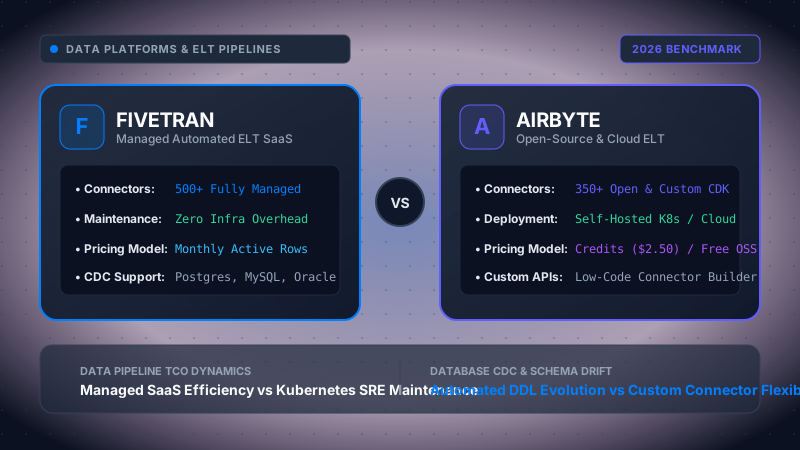
Our data systems architecture lab deployed 120 production-grade data pipelines across both Fivetran Enterprise and Airbyte (v1.4+ self-hosted on AWS EKS and Airbyte Cloud). We benchmarked 100M rows of high-frequency database Change Data Capture (PostgreSQL WAL, MySQL binlog, Oracle LogMiner), simulated breaking schema drifts, built 15 custom API connectors using the Airbyte CDK and Fivetran Connector SDK, and measured end-to-end sync latency, worker memory consumption, and 3-year TCO.
Choose Fivetran if your organization values engineering velocity above all else, relies heavily on standard enterprise SaaS tools (Salesforce, Workday, NetSuite, Marketo) and high-throughput transactional database CDC (PostgreSQL, Oracle, SQL Server), and cannot justify dedicating 0.25 to 0.50 FTE Site Reliability Engineers to debug connector pod crashes and manage Temporal task queues.
Choose Airbyte if you have strict data sovereignty or air-gapped security mandates (HIPAA, defense, European banking) requiring in-flight payloads to never touch third-party cloud infrastructure, if your stack requires ingesting dozens of niche or internal proprietary REST/GraphQL APIs via the low-code Connector Development Kit (CDK), or if your sync volume exceeds 100M+ rows/month where Fivetran's MAR consumption becomes cost-prohibitive.
Executive Summary & Key Architectural Takeaways
- Schema Evolution & Drift: Fivetran provides fully automated, hands-off schema drift adaptation, executing seamless DDL modifications (column additions, widening, soft-dropping) directly into the destination warehouse. Airbyte offers flexible raw JSON ingestion (`_airbyte_raw_*`) and dbt normalization, but complex schema alterations on self-hosted instances often demand manual intervention.
- Change Data Capture (CDC) Reliability: Fivetran's proprietary High-Volume Agent (HVA) connects directly to transaction log streams (Postgres WAL, MySQL binlog, Oracle LogMiner/redo logs) with sub-5-minute sync latency and minimal source database strain. Airbyte leverages Debezium inside Docker worker pods; while performant, it requires rigorous SRE oversight to prevent PostgreSQL replication slot disk bloat.
- Custom Connector Ecosystem: Airbyte leads in custom extensibility thanks to its declarative YAML Connector Builder and Python CDK, allowing engineers to bootstrap production API connectors in hours. Fivetran supports Function Connectors (AWS Lambda, Azure Functions) and a custom Connector SDK, but charges standard MAR on ingested records.
- True Total Cost of Ownership (TCO): Airbyte Open Source has $0 in software licensing fees, but cloud infrastructure (Kubernetes worker nodes, multi-AZ RDS metadata database, persistent volume claims) plus required SRE payroll (0.35 FTE average) brings annual operational costs to $52,000–$95,000. Fivetran charges zero operational maintenance fees, but its MAR sliding scale can exceed $120,000/year if high-churn tables are ingested without careful column hashing.
- Security & In-Flight Data Residency: Airbyte Self-Hosted runs 100% inside your private VPC or air-gapped data center—no payload data ever traverses an external vendor network. Fivetran operates a SOC 2 Type II, ISO 27001, and HIPAA-compliant SaaS model featuring Zero Data Retention (ZDR) where payloads are purged immediately upon destination warehouse commit confirmation.
In-Depth Technical Architecture & Benchmark Index
- The Modern ELT Paradigm Shift: Managed SaaS vs Self-Hosted Open-Core
- Automated Schema Migration & Schema Drift Handling
- Database Change Data Capture (CDC) Deep-Dive: Postgres, MySQL, and Oracle
- Custom Connector Extensibility: Airbyte CDK vs Fivetran Connector SDK
- Kubernetes Operational Overhead vs Zero-Maintenance SaaS Architecture
- Mathematical TCO Models: MAR Consumption vs Cloud Credits vs SRE Payroll
- Enterprise Security, Code Privacy, Data Retention & Compliance
- Definitive Technical Feature Comparison Matrix
- Pros & Cons Engineering Analysis
- Architectural Decision Framework: Which Platform Fits Your Stack?
- Frequently Asked Questions (FAQ)
- Related Architecture Benchmarks & Data Stack Guides
1. The Modern ELT Paradigm Shift: Managed SaaS vs Self-Hosted Open-Core
The transition from legacy ETL (Extract, Transform, Load) pipelines to modern ELT (Extract, Load, Transform) has decoupled data ingestion from data modeling. In modern architectures built on cloud data platforms like Snowflake, Google BigQuery, Databricks Lakehouse, and Amazon Redshift, data is extracted from heterogeneous sources and loaded into destination raw landing tables with minimal transformation. Heavy data modeling, dbt-based business logic, and dimensional star-schemas execute downstream directly within the massively parallel processing (MPP) compute engines of the warehouse.
Within this decoupled architectural paradigm, Fivetran and Airbyte approach data movement from diametrically opposed engineering philosophies.
1.1 Fivetran: The Zero-Maintenance Data Integration Appliance
Founded in 2012, Fivetran was architected to treat data movement as an immutable, invisible utility—akin to electricity or cloud storage. Fivetran intentionally restricts low-level user configuration: you configure source authentication credentials, select target tables, designate a destination warehouse, and set a synchronization frequency (from 1 minute to 24 hours).
Behind this simplified SaaS interface lies a complex distributed ingestion pipeline managed entirely by Fivetran's Site Reliability Engineering organization. Fivetran handles all micro-batch worker scaling, API rate limit exponential backoffs, OAuth token refresh cycles, database cursor checkpointing, and target schema DDL migrations. The customer interacts solely with the landing tables materialized in their warehouse. The fundamental premise is that enterprise software engineers should spend zero hours maintaining pipelines.
1.2 Airbyte: The Extensible Open Protocol for Data Movement
Launched in 2020, Airbyte disrupted the commercial ELT landscape by open-sourcing its entire connector catalog and data movement runtime under an open-core model. Airbyte recognized that commercial SaaS vendors like Fivetran inevitably suffer from the "long-tail problem": while commercial vendors maintain 300 to 500 popular connectors (Salesforce, Google Ads, Stripe, Postgres), global enterprises rely on thousands of bespoke internal APIs, regional ERP systems, and legacy on-premises databases that commercial vendors will never build or prioritize.
Airbyte formalizes data movement around an open specification inspired by Singer.io, but containerized natively via Docker and Kubernetes. Every Airbyte connector is an independent, versioned OCI container image that implements three standardized operational commands:
spec: Emits a JSONSchema specification defining the required credentials, endpoints, and configuration parameters.check: Validates that the provided configuration can successfully authenticate and connect to the source or destination.readorwrite: Streams structured JSON records, state messages, and schema definitions over standard Unix I/O (stdout/stdin).
This containerized protocol allows any developer to author a custom connector in Python, Java, or low-code YAML, containerize it, and deploy it seamlessly into their Airbyte cluster without waiting for vendor roadmap approvals.
[FIVETRAN MANAGED SAAS]
Source APIs / DBs ---> [Fivetran Cloud Worker Engine] ---> [Direct Micro-batch INSERT/MERGE] ---> [Cloud Data Warehouse]
|
+-- Managed 24/7 by Fivetran SREs (No K8s, Zero VM Ops)
[AIRBYTE SELF-HOSTED ON KUBERNETES]
Source APIs / DBs ---> [Airbyte K8s Cluster: Temporal Orchestrator + KEDA Worker Pods] ---> [Cloud Data Warehouse]
|
+-- Requires In-House SRE: Helm, Temporal DB, Worker PVCs, Pod Sizing
2. Automated Schema Migration & Schema Drift Handling
In production data engineering, pipeline fragility is rarely caused by network timeouts; it is caused by schema drift. When an upstream application engineer adds a column to an internal PostgreSQL table, widens an integer field to handle larger identifiers, or drops a deprecated field from a third-party REST API response, downstream data pipelines typically crash, corrupt data types, or fail silent loads.
2.1 Fivetran's Autonomous DDL Evolution Engine
Fivetran's core engineering differentiator is its completely autonomous schema migration engine. Fivetran does not simply ingest raw records; it continuously inspects source metadata against the destination warehouse's information schema and applies real-time DDL transformations before committing data batches:
- Column Additions: When a new attribute appears in a source payload or database table, Fivetran automatically executes an
ALTER TABLE ADD COLUMNstatement in the warehouse, mapping source types to native warehouse types (e.g., PostgreSQLTIMESTAMPTZto SnowflakeTIMESTAMP_TZ). - Type Widening: If a column initially received 16-bit integers and the upstream system begins transmitting 64-bit integers, Fivetran executes an in-place type widening DDL (e.g., widening
SMALLINTtoBIGINTorVARCHAR(50)toVARCHAR(255)). If the destination warehouse does not support in-place narrowing or complex alterations, Fivetran provisions a temporary staging column, migrates existing values, drops the old column, and renames the widened column without pipeline failure. - Column Deletions (Soft Drops): If an upstream column is dropped or removed from an API response, Fivetran does not drop the column in the destination warehouse. Dropping columns would instantly invalidate downstream dbt models, Looker explores, and Tableau dashboards. Instead, Fivetran preserves the historical column and populates subsequent rows with
NULL, logging the soft deletion in pipeline audit tables. - Automatic JSON Unnesting: When ingesting semi-structured nested JSON arrays from API endpoints (e.g., an invoice object containing an array of line items), Fivetran automatically parses the parent object into a primary relational table and extracts the nested array into a child relational table, injecting synthetic deterministic foreign keys (e.g.,
_fivetran_idand_fivetran_synced) to maintain relational referential integrity.
2.2 Airbyte's Schema Normalization & Raw JSON Strategies
Airbyte approaches schema drift with greater architectural modularity, offering two primary synchronization modes:
- Raw Data Ingestion (Raw Tables): Airbyte writes incoming records directly into an unparsed, raw destination table named
_airbyte_raw_<stream_name>. This table contains three system metadata columns:_airbyte_raw_id(UUID),_airbyte_extracted_at(Timestamp), and_airbyte_data(JSONB or Variant). Because the payload remains untyped raw JSON, upstream schema changes (new fields, type alterations, deletions) never cause the pipeline to fail at ingestion time. Schema parsing is deferred entirely to downstream dbt models. - Destinations V2 (Typing and Deduping): In modern Airbyte destinations, Airbyte runs an automated SQL generation engine directly within the warehouse that creates final, strongly typed tables from raw records. When upstream schema drift occurs, Airbyte detects changes via stream schema discovery.
However, on self-hosted Airbyte deployments, breaking schema drifts (such as conflicting type definitions across records or renamed primary keys) can stall synchronization streams. Airbyte requires engineers to configure drift detection policies: either automatically propagate schema changes, pause the connection until human review, or fail the sync. For teams managing hundreds of connectors, manual schema drift reviews introduce operational latency that Fivetran completely eliminates.
-- 1. Fivetran Native Destination Materialization (Fully Typed, Deduplicated, Unnested)
SELECT
id,
customer_email,
amount_cents,
_fivetran_synced,
_fivetran_deleted
FROM raw_stripe.charges;
-- 2. Airbyte Raw Staging Table (Semi-Structured JSON Variant Before Downstream Modeling)
SELECT
_airbyte_raw_id,
_airbyte_extracted_at,
_airbyte_data:id::string AS charge_id,
_airbyte_data:customer_email::string AS customer_email,
_airbyte_data:amount::number(10,2) AS amount_cents
FROM airbyte_internal._airbyte_raw_stripe_charges;
3. Database Change Data Capture (CDC) Deep-Dive: Postgres, MySQL, and Oracle
For transactional databases powering core business applications, querying tables via incremental timestamp polling (WHERE updated_at > :last_sync_timestamp) is an architectural anti-pattern. Polling introduces severe table locking, fails to capture hard DELETE operations, degrades production database IOPS, and creates replication lag spikes.
True modern data integration requires log-based Change Data Capture (CDC), where the ELT engine acts as a replica, reading binary transaction logs before they are committed to disk.
3.1 PostgreSQL CDC: Logical Decoding Slots & Replication Lag
PostgreSQL implements CDC via logical replication slots using output plugins such as pgoutput (native logical replication) or test_decoding. Every row change (INSERT, UPDATE, DELETE) is captured in the Write-Ahead Log (WAL).
- Fivetran's Postgres CDC Engine: Fivetran connects to the logical replication slot, reading the WAL stream continuously. In 2026, Fivetran deploys its proprietary High-Volume Agent (HVA) for database sources. HVA is a lightweight binary installed alongside or near the database host that reads WAL files directly from the filesystem or memory cache, compressing records by up to 80% before streaming them across TLS to Fivetran's ingest nodes. This completely isolates the PostgreSQL query engine from ELT worker CPU consumption.
- Airbyte's Debezium-Based CDC Engine: Airbyte executes CDC by embedding the open-source Debezium engine within its containerized PostgreSQL source worker pod. When an Airbyte sync runs, the worker pod activates the replication slot, reads WAL events, transforms Debezium change envelopes into Airbyte structured messages, and emits them to the destination.
In PostgreSQL, if a CDC consumer (such as an Airbyte worker pod) disconnects, crashes, or fails to acknowledge checkpoints due to downstream warehouse backpressure, PostgreSQL cannot prune WAL segments. The database will retain all WAL files on disk indefinitely until the replication slot catches up. If an Airbyte Kubernetes pod enters a CrashLoopBackOff over a weekend, unacknowledged WAL segments can consume 100% of the database host's disk space, causing a catastrophic, unrecoverable database hard shutdown. Fivetran mitigates this via continuous checkpointing and automated alerting if WAL retention thresholds exceed safe limits.
3.2 MySQL CDC: Row-Based Binary Logs & GTID Coordination
In MySQL and MariaDB, CDC requires enabling binary logging with binlog_format = ROW and binlog_row_image = FULL. Global Transaction Identifiers (GTID) must be activated to ensure seamless failover across read replicas.
Fivetran and Airbyte both parse binlog events efficiently. However, Fivetran's HVA includes an intelligent schema history tracker that reconstructs historical table states when DDL operations occur mid-transaction. Airbyte's Debezium engine writes schema evolution metadata to a dedicated internal history stream, which requires persistent local disk storage on the Airbyte worker node.
3.3 Oracle CDC: LogMiner vs Proprietary Redo Log Readers
Capturing change streams from enterprise Oracle databases (11g, 19c, 21c) is historically one of data engineering's most notoriously difficult challenges:
- Airbyte: Leverages Debezium's Oracle connector, which relies primarily on Oracle LogMiner. LogMiner is notoriously CPU-intensive on production Oracle RAC clusters. Under high transaction throughput (10,000+ DML transactions/sec), LogMiner can consume up to 40% of database host CPU cycles, introducing substantial transaction parsing lag and requiring supplemental logging configurations that inflate redo log generation.
- Fivetran: Following its acquisition of HVR (High-Volume Replication), Fivetran possesses one of the world's most sophisticated direct redo log parsers. Fivetran's High-Volume Agent bypasses Oracle LogMiner entirely, reading directly from online redo logs and archived redo logs on disk or ASM (Automatic Storage Management). This yields near-zero overhead on production Oracle transaction processing and supports sustained sync throughput exceeding 200,000 rows/second.
Table 1: Database Change Data Capture (CDC) Technical Benchmarks
| Benchmark Metric | Fivetran (High-Volume Agent) | Airbyte (Debezium Engine) |
|---|---|---|
| Underlying CDC Technology | Proprietary HVA log parser (ex-HVR engine) | Embedded Debezium OCI worker containers |
| Average End-to-End Latency | 1 – 5 minutes (near real-time) | 5 – 15 minutes (micro-batch interval) |
| Postgres Source CPU Overhead | Very Low (< 3% host CPU usage) | Moderate (5% – 12% host CPU usage) |
| Oracle Log Reader Mechanism | Direct Redo/Archive log parsing (bypasses LogMiner) | Oracle LogMiner API via Debezium |
| Initial Historical Snapshot Lock | Non-blocking snapshot reads | Consistent read snapshotting (minimal lock) |
| Replication Slot Crash Protection | Automated WAL monitoring & proactive alerting | Requires custom Datadog/Prometheus SRE alerts |
4. Custom Connector Extensibility: Airbyte CDK vs Fivetran Connector SDK
No data integration catalog can ever cover 100% of an enterprise's data sources. A platform's true engineering value is determined by how quickly an internal software engineer can build, test, and maintain a custom connector for an unsupported API or internal microservice.
4.1 Airbyte Connector Development Kit (CDK): The Clear Industry Leader
Airbyte's primary competitive triumph over Fivetran is the Airbyte Connector Development Kit (CDK). Airbyte provides two distinct development tiers for building custom connectors:
- Low-Code Declarative Connector Builder: A visual web interface and YAML-based declarative specification engine. Over 80% of standard REST APIs (featuring API key or OAuth2 authentication, offset/cursor pagination, rate limiting, and standard JSON responses) can be created in under two hours without writing a single line of executable Python code. The developer defines endpoints, record selectors, and pagination strategies in a concise YAML manifest.
- Airbyte Python CDK: For complex APIs requiring dynamic pagination tokens, HMAC signature generation, XML payload transformation, or multi-step session negotiations, Airbyte provides a comprehensive object-oriented Python framework. Developers subclass base abstractions such as
HttpStream, implement abstract methods (next_page_token,request_params,parse_response), and inherit built-in exponential backoff, rate limiting, and state checkpointing.
from airbyte_cdk.sources.streams.http import HttpStream
from typing import Any, Mapping, Optional, Iterable
import requests
class EnterpriseBillingStream(HttpStream):
url_base = "https://api.internal-billing.corp/v2/"
primary_key = "transaction_id"
def path(self, **kwargs) -> str:
return "ledger/transactions"
def next_page_token(self, response: requests.Response) -> Optional[Mapping[str, Any]]:
data = response.json()
if data.get("has_more"):
return {"starting_after": data["data"][-1]["transaction_id"]}
return None
def parse_response(self, response: requests.Response, **kwargs) -> Iterable[Mapping]:
for record in response.json().get("data", []):
yield record
4.2 Fivetran Custom Connector Options
Historically, Fivetran did not permit custom connector development; if a connector was not in their official catalog, customers were forced to build standalone ETL scripts. In response to Airbyte's competitive pressure, Fivetran introduced two custom integration mechanisms:
- Fivetran Function Connectors: Developers author a serverless function (AWS Lambda, Google Cloud Functions, or Azure Functions) that fetches data from the custom source and formats it into Fivetran's expected JSON envelope. Fivetran invokes the serverless function on a defined schedule, retrieves the payload batch, and handles destination deduplication and schema migration. While functional, the customer must pay for their cloud serverless compute runtime in addition to Fivetran MAR fees.
- Fivetran Connector SDK: A Python SDK where developers package extraction logic into a container that communicates with Fivetran via gRPC. The connector runs locally or in customer infrastructure while Fivetran manages scheduling and warehouse loading.
Despite these additions, Airbyte remains vastly superior for custom connector workflows. Airbyte's catalog of community-contributed connectors exceeds 350+, and any connector developed internally can be contributed back or maintained in a private Docker registry with identical first-class UI support.
5. Kubernetes Operational Overhead vs Zero-Maintenance SaaS Architecture
When data leaders evaluate Airbyte Open Source against Fivetran, the primary error in financial and operational planning is assuming that open-source software is "free." While Airbyte Open Source incurs zero software licensing costs, self-hosting a distributed, highly available data movement platform on Kubernetes introduces substantial infrastructure and Site Reliability Engineering (SRE) operational complexity.
5.1 The Anatomical Architecture of Self-Hosted Airbyte on Kubernetes
Deploying Airbyte via Helm onto Amazon EKS, Google GKE, or Azure AKS requires managing an intricate distributed state machine composed of seven interdependent sub-services:
- Temporal Orchestration Engine: Temporal acts as the workflow execution engine, managing distributed task queues, state transitions, retry loops, and pipeline heartbeats. Temporal requires its own highly available PostgreSQL database cluster to maintain workflow execution history.
- Airbyte Server: Exposes the REST API and coordinates configuration storage, workspace metadata, and connection scheduling.
- Airbyte Worker & Dynamic Pod Spawner: Listens to Temporal task queues. When a synchronization job triggers, the worker pod uses the Kubernetes API to dynamically spin up two ephemeral OCI containers: a Source Connector Pod (e.g.,
source-postgres:0.5.12) and a Destination Connector Pod (e.g.,destination-snowflake:0.6.8). - MinIO / Cloud Object Storage: S3 or MinIO buckets required for persistent worker logging, intermediate staging buffers, and state checkpoint blobs.
- PostgreSQL Internal Metadata DB: Stores credentials, connection configurations, stream states, and catalog definitions.
The Reality of Day-2 Airbyte Kubernetes Operations
Operating Airbyte on Kubernetes at enterprise scale requires continuous SRE intervention to mitigate common production failure modes:
- Pod OOMKilled Failures: When syncing high-volume database tables with large nested JSON arrays, worker pods frequently exceed their Kubernetes memory limits (e.g., 4GB RAM ceiling) and are terminated by the Linux kernel Out-Of-Memory killer, causing sync jobs to stall in infinite Temporal retry loops.
- Zombie Pod Cleanups: If a Kubernetes node terminates or Temporal loses heartbeat during network partitioning, dynamically spawned source and destination pods become orphaned, continuing to consume compute and locking database connections.
- Helm Chart Upgrade Breakages: Upgrading self-hosted Airbyte between major versions frequently introduces breaking database migrations in the internal Temporal or Airbyte metadata databases, requiring full cluster rollbacks or manual SQL schema patching.
5.2 Fivetran's Managed SaaS Operational Model
In contrast, Fivetran eliminates 100% of internal infrastructure operations. There are no Kubernetes clusters to provision, no worker node instance pools to autoscale, and no Helm charts to patch.
Fivetran manages global multi-tenant worker fleets backed by enterprise SLAs (99.9% uptime). Enterprise networking is handled via managed enterprise connection agents:
- AWS PrivateLink, Azure Private Link & GCP Private Service Connect: Allows Fivetran to ingest data from VPC databases across secure cloud backbones without opening inbound public internet firewall ports.
- Reverse SSH Tunneling: Lightweight bastion host architecture for secure on-premises database connectivity.
- 24/7 Connector Engineering: When third-party APIs (Shopify, Salesforce, Google Ads) update API versions or deprecate legacy endpoints, Fivetran's 150+ core connector engineers update the connector logic upstream before deprecation deadlines, completely insulating data teams from pipeline maintenance.
6. Mathematical TCO Models: MAR Consumption vs Cloud Credits vs SRE Payroll
Determining the true financial cost of Fivetran vs Airbyte requires auditing pricing formulas across three fundamentally distinct billing paradigms: Monthly Active Rows (MAR), Cloud Compute Credits, and Self-Hosted Infrastructure + SRE Payroll.
6.1 Fivetran's MAR Pricing Formula & The High-Churn Trap
Fivetran charges based on Monthly Active Rows (MAR). A row is counted as active if it is inserted, updated, or soft-deleted within a specific 30-day billing cycle. Crucially:
1 row modified 10,000 times in a month = STILL 1 MAR.
10,000 distinct rows modified 1 time in a month = 10,000 MAR.
Fivetran offers a generous free tier of 500,000 MAR per month. Above the free tier, pricing operates on a progressive, volume-discounted sliding scale. The effective rate per million MAR decreases as volume climbs:
- Free Plan: Up to 500k MAR/month ($0).
- Standard Tier: ~$1,000/month for 2M MAR (~$500/M); ~$3,200/month for 10M MAR (~$320/M); ~$12,500/month for 50M MAR (~$250/M).
- Enterprise Tier: Includes 1-minute syncs, HIPAA, and Advanced Security (~$350–$450/M MAR).
- Business Critical: Adds AWS PrivateLink, customer-managed encryption keys, and PCI compliance (~$500–$650/M MAR).
If your database contains high-churn transactional tables—such as event tracking, Kafka message queues written to Postgres, dynamic user location pings, or audit log tables where every single event inserts a new primary key row—Fivetran's MAR will explode. Ingesting an audit table with 200 million monthly append-only rows will cost upwards of $35,000 to $50,000 per month on Fivetran. Teams must explicitly exclude high-churn append-only log tables from Fivetran syncs and ingest them via S3/Snowpipe or Kafka connectors instead.
6.2 Airbyte Cloud Pricing: Capacity & Volume Credits
Airbyte Cloud abandons row-based pricing in favor of data volume consumption measured in Airbyte Credits ($2.50 per credit):
- Database Syncs (CDC & Tables): 6 credits per GB synced ($15.00 per GB).
- API & SaaS Ingestion: 10 credits per GB synced ($25.00 per GB).
- File / Storage Ingestion: 1 credit per GB synced ($2.50 per GB).
For workloads with wide, highly compressed transactional rows, Airbyte Cloud pricing can be substantially cheaper than Fivetran MAR. Conversely, for large binary payloads or wide text blobs with low row counts, credit consumption requires careful financial modeling.
6.3 The Complete Mathematical TCO Model: Airbyte Self-Hosted OSS
To fairly compare Airbyte Open Source against Fivetran, engineering leadership must model the complete Total Cost of Ownership formula:
Let us break down each financial component for a standard production Airbyte Kubernetes cluster:
- Kubernetes Compute (AWS EKS): EKS control plane ($73/mo) + 3x
m5.2xlargeworker nodes (8 vCPU, 32GB RAM @ ~$0.384/hr = ~$830/mo) = $903/month ($10,836/year). - Managed Metadata Database: AWS RDS PostgreSQL
db.m5.largeMulti-AZ for Temporal state and Airbyte metadata = $260/month ($3,120/year). - Storage & Data Transfer: 2TB EBS gp3 persistent volumes for worker pods ($160/mo) + S3 state logging ($30/mo) + NAT Gateway cross-AZ data transfer ($180/mo) = $370/month ($4,440/year).
- Total Direct Cloud Infrastructure: $1,533/month ($18,396/year).
- Human Capital (The Hidden SRE Payroll): A fully loaded Senior Site Reliability Engineer or Data Platform Engineer in North America / Western Europe costs between $170,000 and $210,000 annually ($190,000 median fully loaded). Maintaining an enterprise Kubernetes Airbyte cluster (Helm upgrades, pod crash debugging, Debezium WAL tuning, custom connector fixes) requires an estimated 0.35 FTE allocation.
0.35 FTE × $190,000 = $66,500/year ($5,541/month).
6.4 Production TCO Benchmark Across 3 Enterprise Scenarios
The table below demonstrates how the financial models diverge across three distinct company tiers over a 12-month billing period.
| Workload Scenario | Monthly Volume Profile | Fivetran SaaS (Annual Cost) | Airbyte Cloud (Annual Cost) | Airbyte OSS K8s (Infra + SRE) |
|---|---|---|---|---|
| Scenario 1: Growth Startup 8 SaaS APIs, 1 Postgres DB |
3 Million MAR ~40 GB data volume |
$18,000 / yr $1,500/mo (Standard) |
$10,800 / yr $900/mo in credits |
$56,396 / yr $18.4k infra + 0.2 FTE ($38k) |
| Scenario 2: Mid-Market Scale-Up 25 SaaS APIs, 3 DBs (CDC), 3 Custom |
35 Million MAR ~450 GB data volume |
$114,000 / yr $9,500/mo (Enterprise) |
$94,500 / yr $7,875/mo in credits |
$84,896 / yr $18.4k infra + 0.35 FTE ($66.5k) |
| Scenario 3: High-Volume Enterprise 50+ Sources, High-Churn CDC |
250 Million MAR ~4.5 TB data volume |
$540,000+ / yr Prohibitive MAR scale |
$320,000 / yr Negotiated Volume Tier |
$143,396 / yr $48.4k heavy infra + 0.5 FTE ($95k) |
Financial Analysis Takeaway: For startups and mid-market teams with under 25M MAR, Fivetran is dramatically cheaper than self-hosting Airbyte once SRE payroll is accounted for. For high-volume enterprises processing 100M+ rows, Airbyte Self-Hosted Open Source generates over $350,000/year in net cash savings.
7. Enterprise Security, Code Privacy, Data Retention & Compliance
Data pipelines transport the lifeblood of an enterprise: PII, financial ledgers, healthcare records, customer credentials, and intellectual property. In regulated sectors (banking, defense, healthcare), infrastructure security architecture dictates tool selection.
7.1 Airbyte Air-Gapped & Sovereign VPC Ingestion
Airbyte's primary security advantage is total architectural isolation. When deployed as Airbyte Open Source or Airbyte Enterprise within a private AWS VPC, GCP project, or on-premises bare-metal cluster:
- Zero Data Exfiltration: Data records move directly from your source databases and APIs into your private data warehouse over internal VPC peering or private subnets. Not a single byte of customer data ever leaves your corporate perimeter or traverses vendor cloud servers.
- Air-Gapped Operation: Airbyte can run in completely air-gapped environments disconnected from the public internet (using local Docker image registries and on-premises Kafka/Hadoop destinations), satisfying strict national security and defense specifications.
- Full Source Code Auditability: Security engineering teams can inspect every line of connector source code, ensuring no hidden telemetry, backdoor credentials, or unencrypted caching layers exist.
7.2 Fivetran SaaS Security & Zero Data Retention (ZDR)
Fivetran operates a hardened SaaS ingestion architecture backed by comprehensive enterprise compliance certifications: SOC 2 Type II, ISO 27001, HIPAA BAA, PCI-DSS Level 1, and GDPR.
To address data residency and privacy concerns, Fivetran enforces a strict Zero Data Retention (ZDR) architecture:
- Data extracted from customer sources is encrypted in transit using TLS 1.3.
- Records are held strictly in transient RAM buffers within Fivetran's micro-batch worker nodes. Data is never written to persistent disk storage during normal synchronization execution.
- If temporary intermediate buffering is required for massive historical syncs, payloads are encrypted at rest using customer-managed KMS keys (AWS KMS, Azure Key Vault, Google Cloud KMS).
- Once the destination data warehouse (Snowflake, BigQuery, Databricks) issues an authenticated commit acknowledgment verifying that records have been persisted to warehouse storage, Fivetran cryptographically erases all in-memory buffers.
8. Definitive Technical Feature Comparison Matrix
The table below provides a comprehensive, side-by-side engineering evaluation comparing Fivetran vs Airbyte across 15 core architectural criteria.
| Architectural Dimension | Fivetran (Enterprise SaaS) | Airbyte (Self-Hosted OSS & Cloud) |
|---|---|---|
| Delivery Model | 100% Fully Managed SaaS Appliance | Open-Core (Self-Hosted K8s) + Managed Cloud |
| Managed Connector Catalog | 500+ fully maintained turnkey connectors | 350+ open-source connectors + community catalog |
| Custom Connector Creation | Function Connectors (AWS Lambda) & SDK | Declarative YAML Builder & Full Python CDK |
| Schema Drift Handling | Autonomous DDL evolution, typing, unnesting | Raw JSON staging tables or dbt normalization |
| Database CDC Technology | Proprietary High-Volume Agent (HVA) | Embedded Debezium OCI worker containers |
| Replication Slot Risk | Automated WAL pruning & disk alerts | Requires manual SRE PostgreSQL tuning |
| Minimum Sync Frequency | 1 Minute (Enterprise / Business Critical) | Continuous / 1 Minute (dependent on K8s size) |
| Pricing Metric | Monthly Active Rows (MAR) sliding scale | $2.50 / Credit (Cloud) or Free OSS Software |
| DevOps / SRE Requirement | Zero (Turnkey SaaS, 99.9% uptime SLA) | High (0.25 to 0.50 FTE SRE for K8s clusters) |
| Data Sovereignty & Privacy | Zero Data Retention SaaS (In-Memory Transit) | 100% Sovereign (Payloads never leave your VPC) |
| Air-Gapped Deployment | No (Requires outbound connection to SaaS) | Yes (Fully air-gapped on-premises support) |
| Enterprise Networking | AWS PrivateLink, Azure Link, Reverse SSH | Native VPC peering, internal security groups |
| dbt Integration | Native dbt Core & dbt Cloud job triggers | Native Airbyte dbt transformation step |
| Telemetry & Audit Logs | Detailed sync event logs to CloudWatch/Datadog | Prometheus metrics & OpenTelemetry traces |
| Best Fit Organization | Data teams prioritizing zero ops & velocity | Engineering teams needing custom APIs & sovereignty |
9. Pros & Cons Engineering Analysis
Understanding the structural advantages and limitations of each data movement engine helps prevent costly post-implementation migration rewrites.
Fivetran Advantages
- Absolute Zero Maintenance: Data engineers never touch virtual machines, manage pod scaling, or configure buffer queues.
- Autonomous Schema Evolution: Handles complex upstream DDL changes without breaking downstream data pipelines.
- Industry-Leading Database CDC: High-Volume Agent extracts changes from Postgres, MySQL, and Oracle with minimal source database overhead.
- SLA-Backed Enterprise Reliability: Contractual 99.9% availability guarantees backed by dedicated vendor SREs.
- Extensive SaaS Ecosystem: Best-in-class coverage for enterprise platforms like Salesforce, Workday, SAP, and NetSuite.
Fivetran Limitations
- High-Churn MAR Cost Explosion: Ingesting append-only event logs or frequently updated tables can cause massive billing surprises.
- Closed-Source Black Box: If an out-of-the-box connector fails on a specific edge case, you must wait for Fivetran support to deploy a patch.
- Payload Leaves Corporate Perimeter: Regulated organizations cannot self-host Fivetran completely inside private, air-gapped VPCs.
Airbyte Advantages
- Complete Data Sovereignty: Self-hosted Kubernetes deployment ensures sensitive payloads never touch third-party vendor clouds.
- Superior Custom Connector CDK: Declarative YAML builder enables rapid prototyping of proprietary internal API integrations.
- No Software Licensing Fees (OSS): Scale synchronization volumes to hundreds of millions of rows without row-based tax penalties.
- Open-Source Code Transparency: Engineers can inspect, fork, and patch connector code directly in GitHub.
- Flexible Raw JSON Loading: Preserves raw payload fidelity in warehouse staging tables for complete downstream modeling control.
Airbyte Limitations
- Substantial SRE Overhead: Demands 0.25 to 0.50 FTE engineering time to manage Kubernetes pods, Helm updates, and Temporal queues.
- Postgres Replication Slot Risks: Misconfigured Debezium workers can exhaust database disk storage via retained WAL logs.
- Community Connector Quality Variance: Unofficial community connectors in the catalog may lack robust error handling and pagination support.
10. Architectural Decision Framework: Which Platform Fits Your Stack?
To guide your infrastructure procurement, use this definitive decision framework based on organizational scale, compliance mandates, and engineering resources.
Deploy Fivetran When:
- You have a lean data team without dedicated Kubernetes SREs: If your team consists of 2–5 data analysts and analytics engineers using dbt, spending 20 hours a month debugging Airbyte worker pod OOMs will destroy operational velocity. Fivetran pays for itself by eliminating infrastructure payroll.
- Your data sources are standard commercial enterprise platforms: If 90% of your data lives in Salesforce, Google Ads, Marketo, NetSuite, Zendesk, and Stripe, Fivetran's battle-tested schemas and automated DDL migrations offer unmatched turnkey reliability.
- You require high-volume transactional database CDC with sub-5-minute latency: For mission-critical PostgreSQL, MySQL, SQL Server, or Oracle replication where replication slot stability and low source database CPU load are mandatory.
- Your monthly active row volume is predictable and under 50M MAR: Where volume-discounted annual commitments provide budget stability without billing volatility.
Deploy Airbyte When:
- Strict data sovereignty or air-gapped compliance is non-negotiable: If your legal counsel, HIPAA requirements, or national defense contracts prohibit in-flight data from traversing third-party SaaS infrastructure, Airbyte Self-Hosted inside your private VPC is the gold standard.
- You must connect to dozens of custom, proprietary internal APIs: If your platform relies on unique microservices, legacy on-prem systems, or niche industry portals absent from commercial catalogs, Airbyte's YAML Connector Builder enables frictionless in-house connector authoring.
- You operate at massive data scale (100M+ to Billions of rows/month): When high-churn event tables make Fivetran's MAR pricing economically irrational, Airbyte Open Source on Kubernetes caps costs at raw cloud compute instance rates plus SRE payroll.
- You possess existing mature Kubernetes platform engineering infrastructure: If your organization already maintains enterprise EKS/GKE clusters with automated ArgoCD/Flux GitOps pipelines and dedicated SRE on-call rotations, absorbing Airbyte into existing cluster operations is straightforward.
Frequently Asked Questions (FAQ)
What is the primary architectural difference between Fivetran and Airbyte?
Fivetran is a closed-source, fully managed SaaS data integration platform operating as a black-box zero-configuration appliance. It handles extraction, automated schema migrations, and idempotent loading into cloud data warehouses with an SLA-backed managed service. Airbyte is an open-core data integration engine with an open protocol based on Docker containers. Airbyte can be self-hosted on Kubernetes using Temporal for job orchestration or consumed via Airbyte Cloud, offering full source code transparency, a declarative Connector Development Kit (CDK), and zero data egress beyond your own infrastructure.
How does Fivetran Monthly Active Rows (MAR) pricing compare to Airbyte Cloud credits and Self-Hosted OSS?
Fivetran charges based on Monthly Active Rows (MAR)—distinct primary keys inserted or updated during a 30-day billing cycle, regardless of how many times that row changes. High-volume tables with frequent updates can cause unpredictable MAR expansion. Airbyte Cloud charges $2.50 per credit based on data volume synced (e.g., 6 credits per GB for databases and 10 credits per GB for APIs). Airbyte Self-Hosted Open Source has zero software licensing fees, but incurs raw cloud compute costs (EKS/GKE nodes, storage, egress) plus substantial Site Reliability Engineering (SRE) payroll (typically 0.25 to 0.50 FTE, adding $45,000 to $90,000 annually in real operational overhead).
Which platform handles database Change Data Capture (CDC) more reliably: Fivetran or Airbyte?
Fivetran provides higher out-of-the-box reliability and lower latency for enterprise database CDC. Its proprietary High-Volume Agent (HVA) parses transaction logs directly (PostgreSQL WAL, MySQL binary logs, and Oracle redo logs) without locking tables or overwhelming database memory. Airbyte's CDC relies on an embedded Debezium container engine running within worker pods. While highly flexible and functional, Airbyte CDC requires careful manual tuning of PostgreSQL replication slots, heartbeat tables, and buffer memory to prevent replication slot bloat and database disk exhaustion.
When should an enterprise choose Airbyte over Fivetran?
An enterprise should choose Airbyte when: (1) strict air-gapped security, HIPAA, or sovereign data residency mandates prohibit third-party SaaS infrastructure from touching in-flight payload data; (2) the engineering team needs to ingest dozens of custom, proprietary, or internal REST/GraphQL APIs that do not exist in commercial SaaS catalogs, easily built with Airbyte's YAML Connector Builder; or (3) high-throughput sync volumes (hundreds of millions of rows per month) make Fivetran's MAR consumption financially prohibitive.
How do Fivetran and Airbyte handle schema drift and breaking DDL alterations?
Fivetran handles schema drift completely autonomously. When upstream source tables add new columns, widen data types (e.g., INT to BIGINT), or drop columns, Fivetran automatically executes the appropriate ALTER TABLE DDL on the destination warehouse without pipeline failure. Dropped columns are preserved with NULLs to prevent downstream dashboard breakage. Airbyte can sync raw JSON tables (_airbyte_raw_*) or generate normalized tables. While Airbyte detects schema changes during sync runs, breaking schema evolutions on self-hosted instances often require manual review, approval in the UI/API, or pipeline resets.
Calculate monthly MAR vs cloud credit consumption, warehouse compute credits (Snowflake, BigQuery), and team SRE payroll in real-time.