
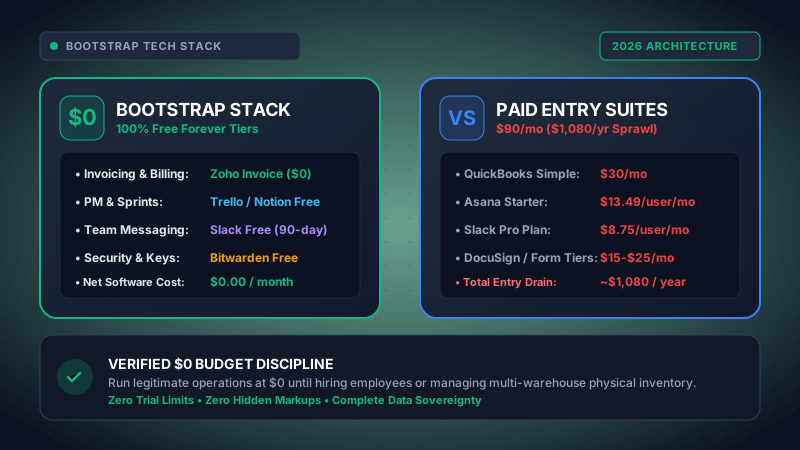
Key Takeaway: The $1,080/Year Bootstrap Advantage
Startups and independent consultants routinely burn $900 to $1,500 in their first twelve months on entry-level subscriptions before generating sustained revenue. By configuring Zoho Invoice (unlimited billing), Trello / Notion (Kanban & documentation), Slack Free (client collaboration), Bitwarden (zero-knowledge passwords), and PandaDoc (legally-binding e-signatures), you eliminate fixed software overhead entirely while preserving identical operational output.
1. The Myth of the "Entry-Level" SaaS Tax
The software-as-a-service marketing machine is engineered around micro-commitments. A billing tool at $30/month feels affordable; a project management board at $11/user/month seems inconsequential; an e-signature service at $15/month is dismissed as an inevitable business cost.
However, for a solo founder, freelancer, or early-stage bootstrap team, these individual charges accumulate into an insidious fixed burn rate. When your monthly recurring revenue (MRR) is erratic or growing from zero, committing $80 to $120 each month to dormant software licenses represents cash that should be funding customer acquisition, legal incorporation, or product development.
The table below details the real financial divergence between purchasing entry-tier commercial software and deploying our verified $0/month architecture:
| Operational Function | Bootstrap Free Tool | Commercial Paid Suite | Monthly Waste | Annual Savings |
|---|---|---|---|---|
| Client Invoicing & Retainers | Zoho Invoice | QuickBooks Simple Start | $30.00 / mo | $360.00 / yr |
| Project & Sprint Management | Trello Free / Notion | Asana Starter | $13.49 / mo | $161.88 / yr |
| Team & Client Communication | Slack Free (90-Day) | Slack Pro Plan | $8.75 / mo | $105.00 / yr |
| Contracts & Legal Signatures | PandaDoc Free eSign | DocuSign Personal | $15.00 / mo | $180.00 / yr |
| Password Vault & 2FA Keys | Bitwarden Free | 1Password Teams | $7.99 / mo | $95.88 / yr |
| Total Operational Stack Cost | $0.00 / month | $75.23+ / month | $75.23 / mo | $902.76 - $1,080 / yr |
2. Pillar 1: Invoicing & Cash Collection (Zoho Invoice)
The foundation of any business is getting paid. Most founders default to QuickBooks Online ($30/month) or FreshBooks ($19/month) simply because of brand recognition. Wave Accounting is another common option, but Wave began gatekeeping bank feed automation behind a $16/month Pro plan in early 2024.
The undisputed gold standard for zero-budget invoicing is Zoho Invoice.
Why is Zoho Invoice 100% Free Forever?
Skeptical founders often ask: "Where is the catch? Is Zoho selling my client financial data?"
The answer is straightforward business economics. In 2021, Zoho publicly made Zoho Invoice 100% free as an ethical customer acquisition mechanism. Zoho is a privately held, highly profitable enterprise software conglomerate with over 100 million users. Unlike venture-backed startups that offer free tiers to inflate user numbers and then suddenly slap paywalls on them, Zoho uses Invoice as a loss leader.
Their strategic calculus is simple: when your business grows to the point of needing double-entry tax ledgers or enterprise CRM automation, you are statistically likely to upgrade to paid products like Zoho Books ($15-$40/mo) or the complete Zoho One operating system. They do not sell customer data, they do not inject advertisements into your client invoices, and they do not add arbitrary surcharges on top of standard payment processing fees.
Unlocked Capabilities in Zoho Invoice ($0):
- Unlimited Clients & Invoices: Zero artificial caps on monthly invoices, estimates, or customer contacts.
- Branded Client Portal: Clients can log into a dedicated portal to view outstanding balances, review historical receipts, and pay in one click.
- Multi-Currency & Global Tax: Complete support for international billing with automatic exchange rate updates and localized VAT/GST calculations.
- Direct Payment Gateway Connectors: Direct integration with Stripe, PayPal, Authorize.net, and 2Checkout without third-party middleman fees.
- Automated Payment Reminders: Configurable escalation sequences (e.g., 3 days before due date, on due date, 7 days overdue) that trigger automatically.
3. Pillar 2: Task Orchestration & Deliverables (Trello Free & Notion)
Project management software is notorious for aggressive license gating. Monday.com enforces a strict 3-seat minimum ($36/mo minimum spend); Asana restricts custom fields and workflow timeline rules to its $10.99/user tier; ClickUp caps custom fields on its free tier to 100 uses.
For solo founders and lean teams, you can operate entirely within two complimentary free systems:
Option A: Trello Free (Best for Visual Kanban Execution)
Trello Free grants up to 10 team Workspace boards with unlimited cards, unlimited members, and unlimited Power-Ups (integrations). By activating Trello's native Butler automation, you can configure rule-based actions (e.g., when a card moves to "Completed", automatically notify a Slack channel and mark due dates finished) without paying for enterprise workflow suites.
Option B: Notion Free (Best for Living Wikis & Relational Roadmaps)
For individual founders, Notion's Free Plan provides unlimited pages and blocks with up to 5MB file uploads. You can build complete relational databases linking customer meeting notes, sprint backlogs, and standard operating procedures (SOPs) into a unified workspace. For external client collaboration, Notion allows inviting up to 10 guest viewers for free.
Operational Topology: The $0/mo Business Data Flow
The diagram below demonstrates how information moves seamlessly through the $0/month architecture without requiring paid API connectors or zapier tasks:
4. Pillar 3: Client & Team Communication (Slack Free)
In September 2022, Slack adjusted its free tier terms, transitioning from a 10,000-message limit to a rolling 90-day searchable history. Many online commentaries claimed this destroyed Slack's viability for small businesses, urging users to upgrade to Slack Pro ($8.75/user/month).
In real-world business practice, this 90-day window is more than adequate for early-stage coordination. Chat is inherently ephemeral; operational decisions and project deliverables should never live exclusively inside a chat message thread.
By establishing two standard operating procedures, a solo founder can utilize Slack Free indefinitely:
- Native Slack Canvases: Slack allows pinning permanent canvas documents inside channels. Canvases do not expire after 90 days, allowing you to store onboarding links, client project scopes, and essential resources directly inside the channel header at $0.
- Immediate Knowledge Archival: Whenever a client approves a scope change or shares critical credentials in Slack, immediately log the confirmation in your Notion project board and archive the passwords inside Bitwarden.
5. Pillar 4: Passwords & Zero-Trust Keys (Bitwarden Free)
Security is frequently neglected during bootstrap phases, with founders reusing passwords across developer accounts, hosting portals, and banking dashboards.
Commercial password managers like 1Password and Dashlane require paid subscriptions ($3 to $8/user/mo). Bitwarden offers the most generous, transparent free tier in the cybersecurity industry:
- Unlimited Devices: Sync credentials across mobile devices (iOS, Android), desktop apps (macOS, Windows, Linux), and browser extensions simultaneously.
- Open-Source & Audited: Bitwarden's codebase is independently audited, utilizing end-to-end zero-knowledge AES-256 bit encryption.
- Secure Notes & Credit Cards: Store server SSH keys, API tokens, and corporate debit cards securely with two-factor authentication (2FA).
6. Pillar 5: Legal Binding Agreements (PandaDoc Free eSign)
Sending contracts for physical printing and scanning conveys amateurism to enterprise clients. Yet subscribing to DocuSign ($15/mo for just 5 documents) or Adobe Acrobat Sign creates recurring license friction.
PandaDoc Free eSign solves this friction completely:
- Unlimited Document Uploads: Upload any PDF proposal, statement of work (SOW), or non-disclosure agreement (NDA).
- Standard Digital Signatures: Place signature, date, and text fields on the document.
- Legal Audit Trail: Each executed agreement generates an official completion certificate with timestamped IP addresses, compliant with the US ESIGN Act and European eIDAS regulations.
7. The Upgrade Trigger Framework: When to Start Paying
Operating at $0/month is a tactical discipline for capital preservation; it is not a permanent religion. As your enterprise scales, free software models eventually hit hard functional boundaries where purchasing specialized commercial tools produces positive return on investment.
You should transition from the $0 Bootstrap Stack to paid software only when you encounter these three specific operational milestones:
Trigger 1: Hiring Your First Full-Time W-2 Employee
The Limitation: Zoho Invoice does not calculate federal, state, or local employment tax withholdings, nor does it submit automated unemployment filings or direct deposit.
The Solution: The moment you hire your first employee, subscribe to an automated payroll suite like Gusto ($40/mo + $6/user) or QuickBooks Payroll. Attempting manual payroll to save $40/month exposes your business to severe IRS and state tax penalties.
Trigger 2: Physical Inventory & Cost of Goods Sold (COGS)
The Limitation: Zoho Invoice tracks services, billable hours, and digital items, but it does not support FIFO/LIFO warehouse inventory valuation or multi-location stock replenishment.
The Solution: If you transition from digital agency services to selling physical e-commerce inventory, upgrade to QuickBooks Online Plus ($99/mo) or Xero Growing ($42/mo) with dedicated inventory add-ons.
Trigger 3: Corporate Compliance & Permanent Legal Retention
The Limitation: Enterprise enterprise clients in healthcare (HIPAA) or fintech frequently require vendors to provide SOC-2 Type II audit reports, Single Sign-On (SAML SSO), and legal compliance retention of all team communications exceeding 1 year.
The Solution: Upgrade to Slack Pro / Business+ for legal message retention, and configure Google Workspace Business Standard for centralized identity governance.
Calculate Your Team's Software Cost Transition
Test how software pricing changes as your business transitions from Solo ($0/mo) to Growth (2-15 users) and Scale (15-50+ users) using our interactive engine.
Launch SaaS Cost Estimator8. Frequently Asked Questions
Is Zoho Invoice truly 100% free with no hidden charges?
Yes. In 2021, Zoho officially made Zoho Invoice 100% free forever for all businesses worldwide. There are zero subscription fees, zero user license caps, and unlimited invoices, estimates, and clients. Zoho does not take transaction cut markups on third-party payment gateways like Stripe or PayPal, and uses the product as an ethical top-of-funnel customer acquisition gateway for its broader paid suite (Zoho Books and Zoho One).
How does a solo entrepreneur handle the 90-day message history limit in Slack Free?
For small teams and solo founders, ephemeral chat is an asset rather than a liability. To preserve critical operational knowledge, pin permanent project documentation into native Slack Canvases (which do not expire) or maintain master project specifications inside Notion Free, treating Slack strictly for daily coordination and client real-time chatter.
Can you legally sign contracts and proposals for free using PandaDoc?
Yes. PandaDoc offers an official Free eSign plan that allows users to upload documents, add legally binding electronic signature tags (compliant with ESIGN and UETA standards in the US and eIDAS in the EU), and collect unlimited client signatures with full audit trail certificates without paying a monthly subscription.
What is the exact financial difference between the $0 Bootstrap Stack and standard entry SaaS suites?
A typical entry software bundle (QuickBooks Simple Start at $30/mo, Asana Starter at $13.49/user/mo, Slack Pro at $8.75/user/mo, and DocuSign at $15/mo) costs a minimum of $67 to $90 per month, draining $800 to $1,080 annually from an early-stage business. The Bootstrap Stack replaces these with Zoho Invoice, Trello/Notion, Slack Free, Bitwarden, and PandaDoc for an exact net spend of $0.00/month.