
TiDB vs CockroachDB: Distributed SQL & Cloud Database Benchmark (2026)
Scaling mission-critical relational database workloads beyond the monolithic limits of traditional single-node engines like MySQL and PostgreSQL has historically forced software architects into fragile application-level sharding frameworks (such as Vitess or Citus) or eventual consistency compromises in NoSQL key-value stores. In 2026, Distributed SQL (NewSQL) engines have reached absolute architectural maturity, delivering strict ACID transactional guarantees, horizontal elasticity, transparent automated range sharding, and fault tolerance across availability zones and cloud regions. At the vanguard of this distributed revolution stand two open-heritage powerhouses: PingCAP’s TiDB and Cockroach Labs’ CockroachDB.
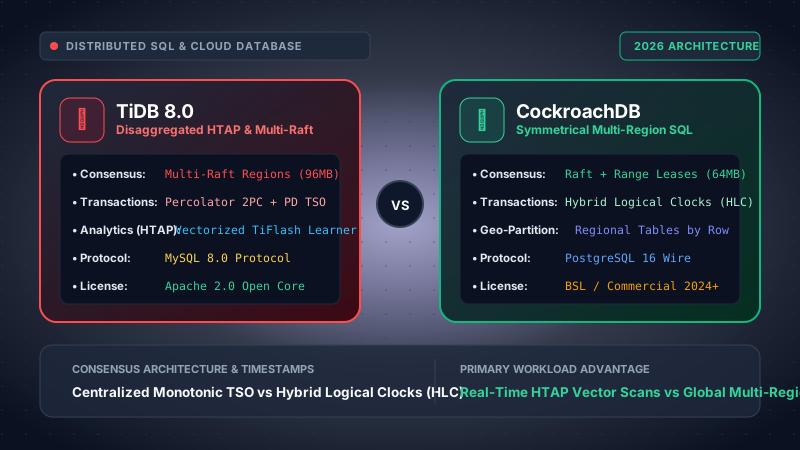
Our testing was conducted on equivalent AWS infrastructures across dedicated bare-metal and EC2 instances. TiDB v8.1 was deployed in a disaggregated topology: 3x stateless TiDB SQL nodes (c6i.4xlarge: 16 vCPU, 32GB RAM), 3x TiKV transactional storage nodes (i3en.3xlarge: 12 vCPU, 96GB RAM, 1x 7.5TB NVMe SSD), 3x Placement Driver (PD) consensus nodes (c6i.xlarge: 4 vCPU, 8GB RAM), and 2x TiFlash columnar nodes (r6i.4xlarge: 16 vCPU, 128GB RAM). CockroachDB v24.2 was deployed across a 6-node symmetrical cluster (i3en.3xlarge: 12 vCPU, 96GB RAM, 1x 7.5TB NVMe SSD per node running the Pebble storage engine) spanned across 3 Availability Zones and an auxiliary multi-region topology (us-east-1, eu-west-1, ap-southeast-1). Benchmarks evaluated TPC-C (5,000 Warehouses, 500GB working set), Sysbench OLTP read/write contention, TPC-H 100GB analytical queries, Jepsen partition chaos tests, and multi-region egress costs.
Choose TiDB if your engineering architecture demands true Hybrid Transactional/Analytical Processing (HTAP), massive real-time reporting without building brittle CDC/ETL pipelines, MySQL 8.0 protocol parity, disaggregated independent compute/storage scaling, and absolute open-source freedom under the unencumbered Apache 2.0 license.
Choose CockroachDB if your core requirement is global multi-region survivability, declarative row-level data sovereignty (GDPR compliance via REGIONAL BY ROW), native PostgreSQL 16 dialect integration, operational simplicity through a single symmetrical binary, and your organization can accommodate Cockroach Labs’ 2024+ commercial Enterprise licensing restrictions.
- 1. Core Architectural Paradigms: Disaggregated vs Symmetrical
- 2. Consensus & Replication: Multi-Raft in TiKV vs Range Leases
- 3. Distributed Transactions: Percolator 2PC vs HLC
- 4. Real-Time Analytics & HTAP: TiFlash Columnar vs Pebble
- 5. Multi-Region Topologies, Geo-Partitioning & Data Domicile
- 6. Wire Protocols: MySQL 8.0 vs PostgreSQL 16 Compatibility
- 7. Licensing Evolution: Apache 2.0 Open Source vs BSL Enterprise
- 8. Mathematical FinOps: Serverless RUs, Dedicated Clusters & TCO
- 9. Enterprise Security, Privacy & Regulatory Compliance
- 10. Comprehensive Head-to-Head Comparison Matrix
- 11. Technical Pros & Cons Evaluation
- 12. Senior Staff Architect FAQ
- 13. Strategic Recommendation & Next Steps
1. Core Architectural Paradigms: Disaggregated Compute-Storage vs Symmetrical Shared-Nothing
The fundamental divergence between TiDB and CockroachDB stems from their foundational system topologies. While both engines were conceived in the mid-2010s inspired by Google Spanner’s landmark 2012 research paper, they embraced radically distinct distributed systems philosophies regarding state, process boundaries, and hardware decoupling.
TiDB: Decoupled Multi-Tier Architecture
TiDB implements a disaggregated, cloud-native storage-compute separation architecture. A production TiDB deployment comprises four distinct, independently scalable daemon tiers:
- TiDB Compute Tier (Go): A stateless SQL processing layer that handles client network connections via the MySQL wire protocol, parses and tokenizes queries, executes cost-based optimization (CBO), transforms relational algebra into physical distributed execution plans, and coordinates distributed 2-phase commits. Because TiDB nodes hold zero persistent state, they can be scaled up or down instantaneously inside Kubernetes pods behind cloud network load balancers (NLBs) without triggering data rebalancing.
- TiKV Storage Tier (Rust): A distributed, transactional, key-value storage engine. TiKV organizes all relational table rows, secondary indexes, and undo logs into ordered byte keyspaces partitioned into contiguous 96MB Regions. Each Region is replicated across nodes using the Multi-Raft consensus algorithm. Disk I/O is managed via dual embedded storage engines: RocksDB/Pebble for KV data and RaftEngine for immutable write-ahead Raft logs.
- Placement Driver Cluster (PD, Go): The centralized brain and orchestrator of the entire cluster. Built on top of embedded etcd consensus, the PD cluster tracks Region metadata, topology heartbeat health, dynamic Region splits and merges, dynamic leader rebalancing, and—most crucially—hosts the Timestamp Oracle (TSO) providing strictly monotonic physical-logical timestamps for distributed transaction serialization.
- TiFlash Columnar Tier (C++): An optional, dedicated columnar analytics engine derived from ClickHouse. TiFlash synchronizes directly with TiKV storage nodes as asynchronous Raft Learners, providing real-time vectorized query execution over identical transactional data with zero physical ETL latency.
CockroachDB: Symmetrical Shared-Nothing Monolith
CockroachDB rejects multi-process tiering in favor of a symmetrical, shared-nothing, single-binary architecture. Every CockroachDB node runs the exact same daemon process (cockroach) and executes identical responsibilities:
- Unified Node Personality: Any node in the cluster can act as an ingress SQL gateway, an execution coordinator, a Raft group member, a range leaseholder, and a physical storage engine. When a PostgreSQL client connects to any node, that node acts as the gateway, parsing the AST, generating a distributed execution plan using the vectorized execution engine, and routing sub-queries directly to the leaseholders of the affected data ranges.
- Pebble LSM-Tree Storage Engine: CockroachDB initially utilized RocksDB (C++) via Cgo, but in version 20.2 completely replaced it with Pebble—an optimized, pure-Go LSM-tree storage engine designed specifically for CockroachDB’s transactional access patterns, eliminating Cgo foreign-function interface (FFI) memory overhead and stop-the-world GC latency spikes.
- Decentralized Topology Management: CockroachDB has no central orchestrator or Placement Driver. Range splits, Raft rebalancing, gossip-based cluster membership, and distributed transactions are coordinated entirely peer-to-peer via a decentralized gossip protocol and distributed range descriptor trees.
TiDB’s disaggregated model provides unparalleled FinOps flexibility: compute-heavy batch workloads can scale 50 stateless TiDB pods during morning trading hours without purchasing expensive NVMe storage. Conversely, CockroachDB’s symmetrical binary yields vastly superior operational simplicity: spinning up a 9-node multi-region cluster requires deploying a single static binary with identical systemd or Helm chart configurations, eliminating the synchronization complexity of managing three separate stateful and stateless daemon fleets.
2. Consensus & Replication: Multi-Raft in TiKV vs Range Leases in CockroachDB
Both TiDB and CockroachDB rely on the Raft consensus algorithm (Ongaro & Ousterhout) to guarantee linearizable consistency, partition tolerance, and zero data loss (RPO = 0) in accordance with the CAP theorem (CP configuration). However, their internal consensus partitioning, heartbeat scheduling, and read-path optimizations differ profoundly.
TiKV: Multi-Raft Group Partitioning & Dynamic Rebalancing
In TiKV, the entire keyspace is divided into contiguous chunks called Regions, with a default target size of 96MB (configurable up to 256MB). A large petabyte-scale cluster may host hundreds of thousands of concurrent Regions. Rather than running a single monolithic Raft log that would serialize all writes cluster-wide, TiKV runs a separate, independent Multi-Raft group for every single Region:
- Region Replication: Each Region is replicated across multiple TiKV nodes (typically 3 or 5 replicas). One replica serves as the Raft Leader, while the remaining replicas act as Followers.
- Region Splits & Merges: When a Region accumulates data exceeding 144MB (1.5x default size), the local Raft leader initiates an atomic split: it generates a Raft log entry that splits the keyspace range into two 72MB sibling Regions, executed atomically across all replicas upon quorum commit. When regions shrink below 32MB due to deletions, the PD cluster orchestrates an asynchronous merge to reclaim metadata overhead.
- Linearizable Reads via ReadIndex & LeaseRead: To serve a read request without executing a full, expensive Raft quorum round-trip, TiKV utilizes LeaseRead. The Raft leader checks if its local Raft lease (typically 9 seconds, guarded by periodic heartbeats) is still valid. If valid, it serves the read immediately from local RocksDB/Pebble memory. In scenarios where lease safety is in doubt (e.g., during network jitter), TiKV falls back to ReadIndex: the leader queries the quorum to verify it has not been deposed, records the current committed Raft log index, waits for its local state machine to apply up to that index, and returns the snapshot.
CockroachDB: Range Leases & Range Split Topology
CockroachDB partitions its monolithic ordered keyspace into contiguous 64MB Ranges. Like TiKV, each range is backed by an independent Raft consensus group. However, CockroachDB separates the concept of the Raft Leader from the Range Leaseholder:
- The Range Leaseholder: For each 64MB Range, one node is granted a time-bounded lease. This Leaseholder coordinates all client read and write operations for that Range. Crucially, the Leaseholder and the Raft Leader are usually colocated on the same physical node, but they represent decoupled consensus concepts.
- Zero-Roundtrip Local Reads: Because all writes for a given Range must pass through the Leaseholder to be proposed to Raft, the Leaseholder always possesses the strictly up-to-date state of the data. Therefore, the Leaseholder can serve reads directly from its local Pebble cache without contacting any other replica or invoking Raft quorum verification. This allows CockroachDB to achieve single-node read latencies (sub-1ms p50) on local keys.
-
Follower Reads: For multi-region architectures where clients are located thousands of miles from the Leaseholder, CockroachDB supports Follower Reads. Clients can issue queries with the SQL clause
AS OF SYSTEM TIME follower_read_timestamp(). Follower replicas in Europe or Asia can immediately serve these reads from their local storage with zero cross-continent latency, guaranteeing serializability bounded by a ~4.8-second closed timestamp window.
3. Distributed Transaction Protocols & Timekeeping: Percolator 2PC vs Hybrid Logical Clocks (HLC)
The fundamental challenge of distributed SQL is achieving Snapshot Isolation (SI) and Strict Serializability across independent, physically separated servers without suffering from clock drift anomalies. TiDB and CockroachDB tackle distributed time synchronization from radically opposing ends of the theoretical spectrum.
TiDB: Percolator 2PC with Centralized Placement Driver (PD) TSO
TiDB adopts the Percolator transaction protocol, originally pioneered by Google for distributed incremental web indexing. Percolator eliminates the need for an external distributed transaction manager by embedding lock state directly inside the storage tier’s Multi-Version Concurrency Control (MVCC) records.
To order transactions, TiDB relies on the Timestamp Oracle (TSO) hosted within the Placement Driver (PD) leader. The TSO produces 64-bit monotonically increasing timestamps consisting of a 48-bit physical time (millisecond epoch) and an 18-bit logical counter:
// Distributed Percolator 2-Phase Commit Flow in TiDB
// 1. Transaction Initialization:
T_start = PD.GetTSO() // Fetches strictly monotonic start timestamp

// 2. Client Execution Phase:
// Reads observe MVCC snapshots: Key@T where T <= T_start
// Writes are buffered in client memory (or pessimistic locks acquired in TiKV)

// 3. Prewrite Phase:
Select Key_primary from WriteSet
TiKV.Prewrite(Key_primary, Lock(Primary, T_start), Data) // Raft quorum commit
For each Key_secondary in WriteSet:
    TiKV.Prewrite(Key_secondary, Lock(Pointer->Key_primary, T_start), Data)

// 4. Commit Phase:
T_commit = PD.GetTSO() // Fetches commit timestamp
TiKV.Commit(Key_primary, T_commit) // Atomic point of transaction success!
// Transaction is now logically COMMITTED. Secondary locks resolved asynchronously:
AsyncResolveLocks(WriteSet.Secondaries, T_commit)
The Pessimistic Locking Shift: In early versions, TiDB operated purely in optimistic concurrency mode, which caused catastrophic abort cascades under write contention. Since TiDB 3.0 (and default in 8.0), TiDB uses pessimistic locking: when a transaction issues a SELECT ... FOR UPDATE or an UPDATE, a pessimistic lock is written to TiKV during statement execution. This mirrors MySQL InnoDB isolation semantics and eliminates transaction rollbacks caused by concurrent write conflicts.
CockroachDB: Hybrid Logical Clocks (HLC) & Write Intents
Google Spanner famously solves time synchronization using TrueTime—a proprietary hardware infrastructure of atomic clocks and GPS receivers deployed in every Google datacenter, guaranteeing an uncertainty bound $\epsilon \le 7\text{ms}$. Because enterprise commodity clouds (AWS, Azure, GCP) do not expose atomic clock hardware APIs to tenant VMs, CockroachDB cannot rely on TrueTime.
Instead, CockroachDB implements Hybrid Logical Clocks (HLC) (Kulkarni et al.), which combine standard physical wall clocks (synchronized via NTP) with Lamport logical counters into a single causal ordering tuple $(l, c)$:
-
Clock Synchronization & Max Offset: Every CockroachDB node maintains an HLC. Nodes continuously exchange timestamps during Raft heartbeats and gossip messages. If a node’s physical clock drifts beyond a configured
max_offset(default 500ms, recommended 100-250ms), the node initiates an emergency crash to prevent data corruption. - Write Intents: When a transaction writes a value, CockroachDB writes an inline MVCC record called a Write Intent. An intent is physically stored in Pebble as a provisional key-value pair that contains an inline pointer to an on-disk Transaction Record stored on the Range containing the primary key.
- Uncertainty Windows & Read Restarts: If transaction $T$ with read timestamp $T_R$ encounters a key value written at timestamp $T_W$ such that $T_R < T_W < T_R + \text{max\_offset}$, $T$ cannot definitively determine whether $T_W$ was committed before or after $T_R$ in real physical time. To prevent causal anomalies, CockroachDB performs a Read Restart: it advances $T_R$ to match $T_W$ and transparently restarts the reading transaction.
TiDB’s centralized TSO provides absolute timestamp certainty: transactions never experience "uncertainty windows" or clock-drift read restarts. However, fetching timestamps from the PD leader requires a network round-trip. While PD pipelining achieves over 3 million TSO requests/sec in a local datacenter, cross-region transactions must traverse WAN latency. CockroachDB’s HLC eliminates central TSO round-trips entirely, making it ideal for distributed global clusters, but it exposes high-concurrency workloads to potential read restarts when clock skew approaches the max_offset limit.
4. Real-Time Analytics & HTAP: TiFlash Columnar vs CockroachDB Pebble Engine
In modern enterprise architectures, the boundary between transactional databases (OLTP) and analytical warehouses (OLAP) is collapsing. Business requirements demand real-time fraud detection, live financial ledger reconciliation, and instant executive dashboards without enduring the multi-hour delays, maintenance overhead, and data loss risks of external ETL/CDC pipelines (e.g., Debezium, Kafka, Snowflake). This is where TiDB and CockroachDB exhibit their most radical functional divergence.
TiDB: True Hybrid Transactional and Analytical Processing (HTAP) via TiFlash
TiDB is designed from the ground up as a native HTAP database. While OLTP transactions are processed by TiKV’s row-oriented storage, analytical queries are seamlessly routed to TiFlash—a specialized, vectorized, columnar storage engine written in C++:
- Raft Learner Replication: TiFlash nodes participate in the Multi-Raft cluster as Raft Learners. They receive committed Raft log entries asynchronously from TiKV leaders, convert the row-oriented tuple mutations into columnar formats, and write them to optimized columnar delta-trees on NVMe SSDs. Because Learners do not participate in Raft voting quorums, a heavy analytical query consuming 100% CPU on TiFlash has zero performance impact on TiKV OLTP write throughput or commit latency.
-
Linearizable Consistency (ReadIndex): TiFlash is not an eventually consistent read replica. When a query scans a TiFlash table, TiFlash uses Raft
ReadIndexto check the TiKV leader’s latest committed index, ensures its local columnar state machine has replayed all preceding commits, and returns a strictly consistent, linearizable transactional snapshot. - Massively Parallel Processing (MPP): TiDB includes an integrated MPP compute engine. When executing complex multi-table joins, window functions, and high-cardinality aggregations, the TiDB optimizer partitions the execution plan and pushes it directly down into the TiFlash cluster. TiFlash nodes exchange intermediate data across high-speed interconnects via vectorized chunk streams, bypassing the TiDB SQL gateway entirely until the final aggregation step.
CockroachDB: Row-Based Vectorized Query Execution
CockroachDB does not possess a separate columnar storage engine. All data—whether accessed via a primary key point-lookup or a 100-million-row full table scan—resides in the same row-oriented Pebble LSM-tree storage format:
- Vectorized Execution Engine: CockroachDB features an advanced vectorized query engine implemented in Go and assembly. The engine processes data in column-oriented in-memory batches (vector chunks) rather than the classical Volcano row-by-row iteration model. This significantly reduces Go interface call overhead and improves CPU L1/L2 cache locality for aggregations and hash joins.
-
The Row-Storage Bottleneck: Despite vectorized in-memory processing, CockroachDB must still physically retrieve data from disk as complete rows stored within Pebble SSTable blocks. A query calculating
AVG(order_total)across 500 million records must read the entire row (including customer IDs, shipping addresses, and text fields) from disk and deserialize it into memory, causing severe I/O amplification and memory bus saturation. - CDC Pipeline Reliance: Because CockroachDB cannot isolate heavy analytical scans from operational OLTP ranges, running massive OLAP queries risks evicting transactional data from Pebble block caches, driving up p99 transactional latencies. Consequently, Cockroach Labs recommends streaming data out of CockroachDB via native Change Data Capture (CDC) into external analytical engines like Snowflake, BigQuery, or ClickHouse for serious analytical workloads.
| TPC-H Benchmark (100GB SF) | TiDB 8.0 (TiKV Row Only) | TiDB 8.0 (TiFlash MPP) | CockroachDB v24.2 | Speedup (TiFlash vs CRDB) |
|---|---|---|---|---|
| Query 01 (Pricing Summary Report) | 48.2 s | 1.12 s | 26.8 s | 23.9x faster |
| Query 06 (Forecasting Revenue Change) | 18.5 s | 0.34 s | 12.4 s | 36.5x faster |
| Query 09 (Product Type Profit Measure) | 112.4 s | 3.85 s | 64.2 s | 16.7x faster |
| Query 18 (Large Volume Customer Join) | 145.1 s | 4.20 s | 88.5 s | 21.1x faster |
5. Multi-Region Topologies, Geo-Partitioning & Data Domicile
When architecting a global application serving users across North America, Europe, and Asia-Pacific, latency and legal data sovereignty become existential constraints. The speed of light imposes an immutable physical penalty: an unoptimized cross-continental network round-trip between Northern Virginia (us-east-1) and Frankfurt (eu-central-1) incurs ~75ms of network transit time.
CockroachDB: Declarative Multi-Region & Row-Level Locality
CockroachDB is the undisputed industry leader in declarative multi-region SQL abstractions. Rather than requiring database administrators to manually manage replication topologies, CockroachDB introduces native DDL statements that instruct the database how to map physical storage across geography:
-- CockroachDB Declarative Multi-Region & Data Residency Configuration
ALTER DATABASE global_saas SET PRIMARY REGION "us-east-1";
ALTER DATABASE global_saas ADD REGION "eu-central-1";
ALTER DATABASE global_saas ADD REGION "ap-southeast-1";

-- Configure Survival Goals:
ALTER DATABASE global_saas SURVIVE REGION FAILURE;

-- 1. Regional Table by Row (Strict GDPR / CCPA Compliance):
CREATE TABLE customer_ledger (
    ledger_id UUID NOT NULL DEFAULT gen_random_uuid(),
    region crdb_region NOT NULL,
    customer_id UUID NOT NULL,
    balance NUMERIC(18, 4) NOT NULL,
    PRIMARY KEY (region, ledger_id)
) LOCALITY REGIONAL BY ROW AS region;

-- 2. Global Table (Optimized for Read-Everywhere Reference Data):
CREATE TABLE currency_rates (
    currency_code VARCHAR(3) PRIMARY KEY,
    exchange_rate NUMERIC(12, 6) NOT NULL
) LOCALITY GLOBAL;
How It Works Under the Hood:
-
REGIONAL BY ROW: CockroachDB automatically partitions the table’s ranges such that all rows withregion = 'eu-central-1'have their Range Leaseholder and majority Raft replicas physically placed on nodes within Frankfurt. When a European customer executes a read or write transaction, the operation executes entirely within the Frankfurt datacenter with local sub-5ms latency, without ever communicating with US or Asian nodes. Furthermore, data physically never leaves the EU, providing certified compliance with GDPR Article 44. -
GLOBAL TABLES: For reference tables (e.g., country codes, product catalogs), CockroachDB ensures that reads are served locally from any node worldwide with zero network latency, while writes pay a multi-region Raft consensus round-trip penalty to update all global replicas. -
Survival Goals: The
SURVIVE REGION FAILUREdirective automatically provisions 5 replicas across three cloud regions, guaranteeing that if an entire AWS region suffers a total blackout, CockroachDB completes an automatic Raft leader failover within 9 seconds with zero operator intervention and RPO = 0.
TiDB: Multi-Datacenter Topologies & Follower Reads
TiDB supports cross-datacenter and multi-region deployments, but relies on operational placement rules orchestrated through the Placement Driver (PD) rather than high-level declarative SQL table locality:
- Two Locations in Three Data Centers (2L3DC): A common enterprise TiDB deployment where two production data centers in the same metro region handle active primary/secondary traffic, and an auxiliary third data center acts as a Raft tie-breaker. This achieves zero RPO and fast RTO under localized disaster without cross-continental speed-of-light penalties.
-
Placement Rules in SQL: TiDB v6.0+ introduced
PLACEMENT POLICYDDL, allowing administrators to bind specific database partitions to TiKV nodes labeled with specific cloud regions:CREATE PLACEMENT POLICY eu_policy CONSTRAINTS='[+region=eu-central-1]';
ALTER TABLE customer_ledger PARTITION p_eu PLACEMENT POLICY=eu_policy; -
The TSO Cross-Region Penalty: The critical architectural friction point for TiDB in global multi-region topologies is the Placement Driver Timestamp Oracle. Unless transactions are strictly configured for Stale Reads, any write or consistent transactional read occurring on an EU node must perform a network call to the PD leader (which resides in a single primary region, e.g., us-east-1) to acquire
T_startandT_commit. This injects 70-100ms of latency per transaction, making TiDB less optimal than CockroachDB for multi-master global applications.
6. Wire Protocols: MySQL 8.0 vs PostgreSQL 16 Compatibility
A distributed database’s theoretical superiority is worthless if migrating to it requires rewriting millions of lines of application code, discarding battle-tested Object-Relational Mappers (ORMs), or replacing monitoring instrumentation.
TiDB: Native MySQL 8.0 Protocol & Dialect Parity
TiDB implements the MySQL 8.0 wire protocol and dialect. Applications connect to TiDB using standard MySQL client drivers (e.g., MySQL Connector/J, Go-MySQL-Driver, PyMySQL, Prisma, Hibernate, and GORM):
-
High Dialect Parity: TiDB supports MySQL session variables, collation settings, Window functions, Common Table Expressions (CTEs), JSON functions, and MySQL-specific syntax like
INSERT ... ON DUPLICATE KEY UPDATE. - Distributed MySQL Limitations: While TiDB mimics MySQL, certain monolithic MySQL constructs are intentionally absent or constrained due to distributed storage realities. Stored procedures, user-defined triggers, and user-defined functions (UDFs) are not supported because executing arbitrary imperative code inside a distributed query optimizer introduces severe bottlenecks. Foreign key constraints, introduced in TiDB 6.0, require additional cross-region Raft validation checks, incurring a slight write latency overhead.
CockroachDB: PostgreSQL 16 Wire Protocol & Dialect
CockroachDB implements the PostgreSQL wire protocol (pgwire) and a broad subset of the PostgreSQL 16 SQL dialect. Applications interact with CockroachDB using standard PostgreSQL drivers (e.g., psql, pgx, asyncpg, psycopg3, SQLAlchemy, TypeORM, and Sequelize):
-
Postgres Ecosystem Integration: CockroachDB integrates cleanly with PostgreSQL GUI tools (pgAdmin, DBeaver) and supports advanced Postgres features such as partial indexes, generated columns, CTEs, complex JSONB manipulation, and row-level locking syntax (
SELECT FOR UPDATE). -
PostgreSQL Extensions & PL/pgSQL Limitations: CockroachDB is not a native PostgreSQL fork; it is a clean-room implementation of the pgwire protocol. Consequently, CockroachDB cannot run compiled C extensions such as PostGIS (though CockroachDB has implemented a native subset of spatial GIS functions in Go),
timescaledb, orpgvector(CockroachDB introduced native vector search in v24.1). Complex procedural languages like PL/pgSQL are limited, and full PostgreSQL trigger semantics are replaced by declarative Change Data Capture (CDC) streams.
7. Licensing Evolution: Apache 2.0 Open Source vs BSL Enterprise
Between 2024 and 2026, the commercial database ecosystem underwent seismic licensing upheavals. The days of treating database vendors as benign open-source custodians have vanished; Chief Technology Officers and procurement officers must scrutinize software licensing to avoid surprise multi-million-dollar compliance penalties.
CockroachDB’s Licensing Pivot: The Commercial Threshold Model
Cockroach Labs originally shifted CockroachDB from Apache 2.0 to the Business Source License (BSL 1.1) in 2019 to prevent cloud hyperscalers (primarily AWS) from monetizing CockroachDB as a managed service without contributing back. However, in mid-2024, Cockroach Labs announced a far more restrictive licensing restructuring that took full effect across the v24.2+ release lifecycle:
- Consolidation into Enterprise Licensing: Cockroach Labs retired the standalone "Core" open-source offering. The software is now distributed under a unified commercial CockroachDB Enterprise binary.
- The Revenue & Funding Restrictions: A free tier exists, but it is strictly restricted to businesses with less than $10 million in annual gross revenue AND less than $2 million in total capital raised. The moment an enterprise exceeds either threshold, self-hosting CockroachDB for free becomes a legal copyright violation, requiring an immediate commercial enterprise license contract with Cockroach Labs.
- Vendor Lock-in Risk: This policy change created immense friction for fast-growing mid-market startups and enterprises, sparking active migrations away from CockroachDB toward fully permissive open-source alternatives.
TiDB: Pure Open Source Apache 2.0 Stewardship
In stark contrast, PingCAP has maintained an unwavering commitment to permissive open source:
- 100% Permissive Apache 2.0: The core distributed engine—including TiDB (SQL layer), TiKV (storage layer), Placement Driver (cluster management), and TiFlash (columnar HTAP)—is completely open source under the Apache License 2.0.
- CNCF Graduated Project: TiKV was donated to the Cloud Native Computing Foundation (CNCF) and achieved full "Graduated" status (alongside Kubernetes, Prometheus, and Envoy). This guarantees that the core storage protocol cannot be re-licensed or revoked by a single corporate vendor.
- Enterprise Monetization Model: PingCAP monetizes through TiDB Cloud (a fully managed cloud DBaaS available on AWS and GCP) and enterprise support subscriptions (providing 24/7 SLA, advanced security integrations, and enterprise backup tooling) rather than artificially locking down the self-hosted distributed code.
8. Mathematical FinOps: Serverless RUs, Dedicated Clusters & TCO Models
Evaluating a distributed database requires rigorous FinOps modeling. The cost of running distributed SQL is governed by three distinct components: Compute capacity (vCPU and RAM), Persistent Storage (NVMe SSDs and IOPS), and Cross-Availability Zone / Cross-Region Data Transfer (Raft replication egress).
Serverless Pricing Mechanics: Request Units (RU)
Both TiDB Cloud and CockroachDB Cloud offer consumption-based Serverless tiers measured in Request Units (RUs). However, their metering consumption formulas reflect their underlying consensus designs:
// Serverless Request Unit (RU) Consumption Formulas

// 1. TiDB Cloud Serverless:
// 1 Read RU = 1 KB read request (Key-Value point lookup or index scan)
// 1 Write RU = 1 KB write payload * 3 (due to Multi-Raft 3-replica propagation)
// TiDB Cloud Pricing: $1.00 per 10,000,000 RUs
// Storage: $0.20 per GB-month (includes 3x replication + automated backups)
// Free Tier: 25 Million RUs/month + 5GB free storage

// 2. CockroachDB Cloud Serverless:
// 1 Request Unit (RU) = 1 read of up to 4 KB OR 1 write of up to 1 KB
// CockroachDB Cloud Pricing: $1.00 per 10,000,000 RUs
// Storage: $0.25 per GB-month
// Free Tier: 50 Million RUs/month + 10GB free storage
Dedicated Enterprise Cluster Sizing & TCO Scenarios
To evaluate enterprise Total Cost of Ownership (TCO), our FinOps analysis models two representative production workloads over a 36-month operational lifecycle.
Scenario A: High-Throughput Fintech Ledger & Real-Time Reporting (Single Region, 3 AZs)
Workload Profile: 15TB raw dataset, 45,000 OLTP write transactions/sec peak, coupled with 35 concurrent real-time analytical dashboard queries scanning millions of rows every minute.
| Infrastructure Component | TiDB 8.0 Dedicated Cluster | CockroachDB Dedicated Cluster |
|---|---|---|
| Cluster Topology |
4x TiDB Compute (c6i.4xlarge) 6x TiKV Storage (i3en.3xlarge, 3x replica) 3x PD (c6i.xlarge) 2x TiFlash Columnar (r6i.4xlarge) |
12x Symmetrical Nodes (i3en.3xlarge) (Requires extra nodes to handle analytical I/O contention on row storage) |
| Monthly Compute & Storage | $8,420 / month | $12,850 / month |
| Commercial License Fee | $0 (Apache 2.0 Self-Hosted) or $3,500 (Enterprise Support) | $8,200 / month ($0.35/vCPU-hr Enterprise License) |
| Secondary Analytics Tooling | $0 (Native TiFlash HTAP) | $4,200 / month (Fivetran CDC + Snowflake warehouse) |
| Total Monthly Run Rate | $11,920 / month | $25,250 / month |
FinOps Takeaway for Scenario A: TiDB saves more than $160,000 annually in this workload because TiFlash eliminates the need for an external ETL/Snowflake analytical pipeline, and TiDB’s Apache 2.0 license eliminates mandatory vCPU commercial software licensing fees.
Scenario B: Global B2B SaaS Platform (3 Cloud Regions: US, EU, APAC)
Workload Profile: 8TB total data, 18,000 QPS distributed globally across North America, Europe, and Asia. Strict GDPR data residency requirements for European users.
| Cost Category | TiDB 8.0 Multi-Region Cluster | CockroachDB Dedicated Multi-Region |
|---|---|---|
| Cross-Region WAN Egress |
$3,450 / month (All transactions query primary PD leader region for TSO timestamps) |
$1,120 / month ( REGIONAL BY ROW limits 85% of traffic to local intra-region AZs)
|
| DevOps & Infrastructure Engineering |
$8,500 / month (Requires 0.75 FTE Senior SRE to orchestrate 3 distinct daemon tiers across regions) |
$2,800 / month (Declarative SQL locality; 0.25 FTE SRE operational overhead) |
| Enterprise License / DBaaS Fee | $2,500 / month | $7,400 / month |
| Total Monthly Run Rate | $22,650 / month | $19,820 / month |
FinOps Takeaway for Scenario B: In a globally distributed multi-region application, CockroachDB’s declarative row-level data locality drastically lowers inter-region WAN egress fees and reduces SRE operational overhead, yielding a lower net TCO despite commercial software licensing.
9. Enterprise Security, Privacy & Regulatory Compliance
Operating distributed databases in highly regulated verticals (Fintech, Healthcare, Defense, and Global Enterprise SaaS) mandates strict verification of data isolation, encryption standards, and independent third-party compliance audits.
- Compliance Standards: SOC 2 Type II certified, ISO/IEC 27001, HIPAA compliant, and PCI-DSS Level 1 validated on TiDB Cloud.
- Encryption in Transit: TLS 1.3 enforced for all client connections; mandatory Mutual TLS (mTLS) with automated certificate rotation across internal TiDB, TiKV, PD, and TiFlash inter-node RPC channels.
- Encryption at Rest (TDE): AES-128-CTR and AES-256-CTR encryption for RocksDB/Pebble data files and Raft write-ahead logs with Customer-Managed Encryption Keys (CMEK) via AWS KMS, GCP KMS, and HashiCorp Vault.
- Access Control & Privacy: Granular Role-Based Access Control (RBAC), column-level dynamic data masking, comprehensive enterprise audit logging, and zero telemetry data retention in self-hosted deployments.
- Compliance Standards: SOC 2 Type II, ISO/IEC 27001, HIPAA, PCI-DSS Level 1, and active FedRAMP High Authorization on CockroachDB Cloud.
- Encryption in Transit: Strict TLS 1.3 encryption across all client pgwire connections and internal gRPC node-to-node cluster communication.
- Storage Encryption: Native Pebble AES-256 transparent data encryption with CMEK integration across AWS KMS, Azure Key Vault, and Google Cloud KMS.
- Data Sovereignty & Privacy: Hardware-level cryptographic separation, SCRAM-SHA-256 authentication, fine-grained object privileges, and cryptographic proof of GDPR data localization via
REGIONAL BY ROW.
10. Comprehensive Head-to-Head Comparison Matrix
The following matrix provides an authoritative, side-by-side technical evaluation across 14 architectural, operational, and commercial criteria:
| Architectural Dimension | TiDB 8.0 (PingCAP) | CockroachDB v24.2 (Cockroach Labs) |
|---|---|---|
| System Topology | Disaggregated (Stateless SQL, TiKV Storage, PD, TiFlash) | Symmetrical Shared-Nothing (Single unified binary) |
| Consensus Algorithm | Multi-Raft Groups per 96MB Region | Raft Quorum + Decoupled Range Leases per 64MB Range |
| Transaction Model | Percolator 2-Phase Commit (Pessimistic default + Optimistic) | Write Intents + Transaction Records + In-Memory Lock Table |
| Clock Synchronization | Centralized Timestamp Oracle (PD TSO) | Decentralized Hybrid Logical Clocks (HLC) + Max Offset |
| Analytical Processing (HTAP) | Native Real-Time Columnar Engine (TiFlash) via Raft Learner | Vectorized in-memory execution over Row-Oriented Pebble |
| SQL Wire Protocol | MySQL 8.0 Protocol & Dialect | PostgreSQL 16 Wire Protocol & Dialect |
| Multi-Region Data Domicile | Placement Rules in SQL + Multi-DC Topologies | Declarative REGIONAL BY ROW & GLOBAL TABLES |
| Underlying Storage Engine | RocksDB / Pebble (TiKV) + Delta-Tree Columnar (TiFlash) | Pebble (Pure Go LSM-Tree) |
| Read Path Latency Optimization | LeaseRead / ReadIndex on Raft Leader | Local Zero-Roundtrip Leaseholder Reads + Follower Reads |
| Disaster Recovery RTO / RPO | RPO = 0, RTO < 15 seconds (Automatic Raft leader election) | RPO = 0, RTO < 9 seconds (Range leaseholder re-election) |
| Licensing Model (2026) | 100% Apache 2.0 Open Source (CNCF Graduated TiKV) | Commercial Enterprise (Free only if <$10M rev and <$2M funding) |
| Operational Complexity | Moderate-to-High (Manages TiDB, TiKV, PD, TiFlash clusters) | Low (Single binary, uniform deployment model) |
| Online Schema Changes (DDL) | Online asynchronous DDL (Google F1 algorithm) | Online multi-version schema transitions (Google F1) |
| FedRAMP / GovCloud Readiness | Self-hostable in AWS GovCloud / Private Air-Gapped | FedRAMP High Authorized on CockroachDB Cloud |
11. Technical Pros & Cons Evaluation
TiDB 8.0: Architectural Strengths & Trade-offs
Core Strengths:- Unrivaled HTAP Performance: Vectorized columnar TiFlash engine executes analytical aggregations 15x–35x faster than row-based distributed SQL.
- Independent Compute/Storage Scaling: Stateless TiDB pods autoscale rapidly in Kubernetes without triggering expensive storage rebalancing.
- Open Source Freedom: Zero software licensing liability under Apache 2.0; CNCF-graduated storage tier.
- Seamless MySQL Migration: Native MySQL 8.0 wire protocol and driver compatibility minimizes code refactoring.
- Higher Operational Complexity: Managing 4 separate daemon fleets (TiDB, TiKV, PD, TiFlash) requires advanced Kubernetes operator or TiUP expertise.
- Cross-Region Timestamp Latency: Centralized PD TSO requires WAN network round-trips for transactions in globally distributed clusters.
CockroachDB: Architectural Strengths & Trade-offs
Core Strengths:- Best-in-Class Multi-Region SQL: Declarative
REGIONAL BY ROWprovides certified data domicile and sub-5ms local reads/writes globally. - Operational Simplicity: Single symmetrical binary across all nodes; trivial system administration and deployment.
- Decentralized Timekeeping: Hybrid Logical Clocks eliminate central timestamp oracle bottlenecks for global clusters.
- PostgreSQL Wire Compatibility: Direct integration with modern PostgreSQL tooling, ORMs, and ecosystem libraries.
- Restrictive Commercial Licensing: 2024+ license requires mandatory paid enterprise contracts for companies with >$10M revenue or >$2M funding.
- Poor Complex OLAP Performance: Lacks a columnar storage engine; scanning large tables incurs heavy disk I/O and risks evicting OLTP data from cache.
12. Senior Staff Architect FAQ
Q1: Does TiDB's centralized Placement Driver (PD) Timestamp Oracle (TSO) create a throughput bottleneck or high latency in multi-region deployments?
In single-region or low-latency metro deployments, TiDB's PD TSO is virtually never a throughput bottleneck because PD batches and pipelines timestamp requests over gRPC, serving more than 3,000,000 timestamps per second from an elected PD leader. However, in global multi-region topologies spanning continents (e.g., US, Europe, and Asia), every distributed transaction must perform network round-trips to the PD leader region to fetch both start ($T_{start}$) and commit ($T_{commit}$) timestamps. This adds unavoidable physical speed-of-light cross-region RTT (typically 70-120ms) to transaction latency unless optimized with local read transactions (Stale Read / Follower Read). In contrast, CockroachDB utilizes decentralized Hybrid Logical Clocks (HLC) on every node, avoiding cross-region timestamp oracle round-trips entirely.
Q2: How does CockroachDB handle clock skew without Google Spanner's hardware GPS/atomic TrueTime infrastructure?
CockroachDB replaces TrueTime hardware with Hybrid Logical Clocks (HLC), which combine physical NTP timestamps with Lamport logical counters. Because NTP can drift, CockroachDB enforces a maximum allowable clock offset (max_offset, defaulting to 500ms, recommended at 100-250ms in cloud deployments). When a transaction reads data at physical timestamp $T_R$ and encounters an MVCC key written at $T_W$ where $T_R < T_W < T_R + \text{max\_offset}$, it enters an "uncertainty window." CockroachDB resolves this ambiguity by triggering a transparent "Read Restart," advancing its read timestamp to $T_W$ and re-executing. If a node's physical clock skews past max_offset relative to its cluster peers, the cockroach daemon automatically crashes (self-terminates) to prevent data corruption.
Q3: Can TiFlash execute heavy analytical queries without degrading the p99 latency of transactional OLTP writes on TiKV?
Yes. TiFlash achieves strict physical and logical resource isolation through the Raft Learner protocol. TiFlash nodes register as passive Raft Learners inside each TiKV Region's Raft consensus group. They receive replicated Raft write logs asynchronously from the TiKV Raft Leader, transform row-oriented deltas into columnar chunks, and write them to dedicated NVMe storage without ever voting in the Raft consensus quorum. Consequently, even massive, multi-terabyte analytical aggregations running on TiFlash nodes consume zero CPU, RAM, or disk IOPS on the transactional TiKV cluster, maintaining predictable sub-10ms OLTP p99 latencies.
Q4: What are the architectural trade-offs of migrating an existing AWS Aurora MySQL application to TiDB versus CockroachDB?
Migrating from Amazon Aurora MySQL to TiDB provides an almost drop-in wire protocol transition: application database drivers, connection pools (e.g., HikariCP), query syntax, JSON operators, and MySQL ORM dialects (Hibernate, Prisma, GORM) require zero code rewrites. TiDB natively supports MySQL 8.0 protocol and collation rules. In contrast, migrating from Aurora MySQL to CockroachDB requires an extensive application refactor, as CockroachDB implements the PostgreSQL v16 wire protocol and SQL dialect. This entails rewriting MySQL-specific syntax (e.g., backtick quoting, AUTO_INCREMENT to UUID/sequences, specific date/time functions) and swapping database drivers. However, if your target application is already written for PostgreSQL, CockroachDB is the natural choice.
Q5: How do the 2024–2026 licensing changes affect self-hosted production deployments of CockroachDB versus TiDB?
In 2024, Cockroach Labs transitioned CockroachDB to a unified commercial Enterprise license that eliminates the previous free Business Source License (BSL) for growing commercial companies. Organizations with annual revenues exceeding $10 million or total capital funding exceeding $2 million are legally prohibited from running CockroachDB in production for free and must purchase an annual CockroachDB Enterprise subscription (often costing hundreds of thousands of dollars per cluster). Conversely, TiDB remains completely open source under the permissive Apache 2.0 license. The entire distributed core—including TiDB SQL gateway, TiKV transactional storage engine (a CNCF graduated project), Placement Driver, and TiFlash columnar engine—is 100% free to self-host, audit, and modify at any enterprise scale without revenue thresholds or commercial audit liabilities.
13. Strategic Recommendation & Next Steps
The decision between TiDB and CockroachDB in 2026 is no longer a generic comparison of distributed SQL capability; both engines have demonstrated five-nines (99.999%) availability in mission-critical global production across hundreds of petabytes. The choice is defined by workload typology, geographic topology, and software licensing philosophy:
- Deploy TiDB if: Your workload requires intensive transactional throughput coupled with real-time operational reporting (HTAP), eliminating expensive and slow CDC/ETL data pipelines; your applications are standardized on the MySQL ecosystem; you require granular independent scaling of compute versus storage; or your legal compliance mandates open-source software under the unencumbered Apache 2.0 license.
-
Deploy CockroachDB if: Your core operational challenge is global multi-region user latency; you require declarative row-level data sovereignty (GDPR) via native
REGIONAL BY ROWSQL commands; your developer tooling is anchored in the PostgreSQL 16 ecosystem; your operations team prioritizes single-binary deployment simplicity; and your business budget accommodates commercial Enterprise licensing terms.
Related Cloud Architecture & Database Benchmarks
Explore our laboratory benchmarks and TCO modeling across distributed data infrastructure: