Vanta vs Drata (2026): Automated Security & Compliance Platform Benchmark
Achieving SOC 2 Type II or ISO 27001 is no longer an annual, manual spreadsheet nightmare. In 2026, Vanta and Drata lead the automated Continuous Control Monitoring (CCM) market. Here is a rigorous, architect-level benchmark comparing API integrations, endpoint agents, auditor networks, automated evidence collection, and real-world TCO.
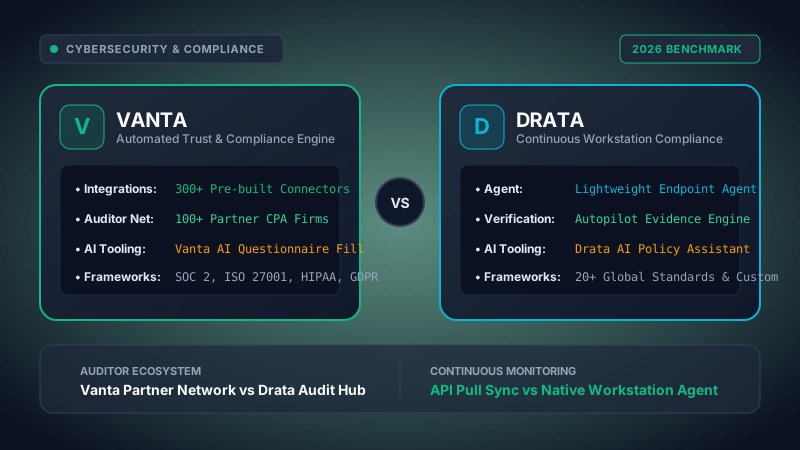
1. The Shift to Continuous Control Monitoring (CCM)
For over two decades, enterprise compliance was governed by "point-in-time" audits. Once a year, engineering and operations teams spent 60 to 90 days scrambling to take screenshots of AWS IAM policies, export Google Workspace user access tables, collect signed employee handbook acknowledgments, and assemble massive binders of static evidence. The day after the audit concluded, technical configurations drifted, leaving massive compliance and security blind spots.
Modern B2B enterprise sales have rendered point-in-time compliance obsolete. Enterprise security teams now demand real-time verification before approving vendor software. This shift has established Continuous Control Monitoring (CCM) as standard architecture. Rather than relying on static sampling, platforms like Vanta and Drata interface directly with your infrastructure (AWS, GCP, Azure), source code managers (GitHub, GitLab), identity providers (Okta, Google Workspace, Azure AD), HR systems (Rippling, Gusto, Deel), and hardware endpoints.
Key Standard Frameworks Covered in 2026
- SOC 2 (Type I & Type II): Trust Services Criteria covering Security, Availability, Processing Integrity, Confidentiality, and Privacy.
- ISO/IEC 27001:2022: Global standard for Information Security Management Systems (ISMS), restructured with updated annex controls for cloud services and threat intelligence.
- HIPAA Security Rule: Protection of electronic protected health information (ePHI).
- GDPR & CCPA / CPRA: Data privacy, subject access requests, and cross-border data transfer safeguards.
- PCI-DSS v4.0.1: Mandatory baseline for entities handling cardholder payment data, enforcing strict multi-factor authentication and continuous log monitoring.
2. Architecture & Evidence Collection: API Pull vs Workstation Agent
While both platforms pursue the same end result—an unassailable audit report—their underlying architectural philosophies exhibit notable differences, particularly in how they interface with endpoints and process evidence.
Vanta: The API-First Ecosystem with Optional Agent
Vanta, founded in 2018, pioneered modern automated compliance. Its architecture is built around an extensive, battle-tested library of over 300+ pre-built API integrations. When connecting a cloud provider like Amazon Web Services (AWS), Vanta provisions a cross-account IAM role with narrowly scoped read-only policies:
{
  "Version": "2012-10-17",
  "Statement": [
    {
      "Sid": "VantaSecurityAuditingPermissions",
      "Effect": "Allow",
      "Action": [
        "ec2:DescribeSecurityGroups",
        "ec2:DescribeVolumes",
        "iam:GetAccountPasswordPolicy",
        "iam:ListMFAdevices",
        "kms:ListKeys",
        "s3:GetBucketEncryption",
        "s3:GetBucketPublicAccessBlock"
      ],
      "Resource": "*"
    }
  ]
}
Vanta periodically polls these APIs, comparing real-time infrastructure state against predefined security tests. For workstation compliance (checking that all employee laptops have disk encryption enabled, auto-lock timeouts set to 5 minutes or less, and operating system updates applied), Vanta provides two paths:
- Direct MDM Integration: If your company already runs an enterprise Mobile Device Management platform (such as Kandji, Jamf Pro, Microsoft Intune, or JumpCloud), Vanta ingests hardware telemetry via API without requiring employees to install anything.
- Vanta Agent: For startups without an existing MDM, Vanta offers a lightweight background daemon (macOS, Windows, Linux) that securely reports hardware state without monitoring browser history or keystrokes.
Drata: Native Workstation Agent & Real-Time Autopilot
Drata entered the market in 2020 with an architecture emphasizing continuous automated validation and a core dependency on its Drata Agent. From day one, Drata built a native endpoint client designed to run silently in the system tray across developer and corporate workstations.
Drata's agent continuously validates local system configurations:
- Disk Encryption Verification: Confirms active FileVault on macOS or BitLocker on Windows.
- Password Manager Presence: Verifies that approved password managers (1Password, Bitwarden, Dashlane) are installed and running.
- Screen Lock Enforcement: Ensures inactivity lock triggers within compliant time thresholds.
- EDR/Antivirus Status: Detects SentinelOne, CrowdStrike, Defender, or native OS firewalls.
Drata pairs this with Drata Autopilot, an automated verification engine that actively tests and scores evidence before flagging it as auditor-ready. If an engineer disables disk encryption or deletes a required CloudTrail trail in AWS, Drata flags the failure in minutes, dispatching automated Slack alerts directly to the engineer with step-by-step remediation commands.
3. The Auditor Experience: Vanta Partner Network vs Drata Audit Hub
A critical reality that many founders overlook is that software does not issue audit certifications. By legal definition, SOC 2 reports can only be issued by an accredited independent CPA firm (certified by the AICPA), and ISO 27001 certificates must be awarded by an accredited certification body (such as ANAB or UKAS).
Therefore, the usability of the platform from the auditor's perspective is just as important as the engineer's interface. If an auditor finds a platform difficult to navigate, they will revert to manual document requests, destroying the speed advantage of automation.
Vanta Auditor Network
Auditor Ecosystem Breadth: Unrivaled. Because Vanta is the oldest dedicated platform, virtually every major tech-focused CPA firm in North America and Europe has trained auditors proficient in Vanta's portal.
- Auditor Marketplace: Over 100+ vetted partner CPA firms compete on price and timeline directly within Vanta.
- Auditor Direct Access: Auditors can log into a dedicated auditor view, review auto-collected test passes, and pull sampling data directly without asking the client.
- Standardized Workpapers: Evidence exports match traditional AICPA workpaper schemas, accelerating sign-off.
Drata Audit Hub
Auditor Interface & Workflow: Highly structured. Drata's dedicated "Audit Hub" provides a centralized workspace where company administrators and external auditors collaborate in real time.
- Granular Auditor Role: Restricts the auditor's view strictly to the controls and time windows within scope, preventing audit overreach.
- In-Context Communication: Auditors leave questions or request clarification directly inside specific control tickets, preventing lengthy email chains.
- Drata Alliance: Rapidly expanding network of certified audit partners who offer bundled discounts when auditing through Drata.
Both platforms support Bring Your Own Auditor (BYOA). If your enterprise already maintains an established relationship with a Big Four firm (PwC, EY, KPMG, Deloitte) or a specialized boutique (BARR Advisory, Johanson Group, Sensiba), both platforms grant your auditor full free access. However, firms experienced with Vanta or Drata often complete audits in 1 to 2 weeks, compared to 6 to 8 weeks for firms unfamiliar with automated evidence platforms.
4. AI Automation: Vanta AI vs Drata AI for Policy & Vendor Risk
In 2026, artificial intelligence has moved beyond a marketing buzzword into a core operational lever for compliance teams. The two most time-consuming operational tasks—answering external security questionnaires and assessing vendor security postures—are now heavily augmented by AI.
Vanta AI: Questionnaire Automation & Vendor Risk Reviews
Vanta has deployed several dedicated AI workflows:
- Vendor Risk Management (VRM) Auto-Analysis: When you onboard a new SaaS vendor (e.g., Datadog, Slack, OpenAI), Vanta AI automatically ingests the vendor's SOC 2 report, parses the auditor's opinion, flags any control exceptions, and scores the vendor's third-party risk profile without requiring an analyst to read 80 pages of dense audit documentation.
- Questionnaire Auto-Fill: Vanta AI indexes your company policies, system architecture, and SOC 2 controls. When enterprise prospects send lengthy 150-question Excel or web-based security questionnaires (SIG Lite, CAIQ, VSA), Vanta AI generates accurate, pre-cited answers with an estimated 85% first-pass accuracy.
- Automated Policy Generation: Generates customized Information Security Policies based on your actual tech stack configurations, avoiding generic templates that fail auditor scrutiny.
Drata AI: Natural Language Posture & Remediation Copilot
Drata's AI strategy focuses on continuous engineering remediation and natural language interaction:
- Remediation Copilot: When a cloud test fails (such as an unencrypted RDS read replica or missing MFA on an administrative account), Drata AI generates context-aware CLI commands or Terraform/Pulumi code snippets tailored specifically to your infrastructure.
- Natural Language Compliance Queries: Security leads can query their compliance posture using plain language, such as: "Which contractor endpoints haven't updated macOS in the last 14 days?" or "List all third-party vendors processing customer PII that lack a current SOC 2 report."
- Adaptive Policy Drafting: Continuously flags when your company's technical operations diverge from your written policies, prompting updates before an audit observation window closes.
5. Head-to-Head Technical Benchmark Matrix
The following benchmark evaluates both platforms across 14 technical and operational dimensions based on verified 2026 enterprise testing:
| Feature / Evaluation Criteria | Vanta | Drata | Technical Advantage |
|---|---|---|---|
| Pre-Built Cloud & SaaS Integrations | 300+ native connectors across cloud, dev, HR, and security tools | 200+ native connectors with strong core cloud coverage | Vanta (Deeper integration catalog) |
| Workstation Monitoring Philosophy | MDM API-first (Kandji, Jamf, Intune) + optional lightweight agent | Proprietary native agent required for deep continuous endpoint validation | Tie (Depends on MDM presence) |
| Supported Compliance Frameworks | 25+ frameworks (SOC 2, ISO 27001, HIPAA, GDPR, PCI-DSS, FedRAMP, AI frameworks) | 20+ frameworks (SOC 2, ISO 27001, HIPAA, GDPR, PCI-DSS, NIST CSF, ISO 42001) | Vanta (Slightly broader catalog) |
| AI-Powered Security Questionnaires | Vanta AI Questionnaire Autofill with direct source citation | Drata AI Questionnaire Assistant with historical learning | Vanta (Higher accuracy & speed) |
| Continuous Verification Engine | Hourly/daily scheduled API tests with automated alerting | Drata Autopilot continuous event-driven verification | Drata (Faster event reactivity) |
| Custom Controls & Framework Engine | Custom controls mapped to custom frameworks via REST API | Highly granular custom control builder with conditional logic | Drata (More flexible custom logic) |
| Auditor Partner Marketplace | 100+ partner CPA and ISO accreditation firms | 75+ partner CPA and ISO accreditation firms | Vanta (Largest auditor ecosystem) |
| Dedicated Auditor Interface | Auditor Portal with workpaper download and bulk review | Drata Audit Hub with real-time threaded chat and sample isolation | Drata (Superior auditor UX) |
| Customer-Facing Trust Center | Included Trust Center with custom domains and auto-NDA gating | Included Trust Center with private access controls and analytics | Tie (Both highly mature) |
| Vendor Risk Management (VRM) | Automated SOC 2 parsing and continuous vendor scorecards | Third-party vendor directory with recurring review workflows | Vanta (Automated report parsing) |
| Developer API & Webhooks | Extensive REST API, Webhooks, and Zapier integration | Open API, Webhooks, and CLI integrations | Tie (Full programmatic access) |
| Average Time to Readiness (SOC 2 Type I) | 2 to 4 weeks (for tech-native startups with standard stacks) | 2 to 4 weeks (for tech-native startups with standard stacks) | Tie (Equal readiness velocity) |
| Observation Window Support (Type II) | Supports standard 3-month or 6-month observation windows | Supports standard 3-month or 6-month observation windows | Tie (Identical window options) |
| User Interface & Onboarding Polish | Clean, intuitive, high data density for operations teams | Modern, sleek, gamified checklist progress for engineers | Drata (Slightly smoother UX) |
6. 2026 Pricing & Total Cost of Ownership (TCO) Breakdown
Neither Vanta nor Drata lists public pricing on their websites. Both enforce enterprise sales models with annual subscriptions scaled by company headcount (number of employees/contractors) and the number of compliance frameworks licensed.
Based on verified 2026 enterprise quote data, the following table details the typical platform licensing tiers alongside the essential third-party costs required to achieve certified compliance:
| Company Scale | Vanta Est. Annual License | Drata Est. Annual License | CPA Audit Fee (External) | Penetration Testing (External) | Est. First-Year TCO |
|---|---|---|---|---|---|
| Startup Tier (1–15 Employees, Single Framework: SOC 2) |
$7,500 – $10,500 / yr | $8,000 – $11,500 / yr | $7,500 – $12,000 | $3,500 – $6,000 | $18,500 – $28,500 USD |
| Growth Tier (16–60 Employees, Dual: SOC 2 + ISO 27001) |
$15,000 – $24,000 / yr | $16,500 – $26,000 / yr | $14,000 – $22,000 | $6,000 – $10,000 | $35,000 – $56,000 USD |
| Mid-Market & Scaleup (61–250 Employees, Multi: SOC 2, ISO, HIPAA, GDPR) |
$30,000 – $55,000 / yr | $32,000 – $60,000 / yr | $22,000 – $40,000 | $10,000 – $18,000 | $64,000 – $113,000 USD |
Crucial TCO Insight: Hidden Audit & Tooling Expenses
When modeling your compliance budget, software licensing represents only 35% to 45% of your total first-year outlay. You must budget separately for:
- Independent CPA Audit Fees: Vanta and Drata partner discounts typically knock $2,000 to $4,000 off standard CPA fees, but the firm must still be paid directly.
- Mandatory Penetration Testing: SOC 2 and ISO 27001 both require an external network and application penetration test conducted by a certified security firm within the preceding 12 months.
- Background Checks: Pre-employment criminal background checks (via Checkr or similar) are mandatory for all team members with system access (~$35 to $60 per check).
7. Decision Framework: When to Choose Vanta vs Drata
Both platforms are exceptionally capable, market-leading solutions. Your selection should depend primarily on your current device management setup, existing auditor preferences, and internal technical team workflows.
Choose Vanta If:
- You already use an enterprise MDM: If your company already enforces device compliance through Kandji, Jamf, Intune, or JumpCloud, Vanta's API-first model eliminates the friction of deploying an additional agent.
- You need the broadest partner auditor network: Vanta's longevity gives it the most extensive roster of certified CPA firms, maximizing competitive bidding on audit pricing.
- Vendor risk management and questionnaire autofill are top priorities: Vanta AI's automated review of vendor SOC 2 reports and security questionnaires provides superior day-to-day administrative time savings.
- You are operating across diverse, niche SaaS tools: Vanta's 300+ integration ecosystem connects to virtually every niche developer and operations tool on the market.
Choose Drata If:
- You do not have an MDM and want seamless endpoint validation: Drata's lightweight desktop agent provides robust, out-of-the-box hardware compliance verification without requiring a complex MDM deployment.
- You want real-time continuous verification (Autopilot): Drata's automated evidence testing engine actively validates proof before auditors see it, catching misconfigurations within minutes.
- Your engineering team prioritizes developer-first remediation: Drata provides rich CLI scripts, code-level remediation snippets, and a clean, gamified engineer onboarding workflow.
- You require highly customized control logic: Drata offers more flexible custom control building and conditional evidence mappings for bespoke internal architectures.
8. Frequently Asked Questions (FAQ)
Can Vanta or Drata perform the official SOC 2 audit directly?
No. Under AICPA (American Institute of CPAs) regulations, software vendors cannot issue official SOC 2 reports because auditing requires strict operational independence. Both Vanta and Drata collect evidence and automate control testing, but an independent licensed CPA firm must review the evidence and issue the final SOC 2 Type I or Type II attestation report.
How does Drata's workstation agent differ from Vanta's MDM integrations?
Drata provides a proprietary lightweight desktop agent for macOS, Windows, and Linux that continuously checks local disk encryption (FileVault/BitLocker), OS patch status, antivirus presence, and password managers in real time. Vanta supports a desktop agent as well, but also offers native deep API connectors to third-party Mobile Device Management (MDM) platforms like Kandji, Jamf, and Microsoft Intune without requiring an extra agent daemon.
What is the typical total cost of achieving SOC 2 Type II with Vanta or Drata?
For a seed-to-Series A tech company with 10 to 30 employees, the first-year investment typically ranges between $22,000 and $38,000 USD. This includes the compliance automation platform subscription ($7,500 to $14,000/year), independent CPA audit fees ($8,000 to $15,000), and an external network/application penetration test ($4,000 to $8,000).
How long does it take to obtain a SOC 2 Type II report using automated platforms?
While a SOC 2 Type I report can be achieved in 2 to 4 weeks (evaluating controls at a single point in time), a SOC 2 Type II report requires an observation window—historically 6 months, though modern automated platforms frequently enable 3-month observation windows for fast-moving startups. With automated continuous monitoring, platform readiness is typically reached within 14 to 21 days.
Can I bring my own auditor (BYOA) to Vanta or Drata?
Yes, both Vanta and Drata support "Bring Your Own Auditor" (BYOA) by granting your chosen CPA firm free read-only access to your compliance dashboard and automated evidence vaults. However, using pre-vetted network auditors often yields significant fee discounts ($2,000 to $5,000) and faster turnaround times because those auditors are already trained on each platform's export schemas.
José Andrade
Founder & Managing EditorArchitect and founder specializing in systems design, project viability, and operational cost modeling. José directs CloudBizStack by bringing structural planning discipline and rigorous TCO (Total Cost of Ownership) analysis to modern software stacks and cloud infrastructure.