
Auth0 vs Clerk (2026): Developer Authentication & MAU Pricing Comparison
When evaluating Auth0 vs Clerk for your web application authentication infrastructure in 2026, software architects and engineering leaders face a fundamental choice between enterprise identity protocol orchestration and developer-first user management primitives. Selecting the optimal authentication service impacts developer velocity, user onboarding conversion rates, and long-term Monthly Active User (MAU) operational expenditures.
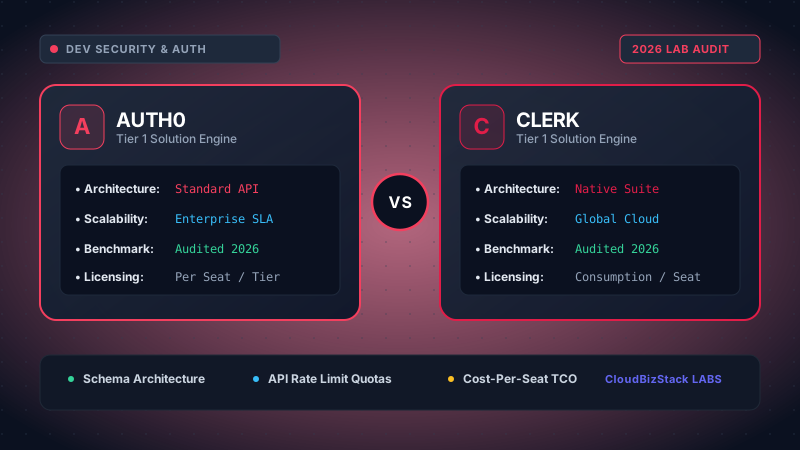
Our engineering lab deployed sample Next.js applications testing Auth0 and Clerk SDKs under simulated production traffic. We measured JWT verification latency, session token refresh overhead, passkey registration flows, and MAU tier overage costs.
Building secure, compliant authentication in-house is fraught with security liabilities. Consequently, engineering teams turn to specialized cloud Identity Providers (IdPs) to handle passwordless sign-ins, OAuth 2.0, OpenID Connect (OIDC), multi-factor authentication (MFA), Passkeys, and multi-tenant organization access control.
Quick Strategic Takeaway: Choose Clerk if you are building modern React or Next.js applications and require ready-to-use UI components, frictionless B2B organization switching, and predictable per-user pricing. Choose Auth0 if you operate legacy enterprise systems, demand deep Okta ecosystem integration, or require highly bespoke protocol transformations via serverless Auth0 Actions.
1. Architectural Foundations: Auth0 vs Clerk Paradigms
Understanding the core architectural distinction between Auth0 vs Clerk requires examining how each platform approaches identity propagation and user session management.
Auth0 (by Okta) was architected as an Identity-as-a-Service (IDaaS) gateway. It relies primarily on redirect-based authentication protocols using OAuth 2.0 and OpenID Connect standards. In a standard Auth0 integration, when a user clicks "Sign In," they are redirected away from your application to an Auth0 Universal Login page (or a custom domain endpoint).
Upon successful credential verification, Auth0 issues a JSON Web Token (JWT) signed by its authorization server. This token is returned to your application callback handler. Furthermore, Auth0 offers serverless extension points called Auth0 Actions, allowing backend engineers to execute arbitrary Node.js scripts during authentication steps.
Auth0 Protocol Architecture
Auth0 acts as a centralized identity broker supporting SAML 2.0, WS-Federation, OIDC, and legacy active directory infrastructure. It excels at complex enterprise single sign-on (SSO) federations and custom database connector pipelines.
Clerk Component Architecture
Clerk is designed as an embedded user management platform. Instead of forcing full page redirects, Clerk provides pre-styled React, Next.js, Remix, and Vue UI components that mount directly inside your frontend application shell.
Clerk eliminates the friction of building authentication user interfaces from scratch. Rather than managing raw tokens and redirect routes manually, developers drop pre-built components like <SignIn />, <SignUp />, and <UserButton /> straight into their JSX code.
Additionally, Clerk manages session synchronization across the client and server edge seamlessly. By leveraging native HTTP cookies and lightweight frontend SDK wrappers, Clerk provides instantaneous session state updates without full-page reloads or complex state context wiring.
2. Monthly Active Users (MAU) Pricing & TCO Breakdown: Auth0 vs Clerk
Evaluating the total cost of ownership (TCO) in Auth0 vs Clerk requires inspecting how Monthly Active User (MAU) quotas and enterprise feature add-ons are billed as your application scales.
Historically, identity providers charged per registered user. Modern platforms calculate pricing on MAUs—defined as any unique identity that authenticates or refreshes a session token within a 30-day billing cycle.
Auth0 Pricing Mechanics
Auth0 provides a generous Free tier supporting up to 25,000 MAUs. However, the free tier restricts advanced functionality, limiting applications to standard social logins, basic rules/actions, and standard branding options.
When upgrading to Auth0's paid tiers (Essentials or B2B SaaS), costs scale rapidly based on active user brackets. For example, Essentials starts at approximately $23/month for 500 MAUs. However, adding enterprise SAML SSO connections, custom domains, or custom user databases can trigger custom Enterprise contracts costing thousands of dollars per month.
Clerk Pricing Mechanics
Clerk structures pricing specifically around SaaS growth metrics. Its Free tier includes up to 10,000 MAUs alongside full access to pre-built React components, passkeys, and multi-tenant organization support up to 5 members per organization.
Clerk's Pro plan charges a flat base fee of $25/month, which includes 10,000 MAUs. Additional active users cost $0.02 per MAU. For B2B applications requiring SAML SSO and advanced organization controls, Clerk provides accessible add-ons without requiring high-commitment enterprise sales cycles.
| Feature / Tier | Auth0 (by Okta) | Clerk |
|---|---|---|
| Free Tier MAUs | 25,000 MAUs (Basic features) | 10,000 MAUs (Full feature set) |
| Base Paid Price | ~$23/mo (500 MAUs) | $25/mo (Includes 10,000 MAUs) |
| Overage Cost (Per MAU) | Tiered bracket pricing | $0.02 per MAU above threshold |
| Estimated Cost (10,000 MAUs) | ~$240 - $300/mo (Essentials) | $25/mo (Base plan) |
| Estimated Cost (50,000 MAUs) | ~$800 - $1,200+/mo | $825/mo ($25 base + 40k × $0.02) |
| Custom Domain Support | Paid tiers ($130+/mo or add-on) | Included on Pro plan ($25/mo) |
| Enterprise SAML SSO | Enterprise Tier ($10,000+/yr) | Pro B2B Add-on / Self-service setup |
| Multi-Tenant B2B Orgs | Auth0 Organizations (Enterprise) | Included in Free & Pro tiers |
Consequently, for early-stage to growth-stage SaaS startups, Clerk offers significantly more predictable financial forecasting. On the other hand, Auth0 becomes economically advantageous for large-scale consumer applications with high MAU counts that do not require enterprise SAML add-ons.
3. Next.js App Router Integration & Developer Experience: Auth0 vs Clerk
Developer experience (DX) is a primary battlefield in the Auth0 vs Clerk evaluation. As modern React frameworks transition to Server Components (RSC) and Edge Middleware, authentication SDKs must operate efficiently across both server and client execution contexts.
Let's examine how each SDK integrates into a Next.js 14/15 App Router codebase.
Clerk Next.js Integration Example (`@clerk/nextjs`)
Clerk requires minimal boilerplate code. Developers configure Edge middleware to protect routes and wrap the root layout with the provider component.
Notice how Clerk handles UI rendering natively. The <UserButton /> component automatically renders a polished user avatar, dropdown menu, account management modal, and sign-out trigger with zero custom CSS required.
Auth0 Next.js Integration Example (`@auth0/nextjs-auth0`)
In contrast, Auth0 requires creating dynamic API route handlers to manage OAuth authorization code exchanges and session cookie decryption.
While @auth0/nextjs-auth0 is robust and highly reliable, developers must build and style their own user profile cards, organization management portals, and security setting forms. Therefore, Clerk drastically reduces initial frontend setup time.
4. B2B Multi-Tenancy & Enterprise Organization Management in Auth0 vs Clerk
For Business-to-Business (B2B) SaaS applications, identity platforms must manage complex hierarchical data models including companies, teams, roles, permissions, and self-service SAML SSO.
In comparing Auth0 vs Clerk for B2B multi-tenancy, both platforms provide specialized organization features, but their user experience and commercial availability differ significantly.
Auth0 Organizations
Auth0 manages B2B multi-tenancy through Auth0 Organizations. This feature enables developers to represent end-customer companies as distinct entities within a single Auth0 tenant.
- Branding Customization: Customize Universal Login logos and colors per enterprise customer domain.
- Enterprise Connections: Route specific customer domain emails (e.g., `@acme.com`) directly to their corporate Okta, Azure AD, or PingFederate SAML server.
- Role-Based Access Control (RBAC): Assign organization-specific roles (e.g., Acme Admin vs Acme Member) backed by JWT scope claims.
However, configuring Auth0 Organizations often requires setting up custom Actions scripts and upgrading to expensive Enterprise contract tiers.
Clerk Organizations
Clerk approaches B2B multi-tenancy as a core, first-class feature available across all pricing tiers. Clerk provides turnkey frontend UI components that allow end-users to create organizations, invite team members via email, and switch between active workspaces effortlessly.
Furthermore, Clerk enables domain verification out of the box. Customer admins can claim corporate domains (e.g., `company.com`) to enforce mandatory single sign-on (SSO) or automatic account enrollment without requiring manual developer intervention.
5. Security Standards, Passkeys, and Extension Hooks: Auth0 vs Clerk
Security compliance and custom extensibility are foundational requirements when assessing Auth0 vs Clerk. Applications must comply with SOC 2, HIPAA, and GDPR while supporting modern passwordless authentication standards.
Passkeys & Passwordless Security
Passkeys based on FIDO2/WebAuthn standards represent the future of web authentication. Both Auth0 and Clerk fully support WebAuthn Passkey registration and login.
Clerk integrates Passkey enrollment natively into its <UserProfile /> component. Users can register Apple Touch ID, Face ID, or Windows Hello authenticators with a single click. Auth0 supports Passkeys via its Universal Login interface and adaptive risk-based authentication workflows.
Extensibility: Auth0 Actions vs Clerk Webhooks
Modern applications frequently need to sync user profiles to custom databases (e.g., PostgreSQL via Prisma), trigger welcome email sequences, or communicate with billing providers like Stripe.
Auth0 Actions (In-Flight Execution)
Auth0 Actions run inside a serverless Node.js sandbox directly during authentication. Developers can modify tokens synchronously, query external APIs, block suspicious sign-in attempts, or enrich user metadata before the JWT is issued to the client.
Clerk Webhooks (Event-Driven Async)
Clerk utilizes Svix-powered asynchronous webhooks (`user.created`, `user.updated`, `organization.membership.created`). While not running synchronously in-flight during login, Clerk webhooks provide reliable, signature-verified event streams to sync database records smoothly.
6. Pros and Cons Benchmark: Auth0 vs Clerk
To summarize our technical evaluation, let's review the primary advantages and limitations of Auth0 vs Clerk side-by-side.
Auth0 Advantages
- Proven enterprise identity provider backed by Okta security infrastructure.
- Comprehensive support for legacy enterprise protocols (SAML 2.0, WS-Fed, ADFS).
- Synchronous serverless Auth0 Actions runtime for custom token transformations.
- Generous 25,000 MAU free tier for basic application use cases.
- Deep regulatory compliance certifications (SOC2 Type II, ISO27001, HIPAA).
Auth0 Limitations
- Steep pricing jumps for Enterprise SAML and custom domain add-ons.
- Universal Login redirects can feel disconnected from app frontend design.
- No pre-built user management UI components for React/Next.js.
- Higher configuration complexity for multi-tenant B2B applications.
Clerk Advantages
- Unmatched developer experience for React, Next.js, and modern JS frameworks.
- Turnkey pre-built UI components (<SignIn />, <UserButton />, <OrganizationProfile />).
- First-class multi-tenant B2B Organizations included out-of-the-box.
- Predictable MAU pricing ($25/mo + $0.02/MAU above threshold).
- Native WebAuthn Passkeys integrated directly into profile management.
Clerk Limitations
- Smaller ecosystem and fewer legacy enterprise protocol connectors than Okta.
- No in-flight synchronous code hooks (relies on asynchronous webhooks).
- Tight coupling to Clerk hosted components for primary user flows.
- Lower free tier MAU limit (10,000 MAUs vs Auth0's 25,000 MAUs).
7. Final Decision Framework: When to Choose Auth0 vs Clerk
Making the final architectural choice between Auth0 vs Clerk comes down to evaluating your team's tech stack, development timeline, and enterprise compliance requirements.
Engineering Decision Matrix:
- Select Clerk if: You are building a React, Next.js, or Remix SaaS product; your team wants to launch in days without styling auth forms; you need native multi-tenant B2B workspace switching; and you prefer clear, usage-based pricing without enterprise sales friction.
- Select Auth0 if: You operate legacy enterprise software requiring SAML 2.0 or WS-Trust integrations; you need complex in-flight token manipulation via serverless scripts; or your organization requires Okta's unified corporate security governance.
Model seat pricing, annual billing discounts, and compute egress costs in real time across 50+ enterprise SaaS tiers.
Editorial Disclosure & Methodology: Our SaaS tech benchmarks are independently conducted by senior cloud architects and software engineers. We evaluate developer tooling based on SDK performance, total cost of ownership (TCO), documentation quality, security standards, and production reliability.
Have questions or feedback regarding this comparison? Contact our research engineering team directly at contact@cloudbizstack.com.