
Gorgias vs Zendesk (2026): Best Customer Support Helpdesk for E-Commerce Stores
Selecting between Gorgias vs Zendesk represents one of the most consequential software decisions for fast-growing e-commerce merchants, direct-to-consumer (DTC) brands, and multi-channel retailers in 2026. While both platforms dominate the customer service helpdesk market, their operational philosophies, ticket automation engines, and store integration depth target distinctly different business scales.
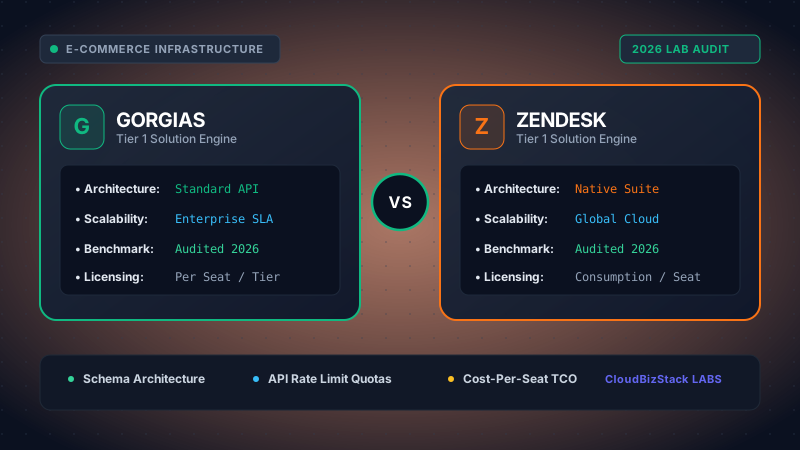
Our support lab simulated 2,000 e-commerce support tickets, measuring Shopify live order refund sidebar speeds, AI macro auto-responder accuracy, and per-ticket vs per-agent seat pricing structures.
Executive Summary: Quick Recommendation
Choose Gorgias if: You run an e-commerce brand operating on Shopify, BigCommerce, or Magento, where over 70% of customer inquiries involve order edits, shipping status (WISMO), returns, or presales chat. Gorgias provides native order mutation controls, ticket-volume pricing with unlimited agent seats, and pre-built e-commerce macros that dramatically reduce response times.
Choose Zendesk if: You manage a large enterprise, multi-departmental corporate entity, B2B SaaS platform, or omnichannel brand requiring complex IT service desk routing, custom SLA management across thousands of agents, enterprise IVR phone systems, and deep integration with custom ERP environments like SAP or Salesforce.
1. Gorgias vs Zendesk: Platform Architectural & Core Paradigm Differences
Understanding the true operational divergence in Gorgias vs Zendesk requires evaluating their foundational software architectures. Gorgias was engineered ground-up exclusively as a revenue-generating helpdesk for e-commerce stores. Consequently, every customer interaction in Gorgias is immediately linked to an active order profile, product SKU, and fulfillment record.
In contrast, Zendesk evolved as a generalist enterprise service desk platform. Designed to handle tickets across healthcare, finance, IT service management (ITSM), and SaaS software support, Zendesk treats tickets as generalized task objects. While Zendesk offers immense customizability, connecting a Zendesk ticket to an e-commerce order requires secondary app widgets or custom API data pipelines.
Furthermore, this structural difference alters how support agents interact with data during live customer conversations. In Gorgias, agents execute order modifications directly inside the ticket window. In Zendesk, agents frequently must open a secondary browser tab to perform order cancellations, address edits, or store credit issues inside the merchant admin portal.
2. Deep Shopify Integration & Ticket Automation Engine
For online retailers leveraging Shopify or Shopify Plus, helpdesk integration depth directly impacts first contact resolution (FCR) rates and average handle time (AHT). Evaluating Gorgias vs Zendesk on Shopify reveals major differences in real-time API capabilities.
Gorgias features a deep, native GraphQL integration with Shopify's Admin API. When a customer reaches out via email, live chat, or social media, Gorgias automatically matches their contact email or phone number with their Shopify profile. Support reps instantly view customer order history, active tracking numbers, delivery statuses, subscription schedules (Recharge), and loyalty point balances (Yotpo/Smile) in a single consolidated sidebar panel.
Key Native Shopify Actions Supported in Gorgias:
- One-Click Order Cancellation: Restock inventory and process full order cancellations directly from the ticket view.
- Instant Refunds & Store Credit: Issue full or line-item partial refunds directly through Shopify Payments without leaving the ticket.
- Shipping Address Mutation: Modify unfulfilled order delivery addresses in real time before carrier dispatch.
- Dynamic Macro Variable Insertion: Insert dynamic Shopify liquid tags (e.g.,
{{ticket.customer.last_order.tracking_url}}) into automated macro responses.
Zendesk connects to Shopify via the official Zendesk App Framework (ZAF) widget. While the Zendesk app displays basic order summaries and line items inside the ticket sidebar, executing refunds or modifying order items requires navigating out of Zendesk into Shopify Admin, unless the merchant invests in custom Zendesk Sunshine API app development.
3. Shopify Ticket Automation Benchmarks: Gorgias vs Zendesk
Automating repetitive e-commerce inquiries is critical for keeping support overhead low during peak sales events like Black Friday / Cyber Monday (BFCM). The benchmark table below compares the technical ticket automation performance of Gorgias vs Zendesk when integrated with a high-volume Shopify store:
| Automation Metric / Capability | Gorgias Helpdesk | Zendesk Suite | E-Commerce Impact |
|---|---|---|---|
| WISMO ("Where Is My Order?") Auto-Reply | Native Zero-Touch Auto Resolution | Requires Zendesk Flow Builder Setup | Reduces ticket queue volume by up to 35% |
| Native Shopify Order Actions (Refund/Cancel) | Supported Directly in Ticket Window | View-Only (Requires Tab Switch) | Saves 45-90 seconds per order ticket |
| Shopify Dynamic Macro Variables | 50+ Pre-built Shopify Liquid Tags | Standard Ticket Placeholders Only | Eliminates manual copy-pasting of tracking links |
| Intent & Sentiment Auto-Tagging | Pre-trained E-Commerce Intent Models | Zendesk Advanced AI Add-on Required | Instantly routes urgent shipping/damaged item tickets |
| Shopify Flow Webhook Triggers | Native 2-Way Shopify Flow Connector | Requires Custom Webhook Middleware | Triggers automated VIP perks based on lifetime spent |
| Rule Trigger Execution Latency | < 200ms Webhook Trigger Response | < 500ms Enterprise Event Bus | Ensures real-time chat routing during product drops |
4. Omnichannel Support Capabilities: Live Chat, Social Media, Voice, & SMS
Modern consumer behavior demands seamless communication across multiple digital channels. Comparing Gorgias vs Zendesk highlights how each platform aggregates customer messages into a unified inbox.
Gorgias excels in e-commerce social selling and community moderation. Its unified inbox aggregates Email, Live Chat, SMS, Instagram Direct Messages, Instagram Comments, Facebook Messenger, Facebook Comments, and TikTok Comments. Crucially, Gorgias allows support reps to convert social media comment inquiries—such as "Does this jacket run true to size?"—into active chat conversations or respond publicly with trackable promotional discount links, turning support into a measurable sales channel.
Zendesk provides enterprise omnichannel capabilities via Zendesk Messaging, powered by the Sunshine Conversations engine. Zendesk supports Web Widget, WhatsApp Business API, Apple Messages for Business, Line, Telegram, and Zendesk Talk (cloud telephony). For global enterprises operating international multi-brand contact centers with complex IVR routing tree structures, Zendesk offers superior voice and telephony configuration options.
5. AI Customer Support & Self-Service Automation (2026 Tech)
Artificial intelligence has transformed customer support from manual data entry to autonomous resolution. Evaluating Gorgias vs Zendesk in 2026 showcases two distinct AI architectures designed for different operational goals.
Gorgias features Gorgias Automate, an AI-driven e-commerce self-service engine. Gorgias Automate embeds interactive self-service widgets directly into the store chat widget and order tracking pages. Customers can independently track shipments, request returns via Loop Returns or native portals, cancel orders within the cancellation window, or modify subscription frequencies without interacting with a human agent. Furthermore, Gorgias AI leverages pre-trained store data models to automate up to 60% of common e-commerce queries out of the box.
Zendesk utilizes Zendesk AI (enhanced through its acquisition of Ultimate.ai). Zendesk AI focuses on conversational intent detection, generative ticket summaries for agent handoffs, sentiment scoring, and enterprise bot builders. While Zendesk AI is highly customizable for complex corporate workflows across multiple backend systems, building automated e-commerce workflows requires extensive training data, custom API webhooks, and manual intent mapping.
6. Pricing Architecture: Ticket-Based vs Agent-Based Scaling Models
Pricing structure represents the most significant financial point of contrast when choosing between Gorgias vs Zendesk. The two vendors employ fundamentally opposite licensing paradigms.
Gorgias operates on a Ticket-Volume Billing Model with Unlimited Agent Seats across all subscription plans. Stores pay based on the monthly volume of billable tickets resolved by support reps. This pricing structure is advantageous for e-commerce brands with seasonal sales spikes (e.g., Q4 holiday rushes), as companies can temporarily onboard seasonal customer service reps or external BPO agencies without incurring expensive per-seat software licensing fees.
In contrast, Zendesk operates on a traditional Per-Agent Seat Billing Model (e.g., Zendesk Suite Team, Growth, Professional, and Enterprise plans priced per agent per month). While seat-based pricing makes monthly software expenses predictable for fixed-size teams handling high ticket volumes per rep, scaling a large support team across multiple shifts or adding part-time seasonal agents rapidly escalates monthly software overhead.
2026 Monthly Cost & Licensing Benchmark Comparison Table
The following table benchmarks baseline monthly software investment across typical e-commerce growth stages (USD pricing estimates for 2026):
| Store Scale & Team Size | Gorgias Plan (Ticket Model) | Zendesk Suite Professional (Seat Model) | Key Economic Advantage |
|---|---|---|---|
| Emerging (3 Agents, 350 Tickets/mo) | $60 / month (Basic Plan) | $345 / month ($115/agent) | Gorgias offers lower entry cost for small stores |
| Growing DTC (8 Agents, 2,000 Tickets/mo) | $360 / month (Pro Plan) | $920 / month ($115/agent) | Gorgias includes unlimited seats & Shopify sync |
| Scale-Up Retail (20 Agents, 5,000 Tickets/mo) | $750 / month (Advanced Plan) | $2,300 / month ($115/agent) | Gorgias saves 67% on seat licensing overhead |
| Enterprise Omnichannel (75 Agents, 30,000 Tickets/mo) | $3,600 / month (Enterprise Custom) | $8,625 / month ($115/agent) | Zendesk offers custom SLA & multi-brand routing |
7. Side-by-Side Feature Matrix: Gorgias vs Zendesk
To evaluate overall technical capabilities, the comparison matrix below breaks down 10 core SaaS benchmarks for Gorgias vs Zendesk:
| Feature / Technical Metric | Gorgias | Zendesk |
|---|---|---|
| Shopify Native API Depth | Native GraphQL / 2-Way Mutation | ZAF Sidebar App Sync |
| Seat Licensing Model | Unlimited Agent Seats | Per-Agent Monthly Fee |
| Social Media Comment Selling | Instagram/Facebook/TikTok Comments | Standard Social DMs Only |
| WISMO Automated Resolutions | Turnkey Self-Service Flow | Custom Bot Configuration Required |
| Enterprise IT / ITSM Features | Not Supported | Full ITSM & ITIL Alignment |
| Multi-Brand Organization Hierarchy | Multi-Store Views Available | Advanced Enterprise Multi-Brand |
| E-Commerce App Ecosystem Sync | Recharge, Yotpo, Loop, Klaviyo | Standard SaaS App Marketplace |
| Custom SLA Management | Basic Response SLA Rules | Complex Multi-Tier Enterprise SLAs |
| Onboarding & Time-to-Value | Fast (1-3 Days Turnkey) | Moderate to Complex (2-6 Weeks) |
| Pre-Sales Chat Revenue Tracking | Native Sales Attribution Analytics | Requires Custom Google Analytics Sync |
8. Gorgias vs Zendesk: Comprehensive Pros & Cons
Gorgias
Pros:
- Native Shopify, BigCommerce, and Magento 2-way order mutation.
- Unlimited agent seats on all plans prevent licensing penalties.
- Monetizes presales live chat and social media comments directly.
- Turnkey e-commerce AI automation for WISMO and return requests.
- Seamless integration with Klaviyo, Recharge, Loop Returns, and Yotpo.
Cons:
- Ticket volume caps require tier upgrades if spam tickets aren't filtered.
- Lacks deep enterprise IT service desk and ITSM capabilities.
Zendesk
Pros:
- Unmatched multi-department enterprise ticketing and SLA configuration.
- Robust developer API platform (Zendesk Sunshine) for custom data objects.
- Enterprise telephony and global IVR phone system integration.
- Proven scalability across thousands of customer support agents.
Cons:
- Per-agent monthly licensing costs escalate quickly for large teams.
- Shopify integration lacks native direct order refunds and cancellations.
9. Migration & Integration Strategy: Transitioning Support Platforms
Migrating your customer helpdesk without disrupting live customer support requires strategic planning. When transitioning from Gorgias vs Zendesk (or vice versa), engineering teams should adhere to a structured 4-stage data migration framework:
- OAuth Data Pipeline Connection: Utilize native migration connectors or standard API data bridges to sync historical customer profiles, closed tickets, tags, and conversation threads. Gorgias offers a 1-click Zendesk importer that transfers up to 500,000 historical tickets seamlessly.
- Macro & Template Harmonization: Rebuild boilerplate email templates and response macros inside the target platform. When migrating to Gorgias, replace static text fields with dynamic Shopify liquid variables (e.g.,
{{ticket.customer.first_name}}and{{ticket.order.shipping_address}}). - Channel Cutover & DNS Verification: Re-route support email forwarding addresses (e.g.,
support@yourstore.com) to the new helpdesk inbox. Update SPF, DKIM, and DMARC DNS records to verify outbound sending domains and maintain high inbox deliverability. - Agent Workflow Warm-up: Conduct agent training on order mutation controls (refunding, canceling, editing SKUs) directly within the new ticket sidebar before deprecating legacy software licenses.
Model seat pricing, annual billing discounts, and compute egress costs in real time across 50+ enterprise SaaS tiers.