
Ahrefs vs Semrush (2026): Which SEO & Keyword Research SaaS is Worth the Price?
When evaluating Ahrefs vs Semrush for enterprise search engine optimization and keyword research, digital marketing leaders face a pivotal software selection choice. Both platforms dominate the B2B SaaS landscape with multi-billion-keyword indexes, advanced crawler infrastructure, and deep SERP analytics. However, their contrasting pricing structures, indexing speed, and core feature priorities create stark operational differences for modern growth teams.
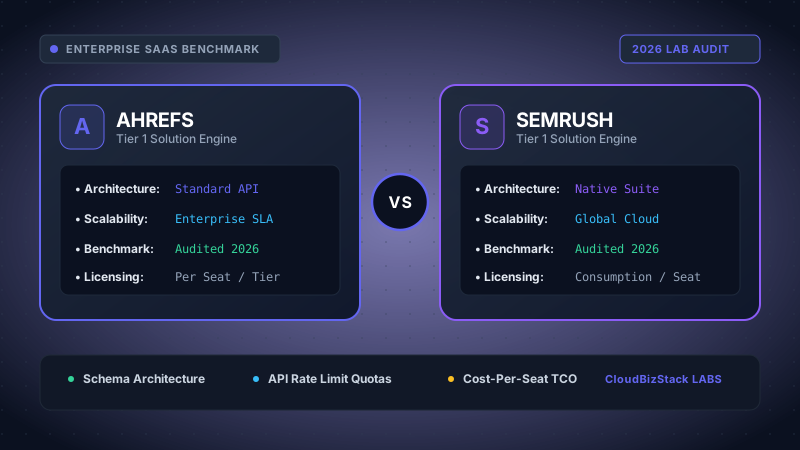
Our search marketing analysts ran comparative keyword audits across 50,000 enterprise search terms, benchmarking SERP crawler index freshness, historical backlink database accuracy, and API rate-limit credit consumption across both SEO platforms.
Navigating the modern search ecosystem in 2026 requires continuous data freshness, precise search intent mapping, and accurate technical diagnostic reporting. Furthermore, with Google’s ongoing integration of generative AI Overviews and continuous zero-click SERP layouts, choosing the right intelligence stack directly impacts your customer acquisition costs. Consequently, relying on outdated or inaccurate search data can compromise your entire content strategy.
In this definitive benchmark, we conduct a rigorous side-by-side comparison of Ahrefs vs Semrush across seven core operational dimensions. We evaluate backlink index accuracy, keyword database precision, SERP rank tracking capabilities, content gap intelligence, site audit performance, and subscription credit consumption models.
1. Core Architectural Philosophy & Platform Focus
Understanding the underlying architectural focus of each tool explains why their workflows feel fundamentally different. Initially built as a specialized backlink indexing engine, Ahrefs has evolved into a sleek, data-focused organic search workstation. Its primary engineering focus centers on web crawler efficiency, backlink profile verification, and intuitive UI data exploration.
In contrast, Semrush was designed from its inception as an all-in-one digital marketing suite. Beyond core SEO features, Semrush provides expansive toolsets for pay-per-click (PPC) ad intelligence, social media management, PR tracking, consumer sentiment analysis, and local search management. As a result, Semrush offers broader digital marketing coverage, while Ahrefs provides a hyper-focused organic search experience.
If your organization requires a multi-departmental tool that supports PPC media buyers, social media managers, and content strategists under one subscription, Semrush provides superior horizontal breadth. Conversely, if your engineering and SEO teams prioritize raw backlink index precision and ultra-fast data filtering, Ahrefs remains the gold standard.
2. Ahrefs vs Semrush: Backlink Index Accuracy & Live Crawler Infrastructure
Backlink analysis represents the historical foundation of off-page SEO benchmarking. In evaluating Ahrefs vs Semrush for backlink discovery, live crawler infrastructure and spam link filtration serve as the primary performance differentiators.
Ahrefs Domain Rating (DR) & Live Index Performance
Ahrefs operates AhrefsBot, consistently ranked among the most active commercial web crawlers globally. Its Live Backlink Index updates every 15 to 30 minutes, allowing link builders to verify recently acquired backlinks almost instantaneously. Additionally, Ahrefs' proprietary metric, Domain Rating (DR), measures logarithmic backlink strength on a 0-to-100 scale without being easily manipulated by low-quality link networks.
Furthermore, Ahrefs excels at filtering out spam link farm networks and toxic link spam from its main index. Consequently, its backlink reporting provides a remarkably clean snapshot of genuine domain authority. Its Historical Index enables SEO researchers to analyze link profiles dating back over a decade, revealing long-term domain authority trajectories.
Semrush Authority Score (AS) & Toxic Link Auditing
Semrush has invested heavily in expanding its backlink database over recent years. Its proprietary metric, Authority Score (AS), incorporates machine learning models that evaluate organic traffic data, backlink profiles, and search spam indicators simultaneously. This multi-layered metric aims to prevent artificial link manipulation from distorting domain authority scores.
Additionally, Semrush features a dedicated Backlink Audit tool that automatically flags potentially toxic backlinks based on over 45 toxicity markers. While Ahrefs focuses on pure link discovery and verification, Semrush provides native disavow file generation and manual link removal outreach workflow integration.
3. Ahrefs vs Semrush: Keyword Database & Search Volume Accuracy
Keyword research remains the strategic cornerstone of content planning. When comparing Ahrefs vs Semrush for keyword discovery, database volume, click metrics, and Keyword Difficulty (KD) algorithms determine platform utility.
Database Scale & Click-Through Rate Metrics
Semrush maintains an expansive keyword database exceeding 25 billion keywords across 190+ countries. Its Keyword Magic Tool allows content teams to filter keyword clusters by search intent (Informational, Navigational, Commercial, Transactional), SERP features, and question formats with exceptional granularity. Moreover, Semrush updates its high-volume keyword data monthly, reflecting seasonal search shifts rapidly.
On the other hand, Ahrefs Keywords Explorer covers over 19.8 billion keywords across 242 countries. Notably, Ahrefs incorporates clickstream data to provide unique click-through metrics, including Clicks Per Search (CPS) and Return Rate (RR). These metrics help SEO strategists identify high-volume keywords that actually drive traffic, eliminating targets dominated by zero-click Google SERP features.
Keyword Difficulty (KD) Algorithm Mechanics
The two platforms calculate Keyword Difficulty using contrasting methodologies. Ahrefs calculates KD using a strict, math-driven formula based solely on the weighted average number of referring domains linking to the top 10 ranking pages. As a result, Ahrefs KD provides a direct estimation of link building effort required to rank.
In contrast, Semrush utilizes a holistic multi-factor KD algorithm. It evaluates referring domain counts, domain authority scores, content length, and search intent alignment. Therefore, Semrush KD provides a broader assessment of overall content and domain authority competitiveness.
4. Ahrefs vs Semrush: SERP Rank Tracking & Visibility Monitoring
Accurate rank tracking is essential for measuring campaign ROI and diagnosing algorithmic movement. In the matchup of Ahrefs vs Semrush for SERP tracking, refresh frequencies and local geo-targeting capabilities determine operational success.
Semrush Position Tracking offers daily automatic rank updates across mobile and desktop devices. Strategists can track keyword performance down to exact ZIP code and city levels, making it invaluable for multi-location enterprises and local SEO agencies. Furthermore, Semrush Sensor monitors daily SERP volatility across categories, providing real-time alerts when Google deploys core algorithm updates.
Conversely, Ahrefs Rank Tracker provides scheduled updates ranging from daily (on higher tiers) to weekly refreshes. It organizes keyword data into clean performance charts, tracking Share of Voice (SoV), average position, and traffic distribution. While its UI is exceptionally clean and readable, agency teams requiring daily rank verification across thousands of hyper-local keywords often prefer Semrush.
5. Ahrefs vs Semrush: Content Gap Analysis & Topic Discovery
Identifying content opportunities before competitors execute on them generates compounding organic advantage. Both Ahrefs vs Semrush feature sophisticated competitive content gap tools, yet their execution models appeal to different marketing workflows.
Ahrefs Content Gap tool enables users to input multiple competitor URLs and compare them against their own domain. It instantly isolates keywords where competitors hold top 10 positions while your domain remains unranked. Additionally, Ahrefs Content Explorer functions as a specialized search engine for web content, allowing marketers to discover viral articles, unlinked brand mentions, and low-competition topics filtered by traffic and word count.
Similarly, Semrush Keyword Gap and Topic Research tools streamline competitive content analysis. Marketers can analyze up to five competitor domains simultaneously using Venn-diagram visual overlays. Furthermore, Semrush integrates an AI Topic Research Assistant that generates subtopic clusters, trending headlines, and frequently asked audience questions directly into content briefs.
6. Ahrefs vs Semrush: Technical Site Audit Crawler Performance
Technical health forms the foundation of organic visibility. Without a clean technical architecture, high-quality content and backlinks fail to achieve maximum search rankings. Comparing Ahrefs vs Semrush technical crawlers reveals powerful diagnostic capabilities in both platforms.
Ahrefs Site Audit is a cloud-based crawler that executes JavaScript rendering via a headless Chromium engine. It identifies over 100 technical issues, including Core Web Vitals performance, broken canonical links, hreflang mismatches, and orphan pages. Its visual Data Explorer allows technical SEOs to write custom filtering rules and construct complex diagnostic reports effortlessly.
Equally impressive, Semrush Site Audit offers ultra-fast crawling speeds with customizable user-agent simulation. It categorizes technical errors into clear thematic groups: Site Performance, Internal Linking, Crawlability, HTTPS Security, and Core Web Vitals. Moreover, Semrush enables direct integration with Trello and Asana, allowing technical teams to convert audit findings into actionable developer tasks with a single click.
7. Ahrefs vs Semrush Pricing: Credit Consumption vs Tiered Project Limits
Subscription cost structure is frequently the decisive factor when selecting between Ahrefs vs Semrush. In recent years, both SaaS platforms have updated their pricing models, making cost predictability a critical consideration for finance leaders.
Ahrefs Consumption-Based Credit System
Ahrefs operates on a consumption-based pricing model. While plan entry points start at $99/month (Lite) and scale to $199/month (Standard), $399/month (Advanced), and $999/month (Enterprise), billing is tied to user credits. Each report request, table filter application, or page view consumes 1 credit from your monthly allocation (typically 500 credits per user).
Consequently, active agency teams or large content departments can exhaust monthly credits quickly. Adding extra power users costs between $20 and $50 per seat per month, plus additional fees for credit expansion packs. Therefore, teams using Ahrefs must manage data query frequency carefully to avoid unexpected billing overages.
Semrush Fixed Subscription Tier & Seat Structure
Semrush utilizes a traditional tiered subscription model with fixed feature allowances. Plans start at $139.95/month (Pro), scaling to $249.95/month (Guru) and $499.95/month (Business). Each tier provides predefined limits for daily report requests (e.g., 3,000 queries/day on Pro, 5,000 on Guru), tracked keywords (500 to 5,000), and active project slots (5 to 40).
Although additional user seats cost between $45 and $100 per user per month, daily query limits reset automatically every 24 hours. As a result, active SEO power users can perform thousands of data searches daily without incurring mid-month credit depletion penalties.
8. Comprehensive Feature Comparison Matrix: Ahrefs vs Semrush
To summarize the technical capabilities of Ahrefs vs Semrush, the following benchmark table compares core specifications side-by-side:
9. Pros and Cons: Ahrefs vs Semrush
Every software suite involves strategic trade-offs. Below is an executive summary of the primary advantages and limitations when choosing Ahrefs vs Semrush:
Ahrefs Pros & Cons
Pros:
- Industry-leading backlink index speed and accuracy.
- Clean, highly intuitive UI for rapid SEO exploration.
- Unique click metrics (CPS) to avoid zero-click keywords.
- Powerful headless Chromium site audit crawler.
Cons:
- Restrictive consumption-based credit pricing system.
- Limited PPC ad intelligence and zero social media management tools.
Semrush Pros & Cons
Pros:
- Largest keyword database with over 25B+ search phrases.
- Daily rank tracking updates included with local ZIP code precision.
- Comprehensive PPC, display ad, and competitor ad history.
- Predictable daily query reset allowances instead of strict credit pools.
Cons:
- Dashboard interface can feel cluttered for beginner users.
- Add-on costs for additional team seats can scale rapidly.
10. Final Verdict: Which SEO SaaS Platform Is Worth Your Investment?
When concluding your benchmark evaluation of Ahrefs vs Semrush, the decision ultimately rests on your core marketing strategy and team structure.
Choose Ahrefs if: You lead a dedicated organic search or link-building agency where backlink profile verification, domain authority tracking, and clean content exploration take top priority. Ahrefs remains an unrivaled precision tool for pure SEO strategists who value data accuracy over multi-channel breadth.
Choose Semrush if: You manage a full-service marketing department, eCommerce enterprise, or digital agency requiring a single platform for organic SEO, PPC keyword intelligence, daily rank tracking, and toxic backlink auditing. Semrush provides superior long-term ROI for teams seeking maximum operational versatility without credit-consumption anxiety.
Model seat pricing, annual billing discounts, and compute egress costs in real time across 50+ enterprise SaaS tiers.