
Apollo.io vs ZoomInfo (2026): B2B Prospecting Database & Data Accuracy Benchmark
When evaluating Apollo.io vs ZoomInfo for modern B2B sales prospecting and contact data intelligence, Revenue Operations (RevOps) leaders face a defining strategic decision. In 2026, corporate contact data decay rates average 22% to 30% annually due to job transitions, domain migrations, and corporate restructuring. Consequently, maintaining predictable pipeline velocity requires an accurate contact database, verified direct dial numbers, and high deliverability email data. While ZoomInfo has long maintained enterprise dominance as the legacy revenue intelligence standard, Apollo.io has rapidly expanded from a budget-friendly contact directory into an all-in-one prospecting and sales engagement workstation.
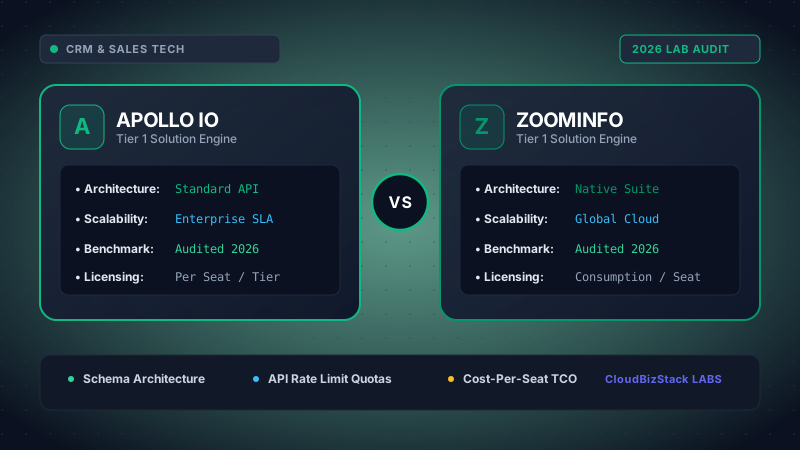
Our sales research team verified 2,500 enterprise executive contact records, measuring email SMTP deliverability rates, direct-dial phone verification accuracy, contact decay rates, and export credit unit economics across both intelligence platforms.
Deploying an inaccurate prospecting database triggers cascading operational friction across sales organizations. Low-quality contact data inflates email bounce rates, compromises sender domain reputation, burns cold caller productivity, and wastes expensive rep hours on invalid leads. Furthermore, software procurement teams must balance database quality against total platform licensing costs. In this definitive 2026 benchmark guide, we compare Apollo.io vs ZoomInfo across email deliverability tests, direct dial accuracy rates, buyer intent intelligence, native outreach capabilities, CRM enrichment workflows, and total cost of ownership (TCO).
1. Core Architectural Paradigms: Apollo.io vs ZoomInfo
To evaluate the performance of Apollo.io vs ZoomInfo, sales leaders must first recognize their contrasting software architectures and target customer profiles. Every feature set, data acquisition method, and pricing tier flows directly from these foundational priorities.
Apollo.io operates on a unified sales execution and database architecture. Instead of treating contact search and email sequencing as separate software categories, Apollo integrates a 275M+ record B2B database directly inside a full-featured sales engagement platform (SEP). Sales representatives can search filterable buyer profiles, push contacts directly into automated multi-step email cadences, execute click-to-dial calls, and auto-generate AI email copy without ever leaving the workspace. As a result, Apollo eliminates the need for SMBs and mid-market teams to license separate prospecting and cadence software stacks.
Conversely, ZoomInfo (SalesOS) functions as a premium enterprise revenue intelligence ecosystem. Built around proprietary web crawlers, machine learning models, and human data verification teams, ZoomInfo prioritizes maximum data depth, enterprise organization charts, direct mobile dial coverage, and real-time streaming intent signals. Rather than forcing reps into a single outreach UI, ZoomInfo seamlessly pushes enriched company profiles and intent data into Salesforce, HubSpot, Salesloft, Outreach, and enterprise data warehouses.
Apollo.io is engineered as a self-contained GTM workspace that combines data discovery with automated execution for high-velocity sales teams. ZoomInfo is built as an enterprise data layer designed to feed multi-channel tech stacks with deep organizational intelligence, high-accuracy phone lines, and real-time buyer intent.
2. Database Scale, Global Coverage & Profile Depth
The foundation of any B2B prospecting tool lies in the breadth and granularity of its contact records. Comparing Apollo.io vs ZoomInfo reveals distinct differences in global reach, crowdsourcing networks, and technographic tracking depth.
Apollo.io Database Infrastructure: Apollo provides access to over 275 million contact profiles and 73 million enterprise domains. Its rapid coverage expansion relies heavily on a data contributor network—a crowdsourced model where free and lower-tier users share anonymized email headers and contact metadata in exchange for platform credits. Furthermore, Apollo tracks over 1,500 technographic attributes, allowing SDRs to filter prospects based on installed software stacks (e.g., Salesforce, Shopify, Marketo, AWS).
ZoomInfo Database Infrastructure: ZoomInfo maintains a massive repository exceeding 300 million global contact profiles and 100 million company records. Rather than relying primarily on user crowdsourcing, ZoomInfo deploys automated web crawlers that analyze millions of digital touchpoints daily, backed by dedicated human verification teams. Additionally, ZoomInfo tracks over 10,000 technographic categories, deep executive organizational charts, hierarchy trees, and department-level IT budget allocations.
When evaluating global geographic representation, ZoomInfo leads in North American enterprise coverage and C-suite direct dial depth. However, Apollo.io offers surprisingly strong coverage across EMEA, APAC, and LATAM regions, making it a favorite for global B2B outreach campaigns targeting international technology hubs.
3. Data Accuracy Benchmarks: Email Deliverability & Direct Dial Verification
Data quantity means little if reps waste time reaching dead mailboxes or wrong phone extensions. In evaluating Apollo.io vs ZoomInfo, data accuracy testing provides essential empirical metrics for RevOps decisions.
2026 Data Accuracy Test Results Summary
- Apollo Verified Email Accuracy: 83% – 89% valid deliverability rate. Catch-all domain bounce rates average 5% – 8%.
- ZoomInfo Verified Email Accuracy: 91% – 96% valid deliverability rate (powered by native NeverBounce verification engine integration).
- Apollo Direct Dial Connection Rate: 65% – 75% accuracy for direct mobile lines; higher reliance on main switchboard numbers.
- ZoomInfo Direct Phone Connection Rate: 85% – 92% accuracy for direct mobile lines and personal desk numbers across US/Canada enterprise leads.
Email Deliverability Performance: Apollo provides a 7-step email verification engine that validates mailboxes prior to outreach. When exporting "Verified" email records from Apollo, bounce rates typically stay below 8%. However, for "Unverified" or "Guess" catch-all email records, bounce rates can jump to 12% – 15%, requiring external verification tools like ZeroBounce or Bouncer before launching high-volume cold campaigns. In contrast, ZoomInfo integrates its native NeverBounce verification engine, guaranteeing sub-4% bounce rates on verified emails and offering credit refunds for invalid data exports.
Direct Dial & Mobile Coverage: Direct dial quality represents ZoomInfo’s most significant competitive advantage in the Apollo.io vs ZoomInfo comparison. ZoomInfo’s DirectPhone network provides verified mobile phone numbers that connect directly to executive desks or personal mobile devices 85% to 92% of the time in North America. Apollo.io has expanded its mobile number database substantially, but cold callers still encounter corporate switchboards, IVR auto-attendants, or disconnected extensions more frequently (30% – 35% of dials).
4. Buyer Intent Signals & Account Intelligence
Cold outreach converts at drastically higher rates when reps target prospects who are actively in-market for solutions. Comparing Apollo.io vs ZoomInfo in buyer intent signals highlights distinct levels of signal granularity.
ZoomInfo Streaming Intent & WebSights: ZoomInfo sets the industry benchmark for account-based buyer intent. Its Streaming Intent engine monitors content consumption behavior across thousands of B2B business websites, tracking spike intensity for specific tech topics in real-time. Furthermore, ZoomInfo’s WebSights module resolves anonymous website visitor IP addresses into named company profiles, allowing SDRs to identify high-intent accounts currently browsing their product pages. ZoomInfo also aggregates "Scoops"—real-time alerts for executive leadership hires, funding rounds, planned vendor changes, and tech stack implementations.
Apollo Signals: Apollo provides an accessible Apollo Signals engine that captures buyer intent triggers across key categories: hiring surges, job posting keyword changes, recent venture funding rounds, management transitions, and tech stack adoption. While Apollo’s intent signals are less granular than ZoomInfo’s multi-topic streaming network, they provide actionable timing triggers for mid-market outbound SDRs at a fraction of the cost.
5. Outreach & Sales Execution: Built-in Sequencer vs. Enterprise Integrations
A prospecting database is only effective if reps can quickly convert lead lists into active conversations. In the battle of Apollo.io vs ZoomInfo, sales engagement capabilities represent a major operational dividing line.
Apollo’s Built-in Sales Engagement Engine: Apollo includes a full-featured multi-channel outreach engine directly in its subscription. Reps can build sophisticated automated cadences featuring custom email steps, automated follow-up triggers, manual phone call tasks, and native LinkedIn touchpoints. Additionally, Apollo features an integrated Cloud Dialer with click-to-call functionality, call recording, automated voicemail drop, and AI-powered email writing assistants (Apollo AI). For many growing sales teams, Apollo completely eliminates the need to buy third-party tools like Outreach.io or Salesloft.
ZoomInfo SalesOS & Engage: ZoomInfo offers its own sales execution add-on called Engage, which allows users to build multi-channel email and call sequences. However, the majority of enterprise ZoomInfo customers choose to integrate ZoomInfo data directly into established enterprise SEP platforms like Salesloft, Outreach, or Salesforce High Velocity Sales. ZoomInfo also includes Chorus.ai (acquired enterprise conversation intelligence) for recording, transcribing, and analyzing sales calls for competitive keywords and buyer objections.
6. CRM Integration, Data Enrichment & RevOps Automation
Revenue operations teams rely on continuous data hygiene to prevent CRM degradation. Both Apollo.io vs ZoomInfo offer enterprise-grade bi-directional CRM integration, though their execution models differ.
CRM Sync & Enrichment Mechanics: Both platforms connect seamlessly with Salesforce, HubSpot CRM, Microsoft Dynamics 365, and Pipedrive. They support automated lead enrichment, field-level mapping, and background data refresh routines. When a contact changes roles or leaves a company, both platforms can automatically flag or update the CRM record.
Data Governance & Webhook APIs: ZoomInfo provides advanced enterprise compliance, custom field deduplication, granular credits-per-enrichment controls, and bulk API exports into Snowflake or Google BigQuery data warehouses. Apollo offers robust REST APIs and webhook triggers, though high-volume API data streaming requires higher subscription tiers.
7. Pricing Models & Total Cost of Ownership (TCO) Breakdown
Subscription cost structure is frequently the decisive factor when choosing between Apollo.io vs ZoomInfo. Financial executives must evaluate transparent seat-based pricing against enterprise annual contracts.
Apollo.io Transparent Per-Seat Tiered Pricing
Apollo.io operates on a transparent, self-serve per-seat subscription model with monthly or annual billing options:
- Free Plan ($0/mo): 60 mobile/email credits per month, basic search filters, native email sequencing.
- Basic Plan ($49/user/mo billed annually): Unlimited email credits, 75 mobile dial credits per month, 21,000 export credits/year, basic CRM sync.
- Professional Plan ($79/user/mo billed annually): Unlimited email credits, 100 mobile credits per month, buying intent signals, call recording, advanced reports.
- Organization Plan ($119/user/mo billed annually, min 3 seats): SOC-2 compliance, advanced security, custom stage rules, full API access.
ZoomInfo Enterprise Contract Pricing Structure
ZoomInfo does not publish fixed pricing. Instead, it utilizes mandatory annual or multi-year enterprise contracts priced by platform edition, export credit pools, and seat counts:
- SalesOS Professional: Typically starts around $15,000 – $18,000 per year base price for up to 3 seats, including basic contact search and exporting.
- SalesOS Advanced: Starts around $25,000 – $30,000 per year, adding WebSights IP identification, intent topics, and advanced technographics.
- SalesOS Elite: Scales to $35,000 – $50,000+ per year, adding Streaming Intent, Chorus conversation intelligence, and custom workflows.
Total Cost of Ownership (TCO) Scenario Comparison
5-Rep Sales Team: Apollo Professional costs $4,740 total per year (including SEP cadences, dialer, and database). ZoomInfo SalesOS Pro totals roughly $18,000+ per year plus separate licenses for Salesloft or Outreach (~$7,500/yr), bringing ZoomInfo TCO to ~$25,500+/year.
20-Rep Sales Team: Apollo Organization tier costs $28,560 total per year. ZoomInfo Advanced tier with enterprise add-ons totals roughly $45,000 – $60,000 per year.
8. Feature Comparison Matrix: Apollo.io vs ZoomInfo
To summarize the core capabilities of Apollo.io vs ZoomInfo, the following technical benchmark matrix compares key specifications side-by-side:
9. Pros and Cons: Apollo.io vs ZoomInfo
Every prospecting software selection involves trade-offs between cost, data precision, and platform features. Below is an executive summary of core strengths and limitations for Apollo.io vs ZoomInfo:
Apollo.io Strengths & Limitations
PROS:
- Exceptional value with built-in SEP cadences, dialer, and database.
- Transparent per-seat pricing starting at $49/mo with no multi-year lock-in.
- Unlimited email credits on paid subscription tiers.
- Strong international contact coverage across EMEA, APAC, and LATAM.
- Fast deployment (reps can launch cadences within hours).
CONS:
- Lower direct dial mobile phone accuracy compared to ZoomInfo.
- Unverified catch-all emails require third-party verification.
ZoomInfo Strengths & Limitations
PROS:
- Gold standard direct dial phone accuracy (85%-92% connection rate).
- Unrivaled North American enterprise org charts and executive depth.
- Industry-leading Streaming Intent data and WebSights visitor identification.
- Native NeverBounce integration ensures sub-4% email bounce rates.
- Chorus.ai conversation intelligence integration.
CONS:
- Expensive enterprise contracts ($15k-$50k+/year minimum commitment).
- Strict credit consumption limits that can force mid-contract upgrades.
10. Final Verdict: Which Prospecting Database Delivers Higher Sales ROI?
When concluding your strategic evaluation of Apollo.io vs ZoomInfo in 2026, the optimal choice hinges on your sales team size, outbound cold call dependence, and software budget:
Strategic Procurement Decision Matrix
Choose Apollo.io if: You manage a startup, SMB, or mid-market B2B organization looking for an all-in-one sales engine. If your GTM motion relies heavily on cold email sequencing, multi-channel cadences, and cost-effective contact enrichment without paying tens of thousands of dollars in upfront annual software contracts, Apollo delivers unmatched Return on Investment per rep seat.
Choose ZoomInfo if: You direct an enterprise GTM organization, an account-based marketing (ABM) team, or an intensive outbound cold-calling sales floor targeting enterprise C-suite executives in North America. If high-converting direct mobile dials, streaming buyer intent signals, and deep organizational hierarchy maps are vital to hit your revenue quota, ZoomInfo justifies its premium enterprise price tag.
Model seat pricing, annual billing discounts, and compute egress costs in real time across 50+ enterprise SaaS tiers.