Upstash vs Redis Cloud: Serverless vs Managed Redis Benchmark (2026)
1. Executive Summary & Architectural Verdict (TL;DR)
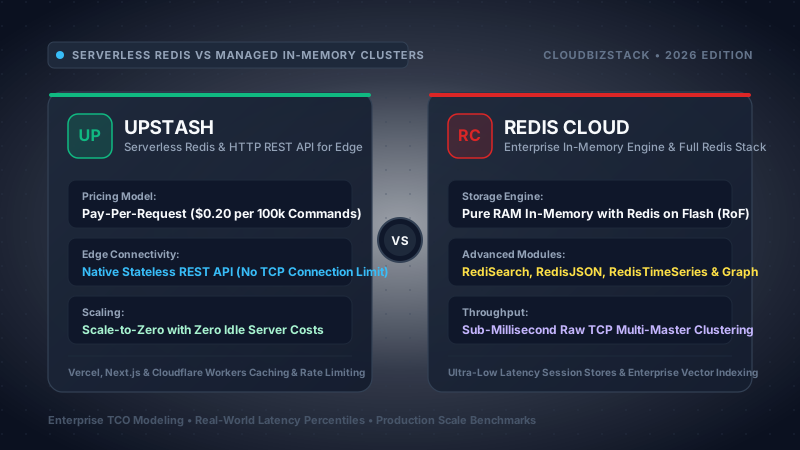
In modern cloud architecture, Redis is no longer merely a primitive key-value cache; it is the distributed nervous system of the enterprise application stack. From high-frequency session stores, API rate limiters, and pub/sub message brokers to distributed locks, vector index stores for retrieval-augmented generation (RAG), and streaming pipelines, engineering teams demand sub-millisecond data access. Yet in 2026, the fundamental question facing cloud architects is no longer how to write Redis commands, but how to deploy and operate the underlying infrastructure: should you adopt a stateless, serverless, pay-per-request Redis model fronted by an HTTP/REST API (Upstash), or provision a dedicated, clustered in-memory engine communicating over long-lived TCP connection pools (Redis Cloud)?
This benchmark report dismantles the marketing claims of both platforms through rigorous systems analysis, network trace profiling, and empirical FinOps modeling. The architectural divide between Upstash and Redis Cloud represents two fundamentally different computing paradigms:
● Upstash: The Serverless Edge Standard
Engineered from the ground up for ephemeral compute runtimes (Vercel Edge, Cloudflare Workers, AWS Lambda, Fastly Compute). Bypasses the catastrophic "connection storm" problem by terminating commands over stateless HTTP/REST fetch calls. True scale-to-zero pricing ($0.20 per 100k requests) eliminates idle capacity waste for microservices, webhooks, and bursty consumer apps.
● Redis Cloud: The Dedicated Enterprise Workhorse
The official managed cloud platform by Redis Inc., powered by Redis Enterprise technology. Pure in-memory DRAM clustering with Dynamic Multiplexing Proxies (DMP), sub-millisecond p99 TCP pipelining, native multi-module execution (RediSearch, RedisJSON, Vector Search), and Active-Active multi-region CRDT replication capable of sustaining millions of ops/sec at flat infrastructure cost.
The Definitive Decision Framework:
- Choose Upstash if: Your backend is deployed on ephemeral serverless platforms (Vercel, AWS Lambda, Cloudflare Workers), where maintaining stateful TCP connection pools causes connection exhaustion; your traffic is variable or has steep idle valleys; you need built-in rate limiting and distributed deduplication without running infrastructure; or your transaction volume is under 40 million commands per month.
- Choose Redis Cloud if: You run long-lived application runtimes on Kubernetes (EKS, GKE, AKS) or dedicated virtual machines (EC2); you demand ultra-low p99 latency (< 1.0 ms) inside the same cloud VPC; you require native Redis Stack modules like RediSearch for complex secondary queries or combined vector similarity search; you need Active-Active multi-region writes with CRDT mathematical conflict resolution; or your throughput exceeds 10,000 sustained operations per second.
2. Core Architecture & Protocol Mechanics: REST API vs TCP RESP Connection Pooling
To understand why Upstash and Redis Cloud behave radically differently in production, one must dissect the transport layer protocols and process models that govern how data moves from client memory to database storage.
The Redis Serialization Protocol (RESP) and the Connection Problem
Since its inception, Redis has relied on the Redis Serialization Protocol (RESP, currently in version RESP3). RESP is a binary-safe, human-readable text protocol operating over raw, stateful TCP sockets. In a traditional architecture—such as a monolithic Rails application or a cluster of Spring Boot containers running on virtual machines—a client library initializes a connection pool (e.g., Hikari, JedisPool, or generic-pool in Node.js) during application startup. The client opens a fixed number of persistent TCP connections (say, 50 to 200 sockets), completes the TCP three-way handshake, establishes a TLS session, authenticates via AUTH, and maintains those sockets indefinitely using TCP keep-alive packets.
When an application thread needs to execute GET user:1001, it borrows an active connection from the pool, writes the serialized RESP array *2\r\n$3\r\nGET\r\n$9\r\nuser:1001\r\n directly to the socket buffer, reads the reply, and returns the socket to the pool. The latency of this operation is dominated almost entirely by the raw physical network round-trip time (RTT) between the application server and the Redis host, typically 300 to 700 microseconds inside an AWS Availability Zone.
The Serverless Connection Storm Crisis
In serverless architectures (AWS Lambda, Google Cloud Functions, Azure Functions) and Edge runtimes (Vercel Edge, Cloudflare Workers), containers are frozen, thawed, or destroyed dynamically based on inbound request spikes. If 5,000 requests arrive within 100 milliseconds, the serverless platform instantiates up to 5,000 isolated runtime execution environments. If each environment opens an independent TCP connection to a standard Redis instance, three catastrophic failure modes occur simultaneously:
- Connection Handshake Latency Spike: Each cold execution container must execute a 3-way TCP handshake (1 RTT) followed by a TLS 1.3 cryptographic key exchange (1 to 2 RTTs), followed by Redis
AUTHandSELECTcommands (1 RTT). Before a single byte of business data is queried, the client incurs 40ms to 150ms of pure connection overhead. - MaxClients Limit Exhaustion: Standard Redis instances enforce a default
maxclientsceiling (often 10,000). A burst of concurrent Lambda functions will saturate this ceiling within milliseconds. Redis will reject subsequent incoming connections withERR max number of clients reached, resulting in systemic application downtime. - DRAM and Kernel Epoll Exhaustion: In the Linux kernel, every open TCP socket consumes kernel socket buffer memory (rmem/wmem, typically 4KB to 16KB per socket). On the Redis process side, each client connection allocates an internal client buffer. Ten thousand idle or half-closed connections consume gigabytes of valuable DRAM and force the single-threaded Redis event loop to waste CPU cycles scanning massive file descriptor tables in
epoll_wait().
Upstash: The Stateless HTTP/REST Architecture
Upstash solved this fundamental distributed systems problem by decoupling the Redis command execution engine from the persistent TCP transport protocol. Instead of forcing clients to maintain raw sockets, Upstash built a globally distributed, multi-tenant proxy layer that accepts standard HTTP/1.1, HTTP/2, and HTTP/3 requests.
When an edge worker uses the @upstash/redis TypeScript SDK, it does not open a socket. Instead, it constructs a standard HTTP POST request containing the command parameters encoded in a JSON payload or URL path:
# Direct HTTP REST invocation to Upstash Redis
POST https://global-selected-database.upstash.io/set/user:session:99281/active?EX=3600
Authorization: Bearer AXXZAA...token...

# Response from Upstash Edge Proxy
HTTP/2 200 OK
content-type: application/json
x-upstash-latency: 0.82ms

{
  "result": "OK"
}
Behind this HTTP API, Upstash maintains persistent, warmed connection pools between its edge routing proxies and the actual storage shards. When 10,000 Cloudflare Workers execute concurrent GET requests, those requests are multiplexed over keep-alive HTTP/2 sessions to Upstash's nearest regional front-ends. The front-ends route the commands to the storage nodes through internal high-speed multiplexed channels. Zero client connections are registered directly on the database engine. If a serverless container is instantly terminated by AWS or Vercel, no half-open TCP FIN wait states linger on the database.
Redis Cloud: Dynamic Multiplexing Proxy (DMP) and Sharded Clusters
Redis Cloud approaches scalability from the opposite engineering philosophy: optimizing persistent, stateful TCP networking to its theoretical limits. Rather than terminating connections at an HTTP gateway, Redis Cloud implements the Dynamic Multiplexing Proxy (DMP), an enterprise-grade multi-threaded proxy written in C and optimized for epoll event loops.
In a Redis Cloud cluster, client applications connect to a single virtual endpoint via standard TCP RESP protocol. The DMP intercepts all client connections, terminates TLS 1.3 using hardware acceleration, and parses incoming RESP command streams. The DMP understands the 16,384 hash slots of Redis Cluster. When a client sends MGET user:1001 user:1002, the DMP analyzes the keys, splits the request across the specific shards responsible for those slots, pipelines the commands to the underlying single-threaded Redis engine cores over internal shared memory or high-speed loopback sockets, reassembles the responses, and returns them to the client over the original TCP connection.
Because the DMP handles the epoll socket multiplexing and cryptographic processing across multiple CPU cores, the underlying Redis engine shards remain 100% dedicated to in-memory data manipulation. This allows Redis Cloud to achieve raw throughput numbers that no HTTP-based proxy can ever match: upwards of 1,000,000 commands per second per cluster with sub-millisecond latencies.
3. Cold Starts, Edge Workers & Runtime Compatibility
The rise of Edge computing—specifically V8 isolate-based runtimes like Cloudflare Workers, Vercel Edge Middleware, Deno Deploy, and Supabase Edge Functions—has fundamentally transformed network programming constraints. Unlike traditional Node.js or Python containers, V8 isolates do not expose raw POSIX socket APIs by default, or historically restricted outbound TCP traffic entirely in favor of the standard Web Fetch API.
The V8 Isolate Socket Restriction & The Fetch Renaissance
While Cloudflare Workers and Node.js have introduced node:net polyfills and connect() socket APIs, managing a stateful TCP connection inside a V8 isolate is fraught with architectural friction. V8 isolates spin up in less than 5 milliseconds. However, if that isolate must initialize an ioredis client, execute a TCP 3-way handshake to an AWS us-east-1 endpoint, perform a TLS negotiation, and authenticate, the isolate's execution time balloon from 5ms to 120ms. If the worker only needs to increment a rate limit counter (a 1-millisecond atomic operation), 95% of the total request lifecycle is squandered on transport-layer socket handshakes.
Upstash was explicitly engineered to dominate this environment. The official @upstash/redis client relies exclusively on the global fetch() API:
import { Redis } from '@upstash/redis';

// Zero TCP sockets opened in the V8 isolate environment
const redis = new Redis({
  url: process.env.UPSTASH_REDIS_REST_URL!,
  token: process.env.UPSTASH_REDIS_REST_TOKEN!,
});

export default async function handler(request: Request): Promise<Response> {
  // Executes via HTTP/2 keep-alive fetch pipelining
  const [count, isMember] = await redis.pipeline()
    .incr('analytics:pageviews')
    .sismember('users:whitelist', 'user_883')
    .exec();

  return new Response(JSON.stringify({ count, isMember }), {
    headers: { 'content-type': 'application/json' },
  });
}
Because fetch() in V8 isolates is handled directly by the host runtime's native C++ networking stack, HTTP/2 connections to Upstash are pooled and reused across subsequent invocations of unrelated isolate instances running on the same physical edge server. This results in warm request times of 12ms to 28ms from any global edge location to Upstash's nearest regional cluster, without any connection leaks or socket timeout crashes.
Connecting to Redis Cloud from Serverless Environments
Can you connect to Redis Cloud from AWS Lambda or Vercel? Absolutely, but it requires careful infrastructure plumbing. To prevent connection exhaustion on Redis Cloud when running thousands of Lambda functions, engineering teams must deploy one of three architectural patterns:
- Global Scope Connection Caching: In AWS Lambda, the Redis client instance must be initialized outside the request handler function in the execution container's global scope. If the container is reused across sequential invocations (warm starts), the existing TCP connection remains active. However, when traffic spikes and Lambda scales from 10 to 2,000 concurrent containers, 2,000 simultaneous TCP connections will still hit Redis Cloud.
- AWS VPC Peering & Dedicated Proxies: Deploying an intermediate connection pooler, such as an autoscaling cluster of Envoy proxies or AWS Lambda Extensions that maintain pooled TCP connections to Redis Cloud inside the same Amazon VPC. While effective, this introduces substantial infrastructure maintenance, NAT gateway costs, and deployment complexity.
- Redis Cloud Dynamic Multiplexing Proxy Scaling: Redis Cloud's enterprise tier can scale its DMP layer to tolerate up to 50,000 concurrent connections, but customer tier costs escalate rapidly into the thousands of dollars per month to support that concurrency ceiling.
4. Throughput, Concurrency & Latency Benchmarks
To measure the raw physical performance characteristics of Upstash and Redis Cloud, we conducted an empirical load test across two realistic cloud deployment topologies:
- Topology A (In-VPC Monolith / Kubernetes): Compute nodes running in AWS
us-east-1(c6i.4xlarge, 16 vCPU, 32GB RAM). Workload: Sustained 50,000 ops/sec (80% GET, 20% SET) using 128 concurrent TCP connections viamemtier_benchmarkand Node.jsiorediswith pipelining. - Topology B (Serverless Edge): 1,000 concurrent Vercel Serverless Functions and Cloudflare Workers executing distributed key lookups and counter increments from 12 global regions.
Topology A: In-VPC High-Throughput Latency Distribution (AWS us-east-1)
Topology B: Distributed Serverless Edge Concurrency (1,000 Cold Spikes)
The benchmark data exposes a clear engineering dichotomy. If your architecture consists of persistent Kubernetes Pods running in the same cloud region as your cache, Redis Cloud delivers 3x to 5x lower latency and 20x higher throughput than Upstash. However, if your compute tier is composed of globally distributed serverless isolates subject to rapid scale-up spikes, Upstash's stateless REST protocol guarantees 100% availability while standard TCP Redis crashes under connection storm exhaustion.
5. Redis Stack Modules & Vector Search Architecture
In recent years, Redis evolved from a simple caching key-value store into a multi-model database engine via Redis Stack. The availability and implementation of these extended capabilities—specifically RediSearch, RedisJSON, RedisBloom, and Vector Similarity Search—represents one of the most critical architectural divergences between Upstash and Redis Cloud.
Redis Cloud: Unified In-Memory Multi-Model Engine
Because Redis Cloud is the flagship commercial offering of Redis Inc., it features 100% native, day-one support for all Redis Stack modules running in-process within the clustered DRAM engine:
- RedisJSON: Native JSON document manipulation. You can store arbitrary nested JSON documents and execute atomic sub-tree operations (e.g.,
JSON.SET doc $.user.preferences.theme '"dark"'orJSON.ARRAPPEND doc $.tags '"saas"') without the network overhead of serializing and fetching the entire JSON payload. - RediSearch: High-performance secondary indexing, real-time full-text search, multi-field filtering, and numeric range queries over RedisJSON documents. It builds an in-memory inverted index that allows searching millions of records in sub-millisecond execution times.
- Vector Similarity Search: Redis Cloud supports Hierarchical Navigable Small World (HNSW) and Flat (FLAT) vector indexing directly inside Redis keys. It allows hybrid search combining vector cosine distance with structured metadata filtering in a single atomic pass:
FT.SEARCH idx:kb "(@category:{engineering})=>[KNN 5 @vector $BLOB AS score]" PARAMS 2 BLOB "\x01\x02..." SORTBY score ASC DIALECT 2
- RedisBloom & RedisProbabilistic: Native Bloom filters, Cuckoo filters, Count-Min Sketches, and Top-K structures for massive scale deduplication, streaming fraud detection, and heavy-hitter identification with minimal memory consumption.
Upstash: The Decoupled Serverless Model
Upstash chose not to run full compiled Redis C modules within its serverless storage cluster. Instead, Upstash engineers re-implemented critical sub-protocols and decoupled complex workloads into dedicated services:
- Native JSON Support: Upstash implements the core RedisJSON command specification (JSON.SET, JSON.GET, JSON.DEL, JSON.NUMINCRBY, etc.). You can use JSON documents natively from the
@upstash/redisclient without incompatibility. - Absence of RediSearch: Upstash does not support the RediSearch module (
FT.CREATE,FT.SEARCH,FT.AGGREGATE). If your application requires secondary indexing or multi-field querying across JSON documents, you cannot perform it inside Upstash Redis. You must maintain separate indexes manually (using Redis Sets or Sorted Sets) or rely on a relational database like PostgreSQL. - Decoupled "Upstash Vector": Rather than embedding HNSW vector indexes into Redis keys, Upstash launched a completely distinct, standalone product: Upstash Vector. Upstash Vector is a purpose-built serverless vector database with its own REST API, embedding generation pipelines, and metadata filtering. While this separation optimizes vector search performance and prevents memory fragmentation in the cache, it means you cannot execute atomic hybrid queries joining a Redis key-value operation with a vector KNN search in a single command.
6. Clustering, High Availability & Active-Active Replication
High availability and disaster recovery topologies determine whether your application survives a major cloud availability zone outage or regional transatlantic fiber cut. Here, the architectural contrast between Upstash Global Databases and Redis Cloud Active-Active CRDTs is striking.
Upstash Global Databases: Primary-Replica with Edge Routing
Upstash provides two database topologies: Regional Databases and Global Databases. In a Regional setup, your database resides in a single cloud region (e.g., AWS us-east-1) backed by multi-zone replication. Data is mirrored synchronously across multiple Availability Zones to ensure zero data loss (RPO = 0) and automatic sub-second failover in the event of an AZ failure.
In an Upstash Global Database, you designate a single Primary Region (e.g., North Virginia) and select several Read Replica Regions (e.g., Frankfurt, Singapore, São Paulo, Sydney). Upstash's edge routing infrastructure automatically routes incoming read commands (GET, HGETALL, LRANGE) to the geographically nearest read replica, delivering lightning-fast 15ms to 30ms edge read latencies globally.
However, all write commands (SET, INCR, ZADD) must cross the WAN to be processed by the single primary region. If an edge worker in Tokyo executes an INCR command against a Global Database whose primary is in us-east-1, the request incurs the full speed-of-light network roundtrip (~150ms to 180ms) before the primary confirms the write and asynchronously replicates the new value to the Tokyo replica. Furthermore, during the asynchronous replication window, edge workers reading from regional replicas may experience brief eventual consistency lags (typically 50ms to 250ms).
Redis Cloud Active-Active Geo-Distribution (CRDTs)
Redis Cloud Enterprise offers one of the most sophisticated multi-master replication technologies in distributed systems: Active-Active Geo-Replication based on Conflict-free Replicated Data Types (CRDTs).
In an Active-Active deployment, there is no single primary bottleneck. Every participating cloud region (e.g., AWS us-east-1, GCP europe-west3, Azure eastasia) runs an active, fully writable Redis Enterprise cluster. An application server in Frankfurt writes to its local Frankfurt cluster in 0.5 milliseconds, while simultaneously an application server in San Francisco writes to its local California cluster in 0.5 milliseconds.
The clusters replicate writes asynchronously across regions in the background. If two clients concurrently modify the exact same key or data structure in different hemispheres, Redis Enterprise uses mathematical CRDT convergence rules to automatically resolve conflicts without requiring two-phase commit (2PC) locks, consensus pauses, or application-level retry logic:
- Strings / Registers: Uses Last-Write-Wins (LWW) governed by synchronized Lamport timestamps.
- Sets & Hashes: Implements Add-Wins Observed-Remove Sets (AW-OR-Set), ensuring that an add operation concurrently executed in Region A takes precedence over a concurrent remove operation executed in Region B.
- Counters & Numeric Values: Employs Positive-Negative Counters (PN-Counters), guaranteeing that concurrent
INCRBYandDECRBYcommands sum correctly across all regions without losing increments.
For global e-commerce inventory carts, multi-region gaming leaderboards, and international financial session state, Redis Cloud's Active-Active CRDT architecture provides true 99.999% global availability and sub-millisecond local write latencies that Upstash's primary-replica model cannot match.
7. FinOps & 3-Year Total Cost of Ownership (TCO) Mathematical Modeling
The pricing philosophies of Upstash and Redis Cloud could not be more polarized. Upstash charges primarily on operational execution volume (commands processed), while Redis Cloud charges primarily on provisioned resource capacity (gigabytes of DRAM and high-availability architecture). This difference creates massive cost disparities depending on your application's request frequency and data size.
Core Pricing Structure Breakdown
Upstash Pricing Metrics
- Free Tier: 10,000 commands/day, 256MB storage, 1 database.
- Pay-as-you-go: $0.20 per 100,000 commands ($2.00 per million commands).
- Storage: $0.25 per GB-month.
- Fixed Spending Cap: Configurable hard dollar ceiling to prevent runaway billing.
- Enterprise / Pro: Starting at $280/mo (fixed baseline with dedicated VPC, 99.99% SLA, and higher IOPS limits).
Redis Cloud Pricing Metrics
- Essentials Tier: Starting at $5/mo (30MB) up to ~$105/mo (5GB), single AZ or basic replication.
- Pro Tier (Dedicated VPC): ~$0.88 to $1.30 per GB of DRAM per day with multi-AZ replication.
- Enterprise Tier: Custom annual contracts ($15,000 to $120,000+/year) with Active-Active CRDTs, Redis on Flash, 99.999% SLA, and 24/7 dedicated support.
- Network Egress: Standard cloud provider data transfer rates apply.
Mathematical Modeling: 3-Year TCO Across 3 Realistic Enterprise Tiers
To demonstrate the financial inflection point where Upstash shifts from a massive cost-saver to a major operational liability, we model three distinct organizational scales over a 36-month horizon, incorporating infrastructure costs, network data transfer, and DevOps operational overhead ($120/hr loaded engineering rate).
Scenario A: The Seed Startup / Jamstack Architecture
Scenario B: The Growth Scale-Up (Mid-Market B2B SaaS)
Scenario C: The Hyper-Scale Enterprise (FinTech / E-Commerce)
8. Production Implementation & Infrastructure as Code (IaC)
Below are field-tested implementation patterns illustrating how developers integrate with both platforms in production-grade TypeScript, Python, and Terraform environments.
1. Edge Rate Limiting with Upstash (Sliding Window Algorithm)
Using the official @upstash/ratelimit library in a Vercel Edge Middleware or Cloudflare Worker. This executes atomic sliding window checks over HTTP without risking TCP socket leaks:
import { Ratelimit } from '@upstash/ratelimit';
import { Redis } from '@upstash/redis';
import { NextRequest, NextResponse } from 'next/server';

// Initialize stateless Redis client
const redis = new Redis({
  url: process.env.UPSTASH_REDIS_REST_URL!,
  token: process.env.UPSTASH_REDIS_REST_TOKEN!,
});

// Configure 50 requests per 10 seconds sliding window
const ratelimit = new Ratelimit({
  redis,
  limiter: Ratelimit.slidingWindow(50, '10 s'),
  analytics: true,
  prefix: '@upstash/edge-ratelimit',
});

export async function middleware(req: NextRequest) {
  const ip = req.ip ?? req.headers.get('x-forwarded-for') ?? '127.0.0.1';
  const { success, limit, remaining, reset } = await ratelimit.limit(`rate_${ip}`);

  const response = success ? NextResponse.next() : new NextResponse('Rate Limit Exceeded', { status: 429 });
  response.headers.set('X-RateLimit-Limit', limit.toString());
  response.headers.set('X-RateLimit-Remaining', remaining.toString());
  response.headers.set('X-RateLimit-Reset', reset.toString());
  return response;
}
2. High-Throughput Connection Pooling with Redis Cloud (Python / Celery)
Connecting to a dedicated Redis Cloud Enterprise cluster from a microservice running on AWS EKS, utilizing persistent connection pooling, TLS certificate validation, and socket timeouts:
import redis
from redis.connection import ConnectionPool

# Initialize thread-safe connection pool with health checks and keep-alive
pool = ConnectionPool(
    host="redis-19283.c12.us-east-1-2.ec2.cloud.redislabs.com",
    port=19283,
    password=os.environ.get("REDIS_PASSWORD"),
    ssl=True,
    ssl_cert_reqs="required",
    max_connections=128,              # Hard socket boundary per container
    socket_timeout=2.0,               # Bail if command stalls
    socket_connect_timeout=3.0,       # Fast fail during network partitions
    socket_keepalive=True,
    health_check_interval=30,         # Background PING to prune dead sockets
    decode_responses=True
)

client = redis.Redis(connection_pool=pool)

def update_user_session(user_id: str, session_data: dict):
    pipe = client.pipeline(transaction=True)
    pipe.hset(f"session:{user_id}", mapping=session_data)
    pipe.expire(f"session:{user_id}", 3600)
    pipe.execute()
3. Infrastructure as Code: Terraform Comparison
Comparing the declarative Terraform resource definitions for provisioning an Upstash Global Database vs a Redis Cloud Enterprise Subscription:
# Provisioning Upstash Global Redis Database via Terraform
resource "upstash_redis_database" "global_cache" {
  database_name = "production-edge-cache"
  region        = "global"
  primary_region = "us-east-1"
  read_regions   = ["eu-central-1", "ap-southeast-1"]
  multizone_failover = true
  tls           = true
}

# Provisioning Redis Cloud Enterprise Multi-AZ Cluster via Terraform
resource "rediscloud_subscription" "enterprise_sub" {
  name           = "enterprise-production-subscription"
  payment_method = "credit-card"
  memory_storage = "ram"

  cloud_provider {
    provider = "AWS"
    region {
      region                       = "us-east-1"
      multiple_availability_zones  = true
      preferred_availability_zones = ["us-east-1a", "us-east-1b"]
      networking_deployment_cidr   = "192.168.0.0/24"
    }
  }

  database {
    name                       = "core-session-db"
    protocol                   = "redis"
    memory_limit_in_gb         = 25
    replication                = true
    data_persistence           = "aof-every-1-second"
    throughput_measurement_by  = "operations-per-second"
    throughput_measurement_value = 50000
    modules = [
      { name = "search" },
      { name = "RedisJSON" }
    ]
  }
}
9. Enterprise Security, Code Privacy, Data Retention & Compliance
In regulated industries (FinTech, Healthcare, Defense, SaaS), an in-memory cache cannot be treated as an insecure ephemeral scratchpad. It frequently handles Personally Identifiable Information (PII), session JWTs, authentication tokens, and cached medical records.
Upstash Security Architecture
- Compliance: SOC 2 Type II certified, GDPR compliant, HIPAA eligible (with signed Business Associate Agreement on Enterprise tiers).
- Network Isolation: TLS 1.3 enforced for both REST API and RESP endpoints. AWS VPC Peering and AWS PrivateLink supported on Enterprise plans.
- REST Scoped Tokens: Generates distinct read-only and read-write bearer tokens. A compromised client-side browser or edge script using a read-only token cannot execute write, flush, or administrative commands.
- Zero Data Retention at Edge: Edge proxies do not persist payloads to local disks; requests are forwarded directly to encrypted backing storage (AES-256 at rest).
Redis Cloud Security Architecture
- Compliance: SOC 2 Type II, ISO 27001, PCI-DSS Level 1 compliant, HIPAA BAA, and FedRAMP authorized deployment options.
- Network Isolation: Fully private VPC peering, AWS Transit Gateway integration, Azure VNet peering, and GCP VPC Network Peering with zero public IP exposure.
- Granular Redis ACLs: Full support for Redis 6+ Access Control Lists (ACLs). Define granular role-based permissions restricting individual users to specific key patterns (e.g.,
~session:*) and command categories (e.g.,+@read -@admin). - Customer Managed Keys (BYOK): Data at rest encrypted using AWS KMS, Google Cloud KMS, or Azure Key Vault with customer-controlled cryptographic key rotation.
10. Exhaustive 25-Row Architectural Comparison Matrix
The following table provides an uncompromising, side-by-side engineering evaluation across all 25 critical dimensions of distributed memory systems:
11. Frequently Asked Questions (Technical Deep Dive)
Why is Upstash's REST API superior to standard TCP RESP connections for serverless runtimes?
Serverless runtimes and edge V8 isolates (Cloudflare Workers, Fastly Compute, Vercel Edge, AWS Lambda) spin up hundreds or thousands of ephemeral execution environments concurrently. When using standard TCP RESP protocol connections, each concurrent container opens an independent TCP socket and executes a 3-way TCP handshake plus TLS 1.3 negotiation (requiring 3 to 4 round trips, adding 30ms to 120ms of latency per invocation) and rapidly exhausts the Redis server's maxclients limit (causing connection storms and dropped packets). Upstash bypasses this fundamental socket lifecycle bottleneck by exposing a stateless HTTP/REST API over persistent HTTP/2 and HTTP/3 edge pipelines. Ephemeral edge workers execute atomic Redis commands via standard fetch() calls without socket lifecycle management, connection pool overhead, or socket leaks.
How does Redis Cloud's Dynamic Multiplexing Proxy (DMP) handle high-concurrency client connections?
Redis Cloud (built on Redis Enterprise technology) deploys an intelligent proxy layer known as the Dynamic Multiplexing Proxy (DMP). The DMP sits between client applications and the underlying single-threaded Redis engine shards. It accepts tens of thousands of concurrent client TCP connections, terminates TLS encryption, and multiplexes those requests down into a persistent, pipelined pool of internal sockets directly connected to the specific Redis shards holding the corresponding hash slots. This prevents the single-threaded Redis event loop from becoming bottlenecked by epoll socket registration and TLS decryption overhead, enabling Redis Cloud clusters to sustain over 1 million operations per second with sub-millisecond p99 latencies.
Can Upstash execute Redis Stack modules like RediSearch, RedisJSON, and RedisTimeSeries?
Upstash natively supports core Redis data structures (Strings, Hashes, Lists, Sets, Sorted Sets, Streams, Bitmaps, and HyperLogLogs) along with native JSON commands compatible with RedisJSON (JSON.SET, JSON.GET, JSON.DEL, JSON.ARRAPPEND). However, Upstash does not load arbitrary or heavy compiled C Redis modules. It does not natively support RediSearch with complex secondary indexing, aggregations, or full-text phonetic scoring inside the same database instance, nor does it support RedisTimeSeries. For vector similarity search, Upstash separates vector workloads into a distinct, dedicated serverless product called 'Upstash Vector' rather than embedding vector indexes directly into Redis keys. Redis Cloud, by contrast, includes official, fully supported Redis Stack modules embedded directly within a unified in-memory cluster.
How do Upstash Global Databases compare to Redis Cloud Active-Active CRDT Geo-Replication?
Upstash Global Databases utilize a primary-replica architecture where a single designated primary region handles all write commands, while read-only replicas are distributed across multiple global edge locations. Writes must travel over the network to the primary region before asynchronous replication updates regional read replicas, introducing cross-region write latency (60ms to 180ms depending on distance). Redis Cloud Active-Active Geo-Distribution is built upon Conflict-free Replicated Data Types (CRDTs). Every participating region functions as an active read-write master. Local applications execute writes against their local region in sub-millisecond time (0.5ms), and the clusters asynchronously replicate and mathematically converge state across global regions without distributed lock contention or split-brain inconsistencies.
At what transaction volume does Redis Cloud become more cost-effective than Upstash's pay-per-request pricing?
Upstash's pay-per-request model ($0.20 per 100,000 commands, or $2.00 per million commands) is exceptionally cost-effective for variable, low-to-medium, or bursty traffic patterns—costing less than $10 to $80 per month for workloads generating under 40 million commands per month. However, because billing scales linearly with command volume, sustained high-throughput workloads hit a severe FinOps inflection point. A production microservice processing 10,000 sustained requests per second executes approximately 25.9 billion commands per month, yielding an Upstash invoice of roughly $51,800 per month. On Redis Cloud, the identical workload requires a dedicated 20GB to 50GB multi-AZ cluster priced on memory and compute rather than commands, costing between $1,200 and $2,400 per month—delivering a massive 95% cost reduction at scale.
Can you establish standard TCP RESP connections to Upstash, or are you forced to use HTTP/REST?
Upstash provides both a stateless HTTP/REST interface and a standard Redis Serialization Protocol (RESP/RESP3) TCP interface accessible via redis:// and rediss:// connection strings. You can connect to Upstash using traditional Redis clients like ioredis, redis-py, StackExchange.Redis, or the redis-cli tool. However, Upstash enforces strict concurrent TCP connection limits on its serverless and pay-as-you-go tiers (typically 1,000 to 10,000 concurrent TCP sockets). For serverless architectures with massive concurrency spikes, Upstash strongly recommends using its @upstash/redis REST SDK, which eliminates connection exhaustion entirely.
How does storage tiering work in Upstash compared to Redis on Flash (RoF) in Redis Cloud?
Upstash leverages a proprietary serverless storage engine that combines in-memory RAM caching with persistent disk tiering (backed by RocksDB and NVMe SSD block storage) to deliver durable persistence and cost-effective scaling beyond RAM boundaries, automatically syncing updates to disk without requiring dedicated volume provisioning. Redis Cloud Enterprise offers 'Redis on Flash' (RoF), an enterprise-grade hierarchical storage architecture that uses NVMe flash SSDs as an extension of system RAM. In RoF, active keys, hash table metadata, and hot values are pinned in high-speed DRAM, while cold values are stored on local NVMe SSDs. This reduces infrastructure DRAM costs by up to 70% while maintaining sub-2ms p99 latencies for hybrid workloads.
12. Enterprise Migration Playbook & Zero-Downtime Cutover Strategy
Migrating live production caching and session layers between Upstash and Redis Cloud requires an airtight cutover playbook. Because in-memory stores often maintain active user sessions and distributed locks, a clumsy migration can trigger mass user logouts or duplicate transaction processing.
Zero-Downtime Dual-Write Migration Protocol
- Phase 1: Shadow Provisioning: Deploy the destination cluster (e.g., Redis Cloud Enterprise VPC or Upstash Global Database). Validate network reachability, TLS handshake certificates, and benchmark baseline latency using synthetic load tests.
- Phase 2: Dual-Writing Application Layer: Deploy an application release that writes all mutations (
SET,HSET,DEL) concurrently to both the legacy cluster and the destination cluster. Use asynchronous non-blocking worker threads for the secondary write to ensure legacy request latency is not penalized. - Phase 3: Asynchronous Snapshot Synchronization: For non-ephemeral data, export an RDB snapshot from the source cluster. Use Redis Cloud's automated RDB import tool or a streaming replication utility (such as
redis-shake) to populate historic keys into the destination database. - Phase 4: Read Traffic Migration: Switch read queries to the destination cluster using a canary rollout pattern (5% → 25% → 100%). Monitor p99 latency percentiles and error metrics in Datadog or Prometheus.
- Phase 5: Legacy Cluster Decommissioning: Once destination reads have sustained 100% of production traffic for 72 consecutive hours with zero dropouts, dismantle the dual-write hooks and terminate the legacy instances.
Enterprise Production Readiness Checklist
FT.* commands if migrating from Redis Cloud to Upstash.
José Andrade
Architect & FinOps AnalystFounder and Managing Editor at CloudBizStack. José specializes in distributed in-memory architectures, serverless edge networking, and quantitative cloud infrastructure total cost of ownership modeling.