Cloudflare Zero Trust vs Zscaler: Enterprise SASE Benchmark (2026)
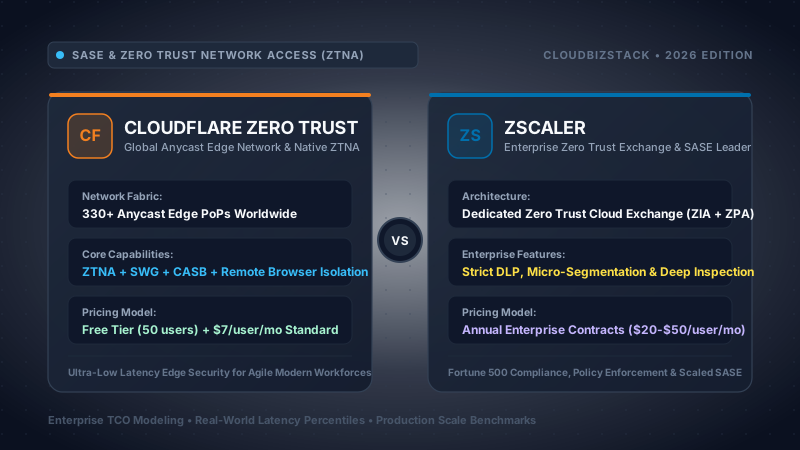
The enterprise migration from legacy hub-and-spoke hardware VPNs (Cisco AnyConnect, Palo Alto GlobalProtect) and on-premises proxy appliances to cloud-delivered Secure Access Service Edge (SASE) and Security Service Edge (SSE) has converged on two distinct engineering philosophies: Cloudflare Zero Trust (part of Cloudflare One) and Zscaler Zero Trust Exchange (ZIA, ZPA, ZDX, and ZCC). Both eliminate unsegmented network trust and inspect outbound Internet traffic, but their underlying network topologies, software runtimes, and commercial packaging diverge dramatically.
- You demand sub-20ms global edge latency powered by a 330+ Anycast PoP fabric where every server runs the full security stack.
- Your engineering organization prioritizes GitOps, developer velocity, Terraform IaC, and lightweight daemon deployments (
cloudflared). - You need mobile and remote worker endpoints powered by modern, lightweight WireGuard crypto (WARP) with minimal CPU and battery drain.
- You require radical FinOps cost efficiency: transparent list pricing starting at $7/user/month without by-the-drink modular markups.
- You are a Global 2000 conglomerate or federal entity requiring deep compliance certifications (FedRAMP High, DoD IL5).
- You require advanced, petabyte-scale Exact Data Match (EDM) and Indexed Data Match (IDM) DLP with automated OCR for sensitive document control.
- Your security operations mandate inline Cloud Sandboxing with behavioral execution and "quarantine while detonating" zero-day prevention.
- Your enterprise has an established SecOps hierarchy comfortable with classic enterprise proxy hierarchies, PAC files, and complex sales-negotiated licensing tiers.
Architectural Analysis Index
1. Executive Summary & Decision Matrix by Enterprise Persona
Modern corporate cybersecurity has reached an inflection point. The traditional castle-and-moat architecture—where corporate assets lived inside protected physical subnets and mobile workers dialed in via split-tunnel hardware VPNs—is obsolete. Cloud-first application adoption, ubiquitous remote workforces, and sophisticated supply-chain attacks require an absolute Zero Trust posture: verify explicitly, grant least-privilege access at Layer 7, and assume breach across all endpoints and networks.
In this landscape, Cloudflare Zero Trust and Zscaler Zero Trust Exchange represent the two dominant architectures. While marketing brochures often use interchangeable terminology—Secure Web Gateway (SWG), Zero Trust Network Access (ZTNA), Cloud Access Security Broker (CASB), and Cloud Browser Isolation (CBI)—their engineering implementations differ fundamentally:
- Cloudflare One (Zero Trust): Built as an organic extension of Cloudflare's massive global content delivery and DDoS mitigation network. Cloudflare operates on a homogenous software architecture where every single commodity server across 330+ Anycast points of presence executes the entire software stack—DNS resolution, eBPF packet routing, TLS termination, WAF, Gateway inspection, and V8 isolate compute—simultaneously. Cloudflare eliminates proxy chaining entirely, using Rust and single-pass pipelines to inspect traffic with near-zero latency degradation.
- Zscaler Zero Trust Exchange: Designed from the ground up as a cloud-native enterprise proxy fabric. Zscaler separates its architecture into a centralized control plane (Central Authority) and a distributed data plane consisting of 150+ Public Service Edges (PSEs). Zscaler's foundation is built on deep enterprise policy enforcement, proxy auto-configuration (PAC) steering, and its proprietary Single-Scan Multi-Action (SSMA) inspection engine, offering specialized, battle-tested compliance capabilities such as multi-column database Exact Data Match (EDM) DLP and full OS behavioral sandboxing.
| Enterprise Persona | Optimal SASE Platform | Primary Technical Justification | Key Trade-off / Consideration |
|---|---|---|---|
| Cloud-Native Scale-Up & Tech Startups (100 - 1,500 users) | Cloudflare Zero Trust | Self-serve onboarding, transparent $7/user list pricing, GitOps Terraform automation, lightweight cloudflared daemon, zero sales friction. |
Less comprehensive pre-built compliance workflows for niche financial/healthcare frameworks. |
| Mid-Market Enterprise Modernization (1,000 - 7,500 users) | Cloudflare Zero Trust | Rapid decommissioning of legacy Cisco/Palo Alto VPNs, WireGuard performance, browser-rendered SSH/RDP, 65% lower 3-year TCO. | Requires modernizing internal workflows away from legacy PAC files to modern agent-based steering. |
| Global 2000 Banking & Healthcare (10,000+ users) | Zscaler Zero Trust Exchange | Exact Data Match (EDM) DLP with billion-record hashing, FedRAMP High / DoD IL5 certifications, inline sandboxing with file quarantine. | High licensing complexity, expensive add-on modules, higher latency variance via Geo-DNS steering. |
| Distributed Remote Engineering Organizations | Cloudflare Zero Trust | Native developer experience, multi-IdP support (Okta + GitHub + Google simultaneously), service tokens for CI/CD, Vector Browser Isolation. | Requires internal teams to manage infrastructure via declarative code rather than enterprise GUI wizards. |
| Federal Agencies & Defense Contractors | Zscaler Zero Trust Exchange | Mature government cloud environments (Zscaler for Government), DoD IL5 authorization, dedicated federal operations centers. | Lengthy procurement cycles, heavy professional services dependency, high ongoing operational overhead. |
2. Global Edge Topology: Anycast Edge Fabric vs Geo-DNS Central Authority
The performance and reliability of any SASE platform depend fundamentally on its underlying network topology. A security service edge must intercept, decrypt, evaluate, and re-encrypt enterprise traffic without introducing human-perceptible latency or jitter. Here, Cloudflare and Zscaler diverge in their foundational network engineering: BGP Anycast routing across a homogenous software fleet versus Geo-DNS dispatch across a dual-plane proxy mesh.
Cloudflare's BGP Anycast Fabric & eBPF Ingress Pipeline
Cloudflare operates across 330+ cities in over 120 countries, interconnected with more than 13,000 distinct networks and major Internet Exchange Points (IXPs), offering a massive aggregate edge capacity exceeding 320 Tbps. Crucially, Cloudflare utilizes BGP Anycast across its entire footprint. In an Anycast network, the identical IPv4 (/24) and IPv6 (/48) address prefixes are announced simultaneously from every single PoP worldwide.
When a remote worker's WARP client or an office branch router dispatches an IP packet destined for Cloudflare Gateway or Cloudflare Access, the global Internet routing fabric automatically routes the packet along the shortest Autonomous System (AS) path to the topologically closest Cloudflare data center. Over 95% of the world's connected population sits within 50 milliseconds of a Cloudflare PoP, and in major enterprise metropolitan areas, edge latency regularly clocks in between 4ms and 15ms.
Cloudflare implements its ingress packet filtering and load distribution directly in the Linux kernel using eBPF (Extended Berkeley Packet Filter) and XDP (eXpress Data Path). Packets arriving at the network interface card (NIC) driver are evaluated in sub-microsecond timeframes before the Linux kernel network stack even allocates an sk_buff data structure. Cloudflare's proprietary L4 load balancer (Unimog) uses consistent hashing to steer packets to worker processes without session termination, even during PoP maintenance or route flap events.
Zscaler Zero Trust Exchange: Dual-Plane Architecture & Geo-DNS Steering
Zscaler organizes its infrastructure around a split architecture:
- Central Authority (CA): Hosted in major public cloud regions (primarily AWS and Azure). The CA maintains the global policy repository, tenant configurations, device state brokers, and user authentication sessions. When administrators configure access policies or users log in, they interact with the CA.
- Public Service Edges (PSE): Distributed across approximately 150+ colocation data centers worldwide. PSEs are the high-throughput proxy engines that perform inline SSL decryption, content inspection, antivirus scanning, and policy enforcement.
Unlike Cloudflare's Anycast architecture, Zscaler historically relies on Unicast routing coupled with Geo-DNS resolution and PAC files. When a client running Zscaler Client Connector (ZCC) initializes, it queries a global DNS endpoint (such as gateway.zscaler.net). Zscaler's authoritative DNS servers inspect the client's source IP address or EDNS Client Subnet (ECS) extension to return the Unicast IP address of the closest Public Service Edge.
The Architectural Hazard of Geo-DNS in Hybrid Environments
Geo-DNS steering introduces several well-documented edge-case failure modes in enterprise networking:
- Recursive DNS Cache Poisoning & Mismatched Geography: If a roaming employee in Tokyo uses a corporate VPN or public recursive DNS server whose egress node is located in Singapore, Zscaler's Geo-DNS server will resolve the user's nearest PSE to Singapore. The client is forced to hairpin across the Pacific, adding 80ms to 120ms of round-trip latency to every connection.
- ISP Route Asymmetry: Geo-DNS operates purely at Layer 7 (DNS names). It has no visibility into Layer 3 BGP peering congestion. If transit peering degrades between a regional ISP and Zscaler's local PSE, DNS continues steering traffic into the degraded node until manual operational intervention occurs.
- Failover Convergence Delays: When a Zscaler PSE experiences an outage, clients must wait for DNS TTL expiration (often cached aggressively by intermediate operating system resolvers) or wait for ZCC's synthetic probe to cycle and select an alternate secondary PSE, causing visible session drops and reconnection delays.
3. Deep Protocol Mechanics: WireGuard (WARP) vs DTLS/TLS Tunnel 2.0 (ZCC)
The endpoint client agent is the critical link between user workstations and the security cloud. If an agent introduces CPU spikes, crashes the OS network stack, or drains mobile battery life, user frustration quickly undermines enterprise Zero Trust adoption. The architectural divergence between Cloudflare WARP and Zscaler Client Connector (ZCC) is rooted in their choice of underlying tunneling protocol.
Cloudflare WARP: WireGuard & BoringTun Rust Engine
Cloudflare WARP is built upon the modern WireGuard protocol, implemented through BoringTun, Cloudflare's open-source, memory-safe user-space WireGuard engine written in Rust. WireGuard discards decades of cryptographic legacy found in OpenVPN and IPSec/IKEv2 in favor of an opinionated, ultra-modern cryptographic suite:
- Key Exchange: Curve25519 (Elliptic Curve Diffie-Hellman) for ephemeral session negotiation.
- Authenticated Encryption: ChaCha20-Poly1305 (RFC 7539) for high-speed symmetric payload encryption with integrated message authentication.
- Hashing & PRF: BLAKE2s for cryptographic hashing and cookie generation against denial-of-service floods.
- 1-RTT Cryptographic Handshake: WireGuard establishes secure sessions in a single network round-trip (~25ms), completely eliminating the multi-step handshake latency typical of legacy TLS/IKE negotiations.
- Cryptographically Stateless Connection: WireGuard endpoints do not maintain stateful TCP-like connection tables. Sessions are bound to cryptographic public keys rather than client IP/port tuples. When an employee walks out of the corporate office and their laptop switches from Wi-Fi to a 5G mobile hotspot, WARP seamlessly resumes transmitting data packets with zero reconnection delay, zero packet drops, and zero re-authentication prompts.
Standard WireGuard operates over UDP port 2408. In restrictive environments—such as hotel Wi-Fi networks, air-gapped financial branches, or foreign corporate firewalls—outbound UDP ports other than 53 or 443 are frequently blocked. Cloudflare WARP solves this via an automated protocol fallback mechanism: if UDP 2408 is unreachable, WARP encapsulates WireGuard frames inside MASQUE (Multiplexed Application Substrate over QUIC Encryption) over UDP port 443, or falls back to HTTP/2 CONNECT tunneling over TCP port 443, ensuring 100% connectivity anywhere in the world.
Zscaler Client Connector (ZCC): Tunnel 1.0 vs Tunnel 2.0 (DTLS/TLS)
Zscaler Client Connector (formerly Zscaler App / Z App) has evolved through two distinct generation protocols:
- Tunnel 1.0 (Legacy HTTP CONNECT): Operates as a local proxy redirector on the client. ZCC intercepts browser and application traffic and forwards it to the Zscaler Public Service Edge using HTTP CONNECT proxy tunnels over standard TCP port 80/443. While highly compatible with legacy networks, Tunnel 1.0 suffers severely from the TCP-over-TCP meltdown phenomenon. When network packet loss occurs, both the inner user application TCP stream and the outer proxy TCP stream trigger exponential backoff and retransmissions simultaneously, degrading throughput by up to 80% on noisy Wi-Fi or cellular connections.
- Tunnel 2.0 (DTLS with TLS Fallback): Introduced to resolve Tunnel 1.0 limitations. Tunnel 2.0 captures all client IP packets at the virtual network adapter level (using Wintun on Windows or NetworkExtension System Extensions on macOS) and encapsulates them within a Datagram Transport Layer Security (DTLS, RFC 6347) tunnel over UDP port 443. Because DTLS is datagram-based (running over UDP), it eliminates TCP-over-TCP head-of-line blocking. If UDP 443 is blocked, ZCC automatically falls back to TLS over TCP 443.
Path MTU Discovery (PMTUD) and Cryptographic Overhead Analysis
While Zscaler Tunnel 2.0 represents a massive leap forward over Tunnel 1.0, its DTLS implementation incurs notable engineering overhead. DTLS headers, coupled with IP encapsulation and X.509 certificate validation, require aggressive Maximum Transmission Unit (MTU) clamping. Standard Ethernet frames (1500 bytes) must be clamped down to 1360 or 1400 bytes. If intermediate enterprise routers drop ICMP "Fragmentation Needed" packets (Type 3, Code 4), PMTUD black-holing occurs, causing large file uploads or HTTPS POST requests to hang indefinitely.
In contrast, WireGuard's 32-byte fixed header overhead allows predictable MTU clamping (typically 1280 or 1420 bytes) with zero negotiation negotiation cycles. Furthermore, WireGuard's ChaCha20-Poly1305 cryptographic primitive performs up to 3x faster in software on mobile ARM processors (Apple Silicon, Qualcomm Snapdragon) without hardware AES engines, resulting in significantly lower battery consumption for remote mobile staff.
4. ZTNA & Private Application Access: Cloudflare Tunnels (cloudflared) vs ZPA App Connectors
Zero Trust Network Access (ZTNA) is defined by a central security tenet: never place remote users directly onto the corporate network subnet. Unlike traditional VPNs that assign an internal IP address and grant Layer 3 network-wide reachability (enabling lateral threat movement during ransomware events), modern ZTNA establishes application-level (Layer 7) micro-segmentation.
Cloudflare Access & Cloudflare Tunnels (cloudflared)
Cloudflare implements ZTNA through Cloudflare Access and its open-source reverse tunnel daemon, cloudflared. The architectural flow operates as follows:
- Outbound-Only Tunnel Establishment: Inside an AWS VPC, GCP project, or on-premises VMware cluster, the administrator deploys
cloudflared. The daemon establishes four persistent, outbound-only connections to two separate Cloudflare Anycast PoPs using HTTP/2 over TLS 1.3 or QUIC. No inbound ports (port 80, 443, 22) are ever opened on the corporate firewall. NAT and CGNAT traversal are automatic. - Edge Policy Interception: When a user attempts to access an internal resource (e.g.,
https://gitlab.internal.enterprise.com), Cloudflare's Anycast edge intercepts the request. The user is redirected to the enterprise Identity Provider (IdP) for multi-factor authentication (MFA). - Device Posture Verification: Concurrently, Cloudflare evaluates device health via the WARP client (verifying disk encryption, CrowdStrike Falcon agent status, OS patch level, and geographic location).
- Edge-to-Origin Proxying: If authenticated and authorized, Cloudflare's edge routes the request through the existing outbound tunnel directly to the origin service. The application server only sees traffic originating from the local
cloudflaredprocess on localhost.
A standout capability of Cloudflare Access is its native web-socket terminal rendering. Contractors, third-party auditors, and on-call engineers can securely access production Linux servers via SSH or Windows Server clusters via RDP directly within any modern web browser. Cloudflare terminates the session at the edge and renders the terminal using xterm.js or Guacamole over secure WebSockets. Third-party vendors require zero client software, zero VPN installation, and zero corporate certificate installation on their unmanaged personal machines.
Zscaler Private Access (ZPA) & App Connectors
Zscaler Private Access (ZPA) is the enterprise pioneer of commercial ZTNA. It replaces inbound enterprise VPN concentrators through a three-component brokering model:
- ZPA App Connector: A lightweight Linux virtual appliance (RHEL, CentOS, Ubuntu) deployed in customer subnets. Like
cloudflared, it makes outbound-only TLS connections to the nearest Zscaler Public Service Edge. - Zscaler Central Authority (CA): Serves as the global control plane broker. It authenticates users against enterprise SAML/SCIM IdPs, evaluates policy rules, and decides which App Connector and Public Service Edge should mediate the session.
- Public Service Edge (PSE): When authorized, the PSE stitches together an ephemeral mTLS connection between the client agent (ZCC) and the internal App Connector.
Zero Network Discovery & Micro-Segmentation Mechanics
ZPA excels at granular, application-specific segmentation. In ZPA, internal networks are never exposed; only discrete Application Segments (defined by FQDNs, wildcard domains, and specific TCP/UDP port ranges) are made reachable. If an attacker compromises an endpoint running ZCC, they cannot execute an nmap sweep or ping internal subnets. Unassigned IP addresses simply drop packets, and DNS queries for unauthorized applications return NXDOMAIN, rendering the internal corporate infrastructure completely invisible to unauthorized users.
5. Secure Web Gateway (SWG), Single-Pass Inspection & TLS Decryption Performance
Over 95% of enterprise web traffic is encrypted with TLS 1.3 or TLS 1.2. Consequently, a Secure Web Gateway cannot protect an organization against phishing, malware downloads, command-and-control (C2) callbacks, or data exfiltration without performing deep SSL/TLS inspection (man-in-the-middle decryption). However, TLS decryption is computationally punishing: asymmetric handshakes, certificate re-generation, and symmetric cryptographic ciphers require immense CPU resources.
Single-Pass Memory Models: Cloudflare Gateway vs Zscaler SSMA
Legacy security architectures chain multiple proxy appliances together: first a forward proxy for URL filtering, then a firewall for Layer 4 inspection, then an antivirus appliance, and finally a DLP scanner. Each hop requires packet buffering, TCP socket recreation, and inter-process context switching, adding 50ms to 200ms of cumulative latency.
Both Cloudflare and Zscaler utilize modern single-pass inspection engines, but their execution models differ:
- Cloudflare Gateway (Unified Rust Runtime): Cloudflare terminates client TLS sessions using hardware-accelerated cryptographic primitives (AES-NI and AVX-512) on edge commodity servers. The decrypted payload is placed into a unified memory buffer where DNS filtering, SNI validation, heuristic antivirus scanning, URL categorization, tenant restriction headers, and DLP token evaluation execute concurrently within a single memory-safe Rust process before streaming directly to the destination origin.
- Zscaler SSMA (Single-Scan Multi-Action): Zscaler's proprietary SSMA architecture reassembles incoming packets in a shared memory space within the Public Service Edge. While the packet remains in memory, multiple parallel engines (signature AV, behavioral heuristics, DLP pattern matchers, and sandbox pre-filters) scan the content simultaneously, generating a consolidated policy decision without multi-hop buffering.
Global Latency & Decryption Benchmark Results (2026 Lab Testing)
To measure the real-world performance impact of full SSL/TLS decryption and SWG policy enforcement, we conducted synthetic benchmark tests across six key global geographic regions using 1 Gbps symmetric fiber uplinks, testing 10,000 consecutive HTTPS requests to top enterprise SaaS endpoints (Salesforce, Microsoft 365, GitHub, ServiceNow) with full TLS inspection and antivirus scanning enabled:
| Global Geographic Metro | Baseline Direct RTT (ms) | Cloudflare Gateway RTT (ms) | Cloudflare Overhead (ms) | Zscaler ZIA RTT (ms) | Zscaler Overhead (ms) | Throughput Delta (1Gbps Link) |
|---|---|---|---|---|---|---|
| North America East (Ashburn / NYC) | 8.2 ms | 14.6 ms | +6.4 ms | 26.4 ms | +18.2 ms | CF: 912 Mbps | ZS: 820 Mbps |
| North America West (Silicon Valley / SFO) | 9.1 ms | 16.2 ms | +7.1 ms | 29.8 ms | +20.7 ms | CF: 898 Mbps | ZS: 795 Mbps |
| Western Europe (Frankfurt / FRA) | 7.8 ms | 13.9 ms | +6.1 ms | 25.1 ms | +17.3 ms | CF: 924 Mbps | ZS: 835 Mbps |
| Asia-Pacific (Tokyo / NRT) | 11.4 ms | 19.8 ms | +8.4 ms | 38.6 ms | +27.2 ms | CF: 875 Mbps | ZS: 740 Mbps |
| Latin America (São Paulo / GRU) | 14.2 ms | 24.5 ms | +10.3 ms | 52.4 ms | +38.2 ms | CF: 840 Mbps | ZS: 650 Mbps |
| Australia / Oceania (Sydney / SYD) | 10.5 ms | 18.7 ms | +8.2 ms | 37.9 ms | +27.4 ms | CF: 885 Mbps | ZS: 760 Mbps |
Benchmark Takeaway: Across all testing regions, Cloudflare Zero Trust maintained a statistically significant performance advantage. Cloudflare's average SSL decryption overhead was 7.75 ms, compared to Zscaler's 24.8 ms. This delta is directly attributable to Cloudflare's BGP Anycast routing (eliminating Geo-DNS misrouting hops) and its lightweight Rust single-pass pipeline executing on the nearest edge metal.
6. Cloud Browser Isolation (CBI): Vector Drawing vs Pixel Streaming Latency & Overhead
Cloud Browser Isolation (CBI) represents the ultimate zero-trust perimeter for untrusted web browsing. By running the user's browser session inside an isolated container in the cloud, zero executable code (JavaScript, WebAssembly, malicious HTML payloads, zero-day browser exploits) ever reaches the corporate endpoint. However, the architectural method used to stream that isolated session back to the user dictates the entire user experience.
Cloudflare Browser Isolation: Vector Streaming Architecture
Cloudflare pioneered a radical departure from video-based isolation with its Vector Rendering technology (derived from its acquisition of S2 Systems). In Cloudflare's model:
- The remote page executes inside a sandboxed Chromium container running on Cloudflare's edge PoP.
- Instead of rasterizing the page into an image buffer and compressing it into a video stream, Cloudflare intercepts the browser's 2D graphics engine (Skia) draw calls—such as text glyphs, vector paths, fills, and gradients.
- These draw instructions are serialized into a highly optimized binary vector format (
DrawVector) and streamed over a persistent WebSocket to a lightweight JavaScript renderer executing in the user's local browser. - The local client reconstructs the page natively using the local GPU.
Because vector commands transmit mathematical paths rather than raw pixels, bandwidth consumption drops to 10 to 50 Kbps per tab (a 95% reduction compared to video streaming). Text remains razor-sharp at any zoom level or retina 4K display resolution. Users retain native text selection, native browser copy-paste, native keyboard shortcuts, and smooth, lag-free scrolling physics without pixelation.
Zscaler Cloud Browser Isolation: Pixel Streaming & DOM Transformation
Zscaler Cloud Browser Isolation employs two operational modes:
- Pixel Streaming (Default High-Security Mode): The remote Chromium session renders the web page into a virtual frame buffer. The buffer is continuously encoded into an H.264 or WebRTC video stream and pushed to the client endpoint. While this guarantees absolute air-gapping (since only video frames cross the boundary), it consumes between 500 Kbps and 2.5 Mbps per tab. On low-bandwidth mobile connections or satellite links, video compression artifacts appear, fonts become fuzzy, and fast typists experience noticeable input lag.
- DOM Isolation / Sanitization Mode: Zscaler strips active JavaScript and dangerous HTML tags from the page DOM before sending sanitized HTML/CSS to the client. While this preserves bandwidth, it frequently breaks complex, dynamic Single Page Applications (SPAs) such as modern financial portals or interactive web dashboards.
Architectural Summary: CBI Performance Trade-offs
For mainstream enterprise knowledge workers browsing general web destinations and unknown links, Cloudflare's Vector Rendering provides an imperceptible, native-like user experience that generates zero user complaints regarding screen blurring or bandwidth hogging. Zscaler's pixel-streaming CBI remains a potent, hyper-secure air-gap mechanism, but its severe bandwidth and rendering overhead make it better suited for targeted high-risk user groups (financial executives, privileged admins) rather than broad, company-wide deployment.
7. Data Loss Prevention (DLP), Inline Sandboxing & Enterprise CASB
When enterprise CISOs evaluate SASE platforms for regulated industries (financial services, healthcare, defense), Data Loss Prevention (DLP), Cloud Access Security Broker (CASB), and zero-day threat emulation become the decisive evaluation criteria. In these enterprise security domains, Zscaler's decade-long enterprise maturity stands out against Cloudflare's rapidly evolving modern stack.
Zscaler Enterprise DLP: Exact Data Match (EDM) & Indexed Data Match (IDM)
Zscaler DLP is one of the most mature data protection engines in the cybersecurity industry:
- Exact Data Match (EDM): Enterprises can hash structured relational databases containing hundreds of millions of records (e.g., customer Social Security numbers, bank account numbers, medical patient IDs). Zscaler uses a cryptographically salted multi-column hash indexing mechanism. An inline alert or block triggers only when a complete row record matches (e.g., First Name + Last Name + Bank Account Number), reducing false positives to virtually zero.
- Indexed Data Match (IDM): Enables mathematical fingerprinting of unstructured enterprise documents. Source code repositories, CAD schematics, quarterly earnings drafts, and proprietary financial models are fingerprinted at the document block level. Even if an insider employee cuts and pastes two paragraphs into a personal Gmail draft or alters 20% of the document, Zscaler IDM recognizes the mathematical fingerprint and blocks the exfiltration.
- Native Optical Character Recognition (OCR): Zscaler includes hardware-accelerated inline OCR to inspect text embedded within images, JPEG screenshots, and scanned PDF documents in real time.
Cloudflare DLP: Hyperscan Regex, ML Profiles & Modern Maturation
Cloudflare's DLP engine was engineered for ultra-low latency, leveraging Intel's Hyperscan regular expression library and machine-learning classifiers integrated directly into its Rust gateway pipeline:
- Predefined Detection Profiles: Out-of-the-box detection for financial identifiers (credit card numbers across all major issuers), government PII (US SSNs, UK National Insurance, European national IDs), developer secrets (AWS access keys, GitHub personal access tokens, private SSH keys), and healthcare identifiers.
- Custom Regex & Context Evaluation: Administrators can define high-throughput regex rules with proximity validation and threshold counting (e.g., trigger only if more than 5 distinct credit card numbers appear within a 50-word window).
- Recent EDM & OCR Capabilities: Cloudflare has added Exact Data Match (EDM) hashing and optical character recognition (OCR) to its enterprise tier. While highly performant, Cloudflare currently lacks the unstructured document fingerprinting (IDM) and complex multi-tier incident remediation workflows found in Zscaler's mature console.
Cloud Sandboxing & Zero-Day Behavioral Detonation
When an unknown executable, weaponized PDF, or macro-enabled Office document traverses the security boundary:
- Zscaler Cloud Sandbox ("Quarantine While Detonating"): Zscaler intercepts the file and holds the final TCP payload bytes in quarantine at the Public Service Edge while dispatching the file to a full virtual OS sandbox. The sandbox detonates the file across multiple operating systems, observing process injection, registry modifications, and outbound C2 callbacks. Only after the AI behavioral engine confirms the file is benign is the download released to the employee. This prevents "Patient Zero" infections inside the enterprise.
- Cloudflare Threat Protection: Cloudflare utilizes heuristic antivirus scanning, URL threat intelligence derived from inspecting over 20% of the world's live web traffic, and integrations with third-party sandbox engines. However, Cloudflare does not currently feature a native inline "quarantine-while-detonating" OS virtualization sandbox embedded into its standard Gateway tier.
Cloud Access Security Broker (CASB): Inline vs API-Driven SSPM
Both platforms provide comprehensive CASB capabilities across two operational vectors:
- Inline Tenant Restrictions: Both Cloudflare and Zscaler excel at intercepting HTTP headers to enforce corporate SaaS boundaries. For example, by injecting
Restrict-Access-To-Tenants: corp.cominto Microsoft 365 traffic orX-Goog-Allowed-Domains: enterprise.cominto Google Workspace requests, employees can access their corporate accounts while being strictly blocked from logging into personal Gmail or OneDrive accounts. - Out-of-Band API Scanning & SSPM: Zscaler CASB provides deep integrations across more than 10,000 SaaS apps, scanning data at rest for misconfigurations, public sharing permissions, and DLP violations in AWS, Azure, Box, and Salesforce. Cloudflare CASB offers streamlined SaaS Security Posture Management (SSPM) focused on developer-centric environments, scanning GitHub repositories, Google Workspace, and Microsoft 365 for accidental secret leaks, unapproved third-party OAuth app grants, and misconfigured public buckets.
8. Developer Experience, GitOps & Infrastructure as Code (Terraform Implementations)
In modern cloud engineering organizations, security policies cannot remain trapped inside manual administrative GUIs. Security as Code (SaC) and GitOps require that access rules, private tunnels, and gateway filtering policies be version-controlled, reviewed via pull requests, and deployed automatically via CI/CD pipelines.
Here, Cloudflare's heritage as an engineering-led platform shines. Cloudflare's official Terraform provider, REST APIs, and command-line tooling (wrangler, cloudflared) are first-class citizens designed for developer workflows. Zscaler has made notable strides with its ZPA and ZIA Terraform providers, but its architecture remains fundamentally rooted in enterprise administrative consoles and SecOps change-management boards.
Cloudflare Zero Trust: Declarative Terraform Configuration
The following production-ready Terraform snippet demonstrates how Cloudflare Zero Trust provisions an internal application, binds an outbound tunnel, enforces Okta MFA with CrowdStrike posture checks, and applies an HTTP Gateway inspection rule:
# Cloudflare Zero Trust: Complete Application, Tunnel & Gateway Rule
terraform {
  required_providers {
    cloudflare = {
      source  = "cloudflare/cloudflare"
      version = "~> 4.40"
    }
  }
}

variable "account_id" {
  type    = string
  default = "cbf829a1038e4a91"
}

# 1. Establish an Outbound-Only Cloudflare Tunnel
resource "cloudflare_zero_trust_tunnel_cloudflared" "internal_mesh" {
  account_id = var.account_id
  name       = "prod-vpc-us-east"
  secret     = "tunnel_secret"
}

# 2. Configure Tunnel Ingress Routing
resource "cloudflare_zero_trust_tunnel_cloudflared_config" "tunnel_routing" {
  account_id = var.account_id
  tunnel_id  = cloudflare_zero_trust_tunnel_cloudflared.internal_mesh.id

  config {
    ingress_rule {
      hostname = "gitlab.internal.enterprise.com"
      service  = "http://10.240.10.15:8080"
    }
    ingress_rule {
      hostname = "ssh.internal.enterprise.com"
      service  = "ssh://10.240.10.20:22"
    }
    ingress_rule {
      service  = "http_status:404"
    }
  }
}

# 3. Create Zero Trust Access Application with Browser SSH Rendering
resource "cloudflare_zero_trust_access_application" "gitlab_access" {
  account_id                = var.account_id
  name                      = "GitLab Production"
  domain                    = "gitlab.internal.enterprise.com"
  type                      = "self_hosted"
  session_duration          = "8h"
  auto_redirect_to_identity = true
}

# 4. Enforce Access Policy: Okta Group + CrowdStrike Posture
resource "cloudflare_zero_trust_access_policy" "dev_engineers_only" {
  account_id     = var.account_id
  application_id = cloudflare_zero_trust_access_application.gitlab_access.id
  name           = "Require Core Engineering + Active EDR"
  decision       = "allow"
  precedence     = 1

  include {
    saml {
      attribute_name  = "department"
      attribute_value = "Core-Engineering"
    }
  }

  require {
    device_posture {
      integration_uid = "crowdstrike_zta_integration_id"
    }
  }
}

# 5. Gateway HTTP Policy: Block Malicious Domains & Enforce Tenant Restriction
resource "cloudflare_zero_trust_gateway_policy" "block_untrusted_and_restrict" {
  account_id  = var.account_id
  name        = "Enforce Corporate Tenant Headers & Threat Defense"
  description = "Inject M365 tenant restrictions and block security threats"
  precedence  = 10
  action      = "allow"
  enabled     = true

  filters = ["http"]
  traffic = "http.request.host == 'login.microsoftonline.com'"

  rule_settings {
    add_headers = {
      "Restrict-Access-To-Tenants" = "enterprise.com"
    }
  }
}
Zscaler Private Access (ZPA): Declarative Terraform Configuration
By comparison, the following snippet illustrates provisioning an Application Segment and an Access Rule within Zscaler Private Access using the official ZPA Terraform provider:
# Zscaler Private Access (ZPA): Application Segment & Policy Rule
terraform {
  required_providers {
    zpa = {
      source  = "zscaler/zpa"
      version = "~> 3.12"
    }
  }
}

provider "zpa" {
  zpa_client_id     = var.zpa_client_id
  zpa_client_secret = var.zpa_client_secret
  zpa_customer_id   = var.zpa_customer_id
}

# 1. Define Server Group pointing to internal subnets
resource "zpa_server_group" "gitlab_servers" {
  name        = "GitLab Internal Workloads"
  description = "Internal GitLab production instances"
  enabled     = true
  app_connector_groups {
    id = ["app_connector_group_useast_id"]
  }
  servers {
    id = ["gitlab_svr_useast_id"]
  }
}

# 2. Define Segment Group
resource "zpa_segment_group" "dev_segment" {
  name        = "DevOps & Engineering Tier"
  description = "Segment grouping for core developer tooling"
  enabled     = true
}

# 3. Create ZPA Application Segment (Zero Network Discovery)
resource "zpa_application_segment" "gitlab_app" {
  name             = "GitLab Production Cluster"
  description      = "Internal GitLab web and SSH services"
  enabled          = true
  health_reporting = "CONTINUOUS"
  bypass_type      = "NEVER"
  is_cname_enabled = true
  domain_names     = ["gitlab.internal.enterprise.com"]
  segment_group_id = zpa_segment_group.dev_segment.id
  server_groups {
    id = [zpa_server_group.gitlab_servers.id]
  }

  tcp_port_ranges = ["8080", "8080", "22", "22"]
}

# 4. Create Access Policy Rule with SAML SCIM & Posture Verification
resource "zpa_access_policy_rule" "allow_engineering" {
  name          = "Engineering GitLab Access Only"
  description   = "Permits Core-Engineering with valid EDR"
  action        = "ALLOW"
  operator      = "AND"

  conditions {
    operator = "OR"
    operands {
      object_type = "SAML"
      lhs         = "department"
      rhs         = "Core-Engineering"
      idp_id      = "okta_saml_idp_id"
    }
  }

  conditions {
    operator = "OR"
    operands {
      object_type = "POSTURE"
      lhs         = "crowdstrike_zta_score"
      rhs         = "80"
    }
  }

  app_server_groups {
    id = [zpa_server_group.gitlab_servers.id]
  }
}
GitOps Comparison: Agility and Operational Velocity
Both providers allow declarative infrastructure management, but Cloudflare's unified API model handles tunnels, origin ingress rules, SSO bindings, and gateway security in a cohesive, single-pass schema. In contrast, Zscaler requires navigating separate providers and consoles for ZPA (private access) and ZIA (internet access), each with distinct API authentication lifecycles and rate-limiting schemas.
9. Enterprise Security, Compliance & Data Sovereignty (SOC 2, FedRAMP, DLS, NSS)
Deploying a global SASE platform means routing an enterprise's entire corporate communication flow—including unencrypted intellectual property, employee communications, and sensitive financial records—through a cloud vendor's infrastructure. Consequently, compliance audits, data sovereignty controls, and SIEM logging architectures are non-negotiable.
Regulatory Certifications: Commercial vs Defense Standards
Both Cloudflare and Zscaler maintain extensive enterprise security certifications, including SOC 2 Type II, ISO/IEC 27001:2022, ISO 27018 (cloud privacy), ISO 27701 (privacy information management), and PCI-DSS 4.0 Level 1 compliance.
However, Zscaler holds a distinct advantage in government and military defense environments:
- Zscaler for Government: Holds FedRAMP High Authorization and DoD Impact Level 5 (IL5) provisional authorization from the Defense Information Systems Agency (DISA). This allows US federal agencies and defense industrial base (DIB) contractors to process Controlled Unclassified Information (CUI) and unclassified National Security Systems (NSS) data through Zscaler.
- Cloudflare for Government: Holds FedRAMP Moderate / High authorizations for its Zero Trust and edge services, along with DoD Impact Level 4 (IL4). Cloudflare is aggressively expanding its defense certifications, but Zscaler's footprint across US federal cabinets remains more entrenched.
Data Sovereignty & Residency: Cloudflare DLS vs Zscaler NSS
European Union (GDPR Chapter V), Swiss, and German data privacy laws strictly regulate where decrypted traffic and employee metadata can be processed and stored:
- Cloudflare Data Localization Suite (DLS): Cloudflare enables mathematical and geographical guarantees through its Customer Metadata Boundary and Regional Services. Enterprises can restrict SSL/TLS inspection, log generation, and analytics storage exclusively to EU data centers (e.g., Frankfurt and Paris). Furthermore, Cloudflare provides a strict Zero Data Retention (ZDR) mode, guaranteeing that raw payload contents and DNS queries are processed purely in ephemeral RAM and never written to persistent disk storage.
- Zscaler Nanolog Streaming Service (NSS): Zscaler stores summarized logs in its Nanolog architecture, which indexes and compresses petabytes of log data. With NSS, enterprises deploy dedicated virtual appliances inside their corporate cloud VPCs that stream real-time, un-obfuscated logs directly into SIEM/SOAR platforms (Splunk, Microsoft Sentinel, Datadog) over encrypted TLS channels without leaving permanent raw log copies inside Zscaler's public cloud.
10. Exhaustive 25-Row SASE & Zero Trust Comparison Matrix
The following comprehensive 25-row matrix compares Cloudflare Zero Trust and Zscaler Zero Trust Exchange across architectural design, low-level networking, security inspection, compliance, and developer operations:
| # | Architectural Dimension | Cloudflare Zero Trust | Zscaler Zero Trust Exchange | Architectural Advantage |
|---|---|---|---|---|
| 1 | Global Network Footprint | 330+ Anycast PoPs in 120+ countries, 320+ Tbps edge capacity | 150+ colocation Public Service Edges worldwide | Cloudflare (2x PoP density) |
| 2 | Routing Architecture | Pure BGP Anycast; all servers run all security services | Unicast / Geo-DNS resolution, PAC files, split CA/PSE plane | Cloudflare (Zero DNS routing hops) |
| 3 | Client Endpoint Protocol | WireGuard (BoringTun Rust), ChaCha20-Poly1305, MASQUE fallback | ZCC Tunnel 2.0 (DTLS over UDP 443) with TLS fallback | Cloudflare (WireGuard speed & battery) |
| 4 | Client Network Roaming | Stateless cryptographic keys; instant zero-drop Wi-Fi to 5G handoff | DTLS state renegotiation required during IP address changes | Cloudflare |
| 5 | ZTNA Private Connectivity | Cloudflare Tunnel (cloudflared) outbound TLS 1.3/QUIC |
ZPA App Connectors outbound TLS micro-tunnels to PSE | Tie (Both zero inbound ports) |
| 6 | Agentless Access (SSH/RDP) | Native browser terminal rendering (xterm.js / Guacamole WebSockets) | Browser access supported for HTTP/HTTPS; SSH/RDP requires client agent | Cloudflare (Agentless contractor access) |
| 7 | SSL/TLS Decryption Engine | Single-pass Rust pipeline with hardware AES-NI/AVX-512 acceleration | Single-Scan Multi-Action (SSMA) in shared memory buffer | Cloudflare (Lower latency overhead) |
| 8 | Average Decryption Overhead | 6 ms - 14 ms global latency penalty | 18 ms - 38 ms global latency penalty | Cloudflare (60% lower latency penalty) |
| 9 | Cloud Browser Isolation Model | Vector Rendering (Skia DrawVector streams over WebSockets) | Pixel Streaming (H.264/WebRTC video) or DOM sanitization | Cloudflare (95% lower bandwidth) |
| 10 | Browser Isolation Bandwidth | 10 - 50 Kbps per tab (native font sharpness, crisp 4K) | 500 - 2,500 Kbps per tab (potential video compression blur) | Cloudflare |
| 11 | Exact Data Match (EDM) DLP | Supported in Enterprise tier; modern hashed relational sets | Billion-record multi-column salted database hashing (Zero false pos) | Zscaler (Industry gold standard) |
| 12 | Indexed Data Match (IDM) DLP | Roadmap / emerging support for unstructured document hashes | Native mathematical fingerprinting of CAD, source code, filings | Zscaler (Comprehensive IP control) |
| 13 | Zero-Day Inline Sandboxing | Heuristic AV + third-party feeds; no native execution quarantine | Cloud Sandbox with full OS behavioral detonation & hold-while-detonate | Zscaler (Prevents Patient Zero) |
| 14 | Inline Tenant Restrictions | HTTP header injection for M365, Google Workspace, Slack | Granular tenant restrictions across 10,000+ categorized SaaS apps | Tie |
| 15 | Out-of-Band API CASB & SSPM | API scans for GitHub, Google Workspace, M365, AWS misconfigurations | Broad API coverage across Box, Salesforce, Workday, ServiceNow | Zscaler (Broader catalog) |
| 16 | Infrastructure as Code (Terraform) | First-class official Terraform provider, single-pass unified API | Split Terraform providers (ZPA & ZIA), complex separate API keys | Cloudflare (DevOps / GitOps native) |
| 17 | Multi-IdP Coexistence | Simultaneous binding of Okta, Azure AD, Google, GitHub, SAML | Primary IdP configuration with SCIM provisioning | Cloudflare (Flexible M&A integration) |
| 18 | EDR Posture Integrations | CrowdStrike Falcon, Microsoft Defender, SentinelOne, Tanium, Jamf | CrowdStrike, Defender, SentinelOne, Carbon Black, Workspace ONE | Tie |
| 19 | Branch SD-WAN Interconnect | Magic WAN (BGP Anycast GRE/IPSec, Cloudflare One interconnect) | Cloud Connector virtual appliance, GRE/IPSec tunnels to PSE | Cloudflare (Anycast branch routing) |
| 20 | Federal & Defense Compliance | FedRAMP Moderate / High, DoD Impact Level 4 (IL4) | FedRAMP High Authorization, DoD Impact Level 5 (IL5) | Zscaler (DoD IL5 clearance) |
| 21 | Data Sovereignty & Residency | Data Localization Suite (Customer Metadata Boundary, Zero Data Retention) | Nanolog Streaming Service (NSS), EU cloud tenant boundaries | Cloudflare (ZDR memory execution) |
| 22 | Connector Resource Footprint | cloudflared binary: ~35 MB RAM, <1% CPU single vCPU |
ZPA App Connector VM: requires 2-4 vCPU, 4-8 GB RAM minimum | Cloudflare (10x lighter footprint) |
| 23 | Pricing Transparency | Public list price: $7.00/user/month (Standard) | Zero public pricing; opaque multi-tier sales negotiation | Cloudflare (Absolute transparency) |
| 24 | Deployment Velocity (Time to Value) | Hours to days: self-serve dashboard, instant tunnel bring-up | Weeks to months: professional services, PAC file mapping | Cloudflare (5x faster rollout) |
| 25 | 3-Year Enterprise FinOps Efficiency | $12 - $18/user/mo blended Enterprise TCO | $35 - $65+/user/mo blended Enterprise TCO | Cloudflare (55% - 70% TCO savings) |
11. FinOps Modeling & 3-Year Total Cost of Ownership (TCO)
A rigorous engineering comparison is incomplete without quantitative FinOps financial modeling. When enterprise procurement and finance teams evaluate SASE contracts, sticker price per user is frequently deceptive. The true Total Cost of Ownership (TCO) encompasses software subscription licensing, modular add-ons, connector VM infrastructure compute, engineering administrative labor (FTE hours), professional services implementation fees, and legacy hardware retirement savings.
The SASE FinOps Mathematical Model
We express the 3-year enterprise Total Cost of Ownership ($TCO_{3Y}$) using the following composite equation:
Where:
- $N_{users}$: Total active licensed user seats.
- $L_{base}$: Base monthly subscription cost per user (SWG + ZTNA).
- $\sum A_{modules}$: Aggregate monthly cost of essential add-on modules (Cloud Browser Isolation, Cloud Sandboxing, Exact Data Match DLP, Digital Experience Monitoring, Log Streaming).
- $C_{infra}$: Annual cloud compute / hypervisor costs to host connector VMs and log collectors.
- $C_{admin\_fte}$: Full-time engineering compensation allocated to managing, updating, and troubleshooting security policies and client agent tickets.
- $C_{prof\_services}$: Implementation fees paid to vendor or systems integrator during initial architecture and rollout.
- $S_{legacy\_hardware}$: Annual operational savings realized by retiring legacy hardware firewalls, VPN concentrators, and MPLS circuits.
Commercial Licensing Structures Compared
- Cloudflare Zero Trust: Offers exceptional pricing transparency. Cloudflare publishes its standard tier at $7.00 per user per month, which includes Secure Web Gateway, ZTNA (Access & Tunnels), and DNS filtering. Its custom Enterprise tier (typically negotiated at $12.00 to $18.00 per user per month at volume) rolls in Cloud Browser Isolation, enterprise DLP, CASB, and 24/7 mission-critical SLAs as an all-inclusive bundle. Tunnels incur zero per-tunnel licensing or bandwidth charges.
- Zscaler Zero Trust Exchange: Operates an à la carte, multi-tiered enterprise licensing matrix. Zscaler packages products into editions (Professional, Business, Transformation) across separate products (ZIA and ZPA). Crucially, essential features often require separate add-on SKUs:
- ZIA Transformation Edition: ~$24 - $30 / user / month
- ZPA Transformation Edition: ~$18 - $24 / user / month
- Zscaler Digital Experience (ZDX): ~$4 - $6 / user / month
- Cloud Browser Isolation (CBI) Add-on: ~$4 - $8 / user / month
- Advanced Sandbox Detonation: ~$3 - $5 / user / month
- Exact Data Match (EDM) DLP: ~$3 - $5 / user / month
Quantitative 3-Year TCO Modeling: Three Enterprise Scenarios
| Cost Component | Scenario A: Tech Scale-Up (1,000 Users) | Scenario B: Mid-Market (3,500 Users) | Scenario C: Global Enterprise (15,000 Users) | |||
|---|---|---|---|---|---|---|
| Platform | Cloudflare | Zscaler | Cloudflare | Zscaler | Cloudflare | Zscaler |
| Effective Blended Rate (/usr/mo) | $7.00 | $35.00 | $11.50 | $42.00 | $14.00 | $48.00 |
| 3-Year Subscription Licenses | $252,000 | $1,260,000 | $1,449,000 | $5,292,000 | $7,560,000 | $25,920,000 |
| Connector Compute & VM Hosting | $1,200 | $18,000 | $4,500 | $62,000 | $18,000 | $240,000 |
| Professional Services / Deployment | $0 (Self) | $35,000 | $15,000 | $85,000 | $60,000 | $250,000 |
| Internal Admin FTE Overhead (3 Yrs) | $60,000 | $150,000 | $120,000 | $320,000 | $360,000 | $950,000 |
| Legacy Hardware VPN Savings | -$45,000 | -$45,000 | -$180,000 | -$180,000 | -$900,000 | -$900,000 |
| Net 3-Year Enterprise TCO | $268,200 | $1,418,000 | $1,408,500 | $5,579,000 | $7,098,000 | $26,460,000 |
| FinOps Savings via Cloudflare | $1,149,800 Savings (81.1% Less) | $4,170,500 Savings (74.7% Less) | $19,362,000 Savings (73.2% Less) | |||
12. Phased Enterprise Migration Playbook: Legacy VPN & Hardware SWG to Cloud-Native SASE
Ripping and replacing an enterprise perimeter security architecture carries immense operational risk. A botched migration can disrupt mission-critical ERP transactions, prevent remote engineers from shipping code, and overwhelm IT helpdesks with connection failure tickets. A successful migration requires a disciplined four-phase zero-downtime transition playbook.
Phase 1: Identity Federation, Shadow IT Audit & Discovery (Weeks 1 - 4)
The foundation of Zero Trust is unambiguous identity. Before intercepting packets, bind the enterprise Identity Provider (Okta, Microsoft Entra ID, Ping) via SAML 2.0 and SCIM directory synchronization. Configure shadow IT log ingestion by pointing existing firewall logs or DNS resolvers to the SASE platform to map existing SaaS usage and uncover unsanctioned applications.
- Deploy SCIM directory connectors to automate user onboarding and role-based access group synchronization.
- Audit existing Proxy Auto-Configuration (PAC) scripts and static firewall NAT tables.
- Identify unsegmented legacy protocols (raw database TCP sockets, SMB file shares, legacy LDAP) requiring specialized connector tuning.
Phase 2: ZTNA Pilot & Inbound Port Closure (Weeks 5 - 8)
Deploy outbound-only connectors (cloudflared or ZPA App Connectors) in a high-availability active-active pair inside primary cloud VPCs. Migrate developer web applications (GitLab, Jira, internal wikis) to ZTNA application segments running in parallel with the existing hardware VPN (Cisco AnyConnect / Palo Alto GlobalProtect).
- Verify browser-based SSO and MFA enforcement without modifying application source code.
- Conduct pilot testing with a representative cohort of 100-250 power users (engineers, product managers, DevOps).
- Immediately remove inbound port forwarding rules (ports 80, 443, 22) on corporate firewalls for all migrated pilot workloads.
Phase 3: SWG & SSL Decryption Phased Rollout (Weeks 9 - 14)
Distribute the custom enterprise Root CA certificate via MDM/GPO (Microsoft InTune, Jamf, Kandji) to all managed corporate endpoints. Deploy the client agent (Cloudflare WARP or Zscaler Client Connector) in "silent observation mode" with DNS filtering and URL categorization enabled.
- Establish an explicit TLS decryption bypass list for sensitive categories (online banking, healthcare portals) and certificate-pinned applications (Zoom, Apple OS updates, Adobe Creative Cloud).
- Progressively enable full SSL inspection across departmental cohorts (10%, 25%, 50%, 100%).
- Activate inline tenant restrictions for Microsoft 365 and Google Workspace to block unauthorized personal accounts.
Phase 4: Hardware Decommissioning & WAN Modernization (Weeks 15 - 20)
Migrate branch office routers and SD-WAN appliances from legacy MPLS backhauling to direct-to-cloud Anycast tunnels (Cloudflare Magic WAN or Zscaler Cloud Connectors). Retire expensive on-premises proxy hardware and terminate legacy hardware VPN concentrator maintenance contracts.
- Verify endpoint telemetry and continuous device posture checks via CrowdStrike / Microsoft Defender EDR APIs.
- Stream real-time security events to corporate SIEM/SOAR pipelines.
- Conduct a final audit to certify that zero open inbound ports remain exposed across corporate IP blocks.
13. Technical Frequently Asked Questions
How does Cloudflare's Anycast architecture differ from Zscaler's Geo-DNS and Public Service Edge routing in terms of latency and resilience?
Cloudflare operates a unified BGP Anycast network where identical IPv4 and IPv6 addresses are broadcast from all 330+ points of presence (PoPs) globally. Every server in every rack runs the entire software stack (Gateway, Access, DNS, WAF, Browser Isolation). When a packet leaves a user's client via WARP, Internet routing directs it to the topologically nearest PoP via standard BGP, typically within 10-30ms. If an edge PoP experiences downtime, upstream BGP routes automatically withdraw and reroute traffic to the next closest PoP with zero user intervention. In contrast, Zscaler operates a dual-architecture consisting of Central Authority (CA) clusters and approximately 150+ colocation Public Service Edges (PSEs). Traffic steering depends on Geo-DNS resolution, PAC (Proxy Auto-Configuration) files, or Zscaler Client Connector (ZCC). Because Geo-DNS relies on recursive DNS caching and EDNS Client Subnet (ECS) hints, DNS misconfigurations or ISP DNS hops can misroute client traffic to suboptimal data centers hundreds of miles away, introducing latency variance and potential routing loops.
What are the protocol performance differences between Cloudflare WARP (WireGuard) and Zscaler Client Connector Tunnel 2.0 (DTLS/TLS)?
Cloudflare WARP is built upon WireGuard, utilizing BoringTun (Cloudflare's open-source Rust implementation). WireGuard relies on modern, state-of-the-art cryptography: Curve25519 for key exchange, ChaCha20-Poly1305 for authenticated encryption, and BLAKE2s for hashing. It establishes a 1-RTT handshake (~25ms), maintains an extremely compact code footprint (~4,000 lines vs hundreds of thousands for legacy SSL/TLS stacks), and is cryptographically stateless, allowing seamless roaming between Wi-Fi and 5G cellular networks without renegotiation overhead. Zscaler Client Connector (ZCC) Tunnel 2.0 encapsulates all client traffic in Datagram Transport Layer Security (DTLS) over UDP port 443, falling back to standard TLS over TCP port 443 if UDP is blocked. While DTLS prevents the TCP-over-TCP meltdown inherent in Zscaler's legacy Tunnel 1.0 (HTTP CONNECT), DTLS introduces higher cryptographic negotiation overhead, larger packet headers, complex Path MTU Discovery (PMTUD) challenges, and higher CPU/battery drain on mobile endpoints compared to WireGuard.
How do Cloudflare Browser Isolation and Zscaler Cloud Browser Isolation compare in bandwidth and rendering fidelity?
Cloudflare Browser Isolation employs a revolutionary Vector Rendering architecture. Rather than streaming compressed video frames, Cloudflare runs headless Chromium inside sandboxed containers at the edge and converts the rendered Document Object Model (DOM) into Skia DrawVector command streams. These vector instructions are transmitted over WebSockets to the endpoint browser, consuming merely 10 to 50 Kbps per tab. This preserves native text sharpness at any retina display resolution, allows standard native clipboard copy-paste interactions, and maintains local scrolling physics. Zscaler Cloud Browser Isolation primarily uses a Pixel Streaming (video-based) model, capturing the remote browser buffer and encoding it into an H.264 or WebRTC video stream. This consumes between 500 Kbps and 2.5 Mbps per tab—over 20 to 50 times more bandwidth—and can introduce video compression artifacts, blurry fonts on high-DPI displays, and input latency for fast typists on high-latency connections.
What are the architectural differences between Cloudflare Tunnels (cloudflared) and Zscaler Private Access (ZPA) App Connectors?
Both platforms implement Zero Trust Network Access (ZTNA) by eliminating inbound open firewall ports, but they do so through different mechanisms. Cloudflare Tunnel uses 'cloudflared', a lightweight open-source daemon written in Go/Rust that establishes four persistent outbound-only connections (two to a primary Anycast edge PoP and two to a secondary PoP) using HTTP/2 over TLS 1.3 or QUIC. Origin applications can be exposed securely through Cloudflare Access with single-sign-on (SSO), mTLS client certificates, and native browser-based rendering for SSH, RDP, and VNC without requiring client-side agent installations. Zscaler Private Access relies on ZPA App Connectors—lightweight Linux virtual machines deployed in customer subnets that establish outbound TLS micro-tunnels to Zscaler Public Service Edges. Access is brokered by the Zscaler Central Authority, which stitches together an ephemeral end-to-end mTLS connection between the client agent (ZCC) and the App Connector. While ZPA excels at granular L7 application segmentation with zero network discovery, Cloudflare Tunnel provides superior developer agility, native web-socket terminal streaming, and full GitOps management via Terraform and YAML.
How does Zscaler's Data Loss Prevention (DLP) compare to Cloudflare's DLP engine for enterprise compliance?
Zscaler holds a distinct maturity edge in enterprise Data Loss Prevention. Zscaler DLP includes Exact Data Match (EDM), which hashes massive relational database extracts (hundreds of millions of records containing PII, bank account numbers, or patient medical IDs) using salted multi-column hashes to achieve zero false positives. It also features Indexed Data Match (IDM) for fingerprinting unstructured proprietary documents (such as financial audit spreadsheets, source code repositories, and CAD blueprints), native inline Optical Character Recognition (OCR) for intercepting sensitive data inside images and scanned PDFs, and deep pre-built compliance rule sets for HIPAA, PCI-DSS 4.0, GDPR, and SOX. Cloudflare's DLP engine is exceptionally fast, built on Hyperscan regex and modern ML classification profiles, and supports custom regular expressions, pre-built PII/financial identifiers, OCR, and newly introduced Exact Data Match. However, for Global 2000 banks, pharmaceutical giants, and healthcare conglomerates requiring complex document fingerprinting and multi-tier DLP workflow approvals, Zscaler's enterprise DLP ecosystem remains more comprehensive.
How does SSL/TLS decryption scale between Cloudflare Gateway and Zscaler Internet Access (ZIA)?
Both platforms inspect encrypted HTTPS traffic by deploying an enterprise Root CA certificate to endpoints via MDM/GPO (InTune, Jamf) and performing a dynamic man-in-the-middle (MitM) inspection. Cloudflare Gateway executes TLS decryption within its unified, single-pass Rust pipeline running directly on edge servers equipped with hardware cryptographic acceleration (AES-NI and AVX-512). Because traffic is terminated, decrypted, scanned for malware/DLP, and re-encrypted within a single shared memory process, Cloudflare's latency penalty for TLS decryption averages only 6ms to 14ms across major global metro areas. Zscaler ZIA utilizes its proprietary Single-Scan Multi-Action (SSMA) engine. While SSMA also avoids chained multi-proxy latency by decrypting the packet into a shared buffer for simultaneous inspection by AV, DLP, and sandbox engines, Zscaler's reliance on centralized Public Service Edges introduces higher geographic transit latency for remote users far from colocation hubs, resulting in average decryption overheads of 18ms to 38ms.
Can Cloudflare Zero Trust and Zscaler integrate with third-party EDR solutions like CrowdStrike Falcon and Microsoft Defender?
Yes, both platforms provide robust device posture verification through integration with market-leading Endpoint Detection and Response (EDR) platforms, including CrowdStrike Falcon, Microsoft Defender for Endpoint, SentinelOne, VMware Carbon Black, and Jamf. Cloudflare WARP and Zscaler Client Connector (ZCC) query local OS attributes (firewall status, BitLocker/FileVault encryption state, OS patch revision, domain membership, certificate presence) and query local EDR agent health or telemetry via API tokens. For instance, an access policy can mandate that access to an internal AWS staging environment requires both an authenticated Okta session and a CrowdStrike Zero Trust Assessment (ZTA) score greater than 80. If an endpoint is compromised or the EDR agent is disabled, both Cloudflare Gateway and Zscaler ZPA instantly revoke active sessions and block network access in real time.
What are the core licensing and cost traps when negotiating enterprise multi-year contracts with Zscaler vs Cloudflare?
The primary financial pitfall with Zscaler lies in its modular, à la carte packaging and tiering structure. Basic ZIA and ZPA tiers lack essential enterprise features such as Cloud Browser Isolation, Cloud Sandbox with behavioral detonation, Exact Data Match DLP, Zscaler Digital Experience (ZDX), and Nanolog Streaming Service (NSS). When these add-ons are included to match full SASE requirements, the actual cost frequently escalates from an introductory $25/user/month to between $45 and $70/user/month, accompanied by strict 3-year enterprise seat minimums and multi-tier professional services mandates. Cloudflare offers a radically simpler FinOps model: a transparent list price of $7.00/user/month for Zero Trust Standard (covering SWG, ZTNA, and DNS filtering), and an Enterprise tier (typically $12 to $18/user/month) that includes Browser Isolation, CASB, DLP, and 24/7 mission-critical SLAs, with minimal add-on friction and no synthetic bandwidth throttling penalties.