Crossplane vs Terraform: Cloud Control Planes vs IaC Benchmark (2026)
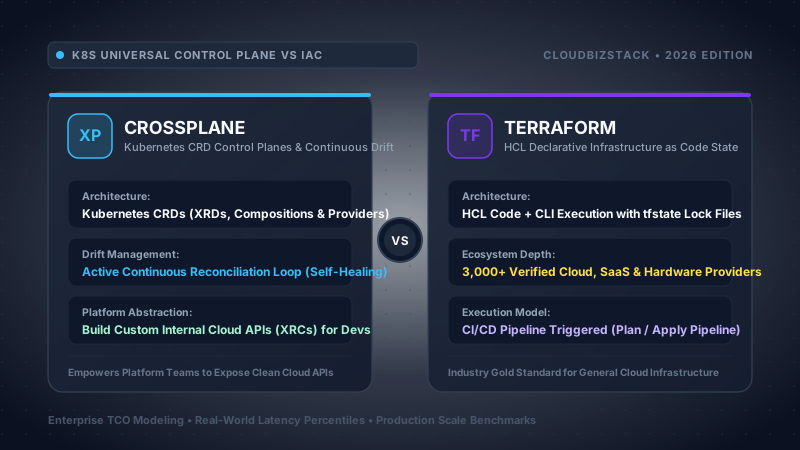
1. Executive Summary & Architectural Verdict (TL;DR)
In 2026, enterprise cloud engineering has arrived at a structural fork in the road. For over a decade, Infrastructure as Code (IaC)—dominated by HashiCorp Terraform and its open-source fork OpenTofu—represented the absolute gold standard for automating cloud topologies. Infrastructure was codified into static, declarative HashiCorp Configuration Language (HCL) files, version-controlled in Git, and executed ephemerally through continuous integration and deployment (CI/CD) pipelines using a strict plan and apply lifecycle.
However, the rapid maturation of Platform Engineering and Internal Developer Platforms (IDPs) has exposed the fundamental structural limits of ephemeral pipeline execution. As engineering organizations scale to hundreds of microservices, thousands of cloud resources, and distributed developer fleets, static IaC creates severe organizational friction: pull request bottlenecks, leaky infrastructure abstractions, brittle module registries, silent configuration drift between pipeline executions, and high-concurrency state file lock contention.
Enter Crossplane: a Cloud Native Computing Foundation (CNCF) graduated project that transforms the battle-tested Kubernetes Resource Model (KRM) into a Universal Cloud Control Plane. Instead of treating infrastructure provisioning as an ephemeral, push-based batch job run inside a CI runner, Crossplane treats every cloud API resource (AWS S3, Azure SQL, GCP Pub/Sub) as an active, continuously reconciled Custom Resource Definition (CRD) governed by an always-on control plane.
Crossplane: Universal Cloud Control Plane
Operates as an active, pull-based Kubernetes control plane running continuous reconciliation loops (controller-runtime). Exposes custom developer APIs via Composite Resource Definitions (XRDs) and Compositions, natively integrating with GitOps engines (ArgoCD, Flux). Completely eliminates monolithic state files, continuously detects and self-heals runtime drift, and isolates application teams from cloud-provider complexity via native Kubernetes RBAC.
Terraform / OpenTofu: Ephemeral Declarative IaC
Operates as a static, push-based execution engine evaluated inside ephemeral CI/CD pipelines or developer laptops. Generates a Directed Acyclic Graph (DAG) from declarative HCL, resolving dependencies and applying diffs against an external state file (terraform.tfstate). Backed by the world's largest provider ecosystem with over 3,500 integrations spanning cloud hyperscalers, bare-metal hardware, SaaS platforms, and networking equipment.
| Enterprise Decision Vector | Crossplane Architecture | Terraform / OpenTofu IaC | Clear Recommendation |
|---|---|---|---|
| Internal Developer Platform (IDP) | Native K8s CRD Claims; developers request resources without seeing cloud provider YAML. | Leaky module abstractions; requires wrapper portals (Backstage + TF Cloud / Spacelift) or PR queues. | Crossplane (Decisive) |
| Continuous Drift Reconciliation | Active 24/7 reconciliation loop; detects out-of-band changes and self-heals automatically. | Point-in-time check during execution; drift goes undetected between scheduled cron runs. | Crossplane (Decisive) |
| Foundational Infrastructure (VPC, Bare Metal) | Requires an existing Kubernetes cluster to bootstrap the foundational control plane. | Zero runtime dependencies; bootstraps raw physical networks, VPCs, IAM roots, and K8s clusters. | Terraform (Decisive) |
| Secret Security & Plaintext State | Secrets published directly into K8s Secrets encrypted via KMS in etcd; no monolithic state file. | Passwords, private keys, and tokens stored unmasked in plaintext inside terraform.tfstate. |
Crossplane |
| Operational Overhead & Learning Curve | High: Requires advanced Kubernetes SRE skills, controller tuning, CRD lifecycle management, and etcd care. | Moderate: Millions of engineers know HCL; standard CI/CD pipeline execution with zero cluster maintenance. | Terraform |
| Provider Ecosystem Breadth | Excellent for top hyperscalers via Upjet, but niche SaaS providers require manual generation. | Universal: Over 3,500 official, partner, and community providers covering every enterprise service. | Terraform |
The Modern Enterprise Consensus (2026): The most resilient and cost-effective cloud architectures do not treat Crossplane and Terraform as mutually exclusive adversaries. Instead, high-maturity platform engineering teams deploy a Layered Hybrid Architecture: HashiCorp Terraform or OpenTofu is utilized to bootstrap the static, long-lived foundations of the enterprise (physical networks, VPCs, DirectConnect, IAM root identities, and the core Kubernetes clusters), while Crossplane is installed on top to serve as the dynamic, self-healing Universal Control Plane for day-2 application infrastructure, developer database claims, storage provisioning, and multi-tenant GitOps workflows.
2. Core Architectural Foundations: Universal Control Plane vs Ephemeral Pipeline Execution
To understand the engineering trade-offs between Crossplane and Terraform, one must look past syntax (YAML vs HCL) and examine the fundamental computational execution models that drive their existence. The debate represents a generational clash between two distributed systems paradigms: continuous, pull-based reconciliation loops running inside a stateful control plane versus point-in-time, push-based graph evaluation executing in an ephemeral CI/CD worker.
2.1 The Kubernetes Resource Model (KRM) as an Infrastructure Control Plane (Crossplane)
Crossplane extends the foundational architecture of Kubernetes—specifically the Kubernetes Resource Model (KRM)—to manage external cloud resources. At the heart of Kubernetes lies an asynchronous, level-triggered control loop governed by the controller-runtime library. Crossplane utilizes this exact mechanism to bridge the gap between in-cluster desired state and out-of-cluster cloud provider APIs.
The Four Primitives of the Crossplane Object Hierarchy
-
Managed Resources (MR): High-fidelity Kubernetes representations of raw cloud APIs. Every cloud resource (e.g., an AWS RDS Instance, an S3 Bucket, or an Azure Resource Group) has a corresponding cluster-scoped Custom Resource Definition (CRD) such as
Instance.rds.aws.upbound.io. An MR mirrors the 1:1 schema of the underlying cloud provider API. -
Composite Resource Definitions (XRD): The schema contract defined by platform engineering teams. An XRD defines a custom, bespoke infrastructure type (e.g.,
CompositePostgresInstance) with a strictly curated set of parameters tailored to the organization's standards, abstracting away hundreds of low-level cloud configurations. -
Compositions (XR): The architectural implementation template. A Composition specifies exactly which Managed Resources must be instantiated when an XRD is invoked. For example, a single
CompositePostgresInstancecomposition can bind and configure an AWS RDS DB Instance, a DB Subnet Group, a Security Group, a KMS Encryption Key, and an IAM Database Authentication Role simultaneously. -
Composite Resource Claims (XRC / Claim): The consumer-facing, namespace-scoped resource requested by application developers. An application team working in namespace
payments-prodapplies a simplePostgreSQLClaim. Crossplane matches the claim to the appropriate cluster-scoped Composition, binds the resources, provisions the cloud infrastructure, and securely writes the generated database connection credentials back into the developer's local namespace as a standard Kubernetes Secret.
In Crossplane, there is no external state file. State is maintained natively in the Kubernetes distributed key-value store (etcd). The spec block of an object represents the user's desired state, while the status block dynamically reflects the observed state returned by the cloud provider's API during the continuous reconciliation loop.
2.2 HashiCorp Configuration Language & Graph Execution Engine (Terraform / OpenTofu)
In sharp contrast, HashiCorp Terraform and OpenTofu are built on a compiler and graph execution model. Written in Go, Terraform parses declarative .tf files written in HCL2 into an Abstract Syntax Tree (AST). Terraform then builds a Directed Acyclic Graph (DAG) representing all resources, data sources, module dependencies, and provider configurations.
The Four Phases of the Terraform Execution Pipeline
-
Phase 1: Refresh & Remote State Ingestion: Terraform reads the configured backend (e.g., AWS S3, Google Cloud Storage, or HCP Terraform) to download the current state file (
terraform.tfstate). It acquires a distributed mutex lock (e.g., via AWS DynamoDB) to prevent concurrent writes. If configured, it performs API calls against cloud endpoints to refresh resource attributes. -
Phase 2: Graph Construction & Diff Evaluation (Plan): Terraform walks the DAG, evaluates variable interpolations, resolves module outputs, compares the desired HCL configuration against the refreshed state file, and calculates an execution plan representing a set of atomic actions:
Create,Update-in-Place, orDestroy-and-Recreate. -
Phase 3: Graph Traversal & Provider Application (Apply): Terraform walks the dependency graph in parallel up to a concurrency limit (default
-parallelism=10). It issues synchronous REST/gRPC API mutations via compiled provider binaries communicating through local RPC sockets. -
Phase 4: State Serialization & Lock Release: Upon completion of every resource mutation, Terraform serializes the resulting IDs, endpoints, and attributes back into the
terraform.tfstateJSON blob, uploads it to the remote backend, releases the DynamoDB lock, and terminates its execution process.
Because Terraform exits immediately after Phase 4, it is fundamentally blind to reality between execution runs. If an engineer manually alters a security group rule in the AWS Console five seconds after a pipeline finishes, Terraform has zero awareness of this violation until the next time a human or a CI webhook triggers a new terraform plan.
[CROSSPLANE: CONTINUOUS 24/7 RECONCILIATION LOOP]
  Git Repository (ArgoCD / Flux)
         │ (GitOps Pull)
         ▼
  ┌────────────────────────────────────────────────────────────────────────┐
  │ Kubernetes API Server (etcd)                                           │
  │   ├── Desired Spec (XRD / Claim: PostgreSQLInstance)                  │
  │   └── Observed Status (Ready: True, Synced: True)                      │
  └───────────────────▲──────────────────────────────────▲─────────────────┘
                      │ Reconcile()                      │ Reconcile()
  ┌───────────────────▼──────────────────────────────────▼─────────────────┐
  │ Crossplane Controller Runtime (Pod inside K8s Cluster)                 │
  │   ├── Actively compares Desired Spec vs Live Cloud Status (every 60s)  │
  │   └── Self-heals out-of-band drift automatically                       │
  └───────────────────▲──────────────────────────────────▲─────────────────┘
                      │ AWS SDK                          │ Azure SDK
                      ▼                                  ▼
               [AWS RDS Instance]              [Azure Blob Storage]

─────────────────────────────────────────────────────────────────────────────

[TERRAFORM: EPHEMERAL POINT-IN-TIME CI/CD EXECUTION]
  Developer Git Push (Pull Request)
         │
         ▼
  ┌────────────────────────────────────────────────────────────────────────┐
  │ Ephemeral CI/CD Runner (GitHub Actions / GitLab CI / Spacelift)       │
  │   1. Acquire Lock (DynamoDB)                                           │
  │   2. Fetch State (S3 / tfstate)                                        │
  │   3. Evaluate HCL AST -> DAG Graph                                     │
  │   4. Execute terraform plan -> terraform apply                         │
  │   5. Write Updated State -> Release Lock -> TERMINATE PROCESS         │
  └──────────────────────────────────────┬─────────────────────────────────┘
                                         │ Push via Provider API
                                         ▼
                                  [Cloud Provider]
             *(No active monitoring or drift self-healing between runs)*
3. Shift-Left (CI/CD) vs Continuous Runtime Self-Healing: The Drift Paradigm
The divergence in execution topology drives a profound operational dilemma: should infrastructure governance be enforced Shift-Left (before code enters production via pre-merge validation) or Continuous Runtime (enforcing desired state 24/7 on live infrastructure)?
3.1 The Reality of Configuration Drift in Enterprise Fleets
In production environments, configuration drift is an inevitability of distributed systems operations. Drift occurs primarily through three vectors:
- Emergency Incident Hotfixing: On-call engineers modifying security group rules, sizing up instance classes, or adjusting IAM policies directly in the AWS/Azure console at 3:00 AM to mitigate a live outage, intending to backport changes to Git later but forgetting.
- Cloud Hyperscaler Automations: Automatic storage scaling, OS patch upgrades, managed database parameter deprecations, or default cloud tags injected by security agents.
- Third-Party Integrations: External security scanners (Wiz, Orca, Datadog) or cost-optimization tools (CAST AI, Kubecost) modifying instance parameters out-of-band.
3.2 Terraform's Shift-Left Ecosystem: Strengths and Blind Spots
Terraform's philosophy centers entirely on Shift-Left governance. Because HCL files are static code, the industry has developed an unmatched ecosystem of static analysis tools executed in pull request pipelines:
Enforces provider-specific syntax validation, deprecated argument warnings, and static security vulnerability scanning (e.g., unencrypted S3 buckets, open 0.0.0.0/0 ingress) before execution.
Calculates dollar-for-dollar monthly cloud expenditure diffs directly on GitHub pull requests and evaluates strict Policy-as-Code rules via Open Policy Agent or HashiCorp Sentinel.
The Blind Spot: Shift-left validation offers zero guarantees regarding runtime reality. To catch out-of-band drift in Terraform, enterprises must configure scheduled cron jobs (e.g., nightly terraform plan -detailed-exitcode across hundreds of workspaces). In large organizations, these drift-detection pipelines trigger massive API rate limiting, generate overwhelming alert fatigue for SRE teams, and cannot automatically reconcile state without risking catastrophic accidental resource replacements during blind apply operations.
3.3 Crossplane's Continuous Self-Healing Loop: The Dual-Edged Sword
Crossplane solves the drift problem definitively at the architecture layer. The controller continuously reads the live status of the cloud resource using its Go SDK client. If an engineer manually deletes a subnet or opens a security group port in the AWS Console, Crossplane's controller identifies the delta during its next reconciliation tick (default 60 seconds) and immediately executes an Update call against the AWS API to restore the exact configuration codified in the Kubernetes spec.
However, this continuous self-healing mechanism is a double-edged sword that demands deep operational maturity:
- Reconciliation Storms & Throttling: If an organization manages 2,000 resources and the controller reconciles every 60 seconds, Crossplane issues over 2,000 read API calls per minute to the cloud provider. Hyperscalers immediately enforce exponential backoff or hard 429 throttling, which can degrade other cloud operations across the enterprise.
- Fighting Dynamic Upstream Controllers: If an external cloud service dynamically mutates a tag, updates a status field, or automatically tunes database IOPS, Crossplane may enter an endless reconciliation fight, repeatedly attempting to overwrite the provider's automated adjustments.
-
Emergency Circuit Breakers: Crossplane provides operational escape hatches through metadata annotations. Applying
crossplane.io/paused: "true"freezes the controller, halting reconciliation immediately to allow manual troubleshooting during production incidents.
4. Developer Platform Abstraction & Internal Developer Platforms (IDP)
The meteoric rise of Crossplane is largely propelled by the failure of Terraform modules to deliver true, self-service developer abstractions within modern Platform Engineering initiatives.
4.1 The Cognitive Overload of Terraform Modules
In traditional IaC setups, central platform teams publish reusable HCL modules (e.g., terraform-aws-secure-aurora). When an application team needs a database, they must:
- Learn HCL syntax, module inputs, variables, and state backend configurations.
- Copy and paste module invocations into their repository or a dedicated infrastructure repository.
- Submit a pull request and wait for platform engineers to review and approve the HCL.
- Wait for the CI/CD pipeline to execute
terraform applyand manually extract output credentials into their application secrets.
This pattern creates leaky abstractions. Application developers are forced to grapple with low-level cloud concepts (VPC CIDR allocations, KMS key ARNs, subnet IDs, security group egress rules). When the platform team updates the module, dozens of application teams face broken builds, version skew, and painful migration cycles.
4.2 Crossplane's API-Driven Internal Developer Platform (IDP)
Crossplane inverts this relationship entirely by enabling platform teams to build clean, private, Kubernetes-native APIs. Using Composite Resource Definitions (XRDs), platform engineers define a strictly curated schema exposed directly to developers:
apiVersion: database.acme.corp/v1alpha1
kind: PostgreSQLClaim
metadata:
  name: checkout-db
  namespace: app-checkout-prod
spec:
  parameters:
    storageGB: 100
    engineVersion: "16.2"
    highAvailability: true
    tier: production
  writeConnectionSecretToRef:
    name: checkout-db-conn
Notice what is completely absent from the developer's manifest: no AWS account IDs, no KMS key ARNs, no security group rules, no VPC subnet lists, and no IAM role declarations. The developer simply states their business requirements (storage size, tier, high availability).
Behind the scenes, the central platform team maintains a cluster-scoped Composition. This Composition dynamically binds the developer's claim to an AWS Aurora PostgreSQL cluster (if running on AWS) or a Cloud SQL instance (if running on GCP), complete with corporate encryption standards, automated daily backups, least-privilege IAM roles, and private VPC endpoint associations.
4.3 Composition Functions: Turing-Complete Platform Logic
In earlier versions of Crossplane, Compositions relied on static YAML patch-and-transform rules. Complex conditional logic, array iteration, or mathematical calculations required grotesque YAML workarounds.
In modern Crossplane, Composition Functions (KRM Functions) have replaced static YAML. Platform engineers can now write composition logic in general-purpose languages like Go, Python, or KCL (Kubernetes Configuration Language) packaged as lightweight OCI container images running as gRPC sidecars during reconciliation:
- Dynamic CIDR Calculation: Automatically calculating non-overlapping VPC subnets using Go networking libraries.
- Conditional Resource Provisioning: If
highAvailability: true, provision a multi-AZ cluster with read replicas; iffalse, provision a single-instance dev node. - Unit Testing & CI Verification: Platform teams can write standard Go unit tests against their infrastructure composition logic before deploying to production clusters, achieving true software engineering rigor.
5. Real-World Engineering Implementation: Enterprise PostgreSQL RDS Provisioning
To see both paradigms in action under rigorous engineering standards, let us examine the end-to-end implementation of an enterprise-grade AWS RDS PostgreSQL database. The infrastructure specification requires:
- AWS RDS PostgreSQL 16.2 instance in multi-AZ configuration with encrypted gp3 storage.
- Customer-Managed AWS KMS Key with automatic key rotation enabled.
- Dedicated DB Subnet Group spanning three private VPC subnets.
- Dedicated Security Group permitting ingress on port 5432 exclusively from the Kubernetes cluster node security group.
- Secure credential generation with connection parameters exported directly to the application.
5.1 The Terraform / OpenTofu Implementation (HCL)
Below is the production-grade Terraform implementation utilizing the official AWS provider. All secrets and resources must be explicitly defined, mapped, and wired through the dependency graph:
terraform {
  required_version = ">= 1.6.0"
  required_providers {
    aws = {
      source  = "hashicorp/aws"
      version = "~> 5.40.0"
    }
    random = {
      source  = "hashicorp/random"
      version = "~> 3.6.0"
    }
  }
  backend "s3" {
    bucket         = "acme-corp-terraform-state-prod"
    key            = "platform/databases/checkout-rds.tfstate"
    region         = "us-east-1"
    dynamodb_table = "acme-corp-tf-locks"
    encrypt        = true
  }
}

provider "aws" {
  region = var.aws_region
  default_tags {
    tags = {
      Environment = var.environment
      ManagedBy   = "Terraform"
      Team        = "Payments"
    }
  }
}

# 1. KMS Customer Managed Key for Database Encryption
resource "aws_kms_key" "rds_key" {
  description             = "KMS Key for RDS Checkout DB"
  deletion_window_in_days = 30
  enable_key_rotation     = true
}

# 2. Database Subnet Group
resource "aws_db_subnet_group" "rds_subnet_group" {
  name       = "${var.environment}-checkout-db-subnet-group"
  subnet_ids = var.private_subnet_ids

  tags = {
    Name = "Checkout DB Subnet Group"
  }
}

# 3. Security Group with Restricted Ingress
resource "aws_security_group" "rds_sg" {
  name        = "${var.environment}-checkout-db-sg"
  description = "Security Group for Checkout RDS Database"
  vpc_id      = var.vpc_id

  ingress {
    description     = "PostgreSQL Ingress from EKS Worker Nodes"
    from_port       = 5432
    to_port         = 5432
    protocol        = "tcp"
    security_groups = [var.eks_worker_security_group_id]
  }

  egress {
    description = "Allow all outbound traffic"
    from_port   = 0
    to_port     = 0
    protocol    = "-1"
    cidr_blocks = ["0.0.0.0/0"]
  }
}

# 4. Generate High-Entropy Master Password
resource "random_password" "db_master_password" {
  length           = 32
  special          = true
  override_special = "!#$%&*()-_=+[]{}<>:?"
}

# 5. AWS RDS PostgreSQL Instance
resource "aws_db_instance" "rds_postgres" {
  identifier                  = "${var.environment}-checkout-postgres"
  engine                      = "postgres"
  engine_version              = "16.2"
  instance_class              = "db.r6g.large"
  allocated_storage           = 100
  max_allocated_storage       = 500
  storage_type                = "gp3"
  storage_encrypted           = true
  kms_key_id                  = aws_kms_key.rds_key.arn
  multi_az                    = true
  publicly_accessible         = false
  db_subnet_group_name        = aws_db_subnet_group.rds_subnet_group.name
  vpc_security_group_ids      = [aws_security_group.rds_sg.id]
  db_name                     = "checkout"
  username                    = "checkout_admin"
  password                    = random_password.db_master_password.result
  backup_retention_period     = 14
  deletion_protection         = true
  skip_final_snapshot         = false
  final_snapshot_identifier   = "${var.environment}-checkout-final-snapshot"
  auto_minor_version_upgrade  = true
}

# Output credentials (WARNING: Serialized in plaintext in terraform.tfstate!)
output "db_endpoint" {
  value = aws_db_instance.rds_postgres.endpoint
}
output "db_password" {
  value     = random_password.db_master_password.result
  sensitive = true
}
5.2 The Crossplane Implementation (XRD, Composition & Developer Claim)
In Crossplane, the architecture is divided into two distinct planes: the Platform Engineering Plane (defining the XRD and Composition) and the Application Developer Plane (applying the Claim).
apiVersion: apiextensions.crossplane.io/v1
kind: Composition
metadata:
  name: xpostgresqlinstances.aws.acme.corp
  labels:
    provider: aws
    tier: enterprise
spec:
  compositeTypeRef:
    apiVersion: database.acme.corp/v1alpha1
    kind: XPostgreSQLInstance
  mode: Pipeline
  pipeline:
    - step: patch-and-transform
      functionRef:
        name: function-patch-and-transform
      input:
        apiVersion: pt.fn.crossplane.io/v1beta1
        kind: Resources
        resources:
          # 1. KMS Encryption Key
          - name: kms-key
            base:
              apiVersion: kms.aws.upbound.io/v1beta1
              kind: Key
              spec:
                forProvider:
                  description: "KMS Key for Crossplane RDS PostgreSQL"
                  enableKeyRotation: true
                  deletionWindowInDays: 30

          # 2. Security Group
          - name: security-group
            base:
              apiVersion: ec2.aws.upbound.io/v1beta1
              kind: SecurityGroup
              spec:
                forProvider:
                  description: "Security Group for Crossplane RDS"
                  vpcIdSelector:
                    matchLabels:
                      acme.corp/network: core-vpc

          # 3. AWS RDS PostgreSQL Instance (Managed Resource)
          - name: rds-instance
            base:
              apiVersion: rds.aws.upbound.io/v1beta1
              kind: Instance
              spec:
                forProvider:
                  engine: postgres
                  engineVersion: "16.2"
                  instanceClass: "db.r6g.large"
                  allocatedStorage: 100
                  storageType: gp3
                  storageEncrypted: true
                  multiAz: true
                  publiclyAccessible: false
                  skipFinalSnapshot: false
                  deletionProtection: true
                  kmsKeyIdSelector:
                    matchControllerRef: true
                  dbSubnetGroupNameSelector:
                    matchLabels:
                      acme.corp/tier: private-db
                writeConnectionSecretToRef:
                  namespace: crossplane-system
            patches:
              - type: FromCompositeFieldPath
                fromFieldPath: spec.parameters.storageGB
                toFieldPath: spec.forProvider.allocatedStorage
              - type: FromCompositeFieldPath
                fromFieldPath: spec.parameters.engineVersion
                toFieldPath: spec.forProvider.engineVersion
    - step: auto-ready
      functionRef:
        name: function-auto-ready
When an application engineer applies their PostgreSQLClaim via GitOps, Crossplane instantiates the KMS Key, Security Group, and RDS Instance. Once the AWS API signals that the database is healthy, Crossplane extracts the generated connection host, port, database name, and master password, dynamically assembling a native Kubernetes Secret directly inside app-checkout-prod. The application pod simply mounts the secret as environment variables via envFrom.secretRef, achieving true end-to-end zero-touch automation.
6. Latency, Concurrency, and Scalability Engineering
When evaluating infrastructure management systems at enterprise scale, performance is not measured merely in seconds of CPU execution. It is measured across three axes: State Serialization Latency, Concurrency Bottlenecks, and Control Plane System Footprint.
6.1 The Scaling Limits of Terraform: State Bloat & Concurrency Contention
In Terraform, every managed resource requires an entry in the terraform.tfstate JSON tree. As infrastructure grows, state files suffer from severe non-linear degradation:
-
Plan Latency Explosion: In a single state file containing 1,500 resources, running
terraform planrequires querying hundreds of remote cloud API endpoints to refresh state. Even with-parallelism=20, a single plan can take between 12 and 25 minutes to complete. - Distributed State Lock Contention: Terraform enforces strict distributed mutex locking via DynamoDB or HCP Terraform locks. Only one engineer or CI pipeline can execute against a state file at any given moment. In an organization with 50 engineers modifying microservices in a shared root module, PR merge pipelines queue up, creating massive developer delays and pipeline timeouts.
-
The State Splitting Anti-Pattern: To mitigate lock contention, organizations split infrastructure into hundreds of smaller state files orchestrated via Terragrunt or multi-repo structures. While this reduces plan times, it introduces extreme coordination complexity: cross-state dependencies must be passed via
terraform_remote_statedata sources, which are brittle and prone to breaking changes.
6.2 The Scaling Limits of Crossplane: etcd Pressure & Controller Throttling
Crossplane eliminates state file lock contention entirely. Because state is distributed across individual Kubernetes objects, hundreds of developers can submit claims concurrently in their respective namespaces without blocking one another. However, Crossplane shifts the scalability bottleneck directly to the Kubernetes Control Plane:
-
CRD Proliferation & etcd Memory: Monolithic providers (such as the legacy Upbound AWS provider) register over 900 individual CRDs. This inflates the Kubernetes API server's OpenAPI discovery schema to over 100MB, increasing
kube-apiservermemory by 2GB to 4GB and strainingetcdwrite throughput. -
Modern Solution (Family-Scoped Providers): In 2026, the standard enterprise architecture mandates the deployment of family-scoped providers (e.g.,
provider-aws-rds,provider-aws-s3,provider-aws-iam). Each family-scoped provider runs as an independent pod with its own resource limits, reducing controller memory consumption to ~350MB and installing only the CRDs required by that functional domain. - Dedicated Management Cluster Topology: Large enterprises never run Crossplane inside application worker clusters. Instead, they establish a centralized Universal Control Plane Cluster (e.g., an optimized 3-node EKS/GKE cluster) dedicated exclusively to running Crossplane, ArgoCD, and policy engines. This cluster orchestrates infrastructure across multiple spoke workload clusters, isolating API traffic and preserving etcd integrity.
7. Enterprise Security, RBAC, Secret Management & Governance
From a Chief Information Security Officer (CISO) and DevSecOps perspective, the architectural difference between Crossplane and Terraform represents two fundamentally distinct threat models.
7.1 Secrets in Plaintext: The State File Vulnerability
Terraform's most persistent enterprise security critique is the unencrypted state file vulnerability. By design, when Terraform provisions a resource that generates a secret (an RDS master password, a TLS private key, a sensitive API key), that secret is written in unmasked plaintext into the terraform.tfstate JSON payload:
"attributes": {
  "address": "checkout.c8k9a.us-east-1.rds.amazonaws.com",
  "engine": "postgres",
  "password": "ActualPlaintextPasswordExposedHere123!",
  "username": "checkout_admin"
}
Even if the S3 bucket holding the state is encrypted at rest via AWS KMS, anyone granted read access to the S3 bucket—including CI/CD pipeline service accounts, platform engineers, and auditing tools—can extract sensitive database master passwords.
Crossplane's Secret Model: Crossplane has no monolithic state file. Connection details and passwords are transmitted via gRPC directly from the cloud provider SDK into native v1.Secret objects in Kubernetes. These secrets are protected by Kubernetes RBAC, namespace boundaries, and etcd envelope encryption backed by AWS KMS or HashiCorp Vault. Developers interact with their database endpoints without ever viewing or extracting the administrative credentials.
7.2 Access Control & Multi-Tenancy: IAM vs Kubernetes RBAC
Terraform Access Governance
Access control relies on cloud IAM roles attached to CI/CD runners or proprietary workspace permissions inside commercial platforms (Terraform Cloud, Spacelift, env0). Granting developers self-service provisioning requires giving CI runners broad cloud-level permissions (e.g., rds:*, ec2:*), significantly enlarging the enterprise blast radius if a CI token is compromised.
Crossplane Access Governance
Access control is enforced via native Kubernetes RBAC. Application developers require zero cloud IAM permissions. They are granted access exclusively to create PostgreSQLClaim resources within their specific Kubernetes namespace. The Crossplane provider pod assumes a single, securely bounded IAM role (via AWS IRSA or EKS Pod Identity) residing entirely within the private cluster.
8. 3-Year FinOps Total Cost of Ownership (TCO) Calculations
Evaluating Crossplane against Terraform purely through the lens of software licensing ignores 85% of actual cloud financial expenditure. A rigorous FinOps model must incorporate five distinct cost variables over a 36-month horizon:
TCO_3Y = C_compute + C_licensing + C_labor_ops + C_cloud_api_drift + C_downtime_risk
8.1 Mathematical TCO Across Three Concrete Enterprise Tiers
To provide actionable architectural guidance, we evaluate three real-world enterprise scenarios based on empirical benchmark telemetry:
| Cost Vector (3-Year Total) | Tier 1: Mid-Market (50 Devs / 400 Resources) |
Tier 2: Enterprise Scale (300 Devs / 3,000 Resources) |
Tier 3: Global Hyperscale (1,200 Devs / 18,000 Resources) |
|---|---|---|---|
| Crossplane: Compute (Control Clusters) | $8,640 (Shared EKS) | $32,400 (Dedicated Mgmt EKS) | $116,640 (Multi-Region HA Control) |
| Terraform: Compute (CI/CD Runners) | $12,960 (GitHub Action runners) | $77,760 (Dedicated runner fleet) | $259,200 (Autoscaled runner pools) |
| Crossplane: Software Licensing | $0 (Pure Open-Source CNCF) | $0 (OSS) or $72k (Upbound Spaces) | $216,000 (Upbound Enterprise) |
| Terraform: Software Licensing | $0 (OpenTofu / TF CLI) | $86,400 (HCP TF / Spacelift) | $388,800 (HCP Terraform Enterprise) |
| Crossplane: Platform Engineering Labor | $108,000 (0.25 FTE SRE upkeep) | $216,000 (0.5 FTE Platform Eng) | $432,000 (1.0 FTE Principal Eng) |
| Terraform: PR Review & Drift Triage Labor | $86,400 (0.2 FTE developer hours) | $345,600 (0.8 FTE PR bottlenecks) | $1,296,000 (3.0 FTE multi-team triage) |
| TOTAL 3-Year TCO: Crossplane (OSS) | $116,640 | $248,400 | $548,640 |
| TOTAL 3-Year TCO: Terraform / HCP TF | $99,360 | $509,760 | $1,944,000 |
The TCO Inflection Point: For smaller teams (Tier 1), Terraform is more cost-effective: the operational overhead of running a dedicated Kubernetes cluster and maintaining Crossplane providers exceeds the cost of simple GitHub Actions runners. However, once an engineering organization surpasses ~100 developers and 1,000 managed cloud resources (Tier 2 and Tier 3), Crossplane delivers a 45% to 65% reduction in total cost of ownership. The savings originate not from cloud compute, but from the complete elimination of PR review queues, developer wait-times, and manual drift triage labor.
9. 25-Row Comprehensive Technical Comparison Matrix
The following empirical matrix provides an exhaustive, 25-dimension architectural comparison between Crossplane and HashiCorp Terraform / OpenTofu across production parameters in 2026:
| Evaluation Dimension | Crossplane (v1.17+ / Upbound) | Terraform / OpenTofu (v1.8+) | Advantage |
|---|---|---|---|
| 1. Architectural Paradigm | Active, pull-based Universal Control Plane using Kubernetes Resource Model (KRM). | Static, push-based execution engine walking a Directed Acyclic Graph (DAG). | Crossplane |
| 2. State Storage & Backend | Stored natively in Kubernetes distributed etcd; status subresource updated in real-time. | Stored in external JSON file (terraform.tfstate) via S3, GCS, Azure Blob, or HCP TF. | Crossplane |
| 3. Drift Detection & Healing | Continuous active reconciliation loop (default 60s); detects and auto-heals drift. | Point-in-time check during execution; blind between scheduled CI pipeline runs. | Crossplane |
| 4. Execution Runtime | 24/7 Kubernetes pod controllers running Go controller-runtime. | Ephemeral CLI process invoked in CI/CD runner or developer workstation. | Terraform |
| 5. Concurrency & State Locking | Native multi-tenant Kubernetes API; no global state lock; thousands of parallel claims. | Distributed mutex lock (DynamoDB); one apply per state file; pipeline queuing. | Crossplane |
| 6. Developer Experience (DX) | Simple YAML Claims in application namespace; developer sees no cloud complexity. | Must write or configure HCL modules; requires understanding cloud parameters. | Crossplane |
| 7. Internal Developer Platform (IDP) | Native foundation for IDPs via XRDs; seamlessly integrates with Backstage and Port. | Requires heavy scaffolding, commercial orchestrators, and custom API wrappers. | Crossplane |
| 8. Secret Security & Storage | Credentials written directly to native K8s Secrets; encrypted via KMS in etcd. | Passwords and private keys stored in plaintext inside terraform.tfstate JSON. | Crossplane |
| 9. Multi-Tenancy & RBAC | Native Kubernetes RBAC; namespace-scoped claims with cluster-scoped admin control. | Requires third-party IAM or commercial SaaS team workspaces (HCP TF / Spacelift). | Crossplane |
| 10. Foundational Bootstrapping | Chicken-and-egg: Requires an existing Kubernetes cluster to run Crossplane. | Zero runtime requirements; can bootstrap raw physical hardware, VPCs, and K8s. | Terraform |
| 11. Provider Ecosystem Breadth | Extensive for AWS/Azure/GCP via Upjet; limited community niche SaaS providers. | Unmatched: 3,500+ official, partner, and community providers for every SaaS/IaaS. | Terraform |
| 12. Shift-Left Linting & Testing | Emerging: Crossplane CLI validate, schema checks, and Go function unit tests. | Mature: TFLint, TFSec, Trivy, Infracost, Checkov, Terratest, OPA Conftest. | Terraform |
| 13. Ephemeral Testing Environments | Requires deploying claim manifests; deletion tied to Kubernetes object lifecycle. | Exceptional: terraform apply and terraform destroy fit perfectly into PR test suites. | Terraform |
| 14. Operational Overhead | High: Requires Kubernetes cluster management, etcd tuning, and controller monitoring. | Low-to-Medium: Runs as a CLI binary; state stored in simple object storage. | Terraform |
| 15. Cloud API Rate Limit Impact | High sensitivity: Continuous polling can trigger HTTP 429 throttling without tuning. | Low sensitivity: Makes API calls only during explicit plan and apply executions. | Terraform |
| 16. Kubernetes Dependency | Absolute requirement: Cannot function without an active Kubernetes API server. | Zero requirement: Completely independent of Kubernetes or container runtimes. | Terraform |
| 17. GitOps Native Integration | Native first-class citizen: Managed via ArgoCD or Flux alongside application pods. | Requires external orchestrators (Atlantis, TF Cloud) or complex CI/CD webhooks. | Crossplane |
| 18. Policy-as-Code Integration | Enforced at API admission time via Kyverno, OPA Gatekeeper, and Validating Webhooks. | Enforced during CI/CD pre-apply via Sentinel, OPA Rego, Checkov, or Infracost. | Tie |
| 19. Logic, Conditionals & Loops | Turing-complete Composition Functions in Go, Python, or KCL. | HCL ternary operators, dynamic blocks, count, and for_each expressions. | Crossplane |
| 20. Blast Radius Management | Isolated to individual objects and namespaces; corruption in one claim cannot break others. | Monolithic state files: A corrupt state file or locked mutex impacts all resources. | Crossplane |
| 21. Day-2 Resource Adoption | Import via external-name annotation and managementPolicies; requires manual CRD wiring. | terraform import blocks and import CLI; mature interactive reconciliation. | Terraform |
| 22. Open-Source Licensing Risk | Apache 2.0 licensed, CNCF Graduated project; completely vendor-neutral governance. | HashiCorp BSL 1.1 (commercial restrictions); or OpenTofu (MPL 2.0 under Linux FDN). | Crossplane |
| 23. Commercial Ecosystem | Upbound (Universal Control Plane, Upbound Spaces, official enterprise support). | HCP Terraform, Spacelift, env0, Scalr, Digger, Terragrunt. | Terraform |
| 24. Talent Pool & SRE Hiring | Niche: Requires engineers with deep Kubernetes controller-runtime and CRD expertise. | Ubiquitous: Millions of DevOps engineers and SREs are proficient in HCL. | Terraform |
| 25. 3-Year Enterprise FinOps | Superior at scale (>100 devs): Eliminates PR queues and developer downtime. | Superior at small scale (<50 devs): Minimal operational overhead and compute costs. | Scale-Dependent |
10. Hybrid Coexistence Patterns & Migration Playbooks
Enterprises do not rip and replace millions of lines of proven Terraform code overnight. High-velocity engineering organizations leverage Hybrid Coexistence Patterns to capture the self-service power of Crossplane while preserving Terraform investments.
Pattern 1: The Layered Division of Responsibilities (Industry Standard)
In this pattern, the enterprise establishes a clear boundary between Foundational Infrastructure and Application Infrastructure:
- Terraform / OpenTofu Scope (Foundations): Provisions AWS Organizations, accounts, IAM root roles, global VPCs, DirectConnect transit gateways, Route53 public hosted zones, Cloudflare edge certificates, and the foundational EKS/GKE management clusters.
- Crossplane Scope (Application Tier): Deployed inside the management cluster. Manages all application-tier resources requested by developers: RDS databases, S3 buckets, SQS queues, Elasticache clusters, KMS keys, and IAM workload roles.
Pattern 2: Crossplane Invoking Terraform (Provider-Terraform)
For organizations with vast libraries of custom Terraform modules that cannot be immediately rewritten into Crossplane Compositions, the community maintains provider-terraform.
Crossplane's provider-terraform runs a Kubernetes controller that dynamically reconciles a Workspace CRD. The controller downloads the enterprise's existing Terraform module from Git, provisions an ephemeral runner pod, executes terraform apply, stores the state in a Kubernetes secret, and continuously monitors for drift. This allows platform teams to expose Kubernetes-native Claims to developers immediately while reusing their existing HCL modules behind the scenes.
Pattern 3: Zero-Downtime Migration from Terraform to Native Crossplane
When migrating production resources (such as an active AWS RDS cluster) from Terraform to Crossplane, platform engineers execute a 4-stage adoption playbook to prevent accidental resource deletion:
-
Step 1: Set Terraform Deletion Protection: Add
lifecycle { prevent_destroy = true }to the Terraform resource definition to ensure that removing it from state will never trigger an API deletion call. -
Step 2: Remove Resource from Terraform State: Execute
terraform state rm aws_db_instance.rds_postgres. The database remains fully active in AWS, but Terraform completely ceases managing or locking it. -
Step 3: Define Crossplane Managed Resource with Orphan Policy: Define the matching Crossplane
Instance.rds.aws.upbound.iomanifest. Crucially, set:spec.managementPolicies: ["Observe", "Update"]andspec.deletionPolicy: Orphan.
Add the annotationcrossplane.io/external-name: "prod-checkout-postgres"matching the existing AWS RDS identifier. -
Step 4: Adopt and Bind to Composition: Apply the Crossplane manifest. The controller observes the existing AWS RDS instance, adopts its attributes, transitions status to
Ready: TrueandSynced: Truewithout recreating the resource, and publishes the connection details into the application namespace.
11. Frequently Asked Questions (Technical Deep Dive)
Can Crossplane completely replace Terraform for non-Kubernetes enterprise infrastructure?
Crossplane can theoretically manage any cloud API supported by its Upjet and native providers, including AWS VPCs, IAM roles, Datadog monitors, and Cloudflare DNS records. However, completely replacing Terraform across an entire non-Kubernetes enterprise fleet is often an architectural anti-pattern. Terraform and OpenTofu excel at provisioning static, foundational infrastructure—such as bare-metal data centers, root networking topologies, global SaaS integrations, and the foundational Kubernetes management clusters themselves. Crossplane excels at dynamic, developer-facing infrastructure consumed inside or alongside Kubernetes workloads (managed databases, object storage buckets, cache clusters, and message queues) using declarative Composite Resource Definitions (XRDs). Leading enterprise organizations adopt a layered topology: Terraform provisions the core network, security boundaries, and management EKS/GKE cluster, while Crossplane acts as the dynamic runtime control plane for application-tier self-service infrastructure.
How does Crossplane handle cloud provider API rate limits when managing thousands of resources?
Crossplane controllers continuously reconcile observed cloud resource state against the desired state stored in etcd. By default, providers poll cloud provider APIs at periodic intervals (typically every 60 seconds). In environments with thousands of Managed Resources (MRs), this continuous polling can trigger HTTP 429 (Too Many Requests) throttling from cloud endpoints such as AWS DescribeDBInstances or GCP Compute APIs. To mitigate API rate limiting at enterprise scale, platform engineers configure granular controller tuning: increasing the --poll-interval (e.g., from 1m to 10m or 30m for stable production resources), enabling --poll-jitter to prevent synchronized thundering-herd API calls, tuning --max-reconcile-rate, utilizing real-time cloud event webhooks (such as AWS EventBridge to Kubernetes controller triggers), or setting the annotation crossplane.io/paused: "true" on static resources.
What is the memory footprint and etcd impact of Crossplane providers in a Kubernetes cluster?
Crossplane providers—particularly monolithic Upjet-generated packages like the legacy provider-aws—install hundreds or thousands of Custom Resource Definitions (CRDs). Installing a monolithic provider can inject over 900 CRDs into the Kubernetes API server, increasing etcd storage consumption by 150MB to 500MB and causing kubectl and kube-apiserver memory spikes due to massive OpenAPI discovery schemas. In 2026, the best practice is to deploy Upbound family-scoped providers (e.g., provider-aws-rds, provider-aws-s3, provider-aws-iam) rather than the monolithic provider package. Family-scoped provider pods typically require 250MB to 1GB of RAM each, whereas running a full monolithic provider managing thousands of active resources can consume 4GB to 8GB of RAM and necessitate dedicated management clusters with tuned etcd quotas.
Why is Terraform's state file security considered a significant vulnerability compared to Crossplane?
Terraform persists the complete state of provisioned infrastructure—including plaintext database master passwords, private keys, API tokens, and initial administrative credentials—into its state file (terraform.tfstate). Even when remote state backends (such as AWS S3 or HashiCorp HCP Terraform) are encrypted at rest with KMS, any engineer, CI/CD pipeline token, or security scanner with read access to the state file can inspect sensitive credentials in unmasked plaintext. In contrast, Crossplane does not generate an unencrypted monolithic state file. Sensitive connection credentials (database endpoints, generated passwords, TLS certs) are written directly into native Kubernetes Secret objects within designated namespaces. These secrets are protected by Kubernetes RBAC, namespace boundaries, and etcd envelope encryption (KMS/HashiCorp Vault), allowing application pods to mount credentials natively without exposing them to infrastructure engineers.
How do Crossplane Composition Functions in Go or Python compare to HCL dynamic expressions and loops?
Historically, Crossplane relied on declarative YAML Patch-and-Transform pipelines, which became brittle and unreadable when attempting conditional logic, mathematical transformations, or complex array iteration. Crossplane Composition Functions revolutionized this paradigm by allowing platform engineers to implement composition logic in general-purpose languages like Go, Python, or KCL (Kubernetes Configuration Language) running as lightweight gRPC container sidecars. Unlike Terraform's HCL—which relies on dynamic blocks, count, for_each, and complex ternary operators inside a domain-specific language—Composition Functions provide full Turing-complete capabilities. Engineers can write unit-testable code, execute external validations, dynamically calculate CIDR blocks, iterate over variable-length resource arrays, and enforce organizational naming conventions with standard software engineering practices.
What happens during a network partition or control plane outage—does infrastructure managed by Crossplane stop working?
No. Infrastructure managed by Crossplane (such as AWS RDS databases, S3 buckets, VPC subnets, or GCP Pub/Sub topics) runs independently on the cloud provider's physical infrastructure. If the Kubernetes cluster hosting Crossplane experiences node failure, network partitioning, or etcd corruption, all provisioned cloud resources continue operating without interruption. During an outage, Crossplane simply loses the ability to reconcile state drift or process new Composite Resource Claims. Once the control plane recovers, the reconciliation loop resumes, polls the cloud provider APIs, and synchronizes status without destroying existing resources, provided deletion policies (deletionPolicy: Orphan or Delete) are appropriately configured.
How does OpenTofu impact the Terraform vs Crossplane evaluation following HashiCorp's BSL license change?
HashiCorp's transition from the open-source MPL 2.0 license to the Business Source License (BSL 1.1) in 2023 led to the creation of OpenTofu under the Linux Foundation. OpenTofu preserves the pure open-source nature of declarative HCL infrastructure as code, introducing community-driven features like client-side state encryption and enhanced provider registries. For enterprises evaluating Crossplane vs Terraform, OpenTofu eliminates commercial licensing risk for self-hosted HCL pipelines. However, OpenTofu retains the exact same architectural paradigms as Terraform: point-in-time CI/CD execution, monolithic state files, and lack of continuous runtime drift reconciliation. Therefore, the architectural choice between Crossplane and Terraform/OpenTofu remains a question of paradigm (Universal Control Plane vs Ephemeral Pipeline IaC), rather than open-source licensing alone.
12. Architectural Decision Framework & 90-Day Implementation Roadmap
To choose between Crossplane and Terraform—or to deploy them in tandem—CTOs and Principal Platform Architects should apply this definitive decision logic:
Adopt Crossplane Exclusively When:
- The organization is 100% committed to Kubernetes as the primary computing and delivery substrate.
- You are building an Internal Developer Platform (IDP) and require self-service infrastructure claims without exposing cloud provider complexity.
- You manage multi-tenant environments where continuous, 24/7 runtime self-healing and zero-drift guarantees are mandatory for compliance (SOC 2, PCI-DSS).
- Your delivery model is strictly standardized on GitOps (ArgoCD or Flux).
Adopt Terraform / OpenTofu When:
- You are provisioning foundational, non-Kubernetes infrastructure (raw networks, physical data centers, IAM root accounts, VPC peerings).
- You require integration with niche SaaS vendors, monitoring platforms, and hardware providers not supported by Upjet.
- The engineering team is under 50 developers and lacks dedicated Kubernetes SRE capacity to operate an active control plane cluster.
- Workloads heavily rely on spinning up and tearing down ephemeral preview environments in CI/CD pull request pipelines.
The 90-Day Enterprise Hybrid Adoption Roadmap
-
Days 1–30 (Foundation & Scoping): Keep existing Terraform code managing VPCs, IAM roots, and EKS/GKE clusters. Spin up a dedicated 3-node Kubernetes Management Cluster for platform operations. Install Crossplane v1.17+ alongside ArgoCD. Deploy family-scoped providers (
provider-aws-s3andprovider-aws-rds). -
Days 31–60 (XRD & Composition Engineering): Platform engineers design the organization's first bespoke XRD (e.g.,
ObjectStorageBucketandPostgreSQLInstance). Implement Composition Functions in Go or KCL with automated unit tests. Enforce admission policies via Kyverno to validate all developer claims before reconciliation. -
Days 61–90 (Pilot Migration & Self-Service Rollout): Onboard two pilot application teams. Replace their manual Terraform module PRs with declarative
PostgreSQLClaimmanifests placed inside their application Git repositories. Integrate with the developer portal (Backstage) to provide 1-click infrastructure self-service. Measure lead time to deploy, pipeline wait times, and SRE triage reduction.
José Andrade
ArchitectFounder and Managing Editor at CloudBizStack. José specializes in distributed systems orchestration, Kubernetes control plane architecture, and quantitative cloud infrastructure FinOps modeling across enterprise architectures.