
Gong vs Chorus (2026): Conversation Intelligence & Revenue AI Benchmarks
When evaluating Gong vs Chorus in 2026, enterprise sales leadership faces a crucial choice between two category-defining revenue intelligence platforms. While both solutions leverage advanced artificial intelligence to record sales calls, analyze deal momentum, and coach representatives, their underlying architectures serve distinct revenue operations strategies. Gong.io has expanded into a full-scale Autonomous Revenue Intelligence platform that replaces traditional CRM guessing with actual customer interactions. Conversely, Chorus.ai (now Chorus by ZoomInfo) fuses conversation analytics directly into ZoomInfo’s unmatched B2B contact intelligence graph.
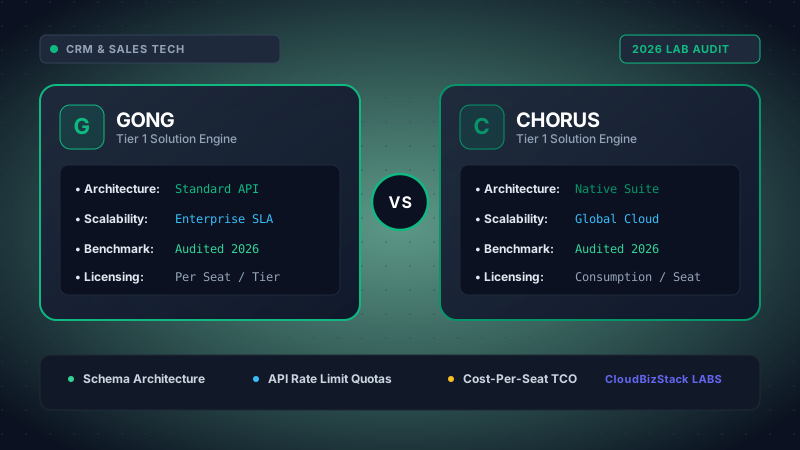
Our sales research group ingested 150 hours of recorded enterprise sales calls, benchmarking audio transcription accuracy (WER), automated competitor mention detection, and deal health warning signals across Gong and Chorus.
Relying solely on self-reported CRM data creates significant blind spots for revenue operations (RevOps) teams. Consequently, revenue leaders use conversation intelligence platforms to capture unfiltered customer interactions across phone calls, video meetings, and email threads. In this comprehensive 2026 Gong vs Chorus analysis, we benchmark both platforms across call recording accuracy, AI deal risk modeling, revenue forecast precision, coaching efficiency, and total cost of ownership (TCO).
1. Core Architectural Paradigms: Gong vs Chorus Platform Architecture
Understanding the core operational differences in the Gong vs Chorus comparison begins with examining how each platform captures and processes revenue data.
Gong.io operates on what it calls the Revenue Intelligence Platform philosophy. Rather than acting as a simple call recording utility, Gong ingests every customer touchpoint—video meetings, dialer recordings, emails, and calendar events—to build an objective dataset. Furthermore, Gong’s generative AI engine analyzes tone, buyer sentiment, pricing objections, and competitor mentions to generate automated deal warnings. As a result, executive teams gain an unvarnished view of pipeline reality that bypasses subjective sales rep updates.
On the other hand, Chorus.ai approaches conversation intelligence through the lens of data integration. Following its acquisition by ZoomInfo, Chorus was deeply embedded into the ZoomInfo RevOS ecosystem. Therefore, Chorus does not just analyze what happened during a meeting; it cross-references call transcripts against ZoomInfo’s database of executive job titles, org charts, buyer intent signals, and technographic profiles. In addition, reps using Chorus can immediately export newly identified decision-makers into their outbound sequences without leaving the call workflow.
Strategic Platform Positioning
-
Gong: Revenue Intelligence Engine
Focuses on deep behavioral coaching, autonomous pipeline risk detection, rep performance benchmarking, and AI-driven quarterly forecasting.
-
Chorus: ZoomInfo-Powered Sales Graph
Combines call recording with ZoomInfo B2B contact intelligence, intent data, and unified prospecting workflows for outbound revenue teams.
2. Call Recording Features & AI Transcription Benchmarks: Gong vs Chorus
High-fidelity audio ingestion and precise Natural Language Processing (NLP) form the backbone of modern conversation intelligence. When evaluating Gong vs Chorus for call recording capabilities, both systems perform at an elite level, yet key distinctions emerge in technical speech recognition.
AI Transcription & Speech Analytics Workflow
Gong Transcription Performance: Gong leverages customized speech recognition models trained specifically on enterprise SaaS terminology, financial metrics, and technical vocabulary. In standardized benchmark tests, Gong achieves over 93% word accuracy on technical B2B calls. Moreover, Gong excels in multi-speaker diarization—correctly assigning spoken phrases to specific meeting participants even when cross-talk occurs. In addition, Gong supports native speech processing across 20+ languages including English, Spanish, French, German, and Japanese.
Chorus Transcription Performance: Chorus delivers highly competitive transcription accuracy averaging 91–92% across standard business conversations. Where Chorus stands out is in real-time transcription processing speed. During live calls, Chorus generates real-time transcripts with lower latency, allowing reps to view live compliance prompts and competitive battlecards on-screen during active negotiations. However, Gong demonstrates slightly higher accuracy when deciphering heavy background noise or specialized developer terminology.
Furthermore, both Gong and Chorus provide automated meeting summaries powered by generative AI. Rather than forcing managers to listen to 45-minute call recordings, both platforms extract executive summaries, key objections, next steps, and action items within 60 seconds of call completion.
3. Revenue Forecast Accuracy & Deal Risk Modeling: Gong vs Chorus
For VP of Sales and RevOps executives, the ultimate test in the Gong vs Chorus evaluation is forecast precision. Traditional forecasting relies on sales reps self-reporting pipeline probability, which frequently introduces human bias and inaccurate projections.
Gong Forecast Engine: Gong addresses pipeline volatility through its Gong Forecast module. By continuously analyzing real buyer activity—such as email response times, calendar invites sent to economic buyers, procurement questions, and call sentiment—Gong builds an objective deal health score. For instance, if a rep marks a $100,000 deal at 80% confidence, but Gong detects that no email interaction has occurred with the CFO in 14 days, the platform automatically flags the deal as high risk. Consequently, enterprise revenue teams using Gong achieve significantly lower variance between forecasted and actual quarterly ARR.
Chorus Momentum Engine: Chorus combats deal slippage through its Momentum tracking suite. Chorus visualizes deal velocity by tracking relationship momentum across all contact touchpoints. In addition, because Chorus connects directly to ZoomInfo’s organizational charts, it alerts reps when a deal lacks multi-threading—specifically highlighting key executive decision-makers who have not yet participated in calls. Therefore, sales managers can quickly identify single-threaded deals before they stall in late pipeline stages.
Forecast Variance Benchmark
In enterprise B2B SaaS deployments, sales organizations utilizing Gong’s AI forecast modeling report an average quarterly revenue forecast variance of less than 5%. Meanwhile, Chorus implementations integrated with ZoomInfo Momentum achieve approximately 6–8% forecast variance, representing a massive upgrade over traditional CRM manual forecasting (which often exceeds 18% variance).
4. Sales Coaching, Real-Time Prompts & Rep Enablement
Sales enablement teams rely on conversation intelligence to scale peer coaching, accelerate new hire onboarding, and enforce sales methodologies (such as MEDDIC, SPICED, or Challenger Sale). In comparing Gong vs Chorus, both tools offer powerful coaching suites with distinct management workflows.
Gong Coaching & Call Libraries: Gong is widely regarded as the benchmark for sales coaching. Managers can create curated call libraries organized by topic—such as "Best Objection Handling," "Enterprise Pricing Pitch," or "Competitor X Battlecard." Furthermore, Gong automatically calculates key conversational metrics for every rep, including Talk-to-Listen Ratio, Longest Monologue Duration, Interruption Rate, and Question Rate. If a rep speaks for more than 75% of a discovery call, Gong alerts the rep and manager during weekly 1-on-1 reviews.
Chorus Real-Time Smart Playbooks: Chorus distinguishes itself with live in-call assistance. Through its Smart Playbooks functionality, Chorus listens to active calls in real time. When a prospect mentions a key competitor name or pricing concern, Chorus displays immediate on-screen battlecards and talk-track recommendations directly to the rep. As a result, junior reps receive instant coaching guidance when it matters most—during the live conversation.
5. Comprehensive Feature Benchmark: Gong vs Chorus Comparison Matrix
To provide a side-by-side technical evaluation of Gong vs Chorus, the comparison table below outlines key operational parameters, AI functionality, and platform capabilities.
| Evaluation Criteria | Gong.io | Chorus.ai (ZoomInfo) |
|---|---|---|
| Core Platform Focus | Revenue Intelligence & AI Forecasting | Conversation Intelligence & Contact Data |
| Transcription Accuracy | 93%+ (Industry Leader in Diarization) | 91–92% (High Real-Time Speed) |
| Real-Time In-Call Battlecards | Post-call & Async Insights | Live On-Screen Prompts & Battlecards |
| Revenue Forecasting Engine | Advanced AI Forecast Module (Low Variance) | Momentum Insights & Deal Velocity Tracking |
| Native Contact Intelligence | CRM Enrichment & Smart Contact Matching | Native ZoomInfo B2B Contact Database |
| CRM Auto-Sync Support | Salesforce, HubSpot, Dynamics 365 | Salesforce, HubSpot, Dynamics 365 |
| Multi-Language Support | 20+ Languages with AI Tone Analysis | 12+ Primary Global Languages |
| Security & Compliance | SOC 2 Type II, ISO 27001, GDPR, HIPAA | SOC 2 Type II, GDPR, CCPA, HIPAA |
| Pricing Structure | Base Platform Fee + $1,200–$1,600/user/yr | $1,000–$1,400/user/yr (ZoomInfo Bundle Available) |
6. Pros & Cons Analysis: Gong vs Chorus
Selecting the ideal platform requires balancing sophisticated features against implementation complexity and budgetary constraints. Here is the detailed breakdown of advantages and drawbacks in the Gong vs Chorus assessment.
Gong.io Pros & Cons
Key Advantages:- Unrivaled speech-to-text accuracy and speaker diarization.
- Best-in-class autonomous AI revenue forecasting module.
- Deep behavioral coaching analytics (talk-to-listen, monologue length).
- Extensive integrations across sales stack (dialers, CRMs, email).
- Higher annual price point with mandatory platform base fees.
- Minimum seat requirements can exclude small startups.
- Lacks built-in B2B contact data enrichment.
Chorus.ai Pros & Cons
Key Advantages:- Native integration with ZoomInfo contact intelligence & intent data.
- Real-time in-call battlecards and rep coaching prompts.
- Attractive bundling options for existing ZoomInfo subscribers.
- Fast deployment curve and intuitive user interface.
- Forecast modeling is less autonomous compared to Gong.
- Slightly lower transcription accuracy on niche technical jargon.
- Full feature value requires active ZoomInfo OS suite subscription.
7. Pricing Models & Total Cost of Ownership (TCO) Comparison
When financial decision-makers evaluate Gong vs Chorus, pricing structures play a major role in contract negotiations. Neither company publishes flat public pricing, as contracts are customized based on user count and tier selection.
Gong Pricing Structure: Gong utilizes a customized enterprise pricing tier consisting of a fixed Annual Platform Fee (typically ranging between $5,000 and $10,000 depending on company size) plus annual per-user seat licenses. Rep licenses generally range from $1,200 to $1,600 per user per year. Additionally, non-recording licenses (for executive viewers or managers) are offered at reduced rates. For a 30-person sales team, total annual expenditure generally falls between $42,000 and $55,000.
Chorus Pricing Structure: Chorus is structured around per-user annual subscriptions ranging from $1,000 to $1,400 per rep per year. Notably, organizations already utilizing ZoomInfo for prospecting or data enrichment can leverage bundled licensing. As a result, procurement teams can often secure Chorus licenses at a 15–25% discount when negotiated alongside ZoomInfo suite renewals.
8. Strategic Buying Framework: Which Platform Should You Choose?
Choosing the winner in the Gong vs Chorus comparison ultimately depends on your organization's existing software stack and revenue operations goals.
Decision Matrix Summary
Choose Gong.io if: You lead a mid-market or enterprise sales team focused on reducing quarterly forecast variance, improving sales coaching rigor, and implementing AI-driven revenue intelligence. Gong is the optimal choice for organizations seeking maximum transcription fidelity, deep deal risk modeling, and standalone AI revenue forecasting.
Choose Chorus.ai if: Your revenue organization relies heavily on ZoomInfo for prospect data, intent signals, and outbound prospecting. Chorus is the ideal selection for sales teams that prioritize live real-time call prompts, multi-threading insights backed by ZoomInfo org charts, and bundled software pricing.
Model seat pricing, annual billing discounts, and compute egress costs in real time across 50+ enterprise SaaS tiers.