Intercom vs Zendesk (2026): Customer Support & AI Helpdesk Benchmark
The customer support paradigm has permanently shifted from managing endless ticket queues to deploying autonomous AI agents that resolve customer issues instantly. In 2026, Intercom and Zendesk represent two fundamentally divergent philosophies: product-first conversational AI vs enterprise omnichannel ticketing. Here is an architect-level benchmark comparing Fin AI, Zendesk AI, voice support, messaging paradigms, and real-world TCO.
1. The Paradigm Shift: Autonomous AI Resolution vs Ticket Queue Triage
For fifteen years, the operational metric governing customer support was deflection: forcing customers through knowledge base search bars, canned macro responses, and rigid decision-tree chatbots in hopes they would abandon the queue. When that failed, customer requests fell into ticket backlogs where human agents worked through queues measured by First Response Time (FRT) and Mean Time to Resolution (MTTR).
In 2026, Large Language Models have made canned deflection obsolete. Modern customer support is defined by Autonomous AI Resolution. An AI agent is expected to read complex customer inquiries, parse product documentation, query internal APIs (e.g., checking an order status or resetting an API token), and deliver an authoritative, conversational resolution in seconds.
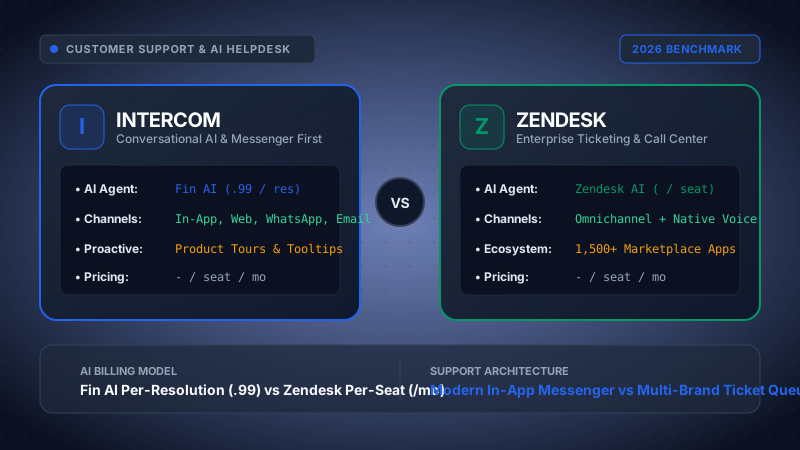
However, Intercom and Zendesk approach this revolution from diametrically opposed engineering origins:
- Intercom treats support as an integrated, real-time conversation embedded inside web and mobile products. Its architecture is built around dynamic user sessions, proactive product tours, and an autonomous AI agent (Fin) designed to replace front-line tier-1 human support entirely.
- Zendesk treats support as an enterprise workflow engine. Its architecture is designed around multi-brand ticketing queues, granular role-based access control (RBAC), multi-tier SLA escalation triggers, and call center telephony, with AI serving as an operational copilot for human agent fleets.
2. AI Architecture: Intercom Fin AI ($0.99/res) vs Zendesk Advanced AI ($50/seat)
The most critical technical divergence between both platforms is their underlying AI engine and how they monetize artificial intelligence.
Intercom Fin AI Agent: The Autonomous Front-Line Worker
Intercom was among the earliest enterprise software companies to bet entirely on OpenAI and Anthropic foundation models, launching Fin AI. In 2026, Fin is not a copilot that drafts suggestions for human reps; it is an autonomous digital agent that handles conversations from start to finish.
- Zero-Shot Knowledge Ingestion: Fin connects directly to your company's knowledge base (Zendesk Help Center, Notion, GitHub docs, internal PDFs, or public URLs) and indexes them with dense vector embeddings without requiring manual intent mapping.
- Hallucination Guardrails: Fin operates under strict deterministic boundaries. If the answer cannot be verified with high semantic confidence from your verified documentation, Fin immediately and gracefully routes the conversation to a human rep with a concise internal summary.
- Autonomous Actions & API Calls: Fin can execute real-time backend actions via webhooks—such as upgrading a customer subscription, generating a temporary password, or querying an external database—without human intervention.
- Resolution-Based Pricing: Intercom charges $0.99 USD per resolution. If a customer is unsatisfied, asks for a human, or downvotes the answer, the fee is waived.
Zendesk Advanced AI: The Agent Productivity Copilot
Zendesk built its AI capabilities through a combination of proprietary machine learning models trained on billions of historical support tickets, augmented by OpenAI enterprise endpoints.
- Intelligent Triage & Sentiment Detection: When an incoming email or ticket arrives, Zendesk AI analyzes sentiment (e.g., frustrated, urgent), intent (e.g., refund request, billing dispute), and language, automatically applying tags and routing the ticket to the specialized agent group with the appropriate skill set.
- Agent Copilot: Inside the agent workspace, Zendesk AI generates automated response drafts, expands bullet points into polite prose, and summarizes 40-message ticket histories into 3 bullet points, reducing human handling time by 30% to 45%.
- Zendesk AI Agents: Zendesk offers customer-facing generative bots, but its primary monetization strategy is an Advanced AI add-on priced at $50 USD per agent per month, regardless of the number of tickets processed.
3. Communication Models: Modern In-App Messenger vs Multi-Channel Helpdesk
The user experience divergence between Intercom and Zendesk shapes how customers perceive your company's brand.
Intercom Messenger: Product-Led & Conversational
Primary Interface: Lightweight, real-time in-app chat widget embedded directly inside web and mobile apps.
- Asynchronous Continuity: Conversations feel like modern WhatsApp or iMessage threads. A customer can start a chat in a web browser, continue on their iPhone, and receive email follow-ups seamlessly.
- Proactive Engagement: Intercom connects directly to user behavioral telemetry. You can trigger automated product tours, feature announcement banners, and targeted onboarding checklists based on user actions (e.g., signed up 3 days ago but haven't invited a teammate).
- Unified Inbox: Human support reps work from a fast, keyboard-shortcut-driven real-time inbox designed like Superhuman.
Zendesk Suite: Enterprise Workflow Engine
Primary Interface: Multi-tab ticket management console built for enterprise support operations.
- Complex Ticket Queues: Granular ticket views, custom statuses (New, Open, Pending, On-Hold, Solved), and parent-child ticket relationships.
- SLA Management & Escalation: Automated triggers that escalate tickets if a response SLA is within 30 minutes of breach, alerting managers or re-assigning priority automatically.
- Ticket Collision Detection: Visual indicators show when another agent is viewing or typing in a ticket, preventing embarrassing duplicate customer replies.
4. Omnichannel Breadth: Call Centers, WhatsApp, and SLA Routing
While modern tech startups often aim to operate 100% via chat and email, enterprise customer service departments frequently require high-volume phone support and multi-brand customer segregation.
Zendesk Talk: The Undisputed Voice Leader
For organizations where phone calls remain a primary support channel, Zendesk holds a decisive architectural advantage:
- Native Twilio-Backed Telephony: Zendesk Talk provides a complete cloud call center solution with zero third-party software required.
- Interactive Voice Response (IVR): Complex multi-level phone trees ("Press 1 for Sales, Press 2 for Technical Support") that route calls directly to agent queues or external phone numbers.
- Warm Transfers & Call Recording: Reps can consult with a supervisor before transferring a caller, with call recordings and AI transcriptions automatically attached to the ticket record.
- Hardware SIP Phone Support: Agents can answer calls using physical desk phones or browser WebRTC headsets.
Intercom Phone: Lightweight Calling for Modern SaaS
Intercom does not attempt to be an enterprise call center. Its voice capabilities (Intercom Phone) are engineered for modern, lightweight interactions:
- In-App Voice Huddles: A support agent or customer success manager can escalate a complex chat into an instant voice call or screen share directly inside the web browser.
- No Complex IVR: Lacks multi-tier interactive voice response trees and hardware SIP desk phone integrations.
- Best For: High-touch B2B SaaS onboarding, VIP customer triage, and complex technical debugging rather than high-volume consumer call centers.
5. Head-to-Head Technical Benchmark Matrix
The following benchmark evaluates Intercom and Zendesk across 14 technical and operational dimensions based on verified 2026 enterprise testing:
| Feature / Evaluation Criteria | Intercom | Zendesk | Architectural Winner |
|---|---|---|---|
| Primary Architectural Model | Conversational in-app messenger + autonomous AI agent | Enterprise omnichannel ticketing queue + call center | Tie (Depends on business model) |
| Autonomous AI Resolution Capability | Fin AI (50%+ autonomous resolution rate with custom actions) | Zendesk AI Agents (conversational bots with intent triage) | Intercom (Superior autonomous engine) |
| AI Pricing & Billing Model | $0.99 per successful resolution (pay-for-performance) | $50 / agent / mo (Advanced AI flat seat add-on) | Intercom (Zero risk pay-on-success) |
| In-App Product Messenger Quality | Industry benchmark; highly customizable, sleek, fast | Zendesk Messaging widget (functional, but less polished) | Intercom (Best-in-class messenger) |
| Voice & Telephony (Call Center) | Basic browser-based voice calls for SaaS escalation | Enterprise cloud call center (Zendesk Talk) with IVR & SIP | Zendesk (Far superior voice suite) |
| Ticketing Workflow & SLA Management | Streamlined inbox with basic SLA timers and tags | Complex multi-tier SLA triggers, macros, and ticket hierarchies | Zendesk (Enterprise ticketing leader) |
| Proactive Onboarding & Product Tours | Native interactive tours, banners, checklists, and tooltips | Requires third-party integrations (e.g., Pendo or Appcues) | Intercom (Built-in product adoption) |
| App Marketplace & Ecosystem | 400+ modern SaaS and developer integrations | 1,500+ enterprise apps, legacy ERPs, and telephony tools | Zendesk (Largest enterprise ecosystem) |
| WhatsApp Business Integration | Native WhatsApp channel with Fin AI automation | Native WhatsApp channel with multi-agent routing | Tie (Both highly mature) |
| Multi-Brand Support | Supported on higher tiers (Custom enterprise plans) | Native multi-brand routing with segregated portals and SLAs | Zendesk (Cleaner multi-brand support) |
| Knowledge Base & Help Center CMS | Intercom Articles (clean, modern, indexed by Fin AI) | Zendesk Guide (deep multilingual localization & versioning) | Zendesk (Deeper localization CMS) |
| Security & Enterprise Compliance | SOC 2 Type II, ISO 27001, GDPR, HIPAA compliant | SOC 2 Type II, ISO 27001, GDPR, HIPAA, FedRAMP | Zendesk (FedRAMP authorization) |
| API & Webhook Extensibility | Modern REST API, real-time webhooks, Canvas apps | Extensive REST API, Sunshine data platform, webhooks | Tie (Full programmatic control) |
| Time to Initial Deployment | 1 to 3 days (drop-in JavaScript snippet + doc sync) | 2 to 6 weeks (complex queue, trigger, and macro setup) | Intercom (Fastest time-to-value) |
6. 2026 Pricing & Total Cost of Ownership (TCO) Breakdown
Evaluating the true financial cost of Intercom versus Zendesk requires examining two completely different pricing architectures: Intercom's consumption-based AI model versus Zendesk's seat-based licensing model.
| Tier / Component | Intercom | Zendesk Suite |
|---|---|---|
| Entry / Small Team Tier | Essential: $39 / seat / mo (Includes shared inbox, basic bots) |
Suite Team: $55 / agent / mo (Ticketing, email, chat, voice) |
| Mid-Market / Growth Tier | Advanced: $99 / seat / mo (Workflows, multiple inboxes, SLA) |
Suite Growth: $89 / agent / mo (Multiple SLA policies, customer portal) |
| Scale / Professional Tier | Expert: $139 / seat / mo (Custom reporting, SSO, workload management) |
Suite Professional: $115 / agent / mo (Advanced voice, custom analytics, multi-brand) |
| AI Capabilities & Pricing | Fin AI: $0.99 per successful resolution (Included in all plans; pay-on-success) |
Zendesk Advanced AI: $50 / agent / mo (Flat fee add-on per human seat) |
| Proactive Product Tours | Add-on ($99 – $199 / mo) or enterprise custom | Not available (requires external SaaS) |
| WhatsApp Business Fees | Meta conversation fees passed through | Meta conversation fees passed through |
Architectural TCO Modeling: The 10-Agent / 6,000-Ticket Scenario
Consider a growing B2B SaaS company with 10 support agents processing 6,000 inquiries per month, with an AI resolution target of 40% (2,400 tickets solved autonomously):
- Zendesk TCO (Suite Professional + Advanced AI):
10 agents × ($115 + $50 AI) = $1,650 / month ($19,800 USD/year).
Note: The cost remains fixed whether AI resolves 500 tickets or 4,000 tickets. - Intercom TCO (Advanced Plan + Fin AI):
(10 agents × $99) + (2,400 Fin AI resolutions × $0.99) = $990 + $2,376 = $3,366 / month ($40,392 USD/year).
However, those 2,400 autonomous resolutions prevent the company from needing to hire 3 to 4 additional human support reps ($150,000+/year in saved payroll).
7. Decision Framework: When to Choose Intercom vs Zendesk
Your selection between Intercom and Zendesk should not be based on feature checklists, but on your company's core operating model and customer communication channels.
Choose Intercom If:
- You are a modern software or SaaS company: Your customers are already logged into a web application, mobile app, or browser dashboard where a real-time messenger feels natural.
- You want maximum autonomous resolution with Fin AI: You want an AI agent that answers technical questions instantly without human rep involvement, paying only when problems are solved.
- Product onboarding and adoption matter to support: You want to eliminate support tickets before they happen using proactive onboarding checklists, banners, and product tours.
- You want a lightweight, modern rep experience: Your team hates traditional ticketing software and prefers a blazing-fast, keyboard-driven conversational inbox.
Choose Zendesk If:
- Inbound phone support and call centers are non-negotiable: You require high-volume IVR phone trees, call recording, warm transfers, and hardware desk phones.
- You operate complex, multi-tier enterprise support teams: You need strict SLA escalation policies, parent-child ticket linking, and rigid departmental approval workflows.
- You manage multiple consumer brands or e-commerce storefronts: Zendesk's multi-brand architecture cleanly isolates customer portals, email domains, and agent queues under a single login.
- You employ a large fleet of outsourced BPO support agents: Zendesk's flat per-seat licensing ($50/seat AI add-on) is far more budget-predictable for high-volume agent operations.
8. Frequently Asked Questions (FAQ)
How does Intercom's Fin AI resolution pricing actually work?
Intercom charges $0.99 per successful resolution generated by Fin AI. A resolution is counted when Fin provides an answer from your knowledge base and the customer confirms it solved their problem, or when the customer closes the conversation without requesting human assistance. If the customer asks to speak with a human agent or marks the answer as unhelpful, you are not charged.
Can Zendesk match Intercom's in-app messenger and proactive onboarding?
While Zendesk offers an embeddable web widget (Zendesk Messaging) that supports live chat and bot flows, it is primarily optimized for reactive support inquiries. Intercom was built from the ground up as a conversational product messenger, offering native product tours, in-app banners, checklists, and automated user onboarding based on real-time event telemetry.
Which platform is better for complex phone support and enterprise call centers?
Zendesk is significantly superior for enterprise voice and call centers. Zendesk Talk provides an integrated cloud call center solution with IVR routing, warm transfers, queue wait time announcements, call recording, and integrations with hardware SIP desk phones. Intercom offers Intercom Phone, but it is designed primarily for quick scheduled video or voice huddles rather than high-volume inbound call center operations.
Is Zendesk cheaper than Intercom for large customer service teams?
For traditional support teams with 20+ human agents handling high ticket volumes via email and phone, Zendesk's flat per-seat pricing (e.g., Suite Professional at $115/agent/month) is often more predictable. Intercom's seat fees ($39 to $139/seat) combined with Fin AI resolution fees ($0.99/resolution) can scale rapidly if ticket deflection volume is massive, though it reduces the need to hire additional human headcount.
How easily can I migrate from Zendesk to Intercom, or vice versa?
Both platforms offer mature migration tools and third-party sync connectors. Intercom provides a one-click Zendesk Help Center scraper that immediately ingests your existing public knowledge base into Fin AI within minutes. However, migrating historical ticket thread schemas, custom macro routing, and trigger automation logic requires careful field mapping and typically takes 2 to 4 weeks for mid-market teams.
José Andrade
Founder & Managing EditorArchitect and founder specializing in systems design, project viability, and operational cost modeling. José directs CloudBizStack by bringing structural planning discipline and rigorous TCO (Total Cost of Ownership) analysis to modern software stacks and cloud infrastructure.