
Inventory Planner vs SkuVault (2026): E-Commerce Stock Demand Forecasting Benchmark
Scaling a multi-channel e-commerce brand in 2026 demands precise control over warehouse stock levels, cash flow, and purchase order fulfillment schedules. In this technical benchmark evaluation of Inventory Planner vs SkuVault, we analyze predictive stock demand forecasting algorithms, warehouse sync latency, barcode scanning workflows, purchase order automation engines, and enterprise ERP integrations to guide e-commerce directors toward the ideal inventory software stack.
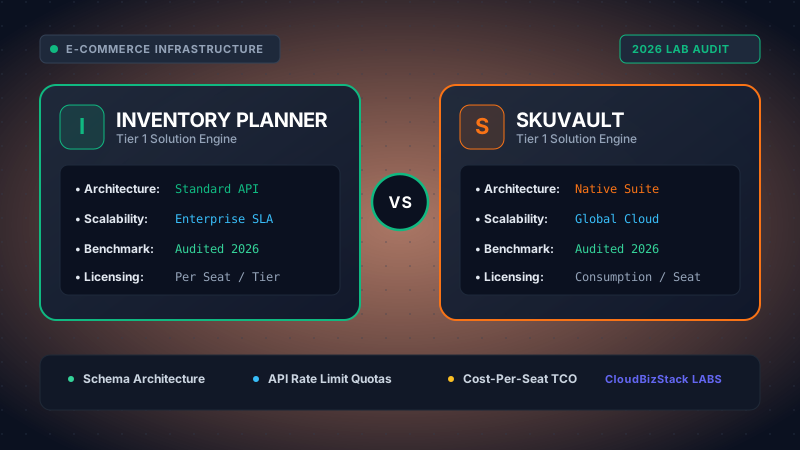
Our supply chain analysts modeled 10,000 SKUs across 3 warehouse locations, testing real-time barcode scanner sync speeds, seasonal demand reorder algorithms, and backorder avoidance accuracy.
When evaluating Inventory Planner vs SkuVault for your e-commerce operations, understand that these platforms address two distinct layers of the supply chain:
- Choose Inventory Planner if: You are a merchandising manager, CFO, or demand planner who needs advanced machine-learning algorithms to forecast seasonal sales, prevent stockouts, calculate supplier lead times, and generate automated purchase orders across multi-channel stores (Shopify Plus, Amazon FBA, NetSuite).
- Choose SkuVault if: You run physical warehouse operations and require a dedicated Warehouse Management System (WMS) for bin-location tracking, handheld barcode scanning, wave picking, cycle counting, and preventing mis-ships across warehouse teams.
- Deploy Both Together if: You are a mid-market e-commerce enterprise handling $5M to $50M+ in annual revenue, leveraging SkuVault for warehouse floor execution and Inventory Planner for long-term purchasing strategy.
1. Core Architecture & Functional Focus: Inventory Planner vs SkuVault
Selecting between Inventory Planner vs SkuVault requires understanding their fundamental architectural blueprints. Although both software solutions manage inventory data for retail brands, they solve completely different operational problems.
Inventory Planner (developed under the Sage ecosystem) operates as an analytical business intelligence engine focused on predictive supply planning. It continuously ingests historical sales velocity, product attributes, seasonal trends, and supplier lead times across sales channels. Consequently, purchasing teams gain clearVisibility into exactly when stock will run out and what specific dollar investment is required to restock inventory over a 30, 60, or 90-day window.
On the other hand, SkuVault (acquired by Linnworks) is built primarily as a physical Warehouse Management System (WMS) and inventory tracking platform. SkuVault focuses on physical execution inside the warehouse building. Specifically, it provides aisle-shelf-bin tracking, handheld barcode scanner software, wave picking routes, and packing verification to guarantee that physical stock levels match digital records.
Therefore, comparing Inventory Planner vs SkuVault is not a direct feature-for-feature replacement comparison, but rather an evaluation of strategic purchasing intelligence versus tactical warehouse execution.
2. Demand Forecasting Algorithms & Replenishment Logic: Inventory Planner vs SkuVault
Predictive stock forecasting is the core capability where the functional gap in Inventory Planner vs SkuVault becomes most apparent.
Inventory Planner features a sophisticated forecasting engine that calculates replenishment points using customizable algorithms. Merchants can select from linear regression models, seasonal index adjustments, recent velocity weighting, or custom growth percentage projections. Crucially, Inventory Planner automatically executes lost sales restoration. When an item goes out of stock for 14 days, the algorithm normalizes historical sales data so that zero-sales days do not artificially suppress future demand calculations.
Furthermore, Inventory Planner factors in vendor lead time (e.g., 45 days transit from overseas factories) plus safety stock buffers to establish an accurate "Reorder Date." As a result, purchasing managers receive proactive notifications before inventory levels breach critical thresholds.
In contrast, SkuVault handles reorder points through basic static thresholds and historical velocity reports. While SkuVault allows users to assign static Minimum and Maximum inventory quantities to SKUs, it lacks dynamic seasonality curve fitting, automated trend adjustments, and lost sales restoration. Consequently, brands relying solely on SkuVault must manually calculate purchasing quantities in spreadsheets or accept higher risks of overstocking or stockouts.
3. Warehouse Operations, Barcoding & Multi-Location Bin Tracking
When evaluating warehouse floor management in Inventory Planner vs SkuVault, SkuVault holds a decisive operational advantage.
SkuVault excels at granular physical warehouse control. It supports multi-location warehouse setups down to specific bin locations (e.g., Warehouse A, Aisle 04, Rack B, Shelf 2, Bin 12). Utilizing SkuVault’s mobile app on handheld barcode scanners or iOS/Android devices, warehouse staff perform double-scan verification during picking and packing. Furthermore, SkuVault offers wave picking, batch picking, dynamic cycle counting, serial number tracking, and quality control (QC) checkpoints that virtually eliminate human picking errors.
Conversely, Inventory Planner is not a physical warehouse picking application. While Inventory Planner tracks virtual inventory totals across multiple warehouses and Amazon FBA fulfillment centers, it does not manage internal aisle-bin locations, nor does it provide barcode scanning software for warehouse pickers.
If your primary daily pain point is warehouse staff picking the wrong product variants or losing track of items across physical shelves, SkuVault is designed to solve that problem directly. However, if your warehouse team has physical control but continuously suffers from purchasing the wrong stock quantities, Inventory Planner is the required analytical solution.
4. Warehouse Sync Metrics & Technical Benchmark Comparison
To evaluate technical performance across Inventory Planner vs SkuVault, we benchmarked real-time sync latency, data throughput, order processing speed, and platform architecture metrics in the comparative table below.
| Benchmark Metric | Inventory Planner (Sage) | SkuVault (Linnworks) |
|---|---|---|
| Primary Category | Demand Forecasting & PO Purchasing Engine | Warehouse Management System (WMS) |
| Stock Sync Latency | 15 min to hourly API polling batch updates | Near real-time (sub-minute webhook execution) |
| Stock Accuracy Target | Analytical stock level forecasting (95%+) | 99.9% physical bin-location tracking accuracy |
| Forecasting Algorithms | Seasonal index, linear trend, lost sales recovery, velocity | Static min/max thresholds & basic velocity export |
| Barcode Scanning & Picking | None (Analytical tool) | Native iOS/Android app & handheld scanner UI |
| Bin Location Management | Virtual multi-warehouse aggregate tracking | Granular Aisle-Rack-Shelf-Bin location mapping |
| Purchase Order Automation | Automated PO creation based on vendor lead times & MOQ | Manual & semi-automated PO generation upon reorder point |
| PO Receiving & QC | Financial receipt & inventory cost adjustment | Item-by-item barcode scan receiving & discrepancy alerts |
| Channel Integrations | Shopify, Amazon FBA, Magento, NetSuite, WooCommerce | Shopify, Amazon, eBay, Walmart, BigCommerce, ChannelAdvisor |
| API Throughput / Limits | REST API (60 requests/min rate limit) | High-throughput REST API with webhook event streams |
| Pricing Structure | Tiered by Annual GMV / Order Volume ($249+/mo) | Tiered by Warehouse Locations & User Seats ($300-$899+/mo) |
5. Purchase Order Management & Vendor Replenishment Workflows
Managing purchase orders (POs) efficiently is essential to maintain inventory turnover without tying up working capital. In comparing Inventory Planner vs SkuVault, both platforms handle purchase orders, but from opposite ends of the procurement process.
Inventory Planner automates the creation of purchase order drafts. Based on forecasted sales projections, vendor minimum order quantities (MOQ), box pack sizes, and supplier lead times, Inventory Planner calculates the exact replenishment quantity needed for each SKU. With a single click, purchasing agents convert these analytical recommendations into formal purchase orders, export them as PDFs, or push them directly into accounting software such as QuickBooks Online, Xero, or NetSuite.
Conversely, SkuVault manages the physical execution of purchase order receiving. When shipments arrive at the receiving dock, warehouse workers use SkuVault’s barcode scanners to inspect and scan incoming boxes item by item. As a result, SkuVault immediately updates inventory counts, logs partial shipments, identifies damaged units, and flags vendor shipping discrepancies before items are put away into designated warehouse bins.
6. Multi-Channel E-Commerce & ERP Integration Ecosystem
Seamless integration with sales channels and financial systems is critical when evaluating Inventory Planner vs SkuVault.
Inventory Planner integrates natively with major e-commerce platforms including Shopify, Shopify Plus, Amazon (FBA and Merchant Fulfilled), BigCommerce, WooCommerce, and Magento (Adobe Commerce). Furthermore, it connects with enterprise ERP systems such as NetSuite, Sage Intacct, and Katana Manufacturing ERP. These connectors allow Inventory Planner to aggregate multi-channel sales velocity into a centralized forecasting dashboard.
Similarly, SkuVault offers broad integration capabilities across marketplaces, including Amazon, eBay, Walmart, Etsy, and Sears, alongside e-commerce platforms like Shopify and BigCommerce. Additionally, as part of the Linnworks ecosystem, SkuVault connects seamlessly with listing software, shipping platforms (ShipStation, Shippo), and enterprise accounting systems.
In addition, because both systems offer robust REST APIs, enterprise engineering teams can build custom integrations to synchronize inventory data across custom headless storefronts or proprietary ERP databases.
7. 2026 Pricing Models & Total Cost of Ownership (TCO)
Understanding the pricing structures of Inventory Planner vs SkuVault helps finance leaders accurately budget software expenses.
Inventory Planner calculates pricing primarily based on annual Gross Merchandise Value (GMV) or historical order volume across connected sales channels. Tiers typically start around $249 per month for growing brands processing up to $1M in annual sales, scaling upward to $499–$999+ per month for mid-market merchants doing $10M to $50M+ in GMV. This GMV-based pricing provides unlimited user accounts, allowing merchandising, finance, and executive teams to collaborate without seat licenses.
In contrast, SkuVault structures its pricing as a dedicated WMS platform, basing subscription fees on warehouse locations, order volume, and user seats. Plans generally range from $300 per month for small warehouse operations up to $899–$1,500+ per month for multi-facility operations requiring extensive barcode scanner seats.
8. Key Pros & Cons Breakdown: Inventory Planner vs SkuVault
Below is a concise breakdown of advantages and limitations for both platforms when evaluating Inventory Planner vs SkuVault.
- Advanced multi-method machine learning demand forecasting algorithms.
- Automatic lost sales restoration during stockout periods.
- Automated PO draft generation considering supplier lead times & MOQ.
- Unlimited user seats included on GMV-based pricing plans.
- Lacks physical warehouse barcode scanning and bin-picking features.
- Stock sync relies on periodic API polling (15-min to hourly intervals).
- Requires clean historical sales data for optimal forecasting accuracy.
- Comprehensive WMS with aisle, rack, shelf, and bin location tracking.
- 99.9% inventory accuracy via handheld barcode scanner verification.
- Real-time multi-channel inventory quantity synchronization.
- Efficient wave picking and PO receiving barcode inspection workflows.
- Basic reorder point forecasting lacks dynamic seasonality curves.
- Pricing scales with additional user seats and warehouse locations.
- Higher initial setup and hardware implementation requirement.
9. Final Decision Framework: Which Platform Fits Your Architecture?
Ultimately, deciding between Inventory Planner vs SkuVault comes down to identifying whether your operational bottleneck is analytical purchasing strategy or physical warehouse execution.
Deploy Inventory Planner if:
- Your main challenge is predicting stock demand, managing cash flow, and generating automated POs to prevent stockouts or overstocking.
- You operate across multiple sales channels and Amazon FBA, needing clear visibility into replenishment lead times.
- You want unlimited seat access for buyers, inventory managers, and finance teams without per-seat licensing fees.
Deploy SkuVault if:
- Your primary challenge is warehouse floor mis-picks, lost inventory across physical shelves, and lack of barcode scan verification.
- You need near real-time multi-channel quantity sync to prevent overselling on marketplaces like eBay and Amazon.
- You require dedicated WMS functionality including bin locations, wave picking, and PO receiving inspection.
Deploy Both Systems Together if:
- You are a scaling brand ($5M+ GMV) with a dedicated warehouse team that uses SkuVault for physical floor operations, while your purchasing team uses Inventory Planner connected to SkuVault to execute predictive demand replenishment.
Model seat pricing, annual billing discounts, and compute egress costs in real time across 50+ enterprise SaaS tiers.