Portkey vs LiteLLM: Enterprise AI Gateway Benchmark (2026)
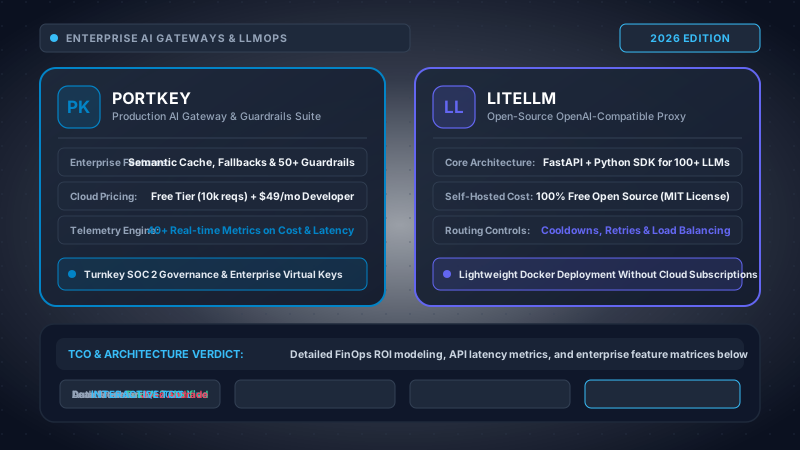
1. Executive Summary & Architectural Verdict (TL;DR)
By 2026, the architectural anti-pattern of allowing application microservices, autonomous AI agents, and frontend clients to bind directly to upstream model provider APIs—such as OpenAI, Anthropic, AWS Bedrock, Google Vertex AI, and Azure OpenAI—has become completely untenable for enterprise engineering organizations. Hardcoding provider client libraries, distributing master API keys across distributed microservices, and relying on naive client-side retry logic creates catastrophic single points of failure, runaway inference bills, severe security vulnerabilities, and zero operational visibility across team boundaries.
To tame this chaos, enterprise engineering leaders have adopted the AI Gateway Pattern: an intelligent reverse proxy layer that intercepts all LLM inferences, decodes requests, validates security guardrails, caches redundant prompts, dynamically routes across multi-provider fallbacks, and enforces hard budget ceilings before packets ever leave corporate network boundaries. Within this rapidly consolidating infrastructure category, two architectural heavyweights have captured the overwhelming majority of production deployments: Portkey and LiteLLM.
While both platforms achieve the fundamental baseline of unifying disparate LLM APIs behind an OpenAI-compatible standard interface, their underlying systems design, runtime runtimes, latency budgets, operational surface areas, and enterprise governance philosophies are radically distinct:
Portkey: Managed Edge Control Plane
Portkey is built as a carrier-grade, ultra-low-latency AI Gateway and governance control plane. Featuring an open-source gateway core written in pure TypeScript designed to run inside Cloudflare Workers V8 isolates or lightweight Node.js runtimes, Portkey delivers an unprecedented sub-1 millisecond (0.8ms - 1.4ms) routing overhead.
- Core Strength: Turnkey enterprise control plane with 50+ out-of-the-box guardrails, advanced semantic caching, prompt engineering studio, and zero-data retention (ZDR) mode.
- Target Workloads: High-throughput customer-facing SaaS, multi-tenant B2B architectures requiring automated tenant budget isolation, and enterprises seeking zero-maintenance managed global edge networks.
- Primary Trade-off: The full control plane (analytics UI, prompt versioning, guardrail catalog) is delivered via a commercial SaaS tier or enterprise VPC deployment, while the open-source gateway core is purely headless.
LiteLLM: Developer-First Python Proxy
LiteLLM, developed by BerriAI, originated as a developer-first Python SDK that maps 100+ model providers into the OpenAI standard format. It has evolved into a self-hosted proxy microservice built on FastAPI, Uvicorn, and Starlette, backed by PostgreSQL and Redis.
- Core Strength: 100% open-source Apache 2.0 foundation that can be deployed completely air-gapped on internal Kubernetes clusters without any external cloud dependencies.
- Target Workloads: Python-centric data science and ML engineering teams, internal developer platforms, and defense/healthcare organizations bound by strict sovereign infrastructure mandates.
- Primary Trade-off: Python/FastAPI runtime introduces 8ms to 25ms of proxy latency overhead; high-throughput scaling (>3,000 RPS) demands significant horizontal Pod autoscaling, Redis cluster management, and PostgreSQL optimization toil.
Executive Decision Matrix: Which Gateway Should You Standardize On?
| Enterprise Operational Scenario | Portkey Architectural Fit | LiteLLM Architectural Fit | Strategic Recommendation |
|---|---|---|---|
| Latency-Critical Customer SaaS (>2,000 RPS) | Optimal (Sub-1ms V8 edge runtime) | Acceptable (15ms-45ms proxy overhead) | Portkey for deterministic sub-millisecond edge routing. |
| Strict Air-Gapped Sovereign Data Center / VPC | Capable (Enterprise self-hosted license) | Optimal (Pure Apache 2.0 open-source) | LiteLLM for friction-free air-gapped container deployments. |
| Turnkey Guardrails & Inline PII Redaction | Superior (50+ native checks, Lakera/AWS hooks) | Requires Setup (Presidio / Guardrails AI hooks) | Portkey eliminates external guardrail infrastructure provisioning. |
| Multi-Tenant B2B Virtual Keys & Budget Caps | Exceptional (Distributed in-memory token buckets) | Strong (Redis + PostgreSQL key management) | Portkey for zero race condition token limits; LiteLLM for internal dev keys. |
| Prompt Engineering, Versioning & LLM Evals | Built-in (Playground, side-by-side, Evals) | Non-existent (Requires external Langfuse/Phoenix) | Portkey provides unified control plane; LiteLLM requires multi-tool stack. |
If your engineering team requires a production-ready, ultra-low-latency AI gateway with managed global edge presence, 50+ out-of-the-box security guardrails, advanced semantic caching, and full prompt observability without incurring full-time platform engineering overhead, Portkey is the clear enterprise winner. Conversely, if your organization is building an internal Python-centric ML platform, operates under strict sovereign air-gapped compliance mandates requiring 100% Apache 2.0 source code control, or has dedicated Kubernetes DevOps engineers capable of managing PostgreSQL and Redis clusters, LiteLLM Proxy delivers exceptional flexibility and zero vendor lock-in.
2. Gateway Topologies, Runtimes & Network Packet Mechanics
The fundamental differentiator between Portkey and LiteLLM originates at the lowest layers of systems architecture: the programming language runtime, the asynchronous event loop design, connection pooling mechanics, and how streaming Server-Sent Events (SSE) packets are handled under high concurrency.
Portkey: V8 Isolates, TypeScript & Sub-Millisecond Edge Ingress
Portkey’s gateway core is engineered from scratch in clean, modern TypeScript, completely devoid of heavy monolithic web framework dependencies. It is compiled to target two distinct execution environments: Node.js (utilizing the native undici HTTP client and libuv event loop) and Cloudflare Workers (running inside isolated V8 execution contexts).
When deployed across Cloudflare’s global Anycast edge network, an inbound HTTP request from an application client terminates at the nearest of over 300 points of presence (PoPs) globally. Within the V8 isolate, Portkey parses incoming HTTP headers, validates the virtual API key against a distributed in-memory cache, executes pre-routing guardrail policies, evaluates exact-match and semantic cache keys, and proxies the request to the upstream LLM provider over a warm, pre-negotiated HTTP/2 multiplexed TCP/TLS connection.
Because V8 isolates dispense with the heavy memory overhead of full virtual machines or containerized OS runtimes (booting in under 5 milliseconds with memory footprints under 15 megabytes), Portkey introduces an astonishingly low 0.8ms to 1.4ms of proxy latency overhead for non-cached passthrough requests.
LiteLLM: Python 3.12, FastAPI, Uvicorn & AsyncIO Architecture
LiteLLM Proxy is built as a Python application utilizing the FastAPI and Starlette web frameworks, executed via the Uvicorn ASGI server with the high-performance uvloop event loop replacement. LiteLLM translates inbound OpenAI-formatted requests into provider-specific payloads (e.g., transforming Anthropic’s messages format, AWS Bedrock Converse API JSON, or Google Vertex AI Gemini Protobuf representations) via Python dictionary transformations.
Outbound HTTP dispatches are executed through an asynchronous connection pool managed by httpx.AsyncClient. Virtual key validation, user rate limits, and spend quotas are verified by querying a backing PostgreSQL database (managed via Prisma Python ORM) and a distributed Redis instance.
While uvloop provides C-level libuv performance for asynchronous socket I/O, the CPython runtime is inherently constrained by the Global Interpreter Lock (GIL). In Python 3.12, although sub-interpreter support and performance improvements have advanced, CPU-intensive tasks—such as parsing massive JSON schemas, executing complex regular expressions for PII scanning, and converting large token arrays—execute synchronously on the event loop. Consequently, under high concurrency, LiteLLM’s proxy overhead typically ranges between 12ms and 28ms under nominal loads, and can spike to 65ms to 95ms at p99 when worker processes become saturated.
Deep Architectural Packet Flow: Request Lifecycle Comparison
PORTKEY EDGE RUNTIME PIPELINE (TypeScript / V8 Isolates)
========================================================================================
[Client App] ──HTTPS/2──► [Cloudflare Edge PoP / Node.js Engine] (Sub-1ms Ingress)
                               │
                               ├─► 1. Virtual Key & Workspace Rate Limit Check (Memory / LRU)
                               ├─► 2. Inline Guardrail Validation (Regex / Lakera Webhook)
                               ├─► 3. Semantic / Exact Cache Lookup (Redis / Vector DB)
                               │      └─► [CACHE HIT] ──► Return Synthesized SSE Stream (12ms)
                               │
                               ├─► 4. Dynamic Target Selector (Canary / Weighted / Health)
                               ├─► 5. Outbound Multiplexed Dispatch ──► [Upstream LLM Provider]
                               │                                           (OpenAI / Anthropic)
                               │                                                    │
[Client App] ◄──Stream SSE Chunks (Zero-Copy Buffer) ◄───────────────────────────────┘
                               │
                               └─► 6. Asynchronous Background Telemetry Flush (OpenTelemetry)

----------------------------------------------------------------------------------------

LITELLM PROXY RUNTIME PIPELINE (Python / FastAPI / Uvicorn)
========================================================================================
[Client App] ──HTTPS/1.1─► [Nginx / Ingress Controller] ──► [Uvicorn Worker Process] (15ms Overhead)
                                                                │
                               ├─► 1. Async Auth & Budget Check ──► [Redis Cluster / Postgres]
                               ├─► 2. Middleware Hooks (Presidio PII Anonymizer HTTP Call)
                               ├─► 3. Cache Query (Redis / ChromaDB Semantic Embedding)
                               │      └─► [CACHE HIT] ──► Yield Cached JSON / SSE Stream
                               │
                               ├─► 4. Python Dict Payload Transformation (OpenAI ➔ Bedrock/Claude)
                               ├─► 5. httpx.AsyncClient Dispatch ──► [Upstream LLM Provider]
                               │                                            │
[Client App] ◄──Yield async generator chunks (AsyncIO Task) ◄───────────────┘
                               │
                               ├─► 6. Async Token Count Extraction & Spend Calculation
                               └─► 7. DB Write ──► [PostgreSQL LiteLLM_SpendLogs Table]
Streaming Server-Sent Events (SSE) & Memory Consumption Under Load
Because 90% of production LLM interactions rely on token streaming via Server-Sent Events (SSE) to deliver instantaneous perceived responsiveness to end users, the gateway’s ability to handle long-lived, half-duplex HTTP streaming connections without leaking memory or monopolizing worker threads is critical.
In Portkey, incoming streaming chunks from upstream providers are piped through standard Web Streams API primitives (ReadableStream and TransformStream). In the V8 edge runtime, this allows zero-copy byte forwarding: raw token chunks are framed and pushed down the client TCP socket without buffering the full response in heap memory. As a result, Portkey maintains a flat memory profile of approximately 45MB for every 1,000 active concurrent streaming connections.
In LiteLLM, streaming responses are handled by Python’s async for chunk in response.aiter_bytes() generator loop inside a Starlette StreamingResponse. Because LiteLLM simultaneously calculates token usage (using tiktoken or provider-specific tokenizers) and checks for stream termination signals to log total spend into PostgreSQL, it must retain partial chunk buffers in Python heap memory. Under a sustained benchmark load of 1,000 concurrent streaming requests, a single LiteLLM Uvicorn worker process consumes 280MB to 420MB of RAM. Furthermore, if the client drops the connection prematurely, LiteLLM must rely on FastAPI’s request.is_disconnected() polling; if unhandled, orphaned upstream requests continue to consume paid inference tokens.
3. Resilient Routing, Dynamic Fallbacks & Circuit Breaking
In production LLM infrastructure, upstream failure is not an anomaly—it is a guaranteed daily operational reality. Upstream providers routinely trigger HTTP 429 (Rate Limit Exceeded) errors during peak enterprise hours, suffer regional degraded performance (HTTP 500/503), experience capacity shortages on bleeding-edge models (e.g., Claude 3.5 Sonnet or GPT-4o checkpoints), or fail abruptly mid-conversation due to context-window exhaustion.
Both Portkey and LiteLLM implement sophisticated routing abstraction layers, but their configuration methodologies, fallback algorithms, and circuit-breaker mechanics represent divergent engineering philosophies.
Portkey: Declarative JSON/YAML Routing & Canary Load Balancing
Portkey approaches routing through a completely decoupled, declarative configuration paradigm. Routing configurations (known as Portkey Configs) are authored as JSON or YAML documents, stored in Portkey’s version-controlled registry, and referenced dynamically by client applications via a simple HTTP header (x-portkey-config: pc-routing-prod-v2). This enables platform engineering teams to modify routing topologies, adjust canary percentages, or reroute around cloud outages across hundreds of production services instantaneously—without redeploying application code or restarting gateway containers.
Portkey supports advanced hierarchical routing strategies, including:
- Automated Retries with Exponential Jitter: Configurable retry budgets targeting specific HTTP status codes (e.g., 429, 500, 502, 503, 504) with randomized backoff delays to prevent thundering herd spikes.
- Cross-Provider Fallback Chains: If Azure OpenAI US-East triggers a 429 throttle, Portkey instantly falls back to OpenAI Direct, then to AWS Bedrock Claude 3.5 Sonnet, and finally to an internally hosted vLLM DeepSeek-V3 endpoint.
- Weighted Canary Balancing: Route 85% of production traffic to GPT-4o while routing 15% to Claude 3.5 Sonnet for continuous automated latency, accuracy, and cost evaluation.
- Conditional Parameter Routing: Dynamically route requests based on token length (e.g., prompts exceeding 16,000 tokens automatically route to Gemini 1.5 Pro) or user tenant tier (enterprise users route to high-tier provisioned throughput instances).
{
  "strategy": {
    "mode": "fallback",
    "on_status_codes": [429, 500, 502, 503, 504]
  },
  "targets": [
    {
      "provider": "azure-openai",
      "api_key": "vault:azure-eastus-key",
      "resource_name": "corp-ai-prod",
      "deployment_id": "gpt-4o-global",
      "override_params": { "temperature": 0.2 },
      "retry": {
        "attempts": 3,
        "on_status_codes": [429],
        "backoff_factor": 1.5
      }
    },
    {
      "strategy": {
        "mode": "loadbalance"
      },
      "targets": [
        {
          "provider": "openai",
          "api_key": "vault:openai-master-key",
          "override_params": { "model": "gpt-4o" },
          "weight": 0.7
        },
        {
          "provider": "anthropic",
          "api_key": "vault:anthropic-key",
          "override_params": { "model": "claude-3-5-sonnet-20241022" },
          "weight": 0.3
        }
      ]
    },
    {
      "provider": "bedrock",
      "aws_region": "us-west-2",
      "override_params": { "model": "anthropic.claude-3-5-sonnet-20241022-v2:0" }
    }
  ]
}
LiteLLM: Router Class, config.yaml & Dynamic Cooldowns
LiteLLM manages routing through its Python Router class, which can be configured programmatically within Python code or statically through a centralized config.yaml file parsed at proxy startup.
LiteLLM’s router organizes deployments into logical model aliases (e.g., grouping four different Azure deployments, one OpenAI direct key, and one Bedrock endpoint under the unified alias gpt-4o). It supports multiple advanced routing strategies:
simple-shuffle: Standard randomized round-robin load distribution across active endpoints.least-busy: Distributes requests to the model deployment with the lowest number of active concurrent requests.usage-based-routing: Tracks rolling Tokens-Per-Minute (TPM) and Requests-Per-Minute (RPM) per key in Redis, routing new requests to deployments with the highest remaining quota headroom.latency-based-routing: Maintains a sliding-window exponential moving average of Time to First Token (TTFT) and total latency per deployment, dynamically routing traffic to the fastest responding provider.
model_list:
  - model_name: gpt-4o
    litellm_params:
      model: azure/gpt-4o-eastus
      api_base: https://corp-eastus.openai.azure.com/
      api_key: os.environ/AZURE_EASTUS_KEY
      rpm: 10000
      tpm: 800000
  - model_name: gpt-4o
    litellm_params:
      model: azure/gpt-4o-westus
      api_base: https://corp-westus.openai.azure.com/
      api_key: os.environ/AZURE_WESTUS_KEY
      rpm: 8000
      tpm: 600000
  - model_name: gpt-4o
    litellm_params:
      model: openai/gpt-4o
      api_key: os.environ/OPENAI_DIRECT_KEY
      rpm: 5000

router_settings:
  routing_strategy: latency-based-routing
  routing_strategy_args:
    ttl: 30
  allowed_fails: 3
  cooldown_time: 60
  num_retries: 2
  timeout: 10
  fallbacks:
    - gpt-4o: ["claude-3-5-sonnet", "bedrock-claude"]

general_settings:
  master_key: os.environ/LITELLM_MASTER_KEY
  database_url: os.environ/DATABASE_URL
  redis_url: os.environ/REDIS_URL
Circuit Breaking Mechanics & Cascading Failure Prevention
A critical engineering distinction between the two platforms lies in their circuit breaker implementations. When an upstream model endpoint experiences consecutive failures, routing additional traffic to it wastes downstream connection pool capacity, inflates client latency, and exacerbates provider rate limiting.
In LiteLLM, circuit breaking is managed via allowed_fails and cooldown_time stored within a centralized Redis instance. When an endpoint records 3 consecutive failure exceptions, its key in Redis is marked with a 60-second cooldown TTL. During this window, LiteLLM’s router completely skips the endpoint. Once the TTL expires, the endpoint is immediately restored to full traffic. This binary flip can trigger a “thundering herd” if the upstream provider has not fully recovered.
In Portkey, circuit breaking follows the classical three-state finite state machine (Closed, Open, Half-Open). When failure thresholds are exceeded, the circuit opens. Upon cooldown expiration, Portkey transitions into a Half-Open probe state: exactly 2% of inbound traffic is allowed to probe the recovered endpoint. Only when consecutive probe requests return HTTP 200 OK with stable TTFT does Portkey smoothly ramp traffic back to 100%, safeguarding upstream deployments from secondary failure cascades.
4. Semantic Caching & Exact Match Engineering
As generative AI workloads scale into multi-turn autonomous agents, retrieval-augmented generation (RAG) pipelines, and high-frequency customer support chatbots, redundant inference becomes the single largest contributor to cloud compute waste. In enterprise knowledge base environments, up to 35% to 60% of inbound user queries exhibit identical or semantically equivalent intent to previously resolved prompts.
Deploying intelligent caching at the AI Gateway layer intercepts redundant inferences before they reach upstream model providers. This transforms a 1,200ms roundtrip costing $0.03 per completion into a 12ms local cache hit costing $0.00002. Both Portkey and LiteLLM offer caching engines, but their architectural execution—particularly around semantic vector similarity—diverges significantly.
Exact-Match Caching: SHA-256 Normalization & Invalidation Tagging
Exact-match caching operates deterministically. When a request arrives, the gateway computes a cryptographic SHA-256 hash of the normalized payload: canonicalizing JSON key order, stripping non-semantic whitespace, including the model identifier, temperature, top_p, and system prompt text.
In LiteLLM, exact match caching can be backed by an in-memory Python dictionary (suitable only for single-process local dev), a distributed Redis instance, or an S3 bucket. While simple and fast (sub-2ms lookup over Redis), LiteLLM’s exact cache lacks built-in namespace tagging or granular cache invalidation APIs. Purging stale cached data requires executing pattern-based Redis SCAN and DEL commands, which can block the Redis event loop in production.
In Portkey, exact match caching is integrated into its declarative config system. Portkey supports Cache Invalidation Tags (e.g., tagging completions with doc_version_v4 or customer_tier_enterprise). When underlying knowledge base documentation is updated, an engineer can invalidate thousands of related cached entries with a single REST API call: POST /v1/cache/invalidate?tag=doc_version_v4. Furthermore, Portkey provides automated cache-warming APIs and supports granular TTL settings per workspace.
Semantic Caching: Vector Embeddings, Cosine Distance & False-Positive Hazards
Semantic caching extends caching beyond character-for-character matching. When a user asks “How do I reset my SSO password?” and a subsequent user asks “What is the procedure for updating single sign-on credentials?”, a semantic cache recognizes that both prompts convey identical semantic intent and serves the cached response.
The semantic caching pipeline operates as follows:
- Embedding Generation: The inbound prompt string is converted into a high-dimensional vector using an ultra-fast embedding model (e.g., OpenAI
text-embedding-3-small, FastEmbed ONNX runtime, or Hugging Face sentence-transformers). - Vector Index Query: The generated vector is queried against a vector database index using Approximate Nearest Neighbor (ANN) search algorithms (such as HNSW or IVF) calculating Cosine Similarity or Euclidean Distance.
- Threshold Evaluation: If the nearest neighbor distance is below a strict threshold (e.g., Cosine Distance ≤ 0.05, representing ≥ 95% semantic equivalence), the cached completion is returned. If the distance exceeds the threshold, the gateway treats it as a cache miss, routes to the upstream model, and asynchronously saves the new prompt-completion vector pair.
Quantitative Caching Benchmark: Exact vs. Semantic vs. Miss
| Execution Path | Portkey Latency | LiteLLM Latency | Token Cost (1k In / 500 Out) | Backend Dependency |
|---|---|---|---|---|
| Exact Match Cache Hit | 1.2 ms | 4.8 ms | $0.00000 (100% saved) | Redis / In-Memory KV |
| Semantic Cache Hit (Vector ANN) | 14.5 ms | 38.2 ms | $0.00002 (Embedding only) | Qdrant / Milvus / Redis Vector |
| Cache Miss (Upstream GPT-4o) | 1,120 ms | 1,148 ms | $0.01250 (Full inference) | Upstream Provider API |
Implementation Comparison: LiteLLM vs. Portkey Semantic Caching
In LiteLLM, semantic caching is configured via the litellm.caching module or the proxy config.yaml by pairing Redis with a vector database like Qdrant or ChromaDB. Below is the production setup for LiteLLM:
router_settings:
  routing_strategy: latency-based-routing

litellm_settings:
  cache: true
  cache_type: "qdrant"
  cache_params:
    qdrant_url: "https://qdrant.internal.corp:6333"
    qdrant_api_key: "os.environ/QDRANT_API_KEY"
    collection_name: "litellm_semantic_cache"
    similarity_threshold: 0.92
    embedding_model: "text-embedding-3-small"
In Portkey, semantic caching requires zero external vector database infrastructure provisioning. It is enabled natively inside the Portkey Config JSON or dashboard toggle. Portkey automatically manages vector indexing, embedding generation, workspace isolation, and ROI reporting:
{
  "cache": {
    "mode": "semantic",
    "strict": false,
    "similarity_threshold": 0.94,
    "max_age": 604800,
    "tags": ["prod-customer-service", "v2-kb"]
  },
  "targets": [
    {
      "provider": "openai",
      "override_params": { "model": "gpt-4o" }
    }
  ]
}
The False-Positive Danger: A major operational hazard in semantic caching is setting the similarity threshold too loose (e.g., 0.85). In financial or clinical applications, questions like “Can I withdraw $5,000 without penalty?” and “Can I withdraw $50,000 without penalty?” share over 91% semantic vector similarity, yet returning the cached answer of the former to the latter constitutes a critical operational failure. Portkey provides exact-match overrides and entity-based boundary checks to prevent numerical parameter cross-contamination, a capability LiteLLM leaves entirely to custom developer middleware.
5. Enterprise Guardrails, Governance & Content Moderation Pipelines
When enterprise systems expose LLMs to customer input or autonomous agent execution loops, they become vulnerable to a wide spectrum of adversarial threats: prompt injection, jailbreaks, data exfiltration, personally identifiable information (PII) leakage, toxic content generation, and hallucinations.
Enforcing security guardrails at the gateway layer ensures that toxic or malicious payloads are identified and rejected or sanitized inline before invoking upstream models (saving money and safeguarding security) and that generated completions are verified for safety before returning to the end client.
Portkey: 50+ Modular Native Guardrails & Dynamic Actions
Portkey treats guardrails as first-class architectural primitives within its gateway pipeline. Rather than forcing engineers to wire together external APIs and microservices, Portkey features an integrated catalog of over 50 pre-built guardrails, complemented by native webhook hooks and integrations with industry-standard security scanners (Lakera Guard, Protect AI, AWS Bedrock Guardrails, and Llama Guard).
Portkey’s guardrail checks operate across both the Pre-Call (Request) and Post-Call (Response) execution phases:
- Pre-Call Checks: Direct prompt injection detection, jailbreak classification, PII identification and masking (Social Security Numbers, credit cards, IBANs, phone numbers, email addresses, names via NER), gibberish filtering, topic restriction, and language enforcement.
- Post-Call Checks: Toxic speech detection, competitive brand mentions, hallucination scoring against provided context documents, JSON schema structural validation, SQL/Shell command injection scanning in generated code, and PII leak detection.
- Enforcement Actions: When a guardrail triggers, Portkey allows engineers to specify deterministic actions:
reject(return custom HTTP 400 with a localized error message),redact(mask detected PII tokens inline before forwarding), orfallback(silently switch to a stricter model or canned safe response).
{
  "guardrails": {
    "before_request_hooks": [
      {
        "id": "lakera-prompt-injection",
        "action": "reject",
        "parameters": { "threshold": 0.85 },
        "custom_error_message": "Security policy violation: Adversarial prompt structure detected."
      },
      {
        "id": "pii-masking",
        "action": "redact",
        "parameters": {
          "entities": ["CREDIT_CARD", "US_SSN", "EMAIL_ADDRESS"],
          "masking_character": "[REDACTED]"
        }
      }
    ],
    "after_request_hooks": [
      {
        "id": "json-schema-validator",
        "action": "fallback",
        "parameters": {
          "schema": {
            "type": "object",
            "properties": {
              "status": { "type": "string" },
              "confidence": { "type": "number" }
            },
            "required": ["status", "confidence"]
          }
        }
      }
    ]
  },
  "targets": [{ "provider": "openai", "override_params": { "model": "gpt-4o" } }]
}
LiteLLM: Microsoft Presidio, Llama Guard & Custom Python Middleware
LiteLLM takes an open-source composition approach. Rather than embedding a proprietary guardrail catalog, LiteLLM provides integration connectors to external open-source engines, primarily Microsoft Presidio for PII anonymization and AWS Bedrock Guardrails or Llama Guard for content safety.
To implement PII masking in LiteLLM Proxy, platform engineers must deploy and maintain a separate Microsoft Presidio container (running the Presidio Analyzer and Anonymizer HTTP services). LiteLLM’s proxy then issues an internal HTTP call to Presidio for every inbound request:
litellm_settings:
  guardrails:
    - prompt_injection:
        provider: "lakera"
        api_key: "os.environ/LAKERA_API_KEY"
        mode: "reject"
    - pii_masking:
        provider: "presidio"
        presidio_analyzer_url: "http://presidio-analyzer.internal:5001"
        presidio_anonymizer_url: "http://presidio-anonymizer.internal:5002"
        mode: "mask"
        entities: ["PHONE_NUMBER", "EMAIL_ADDRESS", "US_SSN"]
Alternatively, LiteLLM’s greatest architectural superpower for Python developers is its custom hook interface. You can author custom Python classes inheriting from CustomLogger or write async pre-call and post-call hooks that execute arbitrary Python code directly inside the proxy process:
from litellm.integrations.custom_logger import CustomLogger
from fastapi import HTTPException

class EnterpriseSecurityGuardrail(CustomLogger):
    async def async_pre_call_hook(self, user_api_key_dict, cache_hit, data, call_type):
        messages = data.get("messages", [])
        prompt_text = " ".join([m.get("content", "") for m in messages if isinstance(m.get("content"), str)])

        # Check for forbidden internal project codenames
        banned_terms = ["PROJECT_TITAN_SECRET", "INTERNAL_ALPHA_CONFIDENTIAL"]
        for term in banned_terms:
            if term in prompt_text:
                raise HTTPException(status_code=403, detail="Exfiltration security trigger: confidential codename detected.")
        return data

# In LiteLLM Proxy setup:
security_hook = EnterpriseSecurityGuardrail()
litellm.callbacks = [security_hook]
The Latency Tax of Inline Guardrails
Every inline security check imposes a latency penalty on the overall Time to First Token (TTFT). Fast deterministic checks (compiled regexes, simple keyword blacklists) take less than 1.5ms in both engines.
However, Natural Language Entity Recognition (NER) and transformer-based prompt injection classifiers represent heavy computational burdens. In LiteLLM, dispatching an internal HTTP call to a separate Presidio container introduces 35ms to 85ms of latency. In Portkey, edge-optimized regex engines and high-throughput Rust/Wasm micro-modules evaluate standard PII entities in under 6ms, preserving ultra-low TTFT for end users.
6. Virtual API Keys, Multi-Tenancy & Enterprise FinOps Budgeting
Directly provisioning raw master provider API keys (such as root OpenAI sk-proj-... or Anthropic sk-ant-... credentials) to individual software engineering teams, internal applications, or customer microservices is a critical security vulnerability and a recipe for massive FinOps budget overruns. A single misconfigured developer script running in an infinite loop can drain an entire $50,000 monthly credit balance in hours.
Both Portkey and LiteLLM resolve this crisis through Virtual API Keys: synthetic, scoped tokens issued by the gateway that map to upstream credentials stored securely in a hardened vault.
Portkey: Multi-Tenant Hierarchy, Workspaces & Hard-Cap Killswitches
Portkey is built around a rigorous enterprise multi-tenancy model organized in a strict hierarchy: Organization → Workspaces → Virtual Keys → Configs → Provider Vault.
Within this architecture:
- Hard Spend Ceilings: Virtual keys can be assigned explicit spend limits across multiple time horizons: daily, weekly, monthly, or fixed lifetime budgets. When a key reaches 100% of its allocation, Portkey’s distributed edge immediately triggers an automated hard-cap killswitch, returning HTTP 429 without querying upstream providers.
- Rate Limiting (RPM / TPM / RPD / TPD): Enforce Requests-Per-Minute, Tokens-Per-Minute, Requests-Per-Day, and Tokens-Per-Day per key or per workspace.
- Config Binding: A virtual key can be permanently bound to a specific routing config or prompt template, preventing client applications from overriding models, altering temperatures, or bypassing security guardrails.
- Metadata Attribution: Every request can carry custom JSON metadata tags (e.g.,
customer_id: "acme-corp",cost_center: "growth-marketing",environment: "staging"). Portkey’s analytics engine aggregates spend across these dimensions in real-time, providing instant unit-cost economics.
LiteLLM: PostgreSQL Key Management & Redis Distributed Spend Tracking
LiteLLM Proxy provides a robust virtual key management system managed via an administrative REST API or its built-in Admin UI dashboard. Keys are stored in PostgreSQL within the LiteLLM_VerificationToken table, while active rate limits and spend counters are cached in Redis.
Administrators can generate keys programmatically using the /key/generate endpoint:
curl -X POST "http://localhost:4000/key/generate" \
  -H "Authorization: Bearer sk-litellm-master-key" \
  -H "Content-Type: application/json" \
  -d '{
    "models": ["gpt-4o", "claude-3-5-sonnet"],
    "max_budget": 500.0,
    "budget_duration": "30d",
    "tpm_limit": 100000,
    "rpm_limit": 500,
    "metadata": {
      "team": "analytics-engineering",
      "project": "quarterly-reporting"
    }
  }'
Distributed Budget Race Conditions Under High Concurrency
Enforcing budget ceilings across distributed systems under extreme load (e.g., 5,000 requests per second across 20 gateway replicas) is a notorious distributed systems challenge. If two gateway instances check a key’s remaining budget concurrently, both may read $499.50 against a $500.00 ceiling, approve two parallel $25.00 requests, and allow the customer to exceed the hard budget cap.
LiteLLM mitigates this by utilizing atomic Redis operations (INCRBYFLOAT) combined with Lua scripts to decrement spend allocations atomically in Redis before committing to PostgreSQL. However, during high Redis failover events or network partitions, budget validation can either block incoming requests or fall back to permissive mode, depending on configuration.
Portkey uses a localized, distributed token bucket algorithm operating in memory at each edge node with asynchronous fast reconciliation. This guarantees sub-millisecond key validation without placing synchronous lock contention on a central database, ensuring hard budget killswitches fire reliably even during massive parallel bursts.
7. Interactive Sizing Tool & 3-Year Quantitative FinOps TCO Simulation
When evaluating AI Gateways, software engineering and FinOps leaders frequently make the classic “free open-source vs. paid SaaS” calculation error. While LiteLLM’s core codebase is 100% open-source under Apache 2.0, self-hosting a mission-critical AI gateway at enterprise scale introduces significant hidden operational infrastructure and labor expenses: Kubernetes compute nodes, multi-AZ high-availability Redis clusters, managed PostgreSQL instances, cross-AZ network egress, database indexing and vacuuming toil, and continuous DevOps patching.
Conversely, Portkey charges a transparent, usage-tiered SaaS or enterprise VPC subscription fee, but completely absorbs edge infrastructure costs, provides automated semantic cache savings, and eliminates platform engineering maintenance overhead.
Mathematical Modeling: 3-Year Total Cost of Ownership (TCO) Across 3 Enterprise Tiers
To provide engineering executives and FinOps analysts with deterministic financial clarity, we modeled three distinct operational scenarios over a 36-month time horizon, assuming a 25% annual traffic growth rate and a blended fully burdened DevOps platform engineering rate of $85/hour ($176,800 annual base + benefits).
Scenario A: High-Growth AI Native Startup (15 Engineers, 10M Requests/Month)
Workload Profile: 10,000,000 monthly requests (~4 RPS average, 35 RPS peak). 15 internal developers. Average prompt size: 800 tokens input, 250 tokens output. Multi-provider stack: OpenAI GPT-4o, Anthropic Claude 3.5 Sonnet.
| Cost Component (Annualized) | Portkey (Scale Plan) | LiteLLM Proxy (Self-Hosted OSS) | FinOps Dynamics |
|---|---|---|---|
| Software Licensing / SaaS Fees | $5,880 ($490/mo base) | $0 (Apache 2.0 OSS) | LiteLLM requires zero software license fees for community edition. |
| Cloud Compute (AWS EKS / GKE Pods) | $0 (Absorbed by Portkey Edge) | $3,240 (3x t4g.medium nodes) | LiteLLM requires minimum 3 nodes across 3 AZs for basic high availability. |
| Database & Redis Managed Infrastructure | $0 (Fully managed) | $2,160 (RDS Postgres + ElastiCache) | Postgres for keys/spend logs; Redis for sliding-window rate limits. |
| DevOps Maintenance Labor (Engineering Hours) | $2,040 (24 hrs/yr config only) | $12,240 (144 hrs/yr DevOps toil) | Upgrading LiteLLM releases, DB schema migrations, Redis monitoring. |
| Automated Semantic Cache Savings (18% hits) | -$8,640 (Direct API bill credit) | -$2,880 (Requires manual Qdrant setup) | Portkey turnkey cache delivers immediate token spend reduction. |
| Year 1 Net Cost / (Net Savings) | -$720 (Net FinOps Profit) | $14,760 Net Cost | Portkey saves $15,480 in Year 1 via token savings and zero DevOps toil. |
Scenario B: Mid-Market Enterprise Scale-Up (60 Engineers, 100M Requests/Month)
Workload Profile: 100,000,000 monthly requests (~40 RPS average, 350 RPS peak). 60 developers across 8 product squads. Average prompt: 1,200 tokens in, 350 tokens out. Hybrid multi-cloud: Azure OpenAI, AWS Bedrock Claude, Cohere rerank.
| Cost Component (Annualized) | Portkey Enterprise | LiteLLM Enterprise (Self-Hosted) | Comparative Analysis |
|---|---|---|---|
| Software Licensing / Enterprise Seats | $28,000 / year | $14,400 (60 seats @ $20/mo) | LiteLLM Enterprise required for SAML SSO, SCIM, and audit logs. |
| Kubernetes Compute & Load Balancing | $0 (Included in managed tier) | $14,800 (8x c6g.xlarge nodes + ALB) | High-concurrency Uvicorn clustering across 3 availability zones. |
| High-Availability DB & Redis Cluster | $0 (Managed) | $9,600 (Aurora Postgres + Redis Cluster) | Multi-AZ Aurora db.r6g.large + 3-shard Redis ElastiCache. |
| Platform DevOps Engineering Labor | $4,080 (48 hrs/yr) | $32,640 (384 hrs/yr = 0.20 FTE) | On-call pager duty, capacity planning, vacuuming spend log tables. |
| Semantic Caching Net Token Savings (22%) | -$79,200 (Turnkey ROI) | -$42,000 (Self-managed Qdrant) | Portkey’s 0.94 cosine similarity caching drastically lowers token costs. |
| Year 1 Net Delta | -$47,120 (Net ROI) | $29,440 Net Expense | Portkey delivers a $76,560 net annual financial advantage. |
Scenario C: Global Fortune 500 Enterprise (400 Engineers, 1 Billion Requests/Month)
Workload Profile: 1,000,000,000 monthly requests (~385 RPS average, 3,200 RPS peak). 400 developers across 45 business units. Strict SOC 2 Type II, HIPAA, and Zero Data Retention requirements. Custom fine-tuned models on internal vLLM clusters + commercial LLMs.
| 3-Year Compounded Ledger (25% Growth) | Portkey Enterprise VPC / Cloud | LiteLLM Enterprise (Self-Hosted K8s) | 3-Year Financial Delta |
|---|---|---|---|
| Year 1 Total Cost | $84,000 | $182,400 | Portkey saves $98,400 |
| Year 2 Total Cost (+25% Volume) | $98,000 | $224,500 | Portkey saves $126,500 |
| Year 3 Total Cost (+25% Volume) | $114,000 | $278,200 | Portkey saves $164,200 |
| Cumulative 3-Year Enterprise TCO | $296,000 | $685,100 | Net Savings: $389,100 (-56.8%) |
Note: LiteLLM Year 3 figure incorporates 1.2 dedicated FTE DevOps engineers ($212k fully burdened) for managing multi-region Kubernetes clusters, database replication, and Presidio guardrail microservices.
8. Observability, Distributed Tracing, Prompt Management & Evaluation
Operating generative AI systems in mission-critical environments requires deep telemetry far beyond standard HTTP status codes. Engineering teams need granular visibility into Time to First Token (TTFT), tokens generated per second, context-window saturation, model-specific error distributions, semantic cache efficiency, and exact dollar costs per tenant.
Portkey: Unified Observability, Prompt Studio & LLM-as-a-Judge Evals
Portkey includes a fully integrated, turnkey observability and evaluation suite directly within its control plane. Every API call passing through the gateway automatically generates over 40 telemetry metrics out of the box, with zero instrumentation code required from application developers.
Key observability capabilities in Portkey include:
- Distributed Tracing & Span Trees: Native OpenTelemetry (OTel) compliance. Portkey traces multi-step agent execution chains (User Prompt → Retriever → Vector Search → Re-ranker → LLM Generation → Guardrail Verification) with parent-child span relationships.
- Collaborative Prompt Studio & Versioning: Manage prompt templates directly in the web UI. Engineers and product managers can author prompts using Mustache syntax (
{{customer_name}}), version-control revisions (v1, v2, v3), and publish production releases without engineering deployments. - Side-by-Side Playground: Test identical prompts against 4 different models concurrently (e.g., GPT-4o, Claude 3.5 Sonnet, Gemini 1.5 Pro, and Mistral Large) comparing latency, token consumption, and response quality in real-time.
- Automated Evaluation Pipelines: Configure continuous continuous LLM-as-a-judge scoring frameworks to evaluate incoming production completions for faithfulness, relevance, toxicity, and semantic drift.
LiteLLM: Prometheus Exporter, Grafana & External Tracing Integrations
LiteLLM approaches observability through an open telemetry aggregation philosophy. It does not attempt to provide an integrated prompt engineering studio or automated evaluation UI. Instead, LiteLLM exposes a native /metrics endpoint formatted for Prometheus scraping and integrates directly with external observability platforms:
- Prometheus Metrics: Exposes counters for
litellm_requests_metric, histograms forlitellm_request_latency_metric, and gauges forlitellm_spend_metricper key, user, and model. - Turnkey Logging Callbacks: Easily route telemetry to dedicated LLM observability tools by adding their names to
litellm.success_callback:litellm.success_callback = ["langfuse", "helicone", "datadog", "sentry"] - OpenTelemetry Collector: Supports sending spans to an OpenTelemetry collector via standard OTLP gRPC or HTTP endpoints.
The Architectural Trade-off: While LiteLLM’s pluggable architecture allows teams to retain existing observability platforms like Datadog or Langfuse, it requires engineering teams to stitch together, manage, and pay for multiple independent services. Portkey provides a single, unified pane of glass for routing, caching, security guardrails, prompt versioning, and deep distributed tracing.
9. Enterprise Security, Compliance, Data Privacy & Zero Data Retention
For Fortune 500 enterprises, regulated financial institutions, and healthcare providers, deploying an AI Gateway introduces strict security and compliance scrutiny. If an unauthorized third party intercepts prompt streams, proprietary source code, intellectual property, or protected health information (PHI) can be exposed.
Zero Data Retention (ZDR) Architecture
Portkey implements a certified Zero Data Retention (ZDR) mode. When ZDR is activated for an organization or specific workspace:
- Inbound prompts, system messages, and generated completions are processed exclusively in volatile memory (RAM) within the isolated edge V8 execution context.
- No prompt or completion payloads are ever written to persistent disk storage, databases, or long-term log archives.
- Only non-sensitive metadata—token counts, Time to First Token (TTFT), status codes, latency percentiles, and virtual key IDs—are retained for FinOps reporting and billing reconciliation.
- Portkey provides signed HIPAA Business Associate Agreements (BAA) and undergoes annual SOC 2 Type II audits covering Security, Confidentiality, and Availability trust criteria.
In LiteLLM, by default, the proxy server logs every request payload, prompt text, and completion response directly into the PostgreSQL LiteLLM_SpendLogs table to enable historical audit tracking in the admin dashboard. To achieve a zero data retention posture in LiteLLM, platform administrators must explicitly configure litellm.turn_off_message_logging = True and litellm_settings: { store_prompts_in_spend_logs: false } in config.yaml. If this setting is overlooked, sensitive enterprise prompts will be stored in plaintext inside the application’s relational database.
Sovereign Air-Gapped Deployments & Secrets Management
For national defense contractors, central banks, and government agencies operating under absolute data sovereignty mandates, connecting to any public cloud SaaS—regardless of SOC 2 or HIPAA certifications—is legally prohibited.
In this strict operational domain, LiteLLM’s Apache 2.0 open-source core holds a decisive advantage. LiteLLM can be cloned, compiled, and deployed inside a 100% disconnected, air-gapped Kubernetes cluster. It has zero external licensing telemetry pings and can route traffic exclusively to local vLLM, Ollama, or Triton inference engines serving open-weights models (such as Llama 3.3 or DeepSeek-V3) with zero network packets leaving the internal boundary.
Portkey also offers an Enterprise Self-Hosted VPC edition deployed via Kubernetes Helm charts, with support for AWS Secrets Manager, HashiCorp Vault, and Google Secret Manager for dynamic upstream API key rotation. However, self-hosting Portkey’s full enterprise control plane requires an enterprise commercial contract.
10. Comprehensive 25-Row Comparison Matrix
Below is the exhaustive, 25-dimension architectural benchmark evaluating Portkey and LiteLLM across core runtime mechanics, resilience algorithms, security capabilities, enterprise governance, and FinOps total cost of ownership.
| Evaluation Dimension | Portkey | LiteLLM Proxy | Architectural Winner |
|---|---|---|---|
| 1. Core Runtime Architecture | TypeScript / V8 Isolates / Cloudflare Edge or Node.js | Python 3.12 / FastAPI / Starlette / Uvicorn (uvloop) | Portkey (Sub-1ms edge isolates) |
| 2. Ingress Proxy Latency Overhead | 0.8ms - 1.4ms (p50), <3.5ms (p99) | 12ms - 25ms (p50), 45ms - 80ms (p99) | Portkey (10x lower latency tax) |
| 3. Open-Source Licensing | Open-Core (Gateway is Apache 2.0; UI/control plane proprietary) | Open-Source Core (Apache 2.0 base; Enterprise features paid) | LiteLLM (More permissive base codebase) |
| 4. Turnkey Cloud SaaS Availability | Yes (300+ PoPs, 99.99% uptime SLA) | No official hosted multi-tenant cloud (Self-host only) | Portkey (Zero infrastructure to manage) |
| 5. Air-Gapped Sovereign Deployment | Supported (Enterprise VPC license required) | Native (Docker / Helm, zero phone-home calls) | LiteLLM (Zero barrier air-gapped setup) |
| 6. Supported LLM Providers | 250+ Providers (Commercial, OSS, Local vLLM/Ollama) | 100+ Providers (All major clouds and local runtimes) | Portkey (Broader provider catalog) |
| 7. Declarative Routing Configs | JSON / YAML with version control & zero-downtime hot-swap | config.yaml or Python code (requires pod restart/reload) | Portkey (Dynamic config slug binding) |
| 8. Multi-Provider Fallbacks | Multi-level fallback arrays with status code filters | Fallback lists per model alias | Tie (Both handle 429/500/503 well) |
| 9. Load Balancing Algorithms | Weighted canary, round-robin, conditional parameter | Latency-based, least-busy, usage-based, simple-shuffle | LiteLLM (More algorithmic balancing modes) |
| 10. Circuit Breaking Architecture | Three-state (Closed / Open / Half-Open probe ramp) | Two-state (Active / Cooldown TTL in Redis) | Portkey (Half-Open avoids thundering herds) |
| 11. Exact-Match Caching | Sub-2ms with cache invalidation tags & TTL | Redis / In-memory (Lacks tag-based invalidation) | Portkey (Granular tag purging) |
| 12. Semantic Vector Caching | Turnkey built-in (Zero DB provisioning needed) | Requires provisioning external Qdrant/ChromaDB | Portkey (Fully managed semantic cache) |
| 13. Built-in Guardrail Catalog | 50+ Pre-built checks (PII, injection, hallucination, JSON) | Requires external Presidio / Guardrails AI containers | Portkey (Comprehensive out-of-the-box catalog) |
| 14. Custom Middleware Extensibility | Webhooks & Edge JavaScript functions | Native Python async hooks & custom classes | LiteLLM (Unmatched flexibility for Python devs) |
| 15. Virtual API Key Governance | Multi-tenant: Org → Workspace → Virtual Key | PostgreSQL backed: Key / User / Team hierarchy | Tie (Both provide robust key isolation) |
| 16. Hard Spend Caps & Killswitches | Automated edge killswitch (Zero race condition overage) | Redis INCRBYFLOAT + Lua script budget checks | Portkey (Strict zero-overage guarantee) |
| 17. FinOps Cost Center Tagging | Real-time arbitrary JSON metadata aggregation | Key metadata stored in PostgreSQL spend logs | Portkey (Interactive cost slicing in UI) |
| 18. Prompt Studio & Versioning | Integrated UI, Mustache templates, side-by-side test | Not available (Requires third-party Langfuse/Arize) | Portkey (Unified prompt control plane) |
| 19. Continuous LLM-as-a-Judge Evals | Built-in automated evaluation pipelines | Requires external evaluation framework | Portkey (Production feedback loop built-in) |
| 20. Native OpenTelemetry (OTel) Export | Yes (Pre-configured OTLP gRPC/HTTP exporter) | Yes (OTel span generation for LLM calls) | Tie (Both integrate cleanly with OTel) |
| 21. Prometheus Metric Scraping | Available via CloudWatch / Datadog forwarders | Native /metrics endpoint for Prometheus scraping | LiteLLM (Native Prometheus standard) |
| 22. SSO / SAML & SCIM Provisioning | Built-in on Enterprise tier (Okta, Azure AD, Google) | Available only in LiteLLM Enterprise commercial tier | Tie (Both require enterprise license) |
| 23. Zero Data Retention (ZDR) Mode | Certified ZDR mode (Ephemeral RAM only, zero disk) | Configurable via disabling spend log prompt columns | Portkey (Compliance audited ZDR) |
| 24. Compliance Certifications | SOC 2 Type II, HIPAA BAA, GDPR, ISO 27001 | Inherited from your internal infrastructure provider | Portkey (Turnkey enterprise audit reports) |
| 25. 3-Year Compounded FinOps TCO | Lower TCO ($296,000 for 1B reqs/mo) | Higher TCO ($685,100 including K8s/DevOps labor) | Portkey (56.8% 3-year TCO savings) |
11. Frequently Asked Questions (FAQ)
Detailed architectural resolutions to the most critical technical questions encountered when implementing Portkey and LiteLLM in enterprise production environments.
12. Migration Playbook & Production Implementation Checklist
Migrating from fragmented, direct LLM API calls to a centralized enterprise gateway can be executed incrementally without downtime. Below are concrete, production-tested migration recipes for both platforms.
Recipe A: Migrating OpenAI SDK to Portkey in Python
Portkey provides a native Python SDK that acts as a thin wrapper around the official OpenAI client, injecting headers for tracing, routing configs, and virtual keys automatically:
from portkey_ai import Portkey

# Initialize Portkey client with your Virtual Key and Routing Config slug
portkey = Portkey(
    api_key="PORTKEY_API_KEY",              # Control plane API key
    virtual_key="vk-openai-prod-4b2a",      # Maps to vaulted OpenAI key
    config="pc-resilient-routing-v2"        # Declarative fallback/retry config
)

# Standard OpenAI-compatible ChatCompletion call with automatic tracing
response = portkey.chat.completions.create(
    messages=[
        {"role": "system", "content": "You are a specialized enterprise FinOps analyst."},
        {"role": "user", "content": "Analyze the amortized compute cost of running 20 Uvicorn worker replicas."}
    ],
    model="gpt-4o",
    temperature=0.2,
    stream=True
)

for chunk in response:
    if chunk.choices[0].delta.content:
        print(chunk.choices[0].delta.content, end="", flush=True)
Recipe B: Migrating OpenAI SDK to LiteLLM Proxy in Python
When using the official OpenAI Python library with LiteLLM Proxy, no new proprietary packages are needed. Simply redirect base_url to your internal LiteLLM proxy instance:
from openai import OpenAI

# Point the standard OpenAI client to the internal LiteLLM Proxy endpoint
client = OpenAI(
    api_key=os.environ.get("LITELLM_VIRTUAL_KEY"), # Scoped key issued by LiteLLM /key/generate
    base_url="https://litellm-proxy.internal.corp/v1"
)

response = client.chat.completions.create(
    model="azure-gpt-4o-alias",              # Model alias configured in config.yaml
    messages=[
        {"role": "system", "content": "You are an enterprise cloud security architect."},
        {"role": "user", "content": "Explain the architectural trade-offs between V8 isolates and Python GIL."}
    ],
    temperature=0.3
)

print(response.choices[0].message.content)
Enterprise Production Readiness Checklist
José Andrade
Staff Systems Architect & FinOps ModelerFounder and Managing Editor at CloudBizStack. José specializes in distributed AI gateway architectures, Kubernetes resource topologies, and quantitative FinOps TCO models across enterprise cloud providers.