
CrewAI vs AutoGen (2026): Multi-Agent AI Frameworks & Production Orchestration Benchmark
Quick Verdict: Which Multi-Agent Framework Should You Deploy in 2026?
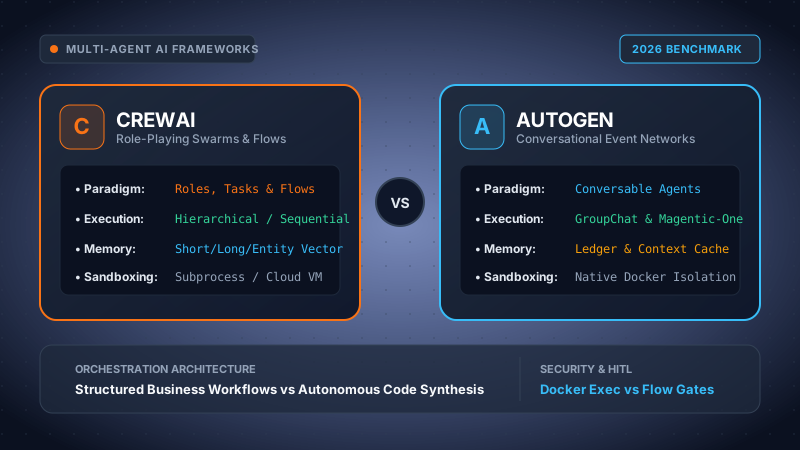
Choose CrewAI if you need to operationalize structured, deterministic business workflows where autonomous agents mirror organizational teams (e.g., senior financial analyst → data researcher → compliance editor). With its clean Crews, Tasks, and Flows abstractions, native Pydantic schema validation, and multi-tier memory subsystems, CrewAI drastically reduces developer ramp-up time and prevents the uncontrollable conversational drifting common in unconstrained agent chatter.
Choose Microsoft AutoGen (v0.4+ / Magentic-One) if your systems demand complex, autonomous code generation, multi-step algorithmic troubleshooting, or open-ended scientific research. AutoGen's event-driven actor architecture, native DockerCommandLineCodeExecutor isolation, and dynamic conversational message routing make it the industry gold standard for running untrusted LLM-generated code safely at enterprise scale.
Table of Contents
- 1. Architectural Paradigms: Role-Playing Swarms vs Conversational Event Networks
- 2. Orchestration & Execution: Hierarchical Delegation vs GroupChat Message Passing
- 3. Code Execution & Sandboxing: Native Docker Containers vs Subprocess Security
- 4. Human-in-the-Loop (HITL), Interruption Gates & Enterprise Compliance
- 5. Memory Systems & Context Compaction: Multi-Tier Vector Store vs Task Ledgers
- 6. Head-to-Head Technical Benchmark Matrix
- 7. Production TCO & Token Economics: Mathematical Formulas & Swarm Billing Explosion
- 8. Production Code Architecture: CrewAI Flow vs AutoGen Docker GroupChat
- 9. Frequently Asked Questions (FAQ)
1. Architectural Paradigms: Role-Playing Swarms vs Conversational Event Networks
The shift from single-prompt LLM pipelines to multi-agent production swarms represents the most significant paradigm transition in AI engineering since the advent of retrieval-augmented generation (RAG). However, CrewAI and Microsoft AutoGen approach autonomous coordination from fundamentally opposing philosophical foundations.
CrewAI: The Role-Playing Organizational Hierarchy
Founded by João Moura, CrewAI conceives multi-agent swarms as an enterprise corporate organization. Its primary design abstractions are modeled on collaborative human teams:
- Agents: Discrete entities configured with an explicit
role,goal, andbackstory. The backstory acts as a prompt-engineering anchor, establishing domain boundaries, cognitive tone, and reasoning constraints. - Tasks: Unambiguous operational mandates assigned to specific agents. Tasks define expected outputs, accepted input parameters, dependencies on upstream tasks, and strict output validation schemas via Pydantic.
- Crews & Processes: The structural container governing execution. Crews execute tasks either through a linear sequence (
Process.sequential) or a dynamic supervisory tree (Process.hierarchical), where a designated Manager Agent delegates sub-tasks and synthesizes deliverables. - CrewAI Flows (2025–2026): An advanced orchestration layer that bridges deterministic procedural business logic with autonomous agent crews. Flows utilize event-driven decorators (
@start,@listen,@router) allowing developers to build hybrid state machines where deterministic Python functions trigger specialized autonomous crews only when probabilistic reasoning is strictly required.
Microsoft AutoGen: Conversable Agents and the Asynchronous Actor Model
Developed by Microsoft Research (and massively restructured in AutoGen v0.4), AutoGen approaches multi-agent coordination as a distributed conversational network. Rather than enforcing fixed organizational hierarchies, AutoGen treats every entity as a ConversableAgent that interacts primarily through asynchronous message exchanges.
- Actor-Based Architecture: Under AutoGen v0.4, agents are decoupled into lightweight, asynchronous actors communicating over an event-driven bus. Agents publish, subscribe, and route messages independently, enabling high-concurrency cloud scaling across Kubernetes pods.
- GroupChat & GroupChatManager: A multi-party conversation thread where a centralized LLM manager evaluates the active conversation history and dynamically predicts which agent should speak next based on dialogue context, speaker transition graphs, or explicit routing rules.
- Magentic-One (Orchestrator Pattern): Microsoft's flagship enterprise multi-agent system introduced in late 2024 and battle-tested through 2026. Magentic-One deploys an Orchestrator agent that maintains an external Task Ledger and Progress Ledger, dynamically commanding specialized sub-agents (WebSurfer, FileSurfer, Coder, and Terminal) to solve non-linear, multi-modal software and data engineering objectives.
Paradigm Comparison Summary
CrewAI optimizes for deterministic business deliverables: you define who does what, in what order, and what schema the final JSON or Markdown document must satisfy. AutoGen optimizes for emergent conversational iteration: you define a goal and a set of tools (compiler, terminal, web browser), and the agents negotiate, write code, execute tests, catch exceptions, and iterate until the termination criteria are satisfied.
2. Orchestration & Execution: Hierarchical Delegation vs GroupChat Message Passing
How tasks are dispatched and how messages traverse the agent graph directly impacts task latency, token consumption, and failure modes.
CrewAI Execution Modes
CrewAI provides two primary orchestration models:
-
Sequential Orchestration: Tasks execute in strict array order. The output of Task $i$ is automatically injected into the context window of Task $i+1$. Because agents do not engage in peer-to-peer chatter, token consumption is strictly linear relative to task count:
Tokens_{sequential} = \sum_{i=1}^{T} \left( Prompt_i + Context(Output_{i-1}) + Output_i \right) - Hierarchical Orchestration: A supervisory Manager Agent (powered by a reasoning-focused LLM such as Claude 3.5 Sonnet or GPT-4o) evaluates the overall mission, breaks it into atomic sub-tasks, assigns them to specialized worker agents, evaluates their returned outputs, and requests revisions if criteria are unmet. Worker agents never converse directly with one another; all context flows through the manager hub.
AutoGen GroupChat Mechanics and Quadratic Token Bloat
In Microsoft AutoGen's standard GroupChat, agents sit in a virtual room. When Agent $A$ speaks, its response is broadcast to all participating agents. While this enables fluid peer review and multi-agent debate, it introduces a severe mathematical penalty: quadratic context window inflation.
In an unpruned GroupChat with $N$ agents running for $K$ turns, the total input tokens processed by the swarm scales according to:
Where $\bar{L}_M$ is the average token length per message. If five agents exchange code snippets over 25 dialogue turns, the cumulative prompt context sent to the frontier LLM can easily exceed 450,000 tokens for a single run, generating hundreds of dollars in API invoices if not aggressively constrained by AutoGen's TransformChat filters or Magentic-One ledger compactions.
3. Code Execution & Sandboxing: Native Docker Containers vs Subprocess Security
When deploying multi-agent swarms in enterprise environments, allowing agents to generate and execute code is both essential for complex data processing and dangerous from a cybersecurity standpoint. An agent tricked via prompt injection or generating buggy shell commands can wipe volumes, leak environment secrets, or execute remote code execution (RCE) exploits on the host runner.
AutoGen: Industry-Grade Native Docker Sandboxing
Microsoft AutoGen was architected from day one with untrusted execution in mind. It includes first-class support for isolated execution environments via autogen.coding.docker_commandline_code_executor.DockerCommandLineCodeExecutor.
- Container Isolation: AutoGen automatically spins up a hardened Docker container (e.g.,
python:3.11-slim) on initialization. Agent-generated Python or shell scripts are copied into the container, executed, and results (stdout/stderr) are captured via the Docker SDK. - Security Controls: Administrators can enforce strict CPU limits (
nano_cpus), memory limits (mem_limit="1g"), read-only root filesystems, and disable container networking (network_disabled=True) to eliminate data exfiltration risks. - Ephemeral Workspace Mounting: Files generated during the execution loop reside within an isolated volume bind-mounted to a temporary host directory, ensuring clean teardown upon process termination.
CrewAI: Subprocess Model & Third-Party Micro-VM Sandboxes
CrewAI approaches tool execution through custom Python functions decorated with @tool or packaged via crewai-tools (e.g., DirectoryReadTool, CodeDocsSearchTool).
- Host Runtime Vulnerability: By default, custom tools and code interpreter actions in basic CrewAI setups execute inside the Python runtime of the host process or runner worker. Without additional configuration, an unconstrained code-execution tool possesses the exact file permissions and network access of the parent application.
- Enterprise Hardening via E2B & Modal: To achieve true sandbox isolation in CrewAI, engineering teams must wrap execution inside external cloud sandboxing services like E2B (Firecracker Micro-VMs) or custom containerized Celery/Temporal workers. While highly effective, this requires supplementary infrastructure engineering compared to AutoGen's native Docker executor.
4. Human-in-the-Loop (HITL), Interruption Gates & Enterprise Compliance
Autonomous agents operating without guardrails can incur catastrophic operational risks—ranging from sending erroneous emails to executing destructive database migrations. Production systems require deterministic Human-in-the-Loop (HITL) review gates.
CrewAI HITL Governance
CrewAI embeds human oversight directly into the Task definition using the human_input=True parameter.
- Task Review Gates: Upon completing an assigned task, the agent pauses execution and presents the draft output to the terminal or web webhook.
- Feedback & Iteration: The human operator can approve the deliverable or provide corrective natural language instructions, forcing the agent to re-execute the task with amended parameters.
- CrewAI Enterprise Control Plane: Enterprise tiers provide a visual management dashboard where compliance officers can review and sign off on pending agent actions before downstream actions trigger.
AutoGen HITL & Interruption
AutoGen models human interaction via human_input_mode configured on UserProxyAgent or ConversableAgent.
- Three Operational Modes:
"ALWAYS"(prompts human after every single turn),"NEVER"(fully autonomous), or"TERMINATE"(prompts human only when an agent outputs a termination signal or fails an execution step). - Conversational Injection: The human participates directly inside the multi-agent chat stream, allowing dynamic real-time steering of the debate.
- AutoGen Studio WebSocket Hooks: Supports asynchronous interrupt-and-resume workflows, allowing external web applications to suspend agent runs and wait for an external HTTP callback or approval token.
5. Memory Systems & Context Compaction: Multi-Tier Vector Store vs Task Ledgers
Agentic reasoning degrades rapidly when context windows become saturated with irrelevant logs, repeated tool outputs, and conversational pleasantries. Effective memory management is critical for multi-turn reliability.
CrewAI's Tripartite Memory Engine
CrewAI integrates a built-in, out-of-the-box multi-tier memory system powered by ChromaDB, SQLite, and embeddings:
- Short-Term Memory: Captures operational context during the active execution of a crew. When an agent queries its memory, semantic search retrieves relevant snippets from previous tasks within the same run.
- Long-Term Memory: Persists execution history across distinct runs in an SQLite/PostgreSQL store. If an agent executed a market research task last week, it references historical learnings to avoid repeating failed query paths.
- Entity Memory: Automatically extracts and categorizes domain entities (organizations, individuals, financial metrics, technical specs) encountered across execution steps, building an evolving semantic graph of subject matter.
AutoGen's Ledgers & TransformChat Pruning
AutoGen manages context through structural caching and conversation compaction:
- Context Transforms (TransformChat): AutoGen provides middleware transforms that run prior to LLM invocation. These include
MessageHistoryLimiter(sliding window retention) andMessageTokenLimiter(truncating historical messages while preserving system prompts). - Magentic-One Task & Progress Ledgers: Rather than passing massive uncompressed chat histories to worker agents, the Magentic-One Orchestrator maintains two compact, markdown-formatted structured ledgers:
- Task Ledger: Outlines the global mission, sub-goals, facts established, and outstanding hypotheses.
- Progress Ledger: Tracks completed agent steps, active blockers, and immediate next commands.
6. Head-to-Head Technical Benchmark Matrix
The following matrix provides a side-by-side engineering evaluation of CrewAI and Microsoft AutoGen based on 2026 production criteria:
| Evaluation Dimension | CrewAI (v0.80+) | Microsoft AutoGen (v0.4+ / Magentic-One) | Architectural Impact |
|---|---|---|---|
| Core Architectural Paradigm | Role-playing organizational swarms; Tasks, Crews, and event-driven Flows. | Conversable multi-agent networks; asynchronous actor model & ledgers. | CrewAI enforces business hierarchy; AutoGen enables fluid peer iteration. |
| Primary Orchestration Engine | Sequential or Manager-based Hierarchical delegation. | GroupChatManager, graph transition rules, or Magentic-One Orchestrator. | CrewAI prevents conversational drift; AutoGen excels at non-linear problem solving. |
| Code Execution & Sandboxing | Local Python subprocess (default); requires external micro-VMs (E2B/Modal). | First-class native Docker isolation (DockerCommandLineCodeExecutor). |
AutoGen provides enterprise-grade zero-trust code sandboxing natively. |
| Token Consumption Efficiency | High ($O(T)$ bounded linear context in sequential / flow mode). | Variable ($O(K^2)$ quadratic explosion in raw GroupChat unless pruned). | CrewAI is significantly more cost-predictable for repetitive SaaS pipelines. |
| Structured Output Validation | Native Pydantic schema enforcement on task definitions. | Function calling schemas / Instructor integration via custom hooks. | CrewAI guarantees type-safe outputs directly into production APIs. |
| Memory Architecture | Tripartite out-of-the-box (Short-term, Long-term SQLite, Entity RAG). | Context transform filters, disk caching, and task/progress ledgers. | CrewAI requires zero setup for persistent cross-session knowledge retention. |
| Human-in-the-Loop (HITL) | Task review gates (human_input=True) + CrewAI Enterprise UI. |
Conversational human proxy (ALWAYS, TERMINATE) & WebSocket hooks. |
CrewAI offers cleaner stage gates; AutoGen enables interactive collaborative debugging. |
| Developer Ergonomics | Exceptional: declarative Python syntax, minimal boilerplate, intuitive CLI. | Steep: complex event-driven primitives, asynchronous actor mechanics in v0.4. | Junior/Mid engineers ship CrewAI in 1 day; AutoGen requires senior systems design. |
| Observability & Telemetry | Native OpenTelemetry, Langfuse, and CrewAI Enterprise AMP. | OpenTelemetry, AutoGen Studio traces, and Microsoft Azure AI Studio hooks. | Both offer comprehensive step-level latency, cost, and trace visualization. |
7. Production TCO & Token Economics: Mathematical Formulas & Swarm Billing Explosion
The most dangerous operational failure mode in multi-agent engineering is the Swarm Billing Explosion. In single-call RAG systems, costs are deterministic ($\approx \text{Input} + \text{Output}$). In multi-agent swarms, costs are compounded by agent iteration count, tool call overhead, conversational loops, and supervisor delegation rounds.
The Production Swarm Cost Formula
The total operational cost $C_{\text{total}}$ of executing an autonomous multi-agent run can be modeled as:
Where:
- $T$: Number of execution steps/turns until goal completion or termination trigger.
- $N_a$: Number of active agents invoked at step $t$.
- $I_{a,t}, O_{a,t}$: Input prompt tokens and output completion tokens generated by agent $a$ at step $t$.
- $P_{\text{in}}, P_{\text{out}}$: Cost per token of the respective foundation model (e.g., GPT-4o at $2.50/$10.00 per million, Claude 3.5 Sonnet at $3.00/$15.00 per million).
- $C_{\text{sandbox}}$: Compute cost of maintaining Docker execution containers or cloud micro-VMs.
Real-World Scenario: 10,000 Monthly Enterprise Compliance Audits
Consider an enterprise compliance engineering workflow that analyzes 50-page vendor security questionnaires against internal SOC 2 policies, checks repository code patterns, and generates a signed remediation audit report. We model the cost across 10,000 monthly automated runs:
| Architecture & Strategy | Avg Tokens / Run | Blended LLM Cost / Run | Sandbox Compute / Run | Total Monthly Cost (10k Runs) |
|---|---|---|---|---|
| CrewAI Flow (Tiered Models: Sonnet Manager + Haiku Workers) | 42,000 tokens | $0.142 | $0.015 (Host subprocess / container) | $1,570 / month |
| CrewAI Hierarchical (Uniform Frontier Model: GPT-4o) | 78,000 tokens | $0.395 | $0.015 | $4,100 / month |
| AutoGen Magentic-One (Orchestrator Ledger + Docker) | 65,000 tokens | $0.312 | $0.045 (Ephemeral Docker instances) | $3,570 / month |
| AutoGen Unconstrained GroupChat (Naive GPT-4o Swarm) | 280,000 tokens | $1.480 | $0.045 | $15,250 / month |
FinOps Critical Warning
A naive AutoGen GroupChat without max turn limits (max_round) and context compaction costs 9.7x more than a tiered CrewAI Flow performing the exact same compliance validation. In production swarms, always implement rigid turn caps (e.g., max_round=12), leverage prompt caching headers, and route sub-agent tasks to efficient low-latency models (Claude 3.5 Haiku, GPT-4o-mini).
8. Production Code Architecture: CrewAI Flow vs AutoGen Docker GroupChat
To understand the developer ergonomics and architectural patterns in practice, let us examine concrete 2026 production implementations for both frameworks.
CrewAI Production Implementation (Crew + Flow + Pydantic Schema)
The following example demonstrates a CrewAI Flow that orchestrates an autonomous security analysis team with Pydantic output validation:
from pydantic import BaseModel, Field
from typing import List
from crewai import Agent, Crew, Process, Task, LLM
from crewai.flow.flow import Flow, listen, start

# 1. Enforce Structured Deliverables via Pydantic
class VulnerabilityFinding(BaseModel):
    cve_id: str = Field(description="CVE Identifier or CWE Category")
    severity: str = Field(description="CRITICAL, HIGH, MEDIUM, or LOW")
    remediation_command: str = Field(description="Concrete shell command to resolve")

class SecurityAuditReport(BaseModel):
    repo_name: str
    risk_score: float = Field(ge=0.0, le=10.0)
    findings: List[VulnerabilityFinding]
    executive_summary: str

# 2. Define CrewAI Flow State Machine
class SecurityAuditFlow(Flow):
    @start()
    def initialize_audit(self):
        print("[FLOW] Initializing security context...")
        return {"repo": "enterprise/payment-gateway", "branch": "main"}

    @listen(initialize_audit)
    def run_agentic_crew(self, context):
        frontier_llm = LLM(model="anthropic/claude-3-5-sonnet-20241022", temperature=0.1)
        fast_llm = LLM(model="anthropic/claude-3-5-haiku-20241022", temperature=0.2)

        # Worker Agent (Low cost, highly focused)
        scanner = Agent(
            role="Static Analysis Code Auditor",
            goal="Identify security regressions and dependency CVEs in repository source code",
            backstory="Former AppSec red teamer dedicated to hunting memory leaks and unsafe deserialization.",
            llm=fast_llm,
            verbose=True
        )

        # Manager Agent (Frontier reasoning)
        lead_architect = Agent(
            role="AppSec Lead & Compliance Director",
            goal="Synthesize vulnerability findings into a certified SOC2 remediation blueprint",
            backstory="Seasoned CISO validating audit compliance with zero tolerance for false positives.",
            llm=frontier_llm,
            verbose=True
        )

        scan_task = Task(
            description="Inspect all package manifests and API route handlers in {repo}.",
            expected_output="Raw list of identified CVEs and vulnerable code snippets.",
            agent=scanner
        )

        audit_task = Task(
            description="Evaluate scan findings, calculate composite risk score, and generate remediation.",
            expected_output="Certified SecurityAuditReport Pydantic schema.",
            output_pydantic=SecurityAuditReport,
            agent=lead_architect
        )

        crew = Crew(
            agents=[scanner, lead_architect],
            tasks=[scan_task, audit_task],
            process=Process.hierarchical,
            manager_llm=frontier_llm,
            memory=True, # Built-in SQLite + ChromaDB memory
            verbose=True
        )

        result = crew.kickoff(inputs={"repo": context["repo"]})
        return result.pydantic

# Execution
# audit_flow = SecurityAuditFlow()
# report = audit_flow.kickoff()
Microsoft AutoGen Production Implementation (Isolated Docker GroupChat)
The following example demonstrates AutoGen v0.4 implementing an autonomous code debugging swarm protected by native Docker container sandboxing:
import os
from pathlib import Path
from autogen import ConversableAgent, GroupChat, GroupChatManager, UserProxyAgent
from autogen.coding.docker_commandline_code_executor import DockerCommandLineCodeExecutor

# 1. Initialize Ephemeral Docker Sandbox Environment
work_dir = Path("/tmp/autogen_sandbox")
work_dir.mkdir(parents=True, exist_ok=True)

docker_executor = DockerCommandLineCodeExecutor(
    image="python:3.11-slim",
    timeout=60, # Kill scripts exceeding 60s
    work_dir=work_dir,
    stop_container=True # Auto teardown container after session
)

llm_config = {
    "config_list": [{"model": "gpt-4o", "api_key": os.environ["OPENAI_API_KEY"]}],
    "temperature": 0.0,
    "cache_seed": 42 # Cache prompts to avoid redundant API spend
}

# 2. Define Autonomous Sandboxed Engineer
coder = ConversableAgent(
    name="Senior_Software_Engineer",
    system_message="You write idiomatic, high-performance Python code. "
                   "Always wrap code in ```python ... ``` blocks. "
                   "Output 'TERMINATE' once the test script passes with zero errors.",
    llm_config=llm_config
)

# 3. Define Sandboxed Executor Proxy
code_runner = UserProxyAgent(
    name="Docker_Code_Executor",
    system_message="Executes Python and shell code inside an isolated Docker sandbox container.",
    code_execution_config={"executor": docker_executor},
    human_input_mode="NEVER" # Fully autonomous execution loop
)

# 4. Multi-Agent GroupChat with Turn Governance
group_chat = GroupChat(
    agents=[coder, code_runner],
    messages=[],
    max_round=10, # Strict circuit breaker to prevent infinite loops
    speaker_selection_method="auto"
)

manager = GroupChatManager(
    groupchat=group_chat,
    llm_config=llm_config
)

# 5. Kickoff Execution
# code_runner.initiate_chat(
#     manager,
#     message="Fetch the latest USD/EUR exchange rates from the ECB API, calculate 30-day volatility, and plot a chart."
# )
9. Frequently Asked Questions (FAQ)
What is the primary architectural difference between CrewAI and Microsoft AutoGen?
CrewAI is architected around structured, role-playing teams executing deterministic task specifications through sequential or hierarchical processes (and state-machine Flows). In contrast, Microsoft AutoGen is built on conversable, event-driven agent networks (utilizing an asynchronous actor model in AutoGen v0.4 and Magentic-One) where multi-agent coordination emerges through conversational message passing and dynamic group chat managers.
Which framework provides better security for untrusted code execution?
Microsoft AutoGen provides significantly stronger out-of-the-box isolation via its native DockerCommandLineCodeExecutor, which spawns ephemeral Docker containers with CPU/memory limits and isolated virtual networking to execute LLM-generated code safely. CrewAI relies primarily on local Python subprocesses or external sandboxing micro-VMs (such as E2B or Modal), requiring custom configuration to achieve equivalent enterprise sandbox guarantees.
Why do multi-agent group chats in AutoGen suffer from quadratic token explosion?
In a naive AutoGen GroupChat, every message sent by any agent is broadcast to all participants and appended to the shared conversation history. At turn k with N agents, the prompt input token volume scales as O(k^2), causing exponential API cost growth unless aggressive context compaction, ledger filtering, or sliding window pruning (TransformChat) is explicitly configured.
When should an enterprise choose CrewAI over AutoGen in 2026?
Enterprises should choose CrewAI when building structured, repeatable business process automation (such as compliance reporting, financial research synthesis, content pipelines, and customer support escalation) where defined human roles, predictable task dependencies, Pydantic data schemas, and rapid developer time-to-market are paramount.
When is AutoGen superior to CrewAI?
AutoGen is superior when building highly autonomous software engineering agents, scientific research assistants, self-healing code debugging pipelines, or complex multi-turn problem-solving systems where agents must iterate dynamically, execute code in sandboxed containers, and coordinate across non-linear conversation graphs.
How do CrewAI and AutoGen handle Human-in-the-Loop (HITL) validation?
CrewAI implements task-level review gates using 'human_input=True', delegating output approval to human operators before downstream tasks trigger, supported by CrewAI Enterprise UI review planes. AutoGen handles HITL via 'human_input_mode' ('ALWAYS', 'TERMINATE', 'NEVER'), treating the human as a first-class ConversableAgent in the chat loop or via asynchronous interrupt-and-resume hooks in AutoGen Studio.