Backstage vs Port: Internal Developer Portal (IDP) Benchmark (2026)
1. Executive Summary & Architectural Verdict (TL;DR)
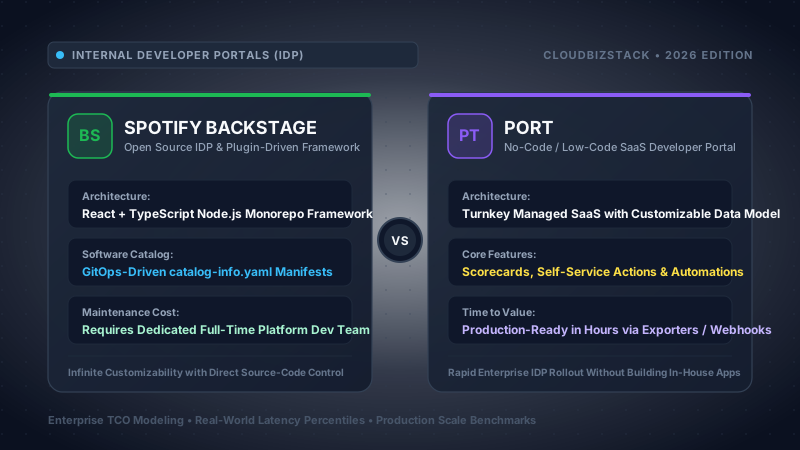
In modern cloud-native engineering, developer cognitive load has become the primary bottleneck to organizational shipping velocity. As microservice fleets multiply, multi-cloud topologies expand across hybrid Kubernetes clusters, and compliance standards (SOC 2, ISO 27001, FedRAMP) intensify, platform engineering teams are tasked with establishing a unified single pane of glass—an Internal Developer Portal (IDP). However, the architectural path chosen to implement this developer control plane represents one of the most critical structural decisions an engineering leadership team will make. In 2026, the market has bifurcated into two fundamentally opposed engineering philosophies: building and maintaining an open-source TypeScript/React monorepo framework (Spotify Backstage) versus adopting a turnkey, no-code, event-driven SaaS developer portal with dynamic blueprints (Port).
This exhaustive 2026 benchmark dissects both platforms across software catalog ingestion mechanics, dynamic data modeling, developer self-service automation, scorecards and governance, day-2 operational maintenance burden, and multi-year FinOps total cost of ownership (TCO). Our findings demonstrate that while Backstage provides absolute code-level customization for enterprise platform organizations willing to fund dedicated portal software teams, Port delivers dramatic time-to-value compression, eliminates the chronic "YAML drift" epidemic through real-time push-based exporters, and reduces 3-year total operational expenditures by 61% to 83%.
● Spotify Backstage: The Extensible Framework
An open-source (CNCF Incubating) developer portal framework created by Spotify. Built as an extensible Yarn/Lerna TypeScript monorepo with a React 18 frontend and Node.js backend. Software catalog entities are defined declaratively via GitOps YAML manifests (catalog-info.yaml). Features a massive ecosystem of 200+ open-source community plugins, rich TechDocs docs-like-code integration, and complete VPC data sovereignty.
● Port: The Turnkey Productized IDP
A turnkey SaaS Internal Developer Portal founded by platform engineering veterans. Employs a dynamic, no-code data model ("Blueprints") that maps any arbitrary cloud resource or entity without code. Continuously synchronized in real time via Kafka event-driven exporters (Kubernetes, AWS, GitHub, Datadog) without manual Git YAML files. Features native RBAC-governed self-service actions, gamified scorecards, and zero source code access.
The Definitive Strategic Decision Matrix:
| Organization Profile | Recommended Platform | Primary Rationale | Expected Time-to-Value |
|---|---|---|---|
| Early-Stage / Scale-Up 20 - 75 Engineers |
Port (Team Tier) | Cannot afford a dedicated platform team. Port provides an instant catalog and self-service scaffolding in under 48 hours without infrastructure overhead. | 1 - 3 Days |
| Mid-Market Scale 75 - 300 Engineers |
Port (Enterprise Tier) | Platform engineers must focus on core cloud infrastructure (Kubernetes, CI/CD, FinOps) rather than debugging React/TypeScript monorepo build failures. | 1 - 2 Weeks |
| Enterprise Division 300 - 1,000 Engineers |
Port or Backstage (Evaluative) | Choose Port if rapid scorecard governance and low TCO are prioritized. Choose Backstage if bespoke internal business workflows require deep React UI canvas coding. | Port: 3 Weeks Backstage: 6 - 9 Months |
| Global 2000 / Regulated 1,000+ Engineers |
Spotify Backstage (Self-Hosted) | Strict air-gapped data sovereignty requirements, sovereign encryption keys, and internal headcount capacity to support a permanent 4-person IDP product team. | 9 - 18 Months |
2. The Platform Engineering Landscape: Why Internal Developer Portals Matter in 2026
To understand the architectural friction between Backstage and Port, one must examine the broader evolution of Platform Engineering. Over the past decade, the rapid adoption of microservices, containerization, and public cloud infrastructure decentralized operational authority. Development teams were empowered with the "You Build It, You Run It" ethos. However, this shift created an unanticipated crisis: catastrophic developer cognitive overload.
In a typical 2026 enterprise engineering environment, a single software engineer must navigate between 15 and 30 distinct tools daily: Git version control (GitHub, GitLab), continuous integration pipelines (GitHub Actions, GitLab CI, Argo Workflows), artifact registries (ECR, Artifactory), cloud infrastructure consoles (AWS, Azure, GCP), Kubernetes orchestration clusters, monitoring and APM dashboards (Datadog, Dynatrace), logging collectors, incident management platforms (PagerDuty), security vulnerability scanners (Snyk, Prisma Cloud, Checkmarx), and secret managers (HashiCorp Vault).
Team Topologies and the Paved Road (Golden Path)
Following the seminal framework established by Matthew Skelton and Manuel Pais in Team Topologies, modern engineering organizations structure themselves into Stream-Aligned Teams (product feature delivery) supported by an underlying Platform Team whose mission is to provide an internal platform as a product. The platform team’s objective is not to mandate rigid processes, but to construct a Golden Path (Paved Road): a frictionless, self-service operational highway that makes the secure, compliant, and cost-effective way of delivering software the easiest way.
The Internal Developer Portal (IDP) functions as the interface and execution engine of this Golden Path. A properly architected IDP addresses four fundamental operational pillars:
- Unified Software Catalog: A single authoritative source of truth tracking every microservice, API definition, cloud resource, database instance, and documentation repository, alongside clear team ownership and dependencies.
- Developer Self-Service Automation: Empowering engineers to scaffold new production-ready services, provision ephemeral cloud environments, execute operational runbooks, and request temporary database access through self-service forms without submitting Jira tickets.
- Engineering Governance & Scorecards: Measuring and gamifying service maturity, code coverage, security vulnerabilities, cloud hygiene, and operational health against explicit organizational standards.
- Centralized Documentation (Docs-Like-Code): Consolidating fragmented technical knowledge, runbooks, and API contracts directly adjacent to the service definitions they document.
While both Backstage and Port seek to solve this developer experience crisis, they approach the problem from fundamentally conflicting philosophical and architectural vantage points. Backstage asks: "How can we give platform teams a flexible software framework to code their own bespoke portal?" Port asks: "How can we give platform teams a finished, dynamic control plane so they never have to write portal code again?"
3. Architecture & Core System Mechanics: Monorepo Framework vs Event-Driven SaaS
A rigorous engineering comparison between Backstage and Port must begin at the foundational systems architecture level. The computational, storage, and networking patterns underpinning each tool dictate their operational stability, scaling ceilings, and Day-2 maintenance overhead.
Spotify Backstage Architecture: The Yarn/Lerna TypeScript Monorepo
Spotify created Backstage internally in 2016 to unify its sprawling fleet of thousands of microservices across polyglot teams, eventually donating the project to the Cloud Native Computing Foundation (CNCF) in 2020 where it currently sits as an Incubating project. Backstage is fundamentally not a software product; it is an application framework. When an enterprise decides to adopt Backstage, it does not deploy a turnkey container image; it executes npx @backstage/create-app, generating a bespoke Git repository containing a full-stack TypeScript monorepo managed via Yarn workspaces.
Backstage Monorepo Anatomy and Component Topology
- Frontend Application (
packages/app): A single-page React 18 application built on top of Material UI (historically MUI v4, with a long-running community migration toward MUI v5). The frontend acts as a shell that mounts routed plugin extensions. Every plugin loaded into Backstage must be imported into TypeScript source files, registered in the application router, and bundled via Webpack. - Backend Service (
packages/backend): A Node.js runtime process that historically relied on Express routers, now migrating to Backstage's "New Backend System". The new system introduces dependency injection, service references (such ascoreServices.logger,coreServices.database,coreServices.auth), and extension points. Each backend plugin (Catalog, Scaffolder, TechDocs, Search) is registered into the backend instance viabackend.add(). - Persistence Engine: Backstage uses
knex.jsas an SQL query builder. While SQLite is bundled for transient local developer environments, production deployments require an enterprise-grade relational database—predominantly PostgreSQL (such as AWS RDS PostgreSQL or Google Cloud SQL). The database stores catalog entity locations, processed entity snapshots, relational foreign keys, search index tokens, and scaffolder task logs. - Build & Deployment Artifacts: Deploying Backstage requires compiling TypeScript into JavaScript, generating Webpack frontend asset bundles, building a multi-stage Docker container image, pushing to an enterprise container registry (ECR, Artifact Registry), and orchestrating pod replicas across a Kubernetes cluster via Helm charts.
Port Architecture: Event-Driven Kafka SaaS Control Plane & The Ocean Framework
Port was architected from the ground up as a cloud-native, productized SaaS developer platform. Rather than forcing organizations to host, compile, and maintain a custom web application, Port provides a multi-tenant cloud control plane engineered with distributed event streaming, paired with lightweight, open-source exporter agents that deploy inside the customer's private cloud network.
Port System Architecture and Real-Time Synchronization Bus
- Distributed SaaS Control Plane: Port’s multi-tenant core is constructed on a high-throughput event streaming backbone powered by Apache Kafka. Inbound entity mutations and state updates are published to Kafka partitions, enabling asynchronous ingestion pipelines, state reconciliation, and real-time streaming to the UI via Server-Sent Events (SSE) and WebSockets.
- The Ocean Integration Framework: Port open-sourced the Ocean framework (written in Python and Go), which standardizes how integrations communicate with the Port API. Ocean provides native resilience, exponential backoff, rate-limit throttling, and delta synchronization out-of-the-box.
- Hybrid VPC Exporters (Data Plane): Exporters are distributed as lightweight Helm charts (for Kubernetes clusters), AWS Lambda functions, or GitHub Apps. The Kubernetes exporter deploys directly into the customer’s cluster, registers Kubernetes Informers against the local API server, watches resource streams (Deployments, Pods, Services, CRDs, Ingresses), and transmits encrypted, metadata-only deltas over outbound HTTPS/TLS to the Port control plane.
- Search & Graph Topology Engine: Underneath the API, Port maintains a relational graph index alongside an Elasticsearch/OpenSearch cluster. This enables instant graph traversals (e.g., finding all microservices that depend on a specific PostgreSQL database instance running in AWS us-east-1 that have open critical Snyk CVEs) in single-digit milliseconds.
Architectural Comparison: Pull Polling vs Event Streaming
The structural divide between Backstage and Port is encapsulated by their communication paradigms. Backstage functions fundamentally on a pull-based batch polling loop: background catalog workers crawl Git repositories, parse YAML files, validate schemas, and write updates to PostgreSQL on recurring 10-to-30 minute intervals. In contrast, Port functions on a push-based event-driven streaming model: whenever a Kubernetes pod restarts, a GitHub PR merges, or a Terraform workspace applies, an event fires immediately into Port's Kafka bus, updating the developer portal catalog in near real-time (sub-second to sub-5-second latency).
4. Software Catalog & Data Modeling: GitOps YAML Polling vs Dynamic Blueprints
The Software Catalog is the architectural nucleus of an Internal Developer Portal. It represents the comprehensive inventory of software assets, dependencies, cloud resources, and organizational structures. The technical mechanisms used to define, ingest, and reconcile these entities govern whether the portal remains an accurate, trusted source of truth or degenerates into a neglected, outdated repository.
Spotify Backstage: GitOps Entity Manifests and the YAML Drift Crisis
Backstage implements a strict GitOps philosophy for catalog registration. Every entity in Backstage is defined in a static YAML file, traditionally named catalog-info.yaml, located in the root or a subfolder of the application repository. Backstage parses these manifests against a fixed, pre-defined entity schema.
The core Backstage catalog schema enforces eight primary entity kinds:
Component:An individual piece of software (Service, Website, Library).API:An interface contract (OpenAPI, GraphQL, gRPC Protobuf, AsyncAPI).Resource:Physical or virtual infrastructure components (Databases, S3 buckets, Kafka topics).System:A collection of resources and components that cooperate to perform a business function.Domain:A high-level business grouping containing multiple systems.Group:An organizational engineering team or squad.User:An individual engineer or team member.Location:A reference pointer to an external manifest location.
The Five Operational Pathologies of Backstage GitOps Catalogs:
- The Human Update Bottleneck: When a development team refactors a service, renames an API endpoint, or migrates an RDS database, they rarely prioritize updating the static
catalog-info.yamlfile. The manifest becomes desynchronized from live infrastructure within weeks. - Orphaned Entities and Repository Bitrot: When repositories are archived, renamed, or transferred, Backstage’s catalog processor often retains the stale entity unless an explicit removal or unregister event is triggered. In enterprise setups with thousands of repos, ghost entities pollute search results.
- Rigid Entity Modeling: Adding a custom entity type (such as a
KubernetesCluster,FeatureFlag,DatadogMonitor, orCostCenter) requires creating custom TypeScript schemas, writing custom catalog processors in the backend monorepo, and registering new database tables. - Catalog Polling & Rate-Limiting Storms: To discover entities, Backstage runs periodic discovery loops across GitHub, GitLab, or Bitbucket APIs. In large organizations with 3,000+ repositories, these polling loops routinely exhaust GitHub API rate limits (5,000 requests/hour/user), causing catalog updates to stall completely.
- Lack of Real-Time Infrastructure Context: A static YAML file cannot tell an engineer whether a microservice’s pods are currently crash-looping in Kubernetes, whether its P99 latency has breached an SLA, or what its AWS EC2 compute cost was yesterday. Backstage must rely on separate frontend plugins querying external APIs on demand from the user's browser, leading to sluggish page loads and fragmented authentication tokens.
Port Dynamic Blueprints: Flexible No-Code Relational Modeling
Port dismantles the static YAML paradigm through its innovative Blueprints architecture. A Blueprint is a dynamic JSON Schema that defines an arbitrary entity type. Unlike Backstage’s hardcoded entity model, Port imposes zero structural assumptions on your software architecture.
Port Blueprint Capabilities and Relational Topology
In Port, platform engineers can create Blueprints for virtually any concept in seconds via the UI or declarative Terraform/API:
- Arbitrary Entity Blueprints: Model
Microservice,KubernetesDeployment,AWSRDSInstance,S3Bucket,KafkaTopic,TerraformWorkspace,PagerDutyService,SonarqubeProject, orJiraProject. - Dynamic Properties: Add strings, booleans, numbers, arrays, JSON objects, URLs, and status indicators without touching code. Define Calculated Properties that automatically aggregate data from child entities (e.g., calculating total monthly cloud spend across all child AWS resources).
- First-Class Relational Edges: Establish bidirectional relationships: a
Microserviceentity links to multipleKubernetesDeploymententities across regions, which link to aK8sCluster, which links to anAWSAccount, which links to aBusinessUnit. This generates an interactive, queryable topological graph. - Automated Real-Time Ingestion: Zero developer maintenance. The Port Kubernetes exporter listens to the Kubernetes cluster API, automatically mapping live Deployments, Pods, and Ingresses to the corresponding Blueprint. If an SRE scales a deployment from 3 to 10 replicas, the Port catalog reflects the new replica count in under 3 seconds without a Git commit.
5. Developer Self-Service & Scaffolding: Backstage Scaffolder vs Port Actions
A passive software catalog quickly becomes a read-only graveyard unless coupled with active developer self-service. The self-service engine allows developers to provision new infrastructure, instantiate standardized boilerplate repositories, deploy ephemeral testing environments, and execute operational day-2 actions without context switching or filing support tickets.
Spotify Backstage Scaffolder: In-Process Node.js Template Execution
Backstage implements self-service through the Backstage Scaffolder plugin. The Scaffolder is built around template.yaml manifests (using the scaffolder.backstage.io/v1beta3 API version). A template defines two primary sections: parameters (rendered in the React frontend using React JSON Schema Form) and steps (executed sequentially by the backend).
Backstage Scaffolder Execution Lifecycle and Limitations
- Template Authoring: Platform engineers write cookiecutter or Nunjucks templates stored in Git repositories. The template defines variables such as service name, owner team, Java/Go runtime version, and port assignments.
- Built-in Actions: Backstage provides primitive action handlers out-of-the-box:
fetch:template,fetch:plain,publish:github,publish:gitlab, andcatalog:register. - Custom Action Complexity: If a platform team needs an action that interacts with an internal API, triggers a custom Terraform run, or executes a proprietary CLI tool, they must write custom TypeScript backend code implementing the
createTemplateActioninterface, compile the monorepo, and deploy the new container. - Execution Environment Vulnerabilities: By default, Scaffolder steps execute directly within the Node.js process inside the Backstage backend container. Running arbitrary template scripts inside the core portal pod poses security risks. While Backstage supports delegating tasks to isolated container runners, configuring and scaling these ephemeral runner pods adds substantial Kubernetes operational overhead.
- Absence of Native Multi-Stage Approval Gates: Core Backstage lacks native approval workflows. If an action requires senior manager sign-off or infosec approval (e.g., provisioning a production database or requesting elevated cloud permissions), platform teams must build complex custom integrations or rely on external Jira ticket automations.
Port Self-Service Actions: Native Decoupled Execution with Multi-Stage Approvals
Port radically rearchitects self-service by decoupling the action interface and governance layer from the execution runtime. Rather than executing scripts within the portal pod, Port defines interactive forms and triggers established enterprise CI/CD runners, while handling permissions, validation, and approvals natively.
Port Self-Service Architecture and Operational Superpowers
- Dynamic Catalog-Driven Form Inputs: Form dropdown fields can execute dynamic JQ/JSON queries directly against the live software catalog. For example, when a developer requests a temporary database clone, the form dynamically displays only the RDS databases owned by their team that are currently healthy in the selected AWS region.
- Turnkey Multi-Stage Approval Workflows: Built directly into Port without external tools. Actions can be gated by role-based approval rules (e.g., "Production deployments require approval from the Security Team and the Service Owner"). Approvers receive interactive Slack or Microsoft Teams notification cards with one-click "Approve" or "Deny" buttons and audit comment requirements.
- Universal Execution Drivers: Port does not execute code inside its own infrastructure. Instead, when an action is triggered and approved, Port dispatches an encrypted payload to the execution backend of your choice: a GitHub Actions
workflow_dispatchevent, a GitLab CI pipeline trigger, an Argo Workflows submission, an AWS Step Function, or a generic HTTP Webhook. - Granular Role-Based Access Control (RBAC): Platform teams can restrict who can see and execute specific actions based on user identity, team membership, or entity attributes (e.g., developers can execute "Restart Staging Pods", but only Tech Leads can execute "Scale Production Cluster").
- End-to-End Audit Logs: Every action invocation is permanently recorded with complete telemetry: who triggered it, exact parameter inputs, timestamps, approval logs, and a direct link to the external CI/CD execution pipeline with real-time status tracking.
6. Engineering Governance, Standards & Scorecards
Engineering leaders cannot improve what they cannot measure. As microservice ecosystems grow, software quality, security hygiene, and architectural consistency inevitably diverge. A primary responsibility of the modern IDP is establishing continuous engineering governance through gamified scorecards and compliance tracking.
Backstage: Fragmented Governance and the Spotify Soundcheck Tax
In open-source Backstage, governance is notoriously fragmented. Core Backstage does not provide a native scorecards engine out-of-the-box. Platform teams seeking to establish standards face two unappealing paths:
- DIY Linter and Plugin Development: The platform team must write custom backend plugins or external CI/CD scripts that parse
catalog-info.yamlmanifests and external APIs (SonarQube, Snyk), evaluate basic rules, and write custom React UI components to render badges. This requires hundreds of engineering hours and ongoing maintenance. - Purchasing Spotify Soundcheck: Spotify offers a proprietary, commercial plugin called Soundcheck that adds scorecards and certification levels to Backstage. However, Soundcheck requires a separate commercial enterprise license from Spotify, substantially inflating software expenditures while still requiring self-hosted infrastructure management.
Port Native Scorecards & Initiatives: Gamified Continuous Governance
Port includes a powerful, multi-tiered Scorecards Engine as a core native feature across all tiers. Because Port maintains a live relational graph of all infrastructure and services, scorecards can evaluate complex cross-system rules continuously and automatically.
Port Scorecard Architecture and Operational Mechanics
- Gamified Maturity Levels: Define progression levels (Bronze, Silver, Gold, Platinum) per Blueprint. A microservice automatically advances or degrades based on real-time rule evaluations.
- Cross-Domain Rule Evaluation: Rules query properties across different integrations. Example Gold Level criteria:
- Repository: Branch protection enabled, README.md present, SonarQube quality gate passing.
- Security: Zero critical or high Snyk vulnerabilities, Dependabot security alerts enabled.
- Kubernetes: CPU and Memory resource limits explicitly configured, replica count ≥ 2, PDB (Pod Disruption Budget) active.
- Operations: PagerDuty escalation policy attached, Datadog SLO monitor configured.
- Initiatives and Campaign Tracking: When engineering leadership mandates an organization-wide migration (e.g., "Upgrade all microservices to Node.js 20" or "Eliminate Log4j vulnerabilities"), platform teams create an Initiative in Port with a hard deadline. Port tracks progress across all engineering squads, visualizes completion percentages on executive dashboards, and sends automated Slack reminders to non-compliant service owners.
7. Documentation: Backstage TechDocs vs Port Knowledge Hub
Centralizing documentation adjacent to code is one of the most effective ways to combat knowledge fragmentation. However, how documentation is compiled, stored, and integrated into the developer portal dictates whether it becomes a heavily utilized knowledge base or an operational burden.
Spotify Backstage TechDocs: The Docs-Like-Code Standard
Backstage’s most celebrated feature is TechDocs. TechDocs embodies the "Docs-like-code" philosophy: developers write technical documentation in Markdown files co-located within the service’s Git repository, configured via an mkdocs.yml manifest.
TechDocs Generation Architectures: Local vs External CI
TechDocs can be operated in two distinct build configurations:
- Local Generation (Node/Docker): When a user navigates to a documentation page in Backstage, the Backstage backend container dynamically clones the Git repository, spins up a temporary Python MkDocs Docker container, compiles the Markdown into static HTML/CSS, and serves it through the portal. While convenient for small setups, this approach causes catastrophic CPU spikes, slow page load times (10-30 seconds on cold cache), and memory exhaustion on Kubernetes pods.
- Recommended CI/CD Generation: In production enterprise environments, the platform team must configure external CI pipelines (GitHub Actions, GitLab CI) using the
@techdocs/cli. Whenever a commit modifies documentation, the CI runner compiles MkDocs and uploads the static HTML artifacts to a cloud object storage bucket (AWS S3, Google Cloud Storage). Backstage then acts merely as a reader and proxy. While performant, this requires maintaining CI workflows across hundreds of repositories.
Port Documentation Integration: Pragmatic Aggregation over Monolithic Rendering
Port takes a decidedly pragmatic architectural stance: do not reinvent documentation static site generation. Most modern enterprises already store technical documentation across established knowledge tools—Notion, Confluence, GitHub Readme files, and specialized documentation platforms like GitBook or Readme.com.
Rather than requiring platform teams to manage MkDocs compilation pipelines and cloud storage buckets, Port provides:
- Markdown Entity Widgets: Embed live Markdown documentation directly on the microservice page, automatically pulled from the repository's
README.mdorDOCS.mdvia the Git integration. - Swagger / OpenAPI Embedded Viewers: Interactive API documentation rendered directly inside the entity dashboard using native Swagger UI / Redoc components without compilation.
- Contextual Knowledge Links: Relational links connecting the service to external Confluence spaces, Notion runbooks, Google Docs, or Jira architecture boards, ensuring developers find relevant knowledge within 1 click.
8. Day-2 Operations, Upgrades & Engineering Maintenance Burden
When evaluating developer platforms, engineering leaders frequently make the classic mistake of focusing exclusively on day-1 feature checklists while completely ignoring day-2 operational lifecycle costs. Building an internal developer portal is never a one-time project; it is an ongoing software product that requires continuous maintenance, dependency management, security updates, and infrastructure operations.
The "Backstage Tax": Monorepo Dependency Hell & Breaking Changes
Across the platform engineering community, the maintenance burden of self-hosting Spotify Backstage is colloquially referred to as the "Backstage Tax". Because Backstage is composed of dozens of independent Yarn packages (such as @backstage/core-plugin-api, @backstage/plugin-catalog, @backstage/plugin-scaffolder-backend), keeping an instance updated is an arduous engineering endeavor.
The Anatomy of a Backstage Upgrade Crisis
Executing a routine Backstage version upgrade (yarn backstage-cli versions:bump) routinely triggers cascading failure states:
- Breaking TypeScript API Signatures: Core Backstage packages frequently introduce breaking API changes between minor releases, requiring manual refactoring of custom frontend components and backend plugin registrations.
- Third-Party Plugin Bitrot: An enterprise Backstage setup typically relies on 10 to 25 community plugins (e.g., Argo CD, Snyk, Datadog). When Backstage bumps its core dependencies (such as React 18 or the New Backend System), community plugins that have not been actively updated by their authors immediately break the build. The internal platform team is forced to fork the external plugin, patch the TypeScript interfaces, and maintain the fork indefinitely.
- Security Vulnerability CVE Management: A Backstage monorepo routinely contains between 1,200 and 2,500 npm/yarn transitive dependencies. Weekly Dependabot alerts for high and critical CVEs in underlying Node.js libraries demand continuous triage, testing, and redeployment cycles.
- Dedicated FTE Requirement: Industry data reveals that maintaining a production Backstage instance in an organization of 250 to 500 developers requires 2 to 4 full-time senior platform engineers (FTEs) dedicated exclusively to portal plumbing, upgrading dependencies, building internal integrations, and debugging deployment failures.
Port Day-2 Operations: Zero Control-Plane Burden & GitOps Exporters
In contrast, Port’s SaaS architecture completely abstracts control-plane maintenance away from the customer’s platform team:
- Zero Control-Plane Upgrades: Port manages 100% of frontend rendering, backend microservices, Kafka streaming clusters, database schema migrations, and high availability failovers. Platform engineers never spend a single Friday afternoon debugging a broken Webpack bundle.
- Automated Agent Upgrades via GitOps: Exporters running in customer Kubernetes clusters are packaged as standard Helm charts. Version upgrades are seamlessly automated using Renovate or Dependabot PRs in the customer’s infrastructure-as-code repository.
- Zero Database Management: Platform engineers do not configure RDS PostgreSQL instances, handle database failovers, manage connection pooling, or monitor disk space for catalog entity tables.
- Platform Team Allocation: Port requires only 0.1 to 0.25 FTE of ongoing platform engineering capacity—primarily configuring new Blueprints, fine-tuning scorecard rules, and authoring self-service action forms. Platform engineers are freed to focus on high-impact cloud automation and developer enablement.
9. FinOps & Quantitative 3-Year TCO Modeling
A rigorous Total Cost of Ownership (TCO) model must look beyond software licensing sticker prices. Open-source software is famously "free like a puppy, not free like beer." To provide financial transparency for engineering leaders and FinOps analysts, we establish a quantitative mathematical framework comparing the fully loaded 3-year TCO of self-hosting Spotify Backstage versus subscribing to Port.
The Mathematical Formulations of IDP Total Cost of Ownership
Where:
• C_Infra = Multi-AZ EKS/GKE compute + RDS PostgreSQL Multi-AZ + ALB + S3 TechDocs storage + ECR egress.
• C_Personnel = (N_FTE × Fully Burdened Senior SRE Salary) + Custom Plugin Dev Hours.
• C_CICD = Monorepo build runners + Docker image compilation + TechDocs MkDocs build minutes.
• C_Opportunity = Value of delayed engineering velocity during 6-12 month initial buildout.
TCO(Port) = C_Subscription + C_ExporterInfra + C_AdminPersonnel
Where:
• C_Subscription = Active Developer Seats × $22/user/month (or Enterprise Tier negotiated volume rate).
• C_ExporterInfra = Lightweight Helm exporter daemonsets in Kubernetes (~0.2 vCPU, 256MB RAM per cluster).
• C_AdminPersonnel = 0.15 FTE Senior SRE for blueprint design, RBAC mapping, and scorecard tuning.
Baseline Assumptions: Senior Platform Engineer / DevOps SRE fully burdened annual compensation is calculated at $180,000 USD (including salary, payroll taxes, healthcare, and equity). All models evaluated over a 36-month operational horizon.
Empirical FinOps Modeling Across Three Organizational Profiles
| Cost Component (Annualized) | Tier 1: 50 Devs (Scale-Up) | Tier 2: 250 Devs (Mid-Market) | Tier 3: 1,000 Devs (Enterprise) |
|---|---|---|---|
| SPOTIFY BACKSTAGE (SELF-HOSTED OPEN SOURCE) | |||
| Cloud Infrastructure (K8s, RDS, S3) | $5,400 / yr | $14,200 / yr | $38,000 / yr |
| Platform Engineering Labor (FTEs) | $180,000 / yr (1.0 FTE) | $360,000 / yr (2.0 FTEs) | $630,000 / yr (3.5 FTEs) |
| CI/CD Build Runners & TechDocs Compilation | $1,800 / yr | $5,200 / yr | $14,800 / yr |
| Backstage 3-Year Total Cost | $561,600 | $1,138,200 | $2,048,400 |
| PORT (TURNKEY SAAS IDP) | |||
| Software Subscription / Licensing | $13,200 / yr ($22/user/mo) | $66,000 / yr ($22/user/mo) | $204,000 / yr (Enterprise Tier) |
| Exporter DaemonSet Infrastructure | $600 / yr | $1,800 / yr | $4,800 / yr |
| Platform Engineering Admin Labor | $18,000 / yr (0.1 FTE) | $36,000 / yr (0.2 FTE) | $63,000 / yr (0.35 FTE) |
| Port 3-Year Total Cost | $95,400 | $311,400 | $815,400 |
| 3-Year Net FinOps Savings with Port | +$466,200 (83.0% less) | +$826,800 (72.6% less) | +$1,233,000 (60.2% less) |
The economic takeaway is unequivocal: while Backstage eliminates software license fees, it shifts the financial burden entirely onto high-cost senior platform engineering labor. For organizations with fewer than 1,000 engineers, Port delivers hundreds of thousands to over a million dollars in net savings over 36 months, while freeing platform engineers to deliver direct business value rather than maintaining internal portal plumbing.
10. Production Code & IaC Implementation Examples
To understand how developers and platform engineers interact with each tool in production, let us examine real-world declarative configuration manifests, backend plugin architecture, and self-service definitions across both ecosystems.
Example 1: Backstage Production catalog-info.yaml Manifest
Below is an enterprise-grade catalog-info.yaml manifest defining a payments microservice in Backstage, complete with Kubernetes annotations, TechDocs location, API dependencies, and PagerDuty alert mappings:
apiVersion: backstage.io/v1alpha1
kind: Component
metadata:
  name: payment-processing-service
  description: High-throughput transaction processing engine for multi-currency settlement.
  tags:
    - java
    - spring-boot
    - payments
    - pci-dss
  annotations:
    backstage.io/techdocs-ref: dir:.
    github.com/project-slug: enterprise-corp/payment-service
    kubernetes.io/api-version: apps/v1
    kubernetes.io/kind: Deployment
    kubernetes.io/name: payment-processor
    backstage.io/kubernetes-id: payment-processor
    pagerduty.com/integration-key: os.environ.get("PAGERDUTY_KEY")
    snyk.io/project-id: 9a7b5c3d-4e2f-1a8b-0c9d-8e7f6a5b4c3d
    sonarqube.org/project-key: enterprise:payment-service
spec:
  type: service
  lifecycle: production
  owner: group:payment-platform-squad
  system: payments-ecosystem
  subcomponentOf: financial-ledger-core
  providesApis:
    - payment-settlement-v2-api
  consumesApis:
    - currency-conversion-v1-api
    - fraud-detection-v3-api
  dependsOn:
    - resource:payment-aurora-postgres
    - resource:transaction-events-kafka-topic
Example 2: Backstage Scaffolder Template template.yaml (v1beta3)
A declarative Scaffolder template allowing developers to instantiate a new standardized Spring Boot microservice, push it to GitHub, and register it in the catalog:
apiVersion: scaffolder.backstage.io/v1beta3
kind: Template
metadata:
  name: spring-boot-microservice-template
  title: Production Spring Boot 3 Service
  description: Scaffolds a production-ready Java 21 microservice with OpenTelemetry, K8s manifests, and CI.
  tags:
    - java
    - spring-boot
    - microservice
spec:
  owner: group:platform-engineering
  type: service
  parameters:
    - title: Service Specification
      required:
        - serviceName
        - ownerTeam
        - javaVersion
      properties:
        serviceName:
          title: Service Identifier
          type: string
          description: Unique kebab-case name of the microservice.
          pattern: '^[a-z0-9-]+$'
        ownerTeam:
          title: Owning Squad
          type: string
          description: Squad responsible for maintenance and on-call.
          ui:field: OwnerPicker
        javaVersion:
          title: JDK Version
          type: string
          default: '21'
          enum:
            - '17'
            - '21'
    - title: Repository Destination
      required:
        - repoUrl
      properties:
        repoUrl:
          title: GitHub Repository Target
          type: string
          ui:field: RepoUrlPicker
          ui:options:
            allowedHosts:
              - github.com
  steps:
    - id: template
      name: Render Template Files
      action: fetch:template
      input:
        url: ./skeleton
        values:
          serviceName: ${{ parameters.serviceName }}
          ownerTeam: ${{ parameters.ownerTeam }}
          javaVersion: ${{ parameters.javaVersion }}

    - id: publish
      name: Publish to GitHub
      action: publish:github
      input:
        allowedHosts: ['github.com']
        description: Standardized microservice ${{ parameters.serviceName }}
        repoUrl: ${{ parameters.repoUrl }}
        defaultBranch: main

    - id: register
      name: Register in Backstage Catalog
      action: catalog:register
      input:
        repoContentsUrl: ${{ steps.publish.output.repoContentsUrl }}
        catalogInfoPath: '/catalog-info.yaml'
  output:
    links:
      - title: Repository Location
        url: ${{ steps.publish.output.remoteUrl }}
      - title: Catalog Registration
        icon: catalog
        entityRef: ${{ steps.register.output.entityRef }}
Example 3: Port Blueprint JSON Definition (microservice.json)
In Port, entities are structured via Blueprints. Below is the JSON schema defining the microservice blueprint with custom properties, scorecards, and relational edges linking to deployments and cloud databases:
{
  "identifier": "microservice",
  "title": "Microservice",
  "icon": "Microservice",
  "schema": {
    "properties": {
      "language": {
        "title": "Programming Language",
        "type": "string",
        "enum": ["Java", "Go", "TypeScript", "Python", "Rust"]
      },
      "framework": {
        "title": "Framework",
        "type": "string"
      },
      "pci_dss_scope": {
        "title": "PCI-DSS In Scope",
        "type": "boolean",
        "default": false
      },
      "daily_cost_usd": {
        "title": "Daily Cloud Cost ($)",
        "type": "number",
        "description": "Aggregated from AWS Cost Explorer integration"
      },
      "oncall_engineer": {
        "title": "Active On-Call",
        "type": "string",
        "format": "user"
      }
    },
    "required": ["language"]
  },
  "relations": {
    "deployments": {
      "title": "Kubernetes Deployments",
      "target": "k8s_deployment",
      "required": false,
      "many": true
    },
    "databases": {
      "title": "Backing Databases",
      "target": "cloud_database",
      "required": false,
      "many": true
    },
    "team": {
      "title": "Owning Team",
      "target": "team",
      "required": true,
      "many": false
    }
  }
}
Example 4: Port Self-Service Action with Multi-Stage Approvals & GitHub Actions
Below is a Port Action configuration for triggering an automated database rollback, protected by role-based permissions, interactive Slack approval cards, and dispatched via GitHub Actions:
{
  "identifier": "rollback_database_migration",
  "title": "Rollback Production Database Migration",
  "icon": "DatabaseRollback",
  "trigger": "manual",
  "blueprint": "cloud_database",
  "requiredApproval": true,
  "approvalWebhook": {
    "url": "https://api.getport.io/v1/actions/approvals",
    "method": "POST"
  },
  "userInputs": {
    "properties": {
      "target_migration_version": {
        "title": "Target Migration Timestamp",
        "type": "string",
        "description": "Flyway / Liquibase version tag to rollback to"
      },
      "justification": {
        "title": "Incident / Ticket Justification",
        "type": "string",
        "description": "Reference active PagerDuty or Jira incident ID"
      }
    },
    "required": ["target_migration_version", "justification"]
  },
  "invocationMethod": {
    "type": "GITHUB",
    "org": "enterprise-corp",
    "repo": "database-migration-ops",
    "workflow": "execute-rollback.yml",
    "workflowInputs": {
      "database_identifier": "{{ entity.identifier }}",
      "target_version": "{{ inputs.target_migration_version }}",
      "initiated_by": "{{ user.email }}",
      "justification": "{{ inputs.justification }}"
    }
  }
}
Example 5: Port Kubernetes Exporter Helm values.yaml
How Port continuously synchronizes live Kubernetes cluster state without YAML files. The Helm chart maps native Kubernetes Deployment objects to Port Blueprints via JQ transformations:
port:
  clientId: os.environ.get("PORT_CLIENT_ID")
  clientSecret: os.environ.get("PORT_CLIENT_SECRET")
  baseUrl: "https://api.getport.io"

clusterName: "production-us-east-1-eks"

resources:
  - kind: apps/v1/deployments
    selector:
      query: '.metadata.namespace != "kube-system"'
    port:
      entity:
        mappings:
          identifier: '.metadata.name + "-" + .metadata.namespace'
          title: '.metadata.name'
          blueprint: '"k8s_deployment"'
          properties:
            namespace: '.metadata.namespace'
            replicas: '.spec.replicas'
            availableReplicas: '.status.availableReplicas // 0'
            image: '.spec.template.spec.containers[0].image'
          relations:
            microservice: '.metadata.labels["app.kubernetes.io/name"]'
11. Enterprise Security, Code Privacy & Compliance (Zero Source Code Access)
When deploying an Internal Developer Portal, Chief Information Security Officers (CISOs) and enterprise infosec teams subject the architecture to rigorous scrutiny. An IDP sits at the nexus of application catalogs, cloud infrastructure, and CI/CD pipelines; a security compromise could allow unauthorized lateral movement across production environments.
Spotify Backstage: Complete VPC Isolation and the Self-Hosted Responsibility
Backstage appeals strongly to defense contractors, intelligence agencies, and strictly air-gapped financial institutions because it is 100% self-hosted. The Backstage application, database, and background workers run entirely within the enterprise's private Virtual Private Cloud (VPC) or on-premise datacenter.
Backstage Security Profile and Inherent Operational Vulnerabilities
- Absolute Data Sovereignty: Entity metadata, service definitions, and documentation never leave the customer's network perimeter. There is no external third-party SaaS vendor to vet for sub-processors.
- Air-Gapped Compatibility: Backstage can run in completely isolated network environments without internet egress, using internal Git mirrors and private npm registries (Verdaccio, Artifactory).
- The Shared Responsibility Burden: Because Backstage is self-hosted, the internal platform team is 100% responsible for patching Node.js runtime vulnerabilities, rotating database credentials, configuring TLS termination on Ingress controllers, and managing Web Application Firewall (WAF) rules.
- Broad Token Permissions Risk: To execute catalog discovery, Backstage backend pods typically hold high-privilege GitHub Personal Access Tokens (PATs) or GitHub App credentials. If an internal attacker compromises the Backstage container via an unpatched npm package vulnerability, they inherit read/write access across all enterprise Git repositories.
Port SaaS Security: The "Zero Source Code Access" Architecture
Enterprise security teams often exhibit initial skepticism toward SaaS developer portals, fearing that proprietary source code or intellectual property will be transmitted to an external multi-tenant cloud. Port was deliberately engineered to overcome this objection through its Zero Source Code Access paradigm.
Port Zero Source Code Access Mechanisms & Compliance Standards
- Metadata-Only Transmission: Port exporters (Kubernetes, AWS, GitHub) only extract operational metadata (e.g., service names, container tags, replica counts, Jira keys, Snyk vulnerability severity counts). Port never clones, reads, parses, or stores proprietary source code files, git blobs, or application database contents.
- Outbound-Only Encrypted TLS: Port exporters running in customer Kubernetes clusters establish outbound-only HTTPS/TLS 1.3 connections to Port’s API. Security teams do not need to open inbound firewall ports or expose internal ingress endpoints.
- Zero Credential Retention for Executions: When self-service actions are triggered, Port does not store AWS IAM secret keys or Kubernetes admin tokens. It dispatches a webhook to the customer’s existing runner (such as GitHub Actions or Argo Workflows), which executes the workload using the customer's native IAM roles and secrets managers.
- Enterprise Compliance Certifications: Port holds SOC 2 Type II and ISO 27001 certifications, is fully GDPR compliant, and supports Enterprise Single Sign-On (SSO via Okta, Entra ID, Ping) paired with automated SCIM user provisioning and granular Role-Based Access Control (RBAC).
12. Comprehensive 25-Row Architectural Comparison Matrix
The following exhaustive benchmark matrix contrasts Spotify Backstage and Port across 25 critical technical, architectural, operational, and financial dimensions:
| Architectural Dimension | Spotify Backstage (Open Source) | Port (Turnkey SaaS) |
|---|---|---|
| 1. Core Delivery Model | Open-source software framework (CNCF Incubating). Bespoke monorepo. | Turnkey multi-tenant SaaS control plane with hybrid VPC exporter agents. |
| 2. Infrastructure Hosting | 100% self-hosted on customer Kubernetes clusters (EKS, GKE, AKS) + RDS PostgreSQL. | Control plane hosted by Port. Exporters run locally inside customer Kubernetes/VPC. |
| 3. Data Model Paradigm | Rigid, predefined entity hierarchy (Component, API, Resource, System, Domain). | Dynamic Blueprints: flexible no-code schema modeling any arbitrary resource. |
| 4. Catalog Ingestion Mechanism | GitOps polling: parses static catalog-info.yaml manifests checked into Git repos. |
Event-driven push: live streaming from Kubernetes Informers, cloud APIs, and Git hooks. |
| 5. Real-Time Synchronization | Slow polling loops (10-30 min refresh intervals). High Git API rate-limit risk. | Sub-5-second real-time streaming via Kafka event bus and WebSockets/SSE. |
| 6. "YAML Drift" Vulnerability | High: manifests become desynchronized as code evolves without manual PR updates. | Zero: catalog is automatically derived from live cluster and cloud infrastructure state. |
| 7. Self-Service Engine | Backstage Scaffolder (v1beta3 templates, Nunjucks, React JSON Schema Form). | Port Self-Service Actions (dynamic JSON Schema forms querying live catalog graph). |
| 8. Approval Workflows | Not native; requires custom plugin authoring or external ticketing automations. | Native multi-stage approval gates via interactive Slack / MS Teams cards and email. |
| 9. Action Execution Runtimes | Executes inside Backstage backend Node.js container or isolated ephemeral pods. | Decoupled dispatch to GitHub Actions, GitLab CI, Argo Workflows, or webhooks. |
| 10. Governance & Scorecards | No native gamified engine; requires proprietary Spotify Soundcheck or DIY linters. | Native Scorecards with Bronze/Silver/Gold tiers, query rules, and migration Initiatives. |
| 11. Documentation Engine | TechDocs: Docs-like-code, MkDocs compilation, S3/GCS hosting, full-text search. | Pragmatic aggregation: Markdown entity widgets, Swagger/OpenAPI, Notion/Confluence links. |
| 12. Frontend UI Customization | Unlimited: developers write native React 18 / Material UI code directly. | High within widgets/dashboards; cannot write raw, arbitrary React frontend code. |
| 13. Plugin Ecosystem | 200+ open-source community plugins (quality and maintenance vary significantly). | Curated catalog of official Ocean framework integrations and REST/GraphQL APIs. |
| 14. Tech Stack & Skills Needed | TypeScript, React 18, Node.js, Webpack, PostgreSQL, Knex, Docker, Kubernetes. | No-code / Low-code: JSON Schema, JQ expressions, Helm charts, Terraform. |
| 15. Initial Time-to-Value | 6 to 18 months for a mature production deployment with custom plugins. | 1 to 3 weeks for full enterprise deployment with active scorecards and catalog. |
| 16. Kubernetes Integration | Frontend plugin queries K8s API server directly from client browser via backend proxy. | In-cluster Helm exporter streams native Pods, Deployments, and CRDs via Informers. |
| 17. Cloud Asset Discovery | Requires third-party plugins (AWS, Azure, GCP) or manual YAML Resource manifests. | Automated Ocean cloud exporters sync AWS, Azure, GCP resources into Blueprints. |
| 18. RBAC & Granular Permissions | Community permission framework requires authoring TypeScript policy decision points. | Native enterprise RBAC: assign role policies per Blueprint, Action, or Entity attribute. |
| 19. SSO & SCIM Provisioning | OIDC/OAuth2 auth providers supported. SCIM user sync requires custom integrations. | Turnkey enterprise SAML/OIDC (Okta, Entra ID) + automated SCIM user provisioning. |
| 20. Audit Logging | Basic Winston console logging; requires external APM/SIEM forwarding pipelines. | Comprehensive native audit trail tracking all actions, approvals, and mutations. |
| 21. Upgrade Maintenance Overhead | Severe: CLI version bumps break plugins, API interfaces, and monorepo builds. | Zero: SaaS control plane updates automatically; Helm agents updated via GitOps. |
| 22. Dedicated Engineering Headcount | Requires 2 to 4 full-time senior platform engineers (FTEs) permanently. | Requires 0.1 to 0.25 FTE of periodic platform administrative tuning. |
| 23. Source Code Privacy | Air-gapped on-premise; source code never leaves private enterprise VPC. | Zero Source Code Access: SaaS receives operational metadata only, never source code. |
| 24. Compliance Certifications | Inherited from customer's cloud infrastructure (customer bears audit burden). | SOC 2 Type II certified, ISO 27001 certified, GDPR compliant. |
| 25. Software Licensing & Pricing | Free open-source (Apache 2.0). Spotify Soundcheck requires separate paid license. | Free tier (up to 15 users); $22/user/mo (Team/Growth); Custom tiered Enterprise. |
13. Frequently Asked Technical Questions (FAQs)
Q1: What is the true engineering maintenance cost of self-hosting Spotify Backstage?
Self-hosting Spotify Backstage requires substantial ongoing engineering dedication. Because Backstage is a code framework rather than a finished product, organizations must maintain an internal TypeScript/React monorepo with custom backend plugins. Industry data shows that an organization of 250 to 500 developers typically dedicates 2 to 3 full-time senior platform engineers (FTEs) exclusively to Backstage maintenance, CLI dependency updates (yarn backstage-cli versions:bump), security patching, breaking API changes, and custom plugin development. At fully burdened engineer rates of $175,000 to $195,000 per year, this creates an ongoing operational labor expenditure of $350,000 to $585,000 annually, dwarfing raw cloud infrastructure costs.
Q2: How does Port's Zero Source Code Access model ensure enterprise security?
Port operates on an event-driven metadata ingestion model using the open-source Ocean framework and lightweight exporter agents deployed within the customer's Kubernetes clusters or cloud accounts. Exporters extract only operational and structural metadata—such as service names, Kubernetes deployment replica counts, pod health, container image tags, Git repository URLs, and Jira issue keys. The exporters never read, clone, parse, or transmit proprietary application source code, secrets, or internal database payloads to Port's SaaS control plane. This Zero Source Code Access architecture enables Port to achieve rapid enterprise infosec sign-off, SOC 2 Type II certification, and ISO 27001 compliance without exposing intellectual property.
Q3: Can Port completely replicate the UI customization capabilities of Backstage React plugins?
Backstage offers virtually unlimited frontend UI flexibility because developers write native React 18 components directly inside the monorepo, allowing custom canvas drawings, bespoke three-dimensional topology graphs, and deeply tailored enterprise design system components. Port provides customizable dashboard widgets, dynamic entity views, custom Markdown embeds, and relational graph visualizations configured via no-code JSON blueprints and UI layouts. While Port covers roughly 90% to 95% of standard developer portal use cases (service catalogs, scorecards, self-service forms, CI/CD status, cost metrics), organizations that require radically bespoke, non-standard user interfaces that cannot be rendered via widgets or iframes will find Backstage's open-ended React codebase uniquely capable of total UI control.
Q4: How do Backstage Scaffolder and Port Self-Service Actions compare for developer workflows?
Backstage Scaffolder relies on template manifests (template.yaml v1beta3) using Nunjucks templating and sequential execution steps (fetch:template, publish:github, catalog:register) that run directly within the Backstage backend container process or isolated Kubernetes runner pods. Custom actions require authoring and compiling Node.js TypeScript code. Port Self-Service Actions decouple form rendering from backend execution. Port renders dynamic JSON Schema forms whose dropdown fields query the live software catalog in real time, natively supports multi-stage role-based approval workflows (via Slack, Teams, or Email), and delegates the actual execution to established enterprise automation runners—such as GitHub Actions workflow_dispatch, GitLab CI pipelines, Argo Workflows, or generic HTTP webhooks—providing complete execution audit logs without running arbitrary user code inside the portal container.
Q5: Why do organizations experience YAML drift in Backstage, and how do Port Blueprints prevent it?
Backstage relies primarily on static catalog-info.yaml manifests checked into application Git repositories. If developers refactor a microservice, rename an API, deploy new cloud infrastructure via Terraform, or fail to commit a catalog manifest, the Backstage catalog becomes stale, inaccurate, or fragmented (YAML drift). Port avoids YAML drift through dynamic Blueprints and continuous event-driven exporters. Instead of asking developers to manually maintain YAML files in every repository, Port's Kubernetes and cloud exporters stream live infrastructure and pipeline state directly from Kubernetes API informers, AWS CloudWatch/Resource Groups, GitHub webhooks, and Datadog APIs into the catalog, ensuring the portal reflects 100% of real production reality in real time.
Q6: Can an enterprise run Backstage and Port together in a hybrid transition architecture?
Yes. Several large enterprises utilize a hybrid architecture during multi-stage migrations. Port provides an official Backstage plugin and REST/GraphQL APIs that allow teams to use Port as the dynamic, live-synced software catalog and scorecard backend while embedding Backstage as a specialized frontend wrapper, or vice versa—importing legacy Backstage catalog-info.yaml manifests directly into Port Blueprints via Git exporters while engineering teams gradually transition self-service actions to Port's native webhook and GitHub Actions triggers.
Q7: What are the primary performance and scaling bottlenecks in large Backstage deployments?
When a Backstage instance scales beyond 5,000 to 10,000 registered entities, two primary architectural bottlenecks emerge: catalog ingestion processing loops and database lock contention. Backstage's catalog engine periodically re-evaluates all registered entity locations via background refresh workers. In large enterprise monorepos or multi-organization GitHub setups, these polling cycles cause severe Git API rate-limiting, heavy CPU spikes on the Node.js event loop during YAML parsing and validation, and transaction locks on the underlying PostgreSQL catalog_entities tables. Mitigating these bottlenecks requires sharding entity providers, switching from polling to push-based webhooks, and heavily provisioning PostgreSQL connection pooling and memory.
14. Strategic Decision Framework & Backstage-to-Port Migration Playbook
For engineering leadership evaluating the two platforms or planning a strategic transition, the decision boils down to organizational DNA: are you building an internal software engineering product, or are you delivering developer platform capabilities to accelerate product delivery?
The 5-Phase Migration Playbook: Transitioning from Backstage to Port
For organizations seeking to escape the ongoing maintenance overhead of the "Backstage Tax", follow this battle-tested 5-phase migration roadmap:
- Phase 1: Catalog Audit & Blueprint Schema Mapping (Week 1): Inventory all existing
Component,API, andResourcekinds in Backstage. Define corresponding Port Blueprints (Microservice, K8s Deployment, Cloud Database) with matching properties and relational edges using Port's Terraform provider. - Phase 2: Ingest Legacy Manifests via Port Git Exporter (Week 2): Deploy Port’s GitHub/GitLab exporter with a mapping configuration that parses existing
catalog-info.yamlfiles. This immediately populates the Port catalog without disrupting existing developer Git repositories. - Phase 3: Deploy Real-Time Kubernetes & Cloud Exporters (Week 3): Install Port's Helm chart into your Kubernetes clusters and configure AWS/GCP Ocean exporters. Link live Kubernetes Deployments directly to their parent Microservice entities, transitioning the catalog from stale YAML polling to real-time event streaming.
- Phase 4: Translate Scaffolder Templates to Port Actions (Week 4): Replicate Backstage
template.yamlforms as Port Self-Service Actions. Instead of executing scripts inside the portal container, configure Port actions to trigger existing GitHub Actions workflows or Argo Workflows, adding Slack approval gates where appropriate. - Phase 5: Establish Scorecards & Decommission Backstage Monorepo (Week 5-6): Configure Bronze/Silver/Gold quality scorecards in Port. Once developers adopt Port as their primary dashboard, shut down the Backstage Kubernetes pods, delete the RDS PostgreSQL database, archive the Backstage TypeScript monorepo, and reassign the platform engineers to high-impact infrastructure automation.