Miro vs Mural (2026): Best Digital Whiteboard Software for Remote Workshop Collaboration
When evaluating Miro vs Mural for enterprise visual collaboration, remote workshops, and agile planning, organizations must weigh rendering performance, facilitation controls, template ecosystems, and integration depth. Choosing the right digital whiteboard impacts cross-functional team productivity, workshop participant engagement, and annual SaaS licensing budgets.
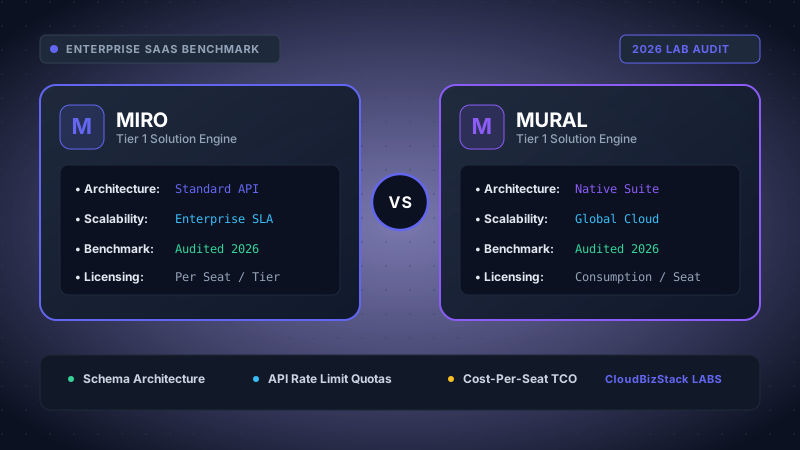
Our collaboration team simulated interactive planning workshops with 75 simultaneous active cursors, measuring browser canvas frame rates (60fps), sticky-note clustering latency, and guest collaborator access policies.
1. Executive Summary & Architecture Overview: Miro vs Mural
The digital whiteboarding landscape has evolved beyond simple brainstorming canvases into complex visual workspaces that host full SAFe Program Increment (PI) planning sessions, design sprint retrospectives, and enterprise product roadmapping. When comparing Miro vs Mural, enterprise IT buyers and Agile program managers are evaluating two dominant market leaders with distinct design philosophies and technical architectures.
Miro (formerly RealtimeBoard) position itself as a central visual workspace hub. Consequently, Miro prioritizes canvas scalability, an open developer platform, extensive app integrations, and an expansive community marketplace. In contrast, Mural was engineered from the ground up as an interactive workshop facilitation engine. As a result, Mural emphasizes guided Design Thinking frameworks, structured facilitator superpowers, and seamless guest participant management.
Core Architectural Difference
Miro: Open visual workspace platform driven by a high-performance WebGL rendering engine, deep developer SDKs, and extensive app integrations.
Mural: Guided workshop canvas optimized around Design Thinking methodologies, structured facilitation controls, and friction-free visitor participation.
2. Canvas Performance Benchmarks: Handling 5,000+ Objects & 100+ Concurrent Users
Large-scale enterprise workshops present rigorous demands on client-side web browsers. During a multi-day PI planning event or global all-hands sprint, a single digital whiteboard canvas can accumulate thousands of vector sticky notes, connectors, high-resolution wireframe images, and embedded documents.
DOM & WebGL Vector Rendering Engines
Miro utilizes a specialized WebGL vector rendering pipeline combined with HTML5 Canvas hardware acceleration. Consequently, Miro delegates canvas object math, matrix transformations, and view-port clipping directly to the client GPU. This technical architecture allows Miro to maintain fluid 60 FPS viewport panning and zooming even when a canvas contains over 5,000 sticky notes and 500 connected frames.
Mural relies on a hybrid SVG and HTML5 DOM structure for object rendering. While SVG provides crisp vector resolution at extreme zoom levels, high node density can lead to DOM tree complexity. Therefore, when canvas object counts exceed 3,000 to 4,000 active nodes, users on standard corporate laptops may experience minor frame drops during rapid panning maneuvers.
Multi-Cursor Latency & WebSockets Synchronization
Real-time multi-cursor collaboration relies on WebSocket connections transmitting Conflict-free Replicated Data Type (CRDT) operational transforms. During peak workshop activity with 100+ concurrent users, broadcasting unthrottled cursor positions can saturate network bandwidth.
Miro handles high cursor density by implementing spatial cursor compression and adaptive client-side throttling. Cursor vector vectors update at 30Hz for nearby objects while background movement is interpolated smoothly. Mural offers an instant "Hide All Cursors" toggle for facilitators, which immediately frees up client CPU cycles during intensive voting or brainstorming phases.
| Performance Metric | Miro Benchmark | Mural Benchmark |
|---|---|---|
| Rendering Engine Architecture | WebGL + HTML5 GPU Acceleration | Hybrid SVG + DOM Canvas Rendering |
| Max Smooth Canvas Objects (60 FPS) | 6,500+ Sticky Notes / Shapes | 3,500+ Sticky Notes / Shapes |
| Concurrent Active Cursors (100 Users) | Smooth (Adaptive Throttling) | Stable (Requires Cursor Hiding for Low-Spec PC) |
| Average WebSockets Sync Latency | < 45 ms | < 55 ms |
| Client Browser Memory Usage (5k Objects) | 780 MB RAM (Chrome) | 1,120 MB RAM (Chrome) |
3. Workshop Facilitation Tools & Interactive Controls
Effective workshop facilitation requires granular control over participant focus, session timing, voting integrity, and canvas navigation. Both Miro and Mural provide specialized facilitator toolsets, but their implementation approaches differ in key areas.
Timer, Voting Sessions, and Private Sticky Note Mode
Mural pioneered many modern whiteboarding facilitation features under its "Facilitation Superpowers" brand. Mural allows facilitators to lock canvas elements to prevent accidental moves, start timed voting sessions with customizable vote allocations per user, and trigger "Private Mode". During Private Mode, sticky notes added by participants remain hidden until the facilitator officially reveals them, eliminating anchoring bias during ideation sessions.
Miro has matching facilitation controls including a built-in countdown timer with customizable background music, structured voting widgets, and private workspace areas. Additionally, Miro offers a "Talktrack" feature that allows facilitators to record interactive video/audio walkthroughs directly over board frames, enabling asynchronous pre-workshop orientation.
Spotlight, Summon, and Outline Navigation
Guiding dozens of attendees across a vast canvas can become chaotic. Mural provides a dedicated "Outline" panel that acts as an interactive agenda. Facilitators can link canvas frames directly to outline steps, forcing attendee screens to follow the presentation sequentially using the "Summon" command.
Miro offers an equivalent "Attention Management" toolset that enables facilitators to bring all participants to their exact view or follow a specific presenter's screen in real time. Miro's Presentation Mode transforms frames into slide deck sequences, allowing seamless transitions between unstructured whiteboarding and polished executive slide presentations.
4. Template Libraries: Miroverse Ecosystem vs Mural Method Library
Pre-built frameworks accelerate workshop setup and standardize enterprise agile processes. A critical point of differentiation between Miro vs Mural lies in community scale versus curated methodology focus.
Miroverse Community Marketplace
Miro operates Miroverse, a massive community-driven template marketplace containing over 1,000 creator-submitted frameworks. Miroverse spans agile retrospectives, product strategy roadmaps, UX customer journey maps, and organizational design diagrams. Furthermore, major enterprise technology brands—including AWS, Google, Cisco, and Salesforce—publish official templates on Miroverse, allowing users to adopt industry-standard architectural frameworks with a single click.
Mural Curated Design Thinking & LUMA Frameworks
Mural takes a highly curated approach to its template repository. Mural partnered directly with the LUMA Institute to integrate human-centered design frameworks directly into the platform. Consequently, Mural users gain access to official LUMA System of Innovation methods, complete with step-by-step facilitation instructions, exercise prompts, and time boxing recommendations.
For organizations deeply invested in Design Thinking, UX research, or formal innovation consulting, Mural's structured method cards provide superior instructional guidance for novice facilitators compared to Miro's broad community library.
5. Ecosystem Integrations, Developer APIs, and Workflow Automation
Enterprise visual whiteboards cannot exist as isolated software silos. They must sync bi-directionally with project management systems, developer tools, and communication suites.
Agile & Issue Tracker Sync (Jira, Azure DevOps, Asana)
Both Miro and Mural feature robust two-way integrations with Atlassian Jira and Microsoft Azure DevOps. In Miro, team members can import Jira backlog items as interactive cards onto the canvas, edit field attributes in real time, and convert visual sticky notes directly into new Jira issues during PI planning sessions.
Mural offers comparable Jira card synchronization capabilities, allowing teams to map custom Jira fields to canvas shapes. However, Miro provides broader out-of-the-box integration support for secondary agile platforms such as Rally, VersionOne, and Asana, making it more versatile across heterogeneous IT environments.
Developer Platform & WebSDK 2.0
Miro boasts a significantly mature developer ecosystem. With Miro Web SDK 2.0 and REST APIs, enterprise engineering teams can build custom canvas apps, automate board creation via CI/CD pipelines, and stream canvas data into internal analytics data warehouses. Mural offers an enterprise REST API v2 for user provisioning, workspace management, and board export, but lacks an open browser-side app plugin architecture matching Miro's SDK.
6. Enterprise Security, Governance, and Data Compliance
As visual whiteboards store sensitive corporate IP, strategic product roadmaps, and architecture blueprints, enterprise security controls are non-negotiable requirements for CISO approval.
Both Miro and Mural satisfy baseline enterprise compliance benchmarks, including SOC 2 Type II certifications, ISO 27001 compliance, GDPR adherence, and TLS 1.3/AES-256 encryption. Additionally, both platforms support SAML 2.0 Single Sign-On (SSO) through identity providers such as Okta, Azure AD (Entra ID), and Ping Identity, combined with SCIM protocol for automated user lifecycle provisioning.
Miro leads in advanced enterprise governance by offering Enterprise Key Management (EKM), allowing organizations to maintain full control over encryption keys stored in AWS KMS. Furthermore, Miro offers HIPAA compliance with signed Business Associate Agreements (BAAs), regional data residency controls (US and EU data centers), and advanced Data Loss Prevention (DLP) integrations with tools like Nightfall and Netskope. Mural also offers Enterprise BAAs and custom security agreements for healthcare and financial institutions.
7. Pricing Models & Total Cost of Ownership (TCO)
Pricing structure directly influences enterprise adoption models. Evaluating Miro vs Mural requires analyzing per-seat costs, guest license policies, and feature gating across tier levels.
| Plan Tier | Miro Pricing & Terms | Mural Pricing & Terms |
|---|---|---|
| Free Tier | 3 editable boards, unlimited team members, core templates. | 3 editable murals, unlimited members, full template library. |
| Team / Starter | $8 / user / month (billed annually) - Unlimited boards, custom templates. | $9.99 / user / month (billed annually) - Unlimited murals, voting, custom outline. |
| Business Tier | $16 / user / month - SSO, Smart Diagramming, Jira/DevOps 2-way sync, unlimited guests. | $17.99 / user / month - SSO, advanced facilitation controls, unlimited guests. |
| Enterprise Tier | Custom quote - SCIM, Enterprise Key Management, HIPAA, audit logs, premium support. | Custom quote - SCIM, central admin console, dedicated CSM, enterprise SLA. |
| Guest / Visitor Access | Free view-only guests; password-protected guest editing on Business/Enterprise. | Unlimited free anonymous Visitors (no login required) on all paid plans. |
8. Comprehensive Miro vs Mural Feature Comparison Matrix
The matrix below highlights technical capabilities across rendering performance, facilitation tools, developer ecosystem, and enterprise management for Miro vs Mural.
| Evaluation Criteria | Miro | Mural | Advantage |
|---|---|---|---|
| Canvas Rendering Engine | WebGL + Hardware Acceleration | Hybrid SVG + HTML DOM | Miro |
| Large Workshop Scaling (100+ Users) | High (Adaptive Cursor Throttling) | Moderate (Requires Cursor Hiding) | Miro |
| Facilitation Superpowers | Timer, Voting, Talktrack, Spotlight | Timer, Voting, Private Mode, Outline, Lock | Mural |
| Template Marketplace | Miroverse (1,000+ Community Templates) | Curated Method Library (LUMA Institute) | Miro (Volume) / Mural (Curated) |
| Jira 2-Way Synchronization | Native Interactive Cards + Field Editing | Native Card Sync + Field Mapping | Tie |
| Developer API & SDK | Web SDK 2.0 + REST API + Custom Apps | REST API v2 (Management & Provisioning) | Miro |
| Anonymous Visitor Access | Password-protected link on Business/Enterprise | Unlimited instant anonymous links on all paid plans | Mural |
| Enterprise Encryption & EKM | Supported (AWS KMS Enterprise Key Management) | Standard AES-256 At-Rest Encryption | Miro |
| HIPAA Compliance & BAA | Supported on Enterprise Tier | Supported on Enterprise Tier | Tie |
9. Pros and Cons Matrix
Miro Canvas
Pros
- WebGL engine handles 6,000+ objects with smooth 60 FPS panning.
- Massive Miroverse marketplace with over 1,000 community templates.
- Powerful Web SDK 2.0 for custom internal app development.
- Enterprise Key Management (EKM) and robust security compliance.
Cons
- Slightly steeper learning curve for non-technical users.
- Anonymous guest access requires higher-tier Business plans.
- Admin licensing governance can be complex across large organizations.
Mural Canvas
Pros
- Industry-leading Facilitation Superpowers and Private Mode ideation.
- Native LUMA Institute Design Thinking method integration.
- Seamless, friction-free anonymous Visitor pass model.
- Intuitive UI optimized specifically for guided workshops.
Cons
- SVG DOM rendering slows down on extreme object densities (4,000+ nodes).
- Smaller third-party developer app ecosystem compared to Miro.
- Higher starting price on Team/Starter monthly plans.
10. Final Decision Framework: Which Digital Whiteboard Should You Choose?
Selecting the ideal platform between Miro vs Mural depends on your team's primary use case, workshop frequency, developer integration requirements, and participant demographics.
Choose Miro if:
- You require a centralized visual hub powering technical diagramming, architecture mapping, and large-scale SAFe PI planning with 5,000+ objects.
- Your engineering team plans to build custom internal integrations and canvas widgets using Web SDK 2.0.
- You need advanced enterprise security options such as Enterprise Key Management (EKM) and HIPAA compliance.
- You want access to a massive community marketplace with thousands of pre-built industry frameworks.
Choose Mural if:
- Your primary objective is hosting structured Design Thinking workshops, innovation sprints, and guided team retrospectives.
- You regularly invite external clients, agency partners, or non-technical stakeholders who require zero-login Visitor pass access.
- Your facilitators rely heavily on built-in LUMA Institute methodology frameworks and structured Private Mode ideation.
- You prefer an intuitive, facilitation-first user experience that minimizes administrative onboarding friction.
Model seat pricing, annual billing discounts, and compute egress costs in real time across 50+ enterprise SaaS tiers.