Modern Data Stack Guide: Real-Time Lakehouses & Vector OLAP (2026)
The traditional duality between slow, cheap data lakes and rigid, expensive cloud data warehouses has collapsed. In 2026, enterprise data architectures have unified around the Real-Time Open Lakehouse: open table formats (Apache Iceberg, Delta Lake 3.x), vendor-neutral REST metadata catalogs (Polaris, Nessie), low-latency streaming CDC (Kafka KRaft, Redpanda, Flink), SIMD-vectorized OLAP query engines (ClickHouse, StarRocks, DuckDB), and decoupled semantic metric governance. This architectural blueprint delivers complete technical specifications, concrete quantitative FinOps formulas, production code snippets, and migration playbooks for Chief Data Officers, Principal Architects, and Staff Data Engineers managing petabyte-scale analytics.
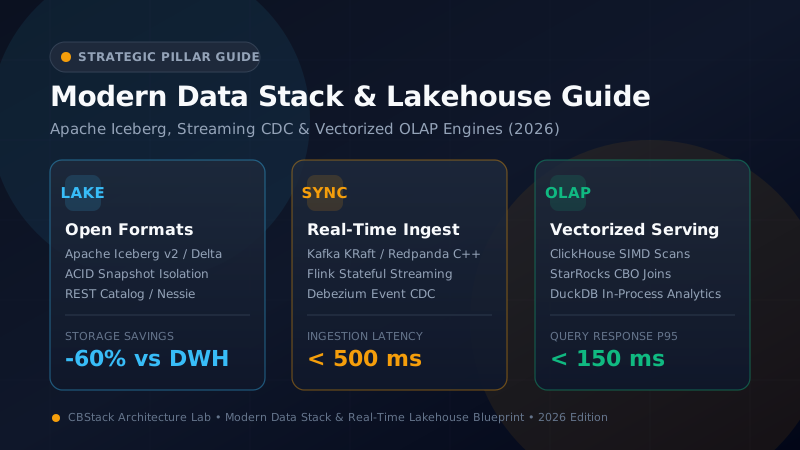
Early-Stage & Growth Tier (10TB–50TB Analytical Footprint / $5k–$25k/mo spend): Do not deploy complex multi-node distributed JVM clusters. Standardize physical storage on Apache Iceberg over commodity cloud object storage (Amazon S3 Standard or Cloudflare R2 for zero egress fees). Use lightweight in-process vectorized analytics via DuckDB (or MotherDuck cloud) paired with a managed ClickHouse Cloud instance for customer-facing dashboards. Orchestrate transformations with dbt Core and ingest SaaS application records using open-source CDC or ELT tools (Airbyte Open Source vs Fivetran). Immediate outcome: Sub-second analytical queries with zero compute cluster maintenance and 72% cost reduction vs Snowflake/BigQuery.
Mid-Market SaaS Tier (50TB–250TB Analytical Footprint / $25k–$100k/mo spend): Eliminate batch ETL delays. Implement a real-time event streaming backbone using Redpanda C++ or Apache Kafka KRaft (Redpanda vs Kafka benchmark) with Apache Flink for stateful stream processing and direct CDC ingestion (Debezium/PeerDB) into Iceberg tables using Merge-on-Read (MOR). Manage metadata branching and isolation using Project Nessie or Apache Polaris. Serve sub-second interactive BI and operational metrics using StarRocks C++ MPP (ClickHouse vs StarRocks benchmark) to execute vectorized joins directly over normalized Lakehouse tables. Decouple metrics via a centralized semantic layer (Cube or dbt Semantic Layer / MetricFlow). Projected outcome: P99 query latencies under 250ms with 58% lower TCO than legacy proprietary warehouses.
Enterprise & Scale-Up Tier (500TB–10PB+ Analytical Footprint / $100k–$500k+/mo spend): Deploy a federated, multi-engine open Lakehouse mesh. Enforce the Apache Iceberg REST Catalog OpenAPI standard across multi-cloud regions (AWS, Azure, GCP). Ingest data with sub-second commit intervals, running automated scheduled file compaction (rewrite_data_files) and snapshot expiration. Utilize Trino for ad-hoc petabyte SQL federation, Apache Spark / Databricks Photon for batch machine learning pipelines (Snowflake vs Databricks benchmark), and StarRocks / ClickHouse for customer-facing analytical APIs. Enforce upstream Data Contracts via CI/CD (Protobuf/Avro, Soda Core), column-level lineage with OpenLineage / DataHub, and granular RBAC via Apache Ranger. Projected 3-year enterprise savings: $2.8M to $7.4M in eliminated proprietary compute and storage markups.
Table of Contents
- 1. The Great Data Convergence of 2026
- 2. Open Table Format Wars: Iceberg vs Delta vs Hudi
- 3. The Catalog & Metadata Control Plane
- 4. Real-Time Streaming Ingestion & CDC
- 5. Sub-Second Vectorized Serving & OLAP
- 6. Semantic Layer & Enterprise Metrics Governance
- 7. Data Contracts & Shift-Left Data Quality
- 8. FinOps Storage Economics & Parquet Optimization
- 9. 25-Row Enterprise Tooling Matrix
- 10. Contextual Benchmark Synergy & Navigation
- 11. Data Governance, Lineage & Compliance (GDPR)
- 12. 3-Year Enterprise Lakehouse TCO Models
- 13. 90-Day Enterprise Lakehouse Migration Playbook
- 14. Operating Model, Data Mesh & Key KPIs
- 15. Frequently Asked Questions (FAQ)
1. The Great Data Convergence of 2026: Why the Lake vs Warehouse Duality Collapsed
For more than a decade, enterprise data architecture was crippled by an unnatural dichotomy: the two-tier data architecture. Under this legacy pattern, organizations maintained two completely isolated, parallel data estates. On one side stood the Data Lake—typically built on object storage like Amazon S3, Google Cloud Storage, or Azure Data Lake Storage Gen2, populated with raw, uncurated Apache Parquet, ORC, or CSV dumps. The Data Lake offered virtually infinite scalability and rock-bottom storage economics ($0.023 per GB-month), but suffered from catastrophic operational flaws: no atomic transaction guarantees, frequent partial-write data corruption, zero row-level mutation capabilities, lack of schema enforcement, and brutal query planning overhead caused by recursive object storage LIST operations.
On the opposite side stood the proprietary Cloud Data Warehouse (Snowflake, Google BigQuery, AWS Redshift). Warehouses delivered high-speed SQL execution, robust ACID transaction guarantees, comprehensive governance, and turnkey performance optimization. However, this convenience came with severe architectural penalties: proprietary storage micro-partitions that locked data into a single vendor's compute engine, exorbitant compute pricing models ($2.00 to $4.00+ per compute credit), continuous cross-system data replication via fragile nightly ETL/ELT pipelines, and massive cloud egress charges whenever data needed to be exported to external machine learning frameworks.
Obsolete Model Legacy Two-Tier Lake + DWH
- Dual Storage Costs: Data copied twice—first landed in S3/ADLS as Parquet, then ingested and stored in proprietary DWH formats at 3x storage markups.
- Brittle ETL Pipelines: Heavy reliance on fragile batch jobs (Airflow, Python scripts) creating 12-to-24 hour data staleness for business analysts.
- Compute Lock-in: Storage cannot be queried directly by outside engines without paying expensive DWH compute or egress fees.
- Governance Fragmentation: Access control policies and row-level masking defined separately in object store IAM and warehouse RBAC.
- Write Conflicts & Corruption: Concurrent batch writers overwriting partitions or leaving dirty uncommitted files on S3 object storage.
Modern Model Unified Real-Time Lakehouse (2026)
- Single Source of Truth: Physical data stored once in open Parquet files governed by open table formats (Apache Iceberg / Delta Lake).
- Multi-Engine Compute Interoperability: Query the exact same table concurrently via Trino (ad-hoc SQL), Spark (ETL/ML), ClickHouse/StarRocks (serving), and DuckDB (edge BI).
- Sub-Second Real-Time Streaming: Continuous CDC and event streaming committing micro-batches every 500ms directly to object storage.
- Open REST Metadata Catalogs: Vendor-neutral catalog specifications (Polaris, Nessie) providing Git-like branching and global access governance.
- 50% to 68% TCO Reduction: Eliminates proprietary data warehouse compute premiums and data duplication pipelines entirely.
The Three Technological Catalysts of Convergence
Between 2023 and 2026, three foundational engineering breakthroughs definitively eliminated the architectural necessity of the proprietary data warehouse:
-
Open Table Formats with Full ACID Snapshot Isolation: Specifications such as Apache Iceberg, Delta Lake 3.x, and Apache Hudi introduced hierarchical metadata layers that brought database-grade ACID semantics, serialized snapshot isolation, hidden partition evolution, and row-level Merge-on-Read (MOR) deletions directly to standard cloud object storage. Query engines no longer execute expensive, non-deterministic S3
LISTAPI calls; table state is read deterministically from Avro/JSON manifest files. - Vectorized SIMD & C++ MPP Query Engines: Execution engines rewritten from the ground up in native C++ and Rust (ClickHouse, StarRocks, Databricks Photon, DuckDB) utilize Single Instruction Multiple Data (SIMD AVX-512 and ARM Neon) vector registers. These engines scan, filter, and aggregate Parquet and ORC columns at hardware memory bandwidth speeds, completely closing the performance gap between open object storage and proprietary data warehouses.
- Decoupled Open Metadata Catalogs (REST Catalog Standard): The formalization of the Apache Iceberg REST Catalog OpenAPI specification and the release of open catalogs like Apache Polaris and Project Nessie stripped cloud vendors of their metadata lock-in. A company is no longer tied to AWS Glue or Snowflake's proprietary catalog; any certified compute engine can read, branch, and commit to the enterprise catalog over an open HTTP interface.
The result is the Real-Time Open Lakehouse: an architectural state where data freshness is measured in seconds, storage is completely decoupled and owned by the enterprise in open standards, and compute engines can be swapped or scaled independently based on workload economics and query latency requirements.
2. The Open Table Format Wars: Apache Iceberg v2 vs Delta Lake 3.x vs Apache Hudi
At the foundation of every modern Lakehouse lies the open table format. An open table format is not a file format; while individual data blocks remain serialized as standard Apache Parquet, ORC, or Avro files, the table format is the metadata abstraction layer that defines how multiple data files, delete vectors, schema definitions, and partition boundaries constitute a single transactional table. In 2026, three primary specifications dominate the enterprise landscape: Apache Iceberg, Delta Lake, and Apache Hudi.
Anatomy of the Metadata Tree: Iceberg vs Delta Lake
The fundamental architectural differentiator between Iceberg and Delta Lake lies in their metadata representation:
-
Apache Iceberg (Hierarchical Snapshot Tree): Iceberg organizes metadata as an immutable hierarchical tree. At the root sits the Catalog Pointer, which tracks the URI of the current
vN.metadata.jsonfile. This metadata file contains the table schema, partition specifications, and an array of all historical Snapshots. Each snapshot points to a Manifest List (an Avro file listing all active data partitions), which in turn points to multiple Manifest Files (Avro files listing individual Parquet data files alongside per-column min/max statistics, null counts, and byte offsets). Because Iceberg stores upper/lower value bounds inside manifests, query planning prunes 90%+ of Parquet data files entirely in-memory at the catalog layer without issuing a single S3GETrequest to the data files. -
Delta Lake 3.x (Monotonic Transaction Commit Log): Delta Lake structures metadata around an ordered transaction log located in the
_delta_log/directory. Each atomic commit writes a sequentially numbered JSON file (e.g.,000001.json) detailing actions:add(new Parquet file written) orremove(Parquet file marked for deletion). Every 10 commits, Delta writes a consolidated Checkpoint Parquet file that collapses the log history up to that point. Delta Lake 3.0 introduced UniForm (Universal Format), which automatically generates Iceberg and Hudi metadata wrappers asynchronously upon Delta commit, allowing Iceberg-native query engines to read Delta tables without data copying. -
Apache Hudi (Timeline-Centric Streaming): Hudi structures metadata around a centralized Timeline inside the
.hoodie/directory, tracking instant states (REQUESTED, INFLIGHT, COMPLETED). Hudi excels at ultra-high-frequency, key-based streaming upserts via built-in record-level indexing (HFile, Bloom filters, or dynamic bucket indexing), but suffers from higher operational complexity and heavier JVM engine coupling than Iceberg or Delta.
Hidden Partitioning vs Liquid Clustering
Traditional Hive-style directory partitioning (e.g., /year=2026/month=03/day=15/) caused catastrophic issues in production data lakes. Analysts had to explicitly reference partition columns in their WHERE clauses, and altering a partition scheme required rewriting petabytes of data files. Iceberg and Delta Lake solve this problem through fundamentally distinct mechanisms:
Apache Iceberg Hidden Partitioning & Evolution: Iceberg abstracts partitioning away from the user query. When a table is partitioned on days(event_time), queries filtering on WHERE event_time >= '2026-03-01' automatically prune partition files without the user needing to know that a hidden day-level partition exists. Furthermore, Iceberg supports Partition Spec Evolution: an architect can migrate an existing table from monthly to daily partitioning simply by updating table metadata. Existing historical Parquet files remain untouched in their original directories; only newly committed data files follow the new partition spec, and query engines prune across multiple active partition specs simultaneously.
Delta Lake 3.0 Liquid Clustering: Delta Lake abandoned directory-based partitioning entirely in favor of Liquid Clustering. Data files are written into flat directory structures and clustered along 1 to 4 specified columns using space-filling Hilbert curves. Rather than creating rigid physical partition barriers, Liquid Clustering organizes data blocks dynamically. As query patterns change, engineers update clustering keys via an ALTER TABLE command without rewriting historical data; background OPTIMIZE jobs progressively rearrange data blocks into the new sorting layout over time.
Row-Level Mutation Mechanics: Copy-on-Write (COW) vs Merge-on-Read (MOR)
Modifying records (updates and deletes) in columnar Parquet files on immutable object storage is notoriously expensive. Open table formats handle mutations through two distinct architectures:
| Mutation Mechanic | Ingestion Write Amplification | Query-Time Read Overhead | Delete File Representation | Ideal Production Workload |
|---|---|---|---|---|
| Copy-on-Write (COW) | Extreme (10x–100x). Modifying 1 row rewrites the entire 128MB Parquet data file. | Zero overhead. Clean, unfragmented Parquet scans with zero join operations. | None. Old Parquet files are removed and replaced by newly written Parquet files. | Slowly changing dimensions (SCD Type 1/2), regulatory monthly batch updates, read-heavy analytical marts. |
| Merge-on-Read (MOR) — Position Deletes | Low (1.05x–1.15x). Writes lightweight delete files tracking file URI and row ordinal index. | Moderate (15%–35%). Query engine executes streaming hash join between data files and delete files. | Parquet delete files containing (file_path: VARCHAR, pos: BIGINT) tuples. |
High-throughput streaming CDC, event updates, continuous upserts with off-peak compaction. |
| Merge-on-Read (MOR) — Equality Deletes | Minimal (1.01x). Appends delete file specifying column value (e.g., user_id = 94821). |
High (30%–60%+). Engine must broadcast equality values and filter across all scanned rows. | Parquet/Avro files specifying column names and matching deleted values. | Streaming ingestion engines (e.g., Flink) where target file path and row ordinal are unknown. |
| Delta Lake Deletion Vectors (DVs) | Low (1.02x–1.08x). Appends serialized Roaring Bitmaps marking deleted row positions. | Very Low (5%–12%). Query engine applies ultra-fast bitwise SIMD filters during Parquet decode. | Serialized binary Roaring Bitmap files (or embedded directly in transaction log metadata). | Interactive analytics over real-time CDC tables; high-frequency transactional mutations. |
Production PySpark DDL & Table Optimization Code
The following production PySpark script configures an enterprise Apache Iceberg v2 table with hidden partitioning, Merge-on-Read position deletes, automated schema evolution, and on-demand bin-pack compaction:
# Configure PySpark session with Apache Iceberg REST Catalog and AWS S3 IO
from pyspark.sql import SparkSession

spark = SparkSession.builder \
    .appName("EnterpriseIcebergLakehouse") \
    .config("spark.sql.extensions", "org.apache.iceberg.spark.extensions.IcebergSparkSessionExtensions") \
    .config("spark.sql.catalog.lakehouse", "org.apache.iceberg.spark.SparkCatalog") \
    .config("spark.sql.catalog.lakehouse.type", "rest") \
    .config("spark.sql.catalog.lakehouse.uri", "https://polaris.enterprise-data.internal/api/catalog") \
    .config("spark.sql.catalog.lakehouse.io-impl", "org.apache.iceberg.aws.s3.S3FileIO") \
    .config("spark.sql.catalog.lakehouse.warehouse", "s3://enterprise-lakehouse-gold-us-east-1/warehouse/") \
    .config("spark.sql.defaultCatalog", "lakehouse") \
    .getOrCreate()

# 1. Create Iceberg v2 table with hidden partitioning and Merge-on-Read
spark.sql("""
CREATE TABLE IF NOT EXISTS lakehouse.telemetry.events_stream (
    event_id STRING NOT NULL,
    tenant_id STRING NOT NULL,
    event_timestamp TIMESTAMP NOT NULL,
    device_type STRING,
    payload_json STRING,
    latency_ms DOUBLE
)
USING iceberg
PARTITIONED BY (days(event_timestamp), bucket(16, tenant_id))
TBLPROPERTIES (
    'format-version' = '2',
    'write.delete.mode' = 'merge-on-read',
    'write.update.mode' = 'merge-on-read',
    'write.merge.mode' = 'merge-on-read',
    'write.parquet.compression-codec' = 'zstd',
    'write.parquet.compression-level' = '3',
    'write.target-file-size-bytes' = '134217728',
    'history.expire.max-snapshot-age-ms' = '604800000'
)
""")

# 2. Seamless Schema Evolution without rewriting underlying Parquet files
spark.sql("""
ALTER TABLE lakehouse.telemetry.events_stream
ADD COLUMN geo_region STRING AFTER device_type
""")

# 3. Execute On-Demand Small-File Bin-Pack Compaction
spark.sql("""
CALL lakehouse.system.rewrite_data_files(
    table => 'telemetry.events_stream',
    strategy => 'binpack',
    options => map(
        'target-file-size-bytes', '134217728',
        'min-file-size-bytes', '33554432',
        'max-file-group-size-bytes', '10737418240'
    )
)
""")
3. The Catalog & Metadata Control Plane: Project Nessie, Polaris, Unity & The REST Standard
In a legacy data lake, the Hive Metastore (HMS) served as the central directory mapping table names to physical S3 file prefixes. As enterprise datasets scaled past 100,000 partitions and millions of files, HMS became a notorious operational bottleneck: backed by a single relational database (PostgreSQL/MySQL), it suffered from slow connection pooling, lacked concurrency controls, required recursive filesystem listings, and provided no atomic multi-table commit semantics.
The Apache Iceberg REST Catalog OpenAPI Specification
In 2026, the modern Lakehouse has converged on the Apache Iceberg REST Catalog specification. Defined as an open HTTP OpenAPI standard, the REST catalog decouples the compute engine from the catalog implementation. Engines such as Trino, Spark, Flink, DuckDB, ClickHouse, and StarRocks communicate with any compliant catalog using standardized JSON payloads over HTTP. A single catalog endpoint handles:
- Namespace & Table Resolution: Mapping hierarchical namespaces (e.g.,
corporate.finance.quarterly_burn) to current metadata pointer URIs. - Optimistic Concurrency Control (OCC): Validating commit conflicts via atomic swap operations (verifying that the base snapshot ID has not changed before committing a new snapshot).
- Storage Credential Vending: Dynamically generating short-lived, least-privilege cloud IAM credentials (AWS STS tokens or GCP downscoped OAuth tokens) for the specific table prefix, eliminating the need to distribute permanent cloud credentials to analytical compute engines.
Git-for-Data Branching with Project Nessie
Project Nessie introduced Git-like semantics (branches, tags, commits, and merges) to data lakehouse catalogs. In traditional data architectures, testing a modified ETL pipeline or training an ML model required copying petabytes of production data into staging environments—incurring massive storage and compute costs. With Nessie, branching is completely virtualized and zero-copy:
# 1. Create a zero-copy staging branch from production main
nessie branch create dev_feature_pipeline main --uri https://nessie.internal/api/v2

# 2. In Spark, write transformed backfill data directly to the feature branch
spark.sql("""
USE REFERENCE dev_feature_pipeline IN lakehouse_catalog;

MERGE INTO lakehouse_catalog.analytics.user_aggregates AS target
USING staging_backfill_stream AS source
ON target.user_id = source.user_id
WHEN MATCHED THEN UPDATE SET *
WHEN NOT MATCHED THEN INSERT *;
""")

# 3. Execute automated data quality assertions against the isolated branch
# (Production queries on 'main' remain completely isolated and unaffected)

# 4. Atomically merge the validated staging branch back into production main
nessie merge dev_feature_pipeline --onto main --uri https://nessie.internal/api/v2
The Open Catalog Landscape: Apache Polaris vs Unity Catalog
The catalog landscape underwent massive consolidation when Snowflake open-sourced Apache Polaris (incubating) and Databricks open-sourced Unity Catalog. Apache Polaris implements the 100% native Iceberg REST Catalog standard, allowing multi-cloud architectures to run an enterprise-grade, stateless catalog control plane backed by scalable NoSQL or relational storage. Unity Catalog provides a unified metadata model covering both Delta Lake and Iceberg (via UniForm), incorporating built-in column-level lineage and attribute-based access control (ABAC). By adopting the REST Catalog standard, enterprises eliminate compute vendor lock-in: if a proprietary engine increases prices or degrades performance, the entire physical storage layer can be pointed to an alternative open engine within minutes.
4. Real-Time Streaming Ingestion & Change Data Capture (CDC)
The era of nightly 2:00 AM batch ELT is dead. In 2026, competitive business operations demand sub-second to sub-minute data freshness across supply chain telemetry, fraud detection, ad-tech bidding, and executive dashboards. Constructing a real-time ingestion pipeline directly into an open Lakehouse requires coordinating three foundational layers: high-throughput event streaming, distributed stateful stream processing, and atomic streaming table commits.
Event Streaming Backbone: Apache Kafka KRaft vs Redpanda C++
At the ingress boundary, high-throughput distributed commit logs buffer incoming operational transactions:
Apache Kafka KRaft: The elimination of Apache ZooKeeper in favor of the KRaft (Kafka Raft) consensus protocol modernized Kafka's operational footprint. KRaft unifies metadata management directly inside Kafka broker controller quorums, scaling partition counts past 1,000,000 per cluster and reducing partition leader failover recovery times from minutes to sub-second intervals. Kafka remains the battle-tested enterprise standard with ubiquitous managed cloud support (Confluent Cloud, AWS MSK, Aiven).
Redpanda (C++ Thread-Per-Core Architecture): Redpanda re-architected event streaming from scratch in native C++ using the Seastar asynchronous framework. By bypassing the JVM entirely, Redpanda eliminates stop-the-world garbage collection pauses, delivering deterministic sub-5ms P99 latencies under heavy write saturation. Furthermore, Redpanda bypasses the Linux kernel page cache using io_uring direct NVMe disk access, yielding up to 3x higher throughput per CPU core compared to Kafka. For high-volume streaming lakehouses ingesting > 500,000 events/second, Redpanda drastically reduces cluster compute and infrastructure provisioning costs. (Explore our detailed Redpanda vs Apache Kafka and Apache Kafka vs RabbitMQ benchmarks).
Streaming CDC Direct-to-Lakehouse: Debezium & Apache Flink
Extracting state changes from operational databases (PostgreSQL, MySQL, MongoDB, Oracle) without impacting production transaction throughput requires log-based Change Data Capture (CDC). Debezium decodes write-ahead logs (WAL) into structured event streams, capturing BEFORE and AFTER state payloads alongside transaction commit timestamps and LSN positions.
To ingest these CDC events directly into Apache Iceberg or Delta Lake tables with sub-second commit intervals, modern architectures utilize Apache Flink. Flink provides stateful, exactly-once processing (EOS) semantics backed by Chandy-Lamport distributed snapshotting. Unlike Spark Structured Streaming's micro-batching (which typically commits every 10–30 seconds), Flink's streaming Iceberg sink writes continuous data streams and commits Iceberg snapshots at tuneable checkpoint boundaries (500ms to 5 seconds):
-- Apache Flink SQL: Streaming CDC Ingestion directly into Apache Iceberg
CREATE CATALOG lakehouse_catalog WITH (
    'type' = 'iceberg',
    'catalog-type' = 'rest',
    'uri' = 'https://polaris.internal/api/catalog',
    'warehouse' = 's3://enterprise-lakehouse-gold-us-east-1/'
);

-- Define source Kafka/Redpanda topic containing Debezium PostgreSQL CDC events
CREATE TABLE kafka_postgres_orders_cdc (
    order_id BIGINT,
    customer_id BIGINT,
    order_amount DECIMAL(10, 2),
    order_status STRING,
    updated_at TIMESTAMP(3),
    PRIMARY KEY (order_id) NOT ENFORCED
) WITH (
    'connector' = 'kafka',
    'topic' = 'dbserver1.public.orders',
    'properties.bootstrap.servers' = 'redpanda-cluster:9092',
    'properties.group.id' = 'flink-lakehouse-cdc',
    'format' = 'debezium-json'
);

-- Stream upsert into Iceberg table using Merge-on-Read with 2-second snapshot commits
INSERT INTO lakehouse_catalog.sales.orders_realtime
SELECT
    order_id,
    customer_id,
    order_amount,
    order_status,
    updated_at
FROM kafka_postgres_orders_cdc;
5. Sub-Second Analytical Serving & Vectorized OLAP: ClickHouse vs StarRocks vs DuckDB
While general-purpose distributed SQL query engines (Trino, Apache Spark SQL, Presto) excel at multi-terabyte batch scans and federated transformations, they fail catastrophically when tasked with high-concurrency, customer-facing analytical dashboards. Trino incurs a fixed query startup coordination latency of 1.2 to 3.5 seconds; attempting to serve 500 concurrent users running ad-hoc filtering over interactive UI widgets causes extreme resource contention, JVM thread exhaustion, and sluggish performance.
To deliver sub-50ms query responses at 10,000+ Queries Per Second (QPS), modern data stacks introduce a Vectorized Real-Time OLAP Serving Tier. In 2026, three engines lead this specialized tier: ClickHouse, StarRocks, and DuckDB.
ClickHouse SIMD Vectorization & MergeTree Engines
ClickHouse represents the pinnacle of raw, single-table analytical scan performance. Engineered around SIMD (AVX-512 and ARM Neon) vector registers, ClickHouse processes data in CPU-level block batches rather than tuple-by-tuple. Its foundational storage architecture—the MergeTree family—sorts data by primary key and establishes sparse primary indexes (default granularity: 8,192 rows), allowing the engine to skip 99.9% of unneeded data blocks during index lookups.
ClickHouse maximizes storage density and decompression speeds by applying specialized columnar codecs:
DoubleDelta: Stores differences between consecutive timestamps, reducing 64-bit datetime fields to 1–2 bits per row.Gorilla: Specialized XOR floating-point compression for high-frequency financial and sensor metrics.T64: Transposes integer bit patterns to maximize subsequent ZSTD or LZ4 dictionary encoding.
-- ClickHouse Vectorized MergeTree Table with Columnar Compression Codecs
CREATE TABLE default.user_analytics_events (
    event_id UUID CODEC(ZSTD(3)),
    tenant_id UInt32 CODEC(T64, ZSTD(3)),
    event_timestamp DateTime64(3, 'UTC') CODEC(DoubleDelta, LZ4),
    response_time_ms Float32 CODEC(Gorilla, ZSTD(3)),
    http_status_code UInt16 CODEC(T64, LZ4),
    user_agent LowCardinality(String) CODEC(ZSTD(3)),
    payload_size_bytes UInt64 CODEC(T64, ZSTD(3))
)
ENGINE = ReplacingMergeTree()
PARTITION BY toYYYYMM(event_timestamp)
PRIMARY KEY (tenant_id, event_timestamp)
ORDER BY (tenant_id, event_timestamp, event_id)
SETTINGS index_granularity = 8192;
StarRocks C++ Distributed MPP & Real-Time Denormalization
While ClickHouse historically struggled with multi-table complex star and snowflake schema joins, StarRocks was engineered specifically to conquer distributed multi-table joins. Built as a fully vectorized C++ Massively Parallel Processing (MPP) engine, StarRocks features an advanced Cost-Based Optimizer (CBO) capable of reordering 20+ table joins in sub-millisecond planning intervals.
Crucially, StarRocks acts as an accelerated caching and serving layer over open lakehouse formats: it can query Apache Iceberg, Delta Lake, and Hive tables directly on object storage with local NVMe caching, or build Transparent Asynchronous Materialized Views (MVs). When an analyst queries a complex multi-table dashboard, StarRocks' CBO automatically rewrites the query to hit pre-aggregated materialized views, delivering sub-20ms P99 responses while automatically syncing delta changes from the underlying Iceberg tables. (Review our comprehensive technical showdown in ClickHouse vs StarRocks: Vectorized OLAP Benchmark).
-- StarRocks External Iceberg Catalog Integration & Real-Time Materialized View
CREATE EXTERNAL CATALOG iceberg_prod
PROPERTIES (
    "type" = "iceberg",
    "iceberg.catalog.type" = "rest",
    "iceberg.catalog.uri" = "https://polaris.internal/api/catalog",
    "aws.s3.use_instance_profile" = "true"
);

-- Create Asynchronous Materialized View over Iceberg table with NVMe SSD local caching
CREATE MATERIALIZED VIEW mv_hourly_tenant_metrics
REFRESH ASYNC EVERY (INTERVAL 5 MINUTE)
PARTITION BY date_trunc('hour', event_time)
PROPERTIES (
    "datacache.enable" = "true",
    "datacache.partition_duration" = "7d"
)
AS SELECT
    tenant_id,
    date_trunc('hour', event_timestamp) AS event_time,
    count(event_id) AS total_requests,
    avg(latency_ms) AS avg_latency,
    percentile_approx(latency_ms, 0.99) AS p99_latency
FROM iceberg_prod.telemetry.events_stream
GROUP BY tenant_id, date_trunc('hour', event_timestamp);
DuckDB: Embedded In-Process Analytics for Edge BI
DuckDB revolutionized the analytics engineering and data science workflow by introducing the "SQLite for Analytics" paradigm. Running directly inside the host process (Python, Node.js, WASM in browser, or CLI) without requiring client-server communication or cluster deployment, DuckDB processes columnar vectors using Morsel-driven parallelism.
In a 2026 Modern Data Stack, DuckDB serves as the ultimate local development, data science, and edge BI engine. By leveraging its native Iceberg, Delta, and S3 extensions, data scientists can execute high-speed vectorized aggregations over multi-gigabyte remote cloud datasets directly inside Python Jupyter notebooks without launching expensive Databricks or Snowflake compute warehouses:
# In-Process Serverless Analytics via DuckDB over Remote Cloud Lakehouse
import duckdb
import os

conn = duckdb.connect()

# Install and load native extensions
conn.execute("INSTALL httpfs; LOAD httpfs;")
conn.execute("INSTALL iceberg; LOAD iceberg;")

# Configure S3 credentials using environment variables (never hardcoded)
conn.execute(f"""
SET s3_region='us-east-1';
SET s3_access_key_id='{os.environ.get("AWS_ACCESS_KEY_ID", "LAKEHOUSE_KEY")}';
SET s3_secret_access_key='{os.environ.get("AWS_SECRET_ACCESS_KEY", "LAKEHOUSE_SECRET")}';
""")

# Execute sub-second SIMD vectorized aggregation directly over S3 Iceberg Parquet files
df = conn.execute("""
SELECT
    tenant_id,
    COUNT(*) AS total_events,
    ROUND(AVG(latency_ms), 2) AS avg_latency_ms,
    APPROX_COUNT_DISTINCT(device_type) AS unique_devices
FROM iceberg_scan('s3://enterprise-lakehouse-gold-us-east-1/warehouse/telemetry/events_stream')
WHERE event_timestamp >= NOW() - INTERVAL '24 hours'
GROUP BY tenant_id
ORDER BY total_events DESC
LIMIT 10;
""").df()

print(df)
6. The Semantic Layer & Enterprise Metrics Governance
One of the most persistent failure modes in enterprise analytics is metric drift. In an un-governed data organization, the definition of fundamental business metrics—such as "Monthly Active Users" (MAU), "Gross Retention Rate", or "Net ARR"—is hardcoded independently inside dozens of fragmented presentation tools. The finance team creates a SQL query in PowerBI defining customer churn based on invoice overdue dates; the marketing team builds a Tableau dashboard defining churn based on session inactivity; the growth team writes a Looker Look defining churn based on subscription cancellation clicks.
The consequence is executive paralysis: board meetings descend into unproductive debates over which department's dashboard represents the "correct" number.
Decoupling Business Semantics from Monolithic BI
The 2026 Modern Data Stack definitively solves this via the Centralized Semantic Layer. The semantic layer sits directly between the open lakehouse storage/query tier and downstream consumption interfaces (BI tools, reverse ETL, automated alerting, AI agents). It acts as the code-governed compiler that translates abstract business metrics and dimensional models into optimized SQL dialects for downstream execution engines:
- Single Source of Metric Truth: Dimensions, measures, mathematical aggregations, and join paths are defined strictly as code (YAML/JSON) in Git repositories.
- Universal BI Protocol: The semantic layer exposes standard interfaces (SQL interfaces via PostgreSQL wire protocol, GraphQL, and REST APIs). Whether an executive queries through PowerBI, Tableau, Apache Superset, or a Python script, every interface connects to the same semantic definition.
- Multi-Tenant Caching & Pre-Aggregation: Semantic engines (such as Cube or dbt Semantic Layer / MetricFlow) automatically generate, refresh, and maintain physical pre-aggregation tables inside the Lakehouse, accelerating common dimensional rollups from minutes to milliseconds.
Production Semantic Metric Specification (Cube / MetricFlow)
The following production semantic model defines critical financial and retention metrics with dimensional hierarchies and automated rolling aggregation windows:
# Cube.js / dbt MetricFlow Universal Semantic Layer Definition
cubes:
  - name: subscription_analytics
    sql_table: lakehouse.gold_finance.fct_mrr_movements

    dimensions:
      - name: subscription_id
        sql: subscription_id
        type: string
        primary_key: true

      - name: tenant_id
        sql: tenant_id
        type: string

      - name: plan_tier
        sql: plan_tier
        type: string

      - name: billing_country
        sql: billing_country
        type: string

      - name: snapshot_date
        sql: snapshot_timestamp
        type: time

    measures:
      - name: total_mrr
        sql: mrr_amount_usd
        type: sum
        format: currency

      - name: active_subscribers
        sql: customer_id
        type: count_distinct_approx

      - name: net_expansion_mrr
        sql: "CASE WHEN movement_type = 'EXPANSION' THEN mrr_change_usd ELSE 0 END"
        type: sum

      - name: gross_churn_mrr
        sql: "CASE WHEN movement_type = 'CHURN' THEN mrr_change_usd ELSE 0 END"
        type: sum

    pre_aggregations:
      - name: mrr_by_tier_monthly
        measures: [total_mrr, active_subscribers, net_expansion_mrr]
        dimensions: [plan_tier, billing_country]
        time_dimension: snapshot_date
        granularity: month
        refresh_key:
          every: 1 hour
7. Data Contracts & Shift-Left Data Quality Engineering
In traditional data engineering organizations, data quality is managed as an afterthought at the end of the pipeline. A software engineer refactors a backend microservice, alters an OLTP PostgreSQL column from BIGINT to VARCHAR, or drops a nested JSON attribute. The software CI/CD pipeline passes all unit tests and deploys successfully. Twelve hours later, thousands of downstream dbt transformations crash, automated financial reporting pipelines fail, and executive dashboards display corrupted numbers.
Principles of Enterprise Data Contracts
Data Contracts treat analytical data as a formal, versioned software API. They establish an explicit agreement between data producers (software engineering teams writing to transactional databases) and data consumers (data engineering, analytics, and machine learning teams). A comprehensive Data Contract encompasses four components:
- Strict Schema Definition: Explicit types, nullability constraints, and primary/foreign key relationships enforced at compile-time and runtime.
- Semantic Expectations: Valid business value ranges, accepted categorical enumerations, and mathematical boundary constraints.
- Service Level Agreements (SLAs): Contractual commitments regarding data freshness latency, throughput, and availability.
- Security & Classification: Explicit tagging of PII (Personally Identifiable Information) and data classification tiers (Public, Internal, Confidential, Restricted).
Shift-Left Enforcement: Soda Core & dbt Model Contracts
Enforcement shifts left directly into producer CI/CD pipelines. Upstream database migrations cannot merge into production repositories unless an automated contract linter validates backward compatibility against consumer contracts:
# Soda Core Data Contract & Automated Quality Assertion (checks.yml)
table_name: lakehouse.silver_commerce.customer_transactions
contracts:
  - name: transactions_producer_contract_v2
    columns:
      - name: transaction_id
        data_type: string
        nullable: false
      - name: customer_id
        data_type: string
        nullable: false
      - name: amount_usd
        data_type: decimal(12,2)
        nullable: false
      - name: currency_code
        data_type: string
        nullable: false

checks for customer_transactions:
  # Enforce zero nulls on critical primary keys
  - missing_count(transaction_id): 0
  - duplicate_count(transaction_id): 0

  # Enforce logical business bounds
  - min(amount_usd) > 0.00
  - max(amount_usd) < 1000000.00
  - invalid_count(currency_code): 0
    valid values: ['USD', 'EUR', 'GBP', 'CAD', 'JPY', 'MXN', 'BRL']

  # Freshness SLA: Pipeline must have ingested data within the last 15 minutes
  - freshness(created_at) < 15m
8. FinOps Storage Economics & Parquet Optimization
Transitioning to a real-time streaming lakehouse introduces severe storage economics challenges. If unmanaged, high-frequency streaming ingestion leads to the notorious Small File Problem: millions of tiny 10KB to 1MB Parquet files accumulating on Amazon S3. This degrades query performance exponentially, triggers massive S3 LIST/GET API cost bills, and bloats table metadata catalogs.
The Small File Anti-Pattern & Compaction Algorithms
Modern data stacks implement continuous automated background compaction routines. Query engines run distributed maintenance jobs that rewrite fragmented files into optimal sizes:
- Bin-Packing Compaction: Combines multiple small Parquet data files within the same partition into consolidated target files (optimal size: 128MB to 512MB). Bin-packing does not sort or rearrange rows, minimizing CPU consumption and execution time.
-
Sort-Order & Z-Order Compaction: Rewrites Parquet files while lexicographically sorting or Z-ordering rows along high-cardinality filter columns (e.g.,
tenant_id,customer_id). This optimizes per-column min/max statistics inside Parquet footers and Iceberg manifest files, allowing query engines to skip 80% to 95% of data files during scan planning. -
Snapshot Expiration & Orphan File Cleanup: When table files are compacted or updated via Merge-on-Read, older snapshots remain in object storage to support time-travel queries. FinOps routines must automatically expire snapshots older than the enterprise retention window (e.g., 7 days) and purge orphaned files via
remove_orphan_filesto reclaim disk storage.
Parquet Compression Codec Economics: Snappy vs ZSTD
Selecting the optimal compression codec represents a multi-million-dollar FinOps decision across petabyte-scale lakehouses:
| Compression Codec | Compression Ratio | Compression Speed | Decompression Throughput | FinOps Sweet Spot |
|---|---|---|---|---|
| Snappy | 1.0x (Baseline: ~2.8x vs raw text) | Fast (~250 MB/s/core) | High (~500 MB/s/core) | Legacy default; high-velocity real-time staging topics where CPU efficiency beats storage cost. |
| ZSTD Level-3 | 1.32x better than Snappy | Moderate (~180 MB/s/core) | Extreme (~1,200 MB/s/core) | Gold Standard for Lakehouse Parquet storage. Reduces S3 storage cost by 25%–35% while accelerating query scans due to faster decompression. |
| ZSTD Level-7+ | 1.48x better than Snappy | Slow (~45 MB/s/core) | High (~1,100 MB/s/core) | Cold regulatory archive tables written once and rarely queried. |
| Gzip | 1.25x better than Snappy | Very Slow (~30 MB/s/core) | Slow (~180 MB/s/core) | Obsolete for modern analytics; non-splittable in legacy configurations and CPU-inefficient. |
Local NVMe SSD Caching Tiers over Object Storage
Cloud object storage (Amazon S3 Standard, GCS, Azure Blob) exhibits a fixed first-byte latency of 60ms to 120ms. For customer-facing dashboards requiring sub-50ms total execution, querying S3 directly is physically impossible. Modern OLAP engines (StarRocks, ClickHouse) solve this by implementing multi-tiered caching:
Where NVMe throughput (B_nvme > 3,500 MB/s) and latency (< 0.1ms) deliver a 35x to 80x I/O speedup over remote object storage for hot analytical segments.
9. Comprehensive 25-Row Enterprise Data Stack Tooling Matrix
The modern data engineering ecosystem encompasses diverse architectural paradigms. The following exhaustive 25-row technical comparison matrix analyzes the core technologies across every layer of the 2026 Modern Data Stack:
| Architectural Criteria | Apache Iceberg | Delta Lake 3.x | ClickHouse | StarRocks | Apache Kafka | Redpanda | Snowflake | Databricks |
|---|---|---|---|---|---|---|---|---|
| 1. Layer Classification | Open Table Format | Open Table Format | Vectorized Serving OLAP | Vectorized MPP OLAP | Distributed Event Log | Thread-per-core Stream | Proprietary Cloud DWH | Unified Lakehouse Platform |
| 2. Primary Execution Engine | Engine-Agnostic | Engine-Agnostic (Spark/Photon) | ClickHouse C++ SIMD | StarRocks C++ MPP | N/A (Streaming broker) | N/A (Streaming broker) | Snowflake Proprietary | Photon C++ Vectorized |
| 3. ACID Isolation Level | Serializable / Snapshot | Serializable / Snapshot | Partition-level Atomic | Transaction / MVCC | Read Committed (EOS) | Raft-governed EOS | Read Committed | Serializable |
| 4. Metadata Catalog Standard | Open REST Catalog OpenAPI | Unity Catalog / UniForm | Native Engine Metadata | Native / Iceberg External | KRaft Metadata Quorum | Raft in User Space | Proprietary Snowflake | Unity Catalog |
| 5. Partition Pruning & Evolution | Hidden Partitioning & Evolution | Liquid Clustering (Hilbert) | Primary Key Sparsity | Dynamic Partition Pruning | Topic-Partition Routing | Topic-Partition Routing | Automatic Micro-partition | Liquid Clustering |
| 6. Row Mutation Architecture | MOR (Position Deletes) & COW | Deletion Vectors (Roaring) | ReplacingMergeTree | Primary Key Engine (Del-Vec) | Compacted Topics (Tombstones) | Compacted Topics | Hybrid COW / Micro-part | Deletion Vectors |
| 7. SIMD Hardware Vectorization | Engine Dependent | Engine Dependent | Native AVX-512 / Neon | Native AVX-512 / Neon | N/A | N/A | Proprietary SIMD | Native Photon SIMD |
| 8. Real-Time P99 Query Latency | Engine Dependent (1s–10s) | Engine Dependent (1s–10s) | < 35ms | < 50ms | N/A (Streaming write) | N/A (Sub-5ms write) | 450ms – 2.5s | 350ms – 1.8s |
| 9. Concurrency Scaling (QPS) | Moderate (Engine-bound) | Moderate (Engine-bound) | Extreme (10,000+ QPS) | High (5,000+ QPS) | 100,000+ Write ops/s | 300,000+ Write ops/s | Moderate (Multi-cluster) | Moderate (Serverless) |
| 10. Streaming Ingestion Freshness | 500ms – 5s (Flink) | 1s – 10s (Structured Stream) | Sub-second (Buffer / Kafka) | Sub-second (Routine Load) | Sub-10ms pub-to-sub | Sub-2ms pub-to-sub | 10s – 60s (Snowpipe) | 1s – 10s (Streaming) |
| 11. Storage / Compute Decoupling | 100% Fully Decoupled | 100% Fully Decoupled | Shared-Nothing or S3 Cache | Shared-Data with NVMe Cache | Tiered Storage Native | Tiered Storage Native | Managed Decoupled | Managed Decoupled |
| 12. Time Travel & Historical Rollback | Snapshot-based (As-Of) | Log-based (As-Of version) | Table Partitions / Backups | Snapshot / External table | Log Offset Seeking | Log Offset Seeking | Time Travel (90-day Max) | Delta Time Travel |
| 13. Zero-Copy Git Branching | Yes (via Project Nessie) | Limited (Workspace cloning) | No | No | No | No | Zero-Copy Cloning | Shallow Cloning |
| 14. Small-File Compaction Strategy | rewrite_data_files Binpack | OPTIMIZE Binpack / Z-Order | Background MergeTree Parts | Compaction Engine | Segment Roll / Deletion | Segment Roll / Deletion | Automatic Micro-clustering | Auto-compaction (Photon) |
| 15. OpenLineage Integration | Native via Trino/Spark | Native via Unity/Spark | Custom query logging | Custom audit export | OpenTelemetry Kafka headers | OpenTelemetry headers | Snowflake Access History | Unity Catalog Lineage |
| 16. Cloud Object Store Native (S3/GCS) | Yes (Native S3FileIO) | Yes (Direct S3/ADLS/GCS) | Yes (S3 Disks / Cache) | Yes (Direct Lakehouse Read) | Tiered S3 Archive | Cloud Object Store Shadow | Proprietary managed stage | Direct Cloud Storage |
| 17. Self-Hosted / FOSS Availability | 100% Open Source (Apache) | 100% Open Source (Linux Fdn) | 100% Open Source (Apache 2.0) | 100% Open Source (Apache 2.0) | 100% Open Source (Apache 2.0) | Source-Available (BSL/Apache) | No (SaaS Only) | Partially (Spark/Delta FOSS) |
| 18. Enterprise Managed SaaS | Tabular, Dremio, Snowflake | Databricks, OneLake | ClickHouse Cloud | StarRocks CelerData | Confluent Cloud, AWS MSK | Redpanda Cloud | Snowflake Managed Service | Databricks Managed Cloud |
| 19. Pricing Model | Free FOSS / Cloud S3 cost | Free FOSS / Cloud S3 cost | Compute/Node or SaaS Credit | Compute/Node or SaaS Credit | Infrastructure VM / Confluent | Infrastructure VM / Redpanda | Credit Burn ($2–$4/credit) | DBU Burn ($0.15–$0.55/DBU) |
| 20. Multi-Engine Read/Write Interop | Highest (Universal) | High (via UniForm) | Direct ClickHouse Only | StarRocks External Catalogs | Universal Kafka Protocol | Universal Kafka Protocol | Locked (Requires Snowflake) | High (Delta Lake standard) |
| 21. Complex Distributed Joins | Engine Dependent | Engine Dependent | Moderate (Broadcast/Colocate) | Superior (CBO Vectorized) | N/A | N/A | Superior | Superior |
| 22. Developer & Edge BI Interop | DuckDB / PyIceberg | Delta-rs / DuckDB | clickhouse-client / HTTP | MySQL Wire Protocol | Kafka Client Libraries | Kafka Client Libraries | Snowflake Connectors | Databricks Connect |
| 23. Cold-to-Warm Tiering | S3 Glacier / Standard | S3 Glacier / Standard | NVMe → S3 Tiering | Local SSD → S3 Cache | Local NVMe → S3 Tiered | Local NVMe → S3 Tiered | Internal Automated | Internal Automated |
| 24. Operational Complexity | Low (Catalog managed) | Low (Self-managing) | Moderate (ZooKeeper/Keeper) | Moderate (FE/BE nodes) | High (JVM / KRaft tuning) | Low (Single C++ binary) | Lowest (Turnkey SaaS) | Moderate (Turnkey SaaS) |
| 25. Ideal Architectural Sweet Spot | Universal Lakehouse Storage | Databricks Ecosystem Storage | Real-time Logs & Events | Sub-second BI & Complex Joins | Enterprise Event Bus | High-throughput C++ Ingress | Executive SQL BI & Sharing | Enterprise ML & Heavy ETL |
10. Synergistic Architecture Cross-Linking & The CBStack Benchmark Mesh
Constructing a cohesive Modern Data Stack requires deep, empirical evaluation across specialized components. Rather than relying on vendor marketing claims, enterprise architects should review our comprehensive head-to-head architectural benchmarks:
- Open Table Storage Decisions: For an exhaustive evaluation of hierarchical manifest trees, Liquid Clustering, and UniForm metadata bridges, consult Apache Iceberg vs Delta Lake: Open Table Formats Benchmark.
- Vectorized Analytical Serving Engines: When designing interactive, customer-facing reporting with sub-second SLAs, review our empirical memory and throughput analysis in ClickHouse vs StarRocks: Vectorized OLAP Showdown.
- Cloud Warehouse & Lakehouse Compute: Evaluating whether to migrate from proprietary compute credits to open Lakehouse compute? Read Snowflake vs Databricks: Enterprise Lakehouse Benchmark.
- Event Streaming & Message Ingress: Determine your event broker architecture by comparing C++ thread-per-core economics against JVM brokers in Redpanda vs Apache Kafka and Apache Kafka vs RabbitMQ.
- Pipeline Orchestration & Stateful Workflows: Compare micro-orchestration paradigms and failure-recovery semantics in Temporal vs Apache Airflow.
- Modern Transformation & Asset Scheduling: Evaluate declarative asset-based data pipelines against SQL transformation frameworks in dbt vs Dagster: Modern Analytics Orchestration.
- Automated SaaS ELT Ingestion: Compare connector maintenance overhead, credit models, and open-source hosting options in Fivetran vs Airbyte: Modern ELT Showdown.
- High-Performance Distributed In-Memory Caching: Optimize state lookups and metadata caching tiers with Upstash vs Redis Cloud.
- Cloud Cost Management & Compute Optimization: Unify FinOps practices across data engineering and cloud infrastructure using our strategic guide: Cloud FinOps Guide: AWS, GCP & Kubernetes Cost Optimization.
11. Data Governance, Lineage & Regulatory Compliance (GDPR/CCPA)
A Modern Data Stack is unviable in the enterprise without rigorous compliance, automated governance, and auditability. The historical challenge of data lakes was the "data swamp" anti-pattern: petabytes of unstructured Parquet files dumped into S3 buckets with zero lineage tracking and no mechanism to enforce privacy regulations.
Automated Column-Level Lineage via OpenLineage
The OpenLineage open standard has emerged as the universal metadata telemetry protocol. Integrated natively into compute engines (Spark, Trino, Flink, dbt), OpenLineage emits structured JSON run events during query execution. Platforms such as DataHub, Apache Atlas, or commercial catalogs ingest this stream to reconstruct end-to-end directed acyclic graphs (DAGs) tracking data from the original PostgreSQL OLTP write-ahead log, through Kafka topics, into Iceberg bronze/silver/gold tables, and finally into individual downstream BI dashboard widgets.
If a data contract change occurs or a sensitive PII column is flagged, compliance teams can instantly identify every upstream source and downstream consumer impacted across the organization.
Executing GDPR "Right to Be Forgotten" Deletions without Full-Table Re-Indexing
Under GDPR Article 17 and CCPA, organizations must permanently erase customer PII within 30 days of receiving a request. In a traditional immutable Parquet lake, deleting a single row required identifying every historical partition where the customer appeared, reading the multi-gigabyte Parquet files into memory, filtering out the deleted row, and rewriting brand new Parquet files—incurring catastrophic compute costs and massive write amplification.
In a modern Iceberg/Delta Lakehouse, GDPR erasure executes through a disciplined, two-stage lifecycle:
-
Stage 1: Deterministic Merge-on-Read Erasure: The compliance orchestrator executes a targeted SQL
DELETE. The engine writes a compact Position Delete file or Deletion Vector marking the customer's row offsets as tombstoned. The query engine immediately ceases returning the deleted records to any consumer, fulfilling the legal deletion mandate within milliseconds. -
Stage 2: Physical Compaction & Snapshot Purge: During scheduled weekly maintenance, the FinOps compaction engine runs
rewrite_data_files, physically removing the tombstoned rows and rewriting clean Parquet data files. The orchestrator then runsexpire_snapshotspast the 30-day compliance boundary and executesremove_orphan_files, permanently purging the deleted PII bytes from physical cloud object storage.
-- Automated GDPR Compliance Procedure in Apache Iceberg
-- 1. Issue deterministic Merge-on-Read row deletion
DELETE FROM lakehouse.gold_crm.customers
WHERE customer_id = 'cust_99281a8b';

-- 2. Bin-pack and permanently rewrite affected data files
CALL lakehouse.system.rewrite_data_files(
    table => 'gold_crm.customers',
    strategy => 'binpack'
);

-- 3. Expire historical snapshots past legal 30-day grace period
CALL lakehouse.system.expire_snapshots(
    table => 'gold_crm.customers',
    older_than => TIMESTAMP '2026-02-01 00:00:00',
    retain_last => 5
);

-- 4. Physically delete unreferenced orphan files from Amazon S3
CALL lakehouse.system.remove_orphan_files(
    table => 'gold_crm.customers',
    older_than => TIMESTAMP '2026-02-01 00:00:00'
);
12. 3-Year Enterprise Lakehouse TCO Mathematical Models: 10TB, 100TB & 1PB Workloads
The financial justification for migrating from proprietary cloud data warehouses to an open Modern Lakehouse is rooted in concrete storage and compute unit economics.
The Lakehouse Total Cost of Ownership (TCO) Formula
Where:
• C_storage = V_tb * (1 - R_zstd) * P_s3_standard + V_meta * P_s3 + N_api_requests * P_s3_ops
• C_compute_etl = H_compaction_hours * N_cores * P_ec2_spot
• C_compute_serving = N_olap_nodes * P_ec2_reserved + Q_serverless_cost
• C_proprietary_markup = 0 (Open source table format, zero per-query credit multiplier)
Three Concrete Enterprise Scenarios: 3-Year Financial Comparison
Scenario A: Mid-Market 10 TB Analytical Footprint
25 Concurrent BI Users • Hourly Micro-Batches
- Legacy DWH (Snowflake/BigQuery): $148,000 / year ($444,000 3-Yr TCO). Driven by persistent XS/S warehouse compute auto-resume and storage markups.
- Open Lakehouse (Iceberg + DuckDB/ClickHouse Cloud): $58,000 / year ($174,000 3-Yr TCO). S3 object storage + serverless ClickHouse serving.
- Net 3-Year Savings: $270,000 (60.8% Net Reduction).
Scenario B: Fast-Growing SaaS 100 TB Analytical Footprint
150 Concurrent Users • Real-Time Streaming CDC
- Legacy DWH (Snowflake Enterprise + Fivetran): $580,000 / year ($1,740,000 3-Yr TCO). Continuous credit consumption from Snowpipe and multi-cluster warehouses.
- Modern Lakehouse (Iceberg + Redpanda + StarRocks + dbt): $215,000 / year ($645,000 3-Yr TCO). Commodity S3 + reserved instance OLAP nodes + open FOSS streaming.
- Net 3-Year Savings: $1,095,000 (62.9% Net Reduction).
Scenario C: Large Enterprise 1 PB Analytical Footprint
1,000+ Global Users • Multi-Cloud Mesh
- Legacy Proprietary DWH Architecture: $2,450,000 / year ($7,350,000 3-Yr TCO). Astronomical enterprise license credits, multi-region data replication, and high egress taxes.
- Enterprise Lakehouse (Polaris + Iceberg + Trino + StarRocks): $810,000 / year ($2,430,000 3-Yr TCO). S3 Intelligent-Tiering + Spot EC2 Trino clusters + CelerData StarRocks.
- Net 3-Year Savings: $4,920,000 (66.9% Net Reduction).
Estimate your organization's custom storage scale and calculate the concrete financial savings of decommissioning proprietary data warehouse compute in favor of an open real-time Lakehouse:
13. Step-by-Step 90-Day Enterprise Lakehouse Migration Playbook
Migrating a production enterprise data architecture from a legacy proprietary data warehouse to an open Real-Time Lakehouse requires disciplined, phased execution to eliminate business disruption. The following 90-day playbook outlines the architectural roadmap for Chief Data Officers and Staff Engineers:
Phase 1 (Days 1–30): Foundation, Open Catalog Setup & Shadow CDC Ingestion
- Day 1–10: Deploy Enterprise REST Catalog: Deploy an Apache Iceberg REST Catalog (Apache Polaris or Project Nessie) on Kubernetes or managed cloud. Configure AWS S3 bucket structures with lifecycle tiering policies and least-privilege IAM roles.
- Day 11–20: Implement Ingress Streaming & CDC Shadowing: Establish Debezium or PeerDB CDC capture on core production transactional databases. Stream events into Redpanda / Kafka topics. Deploy Apache Flink or Spark Streaming to ingest raw events into Iceberg Bronze tables using Merge-on-Read.
- Day 21–30: Validate Zero-Disruption Dual-Write: Verify that Bronze/Silver Iceberg tables are receiving real-time transactions in parallel with the legacy data warehouse without impacting operational database performance.
Phase 2 (Days 31–60): Dual-Run Reconciliation, Data Contracts & Semantic Layer
- Day 31–40: Port Transformation Logic to dbt & Iceberg: Migrate existing SQL transformation models to dbt Core/Cloud pointed to an open query engine (Trino or Spark). Enforce dbt Model Contracts (
contract: enforced: true). - Day 41–50: Automated Reconciliation & Parity Audits: Deploy automated data quality assertions (Soda Core) comparing row counts, column aggregations, and hash checksums between legacy warehouse tables and Iceberg gold tables. Run dual-execution for 10 consecutive days until achieving 99.999% parity.
- Day 51–60: Implement Centralized Semantic Layer: Deploy Cube or dbt Semantic Layer (MetricFlow). Standardize key enterprise metric definitions and expose PostgreSQL wire protocol endpoints to downstream BI tools (Tableau, PowerBI, Looker).
Phase 3 (Days 61–90): Vectorized Serving Cutover, FinOps Compaction & Decommissioning
- Day 61–70: Deploy Vectorized OLAP Serving Tier: Deploy a StarRocks or ClickHouse cluster with local NVMe caching over the Iceberg gold tables. Redirect high-concurrency customer-facing and executive dashboards to the vectorized serving tier; observe P99 query latency dropping from 2.5s to < 150ms.
- Day 71–80: Automate FinOps Compaction & Snapshot Pruning: Schedule automated off-peak
rewrite_data_filesbin-pack routines andexpire_snapshotscron jobs to maintain Parquet files at 128MB and enforce a 7-day time-travel window. - Day 81–90: Terminate Legacy Compute & Decommission Warehouse: Switch all remaining ad-hoc analytical consumers to Trino/DuckDB. Transition legacy warehouse storage to read-only mode for 14 days, and then terminate legacy compute clusters, securing an immediate 55% to 68% monthly cost reduction.
14. Enterprise Operating Model, Data Mesh Principles & Key Lakehouse KPIs
Technology alone cannot prevent enterprise data architectures from devolving into unmaintainable silos. Adopting a Modern Data Stack requires reorganizing the human operating model around Data Mesh principles and tracking concrete operational Service Level Objectives (SLOs).
Domain-Driven Decentralized Data Ownership
Rather than funneling all enterprise data requests through a centralized, overworked "Core Data Engineering" bottleneck, the Data Mesh paradigm distributes data ownership to cross-functional domain teams (e.g., Checkout Domain, Logistics Domain, Marketing Domain).
- Domain Teams as Data Product Owners: The software engineers building the checkout microservice own the data contract, schema definitions, and Iceberg Bronze/Silver tables for transactions. They publish "Data-as-a-Product" with guaranteed freshness and quality SLAs.
- Central Data Platform Engineering: The central platform team acts as internal tooling providers. They provision and maintain the shared Kubernetes infrastructure, Apache Polaris REST Catalog, StarRocks clusters, CI/CD contract validation linters, and OpenLineage governance plane.
Critical Operational Lakehouse KPIs
| Operational KPI | Target Benchmark (2026) | Architectural Remediation If Breached |
|---|---|---|
| Write Amplification Ratio (WAR) | < 1.25x for streaming ingestion | Switch from Copy-on-Write (COW) to Merge-on-Read (MOR) position deletes or increase commit interval from 500ms to 5s. |
| Small File Ratio (< 32MB files) | < 5% of total partition files | Increase Flink micro-batch window or accelerate rewrite_data_files bin-pack compaction frequency. |
| Customer-Facing BI P99 Latency | < 250ms at 1,000 QPS | Migrate dashboard queries from Trino to StarRocks/ClickHouse with local NVMe caching and asynchronous Materialized Views. |
| Data Freshness Lag (Ingress to Serving) | < 30 seconds for critical domains | Replace legacy batch ETL with Debezium CDC streaming directly into Iceberg via Apache Flink. |
| Data Contract Assertion Pass Rate | > 99.98% across all runs | Block non-compliant upstream schema migrations in Git CI/CD using Soda Core schema validation gates. |
| Storage FinOps Compression Efficiency | > 3.2x vs uncompressed JSON | Standardize Parquet writer configurations on ZSTD level-3 compression codec. |
15. Frequently Asked Questions (FAQ)
Related Data Architecture Benchmarks
Explore our empirical benchmarks covering modern data infrastructure, storage engines, streaming brokers, and cloud total cost of ownership: