Zero Trust & Cloud Security Guide: Modern Enterprise Defense (2026)
The traditional perimeter is dead, shattered by distributed microservices, multi-cloud architectures, ephemeral Kubernetes clusters, and remote-first engineering teams. In 2026, enterprise defense is no longer defined by perimeter firewalls or static IP allowlists, but by identity-native infrastructure access, agentless attack graph intelligence, and in-line kernel eBPF runtime defense. As organizations grapple with compliance audits, secret sprawl, and alert fatigue, security leadership requires structural architecture blueprints. This guide provides an exhaustive, engineering-grade blueprint to transition from vulnerable legacy bastions and siloed point tools to a unified Zero Trust and Cloud-Native Application Protection Platform (CNAPP) framework—slashing Mean Time to Remediate (MTTR) by 78% and reducing multi-cloud security total cost of ownership by up to 52%.
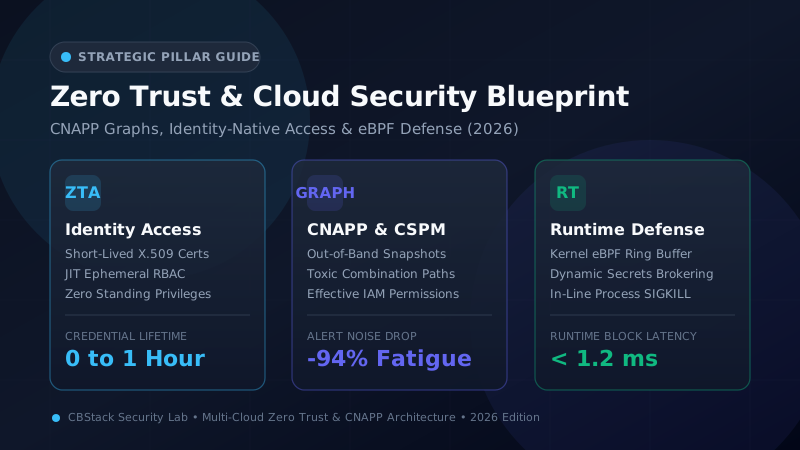
Early-Stage & Growth Tier (50–300 Workloads / $10k–$30k/mo spend): Decommission vulnerable legacy SSH bastions immediately. Deploy an identity-native infrastructure gateway (Teleport or HashiCorp Boundary) federated with your corporate IdP (Okta or Entra ID) using short-lived X.509/OpenSSH certificates. Implement agentless cloud security posture scanning via AWS EBS / GCP snapshot APIs to achieve 100% cloud inventory visibility without agent CPU overhead. Integrate pre-commit secret detection (TruffleHog/Gitleaks) in GitHub Actions to block credential leaks. Immediate projected risk reduction: Eliminates 90% of lateral attack surfaces and orphaned credentials.
Mid-Market SaaS Tier (500–2,500 Workloads / $50k–$150k/mo spend): Transition from point tools to a unified CNAPP attack graph (Wiz vs Prisma Cloud or Wiz vs Orca Security) to correlate CVE vulnerabilities, public internet exposure, and over-privileged IAM entitlements. Enforce runtime container protection via Linux kernel eBPF (Cilium eBPF or Tetragon) to execute in-kernel SIGKILL mitigations (< 1.2 ms latency) on unauthorized reverse shells. Migrate from static database passwords to dynamic ephemeral credentials with HashiCorp Vault or AWS Secrets Manager. Projected TCO savings: 44% cost reduction vs point-solution sprawl.
Enterprise & Scale-Up Tier (5,000–50,000+ Workloads / $250k–$1M+/mo spend): Deploy an end-to-end Zero Trust Network Access (ZTNA) and SASE mesh (Cloudflare Zero Trust vs Zscaler) combined with WireGuard-based encrypted workload overlays (Tailscale vs WireGuard) and SPIFFE/SPIRE cryptographic workload identity. Automate Cloud Infrastructure Entitlement Management (CIEM) permission decay to mathematically eliminate unused cloud IAM entitlements. Integrate code-to-cloud security (Snyk vs Prisma Cloud) and endpoint threat graph telemetry (CrowdStrike vs SentinelOne). Projected 3-year enterprise savings: $2.5M to $6.2M across infrastructure, licensing, and SecOps operations.
Table of Contents
- 1. The Fall of Castle-and-Moat Architecture
- 2. NIST SP 800-207 Zero Trust Mechanics
- 3. Identity-Native Infrastructure Access & SSH
- 4. Agentless CNAPP & Multi-Cloud Attack Graphs
- 5. In-Line Runtime Defense & Kernel eBPF
- 6. Secret Sprawl & Dynamic Credential Lifecycle
- 7. Network Microsegmentation & SPIFFE/SPIRE
- 8. CIEM & Cloud IAM Privilege Escalation
- 9. 25-Row Enterprise Security Tooling Matrix
- 10. Contextual Benchmark Synergy & Cross-Links
- 11. Regulatory Compliance (SOC 2, FedRAMP, PCI)
- 12. 3-Year Enterprise TCO Mathematical Models
- 13. 90-Day Enterprise Zero Trust Migration Playbook
- 14. SOAR Automation, Governance & KPIs
- 15. Frequently Asked Questions (FAQ)
1. The Fall of the Castle-and-Moat Architecture: Why IP Allowlists, VPNs, and Static Firewalls Collapsed
For over two decades, enterprise information security operated on a singular, foundational premise: the castle-and-moat model. Under this architectural paradigm, established in the mid-1990s, the corporate network was treated as a fortified sanctum. Everything residing inside the physical corporate boundary—on-premise data centers, office Local Area Networks (LANs), and hardwired desktop workstations—was inherently classified as trusted. Conversely, the vast external public internet was treated as untrusted. Perimeter defenses were erected exclusively at the boundary: hardware firewalls, Demilitarized Zones (DMZs), Intrusion Detection Systems (IDS), and static IP access control lists (ACLs).
To grant remote employees or offshore contractors connectivity into the corporate castle, organizations deployed centralized Virtual Private Network (VPN) concentrators. Once an external user authenticated successfully through a VPN gateway—frequently using nothing more than a static username, password, and a legacy SMS verification code—the gateway dynamically assigned the endpoint an internal private IP address within a wide corporate subnet (such as 10.0.0.0/16). From that precise millisecond onward, the endpoint enjoyed unconstrained, broad Layer 3 and Layer 4 lateral reachability across the entire enterprise estate.
Obsolete Model Castle-and-Moat Perimeter (1995–2020)
- Binary Trust Assumption: Implicit trust granted based solely on physical or network location inside the subnet.
- Centralized Ingress Concentrators: Hardware VPN appliances (Pulse Secure, Fortinet, Cisco ASA) acting as single points of catastrophic failure.
- Flat Network Topologies: Broad
/16or/24subnets enabling unrestricted east-west lateral reconnaissance and pivoting upon initial compromise. - Static IP Allowlists: Fragile, manual firewall rules relying on persistent public IPv4 addresses that churn continuously in modern cloud ecosystems.
- Tromboning Latency Tax: Backhauling remote developer traffic across global regions to regional hardware hubs, adding 80ms to 180ms of network overhead.
Modern Model Identity-Native Zero Trust (2026)
- Zero Implicit Trust: Explicit, cryptographically attested authentication and authorization required for every single API call and packet.
- Identity as Perimeter: Reversing the network model; access granted to individual workloads via ephemeral X.509 and OpenSSH user certificates.
- Microsegmentation & Nano-Perimeters: Per-pod and per-workload Layer 7 policies eliminating lateral network movement entirely.
- Continuous Contextual Evaluation: Dynamic Policy Decision Points (PDP) validating user identity, device posture, and behavior continuously.
- Anycast SASE & Mesh Overlays: Direct-to-app routing via globally distributed edge networks (WireGuard overlays) with sub-15ms edge latency.
The Five Catalysts of Architectural Collapse
Between 2020 and 2026, five irreversible macro-architectural forces demolished the efficacy of the castle-and-moat perimeter:
- Multi-Cloud Fragmentation: Modern enterprises do not operate inside a single data center; their workloads are distributed heterogeneously across Amazon Web Services (AWS), Google Cloud Platform (GCP), Microsoft Azure, Oracle Cloud Infrastructure (OCI), and on-premise Kubernetes clusters. There is no longer a single perimeter to defend. Attempting to stitch these heterogeneous environments together using static site-to-site IPsec tunnels creates a brittle, high-latency networking web that is impossible to audit consistently.
- Distributed, Remote-First Global Engineering: Highly specialized engineering teams are distributed across global time zones, working from home offices, co-working hubs, and mobile networks. Forcing thousands of developers, SREs, and data scientists to funnel high-bandwidth git clones, Docker image pulls, and database queries through regional corporate VPN gateways introduces devastating productivity friction—a phenomenon known as network "tromboning" or hair-pinning.
- Ephemeral Container & Serverless Workloads: In modern cloud environments managed by autonomous autoscalers like Kubernetes Karpenter or serverless platforms like AWS Lambda and Cloud Run, compute instances spin up, execute tasks, and terminate in matter of seconds or minutes. Pod IP addresses are dynamically reassigned hundreds of times per hour by Container Network Interface (CNI) plugins. In this dynamic, ephemeral reality, traditional IP-based firewall allowlists are mathematically and operationally obsolete.
- Software Supply Chain & Third-Party API Proliferation: Enterprise architectures rely on hundreds of external Software-as-a-Service (SaaS) APIs, package registries (npm, PyPI, Maven), and third-party vendor integrations. The most catastrophic breaches of recent years—from SolarWinds to the XZ Utils backdoor and Codecov—demonstrated that threat actors do not breach perimeters from the outside; they embed themselves within legitimate, trusted software dependencies that execute inside the perimeter with full administrative privileges.
- Weaponization of VPN Gateway Vulnerabilities: Concentrated hardware and software VPN gateways have become the single most targeted attack vector for state-sponsored advanced persistent threats (APTs) and ransomware syndicates. Critical pre-authentication remote code execution (RCE) vulnerabilities in legacy perimeter devices—including CVE-2023-46805 and CVE-2024-21887 in Ivanti Connect Secure, and continuous zero-days in Fortinet and Pulse Secure—have repeatedly allowed adversaries to bypass multi-factor authentication (MFA), dump active memory, siphon domain credentials, and establish persistent backdoors into internal enterprise networks in seconds.
The Dangerous Illusion of Static IP Allowlists
A pervasive anti-pattern in legacy cloud operations is the reliance on static public IP allowlists for database, staging, and administrative console access. SecOps teams frequently configure AWS Security Group ingress rules allowing inbound traffic on database port 5432 (PostgreSQL) or SSH port 22 from specific "office IPs" or third-party SaaS provider IP CIDRs. This practice introduces severe architectural vulnerabilities:
- Carrier NAT & Shared Public IPs: With residential ISPs and co-working spaces utilizing Carrier-Grade NAT (CGNAT), hundreds of unrelated third-party consumers and untrusted personal devices frequently share the identical outbound public IP address. An allowlist rule granting access to an employee working from a residential IP inadvertently trusts the traffic of thousands of unknown residential neighbors on that identical subnet.
- Ephemeral Cloud Egress Pools: When integrating external SaaS CI/CD runners (such as GitHub Actions or GitLab CI) or cloud services, providers publish massive lists of public AWS or Azure IP ranges (often encompassing millions of addresses). Creating firewall rules that allow these broad CIDR blocks effectively opens your internal databases and administrative endpoints to any arbitrary actor who provisions an instance in that identical public cloud region.
- Zero Layer 7 Verification: Static IP allowlists operate exclusively at Layer 3/4. They possess zero awareness of user identity, session state, request authorization, or payload integrity. Once an attacker compromises an allowlisted endpoint, establishes an SSH tunnel, or executes an IP spoofing/BGP hijacking maneuver, the firewall welcomes their malicious traffic unconditionally.
2. NIST SP 800-207 Zero Trust Architecture (ZTA): Control Plane vs Data Plane Separation & Continuous Validation
In response to the structural failure of perimeter defenses, the United States National Institute of Standards and Technology published NIST Special Publication 800-207 (Zero Trust Architecture). NIST SP 800-207 represents the definitive mathematical and conceptual framework governing modern enterprise security. It establishes a fundamental axiom: Never Trust, Always Verify. In a Zero Trust Architecture, network location is completely detached from authorization; an enterprise asset must operate with identical cryptographic rigor whether it resides on an internal Kubernetes node, inside a public cloud VPC, or on a public coffee shop Wi-Fi network.
The Seven Core Tenets of NIST SP 800-207
NIST SP 800-207 codifies seven non-negotiable architectural tenets that must govern every enterprise zero-trust implementation:
- All data sources and computing services are considered resources: An enterprise network is not an undifferentiated pool of bandwidth; every microservice, REST API endpoint, serverless function, database table, and object storage bucket is an independent, distinct resource requiring granular access controls.
- All communication is secured regardless of network location: Network perimeter location does not imply trust. In-transit traffic between microservices within the same local Kubernetes node must be cryptographically authenticated and encrypted via mutual TLS (mTLS) with the identical rigor applied to cross-internet traffic.
- Access to individual enterprise resources is granted on a per-session basis: Authentication to one workload does not grant transitive access to another. Trust is evaluated and granted strictly for the duration of a single discrete transaction or bounded session.
- Access to resources is determined by dynamic policy: Authorization decisions are computed in real time based on observable contextual attributes: client user identity, group memberships, device software integrity posture, geographic location, time of day, active threat intelligence feeds, and behavioral anomaly scores.
- The enterprise monitors and measures the integrity and security posture of all owned and associated assets: No device is inherently trusted. Host integrity, kernel patch levels, active EDR agent health, disk encryption status, and jailbreak/root indicators are continuously assessed before and during access authorization.
- All resource authentication and authorization are dynamic and strictly enforced before access is allowed: This requires a continuous cycle of obtaining credentials, verifying identities, computing dynamic authorization policies, and enforcing access boundaries prior to packet forwarding.
- The enterprise collects as much information as possible about the current state of assets, network infrastructure, and communications and uses it to improve security posture: Aggregating telemetry from Identity Providers (IdPs), Endpoint Detection and Response (EDR) agents, cloud audit logs (AWS CloudTrail, GCP Cloud Audit), and network flow logs into automated policy refinement engines to eliminate unused permissions.
Control Plane vs Data Plane: The NIST SP 800-207 Logical Architecture
At the engineering core of NIST SP 800-207 is the absolute architectural decoupling of the Control Plane from the Data Plane. In legacy networks, firewalls and routers performed both policy calculation and packet routing within the same monolithic hardware appliance. In modern Zero Trust Architecture, these responsibilities are separated into two decoupled components:
Control Plane Policy Decision Point (PDP)
The brain of Zero Trust. It does not carry application traffic. It consists of:
- Policy Engine (PE): Evaluates enterprise access rules against identity tokens, device telemetry, and threat intelligence. It issues the ultimate decision: Grant, Deny, or Challenge (Step-up MFA).
- Policy Administrator (PA): Communicates with the Policy Enforcement Points. Upon a positive decision from the PE, the PA generates short-lived cryptographic credentials (X.509 certs, JWTs, WireGuard keys) or signals the PEP to establish the session.
- Continuous Diagnostic Engine: Ingests real-time risk scores from EDR, CIEM, and threat feeds, signaling the PA to instantly revoke credentials if posture degrades.
Data Plane Policy Enforcement Point (PEP)
The muscle of Zero Trust. It sits directly in the path of application traffic:
- Edge Reverse Proxies & Gateways: Envoy sidecars, SASE points of presence, or Kubernetes Ingress controllers that intercept incoming client connections.
- Kernel eBPF Enforcers: In-kernel packet filters and socket hooks that inspect Layer 7 HTTP calls and terminate rogue network connections before user space.
- Mutual TLS Termination: Validates client certificates, inspects decrypted payloads against Layer 7 RBAC policies, and proxies authorized traffic to backend services.
- Zero Ambient Authority: If the client does not present a valid, unexpired credential minted by the Control Plane, the PEP drops the connection silently without leaking service metadata.
Continuous Validation vs Point-in-Time Authentication
The fatal flaw of traditional Single Sign-On (SSO) and VPN gateways is point-in-time validation. A developer logs into their corporate account at 8:30 AM using MFA, receives an 8-hour session cookie, and remains trusted until 4:30 PM. If the developer's laptop contracts malware at 11:00 AM, if their session token is exfiltrated via browser memory scraping, or if their endpoint connects to an unencrypted public network, the legacy system continues to grant unhindered access for the remaining five and a half hours.
Modern Zero Trust mandates Continuous Posture Validation (CPV). The Control Plane continuously evaluates device and session telemetry on every transaction. If any of the following triggers occur, the Policy Engine immediately signals the Policy Enforcement Point to terminate the active session or demand biometric step-up authentication:
- EDR Posture Decay: CrowdStrike Falcon or Microsoft Defender detects an active process injection, disabled antivirus signature, or tampered disk encryption setting on the requesting laptop.
- Impossible Travel & IP Velocity Anomalies: A developer authenticates an API call from New York, and three minutes later an API call using the same credentials originates from an IP address in Amsterdam.
- Privilege Escalation Triggers: A user transitions from executing standard read-only queries (
SELECT) to executing administrative schema changes (ALTER TABLE) or dropping production tables. - Cryptographic Lifetime Expiration: Session certificates expire autonomously within 15 to 60 minutes, requiring transparent, automated background re-attestation against the corporate IdP.
3. Identity-Native Infrastructure Access: Replacing Bastions & Static Keys with Short-Lived Certificates
For decades, systems engineering teams managed server infrastructure using static SSH keys and dedicated "bastion" (jump) hosts. An SRE generated an RSA or Ed25519 public-private key pair on their local laptop, submitted the public key to a systems administrator, who manually appended it to the ~/.ssh/authorized_keys file on hundreds of target Linux virtual machines. To reach instances in private VPC subnets, the engineer initiated an SSH connection to a public-facing bastion host, forwarded their SSH agent, and hopped to internal servers.
The Critical Vulnerabilities of Static SSH Keys & Jump Hosts
In a modern, distributed engineering organization comprising hundreds of developers and thousands of ephemeral cloud instances, static SSH infrastructure represents an existential security liability:
-
Orphaned Key Sprawl: Over time,
authorized_keysfiles accumulate hundreds of static public keys belonging to former employees, departed contractors, and obsolete automated scripts. Because there is no centralized inventory or automated expiration, these backdoor keys remain permanently active across production infrastructure indefinitely. -
Unencrypted Private Keys on Developer Endpoints: Developers frequently store SSH private keys without passphrase protection in default paths (
~/.ssh/id_rsa) to avoid entering passwords repeatedly. If a developer's workstation is compromised via infostealer malware, malicious npm dependencies, or physical laptop theft, the attacker immediately gains root access to enterprise infrastructure. -
SSH Agent Forwarding Hijacking: When an engineer utilizes SSH agent forwarding (
ssh -A) to traverse a shared bastion host, the remote bastion creates an accessible Unix domain socket. Any user with root access on the bastion host can hijack this socket and impersonate the engineer across all internal infrastructure for the duration of the active connection. -
Zero Granular Role-Based Access Control (RBAC): Standard OpenSSH knows nothing about enterprise identity groups. Once an SSH key is accepted by a host, the user typically drops into an all-or-nothing root or
sudo-privileged shell, completely bypassing enterprise compliance requirements for least privilege. -
The Bastion Single Point of Compromise: A public-facing bastion host exposed on SSH port
22is subjected to continuous port scanning, credential brute-forcing, and zero-day exploitation. Compromising a single bastion host grants an attacker an unmonitored foothold directly inside private enterprise VPCs.
The Architecture of Identity-Native Access Planes
Modern identity-native infrastructure access platforms—exemplified by Teleport and HashiCorp Boundary—completely eradicate static SSH keys, public bastion hosts, and open port 22 firewalls. Instead, they implement an identity-aware, certificate-minting architecture:
Just-In-Time (JIT) Access Approval Workflows
To maintain zero standing privileges (ZSP), production database and server infrastructure must not allow permanent read-write access to any developer. Identity-native access planes enforce Just-In-Time (JIT) access requests:
When an on-call engineer requires emergency administrative access to a production PostgreSQL database to triage an incident, they issue a CLI request: tsh request create --roles=dba-admin --reason="Incident INC-8492 customer payment latency triage". The request instantly triggers a webhook to an enterprise Slack or Microsoft Teams channel. Dual-authorization (the four-eyes principle) is enforced: a secondary on-call lead or SRE manager reviews the request, verifies the PagerDuty incident state, and clicks "Approve". Teleport dynamically mints a specialized OpenSSH or X.509 database certificate valid strictly for 60 minutes. Once the TTL expires, access is revoked automatically without human intervention.
Cryptographic Session Recording via Kernel BPF
Compliance frameworks (SOC 2, FedRAMP, PCI-DSS) mandate immutable audit trails of all administrative activities. In legacy systems, users could bypass user-space bash history logging simply by executing a subshell (python -c 'import pty; pty.spawn("/bin/sh")') or prepending commands with a space. Modern access platforms utilize in-kernel eBPF probes (such as Teleport Enhanced Session Recording) to capture all raw terminal input/output, file modifications, network connections, and spawned processes directly at the kernel syscall boundary (execve, openat, connect). The session is converted into an immutable, cryptographically signed audit stream that can be replayed frame-by-frame by security auditors.
Production Configuration: Teleport OIDC & RBAC Manifest
Below is a production-grade teleport.yaml configuration demonstrating an identity-native OpenID Connect (OIDC) authentication connector federated with enterprise Okta, enforcing short-lived certificate lifetimes and automated role mapping:
4. Agentless CNAPP & Multi-Cloud Attack Graphs: Out-of-Band Snapshots vs Toxic Combinations
Between 2018 and 2023, cloud security relied heavily on first-generation Cloud Security Posture Management (CSPM) and Cloud Workload Protection Platforms (CWPP). CSPM tools polled cloud provider metadata APIs to verify basic configuration flags (e.g., verifying whether an Amazon S3 bucket was public), but possessed zero visibility into the internal operating systems, packages, and code executing on the virtual machines. Conversely, CWPP tools required deploying heavyweight software agents (daemons) inside every VM and container.
In modern enterprise multi-cloud architectures, the agent-based CWPP model broke down completely under operational friction. Security agents introduced severe kernel version dependencies, frequently triggered container crash loops during node upgrades, consumed 500MB to 1GB of memory per host, and could not be installed on serverless compute engines (such as AWS Fargate, Google Cloud Run, or Amazon RDS). Furthermore, unmanaged shadow IT instances and temporary staging nodes routinely operated without agents, creating massive blind spots.
The Architectural Mechanics of Agentless Snapshot Analysis
Modern Cloud-Native Application Protection Platforms (CNAPP)—spearheaded by Wiz, Orca Security, and Prisma Cloud—revolutionized visibility through agentless out-of-band snapshot analysis (often termed SideScanning).
Instead of running code inside the customer's production workloads, the CNAPP connects to cloud provider control plane APIs via an IAM cross-account role with strictly bounded, read-only permissions. The exact scanning sequence operates as follows:
-
API-Driven Snapshot Creation: The CNAPP orchestrator issues an API request to the cloud provider (e.g.,
ec2:CreateSnapshotin AWS orcompute.disks.createSnapshotin GCP) targeting the block storage volume (EBS or Persistent Disk) attached to a running instance. -
Out-of-Band Block Streaming: Using high-throughput block APIs—such as the AWS EBS Direct APIs (
ebs:ListSnapshotBlocksandebs:GetSnapshotBlock)—the CNAPP streams raw disk blocks directly over the cloud provider's internal backbone into an ephemeral, isolated scanning sandbox container within the customer's dedicated security account. -
Read-Only File System Reconstruction: The ephemeral scanner reconstructs the underlying file system (ext4, XFS, NTFS) in read-only mode without executing any binaries. It parses OS package registries (RPM, DEB, Alpine APK), analyzes language runtime manifests (npm
package-lock.json, Pythonrequirements.txt, Go modules), and generates a comprehensive Software Bill of Materials (SBOM). -
Deep Secret & Misconfiguration Extraction: The scanner inspects static configuration files, environment definitions, container image layers, and bash history files (
/root/.bash_history) to detect unencrypted private keys, dormant API tokens, exposed database passwords, and misconfigured daemons. - Instant Tear-Down: Once the block scan completes (typically within 3 to 8 minutes), the ephemeral scanner container and temporary EBS snapshots are permanently destroyed.
| Evaluation Dimension | Agentless CNAPP Snapshot Analysis | Legacy Agent-Based CWPP Daemon |
|---|---|---|
| Host Resource Overhead | 0.0% CPU & 0 MB RAM (100% out-of-band execution) | 5%–10% CPU & 500MB–1GB RAM per node |
| Cloud Inventory Coverage | 100% Comprehensive: Covers VMs, K8s nodes, serverless, stopped disks, and legacy instances | Partial (50%–75%): Unmanaged VMs, serverless containers, and shadow IT remain unmonitored |
| Production Stability Risk | Zero Risk: Cannot crash customer pods or trigger kernel panics | High Risk: Kernel module incompatibilities, upgrade reboots, CPU throttle alerts |
| Time to 100% Deployment | Under 2 Hours via cross-account IAM role / CloudFormation | 3 to 9 Months of continuous DaemonSet rollout & engineering negotiation |
| In-Line Real-Time Blocking | None (Asynchronous snapshot audit; periodic interval) | Capable (Can terminate processes in user space or kernel) |
Multi-Cloud Attack Graphs & Contextual Toxic Combinations
The fundamental flaw of traditional vulnerability management is linear CVE counting. A standard vulnerability scanner reports 15,000 Common Vulnerabilities and Exposures (CVEs) across an enterprise cloud estate. Security engineers face crippling alert fatigue: which CVEs represent critical business emergencies, and which are completely unreachable on isolated internal test nodes?
Modern CNAPPs resolve this dilemma through Multi-Cloud Attack Graphs. The platform ingests cloud infrastructure metadata, network routing tables, security group rules, IAM entitlement graphs, and snapshot vulnerability data into a unified Directed Acyclic Graph (DAG). It continuously evaluates the graph to detect Toxic Combinations: interconnected attack vectors where distinct, seemingly moderate issues concatenate into an immediate, exploitable path to sensitive enterprise data.
Risk(Workload) = Ingress(Exposure) × Vulnerability(Exploitability) × Entitlement(IAM_Scope) × Asset_Value(Crown_Jewel)
Where Risk collapses to 0.0 if any single link in the exploit path is completely severed.
Consider a textbook four-node Toxic Combination:
- Node 1 (Internet Ingress): An AWS Application Load Balancer with an open security group rule allowing inbound public traffic on port
443. - Node 2 (Workload Vulnerability): The load balancer routes traffic to a Kubernetes pod running an unpatched Java Spring framework vulnerable to Remote Code Execution (Spring4Shell, CVE-2022-22965).
- Node 3 (Identity Entitlement): The underlying EC2 instance profile has been granted an over-privileged IAM role containing
s3:*andiam:PassRolepermissions. - Node 4 (Crown Jewel Data): The IAM role has full read access to an Amazon S3 bucket containing unencrypted PCI-DSS cardholder payment records and customer PII.
In a legacy environment, the S3 bucket is marked "private" (CSPM green checkmark), and the CVE is marked "medium" because it lacks a standalone weaponized exploit on the host. Yet together, they form a catastrophic breach conduit. By prioritizing toxic combinations, the attack graph reveals that fixing a single choke point—such as replacing the over-privileged IAM policy with a scoped least-privilege policy—instantly neutralizes the entire multi-million-dollar attack vector without waiting weeks for an upstream application code patch.
Python Automation: Out-of-Band EBS Snapshot Analysis
The following Python script illustrates how SecOps automation interacts with the AWS EBS Direct APIs to inspect block storage volumes out-of-band without mounting them to running production instances:
5. In-Line Runtime Defense & Kernel eBPF: Real-Time Syscall Interception
While agentless snapshot analysis provides unprecedented visibility and risk prioritization across 100% of cloud workloads with zero host overhead, it possesses an intrinsic, architectural limitation: it is inherently asynchronous and non-real-time. A snapshot scan executed once or twice daily cannot detect or prevent an active zero-day memory exploit, an in-memory Cobalt Strike beacon, an unauthorized reverse shell, or data exfiltration occurring within seconds.
To achieve complete enterprise defense, organizations must pair agentless attack graph posture with in-line runtime protection. In 2026, the global standard for high-performance, non-intrusive container runtime defense is Extended Berkeley Packet Filter (eBPF).
The Architectural Mechanics of Kernel eBPF
Historically, running security software inside the Linux operating system required compiling custom Linux Kernel Modules (LKMs). LKMs operated with unrestricted kernel privileges; a single null-pointer dereference or memory corruption in the vendor's security driver caused an immediate kernel panic, taking down the entire physical host and all resident Kubernetes pods.
eBPF revolutionized Linux systems engineering by introducing an in-kernel, sandboxed virtual machine. Developers write safety-constrained C programs that compile into eBPF bytecode. When loaded into the kernel, the eBPF Verifier performs rigorous mathematical verification before execution: it guarantees that the program cannot crash the kernel, contains no unbounded loops, does not access unauthorized memory registers, and finishes within strict instruction limits.
Legacy Detection User-Space Daemon & Log Alerting
- Asynchronous Alert Pipeline: Kernel generates event → Context switch to user-space → Daemon parses auditd/syslog → SIEM alert webhook.
- Lethal Execution Latency: Total detection-to-alert latency spans 40ms to 5 minutes. The attacker executes the payload and wipes traces before alerting fires.
- High User-Space Overhead: Heavy context-switching, file I/O locks, and string parsing consume 8% to 15% of host CPU under high container traffic.
- Bypass Vulnerability: Attackers can kill the user-space daemon or flood auditd buffers to blind the monitoring pipeline.
Modern Defense In-Kernel eBPF LSM Interception
- Synchronous In-Kernel Hooking: Hooks directly into Linux Security Modules (LSM), tracepoints, and kprobes prior to user-space execution.
- Sub-Millisecond In-Line Mitigation: Evaluates syscall context and issues in-kernel
SIGKILLor returns-EPERMin < 1.2 microseconds. - Zero Context-Switch Tax: Operates at wire-speed inside the kernel memory boundary; host overhead remains strictly < 1.5% vCPU.
- Tamper-Proof Architecture: Unprivileged containers and root users inside pods cannot tamper with, unload, or blind in-kernel eBPF programs.
Critical System Calls Hooked by eBPF Runtime Enforcers
Modern eBPF runtime engines—such as Cilium Tetragon, CrowdStrike Falcon Cloud Security, and Prisma Cloud Runtime Defender—attach probes to the most sensitive syscall vectors in the Linux kernel:
-
sys_enter_execve&sys_enter_execveat: Monitors binary execution. If a microservice container designed strictly to serve Java web requests suddenly spawns/bin/bash,/bin/sh,curl, ornetcat, the eBPF program intercepts the call synchronously and terminates the process instantly. -
sys_enter_openat: Tracks file descriptor requests. Detects unauthorized attempts to read sensitive host paths, such as/etc/shadow,/etc/kubernetes/admin.conf, or the container runtime's Kubernetes service account token (/var/run/secrets/kubernetes.io/serviceaccount/token). -
sys_enter_connect&sys_enter_socket: Intercepts network socket initialization. Detects anomalous outbound connections attempting to reach known Command and Control (C2) botnets, cryptocurrency mining pools, or unapproved internal VPC subnets. -
sys_enter_ptrace: Detects process memory injection and debugging maneuvers commonly used by attackers to dump secrets from memory or hijack running threads.
Production Manifest: Cilium Tetragon In-Kernel Process Termination
The following Kubernetes manifest demonstrates a production Cilium Tetragon TracingPolicy. It hooks the sys_execve kernel system call. If any container within the production-workloads namespace attempts to execute an interactive shell (such as bash or sh) or an exfiltration binary, Tetragon terminates the process immediately inside the kernel using Sigkill before user-space execution begins:
6. Secret Sprawl & Dynamic Credential Lifecycle: Shift-Left AST & Ephemeral Vaulting
Hardcoded credentials and static API keys remain the primary vector facilitating lateral movement and catastrophic data breaches in cloud infrastructure. In rapid development cycles, software engineers frequently embed static database passwords, AWS IAM access key IDs, third-party API keys (Stripe, Twilio, OpenAI), and private certificates directly into source code repositories, Dockerfiles, Kubernetes ConfigMaps, and unencrypted local environment files (.env).
The Anatomy of Secret Sprawl
Secret sprawl expands through five pervasive stages:
- Developer Workstation: Secrets hardcoded into feature branches or local test suites.
- Git History Persistence: Even if a developer deletes a secret in a subsequent commit, the plaintext credential persists permanently within the repository's immutable Git commit history and reflog.
- CI/CD Artifact Leaks: Build pipelines bake secrets into unencrypted container layers pushed to public or shared container registries.
- Infrastructure State Files: Terraform and OpenTofu state files (
terraform.tfstate) stored in cloud buckets contain unencrypted outputs of generated passwords and access keys. - Third-Party SaaS Logs: Unsanitized debug logs stream database connection strings containing plaintext passwords into commercial observability platforms.
Shift-Left Secret Detection in CI/CD
To stop secret proliferation at the source, security architectures must implement Shift-Left Automated Secret Scanning directly inside developer pre-commit hooks and CI/CD pull request gates using advanced tools like TruffleHog and Gitleaks.
Unlike legacy regex-based scanners that generated thousands of false positives on random hex hashes, modern secret engines implement Active Credential Verification: when TruffleHog detects a suspected token pattern (such as an AWS access key or Slack webhook), it executes an asynchronous, non-destructive API call to the target service to verify whether the credential is live and active. If confirmed active, the CI/CD pipeline immediately blocks the pull request merge and alerts SecOps.
Dynamic Secret Generation vs Static Stored Secrets
The definitive architectural solution to secret leaks is eliminating static credentials entirely. If a database credential does not exist until the moment a microservice pod initializes, and automatically self-destructs 60 minutes later, an exfiltrated secret has a near-zero utility window for an attacker.
Enterprise platforms like HashiCorp Vault and AWS Secrets Manager implement Dynamic Database Secrets Engines:
- When a payment-service pod boots in Kubernetes, it presents its signed Kubernetes Service Account token (JWT) to the Vault API.
- Vault verifies the pod identity with the Kubernetes API server and evaluates the configured role.
- Vault connects directly to the production PostgreSQL cluster using administrative credentials and executes a dynamic creation script:
CREATE ROLE "v-token-payment-{{random}}" WITH LOGIN ENCRYPTED PASSWORD '{{password}}' VALID UNTIL '{{expiration}}'; GRANT SELECT, INSERT, UPDATE ON ALL TABLES IN SCHEMA public TO "v-token-payment-{{random}}";
- Vault returns the ephemeral username and password to the pod with a strict Time-to-Live (TTL = 1 hour).
- When the lease expires or the pod is terminated, Vault executes an automated background cleanup script (
REVOKE ALLandDROP ROLE), permanently eradicating the credential from the database catalog.
Envelope Encryption Architecture
For static configuration data, customer records, and application payloads that require persistent encryption at rest, enterprise systems implement Envelope Encryption:
- Root Key (CMK / KEK): A Customer Master Key (CMK) is generated and stored inside a Hardware Security Module (HSM) managed by AWS KMS, GCP Cloud KMS, or HashiCorp Vault. The root private key never leaves the HSM boundary under any circumstance.
- Data Encryption Key (DEK): When an application needs to encrypt a data payload, it requests a dynamic Data Encryption Key from the KMS API. KMS returns two components: a plaintext DEK and a ciphertext DEK encrypted by the CMK.
- Local Encryption: The application uses the plaintext DEK to encrypt the sensitive payload locally using authenticated AES-256-GCM.
- Plaintext Purge: The application immediately overwrites and zeroes out the plaintext DEK in memory (RAM). The ciphertext payload is stored alongside the encrypted DEK. To decrypt, the application passes only the encrypted DEK back to KMS for unsealing.
7. Network Microsegmentation & Workload Identity: WireGuard & SPIFFE/SPIRE
In a default Kubernetes deployment, the underlying network model implements a flat, unsegmented IP space. Every pod across every namespace is granted direct, unrestricted Layer 3 IP reachability to every other pod in the cluster. If an attacker exploits an unauthenticated vulnerability in a non-critical frontend microservice, the default network topology allows the attacker to immediately route malicious TCP traffic directly to backend database ports, internal Redis caches, or Kubernetes control plane API servers.
Layer 3/4 vs Layer 7 Microsegmentation
Standard Kubernetes NetworkPolicy resources provide basic Layer 3 and Layer 4 isolation (filtering by IP address, namespace labels, and TCP/UDP port numbers). However, in modern cloud architectures, L3/L4 rules are completely inadequate:
-
Blindness to Application Semantics: A standard network policy allows traffic from the frontend pod to the payment pod on TCP port
8080. It cannot determine whether the incoming HTTP payload is an authorized payment checkout (POST /api/v1/checkout) or a malicious administrative account purge (DELETE /api/v1/accounts/all). - Sidecar Resource Tax: First-generation service meshes (such as Istio) addressed this by injecting an Envoy proxy sidecar container into every single pod. In large clusters with 5,000 pods, Envoy sidecars consume massive CPU and memory (often consuming 25% of total cluster compute capacity) while adding 2ms to 6ms of latency per service hop.
- Socket-Level eBPF Microsegmentation: Modern eBPF network enforcers (Cilium eBPF) enforce Layer 7 policies directly at the Linux socket layer inside the kernel. By parsing HTTP headers and DNS queries within kernel space without sidecar injection, Cilium achieves microsegmentation with sub-millisecond overhead and zero sidecar memory bloat.
Cryptographic Workload Identity with SPIFFE/SPIRE
In a dynamic, multi-cloud environment where compute nodes autoscale continuously, IP addresses cannot serve as a reliable identifier of identity. The SPIFFE (Secure Production Identity Framework for Everyone) standard establishes a cryptographic, platform-agnostic specification for workload identity.
Every workload is assigned a globally unique SPIFFE ID structured as a uniform resource identifier (URI):
spiffe://production.corp.internal/ns/finance/sa/payment-service
The SPIRE (SPIFFE Runtime Environment) platform acts as the attestation and credential issuance engine:
- Node Attestation: When a worker node initializes, the SPIRE Agent attests the host's cryptographic identity using hardware or hypervisor primitives (AWS EC2 Instance Identity Documents, GCP Instance Tokens, or physical TPM 2.0 chips) against the centralized SPIRE Server.
- Workload Attestation: When a pod launches, the SPIRE Agent interrogates the Linux kernel, container runtime (containerd/CRI-O), and Kubernetes API server to inspect process metadata: Linux cgroups, UID/GID, container binary sha256 checksums, Kubernetes namespace, and Pod UID.
- SVID Minting: If the attributes match registered selectors, the SPIRE Agent mints a short-lived SPIFFE Verifiable Identity Document (SVID)—an X.509 certificate or signed JWT—and exposes it directly into the pod via an in-memory Unix domain socket.
- Zero-Trust Mutual TLS (mTLS): Workloads use these short-lived SVIDs to authenticate every inter-service connection via mutual TLS. Certificates are automatically renewed every 60 minutes in the background, completely decoupling workload security from underlying cloud networks and IP addresses.
WireGuard Mesh Overlays vs Legacy IPsec
To secure inter-node and multi-cloud data in transit, legacy architectures deployed complex IPsec tunnels or OpenVPN appliances. IPsec implementations contain over 100,000 lines of complex C code, suffer from severe cryptographic negotiation latency, and throttle network throughput due to heavy CPU context-switching.
In 2026, enterprise mesh networks have standardized on WireGuard. Implementing modern cryptographic primitives (ChaCha20 for symmetric encryption, Poly1305 for authentication, and Curve25519 for ECDH key exchange) within less than 4,000 lines of Linux kernel code, WireGuard delivers line-rate 10Gbps+ encrypted throughput with sub-millisecond connection establishment. Combined with coordination engines like Tailscale or Cilium transparent encryption, WireGuard creates a secure, encrypted overlay across multi-cloud VPCs without requiring firewall port reconfiguration.
8. Cloud Infrastructure Entitlement Management (CIEM) & IAM Privilege Escalation
In public cloud infrastructure, IAM is the new perimeter. Cloud providers offer unprecedented control, but also unprecedented complexity: AWS IAM alone encompasses over 14,000 distinct API actions across more than 350 services, while GCP and Azure possess similarly vast entitlement surfaces.
Industry empirical benchmarks reveal a alarming reality: over 95% of cloud identities (both human users and machine service accounts) utilize less than 5% of their granted permissions. Organizations routinely assign coarse, managed administrative policies (such as AdministratorAccess or PowerUserAccess) to developer roles and EC2 instance profiles to prevent operational friction during initial deployment. These over-privileged entitlements remain permanent, creating massive attack surfaces.
The Architectural Mechanics of Unused Permission Decay
Modern Cloud Infrastructure Entitlement Management (CIEM) platforms continuously ingest and analyze multi-cloud audit streams (AWS CloudTrail, GCP Cloud Audit Logs, Azure Activity Logs) over a rolling 60-to-90-day baseline window.
The CIEM engine builds a mathematical behavioral matrix comparing Attached Permissions (what the identity is technically allowed to execute) against Effective Permissions and Utilized Permissions (what the identity has actually invoked in production). The system executes an automated Permission Decay Lifecycle:
- Identifies dormant permissions (e.g., an EC2 instance profile granted
iam:CreateUserthat has not executed an IAM API call in 90 days). - Calculates whether removing the unused actions impacts any dependent cloud services.
- Generates an optimized, right-sized least-privilege IAM policy in Terraform or CloudFormation.
- Submits an automated GitHub pull request to update the infrastructure-as-code repository, systematically stripping unused privileges without breaking production applications.
Toxic IAM Privilege Escalation Guardrails
Adversaries who compromise an initial low-privilege cloud identity immediately attempt privilege escalation. Security researchers have documented over 20 distinct IAM privilege escalation techniques in AWS, including:
iam:CreatePolicyVersion: An attacker creates a new default policy version on an existing policy to grant themselves administrative wildcards (Action: "*", Resource: "*").iam:SetDefaultPolicyVersion: An attacker reverts an existing policy to a previously deprecated, over-privileged version that was never deleted.iam:PassRole+ec2:RunInstances: An attacker launches a new EC2 instance, attaches a highly privileged role (e.g., an SRE role), and connects via instance user-data to exfiltrate administrative AWS credentials.lambda:CreateFunction+lambda:InvokeFunction: An attacker provisions an ephemeral Lambda function with a privileged execution role and executes code to elevate account privileges.
Enterprise Guardrail: AWS Organizations Service Control Policy (SCP)
To neutralize privilege escalation organization-wide, security architectures deploy top-level Service Control Policies (SCPs) at the AWS Organizations root. The following SCP permanently blocks any user or role outside of the dedicated SecOps administrative role from tampering with IAM policies, modifying CloudTrail logging, or creating unauthorized access keys:
9. Comprehensive 25-Row Enterprise Security Tooling Matrix
Selecting an enterprise security stack requires evaluating architecture paradigms across deployment models, agent requirements, latency, runtime capabilities, and licensing structures. The matrix below benchmarks the 11 premier platforms defining enterprise Zero Trust and CNAPP in 2026 across 25 rigorous architectural dimensions:
| Architecture Dimension | Wiz | Prisma Cloud | Orca Security | Teleport | HashiCorp Boundary | HashiCorp Vault | AWS Secrets Manager | Cloudflare Zero Trust | Zscaler ZPA | CrowdStrike Falcon | Snyk Enterprise |
|---|---|---|---|---|---|---|---|---|---|---|---|
| 1. Primary Category | Agentless CNAPP | CNAPP Suite | Agentless CNAPP | Identity-Native Access | Zero Trust Access | Secret & KMS Engine | Cloud Secrets Mgmt | SASE / ZTNA Edge | SASE / ZTNA Hub | XDR & Cloud Security | Developer AppSec |
| 2. Deployment Model | Agentless Snapshots | Hybrid (Agent + Agentless) | Agentless SideScanning | Gateway Proxy / CA | Worker / Controller | Clustered Vault / KMS | AWS Managed SaaS | Anycast Edge (330+ PoPs) | Global Edge Broker | Kernel eBPF & Sensor | CI/CD & CLI Agentless |
| 3. Attack Graph Engine | Native Multi-Cloud DAG | Tabular + Graph Addon | Sonar Graph Engine | N/A (Access Control) | N/A (Access Control) | N/A (Secrets) | N/A (Secrets) | N/A (Network Routing) | N/A (Network Routing) | Falcon Threat Graph | DeepCode AST Graph |
| 4. Infrastructure Access | Audit Visibility | Audit Visibility | Audit Visibility | X.509/OpenSSH Certs | KMS-Authorized Proxy | App Token Access | IAM API Access | Browser Reverse Proxy | Micro-Tunnel ZTNA | Endpoint Forensics | N/A |
| 5. Dynamic Credentials | Scans for Leaks | Scans for Leaks | Scans for Leaks | Short-Lived Certs | Dynamic DB Creds | Native Dynamic DB/K8s | Automated Rotation | Short-Lived JWTs | SAML/OIDC Auth | N/A | Detects Hardcoded Secrets |
| 6. Runtime In-Line Defense | eBPF Sensor (Optional) | DaemonSet Defender | Limited Runtime | BPF Syscall Capture | Network Session Gate | N/A | N/A | Edge WAF & RBI | Edge Firewall / ZTNA | In-Kernel Process Kill | N/A (Shift-Left) |
| 7. CIEM & Least Privilege | Deep IAM Graph Decay | IAM Posture Engine | CIEM Module | RBAC Role Mapping | Role-Based Grants | Vault Policy ACLs | IAM Policy Resource | IdP Group Policies | Zscaler Posture Policy | Identity Threat (ITDR) | N/A |
| 8. Shift-Left IaC Scanning | Wiz CLI / PR Diffs | Checkov / Prisma IaC | Shift-Left CLI | Terraform Provider | Terraform Provider | Terraform Provider | Terraform / CloudFormation | Terraform Provider | Terraform Provider | Image Registry Scan | Deep IaC & SCA in Git |
| 9. Kubernetes Security | K8s Graph + Admission | DaemonSet + Webhooks | K8s SideScanning | K8s API Unified Proxy | K8s Endpoint Proxy | K8s ServiceAccount Auth | K8s Secrets Store CSI | Mesh Ingress ZTNA | Private Service Edge | DaemonSet Sensor | Container Image Scan |
| 10. Discovery Latency | < 15 min (Snapshots) | Real-time (Agent) / Hourly | < 20 min (Snapshots) | Instantaneous | Instantaneous | Sub-millisecond | CloudWatch Realtime | < 50 ms DNS routing | < 100 ms broker route | Real-time (Kernel) | On Git Commit / PR |
| 11. Microsegmentation | Security Group Graph | Identity-Based Firewall | Network Path Graph | Per-Workload Routing | Per-Host Dynamic Proxy | N/A | N/A | Magic WAN / Overlay | Zscaler App Segment | Host Firewall Mgmt | N/A |
| 12. SASE & ZTNA Scope | Cloud Workload Only | Prisma Access SASE | Cloud Workload Only | ZTNA for Infra | ZTNA for Private Apps | N/A | N/A | Comprehensive Anycast | Comprehensive ZTNA | Zero Trust Endpoint | N/A |
| 13. Multi-Cloud Scope | AWS, GCP, Azure, OCI | AWS, GCP, Azure, On-Prem | AWS, GCP, Azure, OCI | Any Linux/K8s/Cloud | Any Cloud / Boundary | Any Cloud / Bare Metal | AWS Native (Multi-Acct) | Global Edge Network | Global Cloud Broker | Cross-Platform OS/Cloud | Any Source Code/Repo |
| 14. IdP Federation | OIDC / SAML 2.0 | OIDC / SAML 2.0 | OIDC / SAML 2.0 | Native Okta/Entra/Ping | OIDC (Okta/Entra) | OIDC / JWT / AppRole | AWS IAM Identity Center | Native IdP Sync | Native SAML / SCIM | SSO & ITDR Sync | GitHub / GitLab SSO |
| 15. Serverless Support | Lambda, Cloud Run, ECS | Lambda Layers / Scan | Serverless Snapshots | N/A | N/A | Vault Secrets API | AWS Native SDK Call | Cloudflare Workers ZT | Connector Gateway | Serverless Container | Serverless Code Scan |
| 16. Session Recording | N/A | Forensic Snaps | N/A | In-Kernel BPF Replay | Session Tracking | Audit Access Logs | CloudTrail API Logs | Browser Isolation Rec | ZPA Session Logs | Process Memory Dumps | N/A |
| 17. Compliance Mappings | SOC2, FedRAMP, HIPAA, PCI | SOC2, FedRAMP, PCI-DSS | SOC2, HIPAA, ISO 27001 | SOC2 CC6, FedRAMP AC-2 | SOC2 CC6 Access Audit | FIPS 140-2 Level 3, PCI | SOC2, PCI-DSS, FedRAMP | SOC2 Type II, FedRAMP | FedRAMP High, SOC2 | FedRAMP High, PCI-DSS | ISO 27001, SOC2, PCI |
| 18. Host Overhead | 0.0% CPU & 0 MB RAM | 5%–8% CPU (Daemon) | 0.0% CPU & 0 MB RAM | < 0.5% CPU (Reverse Dial) | < 0.5% CPU (Worker) | Dedicated Cluster | AWS Managed (0% host) | Zero (Client-less/WARP) | Zscaler Client Connector | < 1.5% CPU (Sensor) | 0.0% Host Overhead |
| 19. MTTR for Toxic Combos | < 4 Hours (Prioritized) | 12 to 24 Hours | < 6 Hours | N/A (Access Control) | N/A (Access Control) | Instant Revocation | Instant Rotation | Instant Route Block | Instant Broker Drop | Real-Time Containment | PR Remediation PRs |
| 20. IaC Provider Quality | Excellent (Wiz TF) | Comprehensive (Palo Alto) | Good (Orca TF) | Outstanding (Teleport TF) | Native HashiCorp TF | Native HashiCorp TF | AWS Official TF | Cloudflare Provider | ZPA Official Provider | CrowdStrike TF Module | Snyk TF Provider |
| 21. Air-Gapped Deployments | No (Cloud SaaS Control) | Yes (Self-Hosted Console) | No (Cloud SaaS Control) | Yes (Enterprise On-Prem) | Yes (Self-Hosted) | Yes (Air-Gapped Vault) | No (AWS Cloud Only) | No (Global Edge Only) | Private Edge Only | GovCloud / On-Prem | Yes (Snyk Local Broker) |
| 22. Licensing Model | Per-Workload Tiered | Workload Credits (PCC) | Per-Asset / Workload | Per-User / Host Tiers | Per-User / Session | Client Count / Operations | $0.40/secret + API fees | Per-User Monthly Seat | Per-User Annual Contract | Per-Endpoint / Cloud Unit | Per-Developer Seat |
| 23. Implementation Time | 1 to 3 Days | 2 to 4 Months | 1 to 3 Days | 1 to 2 Weeks | 2 to 3 Weeks | 3 to 6 Weeks | 1 Day | 1 to 2 Weeks | 1 to 3 Months | 1 to 3 Weeks | 1 to 5 Days |
| 24. Ideal Workload Scale | 1,000–50,000+ | 5,000–100,000+ | 500–20,000 | 100–10,000 Nodes | 100–5,000 Targets | 500–100,000 Microservices | 50–5,000 Secrets | 250–50,000 Employees | 2,000–100,000 Employees | 1,000–50,000 Endpoints | 50–5,000 Developers |
| 25. CBStack Rating & Score | 9.7 / 10 (Best CNAPP) | 8.9 / 10 (Full Suite) | 9.3 / 10 (SideScanning) | 9.8 / 10 (Best Infra Access) | 9.0 / 10 (HashiCorp Mesh) | 9.6 / 10 (Gold Standard KMS) | 9.1 / 10 (AWS Simplicity) | 9.5 / 10 (Fastest Anycast) | 8.8 / 10 (Enterprise SASE) | 9.6 / 10 (Threat Graph XDR) | 9.4 / 10 (Best DevSecOps) |
10. Contextual Benchmark Synergy & Strategic Cross-Links
Architecting an enterprise Zero Trust and CNAPP ecosystem is not a binary product selection; it is a synthesis of strategic trade-offs across identity, networking, data security, and compute runtimes. To assist engineering leadership in evaluating specific technical pairings, CloudBizStack has published deep-dive architectural benchmarks exploring these critical product decisions:
Wiz vs Prisma Cloud
The defining battle in cloud security. Our benchmark examines Wiz's graph-based agentless snapshot architecture against Prisma Cloud's heavyweight hybrid suite (combining agentless CSPM with DaemonSet defenders and network microsegmentation). Read our exhaustive analysis of deployment speed, false positive ratios, and multi-cloud licensing models in our Wiz vs Prisma Cloud Architectural Benchmark.
Wiz vs Orca Security
A pure-play evaluation of agentless SideScanning technology. We analyze how Orca's patent-backed out-of-band block engine compares with Wiz's toxic combination graph algorithms, Kubernetes runtime sensor capabilities, and developer self-service workflows in our Wiz vs Orca Security In-Depth Comparison.
Cloudflare Zero Trust vs Zscaler
SASE and Zero Trust Network Access (ZTNA) at global enterprise scale. We benchmark Cloudflare's 330+ Anycast edge PoP network (sub-15ms edge latency) against Zscaler's established corporate proxy broker fabric, examining SSL inspection throughput, remote browser isolation (RBI), and per-seat pricing in our Cloudflare Zero Trust vs Zscaler Guide.
Teleport vs HashiCorp Boundary
Decommissioning SSH jump boxes and database bastions. We compare Teleport's unified protocol gateway (short-lived X.509/OpenSSH certificates and in-kernel BPF session recording) with HashiCorp Boundary's KMS-authenticated worker proxies and Vault identity integration in our Teleport vs HashiCorp Boundary Benchmark.
Tailscale vs WireGuard
Secure mesh overlays and peer-to-peer encryption. We evaluate Tailscale's managed coordination control plane, DERP relays, and MagicDNS against self-hosted raw Linux kernel WireGuard routing, analyzing packet throughput, NAT traversal, and SRE maintenance overhead in our Tailscale vs WireGuard Technical Guide.
HashiCorp Vault vs AWS Secrets Manager
Enterprise credential lifecycle and dynamic secrets. We compare HashiCorp Vault's multi-cloud dynamic database engines and HSM transit encryption against AWS Secrets Manager's managed simplicity, analyzing TCO scaling across millions of secrets in our Vault vs AWS Secrets Manager Evaluation.
CrowdStrike vs SentinelOne
Endpoint detection, cloud runtime protection, and threat intelligence. We benchmark CrowdStrike Falcon's cloud-delivered Threat Graph and eBPF sensors against SentinelOne Singularity's on-device autonomous AI behavioral models, analyzing kernel overhead and MTTD in our CrowdStrike vs SentinelOne Guide.
Snyk vs Prisma Cloud
Developer-first AppSec shift-left vs centralized SecOps cloud security. We compare Snyk's IDE plugins, AST code analysis, and automated PR fix generation with Prisma Cloud's holistic code-to-cloud governance suite in our Snyk vs Prisma Cloud AppSec Benchmark.
Cilium vs Calico eBPF
Kernel networking and runtime container security. We benchmark Cilium's socket-level eBPF packet processing, Layer 7 API filtering, and Tetragon runtime enforcement against Calico's Felix iptables/eBPF engine in our Cilium vs Calico Networking Benchmark.
Okta vs Microsoft Entra ID
Enterprise identity as the modern Zero Trust control plane. We evaluate Okta's universal directory and adaptive MFA against Microsoft Entra ID's conditional access policies and Azure ecosystem integration in our Okta vs Entra ID Identity Benchmark.
11. Regulatory Compliance & Audit Readiness: Mapping Controls to SOC 2, FedRAMP, and PCI-DSS
For modern enterprise CISOs and engineering leaders, cybersecurity architecture is inextricably bound to regulatory compliance and legal liability. Operating in regulated sectors—fintech, digital healthcare, federal contracting, and global enterprise SaaS—requires proving to external auditors that technical controls are actively enforced across 100% of production workloads.
Historically, preparing for an annual SOC 2 Type II or ISO 27001 audit was a grueling, manual ordeal: engineering teams spent hundreds of hours capturing manual screenshots of AWS console security groups, exporting spreadsheet logs of SSH keys, and writing retrospective explanations for missing patches. Modern Zero Trust and CNAPP architectures transform compliance from a reactive, point-in-time panic into an automated, continuous evidence generation engine.
Mapping Zero Trust & CNAPP to Core Regulatory Frameworks
The table below demonstrates how modern Zero Trust and CNAPP architectural controls satisfy explicit clauses across major compliance frameworks:
| Compliance Framework | Target Regulatory Clause | Zero Trust / CNAPP Technical Mechanism | Auditor Evidence Generated |
|---|---|---|---|
| SOC 2 Type II | CC6.1 & CC6.2: Logical access controls, authentication, and credential revocation | Identity-native access planes (Teleport) replacing static SSH keys with short-lived X.509 certificates (TTL < 8h) tied to corporate IdP. | Cryptographic OpenSSH certificate issuance logs and automated IdP offboarding audit records. |
| SOC 2 Type II | CC6.3: Least privilege authorization & role-based access control | CIEM permission decay algorithms stripping unused cloud IAM actions after 60-day baseline observation. | Automated before-and-after IAM policy diffs and historical CloudTrail utilization graphs. |
| FedRAMP High (NIST SP 800-53 Rev. 5) | AC-2 & AC-3: Account management and dynamic access enforcement | Just-In-Time (JIT) access approval workflows with dual-authorization webhooks and automated privilege expiration. | Immutable approval records capturing ticket ID, approving manager, and exact session duration. |
| FedRAMP High (NIST SP 800-53 Rev. 5) | SI-4: Information system monitoring & real-time threat detection | Kernel eBPF runtime enforcers (Tetragon) intercepting unauthorized binary executions synchronously in kernel space. | Sub-millisecond process execution audit streams and in-kernel SIGKILL incident logs. |
| ISO/IEC 27001:2022 | Control A.8.20 & A.8.24: Network security and use of cryptography | WireGuard-based encrypted mesh overlays and SPIFFE/SPIRE mutual TLS (mTLS) with automated microsecond cert renewal. | Cryptographic cipher suite enforcement manifests and mTLS handshake verification logs. |
| HIPAA Security Rule | 45 CFR § 164.312(a)(1): Unique user identification and emergency access | Elimination of shared database accounts; dynamic ephemeral database user provisioning via HashiCorp Vault. | Individualized database connection logs mapping every SQL query to an attested human identity. |
| PCI-DSS v4.0.1 | Requirement 7 & 8: Restrict system component access & strong multi-factor authentication | Hardware FIDO2/WebAuthn MFA enforcement at the infrastructure access proxy; zero standing privileges on payment VPCs. | WebAuthn hardware key attestation records and zero-standing-privilege access reports. |
| PCI-DSS v4.0.1 | Requirement 10: Log and monitor all access to system components and cardholder data | In-kernel BPF terminal session recording capturing all keystrokes, subshells, and file writes. | Immutable, cryptographically signed session replay video files stored in write-once (WORM) S3 buckets. |
Automated Evidence Collection vs Screenshot Auditing
Agentless CNAPP platforms continuously snapshot and index the entire multi-cloud configuration graph. When external auditors request proof of compliance for PCI-DSS or SOC 2, the SecOps team does not take manual screenshots; they generate cryptographically signed compliance attestations directly from the CNAPP console.
Because the attack graph correlates live cloud configurations, active container packages, network routing tables, and IAM policies against compliance control baselines continuously, any compliance drift (e.g., an engineer mistakenly launching an unencrypted S3 bucket or modifying an ingress rule) triggers an instantaneous alert within 15 minutes, preventing audit failures months before the formal examination period.
12. 3-Year Enterprise Security TCO Mathematical Models: Consolidation vs Point-Tool Sprawl
In enterprise technology procurement, Chief Information Security Officers (CISOs) and Chief Technology Officers (CTOs) face a fundamental financial dichotomy: Point-Solution Sprawl (assembling best-of-breed specialized vendors for every individual domain) versus Platform Consolidation (deploying a unified Zero Trust and CNAPP architecture).
While point solutions frequently offer niche edge features, their cumulative operational and financial overhead is staggering. Point-solution sprawl forces organizations to absorb duplicated minimum commit fees, multiplied vendor integration maintenance, massive host compute overhead from stacking multiple heavy agents, and severe engineering context-switching costs.
Mathematical Formulations of Security TCO
To establish financial rigor, CloudBizStack models the 3-Year Total Cost of Ownership (TCO) across four quantifiable cost drivers:
TCO_Sprawl = ∑ [ Lic_CSPM + Lic_CWPP + Lic_Bastion + Lic_Vault + Lic_CIEM ] + C_host(Agents) + FTE_maint(Glue_Code) + R_breach(Sprawl)
2. Consolidated Zero Trust & CNAPP Model:
TCO_Consolidated = Lic_CNAPP + Lic_AccessPlane + Lic_VaultEngine + C_host(eBPF) + FTE_maint(Governance) + (1 - δ) × R_breach
Where:
•
C_host = Annual AWS/GCP compute overhead consumed by security agents (vCPU + RAM costs).•
FTE_maint = Fully loaded compensation for Platform SecOps engineers required to maintain APIs, ETL scripts, and agent upgrades.•
R_breach = Annualized actuarial loss expectancy from unprioritized toxic combinations.•
δ = Risk reduction factor (empirically 0.65 to 0.78) achieved via contextual attack graph remediation.
Three Quantitative Enterprise Scenarios
Below, we model 3-year cumulative financial expenditures across three realistic enterprise scales:
Scenario A Mid-Market
Scale: 500 Workloads (VMs + K8s nodes), 150 Engineers, 1 Cloud Provider (AWS).
- Sprawl Annual Licensing: $145,000 (5 disconnected tools)
- Agent Host Compute Tax: $28,000/yr (7% node overhead)
- SecOps Maintenance (1.5 FTE): $270,000/yr
- 3-Year Sprawl Total: $1,329,000
- Consolidated Annual Licensing: $85,000
- eBPF Host Overhead: $4,000/yr (< 1% overhead)
- SecOps Maintenance (0.5 FTE): $90,000/yr
- 3-Year Consolidated Total: $537,000
- Net 3-Year Savings: $792,000 (59.6% Reduction)
Scenario B Growth Enterprise
Scale: 2,500 Workloads, 500 Engineers, Multi-Cloud (AWS + GCP).
- Sprawl Annual Licensing: $480,000
- Agent Host Compute Tax: $138,000/yr (500MB RAM/node)
- SecOps Maintenance (3.0 FTEs): $540,000/yr
- 3-Year Sprawl Total: $3,474,000
- Consolidated Annual Licensing: $260,000
- eBPF Host Overhead: $18,000/yr
- SecOps Maintenance (1.0 FTE): $180,000/yr
- 3-Year Consolidated Total: $1,374,000
- Net 3-Year Savings: $2,100,000 (60.4% Reduction)
Scenario C Global Tier-1
Scale: 10,000 Workloads, 2,000 Engineers, Hybrid Multi-Cloud (AWS + Azure + K8s).
- Sprawl Annual Licensing: $1,650,000
- Agent Host Compute Tax: $550,000/yr
- SecOps Maintenance (7.0 FTEs): $1,260,000/yr
- 3-Year Sprawl Total: $10,380,000
- Consolidated Annual Licensing: $890,000
- eBPF Host Overhead: $72,000/yr
- SecOps Maintenance (2.5 FTEs): $450,000/yr
- 3-Year Consolidated Total: $4,236,000
- Net 3-Year Savings: $6,144,000 (59.2% Reduction)
Why Platform Consolidation Drives Sustained 50%+ Savings
The dramatic cost reduction achieved through consolidation is not merely a byproduct of vendor software discounting; it is structural:
- Reclamation of Stranded Host Resources: Stacking three legacy agents (one for vulnerability scanning, one for file integrity monitoring, and one for runtime EDR) routinely consumes 800MB to 1.2GB of RAM per node. On a 2,500-node Kubernetes estate, that equates to 2.5 Terabytes of stranded memory purely running security overhead. Agentless snapshots eliminate 100% of this waste on worker nodes, while lightweight eBPF probes operate under 80MB.
- Elimination of SecOps "Glue Code" Maintenance: In a sprawl model, platform security engineers spend 60% of their working hours building and troubleshooting custom Python scripts to sync asset lists between the CSPM tool, the vulnerability scanner, and the Jira ticketing backlog. In a consolidated platform, asset discovery, toxic combo graph correlation, and ticketing automation occur natively out of the box.
- Alert Fatigue Compression: By collapsing 10,000 isolated point-tool alerts into 25 high-priority toxic combinations, security analysts spend zero time investigating false positives on air-gapped test nodes, enabling lean SecOps teams to protect expanding infrastructure without adding headcount.
13. Step-by-Step 90-Day Enterprise Zero Trust & CNAPP Migration Playbook
Migrating a large-scale multi-cloud enterprise from legacy perimeter bastions and point tools to a unified Zero Trust and CNAPP architecture cannot occur as a chaotic "big bang" cutover. Attempting to enforce aggressive blocking policies prematurely risks breaking mission-critical production pipelines and alienating software engineering teams.
Successful enterprise implementations execute an incremental, phased 90-day transition roadmap divided into three distinct 30-day phases:
Phase 1 (Days 1–30) Visibility & Audit
Primary Objective: Establish 100% cloud inventory visibility and eliminate active secret leaks without touching production workloads.
- Day 1–3: Connect agentless CNAPP (Wiz or Orca) via read-only cloud provider IAM roles across all AWS, GCP, and Azure accounts in < 2 hours.
- Day 4–10: Ingest initial multi-cloud attack graph. Identify and prioritize the top 1% critical toxic combinations (internet-facing workloads with RCE vulnerabilities and over-privileged IAM).
- Day 11–20: Deploy pre-commit and CI/CD secret scanning (TruffleHog / Gitleaks) in GitHub Actions to block new credential commits.
- Day 21–30: Audit all existing
authorized_keysfiles, static API keys, and IAM roles across the enterprise estate.
Phase 2 (Days 31–60) Identity Access
Primary Objective: Decommission legacy SSH bastions and transition engineering teams to identity-native access planes.
- Day 31–40: Deploy an identity-native infrastructure access plane (Teleport or Boundary). Federate with corporate IdP (Okta or Entra ID) with hardware FIDO2 WebAuthn.
- Day 41–50: Roll out short-lived X.509 and OpenSSH user certificates (TTL < 8h) to SRE, DevOps, and DBA teams. Configure Just-In-Time (JIT) access requests via Slack bots.
- Day 51–55: Systematically purge all static public keys from
~/.ssh/authorized_keysacross all cloud instances via Ansible/SSM. - Day 56–60: Permanently shut down public-facing SSH bastion jump hosts and close inbound port 22 in all security groups.
Phase 3 (Days 61–90) Runtime & CIEM
Primary Objective: Enforce kernel eBPF runtime defense, CIEM permission decay, and Layer 7 microsegmentation.
- Day 61–70: Deploy kernel eBPF sensors (Cilium Tetragon or CrowdStrike) on production Kubernetes clusters in audit mode to establish syscall baselines.
- Day 71–80: Switch eBPF policies to active in-kernel enforcement: issue
Sigkillon unauthorized interactive shells (bash/curl) spawned inside production containers. - Day 81–85: Execute automated CIEM permission decay: prune all unused IAM actions identified during the 60-day baseline, right-sizing roles via automated pull requests.
- Day 86–90: Implement default-deny Layer 7 Cilium network policies and SPIFFE/SPIRE mutual TLS between production microservices.
14. Enterprise Governance, Incident Response Automation & Security Culture
Technology alone cannot defend an enterprise if security operations operate in an organizational silo. High-performing engineering organizations combine advanced Zero Trust architecture with automated Security Orchestration, Automation, and Response (SOAR) playbooks and a developer-centric security culture.
Automated SOAR Blast-Radius Containment Playbooks
In cloud environments, an active adversary or automated ransomware worm can exfiltrate sensitive data or encrypt database volumes within seconds. Human analyst triage via ticketing queues is far too slow. Enterprise architectures implement event-driven automated containment:
Core DevSecOps Key Performance Indicators (KPIs)
To measure the concrete efficacy of modern Zero Trust and CNAPP programs, enterprise leadership must track quantitative operational metrics rather than vanity audit checklists:
- Mean Time to Detect (MTTD): In legacy environments, the industry average MTTD exceeds 200 days. With unified agentless snapshot indexing and eBPF kernel telemetry, target enterprise MTTD must be strictly under 5 minutes for toxic combinations and under 1 second for active runtime exploits.
- Mean Time to Remediate (MTTR) for Toxic Combinations: Rather than measuring generic CVE patch velocity, measure the time required to sever an active toxic combination attack path. Target MTTR: < 4 hours for high-priority toxic combinations.
- Identity Health Index (% Unused Permissions): The percentage of active cloud IAM roles and service accounts operating with zero dormant permissions over a 60-day window. Target: > 92% of roles right-sized.
- Standing Privilege Ratio: The percentage of human developers possessing permanent, standing administrative access to production systems. Target: 0.0% standing privileges (100% of production access governed by Just-In-Time short-lived certificates).
Fostering a High-Trust Developer Security Culture
Historically, corporate security departments earned a reputation as the "Department of NO"—blocking deployments, enforcing cumbersome manual sign-offs, and slowing engineering velocity. This dynamic created an adversarial relationship where developers actively engineered workarounds to bypass security guardrails.
Modern Zero Trust inverts this dynamic through developer empathy and platform self-service:
- Frictionless JIT Workflows: Developers do not file cumbersome IT helpdesk tickets to obtain access; they request ephemeral database or SSH access via native Slack commands, receiving automated manager approval in seconds.
- Actionable PR Comments: Instead of dumping a 500-page PDF vulnerability report, shift-left tools (Snyk and TruffleHog) post targeted inline comments on pull requests with one-click automated remediation diffs.
- Gamified Security Champions: Recognizing engineering squads that maintain the cleanest attack graph posture and lowest toxic combination counts with public accolades and performance incentives.
15. Frequently Asked Questions (FAQ)
ebs:ListSnapshotBlocks, ebs:GetSnapshotBlock) or GCP Persistent Disk snapshot APIs. The platform issues a point-in-time, read-only block snapshot of active instance disks and mounts the block stream into an ephemeral scanning container within an isolated security sandbox account. Because it inspects raw file system blocks (ext4, XFS, NTFS), it reconstructs operating system package registries, application dependency manifests (SBOM), static configuration files, embedded cryptographic keys, and historical command logs without consuming any CPU, RAM, or network bandwidth on the production host. While it cannot inspect volatile active RAM state or dynamic process execution threads, it provides complete static inventory and configuration posture across 100% of cloud workloads without requiring agent installation or maintenance.
sys_enter_execve or sys_enter_openat syscall is triggered. The eBPF verifier-approved bytecode evaluates the execution context within nanoseconds and immediately returns an in-kernel -EPERM error code or issues a SIGKILL signal before the thread ever returns to user space. Total latency is strictly sub-millisecond (typically under 1.2 microseconds), neutralizing malicious process creation before a single byte of execution payload runs.
~/.ssh/authorized_keys file on target hosts. This creates massive secret sprawl, orphaned credentials when engineers depart, and zero native expiration or role enforcement. OpenSSH user certificates fundamentally change this paradigm by introducing an Ephemeral Certificate Authority (CA). Target servers are configured once to trust the CA public key (TrustedUserCAKeys). When an engineer authenticates via enterprise SSO (OIDC/SAML) with hardware MFA, the identity-native access plane (such as Teleport or HashiCorp Boundary) generates a short-lived OpenSSH certificate signed by the CA with an embedded validity window (typically 1 to 8 hours), specific Unix principals, client IP bindings, and strict key IDs. Target hosts mathematically verify the signature and validity timestamp locally without network roundtrips to an identity server. Because certificates automatically expire after hours or minutes, manual key revocation is eliminated for normal operations; emergency instant revocations are enforced through Certificate Revocation Lists (CRLs) or dynamic SSH Key Revocation Lists (KRLs) distributed via host agent sync.
s3:* or iam:PassRole); and (4) network connectivity to an unencrypted production RDS database holding sensitive customer PII. Single-vector CVE scanning produces alert fatigue by treating all vulnerabilities identically, forcing engineering teams to triage thousands of patches on air-gapped, isolated systems. Multi-cloud attack graph engines model infrastructure as a directed acyclic graph (DAG), correlating context to reveal that only 1% to 2% of CVEs sit on an active exploitable attack vector. Resolving the single most cost-effective choke point (e.g., revoking the over-privileged IAM role) dismantles the entire kill chain immediately.
spiffe://prod.internal/ns/payment/sa/checkout-worker), while SPIRE (SPIFFE Runtime Environment) implements the production attestation engine. SPIRE operates via two architectural components: the SPIRE Server and the node-level SPIRE Agent. When a pod initializes inside Kubernetes, the local SPIRE Agent performs node attestation to verify the underlying host's cryptographic identity with cloud hypervisors (using AWS EC2 Instance Identity Documents, GCP Instance Tokens, or TPM 2.0 chips). Subsequently, the Agent performs workload attestation by querying the Linux kernel, container runtime (containerd/CRI-O), and Kubernetes API to inspect process attributes: Linux cgroups, process binary sha256 checksums, UID/GID, Kubernetes namespace, service account name, and pod UID. Once validated against pre-registered selector rules, the SPIRE Agent mints a short-lived X.509 or JWT SPIFFE Verifiable Identity Document (SVID) directly into the pod via an in-memory Unix domain socket. Workloads utilize these SVIDs to establish mutual TLS (mTLS) with automatic microsecond renewal, establishing cryptographic zero-trust workload identities independent of IP addresses or network topology.
pg_authid) will experience severe lock contention, and the database will rapidly exhaust maximum connection limits (max_connections). The correct enterprise pattern utilizes dynamic credentials at the application instance pool level rather than per HTTP request. When a pod starts, its internal database connection pool (such as HikariCP or PgBouncer) authenticates to Vault, leases a dynamic database user with a 1-hour TTL, and establishes a persistent pool of 10 to 20 connections. The application leverages Vault's background renewal API to heartbeat and renew the lease for up to 24 hours. When the pod terminates or gracefully rotates, the lease expires, and Vault executes an automated background SQL drop command (DROP USER IF EXISTS) after terminating idle connections. This architecture scales horizontally across thousands of microservices while restricting blast radius and eliminating static stored credentials.
/16 or /24 CIDR) with unrestricted lateral Layer 3/4 reachability to hundreds of internal services. (2) Exploitable Gateway Attack Surface: VPN gateway appliances (Pulse Secure, Fortinet, Ivanti Connect Secure) represent high-value internet-facing targets that have suffered numerous critical pre-auth remote code execution (RCE) zero-days actively weaponized by advanced threat actors. (3) Traffic Tromboning Latency: Routing distributed, global engineering traffic back through centralized regional hardware concentrators introduces 80ms to 180ms of network latency, degrading developer productivity and incentivizing engineers to bypass security controls. (4) Dynamic Cloud IP Churn: Cloud microservices and CI/CD runners possess ephemeral public IPs that change continuously, forcing SecOps teams to maintain bloated, fragile firewall allowlists (e.g., 0.0.0.0/0 with wide port ranges). Modern Zero Trust Network Access (ZTNA) and identity-native overlays replace IP allowlists with per-application reverse proxies and cryptographic mutual TLS that authenticate every single request at Layer 7 based on user identity and device posture.
Interactive 3-Year Zero Trust vs Legacy Perimeter TCO Calculator
Model your organization's custom infrastructure scale and calculate the concrete financial savings of consolidating point solutions, decommissioning legacy VPN bastions, and deploying agentless CNAPP with in-kernel eBPF defense:
Zero Trust & Cloud Security Benchmark Mesh
Explore our rigorous, independent architectural benchmarks across identity providers, SASE edge networks, secret management, and cloud runtime defense: